





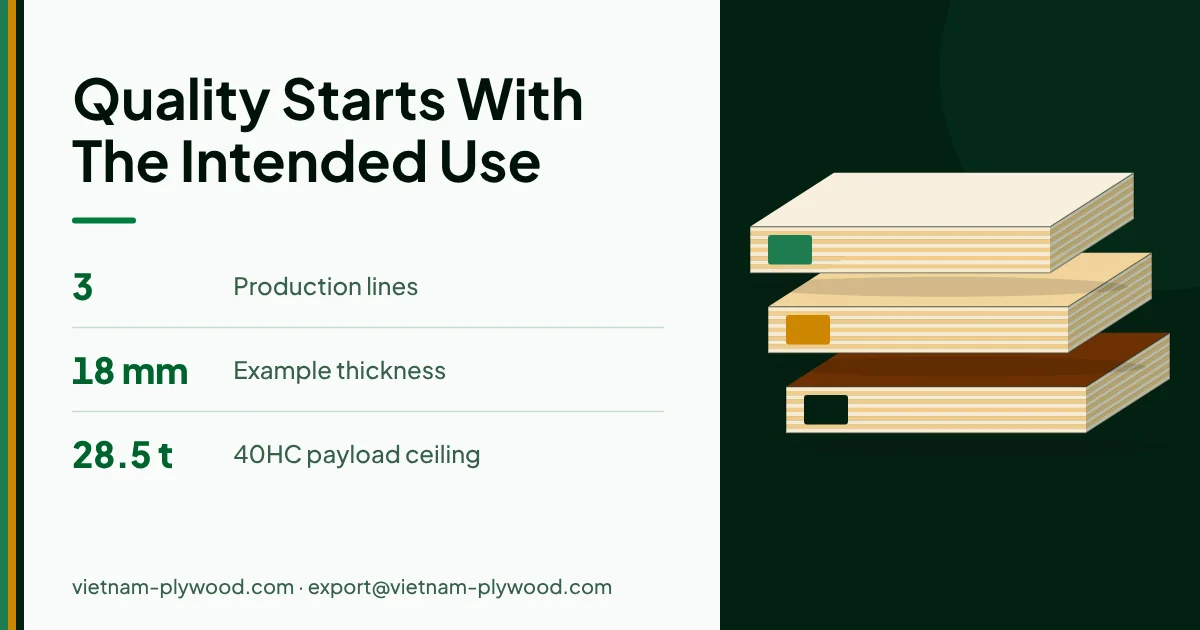
Plywood high quality means a build that meets the face, core, bond and dimensional requirements of its actual application. Choosing by appearance alone can cost a rejected load, extra finishing work or lost production days. HCPLY checks quality against the furniture, packing or formwork specification at the producing factory, rather than treating every sheet as one universal grade.
What is the highest quality of plywood?
The highest quality plywood is the panel that meets its intended use through face finish, core construction, bond performance and measured dimensions. A furniture buyer needs a flat, calibrated face; a packing buyer needs dependable internal veneers; a formwork buyer needs a sound glue line beneath a suitable film. A face grade alone cannot settle all three decisions.
For plywood high quality means repeatable properties against a written purchase specification. HCPLY separates that specification by production line because the failure modes differ. A cabinet panel rejected for sanding marks and a formwork panel rejected for bond separation require different corrective checks.
A-grade appearance is useful for visible furniture, but it says little about the inner veneers or glue. Conversely, a sound packing core can be suitable despite an unsanded face. See the face veneer category for related face choices and the face grade comparison for appearance terminology.
How does quality differ across the three lines?
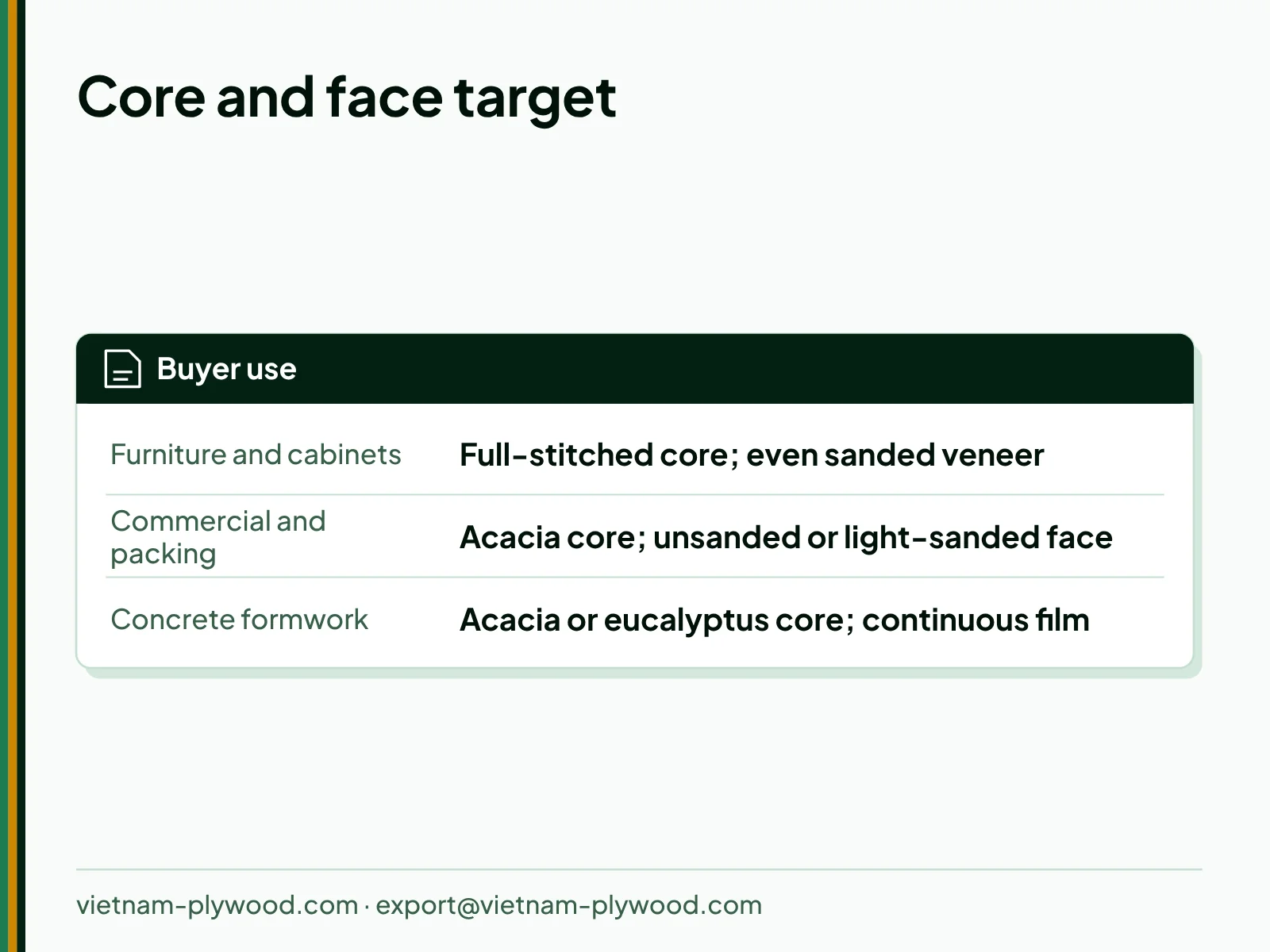
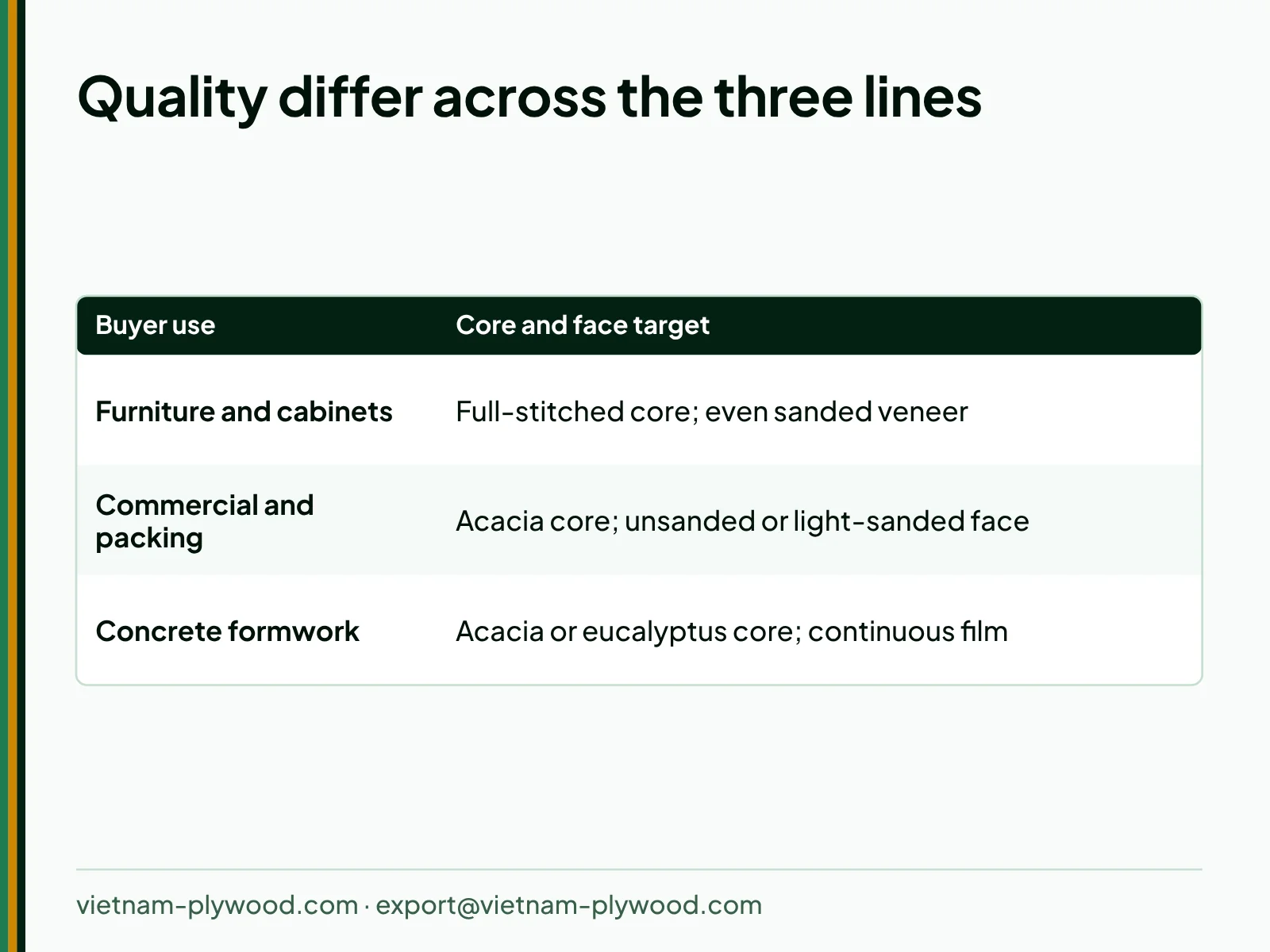
Quality starts with the application and the defect that would make the delivered panel unusable. Our furniture line presses full-stitched, sanded styrax or eucalyptus-core boards with E0 or E1 emission classes. Our commercial and packing line presses acacia-core boards with moisture-resistant (MR) glue and an unsanded or light-sanded finish. Our construction line presses acacia- or eucalyptus-core panels with phenolic, melamine or anti-slip film.
| Buyer use | Core and face target | Thickness acceptance | Main inspection decision |
|---|---|---|---|
| Furniture and cabinets | Full-stitched core; even sanded veneer | ±0.2 or ±0.3 mm, as ordered | Flat face, sanding consistency and visible repairs |
| Commercial and packing | Acacia core; unsanded or light-sanded face | ±0.5 mm commercial; ±0.5–1.0 mm packing | Sound edges and internal veneer placement |
| Concrete formwork | Acacia or eucalyptus core; continuous film | ±0.5 mm | Film coverage, edges and bond integrity |
These are different acceptance decisions at the producing factory. The furniture plywood range explains the visible-face application, while sanded versus unsanded boards explains why a surface treatment cannot substitute for a core specification.
What makes plywood high quality beneath the face?
A good core has veneers arranged to limit gaps, overlaps and poorly supported joints. Full-stitched construction provides the most continuous assembly in our core hierarchy. Stitched outer layers with edge-trimmed inner veneers come next, followed by finger-jointed and loose-laid construction. That hierarchy helps buyers specify the defect exposure they can accept.
Veneer direction matters because plywood is built from alternating grain directions. The US Environmental Protection Agency, in its 2026 Federal Register discussion of NIST PS 1-22, identifies veneer grading, adhesive bonds, construction, dimensions, tolerances and moisture content as distinct structural plywood requirements (Federal Register, 2026). That standards framework explains why visual grade alone cannot establish a complete quality decision; it does not assign a structural rating to these HCPLY products.
A cut edge shows whether internal plies are reasonably aligned, whether gaps repeat and whether the panel has obvious voids. An inspector should compare several edges across a lot rather than relying on a single attractive face. Where load-bearing design values are needed, the buyer must specify an accepted test report for the intended structural grade.
How do thickness, ply count and density affect acceptance?
Thickness quality means the measured board matches the agreed nominal dimension within the tolerance written into the order. Our range spans 3–40 mm, with common thicknesses of 3, 5, 9, 12, 15, 18, 21 and 25 mm. Length and width tolerance is ±2 mm across the listed sizes.
An 18 mm board commonly contains 11–13 plies because individual core veneers are 1.4–2.0 mm thick. A higher ply count by itself does not establish a better board: veneer continuity, adhesive contact and the resulting thickness remain relevant. A buyer should ask for a cut-edge comparison of the ordered construction.
Core species changes handling weight. Styrax is 500 kg/m³, acacia 580 kg/m³ and eucalyptus 650 kg/m³. These densities follow the core rather than the decorative face. For a 1220 × 2440 × 18 mm sheet, the corresponding calculated weights are 26.79 kg, 31.08 kg and 34.83 kg. Record the specified core when comparing samples, transport loads or panel handling.
Which factory checks prove plywood quality before loading?
The producing factory can show an inspector the measurements and samples that connect the written specification to the shipment. A practical witness sequence follows the likely failure points from incoming veneer through finished pallets.
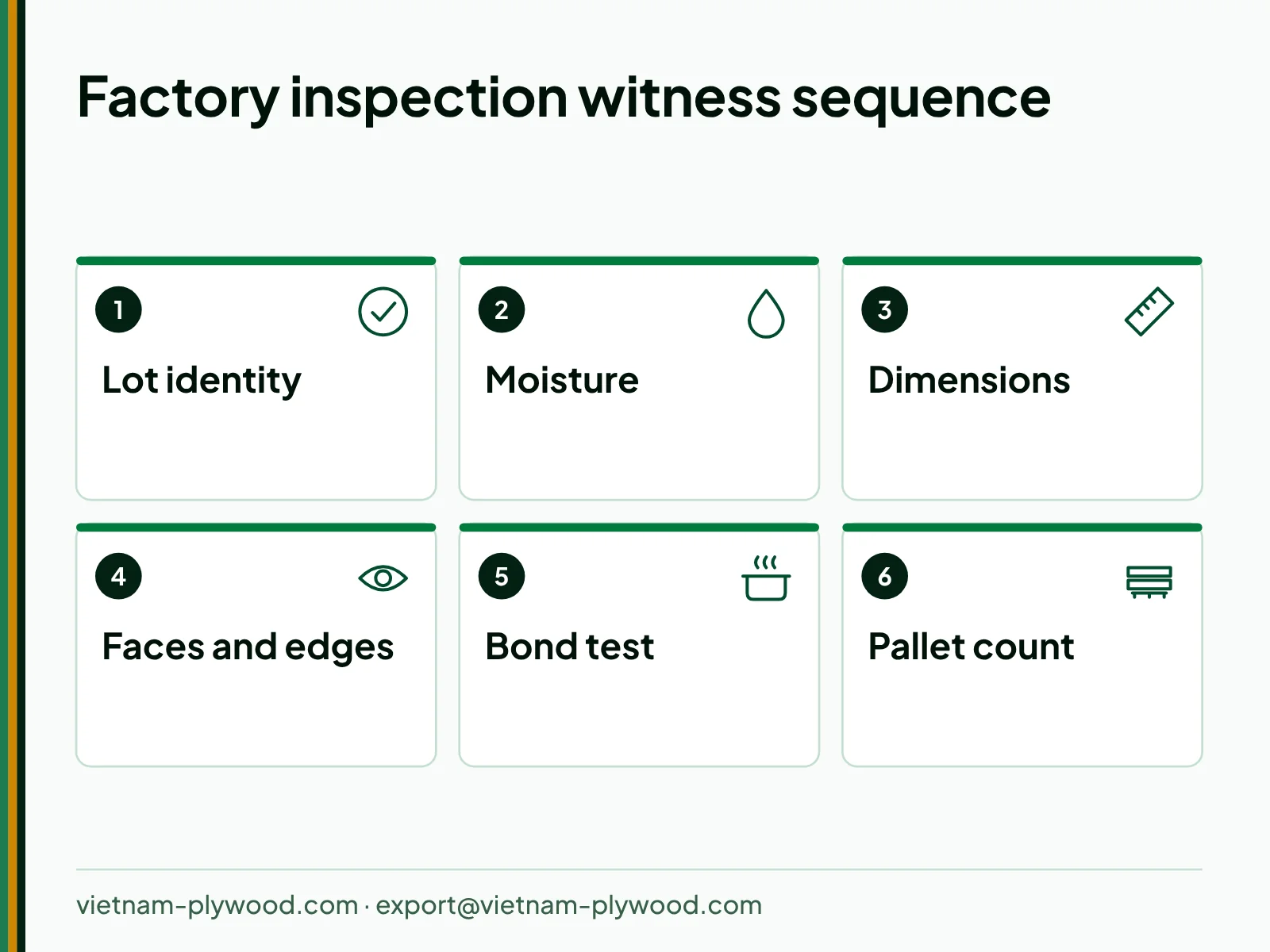
- Identify the lot and build. Match the ordered core, face, glue, emission class, size and nominal thickness to the lot under inspection.
- Check moisture. Take representative meter readings using an agreed sampling method and acceptance threshold recorded in the purchase specification.
- Measure thickness and size. Check several positions across selected sheets and record readings against the line-specific tolerance.
- Inspect faces and edges. Look for veneer splits, open joints, overlap, core voids, sanding defects and film damage according to the ordered grade.
- Check the bond. Witness the agreed glue-line or boil-test procedure, record the method and assess separation against the buyer’s written criterion.
- Verify loading. Match pallet labels, count, protection and the packing list to the accepted lot before sealing the container.
A moisture reading without an agreed target is merely a reading. Likewise, a bond test needs a named method and acceptance rule. HCPLY coordinates on-site QC and the loading review, so buyers can witness these checks where their panels are produced.
What should a film-faced panel show?
A quality film-faced panel should show continuous film coverage, sealed edges and a bond line that passes the agreed test. Our construction line uses 120 g/m² standard film, 135 g/m² premium film or 220 g/m² anti-slip film. These weights describe the film, rather than a measured panel strength rating.
Melamine-glue film-faced panels use an MR specification associated with a 12-hour boil; phenolic glue uses weather and boil proof (WBP) terminology associated with a 72-hour boil. A boil-duration label is not the same as the recorded result of a test on the shipment. The buyer should witness or receive the agreed test record and inspect the edges for early opening.
Inspect the face under oblique light for tears, bubbles and uncoated patches. Check cut edges after any machining because exposed veneers can admit water. With proper handling, a release agent on every pour and sealed edges including cut edges, melamine-glue film-faced panels reach about 12–15 pours and phenolic-glue panels up to about 25 pours. Reuse planning should reflect the actual pour and cleaning procedure.
Can different quality specifications share a container?
A mixed 40HC can carry specifications from different lines when the combined load stays within the 28.5 t payload limit. That lets an importer trial furniture, commercial and construction builds in the same shipment while keeping separate lot identities and acceptance criteria.
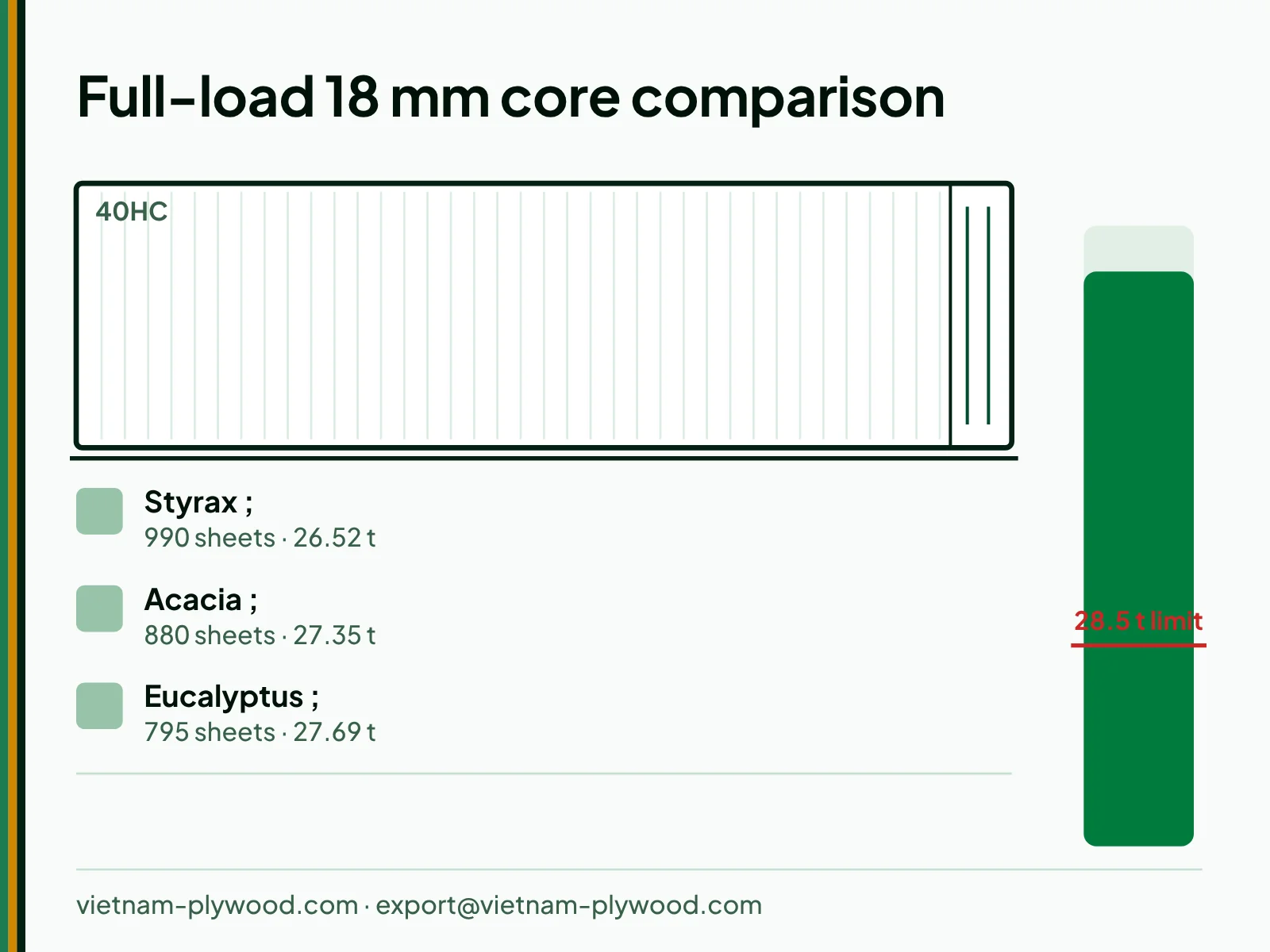
For a 1220 × 2440 × 18 mm reference, full-load quantities are 990 styrax sheets at 26.52 t, 880 acacia sheets at 27.35 t and 795 eucalyptus sheets at 27.69 t. Those are separate single-core reference loads, not quantities to add together. For a mixed shipment, ask for a pallet-by-pallet loading plan showing each specification and the combined gross payload.
For mixed lots, compare the planned pallet counts and gross weights against the container payload ceiling before approving the loading plan. The container loading calculator covers full-load counts; several plywood types in one order covers how to specify distinct builds.
How should buyers read face grades?
Face grades describe visible veneer quality and repairs; they do not replace a separate core or adhesive requirement. Our face choices include bintangor, okoume, engineered veneer (EV), gurjan, pine, poplar, eucalyptus, birch and sapele. Matt refers to an unfaced raw core.
For the faces we describe as A/B, specify the acceptable knots, patches, splits, colour variation and finish on each side. Birch is described with D/E/F grades, so do not assume its letters map directly onto another grading convention. The common face veneer thickness is 0.2–0.4 mm, which makes substrate preparation important to the finished appearance.
Compare actual reference samples under the intended coating or finishing process. A photograph can show colour and broad repairs, but it cannot reveal the bond between a thin face and the core. The B/C grade discussion and face grade chart offer further vocabulary for writing appearance requirements.
Which glue and emission terms belong in the specification?
Glue performance and formaldehyde emission are separate fields on a plywood specification. Melamine MR and phenolic WBP describe adhesive-related performance categories used in our builds. E0, E1 and E2 describe emission classes; CARB Phase 2 and TSCA Title VI refer to a United States emission limit and third-party certification framework.
A request for “E0 glue” mixes those fields and can lead to a quote for the wrong construction. State the adhesive type, the exposure or boil-test requirement, and the emission class separately. When an emission certificate is part of the order, identify the producing member factory and the document needed for the buyer’s market.
Factory-held FSC, CARB P2, ISO 9001 and CE documents, along with EUTR/EUDR papers, are shown with factory details masked, on request. A buyer should match the actual certificate scope to the ordered build and destination rules rather than inferring performance from a logo.
What should be agreed before a quality inspection?
An inspection works when buyer and factory use the same written acceptance schedule. Define face appearance, core assembly, glue and emission, thickness, dimension, moisture threshold, sampling method, bond-test procedure, packaging and permitted defects before production starts.
A simple decision sheet can separate cosmetic findings from failures that affect use. A visible repair might be acceptable on a packing face but unacceptable on an exposed cabinet door. An open glue line needs investigation even if the decorative surface looks clean.
Use a retained approval sample to compare appearance and edge construction, then record measured values for the shipment. Keep the inspection report linked to pallet or lot references so that the buyer can isolate a disputed batch without rejecting unrelated specifications.
Which paperwork carries the quality agreement?
The purchase specification and agreed test reports define the quality build; shipment documents connect accepted lots to the export delivery. The shipment file includes a commercial invoice, packing list, bill of lading (B/L), certificate of origin, phytosanitary and fumigation papers, and any agreed certificate or test documents. EU lots include EUR.1 and the EUTR/EUDR file set; CIF shipments include insurance.
The packing list is especially useful for linking pallet counts and descriptions to inspected lots. The order’s test report supports the agreed bond, emission or other stated criterion. After loading, the draft shipping documents come to you for approval.
HCPLY manages the specification, on-site inspection, documents and loading through FOB Hai Phong shipment. Other delivery terms available are CFR (CNF) and CIF. These shipping terms address delivery responsibility; they do not replace a panel acceptance schedule.
How should an importer plan a trial container?
A trial container should compare a limited number of written builds against the same inspection method and intended use. Choose a furniture reference face, a packing reference core or a formwork film specification according to the products your customers actually purchase.
The minimum order is one 40HC, with mixed specifications possible within the payload limit. Factory lead time runs 15–45 days from receipt of the 30% deposit; the exact figure depends on order size, line loading and what the contract fixes. The 70% balance is against the scanned B/L, by T/T or irrevocable letter of credit at sight. Samples are free; new buyers book their own courier and its cost can be credited against a real order.
For budget orientation, commercial plywood starts from US$250/m³ FOB Hai Phong (October 2026) and furniture plywood from US$350/m³ FOB Hai Phong (October 2026). Film type, core preparation, face selection, sanding and test requirements shape the written quotation for the actual build. Send the specification to Lucy at export@vietnam-plywood.com or through contact.
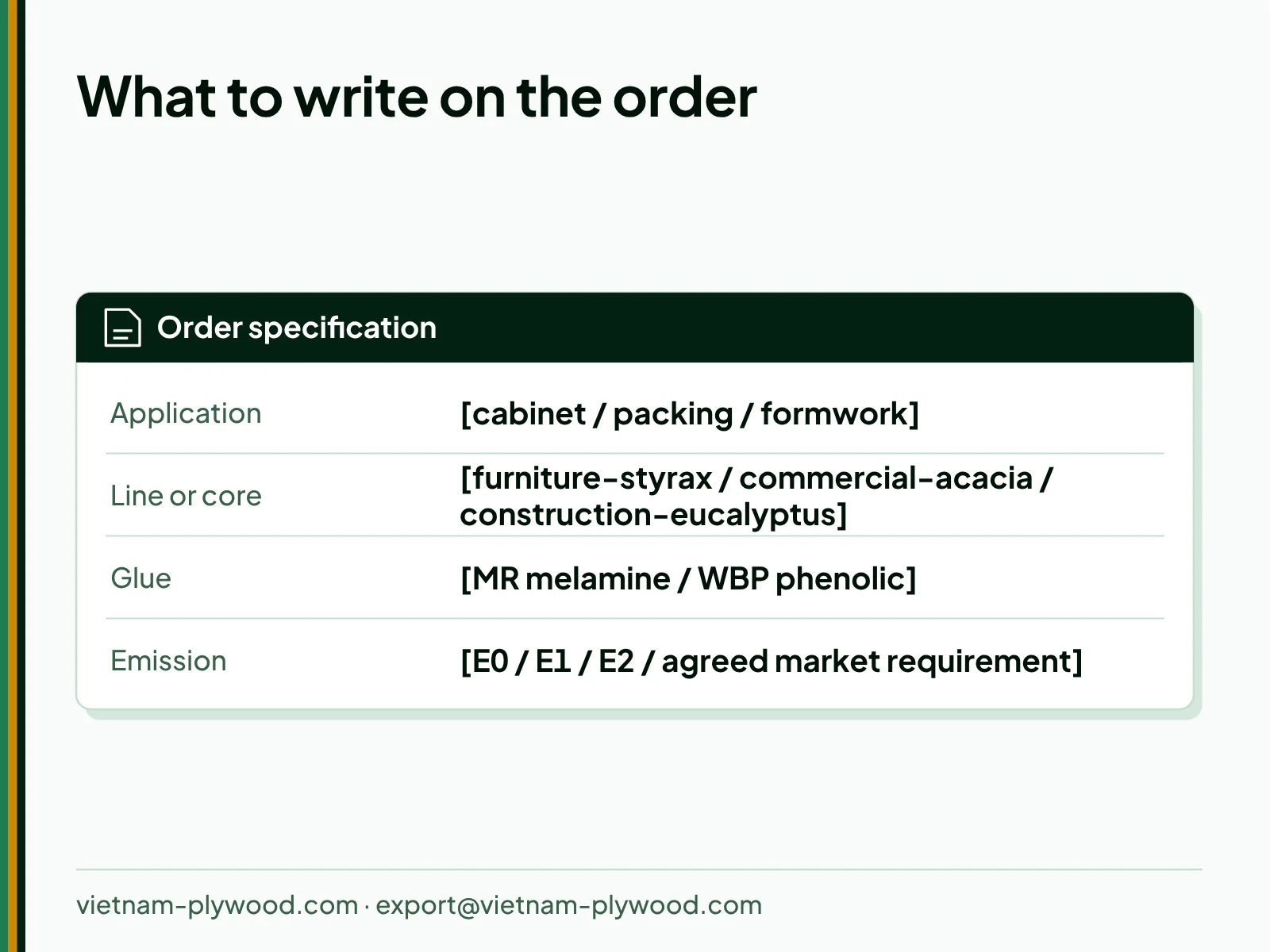
Application: [cabinet / packing / formwork]
Line or core: [furniture-styrax / commercial-acacia / construction-eucalyptus]
Glue: [MR melamine / WBP phenolic]
Emission: [E0 / E1 / E2 / agreed market requirement]
Face and grade: [species or film; grade and repair limits]
Thickness and tolerance: [mm; permitted deviation]
Size: [length x width in mm]
Quantity: [sheets and pallets per build]
Destination port: [port and country]
Plan a trial container with the agreed acceptance checks for each build.