





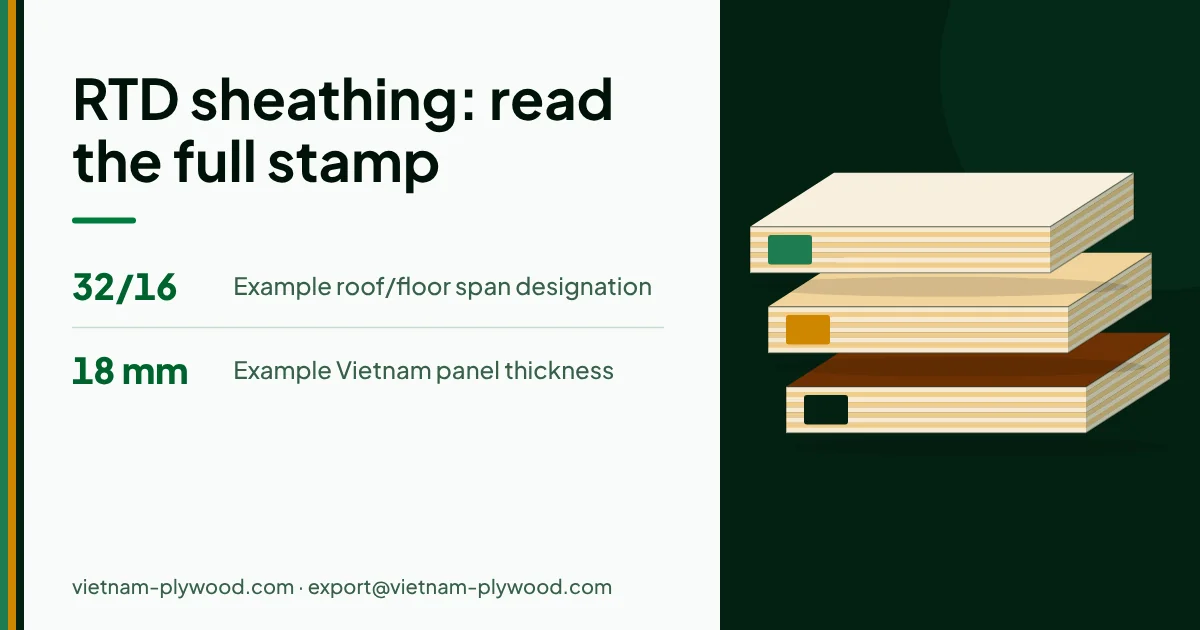
RTD plywood means Rated Sheathing in US panel terminology, rather than a special plywood grade. Ordering by those letters alone can lead to a rejected structural load, costly re-testing or a delayed project. HCPLY builds Vietnam plywood to written specifications and can quote construction-use panels against a test report the buyer accepts, without presenting them as agency-stamped US sheathing.
What does plywood RTD mean?
Plywood RTD means plywood described as Rated Sheathing in US panel terminology. APA – The Engineered Wood Association explains that RTD abbreviates “Rated,” while RTD SHG means Rated Sheathing. It is a designation for a structural application, rather than a new veneer species, adhesive formula or premium manufacturing method. The complete stamp determines the actual panel specification.
Some online explanations expand RTD as “resistance temperature detector,” a temperature-sensing device used in industrial equipment. That is a real engineering term, but it is not APA’s definition of RTD Sheathing. The distinction matters when purchasing imported panels: a reference to press temperature alone cannot establish structural performance.
APA’s plywood technical page explains that Rated Sheathing is an end-use designation and that PS 1 and PS 2 are relevant panel standards. HCPLY manufactures plywood and does not press OSB. For a plywood order, identify the panel material before considering its structural designation.
Buyers who need a decorative surface should start with the face veneer category rather than assume a sheathing designation describes appearance.
What is the difference between RTD and CDX plywood?
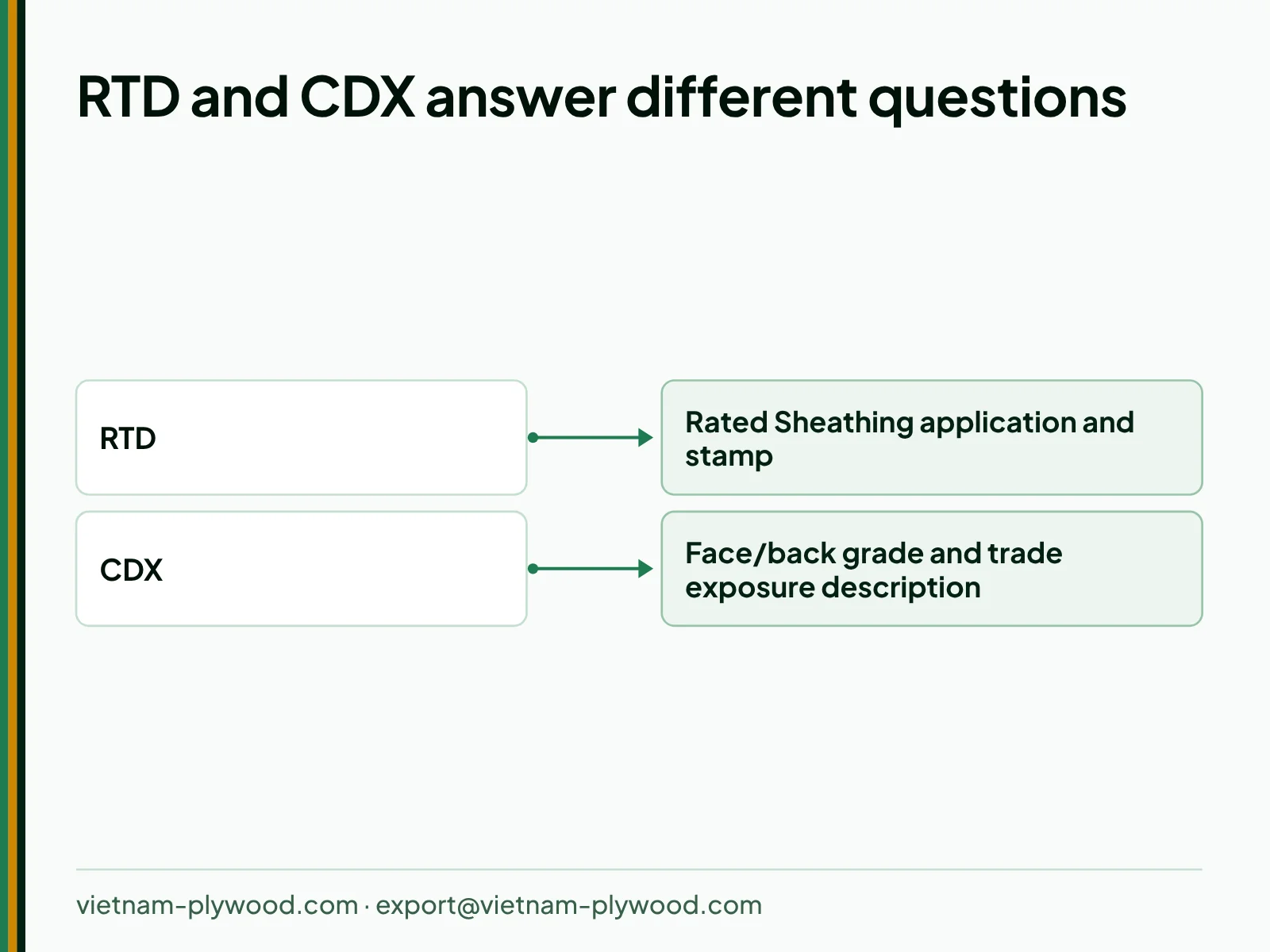
RTD identifies Rated Sheathing, while CDX is trade shorthand for plywood with C- and D-grade veneer faces and an Exposure 1 bond. The labels answer different questions and can describe the same panel. Neither label alone is a substitute for a complete stamped specification.
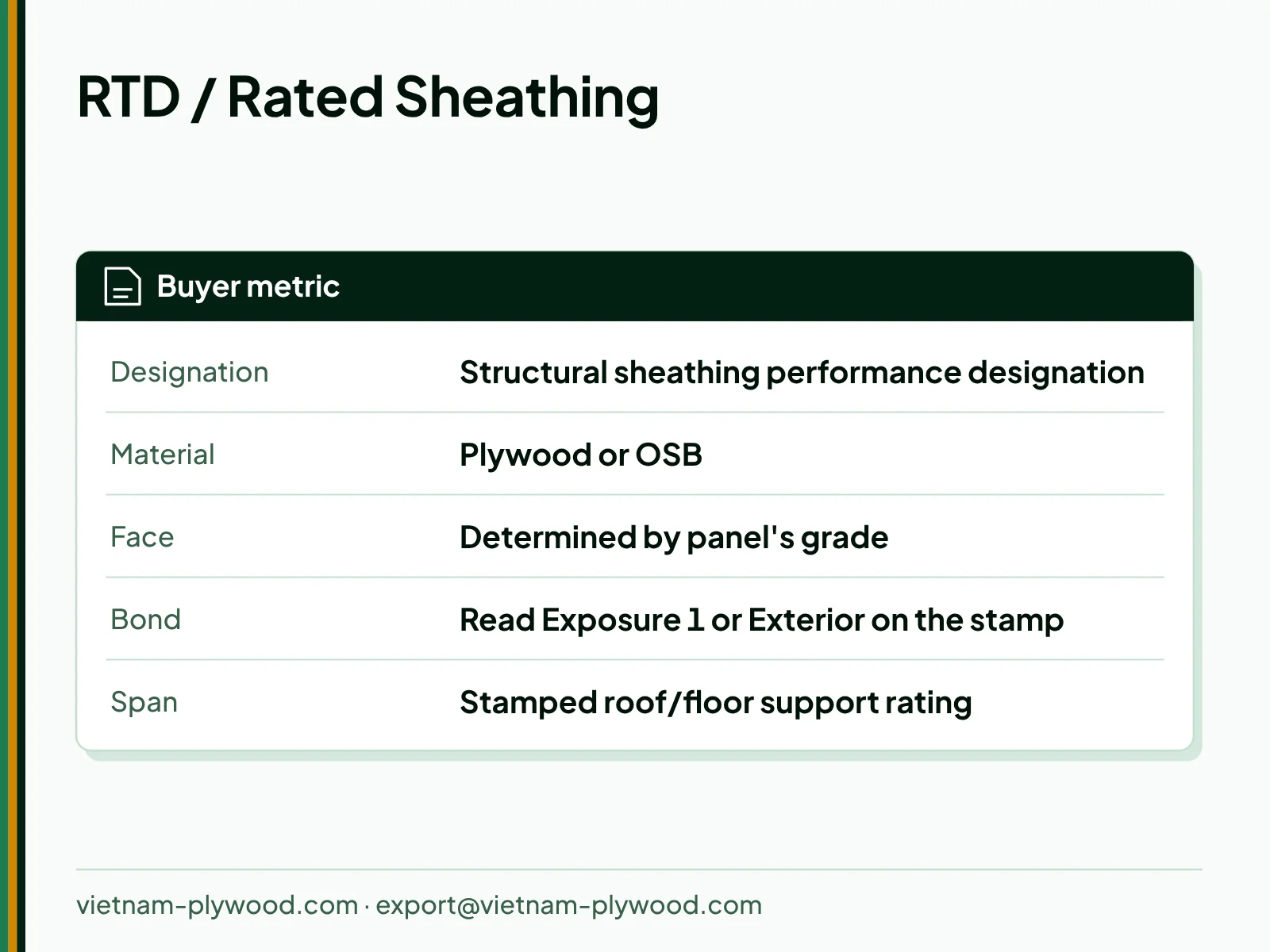
| Buyer metric | RTD / Rated Sheathing | CDX trade description | Verdict by use |
|---|---|---|---|
| Designation | Structural sheathing performance designation | C/D veneer appearance plus common exposure shorthand | For load-bearing sheathing, inspect the structural stamp |
| Material | Plywood or OSB | Plywood | For a plywood-only purchase, state material explicitly |
| Face | Determined by panel’s grade | C face, D back in trade usage | For visible fit-out, request a separate appearance grade |
| Bond | Read Exposure 1 or Exterior on the stamp | Commonly Exposure 1 | For prolonged weather, specify Exterior qualification |
| Span | Stamped roof/floor support rating | No span established by the letters alone | For roof or floor design, use stamped span and design tables |
| Compliance evidence | Agency mark and applicable standard | Trade name by itself provides none | For code-governed work, require accepted qualification |
A CDX listing can describe the surface and bond without establishing a span rating. Conversely, a Rated Sheathing stamp can cover different materials and grades. Compare the BC grade plywood explanation when surface appearance matters, and inspect face defects before accepting a decorative order.
Do not treat the X in CDX as proof that a panel can remain exposed indefinitely. Its common trade meaning is linked to Exposure 1 construction-stage weather resistance.
What does RTD sheathing imply about glue and span rating?
RTD sheathing calls for checking two separate stamp fields: bond exposure classification and span rating. The abbreviation alone establishes neither an exact adhesive chemistry nor a permissible support spacing.
An Exposure 1 panel is intended to withstand temporary moisture during construction before permanent protection is installed. Exterior-rated sheathing is specified where long-term weather exposure is expected. Even an Exterior bond classification does not make untreated wood immune to decay, and neither classification means pressure treatment.
APA’s How to Read an APA Trademark Stamp explains that a two-number sheathing span rating refers to roof and subfloor support spacing. For example, a 32/16 marking indicates 32 inches on-center for roof supports and 16 inches for subfloor supports under the stated conditions. Design loads, strength-axis orientation, edge support and local code remain part of the selection.
APA’s plywood technical page also notes that span ratings appear in the trademark and govern selection. A thickness figure by itself cannot replace the tested structural rating. Ask for the applicable standard, span marking, exposure class and agency identification on the same product.
Can imported plywood carry an RTD mark without an agency stamp?
An imported plywood panel cannot establish an APA Rated Sheathing qualification simply by printing RTD on its packaging. A legitimate agency trademark is tied to an applicable qualification and oversight program. A seller’s shorthand, mill description or temperature-control statement cannot replace that evidence.
Read the full mark for the agency, product standard, panel grade, exposure classification, performance category and span rating. Then compare the stamped identity with the purchase specification and relevant acceptance rules. If the contract requires an APA-qualified panel, obtain that qualified product from an authorized source.
HCPLY does not apply APA or PS 1 stamps to its panels. Our structural-use quotations instead identify the proposed construction and the test report the buyer accepts. That route is appropriate only where the buyer’s project specification and approving authority accept the evidence; it does not create an APA-rated substitute for a code-required stamped panel.
A factory visit allows the buyer to inspect the producing factory, compare the order specification with the panels and witness dimensional and face checks. Those observations support product acceptance, while structural suitability still requires the agreed testing and project approval.
Which Vietnam builds can be quoted for structural use?
Our construction line can quote an acacia- or eucalyptus-core plywood build against a test report the buyer accepts for the intended structural use. Our commercial and packing line offers acacia-core MR-glue panels for different duties. Our furniture line builds sanded, full-stitched styrax- or eucalyptus-core panels for fit-out and cabinet specifications.
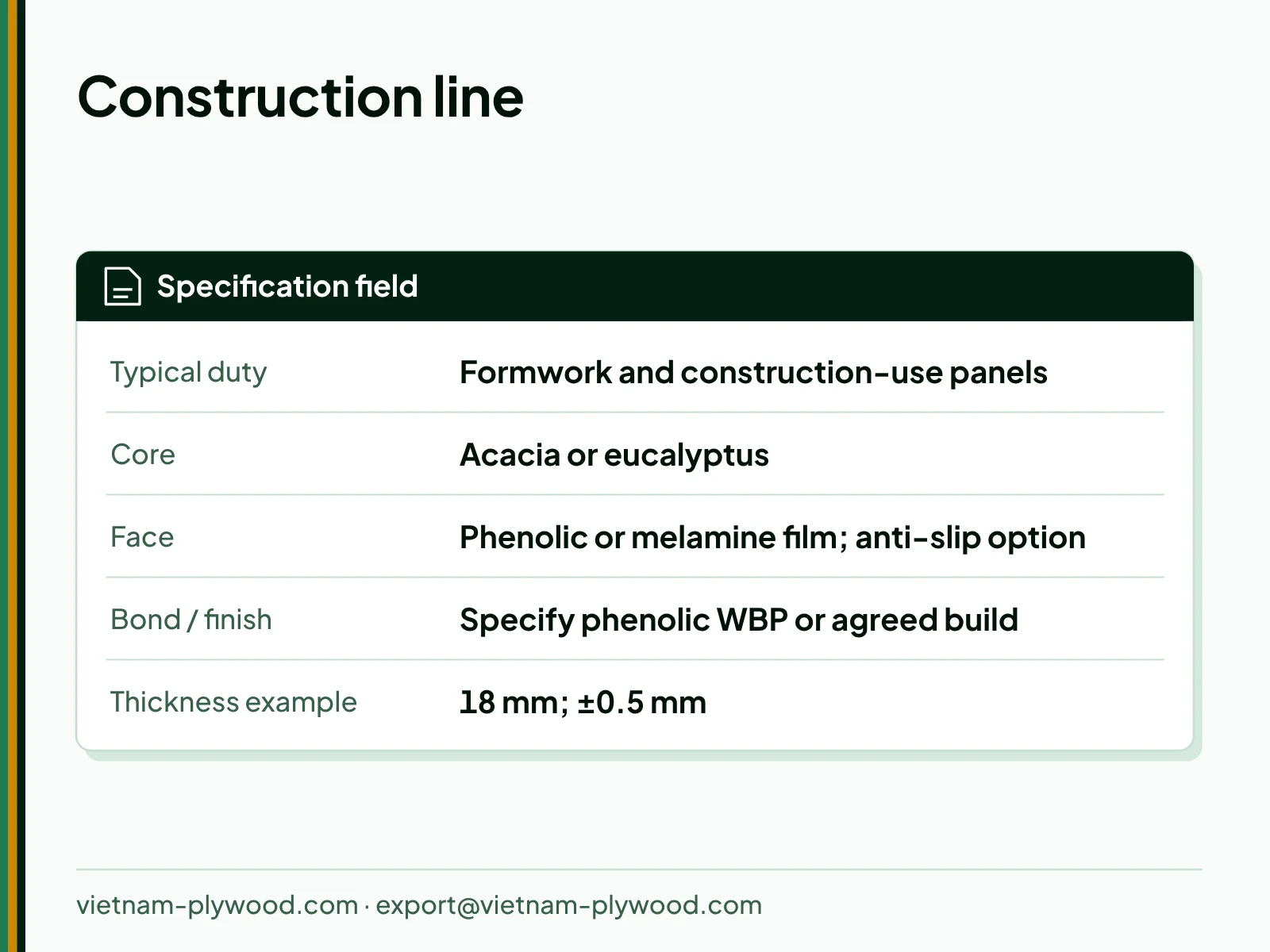
| Specification field | Our construction line | Our commercial and packing line | Our furniture line |
|---|---|---|---|
| Typical duty | Formwork and construction-use panels | Packing and commercial applications | Cabinetry and fit-out |
| Core | Acacia or eucalyptus | Acacia | Styrax or eucalyptus |
| Face | Phenolic or melamine film; anti-slip option | Raw, unsanded or light-sanded | Sanded decorative veneer |
| Bond / finish | Specify phenolic WBP or agreed build | MR glue | Specify glue and E0/E1 emission separately |
| Thickness example | 18 mm; ±0.5 mm | 18 mm; ±0.5 mm, packing ±0.5–1.0 mm | 18 mm; ±0.2 or ±0.3 mm as ordered |
| Decision | Seek accepted testing for proposed construction use | Select for packing duty | Select for appearance and machining |
These are different builds, even when all three are ordered at 18 mm. Film-faced plywood is a formwork surface choice; it is not automatically US roof sheathing. For details on possible exterior specifications, see exterior plywood and comparisons across factory lines.
The construction face can use 120 g/m² standard film, 135 g/m² premium film or 220 g/m² anti-slip film. Film weight describes the surface layer, while the core and bond construction govern other performance questions. A project seeking a structural grade needs the agreed test report and approval for that grade.
How should a buyer specify bond and emission?
Specify adhesive durability and formaldehyde emission as separate order fields. HCPLY uses melamine MR glue with a 12-hour boil description or phenolic WBP glue with a 72-hour boil description. Those process descriptions are not US Exposure 1 or Exterior classifications by themselves.
For our furniture line, E0 and E1 are emission classes; E2 is another emission class in the specification vocabulary. CARB P2 and TSCA Title VI concern a US formaldehyde limit and third-party certification, rather than a glue type. Ask for the applicable factory documents and the tested product construction.
Factory certificates including FSC, CARB P2, ISO 9001 and CE, plus EUDR/EUTR documents where relevant, are shown with factory details masked, on request. They belong to the member factories. For a US structural project, emission documentation does not replace structural qualification.
The quality plywood checklist helps separate core assembly, bond durability, surface defects and dimensional acceptance.
What does the 18 mm panel mean for container planning?
At 18 mm and 1220 × 2440 mm, core density changes a full 40HC load substantially. The core determines density, even when a decorative or film face gives the product its name. Our planning figures exclude film weight.
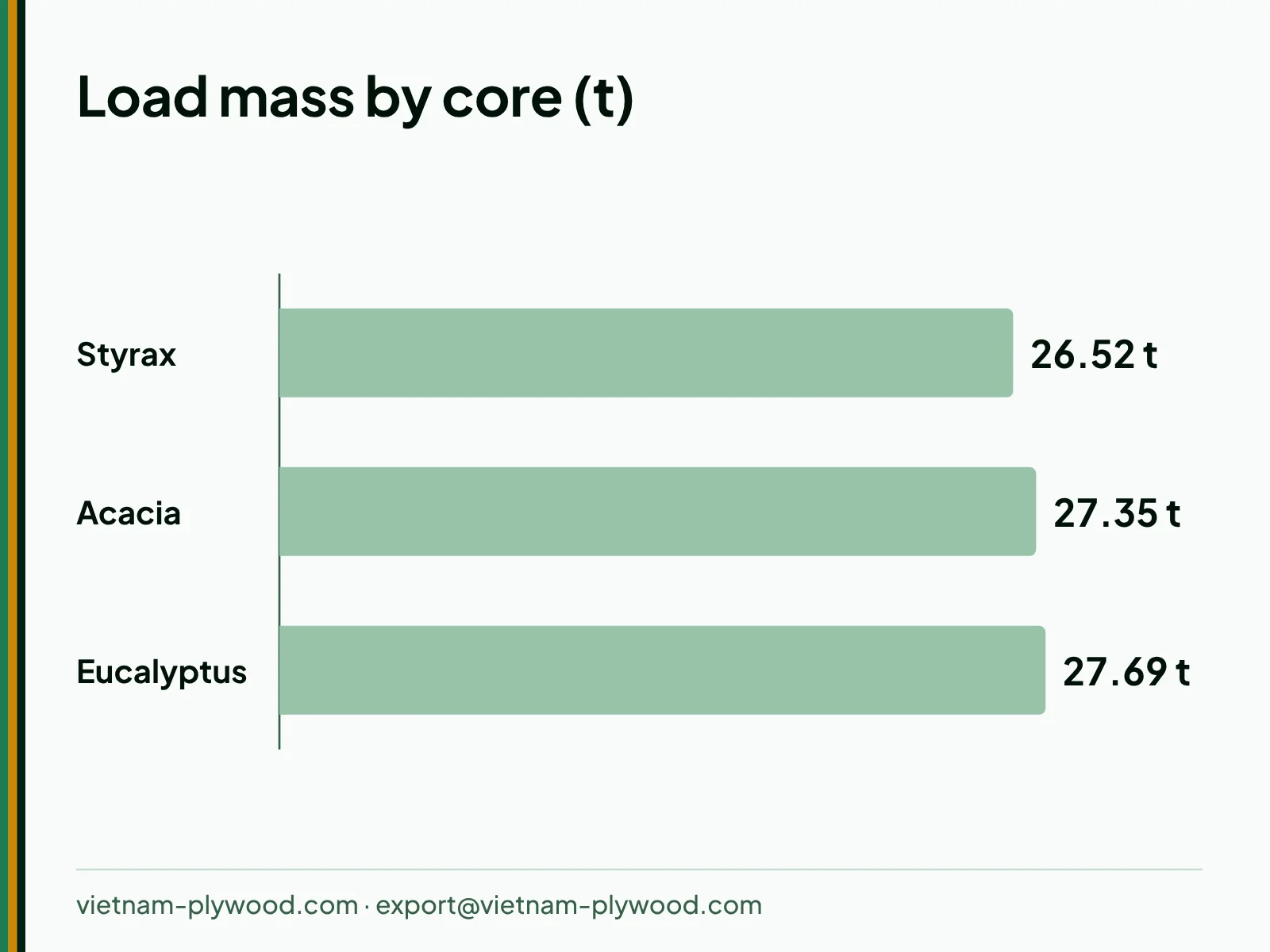
| Core | Density | Sheet weight | Full 40HC sheets | Load mass |
|---|---|---|---|---|
| Styrax | 500 kg/m³ | 26.79 kg | 990 | 26.52 t |
| Acacia | 580 kg/m³ | 31.08 kg | 880 | 27.35 t |
| Eucalyptus | 650 kg/m³ | 34.83 kg | 795 | 27.69 t |
The 40HC payload limit is 28.5 t. A mixed order can combine specifications within that limit, but the planner must total each product’s mass rather than add the maximum full-load counts. For a mixed load, request a packing plan showing the sheet counts, pallet weights and total cargo mass before loading.
The container-load calculation covers other thicknesses and configurations. A mixed container is useful when an importer needs both commercial sheets and furniture panels, provided the packing arrangement and weight are agreed.
What should the producing-factory inspection cover?
An inspection should compare the written order with the actual panel construction and measured dimensions. For an RTD-related enquiry, the buyer should also distinguish physical checks from independent structural qualification.
- Match the order’s line, core, face and adhesive description to the production lot.
- Check 18 mm thickness against the tolerance ordered for that line, and check length and width against ±2 mm.
- Inspect cut edges for core gaps and the face for patches, splits and visible defects.
- Check the panel marking and accompanying test report against the exact construction and application requested.
- Record pallet identification and loading quantities for the shipment documents.
At the producing factory, the buyer or appointed inspector can witness thickness measurement and edge inspection before loading. An on-site check cannot by itself establish a US span rating. When a project requires a third-party structural test, the report must identify the tested build and the method accepted by the buyer.
For appearance-critical work, use the birch veneer grade explanation to avoid confusing decorative veneer classes with structural sheathing ratings.
Which export documents support the order?
The shipment document set links the agreed specification to the goods loaded and shipped. HCPLY manages specifications, on-site quality control, shipping paperwork and loading from the selected factory, FOB Hai Phong.
The commercial invoice and packing list identify the goods and quantities; the bill of lading records carriage. The certificate of origin, phytosanitary and fumigation papers, and order-specific certificate or test documents accompany the shipment as applicable. EU lots also use EUR.1 and the EUTR/EUDR file set; CIF shipments include insurance. After loading, the draft shipping documents come to you for approval.
A test report should be associated with the exact agreed construction and application. The export documents establish the transaction and traceability; they do not independently create a US structural rating.
How does an importer request a comparable quotation?
A comparable quotation starts with the application and the evidence required for acceptance. Tell us whether the order is for code-governed roof sheathing, non-code construction work, packing, or a furniture and fit-out use.
For a construction-use panel, the principal cost drivers are the required test and acceptance scope, adhesive and core construction, film choice, thickness and order mix. A phenolic WBP build costs more than a simpler MR packing build because the adhesive system and manufacturing specification differ. We quote construction-use grades against the written specification, without a generic RTD price.
For reference, commercial plywood starts from US$250/m³ FOB Hai Phong (October 2026) and furniture plywood starts from US$350/m³ FOB Hai Phong (October 2026). Those dated starting figures describe their respective product categories, not RTD-qualified sheathing.
The minimum order is one 40HC, with mixed specifications possible within the payload limit. Production takes 15–45 days from the 30% deposit, set by order size, line loading and the contract. The remaining 70% is paid on the scan of the bill of lading, by T/T, or by irrevocable sight L/C. We ship FOB Hai Phong, or CFR (CNF) or CIF to your port.
Send the following specification to Lucy at export@vietnam-plywood.com or through contact:
Application: [roof / wall / floor / formwork / packing / fit-out]
Line or core: [construction / commercial and packing / furniture; acacia / eucalyptus / styrax]
Glue: [MR melamine / WBP phenolic]
Emission: [E0 / E1 / E2 / applicable US requirement]
Face and grade: [film type and weight / veneer species and grade / raw]
Thickness and tolerance: [mm; agreed tolerance]
Size: [length x width in mm]
Quantity: [sheets / pallets / 40HC mix]
Destination port: [port and country]
Required test report and acceptance criteria: [standard / method / approving party]
Ask Lucy for a free sample set; a first-time buyer pays the courier, and that charge comes off the first confirmed order.