





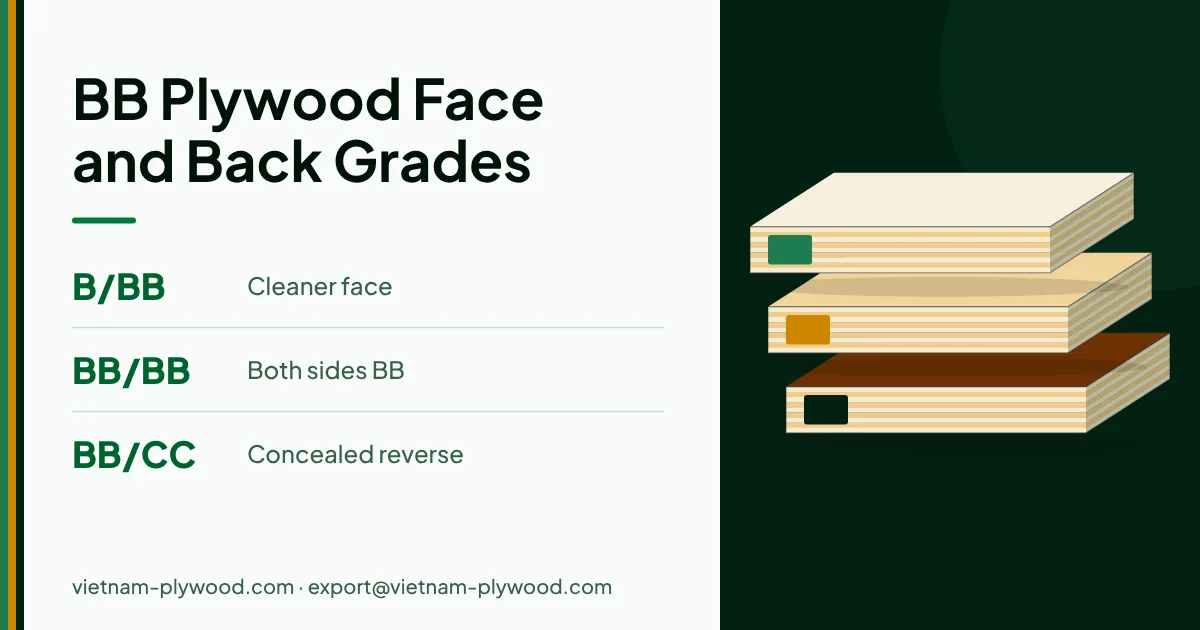
BB plywood describes a veneer appearance grade, while B/BB, BB/BB and BB/CC identify the face and back separately. A mistaken pair can leave visible cabinet panels with unwanted patches, causing rejected sheets and rework. At HCPLY, we write each side’s acceptance criteria into the order before our producing factory presses the panels.
What does BB mean in plywood grading?
BB plywood is a commercial appearance description for a veneer surface that can contain sound, repaired imperfections. It does not by itself specify the opposite face, core, adhesive, emissions class or structural performance. The buyer must identify the grading convention and agree on an approved visual sample.
In many export descriptions, BB means a serviceable decorative face with more repairs than a cleaner B face. The actual size, count, shape and visibility of patches are controlled by the agreed sample and written defect schedule.
The Canada Border Services Agency explained in its 2021 decorative plywood investigation that face and back grades reflect features including colour variation, burls and pin knots. Its discussion also notes proprietary or custom grading systems. This supports treating a BB designation as a commercial specification requiring a shared reference, rather than assuming that every grading system uses the same letters. See the 2021 CBSA explanation.
For a wider map of terms, use our plywood face grade comparison chart and the face veneer category. Those resources place this pair-based purchasing decision alongside other veneer descriptions.
What is BB/BB plywood?
BB/BB plywood specifies a BB-grade face and a BB-grade back. Both surfaces are intended to meet the same agreed BB visual criteria, although their grain and colour need not match without an additional matching requirement. It is a useful starting point when a fabricator can see both sides of a panel.
A double-BB designation is not a promise of two clear faces. Repaired knots, plugs, colour differences and grain variation can still be visible within the approved reference. For cabinet interiors, partitions and fit-out components, the practical question is whether the actual visible side passes the finish sample after cutting and assembly.
Ask for face and back photographs taken under the same lighting, with each side marked. Then approve physical reference panels that show the upper limit of accepted repairs.
How do B/BB, BB/BB and BB/CC differ?
B/BB allocates the cleaner appearance to the face, BB/BB uses the same BB target on both sides, and BB/CC reserves the lower CC target for the back. These are commercial pair labels; the agreed samples define what each label permits for a specific veneer species.
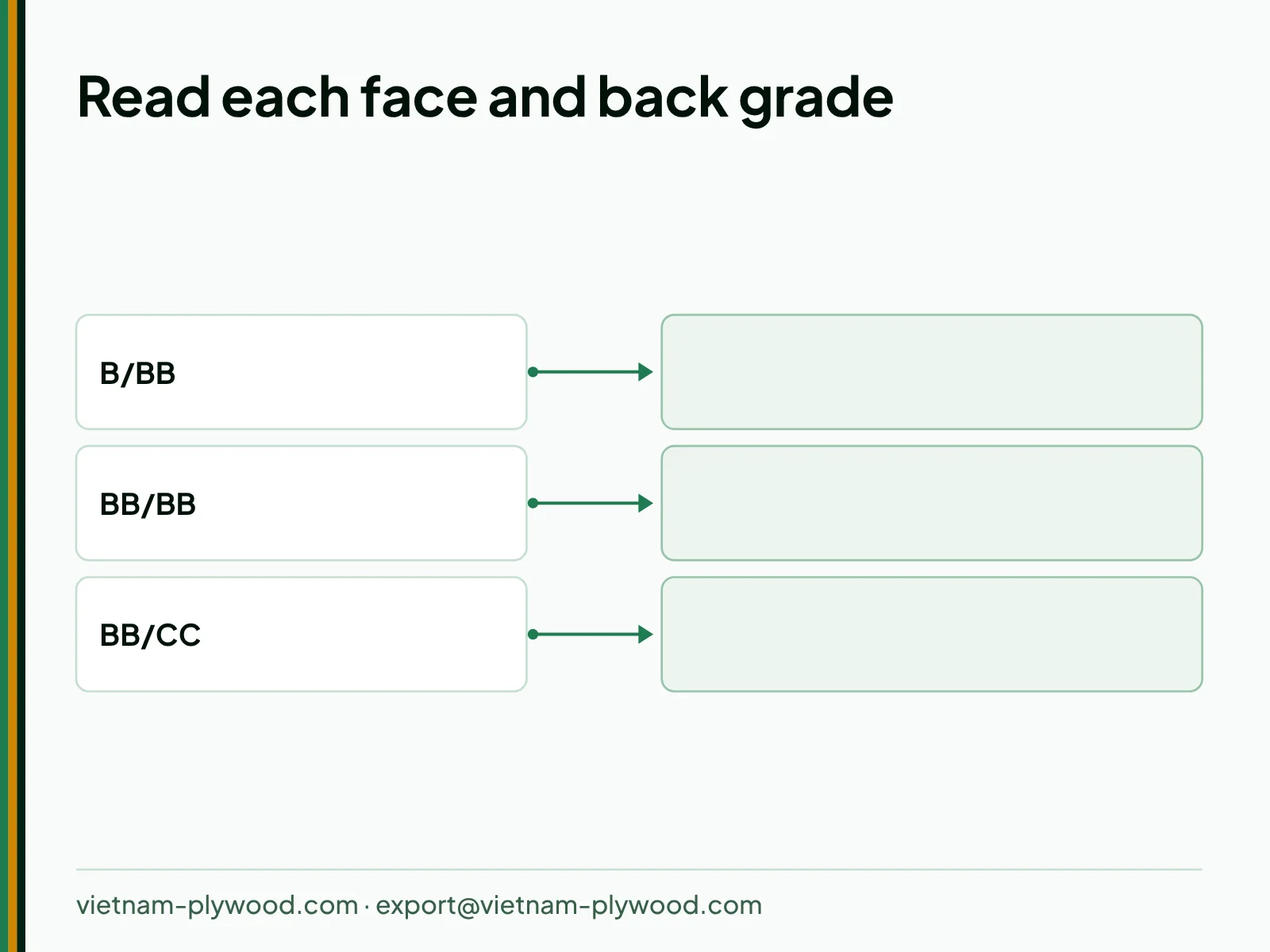
| Pair | Face target | Back target | Typical decision by use |
|---|---|---|---|
| B/BB | Cleaner B appearance, fewer visible repairs | BB, repaired imperfections acceptable | Visible furniture fronts with a concealed reverse |
| BB/BB | BB, controlled repairs | BB, controlled repairs | Cabinet components seen from either side when patch visibility is accepted |
| BB/CC | BB, presentable working face | CC, more cosmetic defects allowed | One-sided lining, covered backs and commercial fit-out substrates |
The exact transition from B to BB or BB to CC must be established by a veneer-specific reference. Our BC-grade plywood explanation covers another letter pairing; its notation should not be silently substituted for BB/CC.
A B/BB face can cost more to sort than BB/BB because fewer veneer repairs or colour differences can be accepted. BB/BB can cost more than BB/CC when both sides need presentable veneers. Core construction, face species, sanding and order quantity can change the quotation more than the pair label alone.
Which patches and colour variations are acceptable?
Acceptable BB patches and colour variations are those defined in the signed reference and defect schedule for each face. Neither a slash nor the letters BB give a universal patch-count limit. Record the allowable repair types and their placement before the first production inspection.
For the B face, specify whether filled knots, oval plugs, closed splits, mineral streaks, sapwood and colour bands are permitted in the viewing area. For the BB face, identify which repairs can remain visible after sanding and finishing. For a CC back, decide whether open defects are acceptable at all when the panel must receive adhesive, screws or a decorative covering.
Colour needs its own acceptance rule. A species can show natural tone changes without a structural defect, but a furniture maker may need consistent panels across adjacent cabinet doors. Use a range of reference veneers, identify the viewing distance and lighting, and state whether adjacent sheets must be colour-matched.
Also inspect repair adhesion and the surrounding veneer. A patch that is flush before finishing can telegraph through a thin coating; an open repair can interfere with a laminated surface.
How do our production lines interpret the same pair?
Our furniture line is the natural route for a sanded, visible-face BB specification; our commercial and packing line serves utility surfaces and packaging requirements. Our construction line presses film-faced panels, whose surface specification follows a different description. HCPLY assigns the producing factory from the written build, rather than treating a face grade as a complete product.
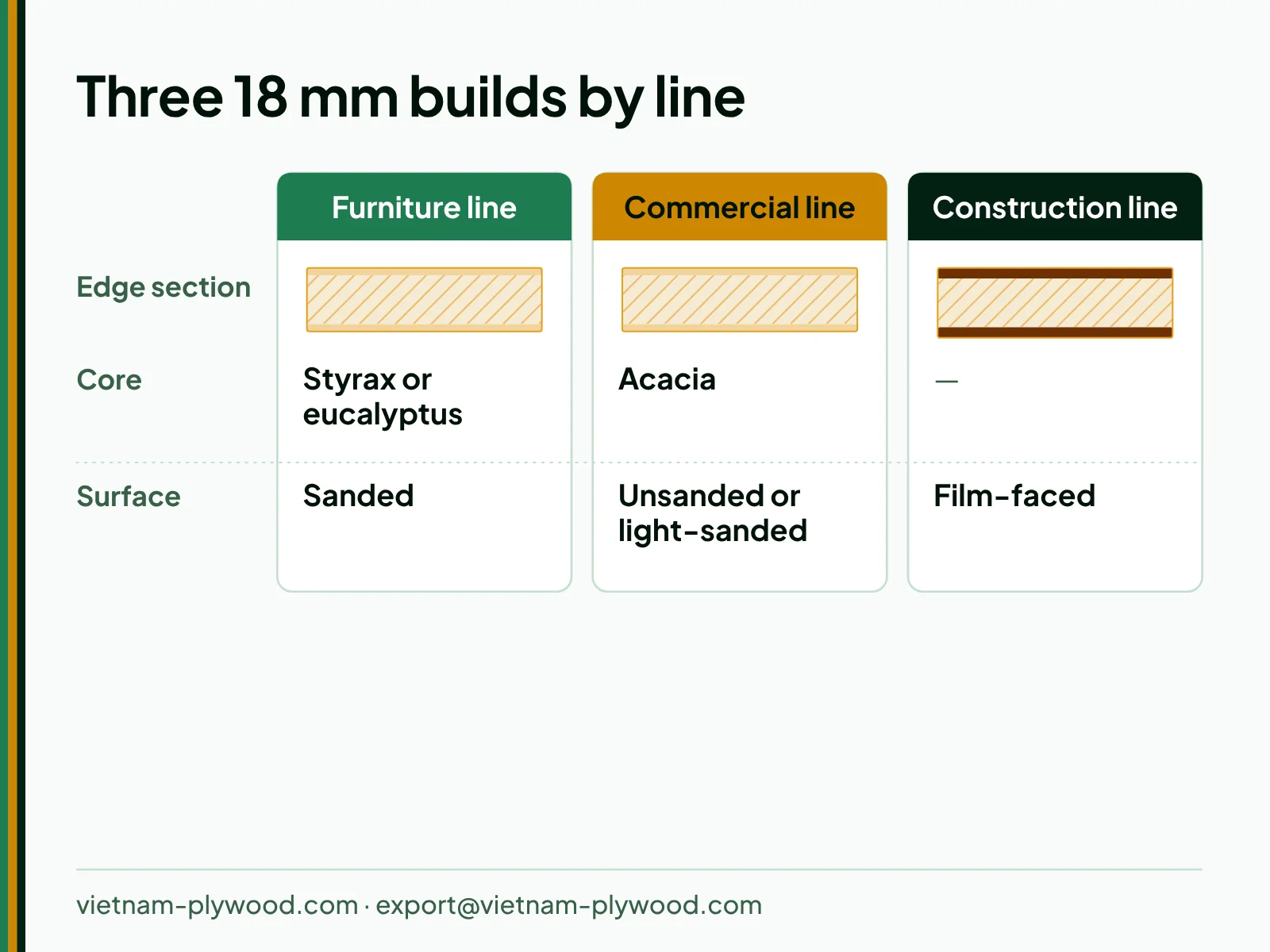
| Same 18 mm thickness | Core and surface | Thickness tolerance | Grade-pair relevance |
|---|---|---|---|
| Furniture line | Styrax or eucalyptus, full stitched core, sanded veneer | ±0.2 or ±0.3 mm as ordered | Face/back reference samples for visible cabinet parts |
| Commercial and packing line | Acacia, MR glue, unsanded or light-sanded | Commercial ±0.5 mm; packing ±0.5–1.0 mm | BB/CC-style appearance targets only if written into the order |
| Construction line | Acacia or eucalyptus, phenolic or melamine film, unsanded | ±0.5 mm | Film weight and surface finish replace decorative veneer pairs |
For a cabinet order, our furniture line can build with a styrax or eucalyptus core and a specified veneer face. The commercial line instead makes an acacia-core commercial or packing panel. The construction line makes film-faced shuttering material; its labels belong in the construction specification, not in a BB/CC veneer comparison.
Compare the sanded and unsanded plywood options before approving the finishing route.
What is BB/CC plywood used for?
BB/CC plywood suits components with one presentable face and a reverse that will remain hidden or covered. Examples include cabinet backs, partition linings, fit-out backing and commercial panels where appearance is judged from one side. It is less suitable for exposed shelves or double-sided partitions unless the CC reverse is explicitly accepted.
Melamine, high-pressure laminate and other laminate faces are separate finishing topics, not HCPLY production lines. We do not press medium-density fibreboard, oriented strand board, chipboard or blockboard. When comparing such substrates, specify the required material independently of the BB/CC veneer notation.
The furniture plywood product page describes the route for visible cabinet and furniture components. Distributors supplying multiple fabrication customers can also use our plywood supply programmes to organize specifications by application.
Does a BB grade tell you the core, glue or emission class?
A BB grade describes veneer appearance; core, adhesive and formaldehyde-emission class are separate order fields. Two panels with identical BB faces can differ in density, pressing process and intended service conditions. Never infer a water-resistance claim from a face pair.
Their reference core densities are 500 kg/m³ for styrax, 650 kg/m³ for eucalyptus and 580 kg/m³ for acacia. Density follows the core rather than the decorative face.
Adhesive options are melamine (MR, 12-hour boil) or phenolic (WBP, 72-hour boil). Emission classes are E0, E1 and E2; the furniture line is specified with E0 or E1. CARB P2 and Toxic Substances Control Act Title VI concern US emissions limits and third-party certification, rather than the veneer appearance code.
The 2024 American National Standard ANSI/HPVA HP-1 uses face grades AA through E and back grades 1 through 4. Its scheme therefore should not be assumed identical to a commercial BB/CC convention. For US structural-grade markings, read our US plywood grade stamps guide.
How should the pair appear in a plywood contract?
Write the grade pair as two explicitly named surfaces, then attach a defect schedule and approved reference samples. Include the face species, core, glue, emission class, thickness tolerance and intended finish. The slash must never stand in for those missing fields.
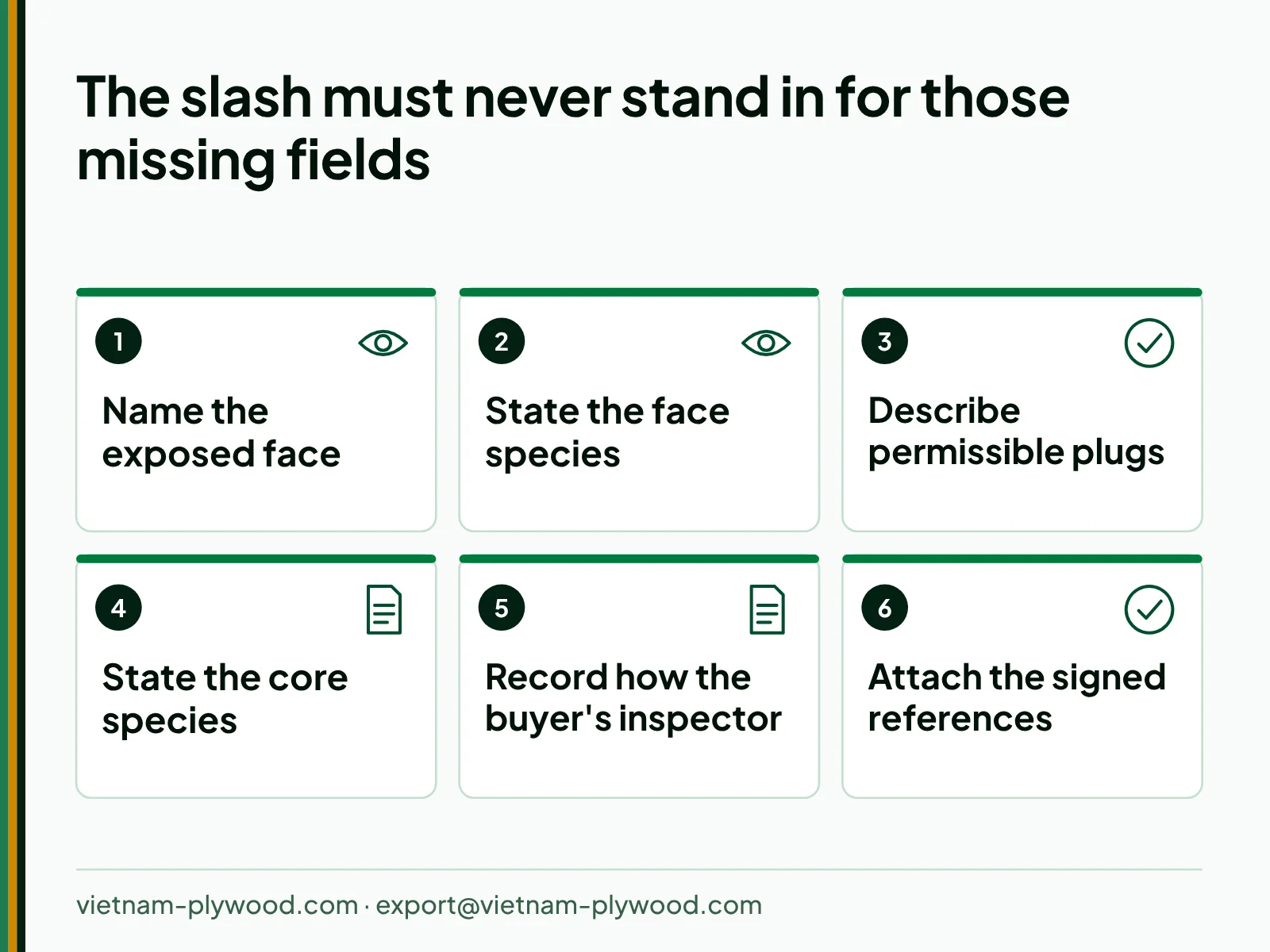
- Name the exposed face and the reverse; mark the panel orientation on the reference sample.
- State the face species and pair, such as B face / BB back, using the approved sample identifiers.
- Describe permissible plugs, filled knots, splits, colour variation and any matching requirement separately for each side.
- State the core species and construction, adhesive, emission class, size, thickness and tolerance.
- Record how the buyer’s inspector will sample sheets, compare surfaces and document rejection or acceptance.
- Attach the signed references to the order and repeat the grade description in the packing specification.
For HCPLY, the export documents include the commercial invoice, packing list and bill of lading, with additional documents according to the shipment and agreed build. The packing list identifies the shipped goods; the contract and approved grade references carry the detailed visual acceptance criteria. After loading, the draft shipping documents come to you for approval.
What can a buyer inspect at the producing factory?
A buyer can inspect both faces against the signed samples, check thickness and examine core edges at the producing factory. The inspection should record both passing and borderline examples, rather than photographing only clean panels.
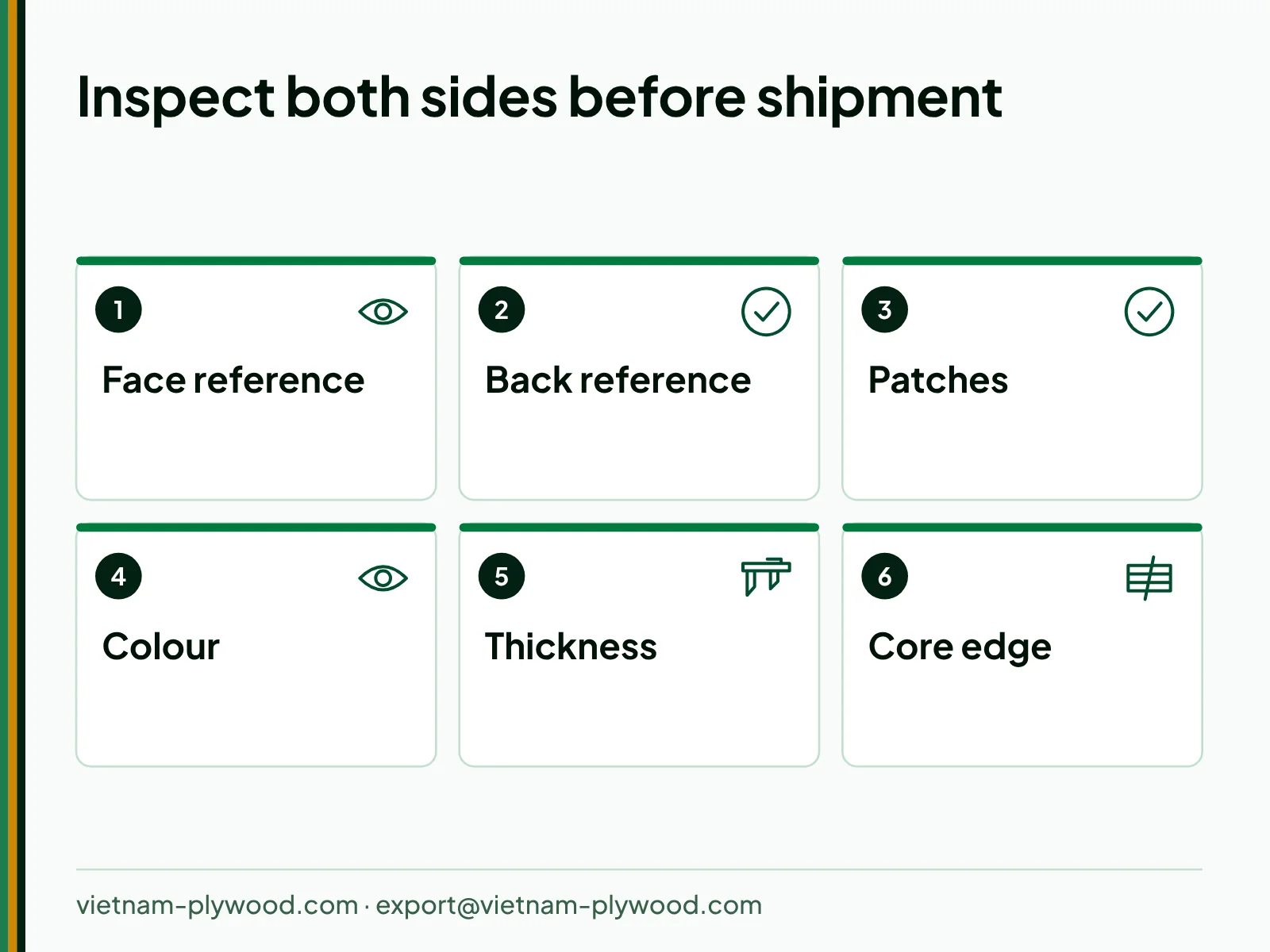
Begin with a random selection from identified bundles. Mark the face and reverse, then count and photograph repairs against the agreed schedule. Compare colour in consistent light, check whether sanding exposes glue or core, and inspect edge voids at cut samples where the agreed inspection plan permits.
Use a thickness gauge at agreed points and compare the readings with the ordered tolerance. A furniture panel ordered at 18 mm with ±0.2 mm tolerance must be judged against that written band; a commercial panel’s ±0.5 mm tolerance is a different acceptance condition. Surface grading cannot replace dimensional inspection.
Our comparison across factory lines helps align grade language with the actual manufacturing route.
How does a face-grade choice affect container planning?
Face-grade choice changes veneer sorting and price, while core density and panel dimensions drive the main load-weight calculation. For 18 mm, 1220 × 2440 mm sheets, the reference full 40HC loads are 990 styrax sheets at 26.52 t, 880 acacia sheets at 27.35 t, and 795 eucalyptus sheets at 27.69 t. The payload limit is 28.5 t.
These are single-core reference loads; film weight is excluded. A mixed-specification container can combine qualifying products within the payload limit, but its sheet count must be recalculated from the selected mix. For full pallet assumptions and other thicknesses, use the container loading guide.
Minimum order is one 40HC; one container can carry several specifications as long as the payload limit holds. For commercial plywood the indicative starting price is from US$250/m³ FOB Hai Phong (October 2026); furniture plywood is from US$350/m³ FOB Hai Phong (October 2026). The final grade-pair quotation is based on face selection, repairs, core construction, sanding and the written specification.
Is B/BB the same as marine or structural plywood?
B/BB is an appearance pair and does not establish marine or structural performance. If a buyer needs a marine designation or BS 1088, it must be assessed against a test report the buyer accepts.
The US Department of Commerce’s 2017 Federal Register description distinguishes the outer face and back veneers from the underlying core in hardwood plywood. That physical distinction is one reason a visible-face label cannot replace the full panel specification. See the 2017 Federal Register notice.
Similarly, film-faced construction panels are specified by film weight and agreed performance rather than a decorative BB/CC pair. Our construction line uses 120 g/m² standard film, 135 g/m² premium film or 220 g/m² anti-slip film.
What should you send for a trial container?
Send a side-by-side face specification with reference samples, the application and the destination port. Lucy can route the request to the appropriate producing factory and arrange the on-site quality checks. Use the written fields below as the starting point for a grade-specific enquiry.
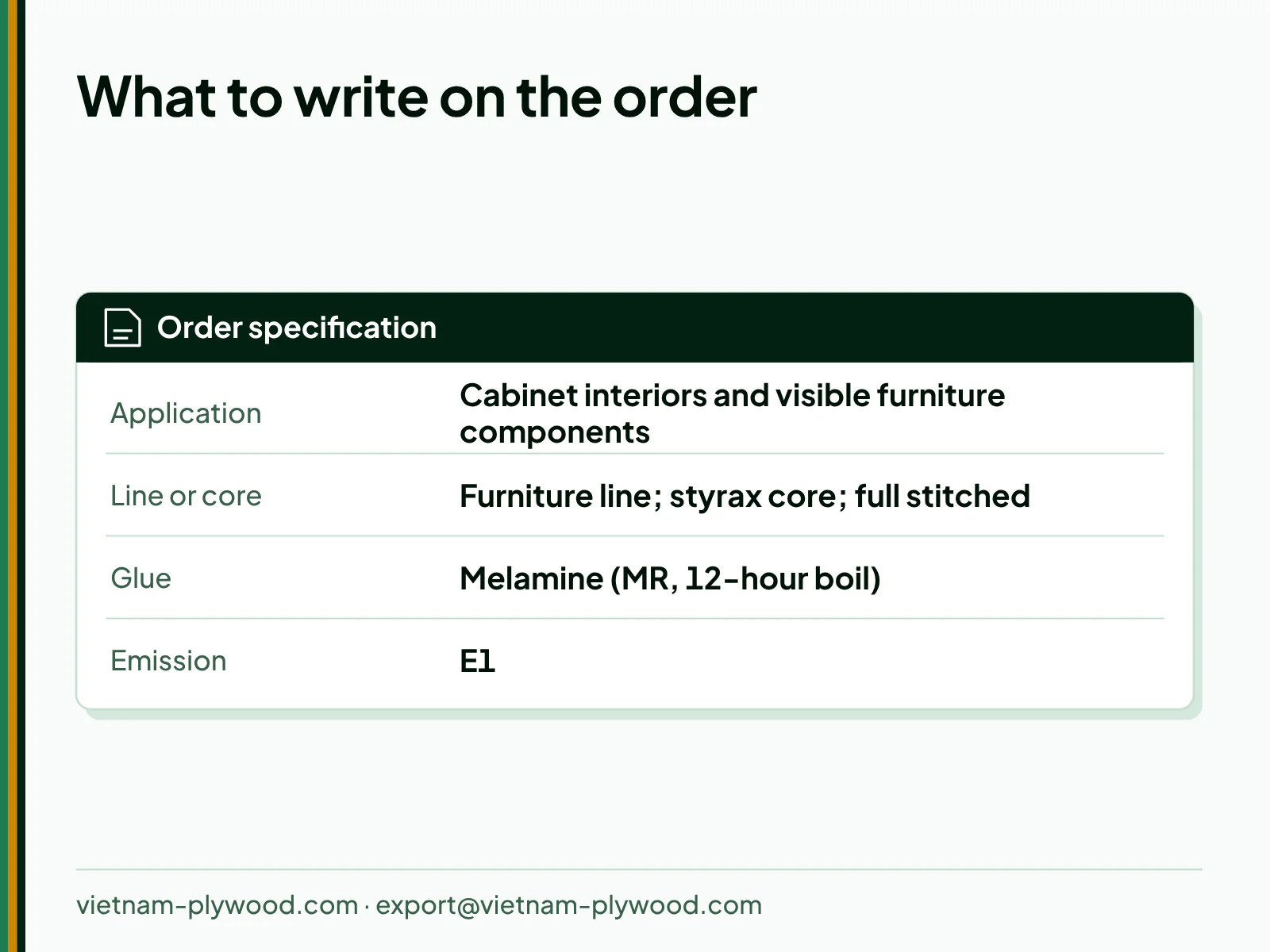
Application: cabinet interiors and visible furniture components
Line or core: furniture line; styrax core; full stitched
Glue: melamine (MR, 12-hour boil)
Emission: E1
Face and grade: okoume veneer; B face / BB back; signed repair and colour references attached
Thickness and tolerance: 18 mm; ±0.2 mm
Size: 1220 × 2440 mm
Quantity: one 40HC, mix by approved specification within payload limit
Destination port: [buyer to enter]
Next step: plan a trial container with Lucy at export@vietnam-plywood.com, using the approved face and back samples as the inspection reference.