





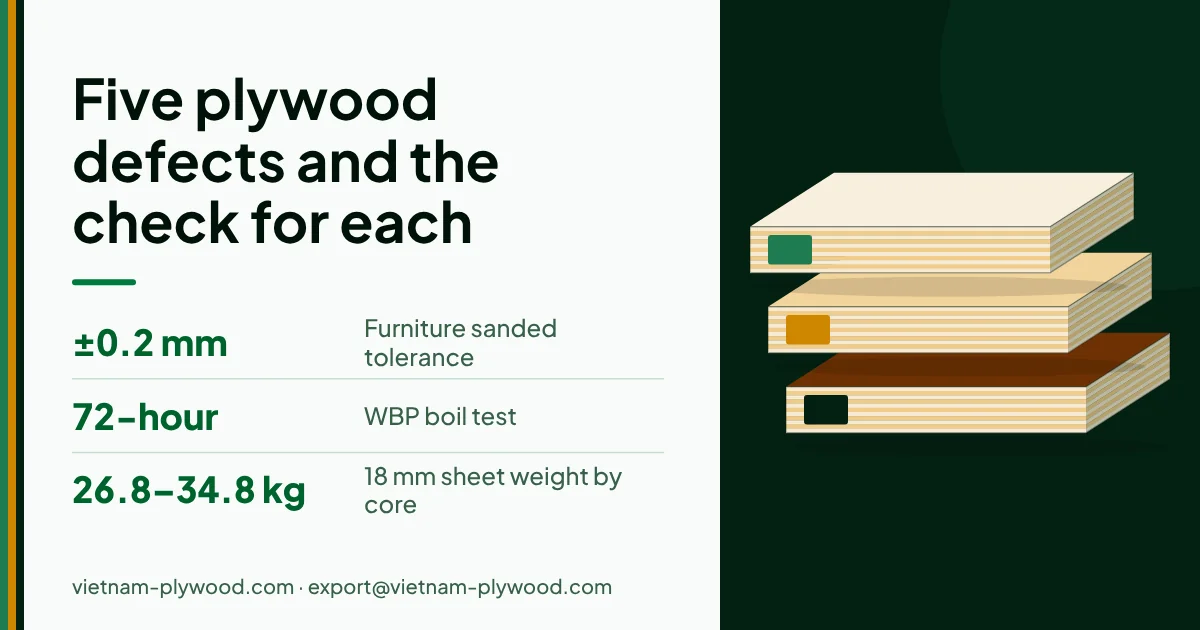
Vietnamese export plywood holds its specification when the order names every build field, and at HCPLY the defects we see trace back to a field left open: core construction, glue, tolerance or face grade. A missed defect is paid for in containers. One 40HC of sheets 1 mm under thickness or with voids at the edge becomes a claim, a discount and a lost season.
Is Vietnamese plywood good quality?
Yes, for buyers who write the build down and check it at the press. Vietnam reliably delivers dense plantation hardwood cores, MR and WBP glue lines, sanded furniture faces and film-faced formwork panels. It fails where an order says only “18 mm, BB/CC”: the producing factory then fills each open field with its cheapest option.
Our three factories each press one product group, so we see the same pattern on every line. Plywood quality in Vietnam is set factory by factory and order by order. The country of origin tells you the core species; the order tells you everything else.
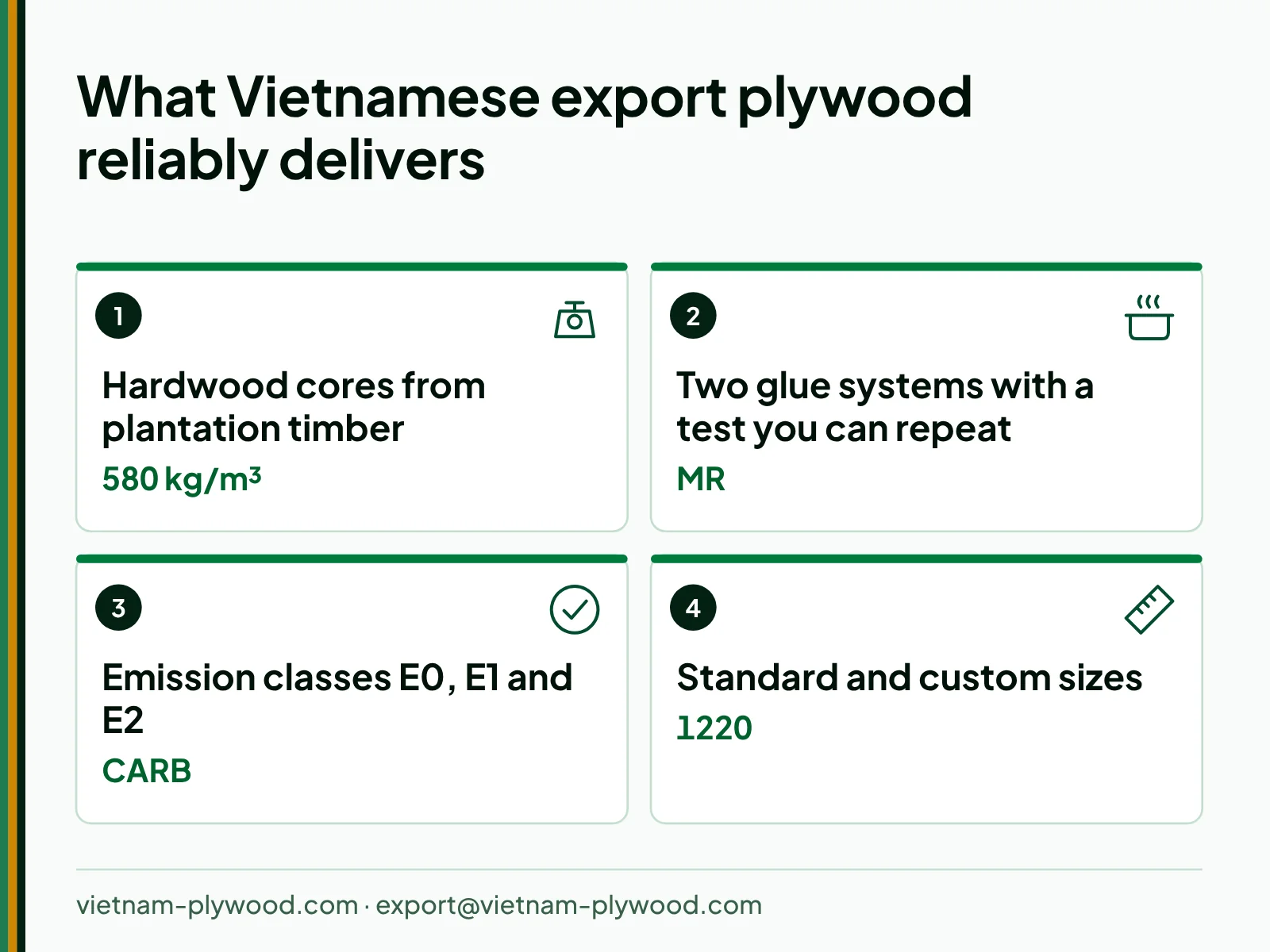
What Vietnamese export plywood reliably delivers:
- Hardwood cores from plantation timber: acacia at 580 kg/m³, eucalyptus at 650 kg/m³ and styrax at 500 kg/m³. No other core species are used here.
- Two glue systems with a test you can repeat: melamine (MR) passing a 12-hour boil and phenolic (WBP) passing a 72-hour boil.
- Emission classes E0, E1 and E2, and CARB P2 / TSCA Title VI with third-party certification for US orders.
- Standard and custom sizes: 1220×2440, 1250×2500, 1220×2135, 1220×1830, 915×2440, 915×2135 and 915×1830 mm, plus custom cutting.
Where it fails, and why, is the subject of the rest of this page. If you are still choosing who to buy from, our guide to finding reliable Vietnam plywood suppliers covers the vetting before this stage.
What are the common quality issues with Vietnam plywood?
The common Vietnam plywood quality issues are six, and each has a cause on the press floor and a check that finds it. The table lists them in the order buyers raise them in claims, with the grade each one hits hardest.
| Defect | Usual cause | Grade most exposed | Check at the producing factory |
|---|---|---|---|
| Core gaps and overlaps | Finger-jointed or loose-laid inner core | Packing, commercial | Edge cut on sample sheets; count gaps per edge |
| Sheet thinner than ordered | Thin core veneer, heavy sanding, nominal versus actual thickness | Furniture, commercial | Caliper at four corners and centre against the ordered tolerance |
| Glue line fails in water | Wrong glue for the use, short press time, low press temperature | Film-faced, exterior use | 12-hour boil (MR) or 72-hour boil (WBP) on cut samples |
| Core species differs from order | Acacia or eucalyptus substituted for styrax, or the reverse | Furniture | Sheet weight against core density, plus edge colour |
| Face below sample grade | Face veneer graded loosely, patches on an A face | Furniture | Face grade against the approved sample, sheet by sheet on a share of each pallet |
| Film wears through early | Film lighter than ordered, cut edges left unsealed | Film-faced | Film weight in g/m² on the label and test report; edge seal on every sheet |
Two of these, core substitution and short thickness, cannot be seen from a photo. They need a caliper and a scale at the producing factory, which is why the checks section below starts there.
What do importers complain about most with Vietnamese plywood?
Importers complain most that the container differs from the sample or the quote. The sample was full stitched and the bulk was finger-jointed; the quote said 18 mm and the sheets measure under tolerance; the face was A and the bulk arrives B with patches.
These complaints share a root. The quote fixed a thickness, a size and a face name, and nothing else. Face veneer is only 0.2–0.4 mm per side, so the name on the quote covers a fraction of the panel. The core, glue and repair method decide how the sheet behaves, and none of them shows on the face.
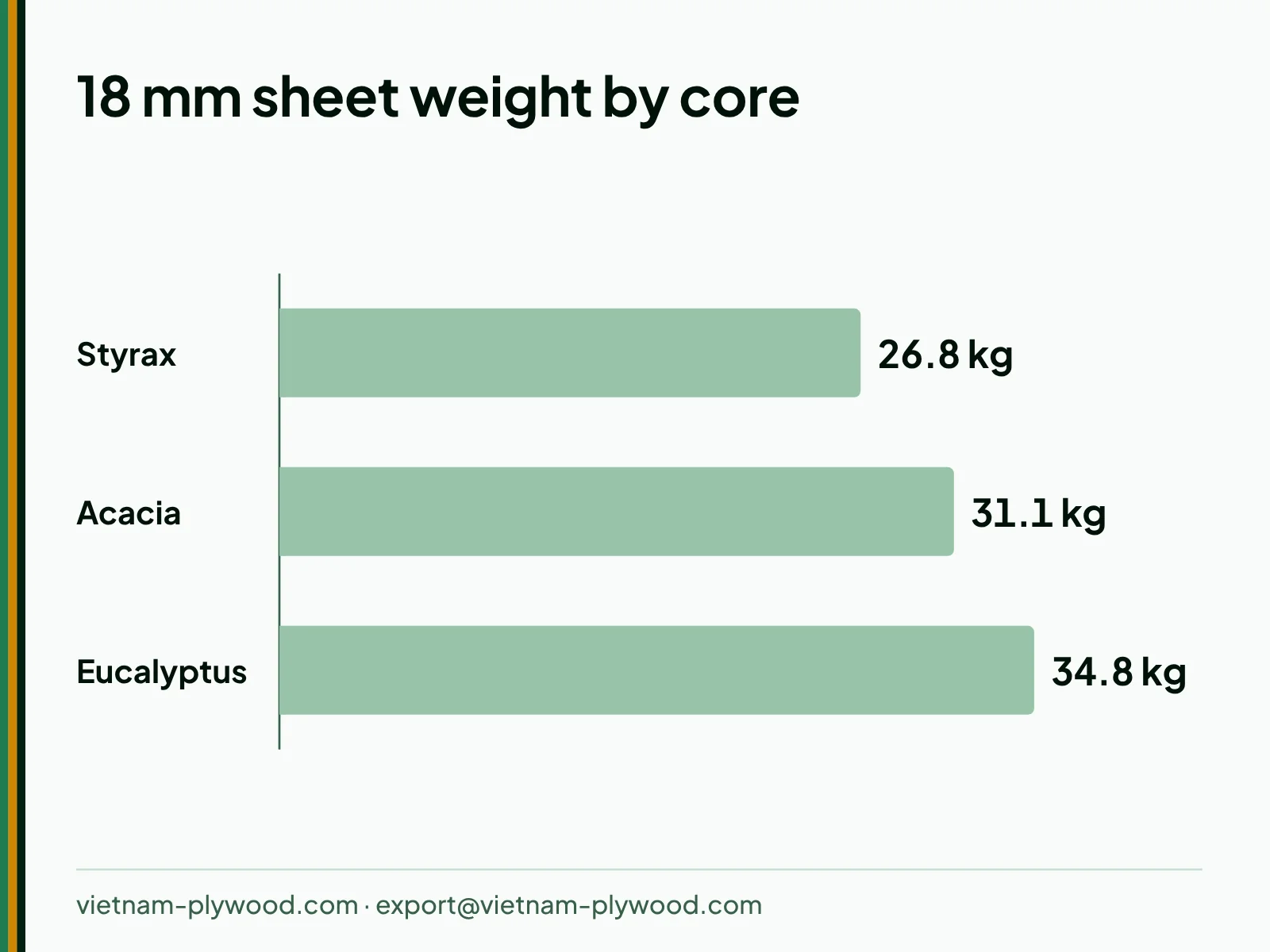
The second complaint is weight. A buyer who orders styrax-core furniture panels and receives eucalyptus pays freight on heavier sheets and handles a harder core on the CNC. An 18 mm sheet at 1220×2440 mm weighs 26.8 kg on styrax and 34.8 kg on eucalyptus. That 8 kg gap is easy to catch on a scale and hard to argue about after delivery.
The third complaint is paperwork that does not match the goods: an emission certificate for a class the order did not name, or an FSC claim missing from the sales documents. Our page on plywood import scams and hidden costs covers the commercial side of these traps. This page stays with the panel.
Which factors affect the quality of Vietnamese plywood?
Seven factors decide the quality of a Vietnamese panel, and every one of them can be written on the order. In order of their effect on a claim:
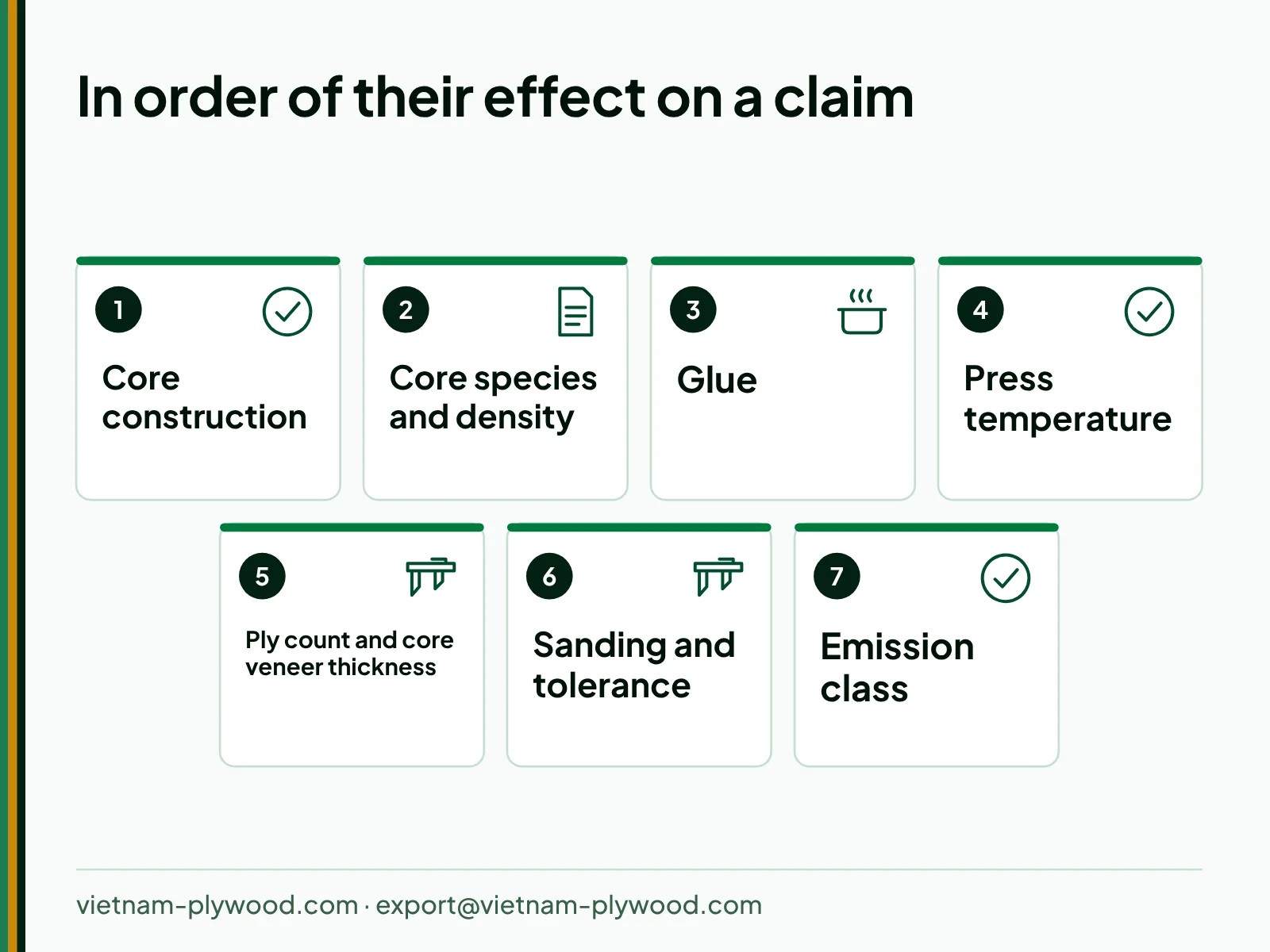
- Core construction. Best to cheapest: full stitched; stitched outer layers with edge-trimmed inner; finger-jointed; loose-laid. A loose-laid core leaves gaps and overlaps that show as soft spots, telegraphing and edge voids.
- Core species and density. Acacia 580, eucalyptus 650, styrax 500 kg/m³. Density follows the core, not the face, so weight, screw behaviour and machining all follow the core.
- Glue. Melamine (MR) for interior and dry use, 12-hour boil; phenolic (WBP) for wet sites and repeated pours, 72-hour boil. Glue and emission are two separate fields.
- Press temperature. MR presses at 110–120 °C and WBP at 130–145 °C. A WBP order pressed at MR temperature is the textbook cause of delamination in the boil test.
- Ply count and core veneer thickness. Core veneers run 1.4–2.0 mm, so an 18 mm panel holds 11–13 plies. Fewer, thicker core veneers mean coarser layers and more room for gaps.
- Sanding and tolerance. Furniture sanded to ±0.2 or ±0.3 mm as ordered; commercial and film-faced ±0.5 mm; packing ±0.5–1.0 mm; length and width ±2 mm.
- Emission class. E0, E1 or E2, or CARB P2 / TSCA Title VI. A quote that reads “E0 glue” merges two fields, and the panel class should be written separately from the glue.
The plywood quotation guide shows how these fields sit on a quote line, and how two quotes for “the same” panel can differ by three of them.
Which defects are furniture, packing and film-faced grades each prone to?
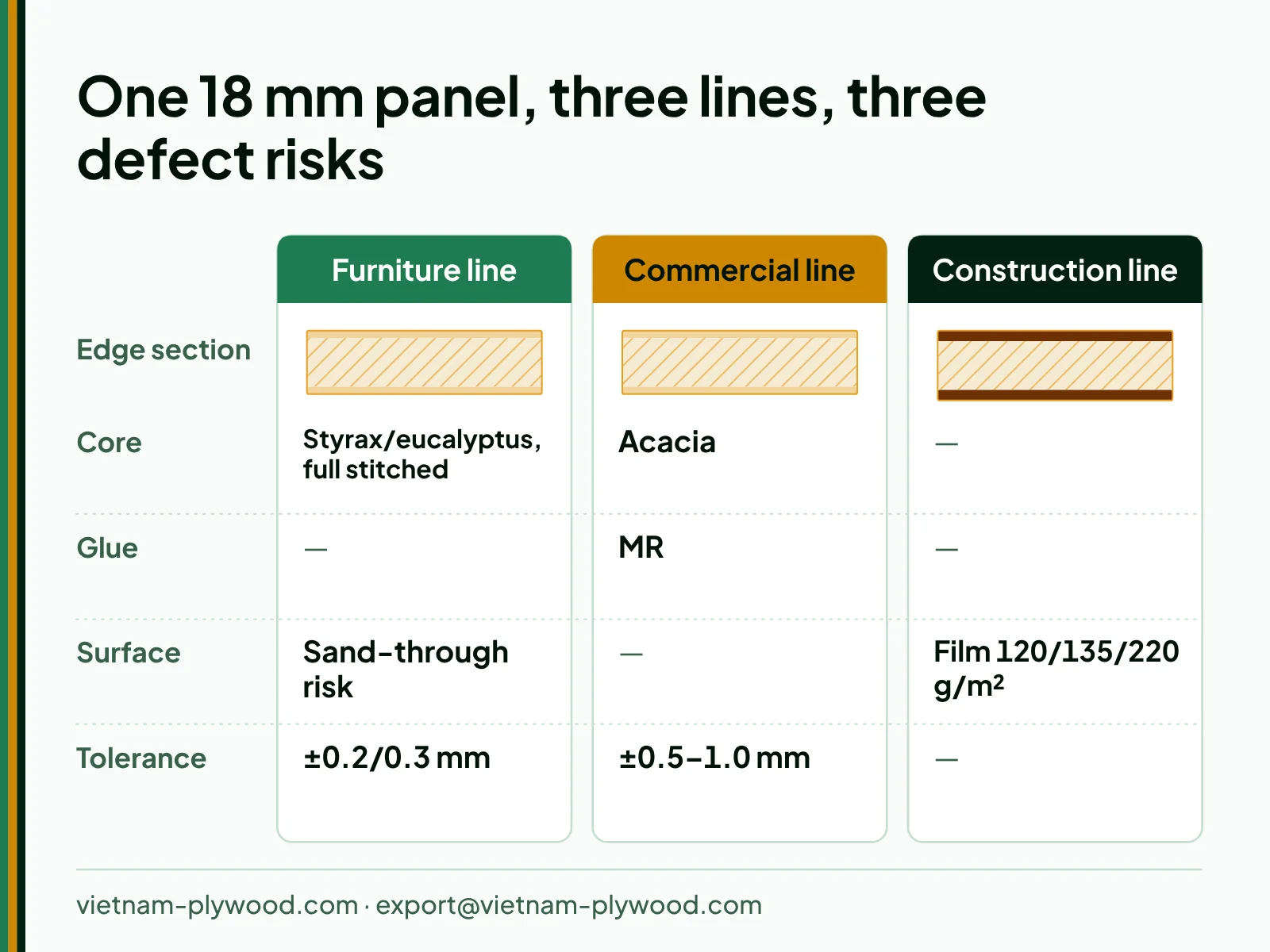
Each grade fails in its own way because each line sets different fields. The table compares one 18 mm, 1220×2440 mm panel built on each of our lines, with the defect the build is exposed to and the check that answers it.
| Field (18 mm, 1220×2440 mm) | Our furniture line | Our commercial and packing line | Our construction line |
|---|---|---|---|
| Core and density | Styrax 500 or eucalyptus 650 kg/m³ | Acacia 580 kg/m³ | Acacia 580 or eucalyptus 650 kg/m³ |
| Core construction | Full stitched | Written on the order | Written on the order |
| Glue | MR or WBP as ordered | MR | Phenolic or melamine film; MR or WBP glue |
| Surface | Sanded, face A or B | Unsanded or light-sanded | Film 120 g/m² standard, 135 g/m² premium, 220 g/m² anti-slip |
| Tolerance | ±0.2 or ±0.3 mm | ±0.5 mm; packing ±0.5–1.0 mm | ±0.5 mm |
| Sheet weight | 26.8 kg (styrax) or 34.8 kg (eucalyptus) | 31.1 kg | 31.1 kg (acacia) or 34.8 kg (eucalyptus) |
| Defect it is prone to | Sand-through on a thin face, core shadow under lacquer, tolerance drift | Edge voids, overlaps, wide thickness spread | Glue failure in water, film wear, edge swelling |
| Check that catches it | Caliper on each pallet, face against sample, weight | Edge cut, caliper spread across the pallet | Boil test, film weight, edge seal |
Furniture grade
A furniture panel fails on the surface. With 0.2–0.4 mm of face veneer, aggressive sanding at the furniture shop goes through to the core, and any core gap beneath the face prints through a high-gloss lacquer. Our furniture line builds a full stitched styrax or eucalyptus core and sands it to ±0.2 or ±0.3 mm as ordered, which leaves the buyer less to sand away. The furniture plywood page lists the faces and sizes for this group.
Packing grade
Packing grade is built for price, so the core is where it gives way. An acacia core with MR glue, unsanded, at ±0.5–1.0 mm is fit for crates and pallets. It is not fit for a visible furniture part, and most “bad quality” claims on packing grade come from buyers who used it as one. The fix is in the order: name packing grade for packing, or name the core construction step you need.
Film-faced grade
A film-faced panel fails on site, at the edge and in the glue line. Light film or open cut edges let water into the core, and an MR glue line in a wet pour gives out early. Our construction line describes film by weight: 120 g/m² standard, 135 g/m² premium, 220 g/m² anti-slip only. With proper handling, a release agent on every pour and sealed edges (cut edges included), melamine-glue film-faced lasts about 12–15 pours and phenolic-glue up to about 25 pours. Contractors can read more on plywood supply for construction projects.
How good is the quality of Vietnamese birch-faced plywood?
Vietnamese birch plywood is a birch face of 0.2–0.4 mm over a Vietnamese hardwood core, and it is good for painted and lacquered furniture parts. It is not Baltic-type birch plywood, which is birch through every ply. Buyers who expect birch-core edges and screw behaviour from a birch-faced panel file the claim.
Three things set its quality:
- Face grade. Birch faces are graded D, E or F, never A, B or C. A quote that offers “A-grade birch” from Vietnam is using a different scale, and the sample is the only fair reference.
- Core. The core is acacia, eucalyptus or styrax, so weight and screw-holding follow that species. A styrax core gives the lightest sheet; eucalyptus the heaviest.
- Face thickness against sanding. A thin birch face tolerates a light finish sand. Specify sanded at the factory to the furniture tolerance, so your shop removes little.
We do not press birch-core plywood, MDF, OSB, chipboard or blockboard. Birch appears on our panels only as a face veneer. If your product needs birch through the core for exposed edges, that is a different panel and a different origin.
Which factory checks catch quality problems before shipment?
Seven checks at the producing factory catch nearly every defect in the table above, and a buyer or inspector can witness each one before the container is sealed. Run them in this order, because each one narrows what the next must look for.
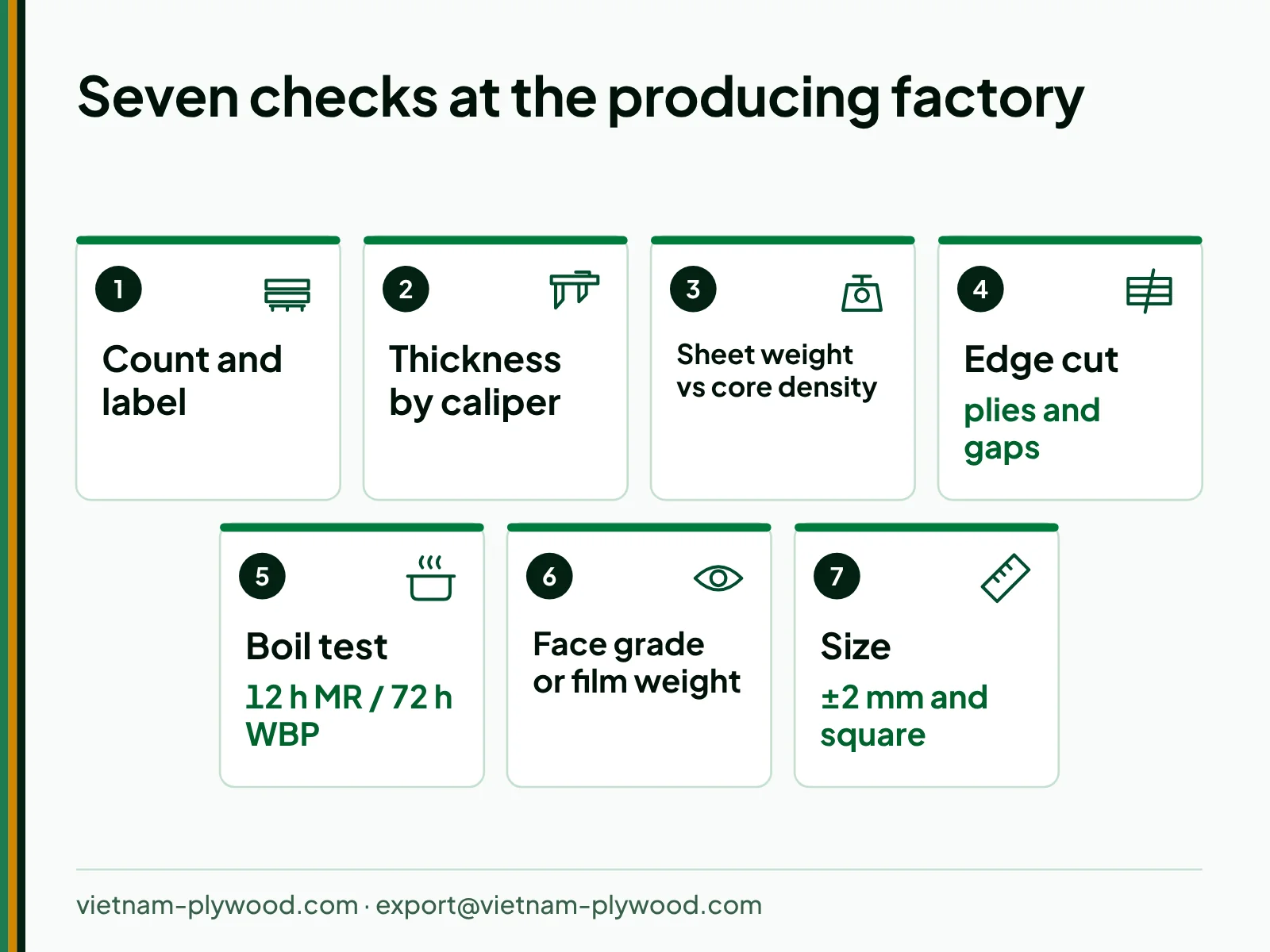
- Count and label. Pallet count and labels against the packing list: core species, thickness, size, grade and emission class on each pallet.
- Thickness. Caliper at the four corners and the centre of sheets drawn from several pallets, recorded against the ordered tolerance (±0.2, ±0.3, ±0.5 or ±0.5–1.0 mm).
- Sheet weight. Weigh sheets and compare with sheet weight = length × width × thickness × core density. An 18 mm, 1220×2440 mm sheet should sit near 26.8 kg on styrax, 31.1 kg on acacia and 34.8 kg on eucalyptus.
- Edge cut. Cut a strip from a sample sheet and count plies (11–13 at 18 mm) and gaps or overlaps in the core. This is where the core construction step shows.
- Boil test. 12-hour boil for MR glue, 72-hour boil for WBP, on cut samples. The glue line should hold without delamination.
- Face or film. Face grade against the approved sample; for film-faced, film weight against the label and edge sealing on every sheet, cut edges included.
- Size and square. Length and width to ±2 mm, and diagonals for square on custom cuts.
A sheet found outside the order is the reason to re-sort that pallet before loading, while the fix costs little. The record of each check travels with the shipment, so a later dispute starts from a measured fact. Our plywood claims handling page explains what happens if something is still found at destination.
Which export document proves each check?
Each check has a document in the shipment’s export set, and the buyer sees the drafts after loading. The table maps quality topics to the paper that covers them.
| Quality topic | Document in the export set |
|---|---|
| Quantity, pallets, thickness, size per pallet | Packing list and commercial invoice |
| Glue type and boil test result | Test reports for the agreed build |
| Emission class (E0, E1, E2) or CARB P2 / TSCA Title VI | Emission certificate |
| FSC claim | FSC claim on the sales documents |
| Treatment of pallets and packing wood | Phytosanitary and fumigation papers |
| Country of origin | Certificate of origin (EUR.1 for EU lots) |
| Legality and origin of timber for EU lots | EUTR/EUDR file set |
Certificates such as FSC, CARB P2, ISO 9001 and CE belong to the member factories and are shown with factory details masked, on request. After loading, the draft shipping documents come to you for approval, so a wrong class or a missing claim can be fixed before the originals are issued.
For US orders, emission paperwork carries legal weight. Under the US emission rule in 40 CFR 770.10 (EPA, as reproduced by the Legal Information Institute in 2026), the limit is set for hardwood plywood made with a veneer core at 0.05 ppm of formaldehyde. A US importer should order the class by name and check that the certificate matches the goods.
What is the reputation of Vietnamese plywood in the global market?
Vietnamese plywood is known abroad as a dense hardwood-core panel at a commercial price, shipped to the Middle East, Europe, the US and Africa. Its reputation has two marks against it. One is uneven quality between factories; the other is origin.
The origin mark comes from the US. In its July 2023 final determination, the US Department of Commerce found that hardwood plywood completed in Vietnam from Chinese face veneer, back veneer or core components was circumventing the duty orders on Chinese hardwood plywood. Since then, a US buyer’s first quality question is often where the veneers were made, ahead of how the panel performs.
Both marks have the same answer: evidence from the producing factory. Cores of acacia, eucalyptus or styrax are Vietnamese species, and the export set carries the certificate of origin and, for EU lots, the EUTR/EUDR file set. Buyers who compare suppliers on that evidence, rather than on a unit price, can use our checklist to compare plywood quotes.
How do quality choices change the price and the container?
Each step up in build costs more, and each one changes sheet weight and load. HCPLY quotes commercial plywood from US$250/m³ FOB Hai Phong (October 2026) and furniture plywood from US$350/m³ FOB Hai Phong (October 2026). Film-faced and other builds are quoted against the written specification.
The price drivers, from largest effect to smallest:
- Core construction: full stitched costs more than finger-jointed, which costs more than loose-laid.
- Sanding and tolerance: a sanded ±0.2 mm panel costs more than an unsanded ±0.5 mm one.
- Glue: WBP with its 72-hour boil costs more than MR.
- Emission class: E0 and CARB P2 / TSCA Title VI cost more than E2.
- Face grade and species: an A face costs more than B; matt (unfaced raw core) costs least.
The container rewards a lighter core. At 18 mm and 1220×2440 mm, a 40HC holds 990 styrax, 880 acacia or 795 eucalyptus sheets, all within the 28.5 t payload limit; the full arithmetic is on our container load tool. The minimum order is one 40HC, and specifications can be mixed in it, so a buyer can trial a furniture grade and a packing grade in the same load. Buyers mixing several products can read how one supplier covers several plywood types.
How do you write a quality specification we can check?
Write every field the checks above measure, and the producing factory has nothing left to choose for you. A buyer sending the lines below gets a quote, a sample and an inspection plan built on the same numbers.
Application:        furniture carcass, lacquered
Line / core:        furniture line, styrax core, full stitched
Glue:               MR (12-hour boil)
Emission:           E1 (or CARB P2 / TSCA Title VI for US)
Face and grade:     okoume face, grade A / back grade B
Thickness:          18 mm, sanded, tolerance ±0.3 mm
Size:               1220 × 2440 mm, length and width ±2 mm
Quantity:           one 40HC (990 sheets at 18 mm styrax)
Inspection:         caliper, sheet weight, edge cut, boil test at the producing factory
Destination port:   [your port], FOB Hai Phong or CIF
Samples cost nothing: a first-time buyer pays the courier, and that charge comes off the first confirmed order. Production runs 15–45 days from the 30% deposit, set by order size, line loading and the contract. Next step: request the spec sheet for the grade you want checked, and Lucy will send it with the inspection points marked.