





Plywood import traps are caught by matching the written build to factory inspection, certificate scope and shipping charges. A missed check can cost money, delay a shipment or leave an importer with a rejected load. HCPLY explains how to avoid scams when buying plywood from vietnam by placing each check at the stage where evidence still changes the order.
How to avoid scams when buying plywood from vietnam?
To avoid scams when buying plywood from Vietnam, lock the specification before payment, inspect the actual producing factory, verify certificates with their issuers, and reconcile freight and documents against the proforma invoice. Each control belongs at a different order stage.
Start by separating three risks: an inaccurate product description, a claim unsupported by the relevant document, and an unexpected landed-cost charge. A genuine certificate can also belong to a different factory or product scope.
HCPLY makes the order at the producing factory in Phu Tho or Hai Phong, with the line chosen for the written build. Buyers can visit the factory office and inspect the goods there. For a wider supplier-screening sequence, use our guide to finding reliable Vietnam plywood suppliers.
Which trap can be caught at each order stage?
The earliest effective check depends on the trap: specification ambiguity is caught before deposit, physical substitution during production, and freight surprises before the proforma invoice is accepted.
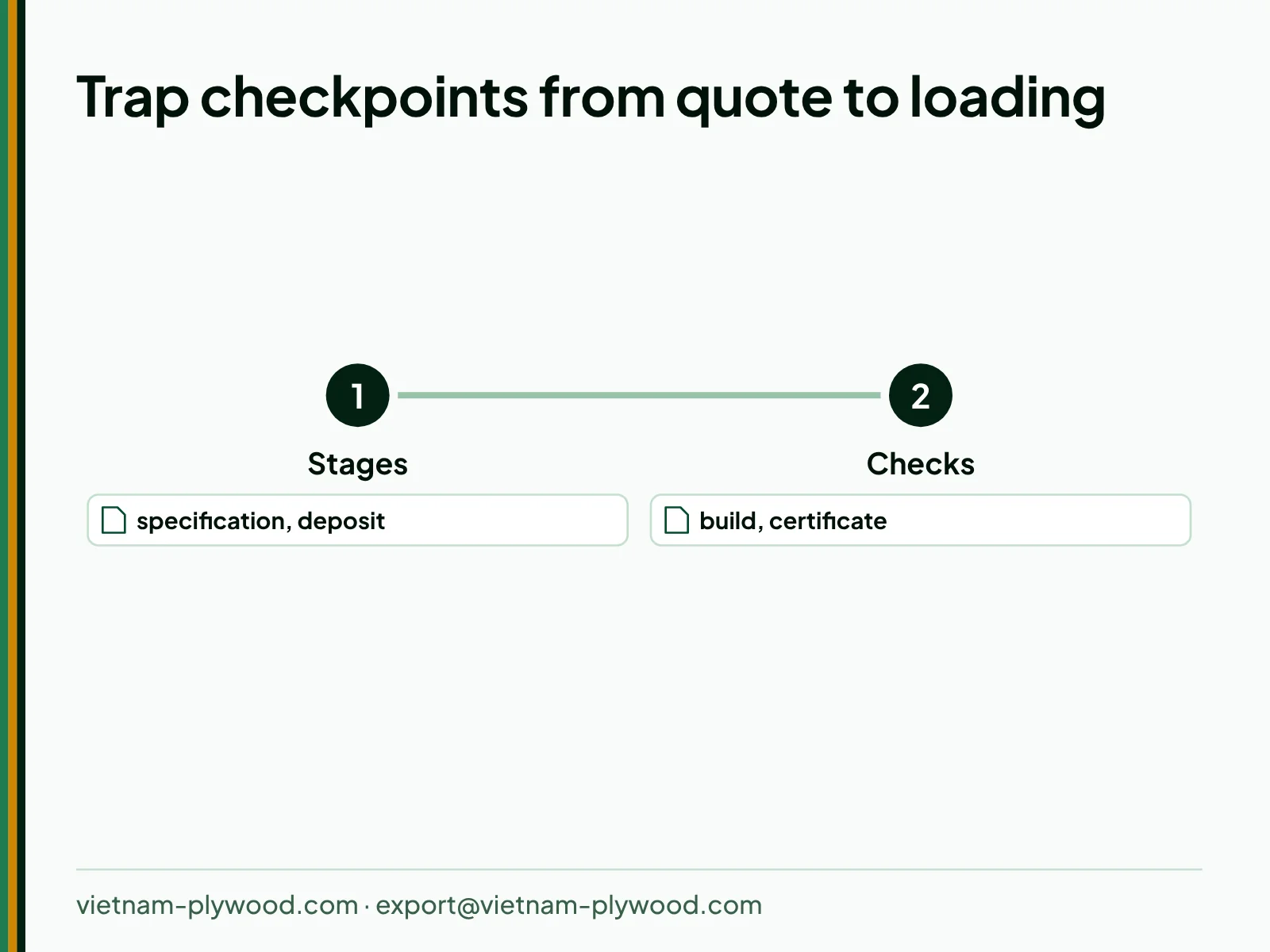
| Trap | Earliest useful checkpoint | Evidence to request | Stop or correction |
|---|---|---|---|
| Undefined face thickness | Written specification | Face species, veneer thickness, grade | Rewrite the specification |
| Mixed or substituted cores | Factory inspection | Edge and sampled cut-section photographs | Segregate and inspect the lot |
| Thin or uneven finished panels | Finished-goods inspection | Thickness readings against ordered tolerance | Hold affected pallets |
| Borrowed or expired certificate | Before deposit | Issuer record, holder, scope, validity | Resolve the exact claim |
| Inadequate bonding claim | Sample and production checks | Glue specification and agreed test report | Test the agreed build |
| Unexpected freight or terminal charges | Proforma invoice | Named port, trade term, included charges | Revise commercial terms |
| Missing shipment papers | Before loading | Document checklist and draft instructions | Complete document requirements |
| Packaging or count discrepancy | Loading | Pallet marks, tally and container photographs | Correct the packing list |
Treat each row as a hold point, with a named person authorized to release it. An inspection report is useful only when it identifies the actual batch and measured acceptance criteria.
For a practical pre-order checklist, see 10 questions to ask a plywood supplier.
Step 1: Match the proposed panel to the producing line
A line-specific specification makes substitution easier to detect because the expected core, surface and finish are recorded before production.
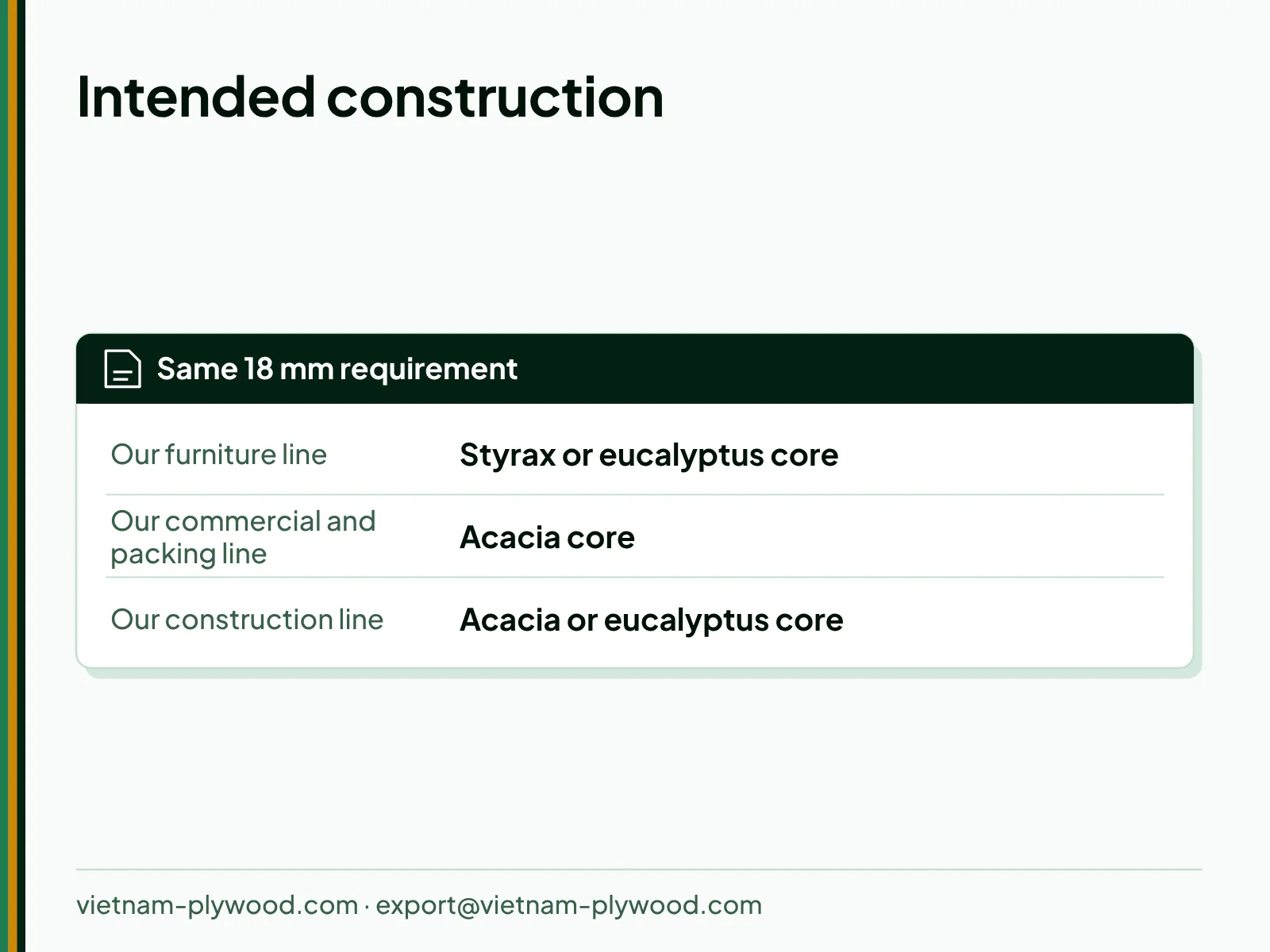
| Same 18 mm requirement | Intended construction | What an inspector should see | Appropriate use |
|---|---|---|---|
| Our furniture line | Styrax or eucalyptus core, full stitched, sanded, E0/E1 | Uniform stitched core and sanded face | Cabinet and furniture components |
| Our commercial and packing line | Acacia core, MR glue, unsanded or light-sanded | Acacia core and agreed surface finish | Commercial or packing panels |
| Our construction line | Acacia or eucalyptus core, phenolic or melamine film, unsanded | Specified film and core | Formwork panels |
On the furniture line, an ordered sanded tolerance is ±0.2 or ±0.3 mm. Commercial and film-faced tolerance is ±0.5 mm; packing tolerance is ±0.5–1.0 mm. Length and width tolerance is ±2 mm. Put the selected tolerance beside the nominal thickness in the purchase order.
The face names the product, while density follows the core. An okoume-faced panel is not necessarily an okoume-core panel. HCPLY uses styrax at 500 kg/m³, acacia at 580 kg/m³ and eucalyptus at 650 kg/m³. A buyer comparing grades across factory lines should separate surface appearance from core construction.
Ask which line will press the ordered panel, then identify the expected materials before scheduling inspection. A change in production line requires an updated written build, rather than an informal assurance that the panel is equivalent.
Step 2: How do I spot thin face veneer or mixed cores?
Inspect face veneer thickness at a cut edge and check the core throughout sampled panels from the actual production lot.
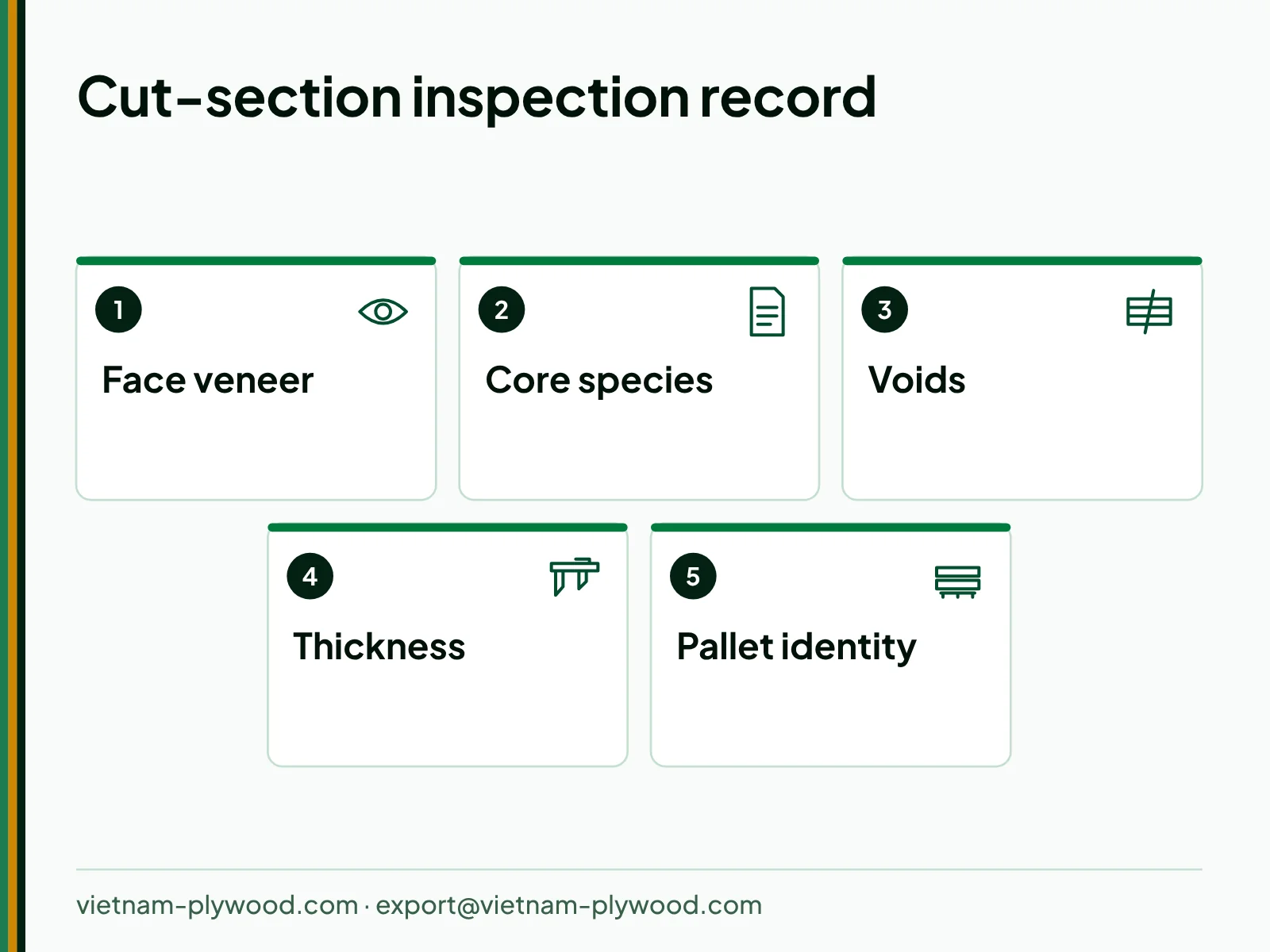
- Agree the face species, face grade and veneer thickness before production. Common face veneer thickness is 0.2–0.4 mm; write the actual ordered target rather than treating that range as acceptance.
- At the producing factory, select panels across pallet positions and production batches. Record pallet marks and sample locations before any cutting.
- Cut representative samples where permitted, expose the cross-section and measure the face veneer with an appropriate gauge. Compare each reading with the agreed measurement method and tolerance.
- Examine the full edge and cut face for species changes, open joints, gaps and uneven veneer layering. For 18 mm plywood, 11–13 plies are expected, depending on the 1.4–2.0 mm core veneer thickness.
- Measure finished thickness at agreed positions and record actual values. Compare them with the line-specific tolerance, not a tolerance borrowed from another product.
- Photograph sample identifiers, measurement scale, pallet labels and any rejected section together. Record disposition before loading.
Full stitched construction differs from stitched outer layers with edge-trimmed inner layers, finger-jointed cores and loose-laid cores. Those descriptions should never be treated as interchangeable. Inspectors should match the ordered core construction, rather than accept a neat surface as evidence of the interior.
For cabinet parts, inspect the cut edge where machining will expose voids. Our Vietnam plywood quality and grade guide explains how acceptance criteria change with the intended use.
Step 3: Test bonding and emission as separate claims
Glue performance and formaldehyde emission are separate specification fields; a claim about one does not prove the other.
Our commercial and packing line uses moisture-resistant (MR) glue. The stated melamine MR system is associated with a 12-hour boil, while phenolic water-and-boil-proof (WBP) glue is associated with a 72-hour boil. These are descriptions of the glue systems, not a substitute for an agreed lot test. MR pressing is at 110–120 °C; WBP pressing is at 130–145 °C.
Emission classes are E0, E1 and E2. California Air Resources Board Phase 2 (CARB P2) and US Toxic Substances Control Act Title VI refer to a US regulatory limit and third-party certification, rather than a glue recipe. Request the relevant report and identify the product, factory, date and test scope. Avoid shorthand such as treating an emission class as the adhesive name.
Samples cost nothing: a first-time buyer pays the courier, and that charge comes off the first confirmed order. Mark the approved sample with its specification and keep the inspection criteria alongside it.
Step 4: How do I verify a certificate is genuine?
Check the certificate code in the issuer’s public record, compare the holder and product scope, and view the original at the producing factory. A valid-looking scan is insufficient when its scope excludes the ordered goods.
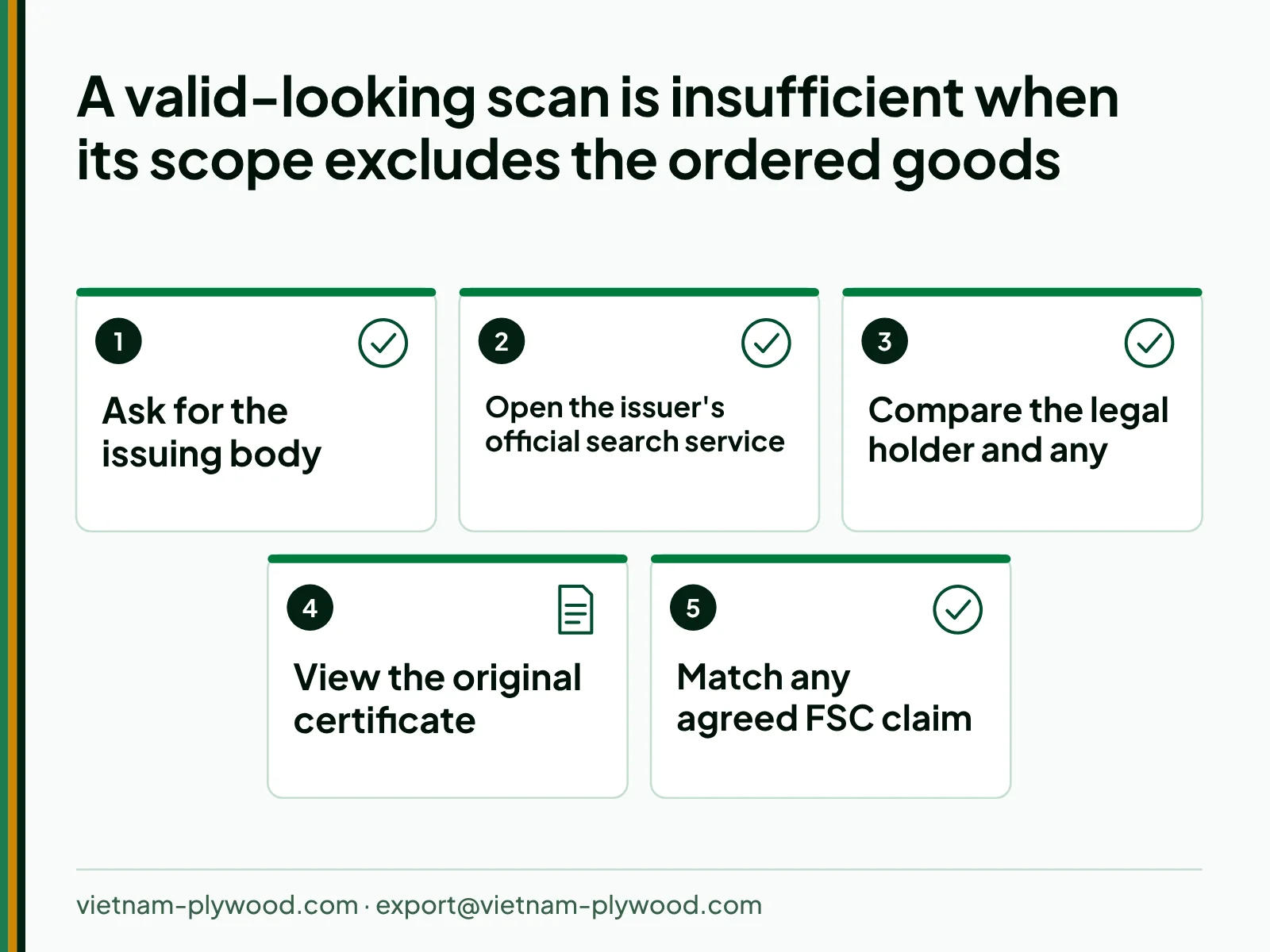
- Ask for the issuing body, certificate or licence code, holder, scope and validity period relevant to the claim.
- Open the issuer’s official search service independently. For Forest Stewardship Council (FSC) claims, the FSC’s public search instructions describe searching by licence code, certificate code or organization name (FSC, 2026).
- Compare the legal holder and any listed group members with the actual producing factory. Check product categories, chain-of-custody scope, status and applicable claim type.
- View the original certificate at the producing factory and check its details against the public entry.
- Match any agreed FSC claim on sales documents to the order and certificate scope. For emissions, CE or quality-management claims, use the relevant issuing or notified body’s verification route and agreed evidence.
Certificates associated with our member factories—including FSC, CARB P2, ISO 9001 and CE—are shown with factory details masked, on request. The EUTR/EUDR file set for EU lots is a separate documentary requirement, not a substitute for product testing. Discuss exactly which certificate documents the order requires before deposit.
If a database entry is unavailable, obtain verification from the issuing organization and retain the response with the order file. Do not infer validity from a logo on a quotation or a photograph of a certificate on a wall.
Step 5: Check the proforma invoice for hidden freight costs
The proforma invoice must state the named delivery term, port, currency, product specification and responsibility for charges that sit outside the quoted panel price.
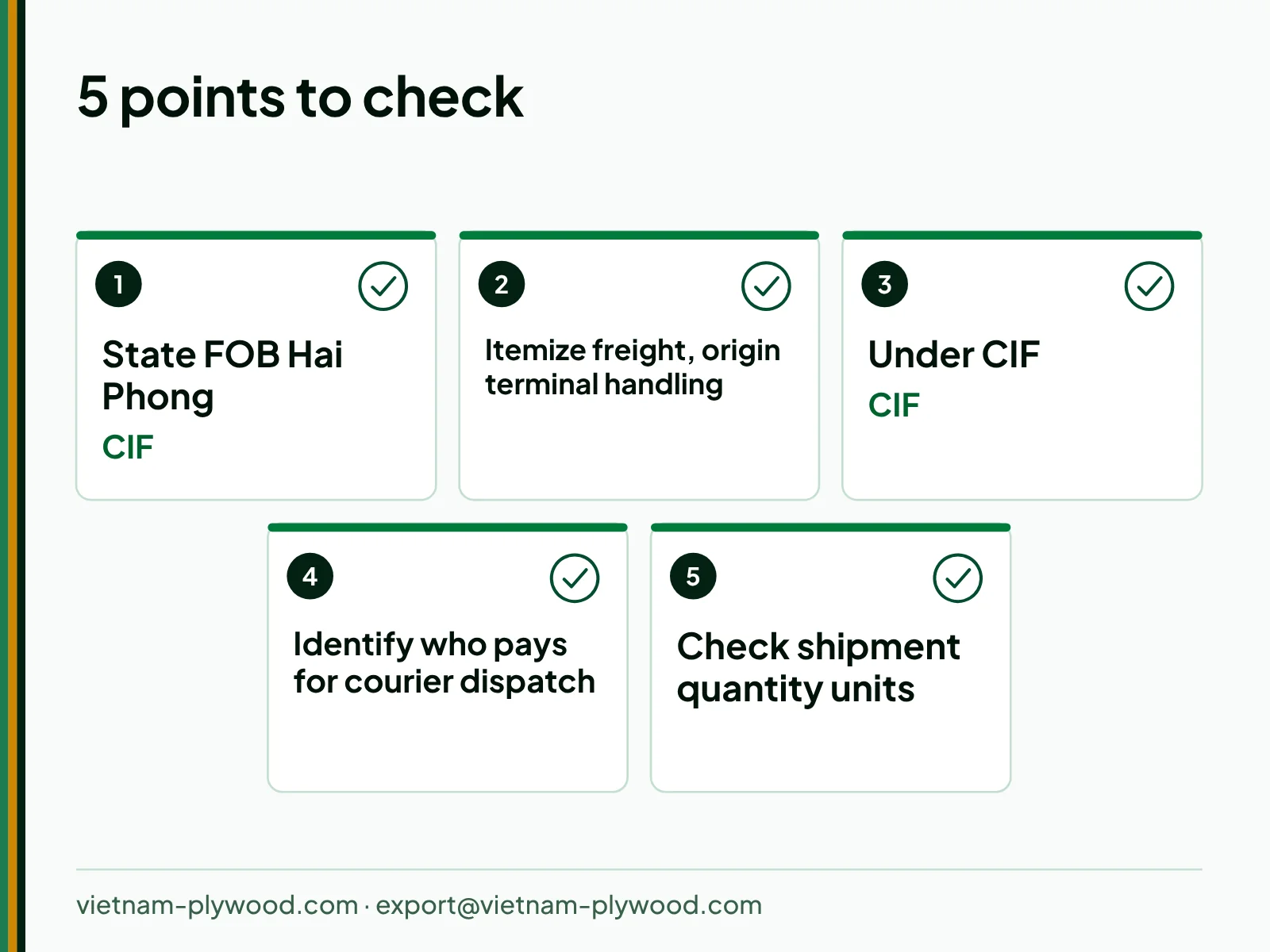
The International Chamber of Commerce’s Incoterms 2020 rules distinguish Free On Board (FOB), Cost and Freight (CFR) and Cost, Insurance and Freight (CIF) by who arranges and pays carriage and insurance (ICC, 2020). Under FOB, risk transfers when goods are on board the vessel. Under CFR and CIF, the seller pays the specified main carriage, although risk also transfers on board; CIF adds insurance under its rule.
- State FOB Hai Phong, CFR (CNF) or CIF, followed by the named port and the agreed Incoterms edition.
- Itemize freight, origin terminal handling, destination terminal handling, document issuance, customs clearance, inspection, storage, demurrage and detention responsibility. Ask the forwarder for destination charges separately.
- Under CIF, identify insurance coverage and the insured interest. ICC describes the default CIF obligation as minimum cover; additional cover needs an express agreement.
- Identify who pays for courier dispatch, bank charges, document amendment and any requested extra testing. A quotation that says ‘all included’ should still define the covered services.
- Check shipment quantity units, pallet count, net and gross weights, loading plan and the destination port spelling. Reconcile these against the purchase order before deposit.
Commercial plywood starts from US$250/m³ FOB Hai Phong (October 2026), and furniture plywood starts from US$350/m³ FOB Hai Phong (October 2026). Those are dated starting points rather than a quote for a particular build. Core construction, face, sanding, thickness tolerance, grade, glue and shipment composition affect the final offer. Request a written quotation for the exact specification.
Our minimum order is one 40HC. Specifications can be mixed in a container within the payload limit. For an agreed mix, use the mixed-container planning guide and record each pallet type in the proforma invoice.
Step 6: Reconcile container weight before booking
A pallet plan must fit both the container payload limit and the volume of the chosen core and thickness.
At 18 mm and 1220×2440 mm, the full 40HC lookup is 990 styrax sheets at 26.52 t, 880 acacia sheets at 27.35 t, or 795 eucalyptus sheets at 27.69 t. The payload limit is 28.5 t. Film weight is excluded from those lookup figures.
For a mixed shipment, use the weight of each specified panel and sum the pallets before accepting the loading plan. The corresponding 18 mm sheet weights are 26.79 kg styrax, 31.08 kg acacia and 34.83 kg eucalyptus. These differences explain why a sheet count copied from a lighter-core offer can produce an unsuitable heavier-core loading plan.
Check pallet marks against the packing list and the actual core before sealing the container. Record the container number, seal number, loading photographs and tally. The full container loading calculations belong in the packing reference; this page uses the 18 mm comparison only to show the weight trap.
Step 7: Match every shipment paper to the agreed build
A shipment document set should identify the same seller, buyer, product, quantity and destination throughout the transaction.
For each shipment, HCPLY prepares the commercial invoice, packing list, bill of lading (B/L), certificate of origin, phytosanitary and fumigation papers, and the order’s certificate documents. EU lots include EUR.1 and the EUTR/EUDR file set; CIF shipments include insurance papers. Agreed documents can include an FSC claim on sales documents, an emission certificate and test reports for the selected build.
- Before the proforma invoice is accepted, list required documents and the exact names, descriptions and consignee details they must carry.
- Before loading, compare the inspection report and pallet marks with the packing instructions and shipping marks.
- After loading, review draft shipping documents sent to the buyer for approval. Check spelling, quantity, core, thickness, destination and certificate references.
- Before release, reconcile the final documents against the approved drafts and the payment terms. Record any requested amendment and its responsible payer.
Factory lead time runs 15–45 days from receipt of the 30% deposit; the exact figure depends on order size, line loading and what the contract fixes. The balance is 70% against the scanned B/L, by telegraphic transfer (T/T) or irrevocable letter of credit (L/C) at sight. Write the agreed payment method in the contract and use the order process guide to align approval stages.
Step 8: Inspect packaging, loading and claim evidence
Loading photographs and a signed pallet tally can expose count and handling discrepancies before the container leaves the factory.
An inspector should check pallet identification, panel edge protection, packaging condition, visible moisture damage, stack stability and the recorded count. For film-faced panels, check that the ordered film and cut-edge treatment match the written specification. The standard film weight is 120 g/m², premium is 135 g/m², and anti-slip film is 220 g/m² only. A film label cannot establish core or glue quality.
For construction buyers, reuse expectations depend on handling: with proper handling, a release agent on every pour and sealed edges (cut edges included), melamine-glue film-faced panels achieve about 12–15 pours, while phenolic-glue panels reach up to about 25 pours. Do not use a reuse figure as a substitute for inspecting the actual delivered panel.
If a discrepancy appears after arrival, preserve packaging, pallet marks, container seal information, photographs, quantities and the agreed specification. Separate transit damage from manufacturing defects and record when the damage was first observed. Use the plywood claims handling process to organize evidence without losing batch traceability.
What are the common warning signs before a deposit?
The strongest warning sign is resistance to putting a verifiable detail into writing before money changes hands.
Watch for a quotation without a named core, face veneer thickness, glue field or thickness tolerance. Other warning signs include a certificate image without a searchable issuer record, refusal to identify the producing location for inspection, a sample with no batch reference, and a freight term without a named port. Each gap has a direct remedy: add a specification field, verify the record, schedule an inspection or revise the invoice.
Do not treat every difference as deliberate fraud. Some disputes begin with regional grade names, ambiguous email shorthand or a changed order revision. Keep a single dated specification revision and have both sides acknowledge changes.
A lower initial price can also reflect a legitimate change in core construction, surface grade or finish. Compare the full build and the expected use before deciding whether two quotations describe the same product.
What should I send before a trial container?
Send a complete specification, a destination port and a request for line-specific inspection checkpoints before committing to the first shipment.
HCPLY’s three factories cover furniture, commercial and packing, and construction products. Each order is produced and shipped directly from the factory suited to its specification. Lucy coordinates specification, on-site quality control, documents and loading. The buyer can witness agreed checks at the producing factory and review the shipment paperwork.
Use the following request as a starting point, then attach a drawing or acceptance protocol where the application calls for one.
Application: Import distribution / cabinet production / packing / formwork
Line or core: Furniture—styrax or eucalyptus / commercial—acacia / construction—acacia or eucalyptus
Glue: Melamine MR or phenolic WBP, as specified
Emission: E0 / E1 / E2; separate regulatory certificate requirement if applicable
Face and grade: Species or film type, A/B or applicable birch D/E/F; face veneer target
Thickness and tolerance: 18 mm; ordered line-specific tolerance
Size: 1220 × 2440 mm or agreed listed size
Quantity: One 40HC, with itemized mix and pallet tally if applicable
Destination port: [named port and country]
The next step is to contact Lucy at export@vietnam-plywood.com and plan a trial container against this written build.