





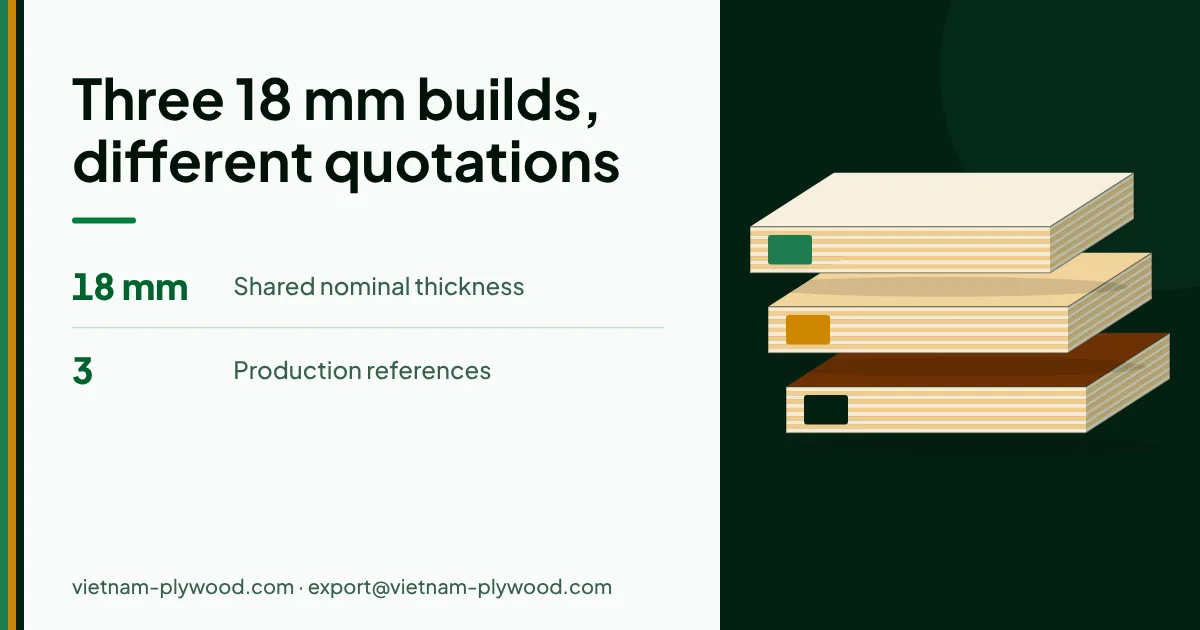
How to compare plywood quotations means matching the actual panel build and delivery basis before judging price. A wrong comparison can cost money, delay production or produce a rejected load. At HCPLY, our furniture, commercial and construction references show how one nominal thickness can conceal different materials and tolerances.
How to compare plywood quotations?
How to compare plywood quotations starts with one written specification and a field-by-field check of every offer. Match face grade, core construction, adhesive, emission class, ply count, thickness tolerance, packing and delivery basis before comparing unit prices. A difference in any field means the offers describe different goods or different landed obligations.
Step 1 — Fix the application. State whether panels become cabinet carcasses, visible fit-out surfaces, distribution stock or industrial packaging. Appearance, machining and exposure requirements determine which construction is worth paying for. A decorative face adds little value to a concealed crate panel, while an unsanded surface can add machining work for cabinet production.
Step 2 — Issue the same specification to every factory. Include a named face and grade, core species and construction, glue chemistry, emission class, size, nominal thickness and allowed tolerance. State sanding, quantity, packing and destination port. Do not let an offer substitute an undefined phrase such as “hardwood core” for a named core.
Step 3 — Build a comparison grid. Record each offered value beside the requested value. Mark missing fields as unresolved, rather than assuming they match. Ask for a revised written offer where an item is missing. The supplier-selection framework explains the wider checks around a specification comparison.
Step 4 — Compare like delivery terms. Separate the panel price from the agreed freight and insurance obligations. An FOB figure and a CIF figure are different commercial bases. Only after those bases are aligned should the buyer judge the commercial difference.
Why are two 18 mm plywood quotes so different?
Two 18 mm quotations can differ because thickness describes only one dimension of a panel. A sanded, full-stitched furniture panel with a selected face and a tighter tolerance requires a different build from an unsanded packing panel. A film-faced construction panel adds a surface system and an exposure-oriented adhesive choice.
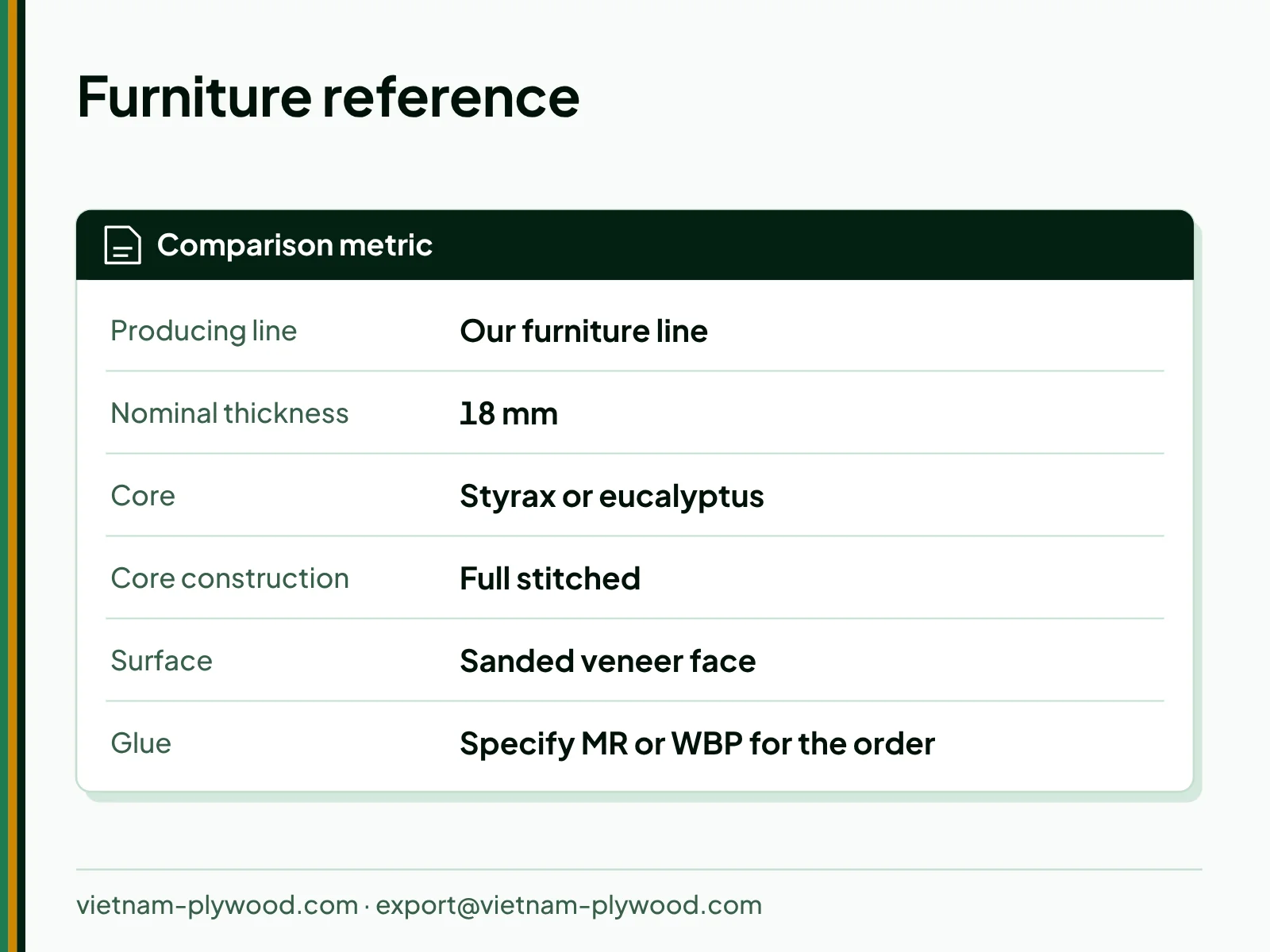
We use three production references to make these differences visible. The following are alternative specifications, not interchangeable grades of a single product. Each is built at the producing factory matched to the application.
| Comparison metric | Furniture reference | Commercial and packing reference | Construction reference |
|---|---|---|---|
| Producing line | Our furniture line | Our commercial and packing line | Our construction line |
| Nominal thickness | 18 mm | 18 mm | 18 mm |
| Core | Styrax or eucalyptus | Acacia | Acacia or eucalyptus |
| Core construction | Full stitched | Specify the agreed construction | Specify the agreed construction |
| Surface | Sanded veneer face | Unsanded or light-sanded veneer | Phenolic, melamine or anti-slip film |
| Glue | Specify MR or WBP for the order | MR | Specify melamine or phenolic |
| Thickness tolerance | ±0.2 or ±0.3 mm, as ordered | ±0.5 mm; packing ±0.5–1.0 mm | ±0.5 mm |
| Typical use verdict | Cabinet and fit-out machining | Distribution and packing requirements | Concrete formwork or slip-resistant surface needs |
These rows explain why a quote described only as “18 mm plywood” is incomplete. They also show why a higher-priced offer cannot be judged without seeing the build. A full-stitched, sanded furniture specification carries more preparation than a loose-laid, unsanded packing build. Film-faced material has a different use and should be compared against film-faced alternatives.
For the furniture construction itself, see furniture plywood. For differences between producing lines and grades, use the factory and grade comparison.
Which specification changes move the price most?
The largest practical comparison error is accepting an unexplained change in the panel build. For a like-size order, first investigate core construction and face selection, then adhesive and surface processing, then tolerance and ply construction. This is a diagnostic order for reviewing quotations, not a universal ranking of monetary premiums; no measured price contribution for each field is available.
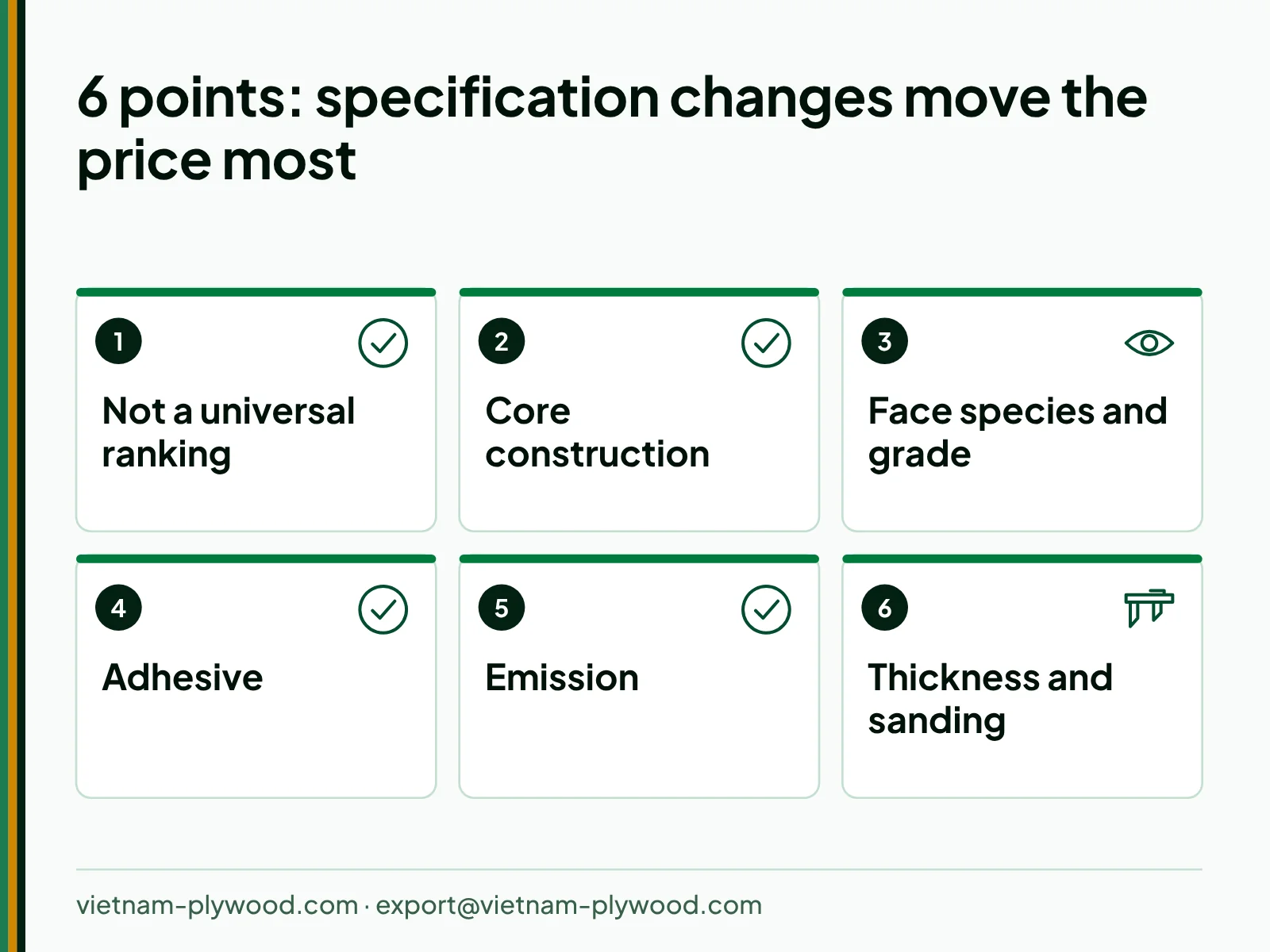
Core construction: Full stitched veneers have joined edges across the core. Stitched outer layers with edge-trimmed inner veneers represent another construction. Finger-jointed and loose-laid cores are further alternatives. In the stated construction hierarchy, full stitched sits above stitched-outer, finger-jointed and loose-laid. The buyer should request the actual construction rather than a broad quality adjective.
Face species and grade: Bintangor, okoume, engineered veneer (EV), gurjan, pine, poplar, eucalyptus, birch and sapele identify face options. The face names the product; density follows the core. Face grades A and B apply to the listed non-birch faces, while birch faces use D, E and F. A grade designation without a defect acceptance sample is open to different interpretations.
Adhesive: Melamine moisture-resistant (MR) glue is associated with a 12-hour boil specification; phenolic weather-and-boil-proof (WBP) glue with a 72-hour boil specification. These describe adhesive systems and stated test conditions, not automatic proof that a particular lot passed a test. Ask which glue and which agreed test report apply.
Emission: E0, E1 and E2 are emission classes, separate from glue. For regulated US hardwood plywood, CARB Phase 2 and Toxic Substances Control Act (TSCA) Title VI involve a separate compliance and certification question. The US Environmental Protection Agency’s 2016 final rule, summarized on its official formaldehyde standards page, establishes a third-party certification program. Request applicable evidence for the exact producing factory and order rather than treating an E-class label as equivalent.
Thickness and sanding: A ±0.2 mm sanded furniture tolerance is a different commitment from ±0.5 mm commercial tolerance. Both can be legitimate, but the intended machining process decides which is suitable. Sanding also changes the delivered surface and therefore the work left to the buyer.
How can I tell whether two quotes describe the same build?
Two quotations describe the same build only when their specified materials, construction, dimensions, quality acceptance criteria and commercial basis align. A shared product name is insufficient. Use the following comparison procedure before asking for a price revision.
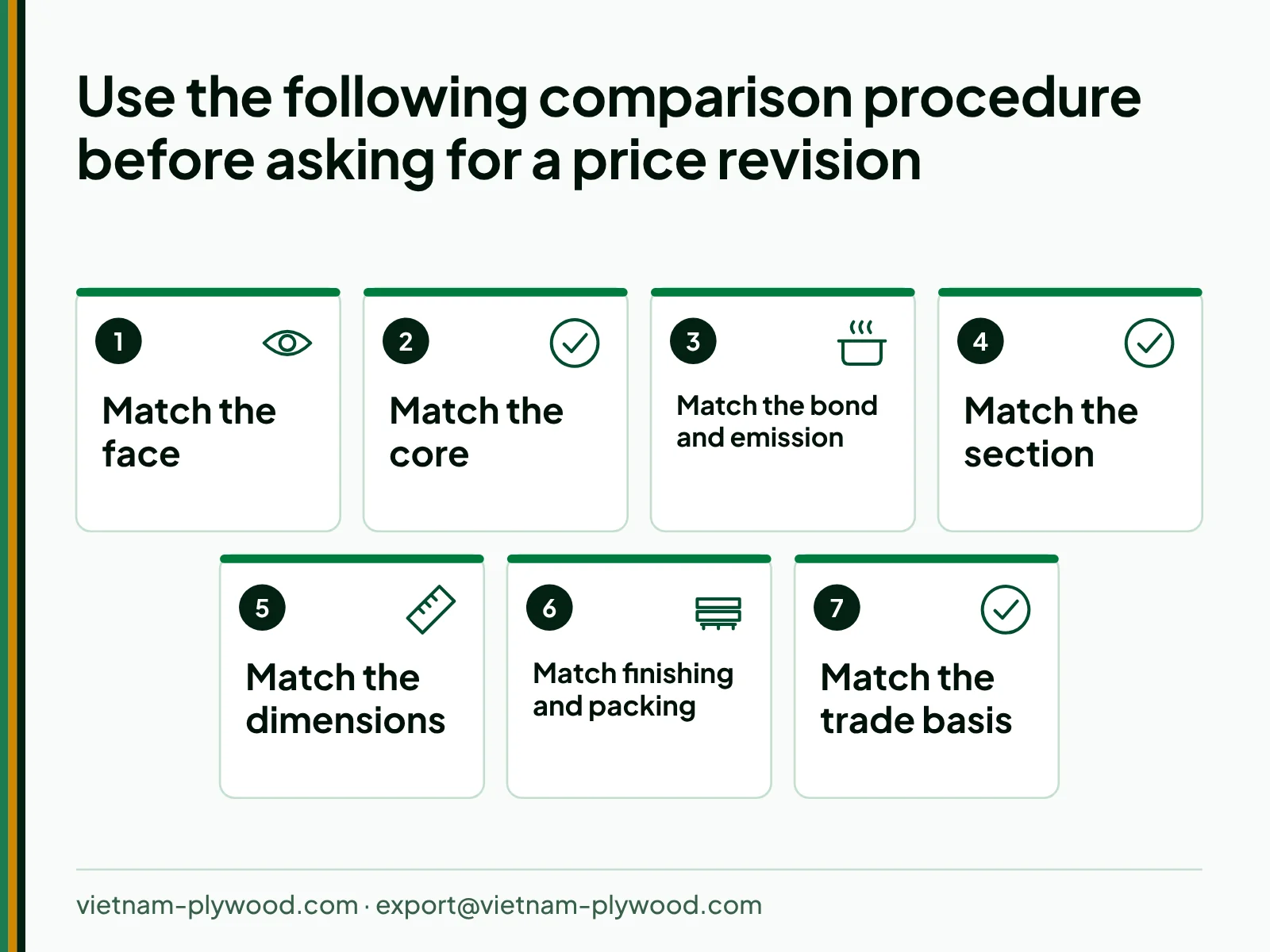
- Match the face. Write the species, grade, finish and accepted defect sample beside each offer. A birch face does not imply a birch core; we do not press birch-core plywood.
- Match the core. State styrax, acacia or eucalyptus and the edge-joint construction. Record whether the face and back are the same grade.
- Match the bond and emission. Record adhesive and emission in separate columns. Specify any agreed laboratory test and the lot it will cover.
- Match the section. Compare nominal thickness, tolerance and ply count. For 18 mm panels, 11–13 plies is the stated range because core veneers are 1.4–2.0 mm thick; a different count is not automatically defective.
- Match the dimensions. Record length, width and their ±2 mm tolerance. A 1220 × 2440 mm sheet and a 1250 × 2500 mm sheet have different material volumes.
- Match finishing and packing. Compare sanding, edge condition, palletization and labeling requirements.
- Match the trade basis. State FOB Hai Phong, CFR (CNF) or CIF, currency, quotation validity and the named destination port.
See the pre-deposit factory audit for checks beyond the paper specification.
What can an inspector witness at the producing factory?
An inspector can compare the agreed reference panel with the production lot at the producing factory. We run on-site quality control, and buyers can visit the factory office and inspect goods where their order is made. The inspection should use written acceptance criteria, with recorded findings for the sampled sheets.
Start with face grading under adequate light. Compare knots, patches, splits and visible repairs against the approved reference. Check the panel edge for the agreed core arrangement and visible gaps. Count plies on a clean section, then record that count alongside the 18 mm specification rather than treating one count as mandatory.
Next measure thickness at agreed positions and compare every reading with the contracted tolerance. Check length and width against the ±2 mm specification. Inspect sanding uniformity on furniture panels and film condition on construction panels. An inspector can witness these physical checks; glue chemistry and emission performance require the relevant documentation or agreed testing rather than visual judgment.
Record sampled sheet identities so the report connects to the packed lot. Member-factory FSC, CARB P2, ISO 9001 and CE documents are shown with factory details masked, on request.
How does core density change the container comparison?
Core density changes the mass of an identically sized sheet and therefore the practical loading plan. For 18 mm sheets measuring 1220 × 2440 mm, the stated core densities are styrax 500 kg/m³, acacia 580 kg/m³ and eucalyptus 650 kg/m³. The face veneer does not determine these calculation densities.
Sheet volume is 1.220 × 2.440 × 0.018 = 0.0535824 m³. Multiplying by core density gives approximately 26.79 kg for styrax, 31.08 kg for acacia and 34.83 kg for eucalyptus. These are formula-based reference masses, not measured shipping weights.
For the same 18 mm size, the reference 40HC totals are 990 styrax sheets, 880 acacia sheets and 795 eucalyptus sheets. They follow the respective pallet counts of 18, 16 and 15 and the specified stack heights. Calculated cargo weights are approximately 26.52 t, 27.35 t and 27.69 t, each below the stated 28.5 t payload limit.
Specifications can be mixed in one 40HC within that payload limit. A furniture pallet and a commercial pallet can share the shipment if the final packing calculation remains within the limit and the order defines each build. That possibility does not make the panels interchangeable. The container loading calculations cover the detailed packing question, while several plywood types in one order addresses the product mix.
What should I check on a plywood proforma invoice?
A plywood proforma invoice should repeat the agreed build and the commercial conditions without silently dropping technical fields. Read it as the contract-ready description of what will be manufactured and shipped, then reconcile it with the approved quotation.
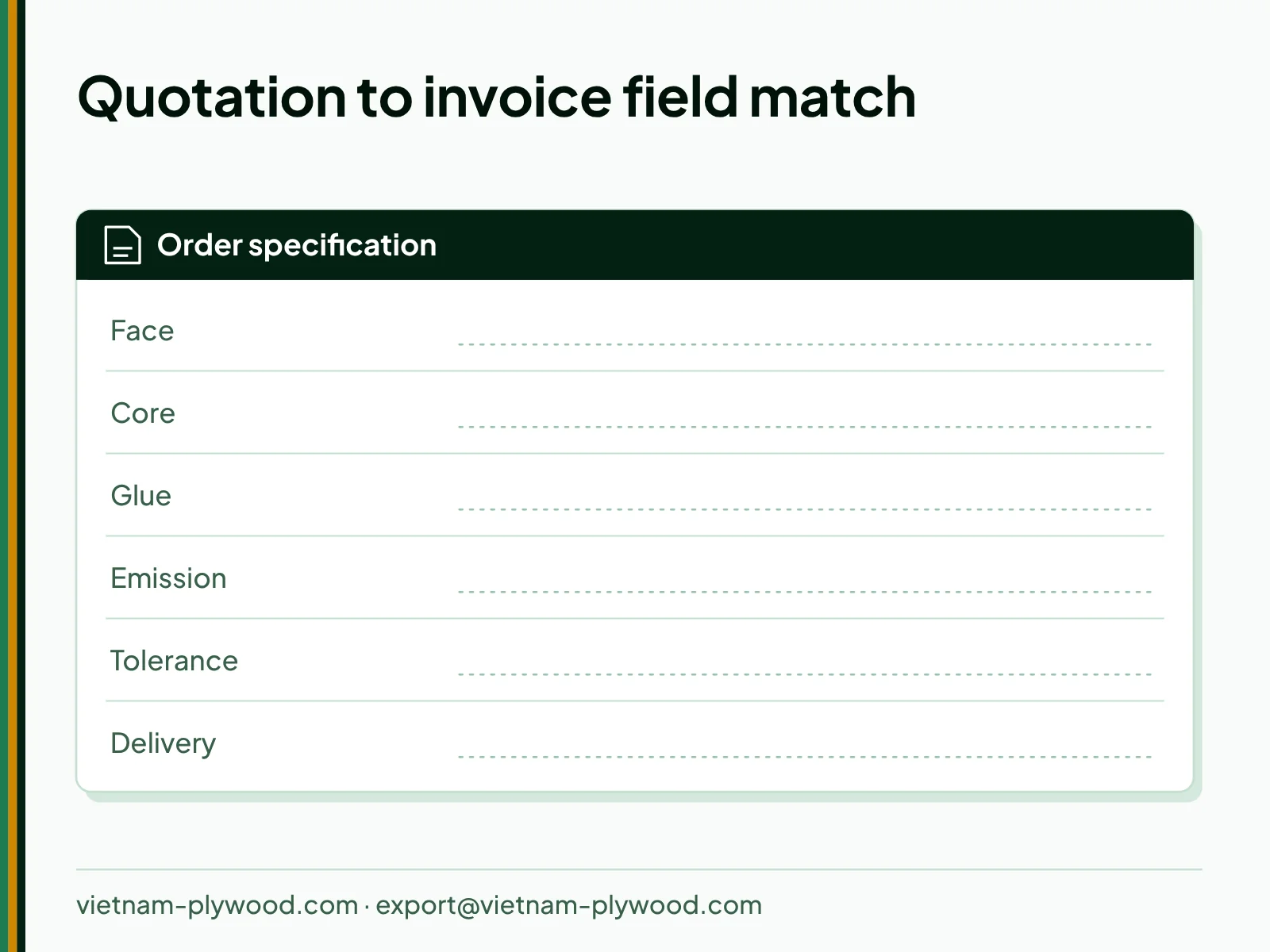
- Parties and goods: Check the buyer and seller details, item descriptions and separate line items for mixed specifications.
- Product specification: Confirm face, grade, core, construction, adhesive, emission, ply count requirement if agreed, size, thickness, tolerance and finish.
- Quantity and basis: Check sheets, cubic metres, unit of sale, currency, total and any packing assumptions. Make sure conversions use the same nominal dimensions.
- Delivery: Confirm FOB Hai Phong, CFR (CNF) or CIF and the named port. Under CIF, identify the insurance obligation in the shipment documents.
- Payment: Our stated terms are a 30% deposit and 70% balance against the scanned bill of lading (B/L), by telegraphic transfer (T/T) or irrevocable letter of credit (L/C) at sight.
- Production: The stated production period is 15–45 days from the 30% deposit, set by order size, line loading and the contract. Do not replace this with an unsupported fixed dispatch date.
- Evidence: List any agreed emission certificate, test report or sales-document claim and the exact build it covers.
The minimum order is one 40HC. The ordering sequence explains the broader handoff, and the hidden-cost checks help identify terms omitted from an attractive headline price.
Which shipment documents support the quoted specification?
The packing list connects quantities and packages to the shipped goods; agreed test reports and certificate documents address the specified quality or compliance requirement. These have different jobs, so a commercial invoice alone cannot prove a glue test or an emission class.
For each shipment, the document set includes the commercial invoice, packing list, B/L, certificate of origin, phytosanitary and fumigation papers, plus the order’s certificate documents. EU lots use EUR.1 where applicable and the EUTR/EUDR file set; CIF shipments include insurance. A factory FSC claim, if agreed, belongs on the relevant sales documents.
After loading, the draft shipping documents come to you for approval. At that stage, compare the item description, quantities, destination and package marks against the proforma invoice and the packing record. Ask for correction while the drafts can still be reconciled.
For US-regulated hardwood plywood, the EPA’s published rule distinguishes third-party certification from an ordinary supplier statement. The supporting record should therefore be requested against the exact regulated product and producing factory. We do not offer an APA or PS 1 stamp, a JAS mark or a birch-core build.
How should I respond to a lower quotation?
A lower quotation should prompt a specification reconciliation before a price negotiation. If the alternative uses a different face, core construction, tolerance or delivery term, ask for a corrected offer against the common specification. The response should identify the field and the commercial consequence.
For a cabinet order, an unsanded acacia packing panel cannot replace a full-stitched, sanded furniture panel unless the buyer changes the acceptance criteria.
Next separate negotiable terms from acceptance criteria. Quantity, pallet configuration and delivery basis can be discussed openly; a lower emission class or a wider thickness tolerance changes the product. A request for a price reduction without a specification reference can invite an unrecorded substitution.
Finally ask for a sample against the written build. A sample is useful only when its face, core and finish correspond to the proposed production lot. A sample comparison is a preparation step, not proof of every sheet in the shipment.
What if the quotation leaves out a field?
A missing field means the quotation is incomplete for a like-for-like comparison. Ask for a revised document that states the missing value, or mark the offer as unresolved until the seller supplies it. Do not fill gaps using assumptions from a previous order.
A phrase such as “18 mm birch plywood” needs particular care. Birch can name the face, while the core must be stated separately. For our furniture line, birch face is available in D/E/F grades, but birch-core plywood is outside our production scope. The same distinction applies to “waterproof”: request the actual adhesive and agreed test evidence rather than a broad label.
If the quote describes melamine, high-pressure laminate (HPL) or laminate faces, establish whether it refers to a separate decorative finishing product. Those finishes can be discussed as specification topics, but they are not our product lines. We also do not press medium-density fibreboard (MDF), oriented strand board (OSB), chipboard or blockboard.
What is the final quotation decision?
The final decision is the offer that meets the written application and acceptance criteria at the agreed commercial basis. Price becomes comparable only after all material differences are resolved or explicitly accepted. A documented exception can be a valid purchasing choice; an unnoticed substitution is a future dispute.
Commercial plywood has an indicative starting price of from US$250/m³ FOB Hai Phong (October 2026); no furniture plywood price is provided for this page. Those figures do not price the three example builds or any individual grade. A precise quotation requires the written specification, quantity and delivery details.
Our three factories in Phu Tho and Hai Phong make the appropriate products on their respective lines. HCPLY manages specification, on-site QC, export paperwork and loading, with each order shipped directly from its producing factory. For a comparison, send Lucy at export@vietnam-plywood.com the competing specification fields rather than only their prices.
Copy this specification request and complete the bracketed values:
Application: [cabinet / fit-out / distribution / packing / formwork]
Production line or core: [furniture / commercial and packing / construction; core species]
Core construction: [full stitched / stitched outer / finger-jointed / loose-laid]
Glue: [melamine MR / phenolic WBP]
Emission: [E0 / E1 / E2 / required third-party evidence]
Face and grade: [species or film; A/B or birch D/E/F]
Thickness and tolerance: [18 mm; agreed +/- mm]
Ply count: [agreed requirement or accepted range]
Size: [1220 x 2440 mm or other agreed size]
Surface: [sanded / light-sanded / unsanded / film specification]
Quantity: [sheets and m3; one 40HC minimum]
Delivery basis and destination port: [FOB Hai Phong / CFR / CIF; port]
Inspection and documents: [acceptance criteria and required evidence]
Next step: Ask Lucy for a sample set matched to the written comparison specification. Samples cost nothing: a first-time buyer pays the courier, and that charge comes off the first confirmed order.