






A plywood quality claim is settled by comparing arrival evidence with the approved sample, contract tolerances and the producing factory inspection record. A wrong decision can mean rejected panels, wasted machining costs and delayed deliveries. HCPLY uses the shipment identifiers and measured defect evidence to investigate the affected lot with the factory that pressed it.
How do I file a plywood quality claim?
A plywood quality claim starts with a written notice identifying the shipment, affected panels and alleged departure from the approved specification. We compare the arrival record with the producing factory’s pre-shipment inspection and the approved sample. The buyer and factory then establish the affected quantity and agree a documented settlement against the contract.
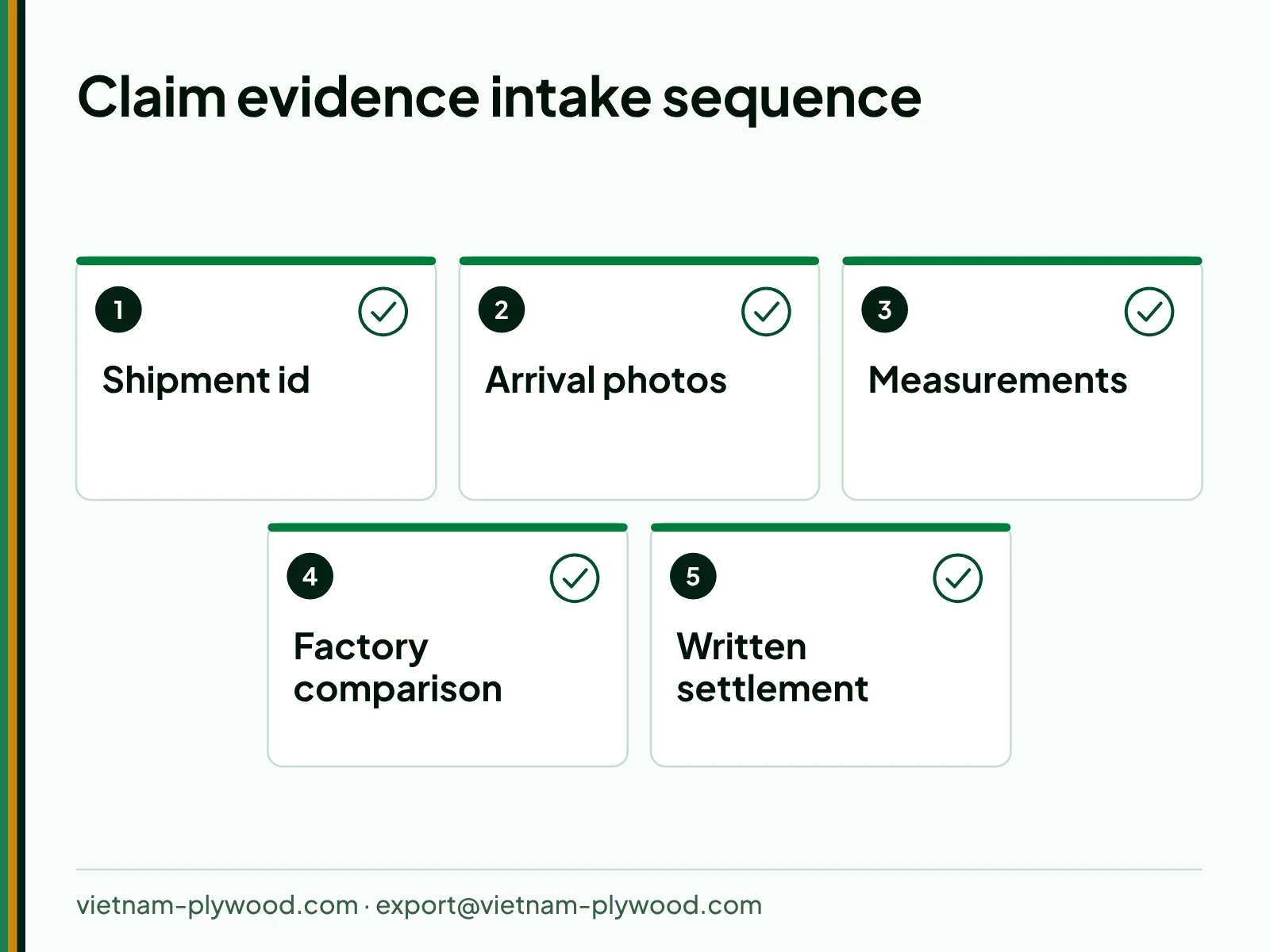
- Identify the shipment. Give the purchase order reference, invoice, bill of lading (B/L), container identification, product specification and pallet marks. State the date and location of unloading.
- Preserve the condition. Photograph the seal before opening when possible, the container interior, pallet wrapping, labels and affected boards before cutting or redistribution. Keep representative panels available for joint examination.
- Separate defect types. Record manufacturing defects separately from wet packaging, impact damage, handling marks and damage after machining. This distinction determines which evidence is relevant.
- Measure the affected material. Identify the count inspected, count affected, defect category and measurement method. Show both close-up images and a wider view linking each defect to its pallet.
- Send the claim file. Email Lucy at export@vietnam-plywood.com with the evidence and the requested remedy. We coordinate the review with the producing factory.
- Record the decision. Keep the agreed affected quantity, remedy, responsibility and supporting evidence together with the shipment file.
A short message saying that a whole container is defective leaves the factory unable to locate the disputed lot. A claim with pallet references and repeatable measurements can be checked against the loading record. For broader procurement safeguards, see how to find reliable Vietnam plywood suppliers.
What evidence does the factory need?
The factory needs a traceable link between the claimed defect, the shipped lot and the acceptance criteria agreed before pressing. Send the contract specification and approved sample reference alongside the arrival record, rather than sending photographs alone.
For thickness complaints, place a calibrated measuring tool against the panel and record the position, reading and panel identification. For face defects, show the entire face and the close-up, with lighting that reveals the defect without hiding its scale. For core gaps, photograph the cut edge and identify whether the panel was cut before or after receipt. For delamination, retain the physical panel and record storage and exposure conditions.
A moisture or warping complaint needs the unloading condition, storage history, measurement method and any agreed moisture criterion. Without a contracted moisture limit, an isolated meter reading does not establish a contractual failure. If an independent inspector examines the lot, request the sampling method, panel identifiers and raw readings rather than a verdict alone.
Packaging evidence matters too. Capture the pallet exterior, corner protection, wrapping, strapping and any signs of standing water. Record whether damage follows a particular pallet or appears across multiple pallet positions. That pattern helps distinguish localized transport exposure from repeated production defects.
Retain the approved sample, photographs of its face and edges, the inspection report and correspondence approving changes. The most useful file allows another inspector to repeat the observation without guessing what was measured.
How is the claim judged against the approved sample?
The decision begins with the signed product description, the approved sample and the factory inspection record for the same shipment. We check whether the arrival defect existed at dispatch, whether it breaches an agreed acceptance limit and how many boards are affected.
The approved sample is especially useful for face appearance, permitted repairs, veneer character and sanding finish. It should have an identification reference and agreed acceptance notes. A photograph alone cannot show every edge or internal layer, so the written core specification and inspection checklist remain necessary.
The pre-shipment record supplies the earlier condition: measured dimensions, surface observations, packaging and lot identification. Arrival measurements must use comparable points and methods. A disagreement between a single arrival reading and a factory average requires a repeatable measurement series before classifying the lot.
For sample-based acceptance, the U.S. National Institute of Standards and Technology’s Engineering Statistics Handbook explains lot acceptance sampling. Its guidance describes selecting a random sample to decide whether to accept or reject a lot. The buyer and factory must agree which sampling plan and defect definitions apply; citing sampling guidance alone does not set a contract’s acceptance threshold. See the NIST acceptance sampling guidance.
If the contract has no sampling plan, the parties should agree how to inspect the remaining stock and document the basis of any proposed extrapolation. A sample of damaged panels selected by the complainant cannot automatically establish the defect rate of every unopened pallet.
Which tolerances decide whether a claim is valid?
The ordered tolerance decides a dimensional claim, measured against actual panels using the agreed method. Nominal thickness is a product label; the contract must also state its allowable deviation.
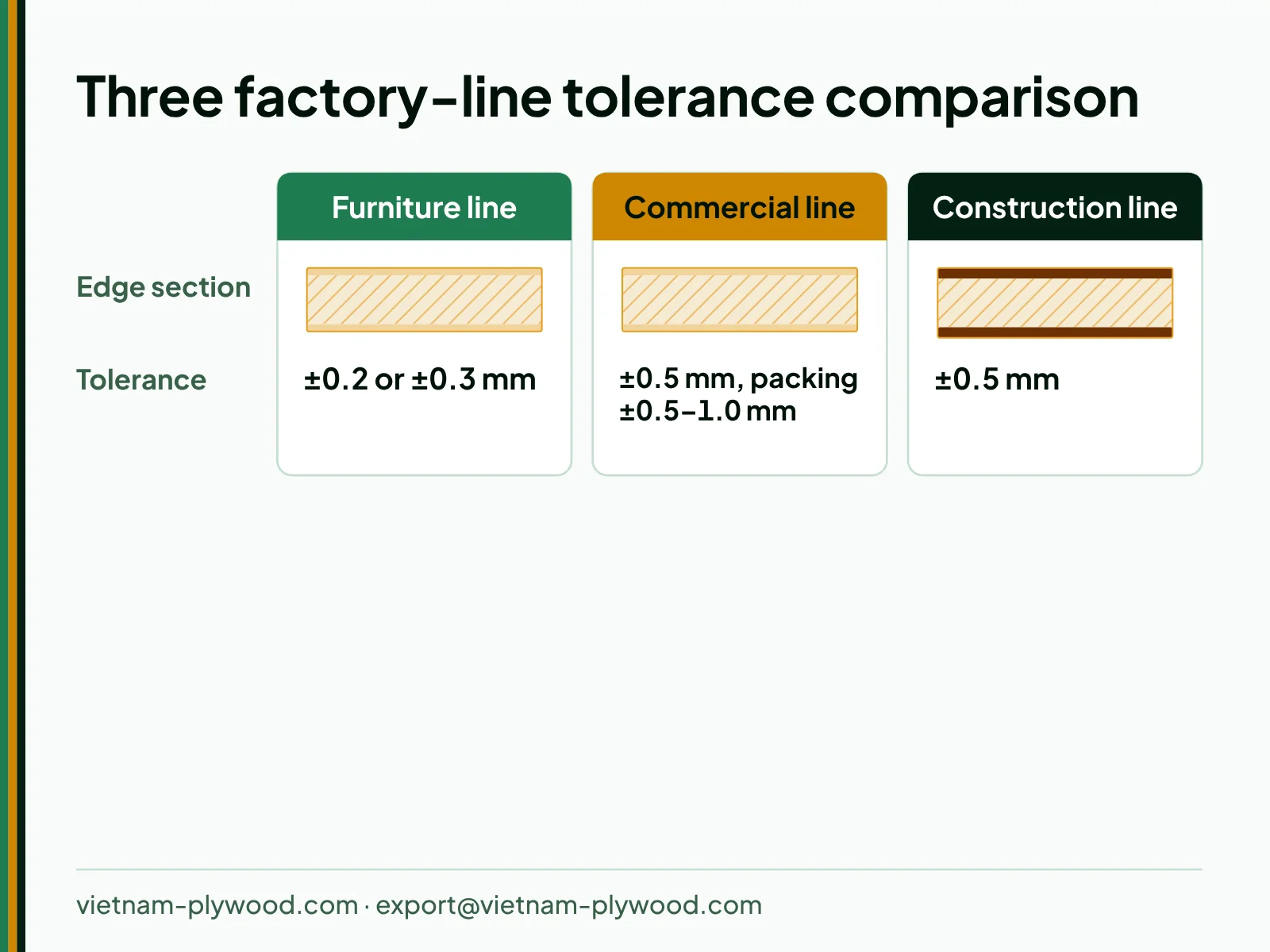
| Producing line | Typical core and finish | Thickness tolerance when ordered | Claim-relevant check |
|---|---|---|---|
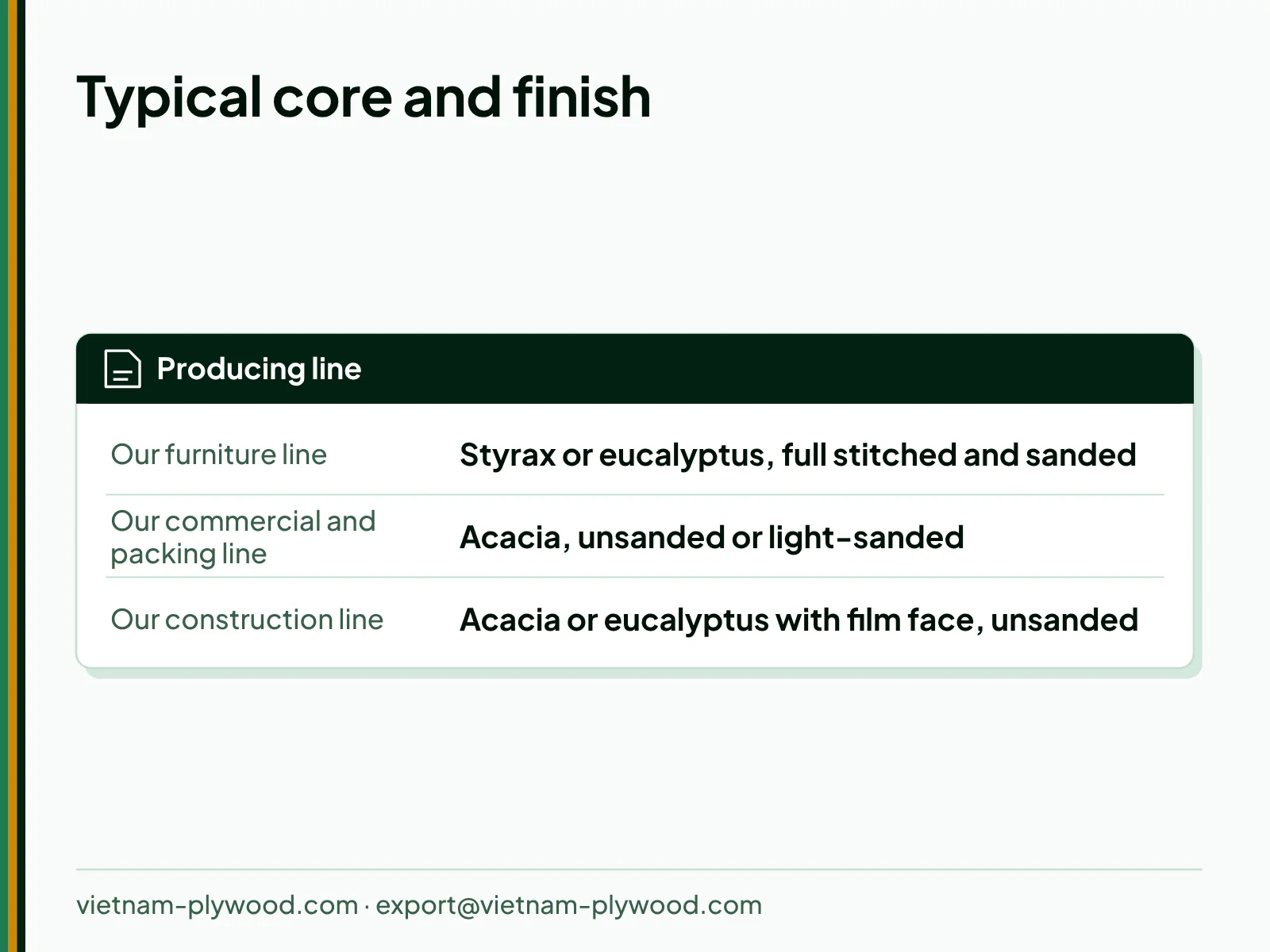
| Our furniture line | Styrax or eucalyptus, full stitched and sanded | ±0.2 or ±0.3 mm | Multiple readings against the selected tighter or wider band |
| Our commercial and packing line | Acacia, unsanded or light-sanded | Commercial ±0.5 mm; packing ±0.5–1.0 mm | Identify commercial versus packing acceptance before measuring |
| Our construction line | Acacia or eucalyptus with film face, unsanded | ±0.5 mm | Measure substrate thickness and inspect the specified film face |
All three lines use an ordered length and width tolerance of ±2 mm. These figures describe our available specification bands; the selected band in the order is the acceptance reference. An 18 mm furniture order with ±0.2 mm tolerance cannot be judged by a packing-grade allowance.
For a face complaint, the agreed face grade and sample matter more than a thickness reading. A/B are face grades used for applicable veneers; birch faces use D/E/F. Core construction also needs a named build: full stitched, stitched outer layers with edge-trimmed inner, finger-jointed or loose-laid. The inspector should examine cut edges and representative cross-sections against that description.
For bond complaints, the glue specification must be separate from the emission class. Melamine is the MR, 12-hour-boil option; phenolic is the WBP, 72-hour-boil option. E0, E1 and E2 describe emission classes, while CARB Phase 2 and TSCA Title VI concern a US emissions limit and third-party certification. A contract should identify the test method and accepted report before a test result becomes a settlement criterion. Read how plywood grades compare across factory lines.
What can an inspector witness at the producing factory?
An inspector can witness the same checks that later anchor a defensible arrival claim. Buyers visit the factory office and inspect the goods at the producing factory; the inspection scope should match the signed specification.
For furniture plywood, examine face grade, full-stitched core edges, sanding and thickness readings. For commercial and packing plywood, check the acacia core arrangement, surface condition and the correct tolerance band. For construction plywood, inspect film weight designation, face condition, edge treatment and the selected bond specification.
At the pre-shipment stage, record which pallets were sampled and where the tested boards came from. Label photographs by pallet and board. Note the measuring instrument and inspection conditions. Where a destructive bond or core check is agreed, keep its sample reference and test report linked to the shipment.
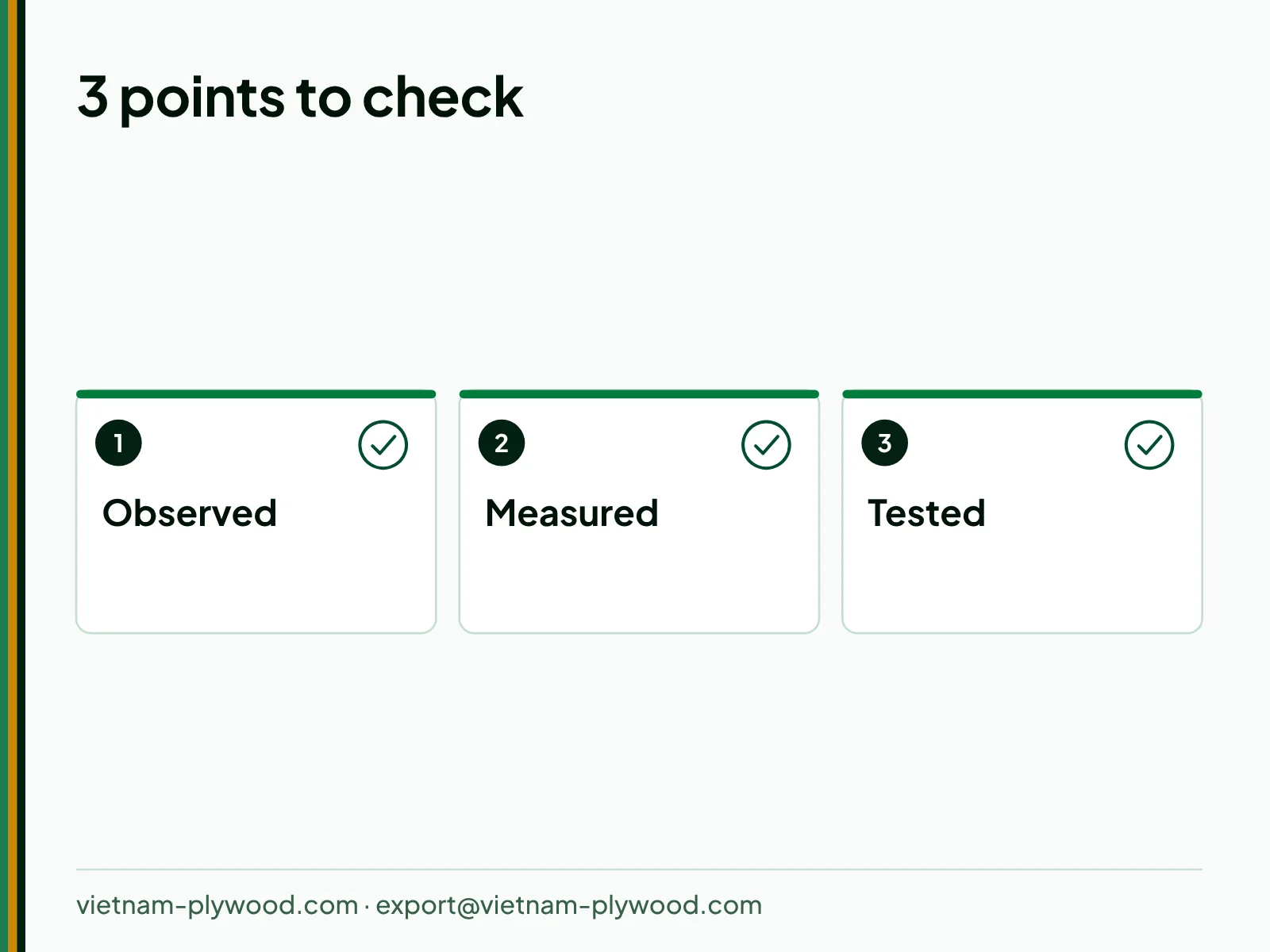
A useful witness record distinguishes observed, measured and tested findings. Surface scratches can be photographed. Thickness can be measured. Bond performance needs the agreed test procedure; tapping an edge alone does not establish a laboratory result.
The producing factory can also show the packed lot before loading and the container condition during loading. HCPLY handles on-site quality control and export documents. For a fuller checklist before deposit, see the plywood factory audit and questions to ask a plywood supplier.
How do we separate manufacturing defects from transit damage?
Manufacturing defects are judged against production and inspection evidence; transit damage is investigated using the loading and arrival condition. A split face found on many interior boards points to a different inquiry from water staining concentrated beside a damaged container door.
Start with the container seal and exterior condition, then compare loading photographs with unloading photographs. Check whether wrapping was intact, whether pallet corners were crushed and whether the affected boards were exposed before inspection. Record the location of each affected pallet rather than treating the load as a single undifferentiated quantity.
If panels have been cut, coated, laminated or installed, keep an untouched representative board when available. Cutting can reveal pre-existing core gaps, but it can also introduce edge damage. The record should say exactly when the defect first appeared and what processing had occurred.
For warping, separate the condition at opening from later storage. Stack support, humidity exposure and acclimation history affect interpretation. A claim cannot be settled fairly by assuming every shape change was present at loading or every shape change arose after delivery.
For cargo insured under CIF, the shipment document set includes insurance papers. A transport-damage file should preserve carrier and insurer evidence as required by the applicable policy, while the factory quality review continues on the technical facts.
How is a plywood claim settled?
A plywood claim settlement is a written agreement based on the verified defect, affected quantity and applicable contract terms. The remedy is discussed after the factory and buyer establish the evidence; it is not inferred from a photograph or a generic warranty label.
The review records the claimed specification, the actual finding, the inspected sample, the affected pallet references and the agreed calculation basis. Where some boards meet the specification, those boards should remain separately counted. Where the evidence supports further inspection, the parties can agree an additional joint or independent check before fixing the settlement quantity.
Possible commercial outcomes include replacement material on a later shipment, a credit against an agreed order or another negotiated adjustment. These are settlement options, not automatic entitlements. The agreement should identify the remedy, its value or quantity, any return or disposal requirement, and how completion will be documented.
A buyer who needs replacement stock urgently should identify which panels cannot be used and which can still be processed. The factory can then evaluate the proposed remedy against the actual production specification and shipping arrangement. Keep any agreed credit or replacement separate from unresolved transport or processing damage.
Close the file with the buyer’s acceptance of the settlement record and the corresponding commercial documentation. A claim that is verbally resolved but never recorded can resurface when the next invoice or container is checked.
Does plywood come with a warranty?
A plywood warranty is defined by the written sale agreement and any expressly accepted warranty terms. The contract sets the coverage period, notification procedure and available remedies.
A manufacturer can document conformity to a specified face grade, core construction, adhesive, emission class, size and tolerance at the agreed inspection point. Service performance is a separate question involving application, exposure, storage and installation. A plywood warranty should state the covered defect, coverage period if any, notification method, exclusions and available remedy.
Buyers should ask whether a proposed warranty addresses manufacturing defects, damage in transit, workmanship after delivery or performance under particular environmental conditions. Those categories should not be merged into one undefined phrase such as “quality problem.” A construction panel’s reuse expectation also requires handling conditions and should not be transferred to furniture plywood.
The right time to settle warranty language is before the deposit and production approval. Include the notice channel, evidence required and procedure for disputed findings. See quotation terms to agree before pricing for the wider contract checklist.
How does a mixed container affect claim tracing?
A mixed-specification container needs each product and pallet identified separately in the packing list. The minimum order is one 40HC, and specifications can be mixed within its 28.5 t payload limit.
For 18 mm sheets at 1220 × 2440 mm, the reference full-container loads are 990 styrax-core sheets at 26.52 t, 880 acacia-core sheets at 27.35 t and 795 eucalyptus-core sheets at 27.69 t. Those are separate full-load examples, not quantities that can be added together. Film weight is excluded from these reference calculations.
A mixed shipment needs a new weight check based on the actual pallet composition. For example, a pallet label should distinguish a sanded furniture panel from an unsanded commercial panel even if both have the same nominal thickness. A claim against one grade should identify only the relevant pallet references until inspection shows wider impact.
The packing list links quantity and product description to the shipment. The commercial invoice and B/L link that shipment to the sale and transport. For pallet and container arithmetic, consult plywood container loading.
Which export documents help establish the record?
The shipment paperwork helps identify the cargo, but physical inspection and the agreed specification establish a manufacturing defect. HCPLY manages the export process from specification and on-site inspection through loading and documentation.
The shipment file includes a commercial invoice, packing list, B/L, certificate of origin, phytosanitary and fumigation papers, and order-specific certificate documents. EU lots use EUR.1 and the EUTR/EUDR file set; CIF shipments include insurance papers. Relevant order-specific materials can include an FSC claim on sales documents, an emission certificate and test reports for the agreed build.
Member-factory certificates such as FSC, CARB P2, ISO 9001 and CE are shown with factory details masked, on request. Their scope should be checked against the specific order and producing factory. A certificate is not a substitute for evidence that a particular panel met its contracted thickness or face grade.
After loading, the draft shipping documents come to you for approval. That approval is a useful checkpoint for shipment description, quantity and consignee details. It does not replace the approved physical sample or the inspection record when a quality dispute arises.
When reporting a problem, attach the relevant document pages and identify any mismatch between the actual pallet label and the packing list. That makes document corrections and physical defect review distinct tasks.
How can buyers prevent the next claim?
Prevent the next claim by making acceptance criteria measurable before the factory starts the order. A strong specification connects the end use to a named build, an approved sample and a repeatable inspection method.
For cabinet work, agree the face, core build, sanding and thickness tolerance that the machining process needs. For packing applications, identify acceptable surface repairs and the wider tolerance when ordered. For formwork, specify the film designation, glue and intended handling conditions. Each category needs its own acceptance points.
Record the version of the sample that was approved. Do not replace it informally during production. If a change is accepted, update the specification, sample reference and inspection checklist together. The same discipline should apply to changes in packaging and pallet identification.
For the next order, select an inspection plan, defect definitions, sample size and treatment of borderline readings before production. Decide who can witness inspection and how disagreements will be rechecked. Keep the report accessible to both the buying team and the producing factory.
A trial order can test whether the agreed language translates into actual panels. Review the furniture plywood specification for cabinet applications and plywood supply for construction projects for formwork purchasing.
What should the buyer send before a trial container?
Send a complete written specification with the application, factory line, measurable acceptance limits and destination port. We can then align the approved sample, production inspection and shipment description to the same order.
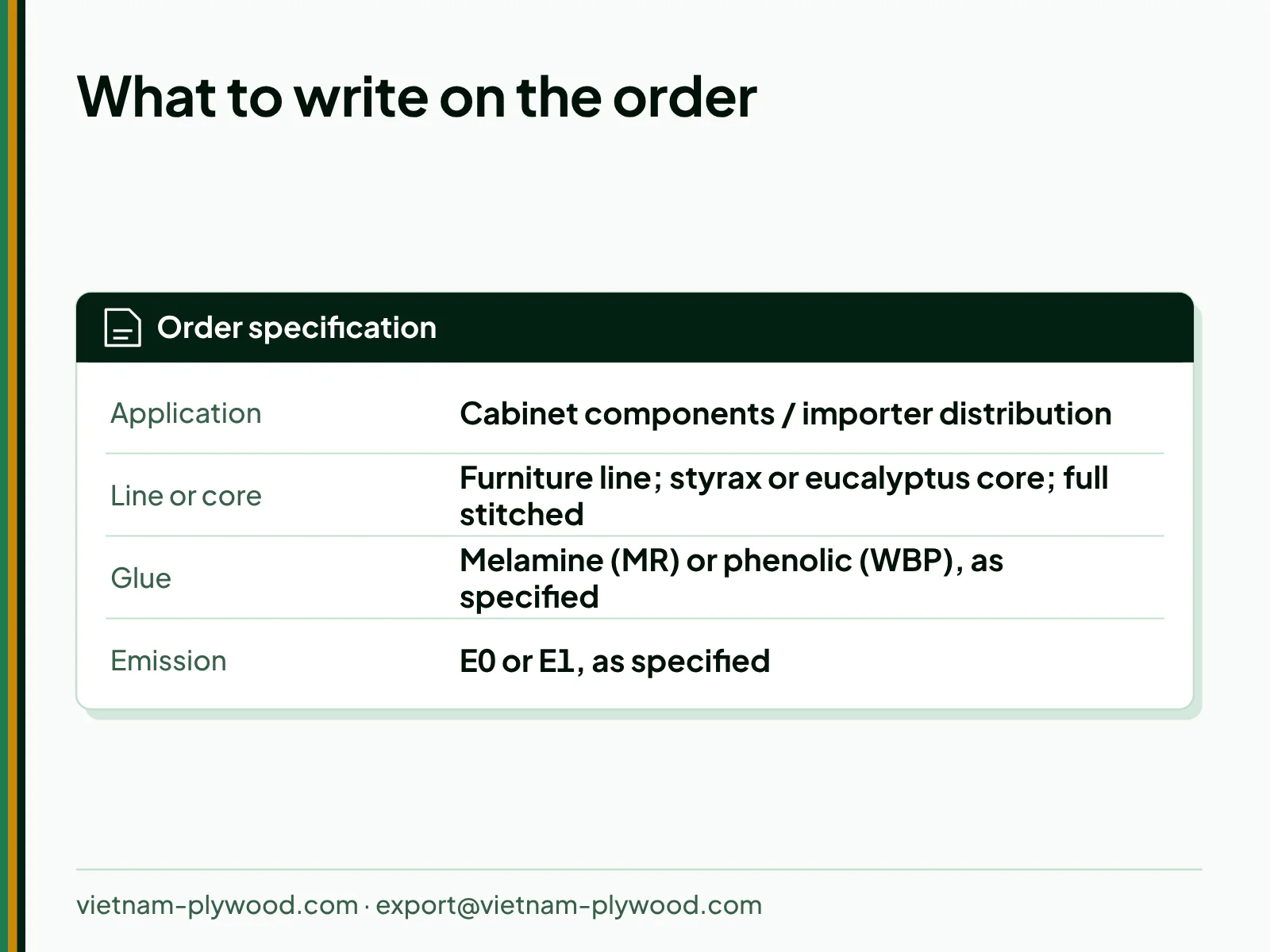
Use the lines below as the opening request. Add face-defect acceptance examples, a sampling plan, moisture criteria where needed and the proposed claim-notice procedure as separate contract attachments. This gives both sides a common basis before the panels are pressed.
Application: Cabinet components / importer distribution
Line or core: Furniture line; styrax or eucalyptus core; full stitched
Glue: Melamine (MR) or phenolic (WBP), as specified
Emission: E0 or E1, as specified
Face and grade: Named veneer and approved face grade/sample
Thickness and tolerance: 18 mm; ±0.2 mm or ±0.3 mm as ordered
Size: 1220 × 2440 mm; length/width tolerance ±2 mm
Quantity: One 40HC; identify each specification and pallet
Destination port: [buyer to specify]
Next step: contact Lucy to plan a trial container with the approved sample and inspection criteria attached.