





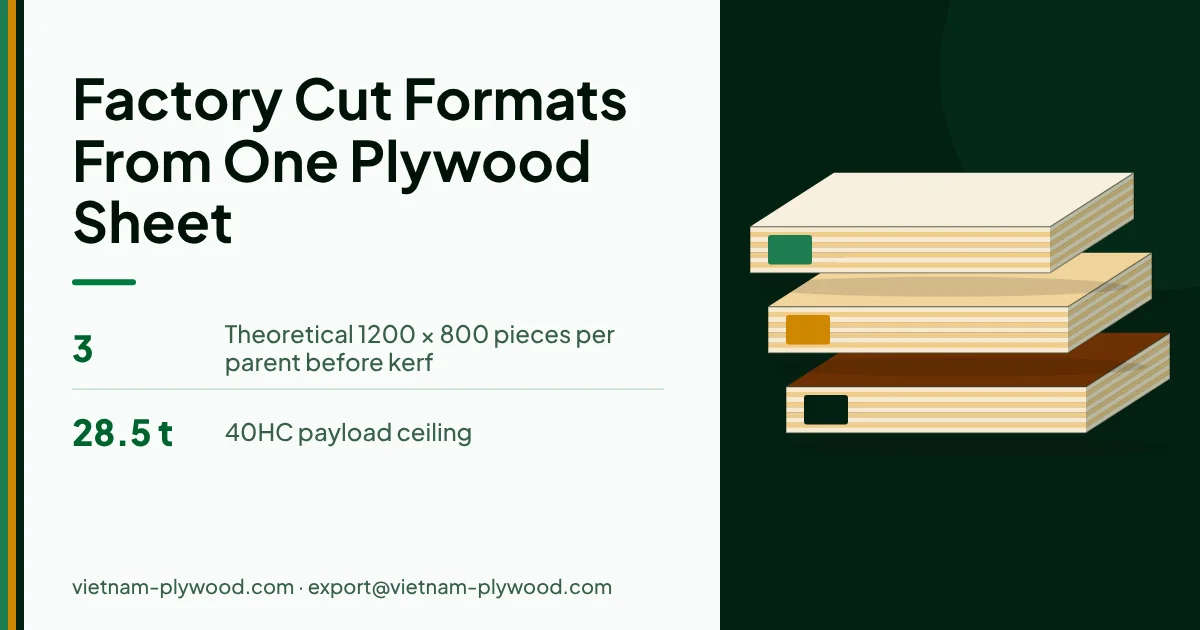
HCPLY can supply factory-cut plywood 4x4 panels, half sheets and smaller formats from an agreed parent-sheet cutting plan. An incorrect finished-size assumption wastes material, delays packing or produces a rejected load. The right quotation starts with the finished drawing, saw allowance, core choice and pallet plan.
What does plywood 4x4 mean for a factory-cut order?
Plywood 4x4 usually means a nominal four-foot-square panel, approximately 1220 × 1220 mm in metric purchasing language. HCPLY cuts small formats at the producing factory from a specified parent sheet, with the cut plan agreed before production. An exact 1220 × 1220 mm finished pair cannot be obtained from a 1220 × 2440 mm parent without accounting for saw kerf: two nominal halves consume the entire parent length.
For importers, the first decision is whether the drawing describes nominal trade dimensions or a finished, measured component. A 4x4 plywood sheet sold as a project panel is a different procurement proposition from a factory-cut component supplied in export pallets. A finished-size drawing controls the saw allowance, finished-edge inspection and packed quantity. A nominal-size order can instead allow a mutually agreed cut tolerance.
The same issue applies to half sheet plywood, plywood 2x4 and plywood 1220x610 requests. Write the dimensions in millimetres and specify which dimension follows the face grain. Buyers of cut-to-size plywood should approve the cutting drawing before asking for container totals.
Can half sheets and long strips be cut at the factory?
Yes. Our furniture line and our commercial and packing line can prepare factory-cut panels from their respective plywood builds; the producing factory cuts and packs the approved specification. Custom cutting is available across the stated sheet range. A cut format is therefore part of the order specification rather than a promise that every nominal size fits every parent exactly.
A 610 × 2440 mm strip is half the width of a 1220 × 2440 mm sheet on paper. Two finished strips at exactly 610 mm leave no width for the blade. The same problem appears when cutting 1220 × 610 mm pieces along the 2440 mm length: four pieces use the whole length before kerf. Agree a slightly smaller finished width or length, a larger parent blank, or an alternate cutting arrangement.
Cutting follows the build and inspection plan. For visible cabinet parts, we specify a sanded furniture panel and assess the cut edge for core gaps. For protective tops and packing separators, an acacia-core commercial build offers a different surface and tolerance. See plywood furniture components for component-oriented requirements and drawer box plywood for drawer-part details.
Which small panel sizes should an importer specify?
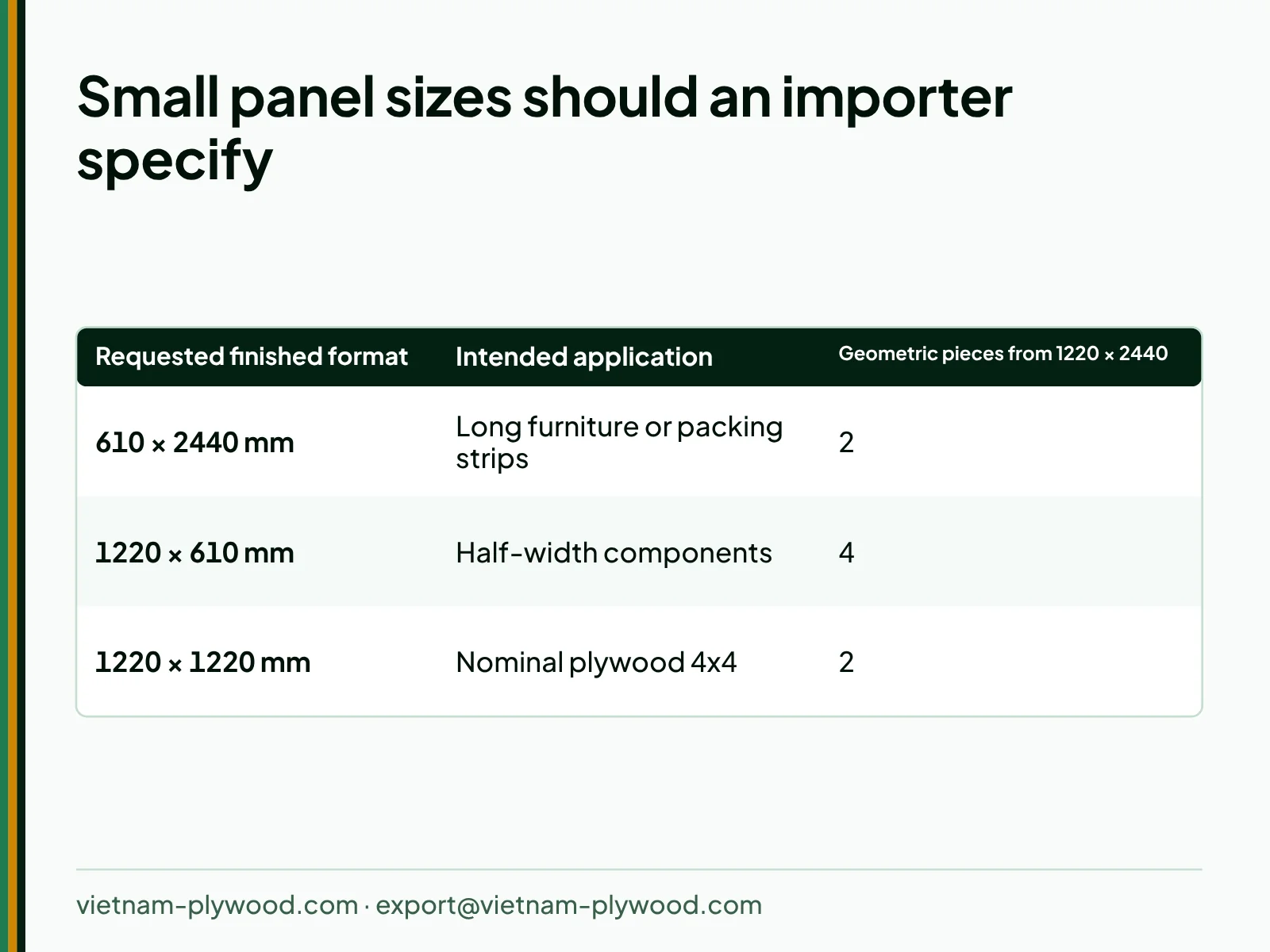
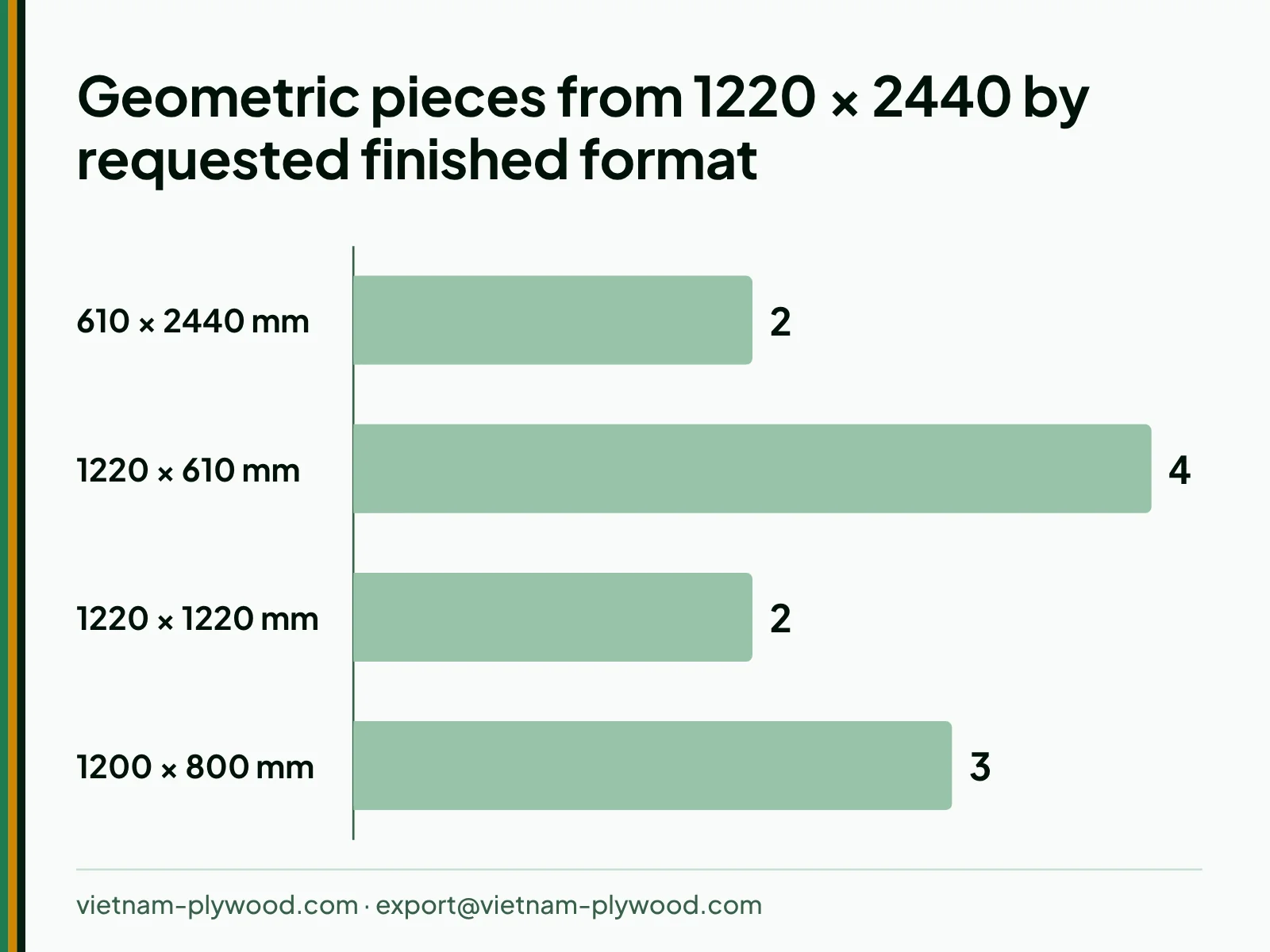
The most useful formats are the ones matched to the buyer’s cutting equipment, assembly drawing and pallet footprint. Common requests include 610 × 2440 mm strips, 1220 × 610 mm rectangles, nominal 1220 × 1220 mm squares and 1200 × 800 mm pallet tops. The table below separates geometric layout from saleable finished output.
| Requested finished format | Intended application | Geometric pieces from 1220 × 2440 | Cutting decision |
|---|---|---|---|
| 610 × 2440 mm | Long furniture or packing strips | 2 | Exact pair needs kerf allowance or wider blank |
| 1220 × 610 mm | Half-width components | 4 | Exact four need kerf allowance or longer blank |
| 1220 × 1220 mm | Nominal plywood 4x4 | 2 | Exact two need kerf allowance or longer blank |
| 1200 × 800 mm | Pallet top or divider | 3 | Three can fit as a 1200 × 2400 strip before kerf review |
| 915 × 1830 mm | Nominal plywood 6x3 | 1 from suitable stock | Consider the listed 915 × 1830 parent size |
These counts are theoretical layouts, not committed saleable yields. For 1200 × 800 mm, a 1220 × 2440 blank has a nominal 20 mm width margin and 40 mm length margin. The blade width and edge trimming must fit within those margins. A cutter can arrange three 800 mm lengths along 2440 mm while retaining some trimming space; the signed drawing settles the actual result.
A plywood 6 x 4 or 6x4 plywood sheet request corresponds approximately to 1830 × 1220 mm, while a 4x6 plywood sheet describes the same rectangle with its axes reversed. Plywood 3x8 refers approximately to 915 × 2440 mm. These are descriptions to decode, not interchangeable finished dimensions. Our listed parent sizes include 915 × 2440, 915 × 2135 and 915 × 1830 mm.
Can 1200 × 800 panels serve as euro pallet plywood tops?
Yes, a 1200 × 800 mm plywood panel can be specified as a pallet top or cover when the buyer supplies its load and fixing requirements. It must be evaluated as a component of the buyer’s pallet assembly, not assumed to carry a certified pallet load on its own. A pallet size plywood drawing should show corner treatment, fastening positions and permitted overhang.
The International Organization for Standardization’s ISO 6780:2003, confirmed in 2026, addresses principal dimensions and tolerances of flat pallets used in materials handling. The Albanian national standards authority’s published scope also covers features such as openings and clearances. That scope is useful when distinguishing a 1200 x 800 plywood sheet from a complete, performance-tested pallet.
Specify whether the euro pallet plywood top will be screwed, nailed or strapped to a supporting assembly. The buyer should state the intended load path, exposure and whether the top is disposable protective packaging or a reusable structural component. HCPLY supplies plywood panels against the agreed build; pallet-system testing belongs to the complete assembly specification.
A packing top normally points toward our commercial and packing line with acacia core and MR glue. A sanded visible cover or cabinet panel belongs on our furniture line. For a wet concrete application, our construction line builds film-faced plywood instead; frame and formwork replacement plywood covers that distinct use.
How many usable panels come from one parent sheet?
Usable yield is the number of finished pieces that remain after saw kerf, edge trimming and rejected pieces are accounted for. A simple area division gives an upper bound, but it cannot prove that the rectangles can be nested or that the blade fits.
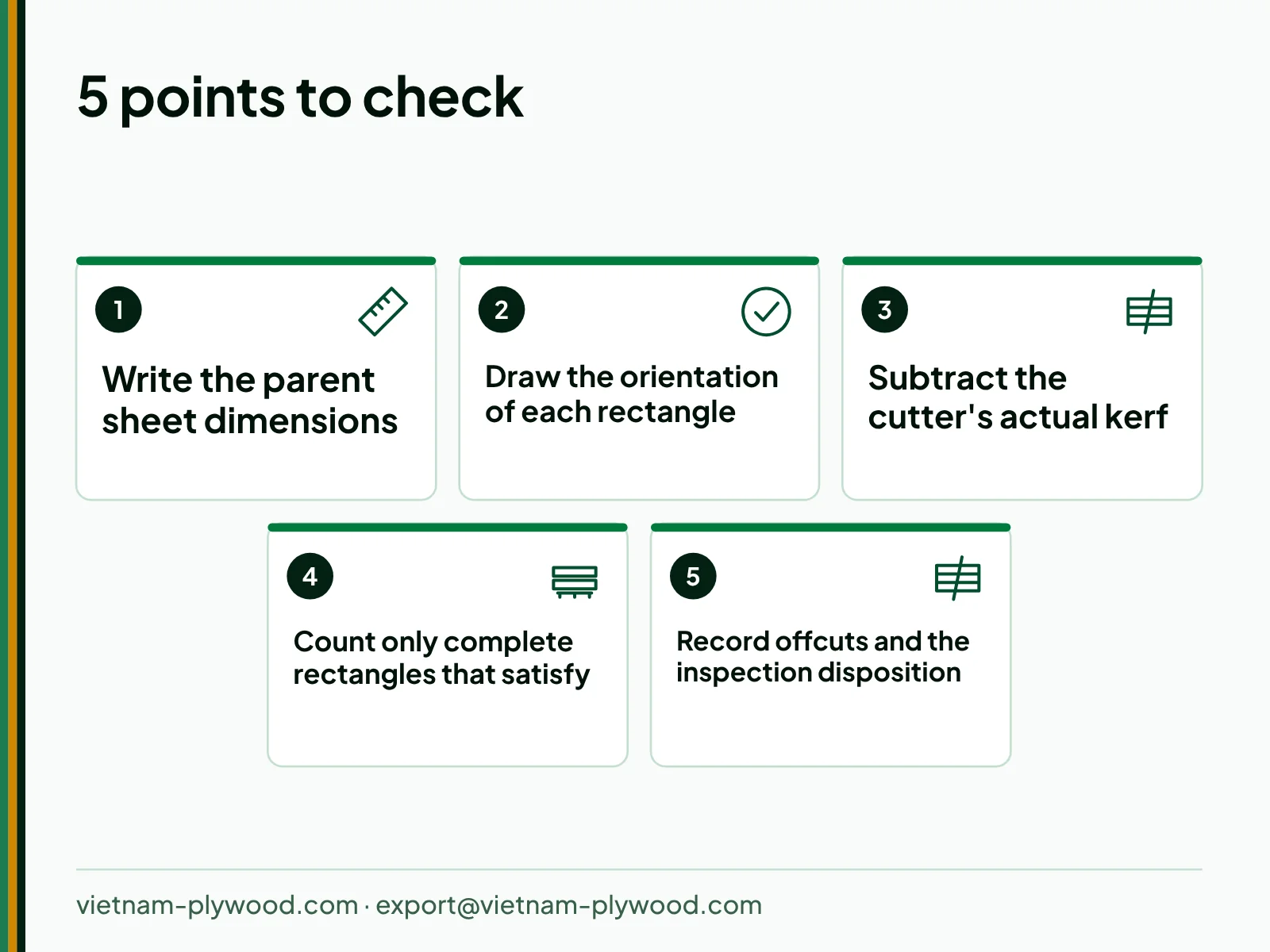
- Write the parent sheet dimensions and finished component dimensions in millimetres.
- Draw the orientation of each rectangle, including face grain direction where relevant.
- Subtract the cutter’s actual kerf for every internal cut and the specified edge-trim allowance.
- Count only complete rectangles that satisfy the finished dimensions and tolerance.
- Record offcuts and the inspection disposition separately from saleable pieces.
For a 1220 × 2440 parent, the nominal area is 2.9768 m². A 1200 × 800 rectangle occupies 0.96 m²; three occupy 2.88 m². That leaves 0.0968 m² of nominal area for the edge margins and saw loss. The geometry is favourable, but a signed nesting plan is still required.
A 1220 × 1220 rectangle occupies 1.4884 m², exactly half the parent area. Thus the apparent two-piece yield has zero area for any cut loss. The same zero-margin issue applies to four 1220 × 610 pieces and two 610 × 2440 strips. These arithmetic examples explain why a nominal plywood 4x4 quote must distinguish blank yield from finished yield.
Which factory line should press the cut panels?
The application determines the build before the cutting plan determines the final footprint. Our three factories in Phu Tho and Hai Phong cover furniture, commercial and packing, and construction plywood. Each order is produced in the factory that fits the specification and shipped directly from it.
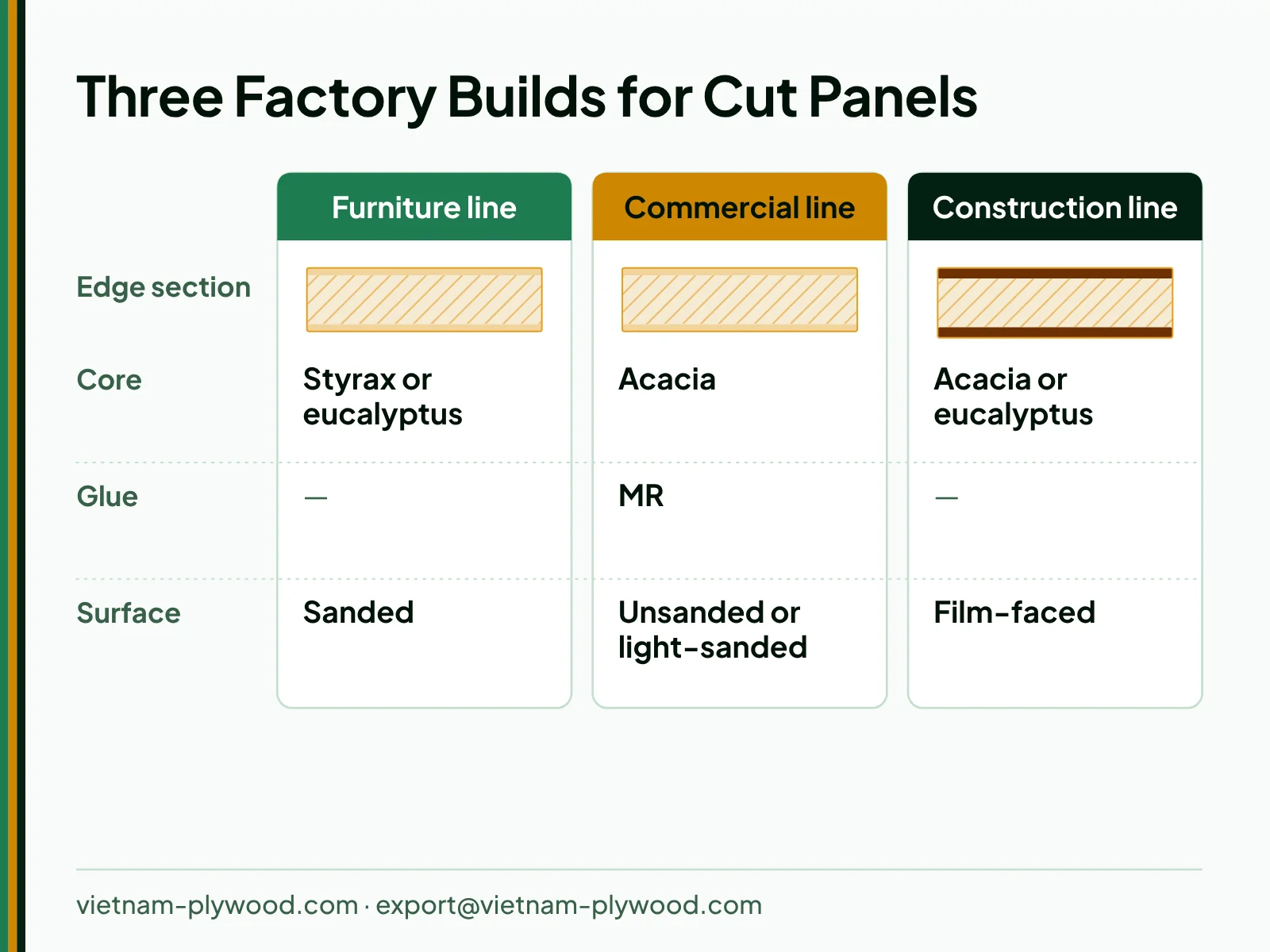
| Decision field | Furniture line | Commercial and packing line | Construction line |
|---|---|---|---|
| Typical cut use | Cabinet and fit-out parts | 1200 × 800 tops and separators | Cut formwork or site panels |
| Core | Styrax or eucalyptus | Acacia | Acacia or eucalyptus |
| Surface | Sanded veneer face | Unsanded or light-sanded | Phenolic, melamine or anti-slip film |
| Thickness tolerance | ±0.2 or ±0.3 mm as ordered | ±0.5 mm; packing ±0.5–1.0 mm | ±0.5 mm |
| Main inspection | Face and finished edge | Edge and packing dimensions | Film and cut-edge protection |
The furniture build uses full stitched core and E0/E1 emission classes. The commercial and packing build uses MR glue and acacia core. The construction build uses film-faced surfaces. Glue and emission are separate fields: MR and WBP describe adhesive performance categories, whereas E0, E1 and E2 describe emission classes.
A birch face does not imply birch-core plywood. HCPLY names the product by face, while density follows its core. We do not press birch-core plywood, medium-density fibreboard (MDF), oriented strand board (OSB), chipboard or blockboard. For a line-by-line selection, see comparison of plywood grades across factory lines.
How many small panels fit in a 40HC container?
A 40HC count starts with the documented full-sheet loading model and then needs a separate cut-panel pallet plan. The published full-sheet lookup is for 1220 × 2440 mm sheets, with core-specific pallet counts and stack heights. It is not a certified count for loose small rectangles or custom pallets.
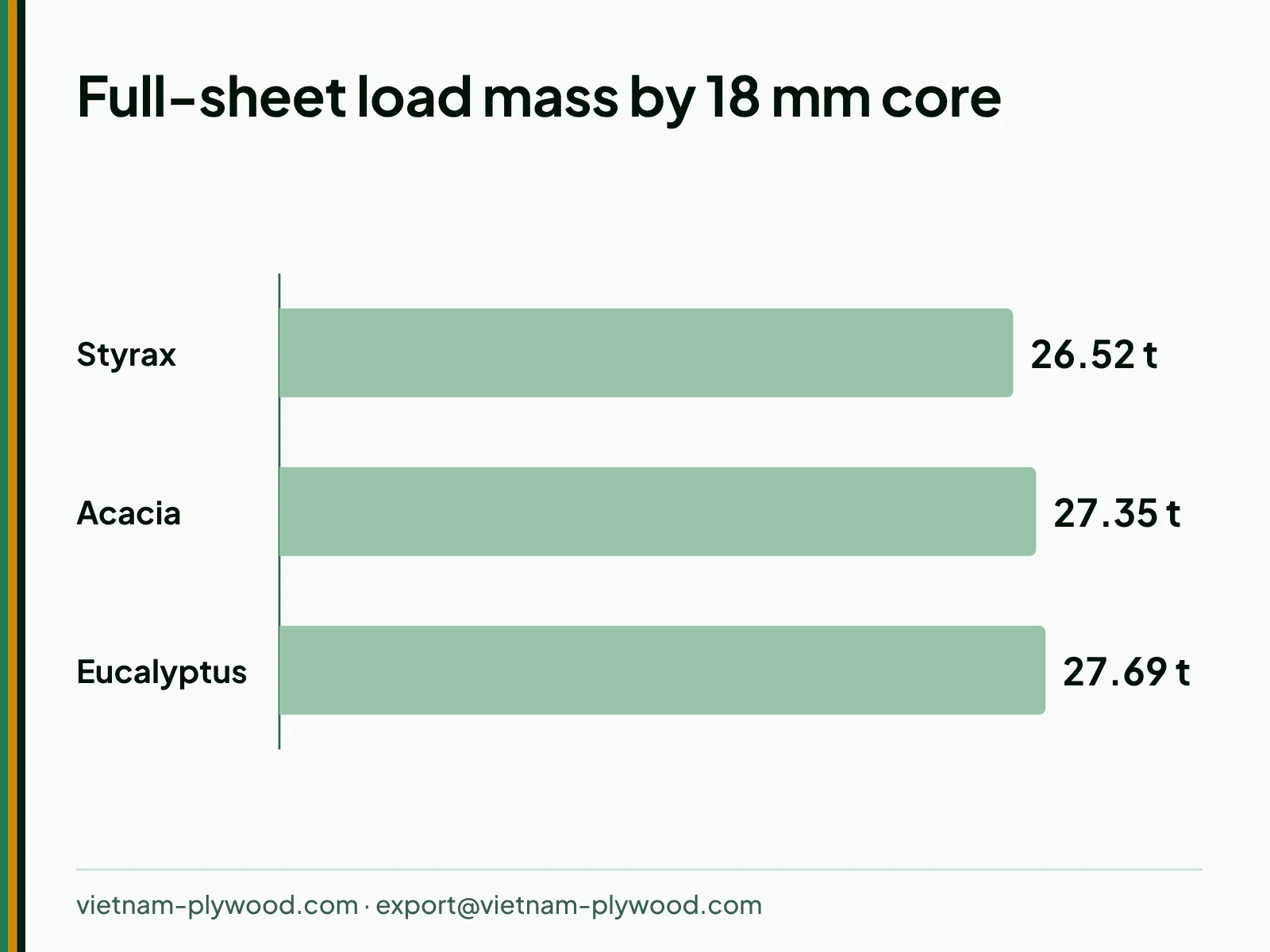
At 18 mm, the full-sheet lookup gives 990 styrax sheets, 880 acacia sheets or 795 eucalyptus sheets per 40HC. Those correspond to 26.52 t, 27.35 t and 27.69 t respectively, with a 28.5 t payload limit. A finished small-panel count needs the accepted cutting yield and a separate pallet loading plan.
| 18 mm core | Full sheets per 40HC | Full-sheet load mass |
|---|---|---|
| Styrax | 990 | 26.52 t |
| Acacia | 880 | 27.35 t |
| Eucalyptus | 795 | 27.69 t |
Cutting creates offcuts, while repacking changes stack height, pallet weight and securing arrangements. Ask for a finished-piece count supported by the approved cutting schedule, pallet drawing and loading plan.
The quantity ultimately loaded depends on the actual cut yield, pallet geometry and payload. Use the container loading reference for the underlying full-sheet counts, then request a cut-format loading plan.
How are cut plywood panels packed for export?
Cut panels are grouped by specification and palletised at the producing factory for export. The packing instruction should identify finished length, width, thickness, core, face, pieces per bundle and bundle orientation. It should also separate different sizes so the receiving warehouse can count each item without opening every stack.
A long 610 × 2440 strip needs support along its length to reduce handling damage. Smaller 1220 × 610 components benefit from square stacks and corner protection. A 1200 × 800 top should be bundled to match the buyer’s handling and receiving equipment, with the maximum safe stack determined by the agreed packing drawing.
For each bundle, the buyer should request a label tied to the purchase-order item and packing-list line. The inspector can count pieces, measure representative finished panels and compare the pallet stack with the approved diagram. The shipping packing list records the shipment’s actual item quantities and packages; the commercial invoice records the commercial goods description.
Under CIF delivery, the shipment document set also includes insurance. It includes a bill of lading, certificate of origin and applicable phytosanitary and fumigation papers, alongside agreed certificate documents. After loading, the draft shipping documents come to you for approval. A cut-size order benefits from a clear match between the cutting schedule and the packing-list descriptions.
What should a buyer inspect before the cut load leaves?
Inspect finished dimensions, cut edges and pallet identity against the approved cutting drawing at the producing factory. Buyers can visit the factory office and inspect goods where the order is made. A sample of the parent-sheet appearance alone does not verify the finished component size.
The inspector should measure length and width across representative pieces and record any chip-out, splintering or exposed core voids. For furniture parts, review face grade, sanding and the ordered ±0.2 or ±0.3 mm thickness tolerance. For commercial pieces, assess the agreed ±0.5 mm thickness tolerance; packing builds use ±0.5–1.0 mm.
Length and width tolerance is ±2 mm on the specified plywood sizes. A finished custom-cut dimension needs its own agreed acceptance drawing, particularly where a nominal 1220 mm dimension conflicts with saw kerf. The inspector should verify the approved custom-cut acceptance criteria rather than assume the parent-sheet tolerance resolves every cut-edge question.
For pallet tops, include flatness and fastening-edge inspection requirements in the written order. For film-faced pieces, specify protection of cut edges. A signed inspection record should identify the lot and the packing-list item so the receiving buyer can trace any discrepancy.
How do cut size and build affect the quotation?
The quoted cost follows the selected core and surface build, cutting yield, edge quality requirement and packing complexity. A fully stitched, sanded furniture build involves more core preparation and finishing than a basic unsanded packing build. A tighter finished-size requirement adds cutting and inspection work, while offcuts increase material consumed per accepted component.
For commercial plywood the indicative starting point is from US$250/m³ FOB Hai Phong (October 2026). For furniture plywood it is from US$350/m³ FOB Hai Phong (October 2026). Neither is a cut-piece quotation; a written specification is needed for the actual size mix, kerf plan, face and grade.
The minimum order is one 40HC, and one container can carry several specifications as long as the payload limit holds. We ship FOB Hai Phong, or CFR (CNF) or CIF to your port. Factory lead time runs 15–45 days from receipt of the 30% deposit; the exact figure depends on order size, line loading and what the contract fixes. The remaining 70% is paid on the scan of the bill of lading, by T/T, or by irrevocable sight L/C.
Free samples are available; a first-time buyer pays the courier, and that charge comes off the first confirmed order. For the sequencing of cutting, inspection and loading, read plywood production lead time.
Which dimension names need clarification on the purchase order?
Every foot-based size should be converted into a written millimetre drawing before the purchase order is accepted. Trade shorthand often conceals whether the stated size is nominal, exact or the orientation of the face grain. The drawing should carry both finished dimensions and permissible tolerance.
A plywood 6x3 request can describe a nominal 1830 × 915 mm panel; a plywood 6 x 4 request often means approximately 1830 × 1220 mm. Plywood 2x4 commonly means approximately 610 × 1220 mm. A 610x2440 plywood request instead describes a long strip, which is geometrically different despite sharing the 610 mm dimension.
Plywood 1200x800 and plywood 1200 x 800 should both be written as 1200 × 800 mm in the order. A 1200x800 plywood sheet intended as a euro-pallet top also needs its fixing and loading specification. The same principle applies to plywood 1220x610, plywood 3x8 and plywood 4x4: the drawing overrides shorthand.
A buyer comparing retail project panels with export-ready cut components should also specify surface, core, thickness and the number of pieces per pallet. A retail label describes a saleable size; an export specification must describe the exact component that arrives.
What specification should you send for a factory-cut quotation?
Send the finished component drawing, application and quantity alongside the required plywood build. HCPLY can then assign the producing line, prepare a cutting layout and quote against the specified pallet arrangement. Contact Lucy at export@vietnam-plywood.com for the specification sheet.
For furniture and cabinet parts, mark visible faces and exposed edges on the drawing. For pallet tops, include the load and fixing requirements of the completed pallet assembly. For mixed sizes, show the quantity of each component separately and identify which may share a pallet or container.
Application: cabinet components / packing tops / formwork pieces
Line or core: furniture—styrax or eucalyptus / packing—acacia / construction—acacia or eucalyptus
Glue: MR melamine / WBP phenolic, as applicable
Emission: E0 / E1 / E2; agreed certificate requirement
Face and grade: named veneer and A/B; birch face D/E/F / matt / film weight
Thickness and tolerance: __ mm; __ mm
Finished size: __ × __ mm; drawing revision __; cut tolerance __
Quantity: __ finished pieces per size; __ pieces per pallet
Destination port: __