





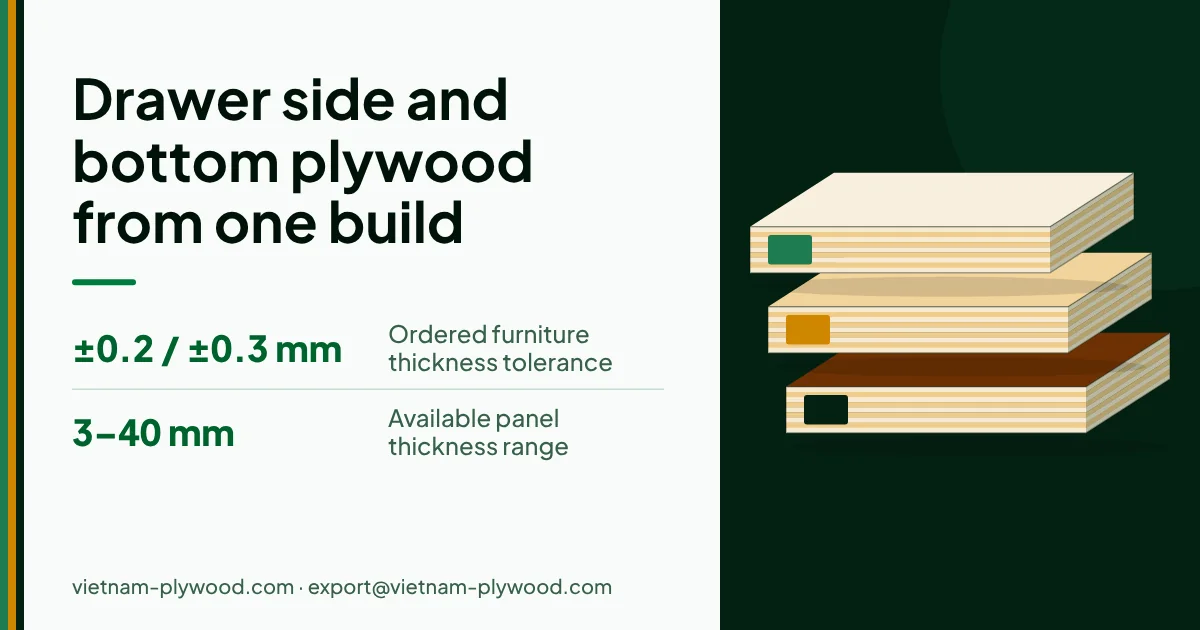
Plywood drawer boxes can be supplied as coordinated furniture plywood sheets or cut parts for sides and bottoms. Choosing the wrong face, thickness or edge construction costs machining time and can lead to rejected components. HCPLY makes the matching panel build on our furniture line, with separate thickness schedules for the cabinet maker’s approved drawer design.
What plywood is best for drawer boxes?
Plywood drawer boxes work well when the side panels and bottoms share a specified furniture-grade construction, even though their thicknesses differ. HCPLY makes the panels on our furniture line with a full stitched core, sanded surfaces and a chosen face. The cabinet maker sets joint geometry and load requirements before selecting the side and bottom thicknesses. A consistent panel specification reduces mismatched visible edges, rework at assembly and rejected cut parts.
The practical starting point is a furniture panel with styrax or eucalyptus core, a specified face grade, and the same glue and emission requirements across both component groups. Styrax core density is 500 kg/m³; eucalyptus core density is 650 kg/m³. Those densities describe the core, not a decorative face. A lighter panel can help where drawer weight matters, while a denser core changes the weight calculation and machining response.
For plywood for drawers, ask first whether the factory will cut the material into components or receive precut rectangles. Our cut-to-size plywood supply supports the second route. The furniture components page covers the broader component specification.
What thickness should drawer sides and bottoms be?
Choose drawer side thickness from the joint and runner design; choose bottom thickness from the unsupported span, groove engagement and intended load. There is no single thickness that suits every drawer. HCPLY offers 3–40 mm panels, including common 3, 5, 9, 12, 15 and 18 mm choices relevant to component planning. These are available panel thicknesses, not tested drawer load ratings.
A useful procurement exercise is to quote 12 or 15 mm sides alongside a 5 or 9 mm bottom, then have the cabinet engineering team approve the combinations against its hardware and loading tests. A thin bottom needs particular attention to the groove depth and clear span. The specification must state finished panel thickness, not just a nominal trade name.
For sanded furniture plywood, the ordered thickness tolerance is ±0.2 or ±0.3 mm. Length and width tolerance is ±2 mm. A bottom intended for a narrow groove should be checked against the actual groove allowance, and a side intended for a dovetail or dowel pattern against the machining drawing.
Can sides and bottoms be ordered as cut parts?
Yes. Drawer sides and bottoms can be ordered as full sheets or as cut-to-size parts from the same furniture-line specification. A cut-part order must carry a dimensioned drawing, quantity by part, face direction and edge identification. The service supplies cut plywood components; the buyer’s cabinet operation remains responsible for its selected joints, grooves, finishing and drawer assembly.
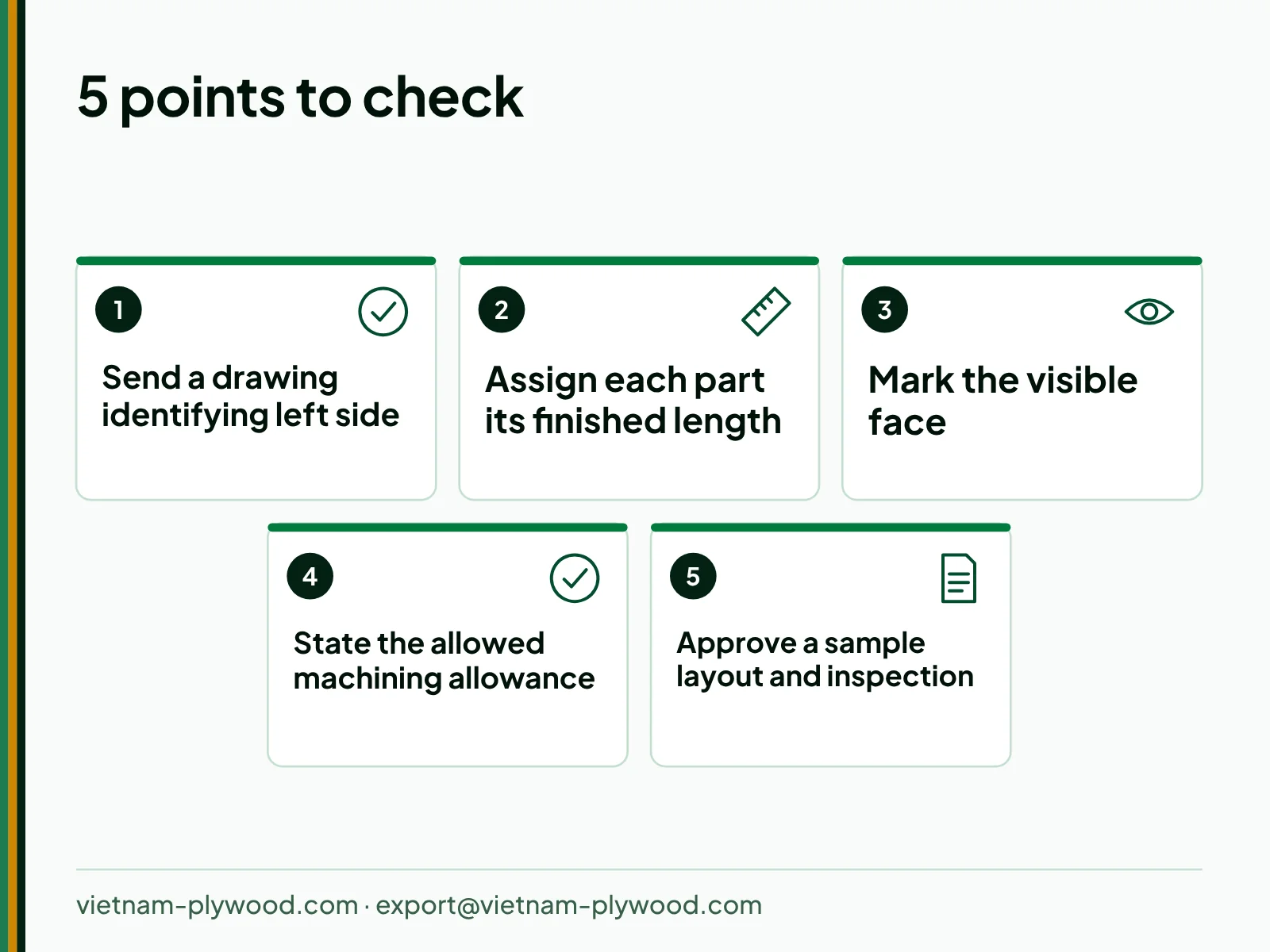
- Send a drawing identifying left side, right side, back, front-related panel and bottom where applicable.
- Assign each part its finished length, width, thickness, face orientation and quantity.
- Mark the visible face and the edges that remain exposed after assembly.
- State the allowed machining allowance and whether dimensions refer to cut blanks or final machined parts.
- Approve a sample layout and inspection method before production quantities are cut.
Neither route automatically includes dovetails, runners, preassembled boxes or a finish coating. For smaller sheet formats, see small plywood panels and half sheets.
Is birch plywood good for drawers?
Birch-faced plywood can be a suitable visual choice for drawers when its face grade, edge appearance and machining behaviour match the cabinet specification. HCPLY offers birch as a face veneer, with birch face grades D, E and F. We do not make birch-core plywood. A buyer requesting birch ply drawers should distinguish a birch face from a birch-through-core construction.
The face veneer is commonly 0.2–0.4 mm. The selected styrax or eucalyptus core still determines the core density and the cross-section seen at a cut edge. A buyer expecting a uniform birch edge should request an approved edge sample rather than assuming the face species continues through the panel.
Bintangor, okoume, engineered veneer (EV), sapele, poplar and other listed faces can be specified for a different visual brief. If the project requires a fully birch-core sheet, that requirement sits outside our production range.
Which factory line builds drawer panels?
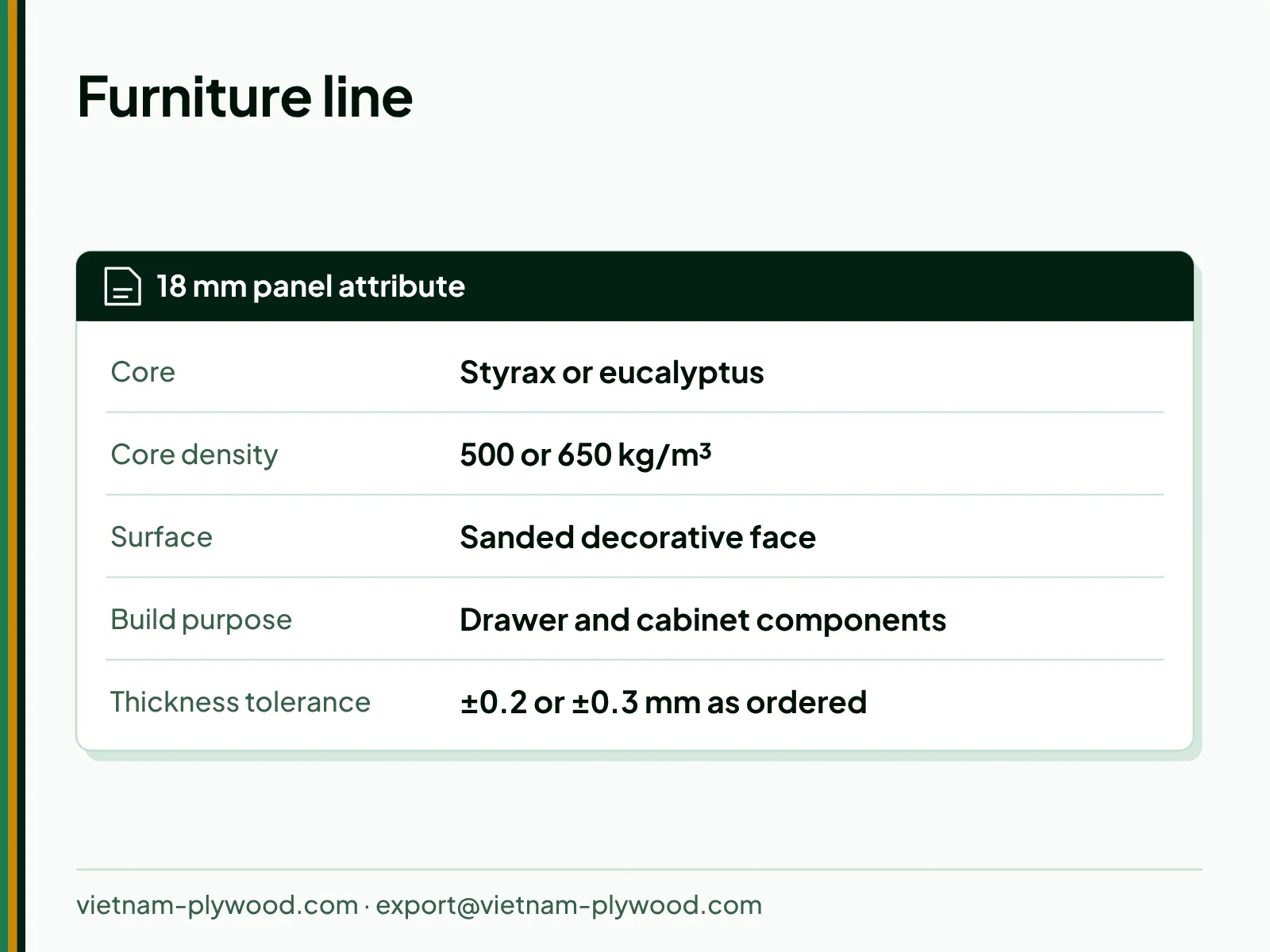
Our furniture line presses drawer plywood with full stitched styrax or eucalyptus core, sanded surfaces and E0 or E1 emission class. The other lines are built around different uses. The table compares an 18 mm panel across the three lines; it does not imply that their surfaces are interchangeable for a drawer box.
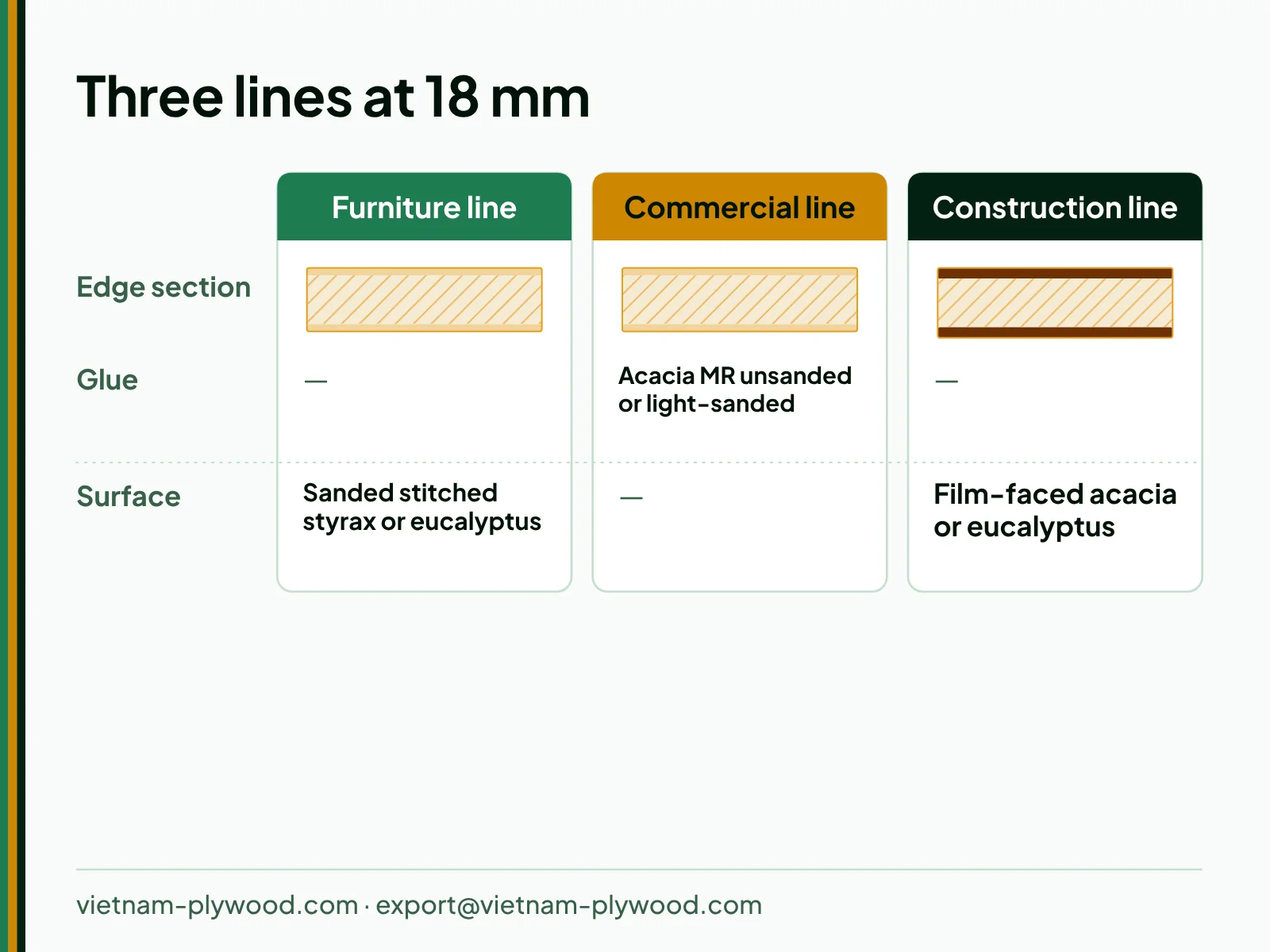
| 18 mm panel attribute | Furniture line | Commercial and packing line | Construction line |
|---|---|---|---|
| Core | Styrax or eucalyptus | Acacia | Acacia or eucalyptus |
| Core density | 500 or 650 kg/m³ | 580 kg/m³ | 580 or 650 kg/m³ |
| Surface | Sanded decorative face | Unsanded or light-sanded | Phenolic or melamine film |
| Build purpose | Drawer and cabinet components | Commercial or packing panels | Formwork panels |
| Thickness tolerance | ±0.2 or ±0.3 mm as ordered | ±0.5 mm; packing ±0.5–1.0 mm | ±0.5 mm |
| Verdict for visible drawer parts | Specify here | Different surface and tolerance brief | Film surface designed for formwork |
See factory-line grade comparisons for other applications. Our formwork replacement panels serve a separate buying purpose.
How do face, edge and moisture stay consistent?
Keep the face, exposed edge and moisture acceptance criteria together on the same approved component specification. A matching face alone cannot control the visible edge or the condition of the delivered panels.
Specify the face species and grade, core species, stitched construction, sanding condition, glue system, emission class and allowed appearance variation. Mark which face is outward and whether the bottom is visible from inside the drawer. If the cabinet plant applies a clear finish, test both faces and exposed edges using that actual finishing schedule.
Moisture is a separate acceptance field: agree the measurement instrument, sampling locations, test condition and acceptance range in writing. Set the numerical moisture target against the cabinet plant’s climate, finishing method and acceptance protocol before inspection. The inspector can witness readings on both side and bottom stock at the producing factory and record the lot identification.
Edge checks should include core gaps, stitching continuity, chipped veneers, cut squareness and the face-to-edge transition. Inspect a cut sample for approval; a raw plywood edge has a different finish from a solid timber drawer side.
How should a mixed-thickness drawer order be packed?
A mixed-thickness order can share a 40HC container when the combined shipment stays within the 28.5 t payload limit. The same furniture-line face and core specification can cover side and bottom sheets, with separate thickness and part-count lines on the packing list. A cut-part order additionally needs clear bundle labels that identify the drawing revision and part code.
For reference, a full 40HC of 18 mm, 1220×2440 mm styrax-core sheets contains 990 sheets, 53.05 m³ and 26.52 t. At 5 mm, the same format and core yields 3,600 sheets, 53.58 m³ and 26.79 t for a full single-thickness load. Use these full-load figures when preparing the mixed-thickness pallet plan. Mixed orders require an actual pallet-by-pallet weight plan, accounting for the different quantities and any cutting yield.
The container loading reference explains standard sheet loads.
What can an inspector check at the producing factory?
An inspector can compare the approved drawer specification with actual panel and cut-part measurements before loading. Buyers visit the factory office and inspect goods at the producing factory. HCPLY coordinates on-site quality control, document preparation and loading through the export process.
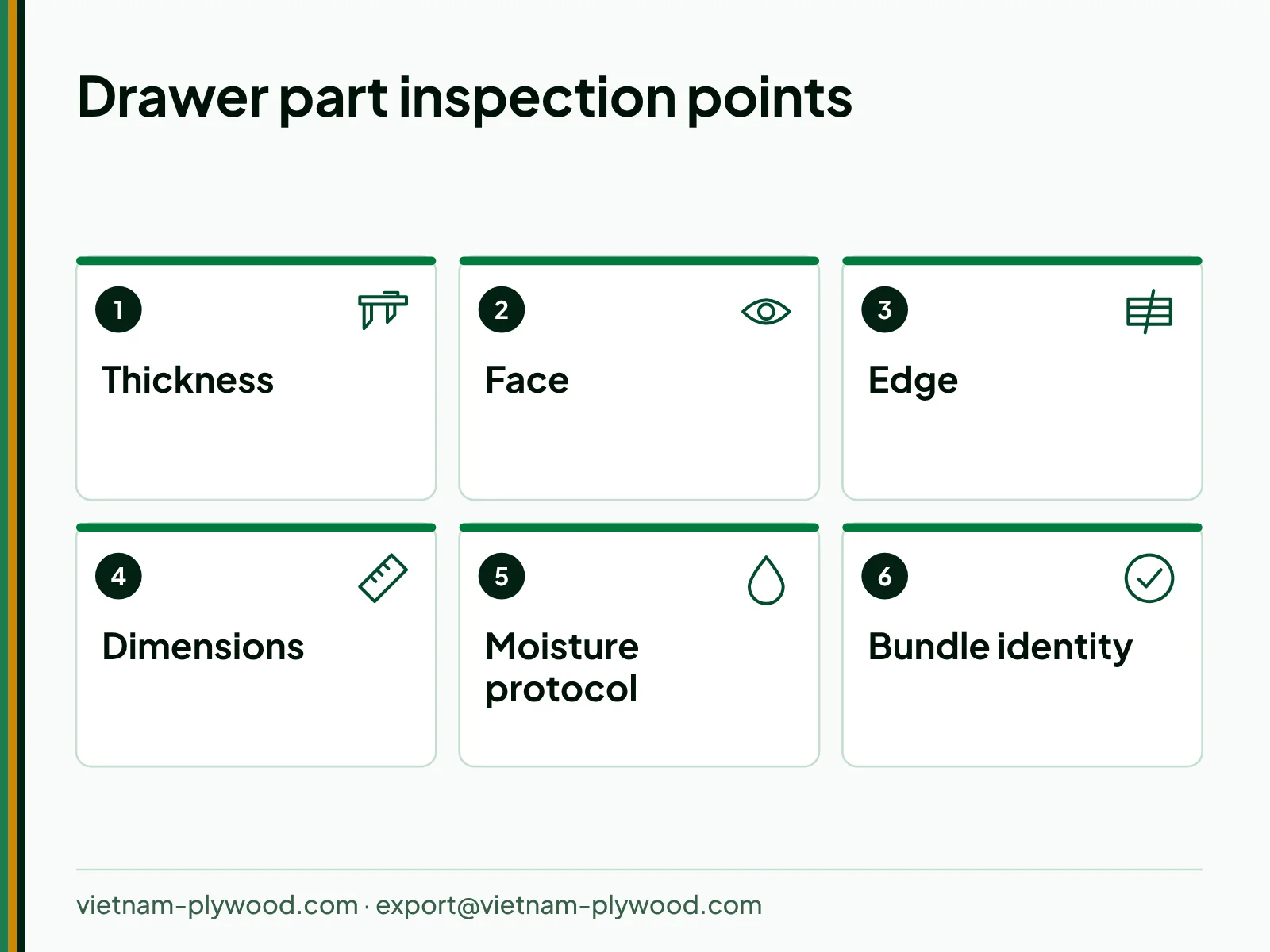
Check the finished thickness at multiple points on both side and bottom panels, using the ordered ±0.2 or ±0.3 mm furniture tolerance. Check length and width against the ±2 mm sheet tolerance where that specification applies; separate cut-part dimensional acceptance must be written into the drawing. Inspect the face under agreed lighting, then examine the edge for gaps and irregular veneer joins.
For a cut-part lot, the inspector should compare bundle labels and part counts with the drawing revision and packing list. Record moisture readings against the buyer-approved protocol.
What glue and emission evidence belongs on the order?
State glue type and emission class as separate fields. Melamine glue is described as MR with a 12-hour boil condition; phenolic glue as WBP with a 72-hour boil condition. E0, E1 and E2 are emission classes, whereas California Air Resources Board Phase 2 (CARB P2) and Toxic Substances Control Act (TSCA) Title VI concern a US emissions limit and third-party certification.
The US Environmental Protection Agency’s 2016 final rule, as summarized on its official formaldehyde standards page, covers hardwood plywood and requires third-party certification for regulated composite wood products. Its October 2026 technical update adds a quality-control test method; it does not replace the buyer’s need to match the specific shipment to accepted certification documents.
For relevant orders, member-factory FSC, CARB P2, ISO 9001 or CE documents are shown with factory details masked, on request. The export document set can include an emission certificate and agreed test reports. Buyers should identify the destination-market rule and required documentary evidence before approving production.
How do drawer dimensions relate to joints and runners?
Drawer dimensions should follow the cabinet maker’s approved hardware drawing and joint design. A nominal panel thickness does not establish finished box width, drawer clearance or runner positioning.
Dovetail drawers require a different machining allowance from dowelled or mechanically fastened boxes. A grooved bottom requires a bottom thickness that fits the groove after tolerance is considered. Where the bottom is captured, its cut size must reflect groove engagement; where it is fastened beneath the box, the engineering drawing changes accordingly.
For a “5 8 drawer box material” request, the order should still give the required finished millimetre thickness and tolerance.
What determines the quotation and export paperwork?
The quotation is driven first by core construction and face selection, then thickness, sanding tolerance, cut-part yield and packing complexity. More exact cutting and sorting add operations and can create offcuts. Request a quotation against the written drawer specification rather than a generic drawer plywood price.
Minimum order is one 40HC; one container can carry several specifications as long as the payload limit holds. Factory lead time runs 15–45 days from receipt of the 30% deposit; the exact figure depends on order size, line loading and what the contract fixes. The remaining 70% is paid on the scan of the bill of lading, by T/T, or by irrevocable sight L/C. We ship FOB Hai Phong, or CFR (CNF) or CIF to your port.
Each shipment has a commercial invoice, packing list, bill of lading (B/L), certificate of origin, phytosanitary and fumigation papers, plus order-specific certificate documents. EU lots include EUR.1 and the EUTR/EUDR file set; CIF shipments include insurance. After loading, the draft shipping documents come to you for approval. The packing list is the principal shipment document linking side and bottom bundle quantities to the purchase specification.
What should a trial drawer-panel order specify?
A trial order should define one furniture-line build with separate side and bottom thickness and size schedules. The buyer’s drawings should state whether the goods are full sheets or cut blanks, and which face and edge will be visible after assembly. HCPLY can review the written specification through Lucy at export@vietnam-plywood.com.
Sample approval should cover appearance, thickness, edge quality and machining fit under the receiving plant’s actual tools.
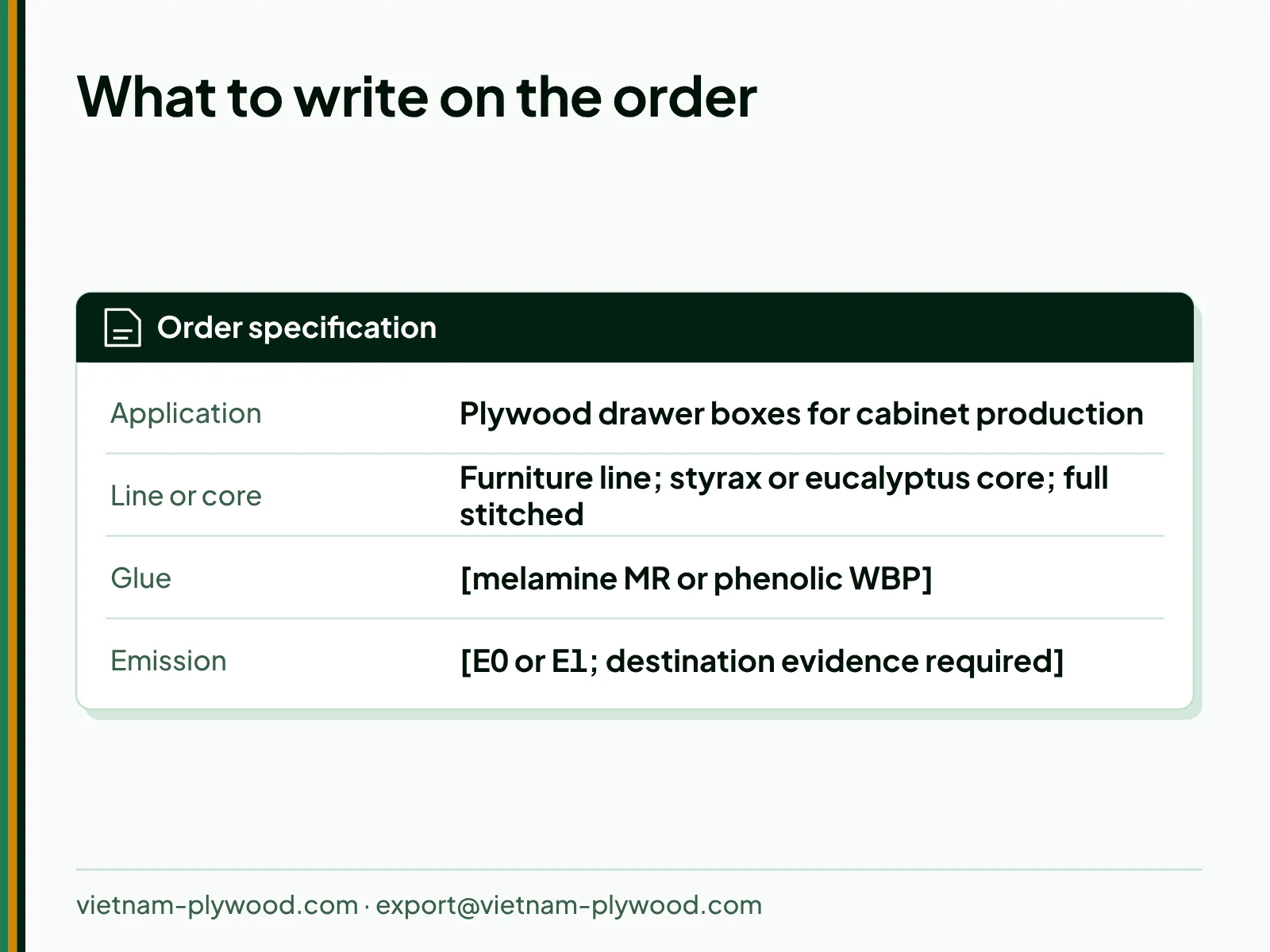
Use the following specification lines as the purchasing brief. The selected dimensions, quantity and destination are to be filled by the cabinet maker before requesting a quotation.
Application: plywood drawer boxes for cabinet production
Line or core: furniture line; styrax or eucalyptus core; full stitched
Glue: [melamine MR or phenolic WBP]
Emission: [E0 or E1; destination evidence required]
Face and grade: [species and grade]; visible face and exposed edge marked
Thickness and tolerance: sides [mm, ±0.2 or ±0.3 mm]; bottoms [mm, ±0.2 or ±0.3 mm]
Size: [sheet dimensions or drawing-revision cut-part dimensions in mm]
Quantity: [sheets or pieces by part code; bundle schedule]
Destination port: [port, country]
Moisture inspection: [agreed method, sampling and acceptance range]
Next step: contact Lucy to plan a trial container against the approved drawer-part schedule.