





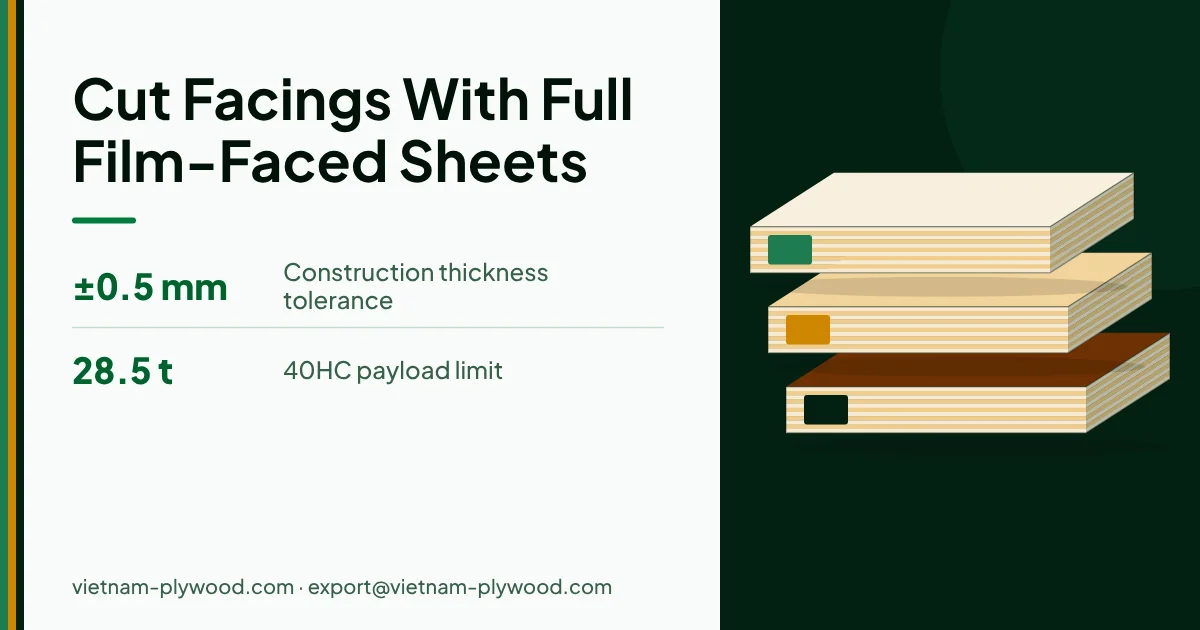
Replacement plywood for frame formwork can be cut from film-faced sheets to match an approved system-frame size list. A wrong thickness, hole pattern or unsealed edge can waste panels, delay a pour and cause rejected facings. HCPLY produces cut facings on our construction line and can load them with full sheets against a documented packing plan.
Can replacement plywood for frame formwork fit system frames?
Replacement plywood for frame formwork can re-face an existing system frame when its panel dimensions, thickness, fixing pattern and design requirements match the frame specification. A contractor must verify the assembled formwork for its intended concrete pressure and loads before use. HCPLY cuts film-faced plywood against an approved facing schedule on our construction line; frame hardware and engineering approval remain with the system owner.
Start with a removed facing or an approved system drawing. Record the clear recess dimensions, panel support spacing, fastener positions, corner details and whether the facing sits flush with its frame. A nominally matching board can still foul a clamp, bow across a support or leave an exposed joint. Replacing only the plywood also leaves the existing steel or aluminium frame, locks and welds to be inspected separately.
The 2025 US Code of Federal Regulations, 29 CFR 1926.703, requires formwork to resist anticipated vertical and lateral loads. That requirement concerns the complete assembly, so a replacement facing should be accepted against the frame supplier’s specifications and the project’s formwork design. This is especially relevant when changing from an original proprietary facing to another film-faced panel.
What maximum sheet size can cut facings come from?
Our listed sheet formats extend to 1250 × 2500 mm, with 1220 × 2440 mm another common starting format. The available range also includes 1220 × 2135, 1220 × 1830, 915 × 2440, 915 × 2135 and 915 × 1830 mm. Custom cutting is available, but a finished rectangle must fit within its selected parent sheet after allowance for saw kerf and edge finishing.
A frame opening larger than a parent sheet cannot be supplied as a single continuous facing from that sheet. A splice changes the facing and joint arrangement; it needs separate acceptance in the system design. Send a dimensioned nesting schedule with finished lengths and widths, quantities by frame type and grain or film orientation requirements. The schedule should distinguish clear opening dimensions from finished plywood dimensions.
For broader sheet preparation options, see our cut-to-size plywood supplier page. A factory cutting drawing is preferable to an unlabeled spreadsheet because it identifies each repeated component and reduces the chance of reversing length and width.
How are cut edges and drilled holes sealed before shipping?
Specify sealing for every newly exposed cut edge and the walls of every drilled hole, then inspect coverage before packing. Factory-applied film protects the broad faces, while sawing and drilling expose the core. A sealed original edge does not protect a later cut.
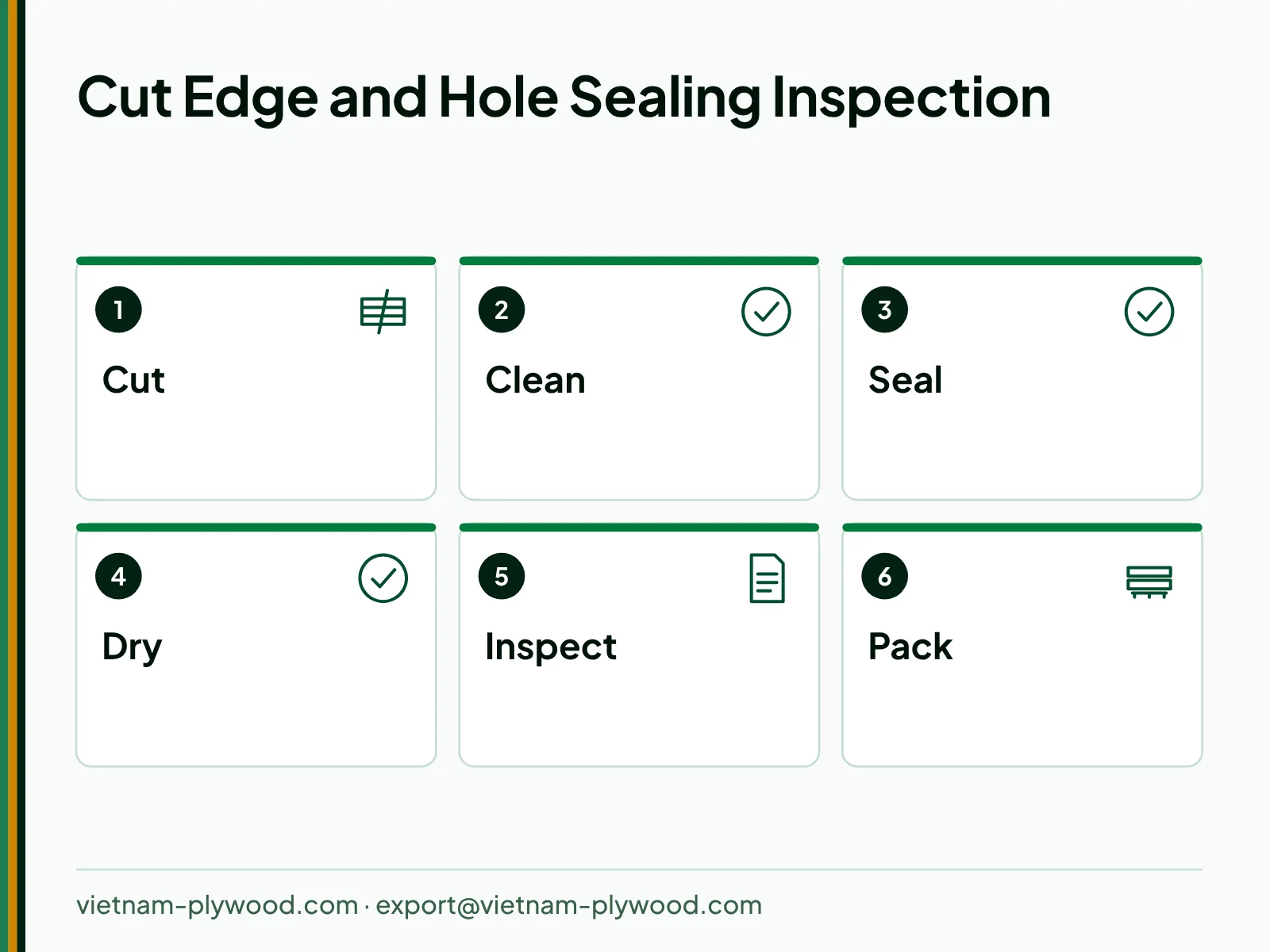
Use this production and acceptance sequence:
- Approve the facing drawing, including holes, slots, notches and finished dimensions.
- Cut the film-faced blanks and remove loose dust from exposed core surfaces.
- Apply a buyer-approved edge-sealing system to all cut perimeters, notches and hole walls according to that product’s application instructions.
- Allow the specified cure or drying period before stacking; keep wet sealant away from adjacent film faces.
- Check the finished pieces for missed edges, uncovered holes, damaged film and legible part identification.
- Pack the accepted facings with surface protection and an identification list linked to the cutting schedule.
Cut edges expose absorbent core material, so specify a compatible sealer for the facing and intended wet-use conditions. The exact sealer chemistry, coat count, application method and drying time belong in the approved order specification; no universal cure period can be inferred from the plywood thickness.
If holes are drilled after delivery, the contractor must seal those new surfaces before the next pour. Fastener damage and edge abrasion also need attention during reuse.
Which facing thickness fits: 15, 18 or 21 mm?
The correct thickness is the one accepted for the particular frame, support spacing and loading design. HCPLY can produce 15, 18 and 21 mm film-faced plywood, but those numbers are alternatives for specification review, not interchangeable structural ratings.
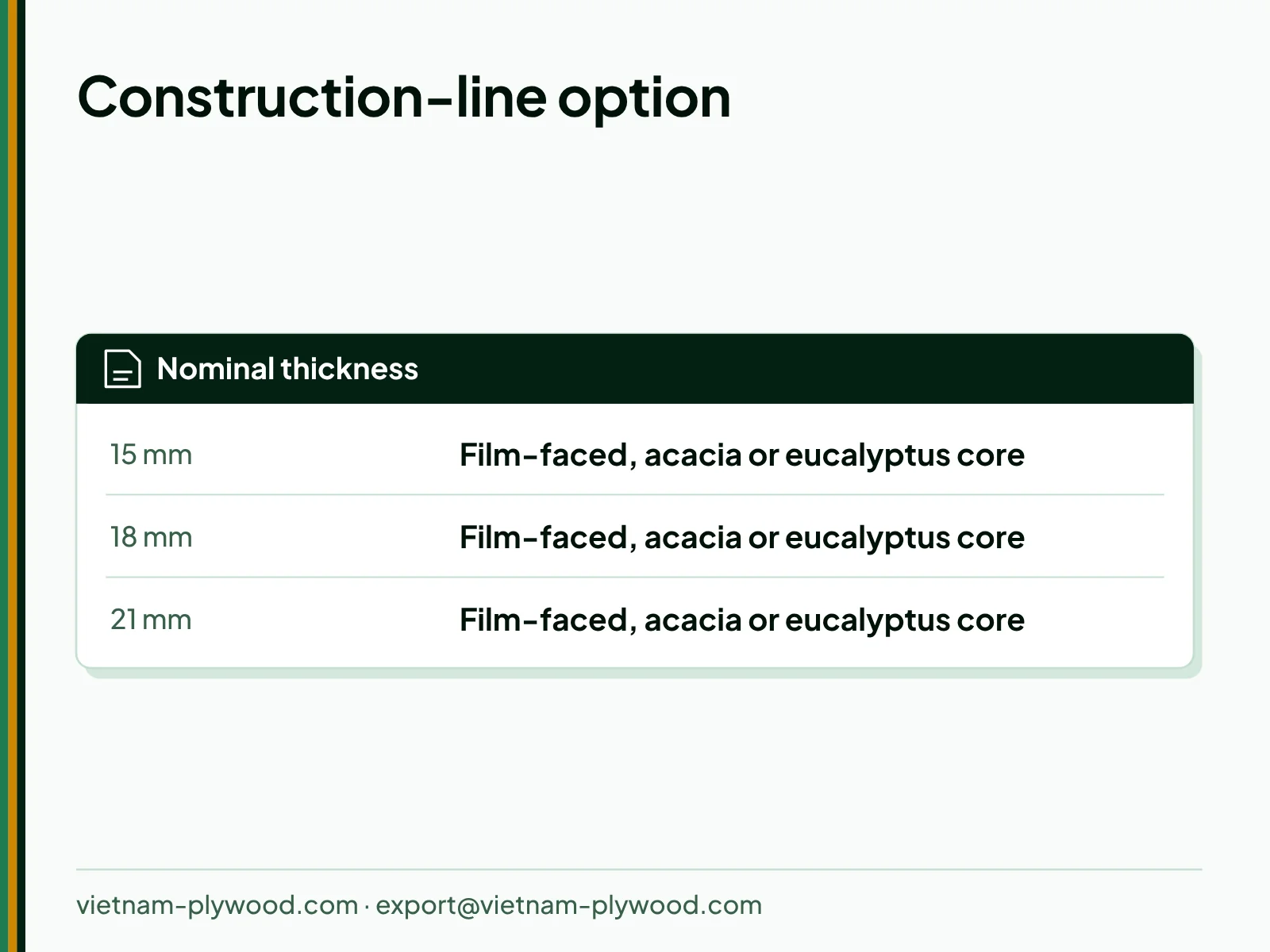
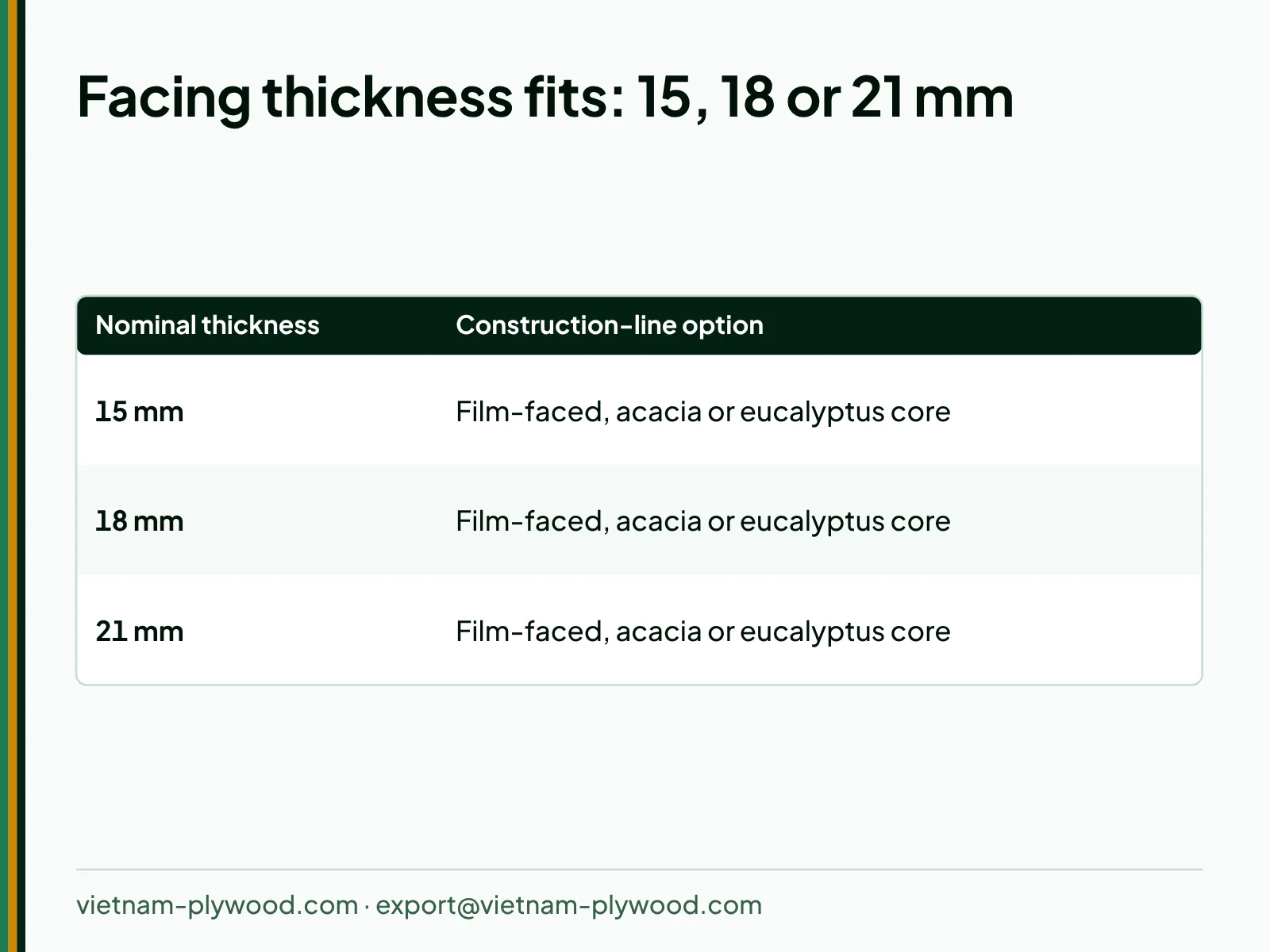
| Nominal thickness | Construction-line option | Selection check | Verdict by use |
|---|---|---|---|
| 15 mm | Film-faced, acacia or eucalyptus core | Confirm recess depth, bearing and deflection | Choose only where the frame design accepts 15 mm |
| 18 mm | Film-faced, acacia or eucalyptus core | Check fixing engagement and supported span | Choose for frames documented for 18 mm |
| 21 mm | Film-faced, acacia or eucalyptus core | Check frame clearance and increased weight | Choose for frames documented for 21 mm |
For the construction line, nominal thickness tolerance is ±0.5 mm. Length and width tolerance is ±2 mm. Those manufacturing tolerances are separate from the fit clearance required by a particular frame; specify finished size and inspection datum accordingly. A recess measured from a worn panel can mislead, so compare the drawing with an undamaged reference where possible.
An 18 mm panel uses 11–13 plies according to the supplied core veneer thickness. Ply count alone does not establish allowable concrete pressure. The 2012 APA Concrete Forming Design/Construction Guide identifies panel tolerances, concrete pressure and form maintenance as distinct design topics. Our product is not offered with an APA or PS 1 stamp.
What film, glue and core belong on the order?
Our construction line presses film-faced plywood with acacia or eucalyptus core, using phenolic or melamine film. Standard film weight is 120 g/m², premium film weight is 135 g/m², and 220 g/m² is reserved for anti-slip film. A smooth concrete-contact facing should be specified by its agreed film surface, rather than ordering anti-slip texture by mistake.
Glue type and emission class are separate specification fields. Melamine glue is described as MR with a 12-hour boil condition; phenolic glue is described as WBP with a 72-hour boil condition. Neither boil description is a substitute for a project-specific structural test or a frame compatibility check. Film weight describes the facing material, while core choice affects panel density and shipment weight.
For this re-facing application, the producing factory is our construction line. Our furniture line instead makes full-stitched, sanded styrax- or eucalyptus-core plywood with E0/E1 emission options. Our commercial and packing line makes acacia-core, MR-glue panels that are unsanded or light-sanded. The construction plywood range covers the relevant film-faced build; factory-line grade comparisons explain why identical nominal thickness does not mean identical panel construction.
How many pours can a phenolic facing give in a frame?
With proper handling, a release agent on every pour and sealed edges including cut edges, phenolic-glue film-faced plywood can reach up to about 25 pours. Under those same conditions, melamine-glue film-faced plywood gives about 12–15 pours. These are conditional reuse figures for film-faced plywood, not a verified cycle count for a specific proprietary frame.
Concrete mix, surface finish requirements, cleaning tools, stripping practice, edge exposure and frame alignment all affect service life. A facing can be rejected earlier for a damaged concrete-contact surface even if the panel remains intact. Keep an inspection record for each cycle: film abrasion, edge swelling, fastener-hole wear, delamination and joint leakage.
The frame must also release without gouging the film or dragging fasteners across its surface. A repeatable release-agent routine matters more than a claimed pour count without site conditions. Replace damaged facings before their defects print into the concrete surface.
What tolerances can the producing factory inspect?
The construction-line thickness tolerance is ±0.5 mm, and the listed length and width tolerance is ±2 mm. For a replacement facing, the buyer’s approved drawing should identify nominal dimensions, measuring points, hole positions and any tighter fit requirements separately. We do not substitute the general sheet tolerance for an unagreed hole-position tolerance.
At the producing factory, an inspector can witness caliper readings for thickness, tape or gauge measurements for length and width, and a template fit for the cut profile. The inspector can also examine film continuity, exposed-core sealing, hole-wall coverage and the part labels against the cutting schedule. Record the sample selection and readings on the order inspection sheet.
A trial facing fitted into an actual reference frame is particularly informative for corner reliefs and fastener clearance. If the buyer supplies a frame drawing rather than a physical frame, identify the dimensional acceptance criteria in writing before cutting. Distinguish a rejected dimensional part from a part requiring additional sealant; the corrective actions differ.
Can cut facings and full sheets share one container?
Yes. The minimum order is one 40HC, and specifications can be mixed in a container within its 28.5 t payload limit. HCPLY can plan cut facings with full film-faced sheets, provided the approved packing schedule accounts for the different pallet footprints and weights.
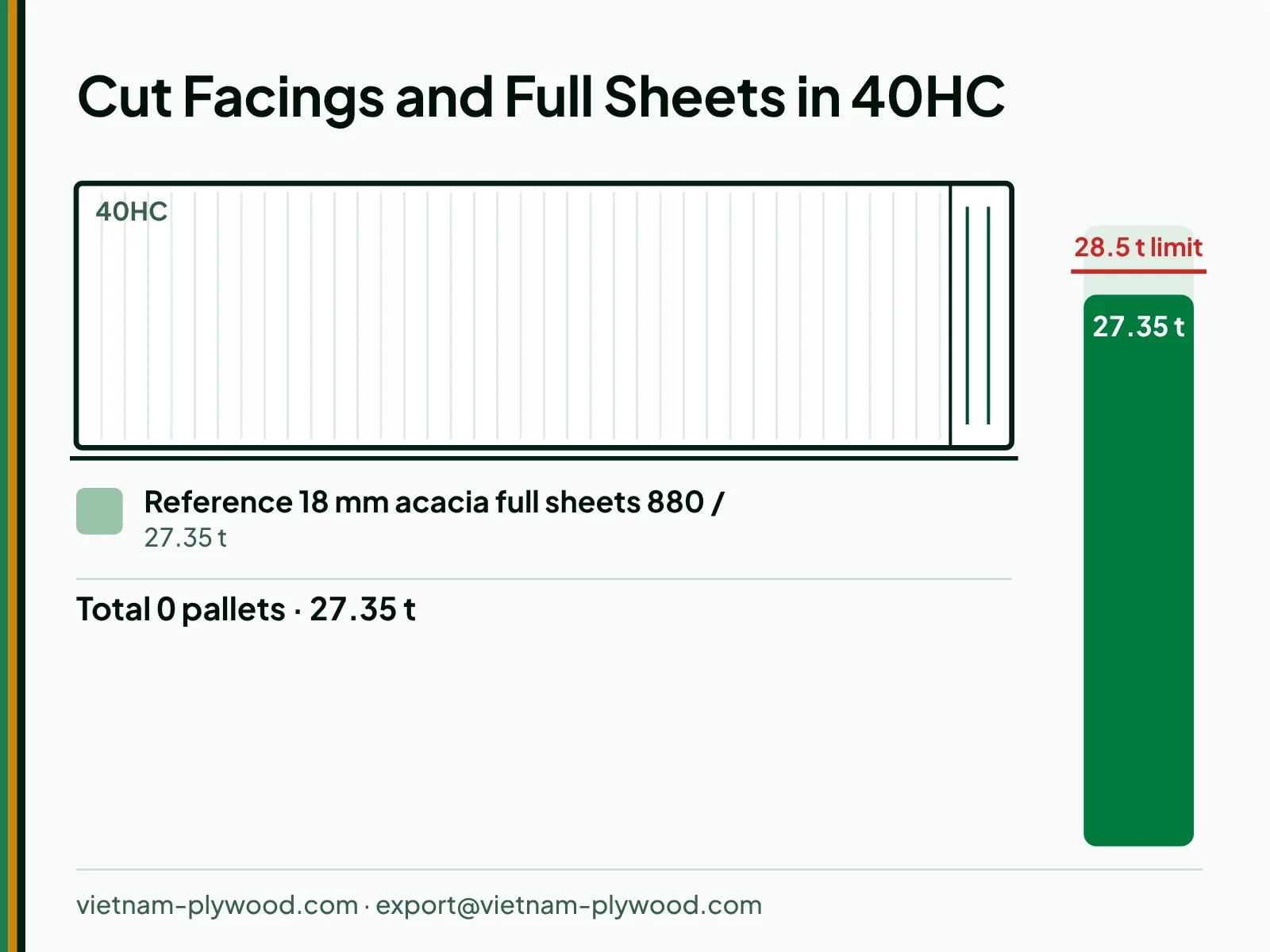
As a reference, 18 mm, 1220 × 2440 mm acacia-core panels weigh 31.08 kg per sheet; a full reference load is 880 sheets, 47.15 m³ and 27.35 t. The eucalyptus-core equivalent is 34.83 kg per sheet, with a full reference load of 795 sheets, 42.60 m³ and 27.69 t. Those figures exclude film weight, and they describe full-sheet reference loads rather than a cut-piece packing promise.
For a mixed shipment, list each cut part by finished size, thickness, core, quantity and pack; then calculate its panel volume and core-based weight. Add full-sheet packs, pallets, packaging and other applicable weight allowances before fixing the load plan. Cutting creates offcuts, so do not assume that the number of facings equals the number of parent sheets. The detailed container-load calculations belong on the packing page.
What should a factory inspection and document review cover?
A useful inspection follows the approved cutting schedule from finished part to labeled pack. Check the first approved sample, dimensional readings, sealing coverage and final packing count at the producing factory. Buyers visit the factory office and inspect goods at the producing factory.
HCPLY manages specification, on-site quality control, export documents and loading. The shipment packing list identifies the quantities and pack breakdown for cut facings and full sheets; the commercial invoice identifies the contracted goods. The bill of lading records shipment carriage, while agreed test reports belong with the order’s certificate documents. After loading, the draft shipping documents come to you for approval.
Member-factory certificates and applicable EUTR/EUDR documents are shown with factory details masked, on request. Any claimed compliance or project performance should be matched to the actual producing factory, ordered build and accepted test report. Avoid treating a general certificate as proof of frame-system compatibility.
What determines a replacement-facing quotation?
A quotation follows the approved size list, panel build, finishing work and packing plan. The main cost drivers are cutting yield and complexity, chosen core and film/glue build, edge and hole sealing work, and mixed-pack handling. Many small facings with numerous drilled holes require more processing and inspection than full uncut sheets.
A premium film specification costs more to produce than a standard film specification because it uses a heavier facing material. More cut-outs and low-yield nesting consume additional parent-sheet material. We quote against the written specification rather than giving a universal price for replacement facings.
We ship FOB Hai Phong, or CFR (CNF) or CIF to your port. Factory lead time runs 15–45 days from receipt of the 30% deposit; the exact figure depends on order size, line loading and what the contract fixes. The remaining 70% is paid on the scan of the bill of lading, by T/T, or by irrevocable sight L/C. Samples cost nothing: a first-time buyer pays the courier, and that charge comes off the first confirmed order.
What should the trial-container specification include?
The trial-container specification should link every facing to a frame reference and an approved finished-part drawing. Include a sealing acceptance method and a packing breakdown that keeps cut pieces identifiable. A trial assembly and pour record can then show whether the selected facing fits, releases cleanly and meets the contractor’s surface requirements.
The order should identify which tolerances apply to sheet thickness and finished dimensions, plus any separately agreed hole or profile criteria. Attach a sample or annotated photograph showing how the facing is retained in the frame. If frame approval is pending, resolve that engineering decision before the order is released for production.
Send the following fields to Lucy via the contact page for the trial-container discussion:
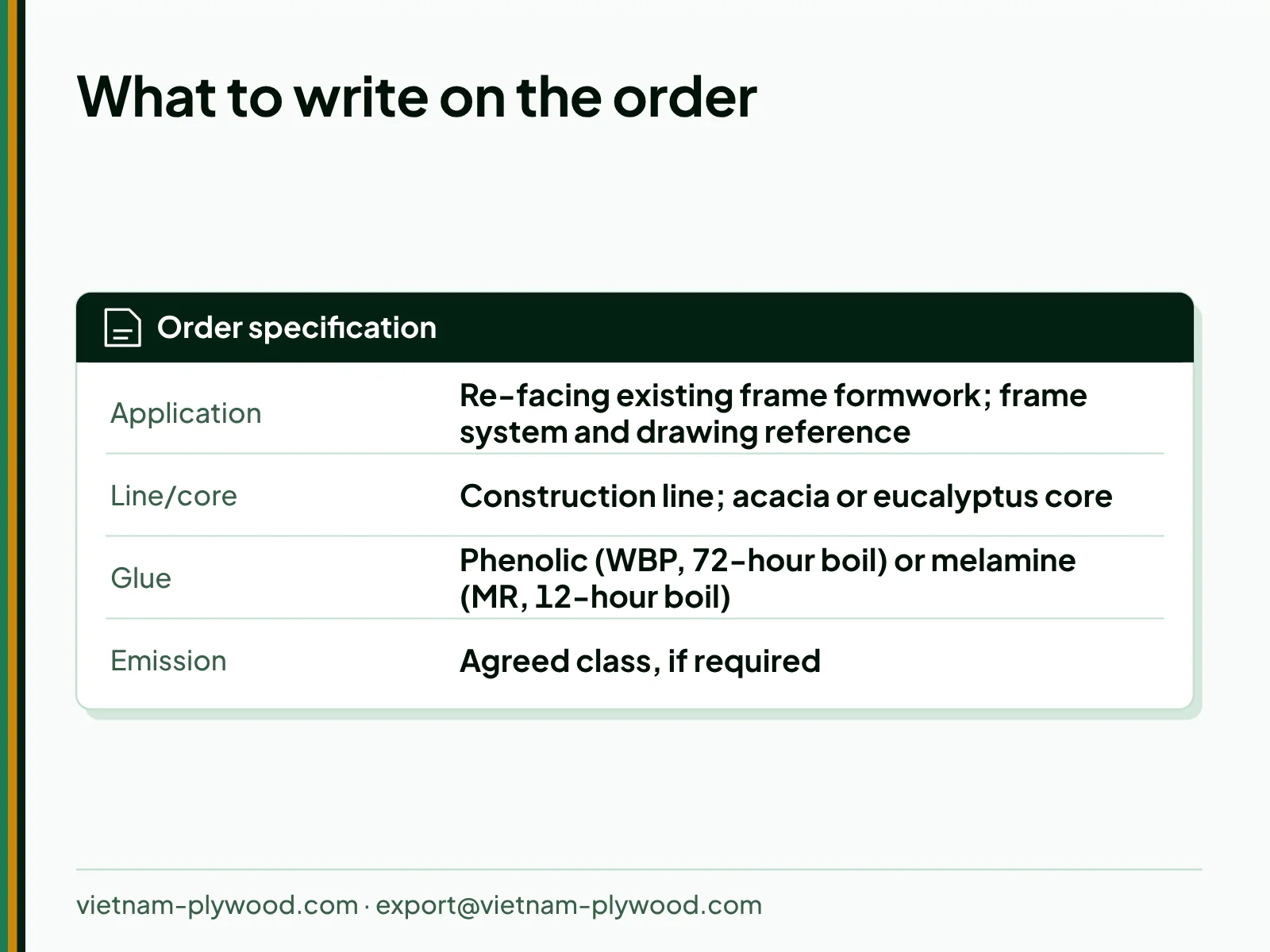
Application: Re-facing existing frame formwork; frame system and drawing reference
Line/core: Construction line; acacia or eucalyptus core
Glue: Phenolic (WBP, 72-hour boil) or melamine (MR, 12-hour boil)
Emission: Agreed class, if required
Face and grade: Film-faced; 120 or 135 g/m²; finish specification
Thickness and tolerance: 15 / 18 / 21 mm; ±0.5 mm
Size: Parent sheet and finished size list; length/width ±2 mm
Cutting details: Holes, notches, edge and hole sealing; acceptance criteria
Quantity: Cut facings by part number plus full sheets; one 40HC minimum
Destination port: [insert destination port]
Next step: plan a trial container with the approved frame-facing schedule and full-sheet balance.