





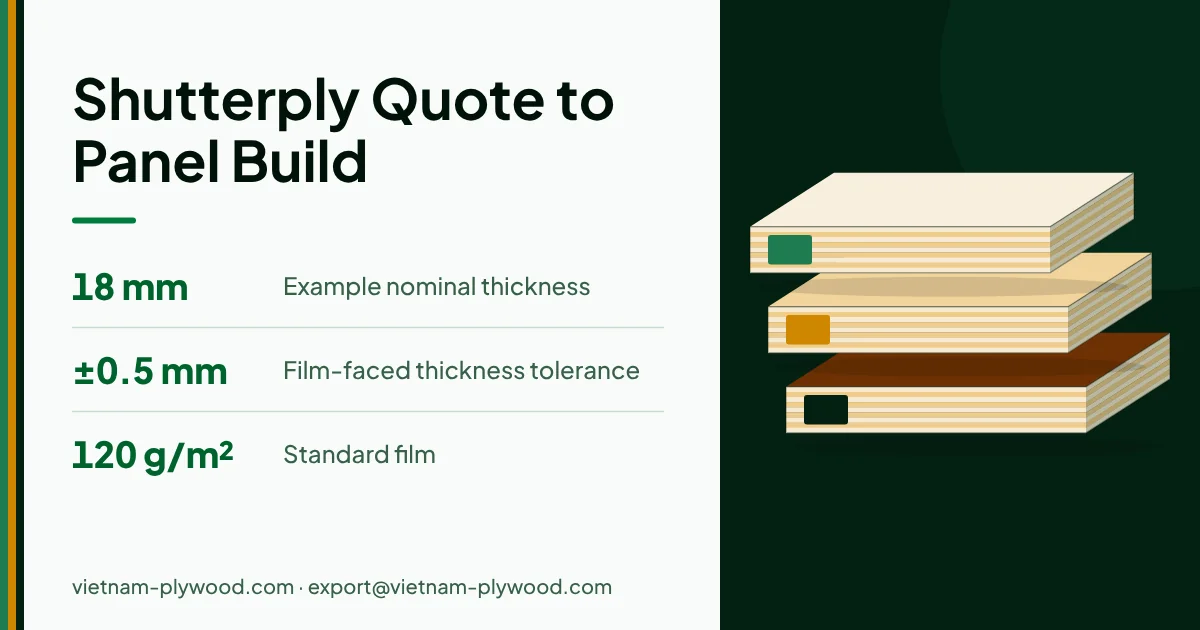
A shutter ply board quote at HCPLY becomes a specified film-faced panel when film weight, glue, core, size and grade evidence are written separately. Choosing the wrong bond, thickness or grading basis can cost a rejected load, extra site handling or lost forming days. We map UK, Irish and South African shutterply wording to the build our construction line actually presses.
What is a shutter ply board?
A shutter ply board is plywood used to form temporary moulds around wet concrete until the concrete can support itself. In UK, Irish and South African buying language, shutterply often means a formwork panel, but the name alone does not identify its film, adhesive or core. A usable quotation states each of those components alongside dimensions and intended service.
A shuttering board forms slab soffits, beam sides, walls or columns against a supporting formwork frame. Its job is to hold the specified shape and surface while wet concrete loads are transferred into that frame. The formwork designer selects panel thickness and support spacing from the actual load case; a trade name cannot establish structural capacity.
HCPLY presses film-faced shuttering panels on our construction line. Our concrete formwork specification guide explains the broader choice of panel, support arrangement and release practice.
What is the standard shuttering board size?
1220 × 2440 mm is the familiar nominal 4 × 8 ft format, while 1250 × 2500 mm is another regular quotation size. Our construction line also works with 1220 × 2135, 1220 × 1830, 915 × 2440, 915 × 2135 and 915 × 1830 mm panels. Custom cutting is available. The ordered length and width tolerance is ±2 mm.
Common thicknesses include 9, 12, 15, 18 and 21 mm; the overall plywood thickness range is 3–40 mm. For shutter ply 18mm, write 18 mm nominal, ±0.5 mm rather than assuming every panel will measure exactly 18.0 mm. That tolerance applies to our film-faced line. A formwork designer must check the span, supports and wet-concrete pressure before approving a thickness.
Record dimensions in millimetres and specify any face pattern direction.
Is shutterply the same as film-faced plywood?
Shutterply is a regional buying name; film-faced plywood identifies a particular coated panel construction. Many shutterply orders are for film-faced plywood, but uncoated shuttering plywood also appears in market quotations. Read the surface field before treating the names as interchangeable.
Our film-faced plywood product specification describes the construction-line build. Its smooth film protects the face during concrete contact and supports release when site handling is correct. Film-faced boards can also have an anti-slip surface, which serves a different working-face requirement.
In an English-language quotation, “phenolic board” may refer to the film, the glue or both. Separate the overlay from the internal bond: film weight describes the surface; phenolic or melamine glue describes the veneer bond. The regional name crosswalk keeps these terms separate.
Which film, glue and core does a shutterply quote buy?
Our construction line presses phenolic or melamine film on acacia or eucalyptus core, with an unsanded core build. Standard film weight is 120 g/m², premium film is 135 g/m² and anti-slip film is 220 g/m². Write the surface and adhesive separately: melamine glue is MR (moisture-resistant), with a 12-hour boil specification; phenolic glue is WBP (weather and boil proof), with a 72-hour boil specification.
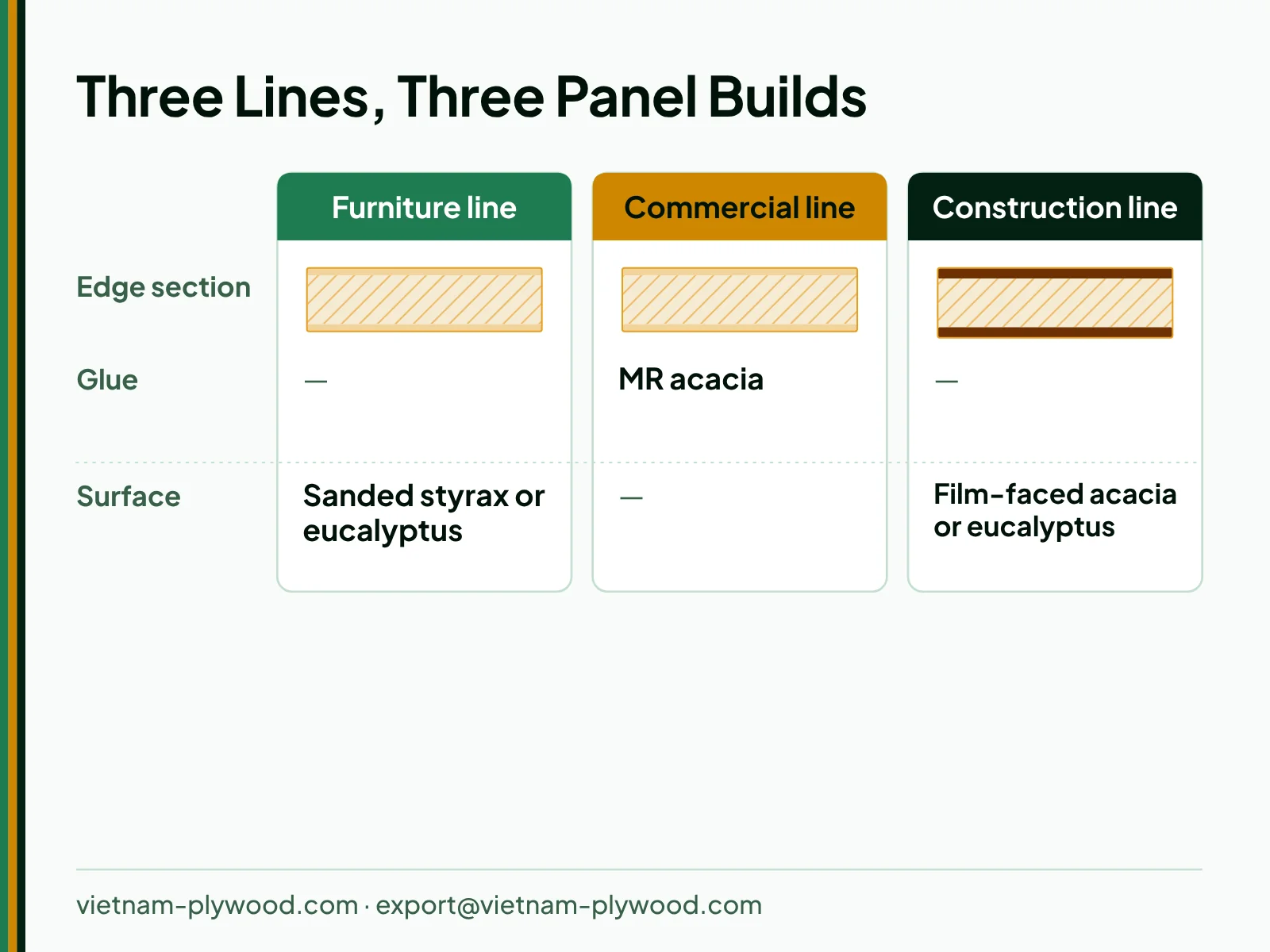
The following crosswalk shows what the same nominal 18 mm request would mean across our production lines. Only the construction-line entry is the film-faced shutterply build.
| Order interpretation | Producing line and core | Surface, glue and finish | Appropriate use |
|---|---|---|---|
| 18 mm shutterply for concrete | Construction; acacia or eucalyptus | Phenolic or melamine film; selected MR or WBP glue; unsanded | Concrete formwork |
| 18 mm furniture panel | Furniture; styrax or eucalyptus | Selected decorative veneer; full stitched and sanded; E0/E1 emission | Furniture and cabinetry |
| 18 mm utility packing panel | Commercial and packing; acacia | Raw or selected face; MR glue; unsanded or light-sanded | Packing and commercial use |
Density follows the core, rather than the face: acacia is 580 kg/m³ and eucalyptus 650 kg/m³.
Is shutterply waterproof?
Film-faced shutterply resists wet concrete exposure when the film, bond and edges are specified and maintained correctly; “waterproof” alone is too broad a purchase criterion. The film shields the faces, while cut edges expose veneer and adhesive lines. Ask for the required bond test report and define how edges will be sealed after site cutting.
For repeated forming, phenolic WBP glue is the more exposure-resistant choice than melamine MR glue under the stated boil specifications. With proper handling, release agent on every pour and sealed edges including cut edges, melamine-glue film-faced panels achieve about 12–15 pours; phenolic-glue panels up to about 25 pours. These figures describe handling conditions, not a load rating.
See formwork stripping and panel life for the site sequence that protects the panel between pours.
What do UK and South African grade lines mean?
UK and South African shutterply quotations can combine a product nickname with dimensions, surface finish, bond class and a local conformity requirement. Treat each printed grade or marking as a separate claim that needs its own definition and evidence. Neither “shutterply” nor a film colour establishes a structural grade.
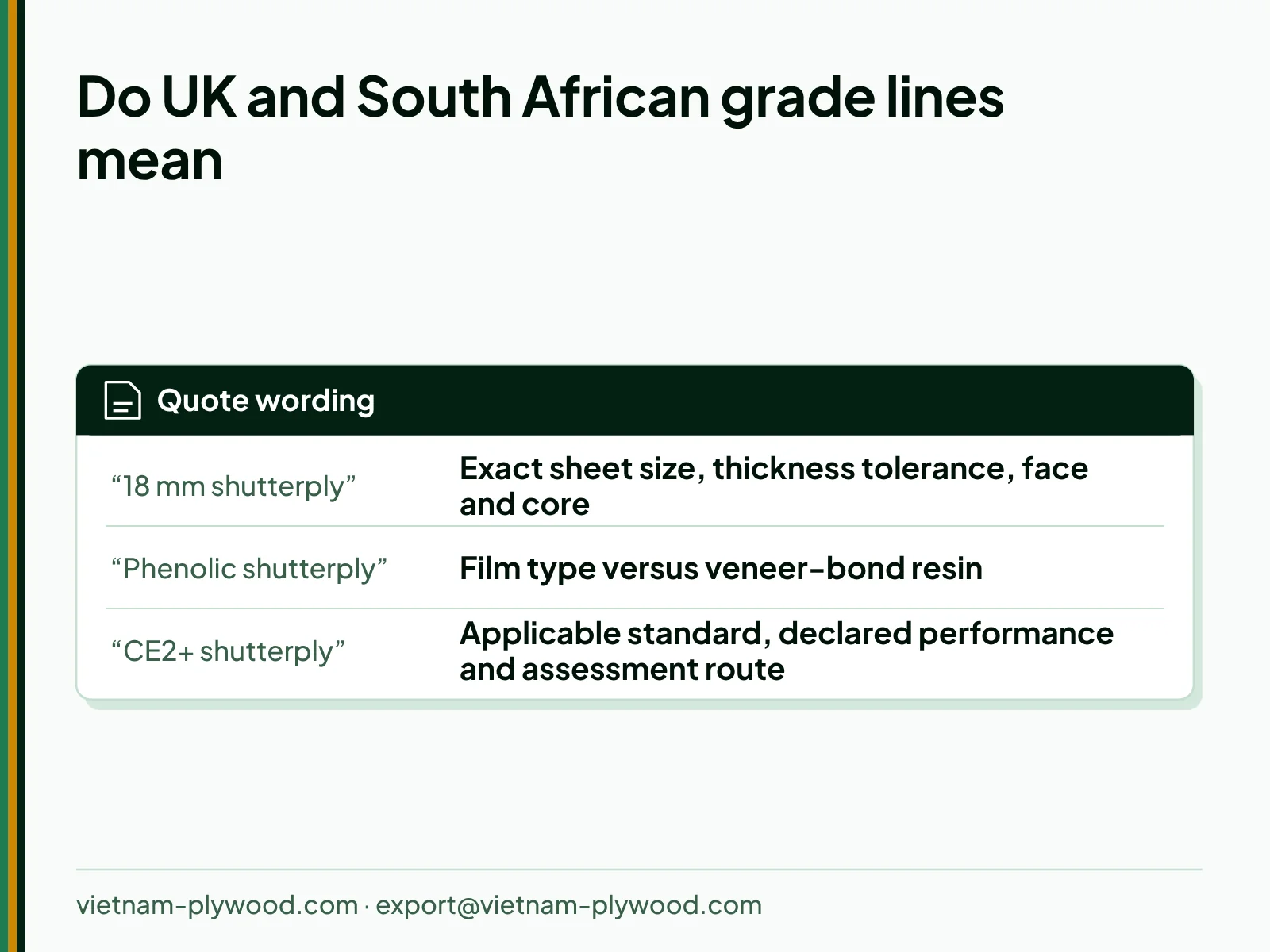
| Quote wording | What to ask the seller to identify | What our quotation can specify |
|---|---|---|
| “18 mm shutterply” | Exact sheet size, thickness tolerance, face and core | 18 mm, ±0.5 mm; named dimensions and construction build |
| “Phenolic shutterply” | Film type versus veneer-bond resin | Film weight and phenolic WBP bond as separate fields |
| “CE2+ shutterply” | Applicable standard, declared performance and assessment route | Relevant member-factory documents shown with factory details masked, on request |
| “CC shutterply” | The grading system, issuer and grade definition | Core construction and inspection criteria in the purchase specification |
| “SANS 929 shutterply” | Edition, scope, test report and claimed conformity | Assessment against a test report the buyer accepts |
The UK government’s 2026 guidance on construction product marking says recognition of CE marking continues in Great Britain while the regulatory framework is reformed (Department for Business and Trade, 2026). That rule does not establish a structural grade for every shuttering sheet. Identify the applicable project standard and evidence before ordering.
A South African SANS 929 reference is a distinct specification issue, rather than a synonym for 18 mm film-faced plywood. The buyer should provide the required edition and acceptance criteria for review against a test report the buyer accepts. Do not substitute a generic “export grade” description for that project requirement.
What does CC shutterply mean?
“CC shutterply” is an incomplete grade description unless the seller names the grading system that defines CC. It can be used as a commercial shorthand, but its letters alone do not specify core voids, veneer repairs, face quality or bond performance. Ask for the actual grading schedule and acceptance photographs.
Our practical core-construction vocabulary is full stitched, stitched outer layers with edge-trimmed inner veneers, finger-jointed and loose-laid. These describe construction choices in descending order of core continuity and price, not an automatic translation of “CC”. A buyer who needs a full stitched core should write those words explicitly and add permitted defects and inspection method.
Inspect a cut sample instead of inferring the inner build from a grade printed on a packing label.
How does pine shutterply compare with hardwood-core film?
Pine shutterply is commonly used as a description for pine-based shuttering material, but the actual species, surface and bond still need to be stated. Our construction line uses acacia or eucalyptus cores, not pine cores. Pine is among our available face veneers on other plywood specifications; naming a pine face does not make the core pine.
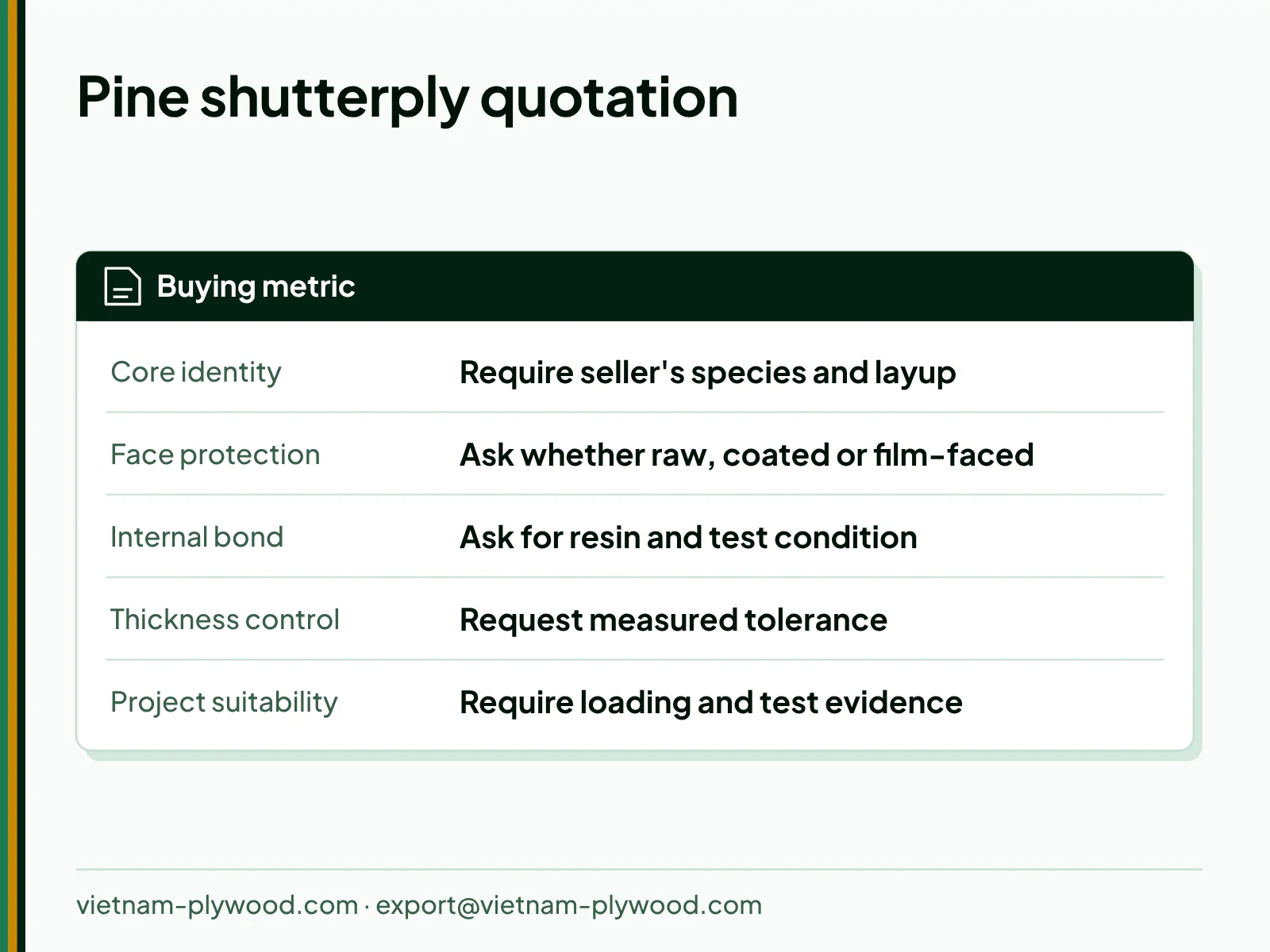
| Buying metric | Pine shutterply quotation | Our hardwood-core film-faced build | Selection consequence |
|---|---|---|---|
| Core identity | Require seller’s species and layup | Acacia 580 kg/m³ or eucalyptus 650 kg/m³ | Compare mass and the actual core construction |
| Face protection | Ask whether raw, coated or film-faced | 120 or 135 g/m² film; 220 g/m² anti-slip | Specify concrete-contact surface |
| Internal bond | Ask for resin and test condition | MR melamine or WBP phenolic | Choose for expected wet exposure |
| Thickness control | Request measured tolerance | ±0.5 mm for film-faced | Match the formwork setting-out schedule |
| Project suitability | Require loading and test evidence | Build offered against the agreed specification | Engineer checks spans and pour loads |
For another core comparison, read birch or hardwood film-faced plywood; our construction line does not press birch-core plywood.
What can an inspector check at the producing factory?
The producing factory can present the ordered build for a witness inspection before loading. HCPLY coordinates specification, on-site quality control, documents and loading, while the panel is pressed at the line matched to the order. Buyers visit the factory office and inspect goods at the producing factory in Phu Tho or Hai Phong.
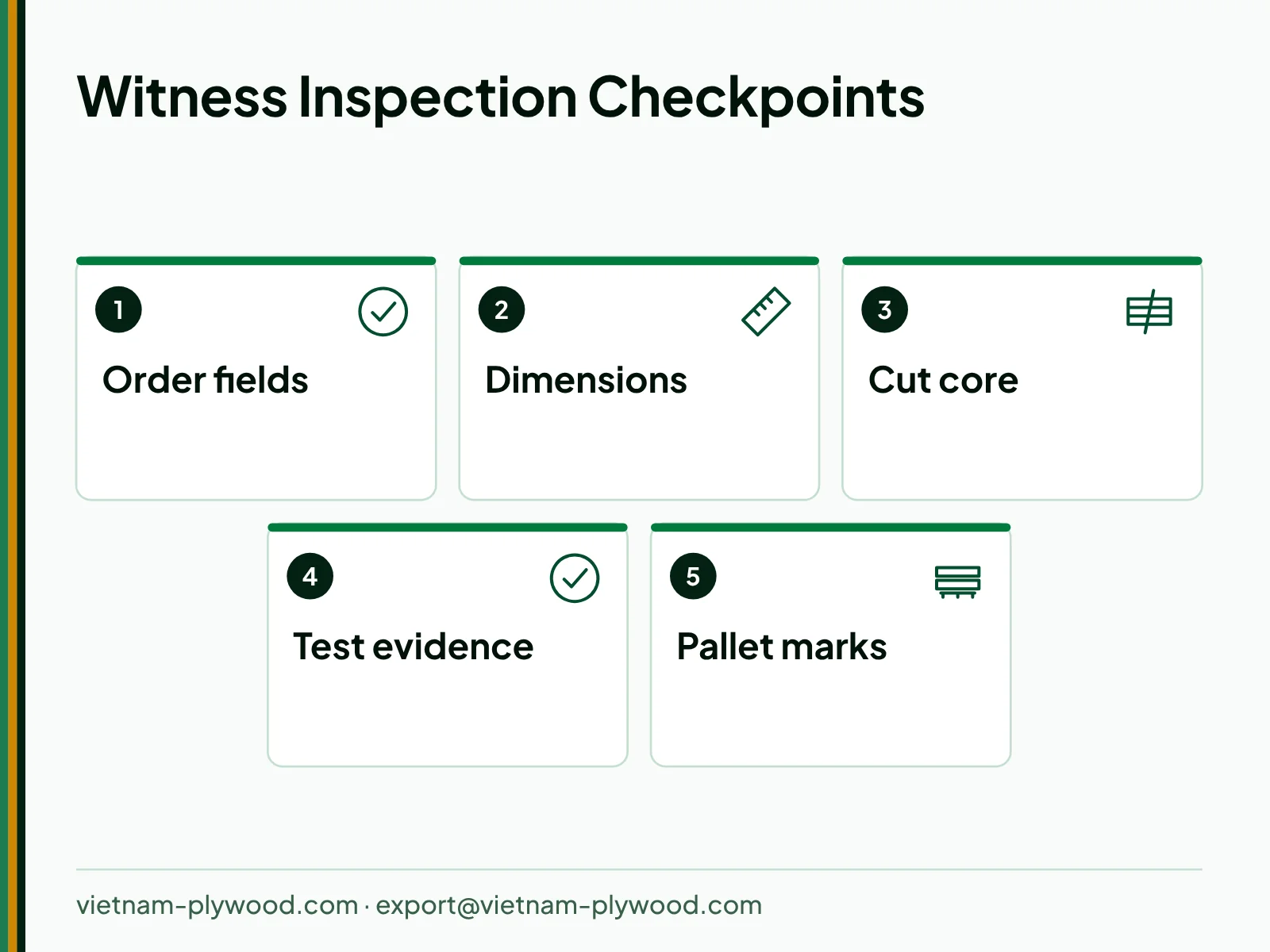
- Match the purchase-order line against film weight, resin type, named core and dimensions.
- Measure length, width and thickness on the agreed sampling plan; compare with ±2 mm dimensions and ±0.5 mm film-faced thickness tolerance.
- Examine both faces, edge sealing and a cut section for the specified core construction and visible gaps.
- Review the agreed bond or emission test report and any required member-factory certificate documents.
- Reconcile pallet marks, packing counts and the loading list with the inspected order lines.
The factory certificate documents for FSC, CARB P2, ISO 9001 or CE, where relevant to the order, are shown with factory details masked, on request. Glue and emission are separate specification fields: E0, E1 and E2 refer to emission classes; CARB P2 and TSCA Title VI concern US formaldehyde limits and third-party certification.
How do mixed shutterply loads affect the quote?
A minimum order is one 40HC container, with different specifications able to share it within the 28.5 t payload limit. For 1220 × 2440 × 18 mm panels, the acacia-core lookup is 31.08 kg per sheet, 55 sheets per pallet and 880 sheets for a full acacia-core 40HC load, excluding film weight. Eucalyptus-core panels are 34.83 kg each and the corresponding full-load lookup is 795 sheets.
The final mixed loading plan must account for film, pallets and other packing within the payload limit.
The container-loading calculation covers complete pallet and container counts. The mixed-container ordering process explains how to separate line items.
Which quote details affect price and delivery?
For film-faced shutterply, the largest build-related price decisions are the core construction and adhesive system, followed by film grade, core species, sheet dimensions and cutting requirements. A full stitched core costs more than finger-jointed or loose-laid construction because it requires more veneer preparation. Phenolic WBP bonding costs more than melamine MR bonding for a more demanding exposure specification; premium or anti-slip film adds surface cost compared with standard film.
Ask for a written quotation against the complete build rather than a generic shutter board price. Factory lead time runs 15–45 days from receipt of the 30% deposit; the exact figure depends on order size, line loading and what the contract fixes. The remaining 70% is paid on the scan of the bill of lading, by T/T, or by irrevocable sight L/C. We ship FOB Hai Phong, or CFR (CNF) or CIF to your port.
Free samples are available; a first-time buyer pays the courier, and that charge comes off the first confirmed order. Our construction plywood capacity is up to 140 containers a month. Construction-project plywood supply addresses site handoffs.
Which shipping papers carry the agreed specification?
The commercial invoice and packing list identify the ordered goods and quantities, while the bill of lading records the sea shipment. The shipment file also includes the certificate of origin, phytosanitary and fumigation papers, insurance under CIF, and order-specific certificate or test documents. EU lots include EUR.1 where applicable and the EUTR/EUDR file set.
A requested FSC claim belongs on the relevant sales documents; agreed emission certificates and test reports accompany the specified build. After loading, the draft shipping documents come to you for approval.
Keep the destination port, trade term and individual shutterply grades consistent across the order and documents.
What should a shutterply purchase specification say?
A workable shutterply order names the concrete application, producing line, core, adhesive, emission requirement, film, nominal thickness, tolerances and sheet size. It also states quantity and destination port. The project engineer approves the support arrangement and loads.
Replace bracketed entries with the agreed build before sending it to Lucy at export@vietnam-plywood.com or through contact.
Application: [slab / wall / beam / column formwork; project load criteria]
Line or core: construction line; [acacia / eucalyptus]; [core construction]
Glue: [phenolic WBP / melamine MR]; required bond evidence [test report]
Emission: [E0 / E1 / E2 / applicable destination requirement]
Face and grade: [120 g/m² standard / 135 g/m² premium / 220 g/m² anti-slip film]; [surface acceptance]
Thickness and tolerance: [18 mm nominal]; ±0.5 mm
Size: [1220 × 2440 mm]; length and width ±2 mm
Quantity: [sheet count and mixed-line breakdown]; minimum one 40HC
Destination port: [port and country]; [FOB Hai Phong / CFR (CNF) / CIF]
Next step: book a factory visit to inspect the proposed shutterply build at the producing factory before loading.