





Film faced plywood vs formply is a comparison of a broad surface description with a regional formwork product name. A mistaken equivalence can cost a contractor a rejected load, replacement panels or days of formwork delay. At HCPLY, our construction line makes film-faced builds whose film, glue and core can be written consistently across regional quotations.
What is the difference in film faced plywood vs formply?
Film-faced plywood means plywood surfaced with resin-treated film; formply commonly means plywood sold for concrete forming, particularly in Australia. The labels can describe similar-looking sheets, yet formply may also imply a specified structural grade and local product requirements. Compare the written construction and project evidence before treating two quotations as equivalent.
For a broad purchasing baseline, see our concrete formwork plywood specification guide. It separates the concrete-contact surface from the panel’s structural role and supporting frame. A dark film does not supply a bending classification, nor does a regional product name establish the bond type.
In Australian procurement, an F17 request is a structural performance requirement. Our construction line does not produce AS/NZS stress-graded plywood; an F17 schedule therefore calls for a different qualified supply route. The Australian formply F17 explanation covers that distinction in its own context.
Which name gives which specification and verdict?
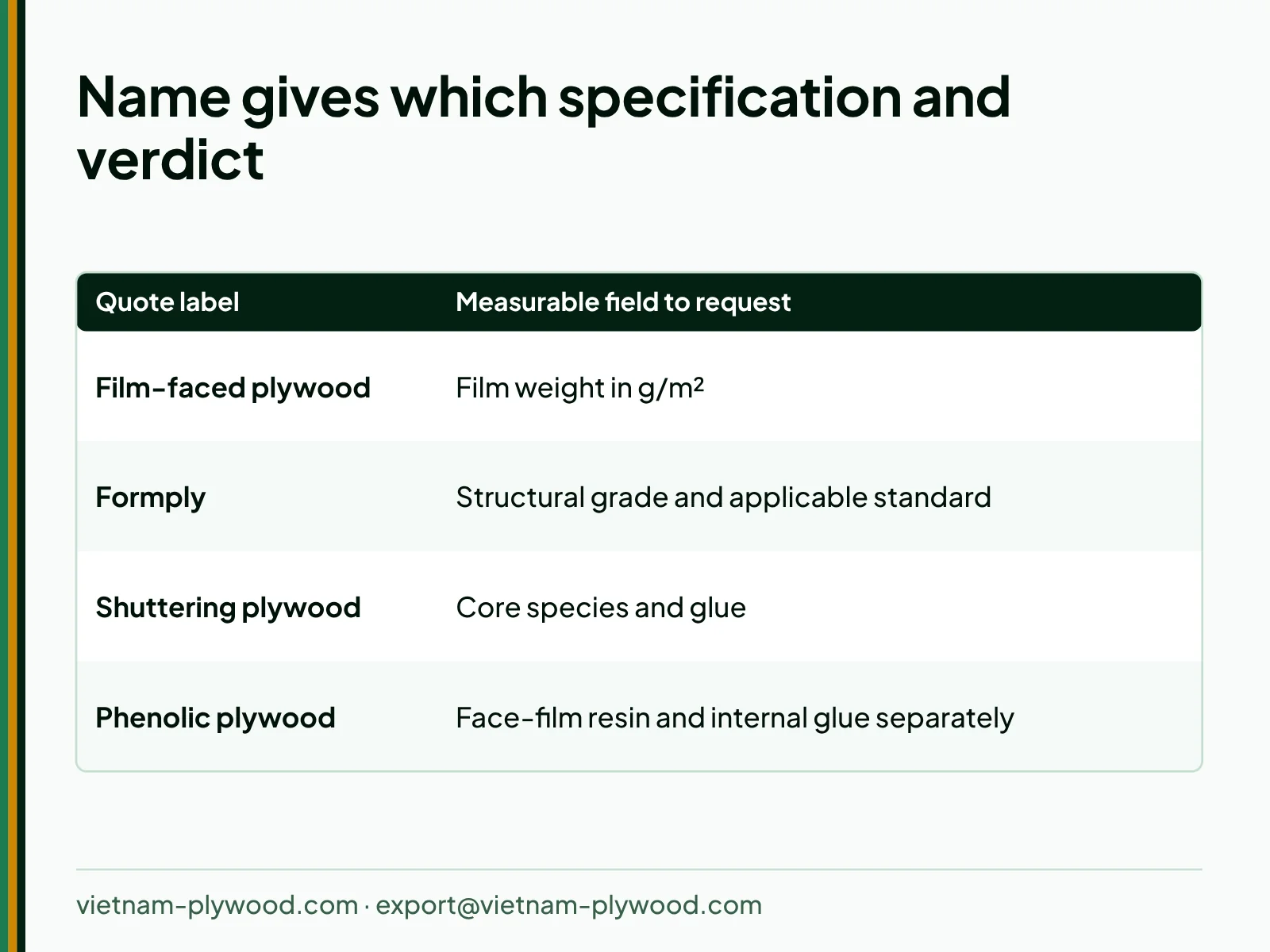
The same market name can hide different films, adhesives and core species. This matrix treats every label as a starting point for a written quotation, with a use-based decision rather than an assumed equivalence.
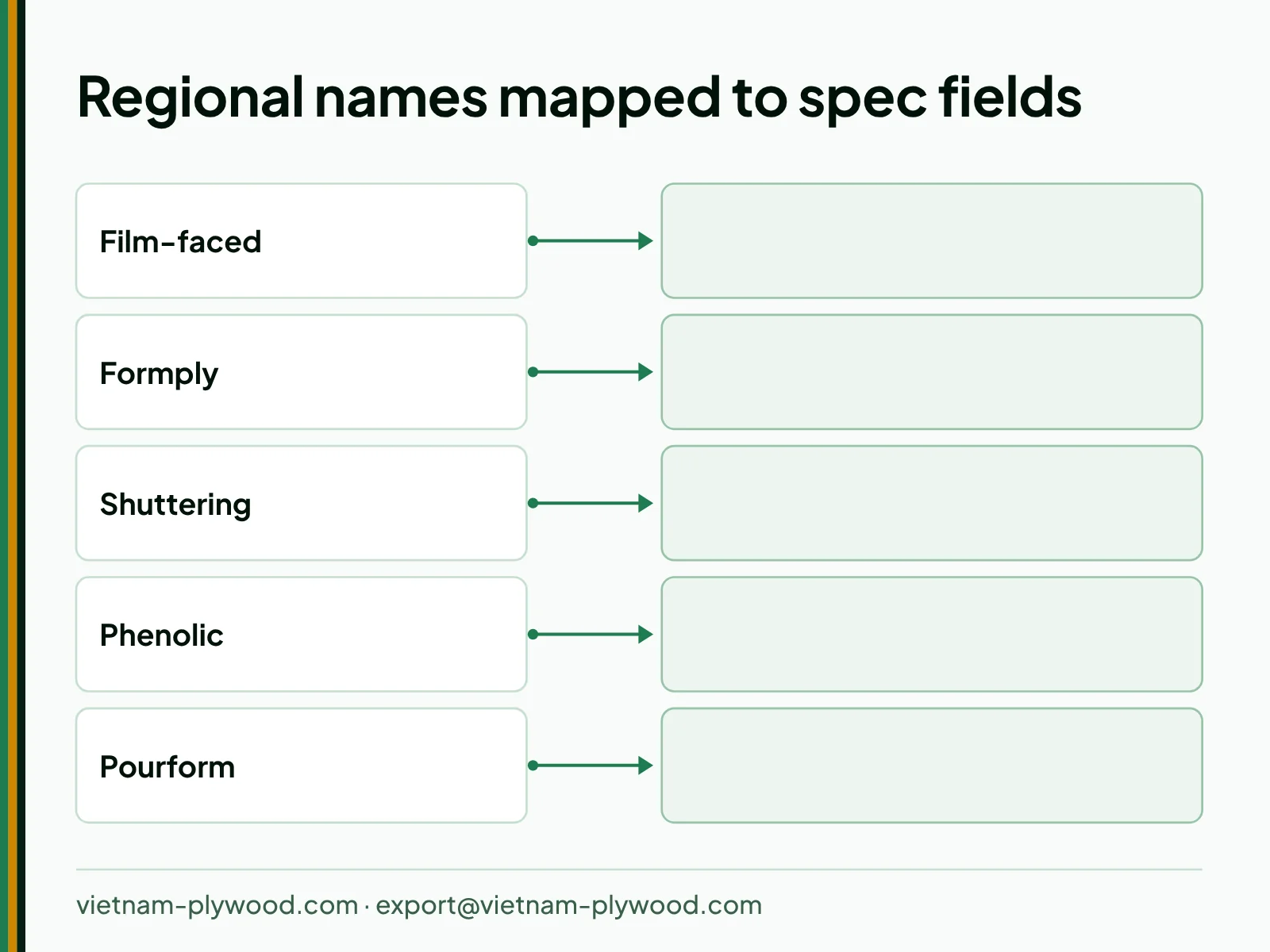
| Quote label | Measurable field to request | What the label establishes | Verdict by use |
|---|---|---|---|
| Film-faced plywood | Film weight in g/m² | Resin-film surface | Suitable candidate for general concrete-contact panels after build review |
| Formply | Structural grade and applicable standard | Formwork application; sometimes local grading | For engineered Australian F-grade schedules, require matching graded evidence |
| Shuttering plywood | Core species and glue | Concrete mould application | Compare construction for walls and columns; name alone is insufficient |
| Phenolic plywood | Face-film resin and internal glue separately | Ambiguous phenolic reference | Accept for wet-cycle evaluation only with the two resin fields separated |
| Pourform plywood | Film, bond and panel dimensions | Poured-concrete application | Compare with other pour-facing sheets on the same written specification |
| Anti-slip film-faced | Textured film at 220 g/m² | Grip-oriented surface | Choose for a grip requirement, not automatically for a smooth off-form finish |
Conversely, a shuttering quote may describe the same non-structural contact-panel build as a film-faced quote once its individual fields match.
What is the difference between film faced and phenolic plywood?
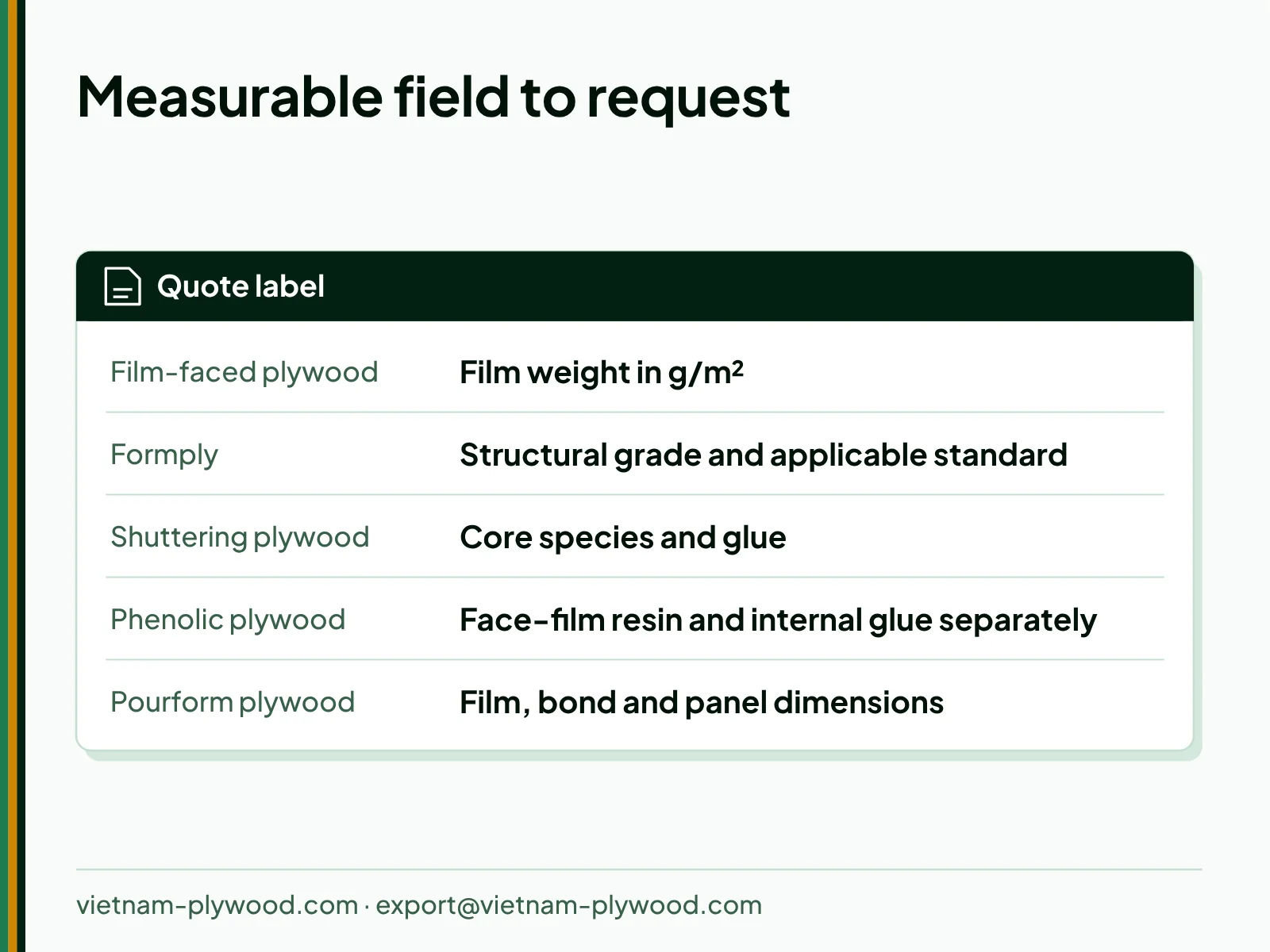
Film faced describes the outer surface, whereas phenolic can refer either to that surface resin or to the adhesive bonding the veneers. A quotation saying “phenolic plywood” should therefore name the face film and the core glue on separate lines.
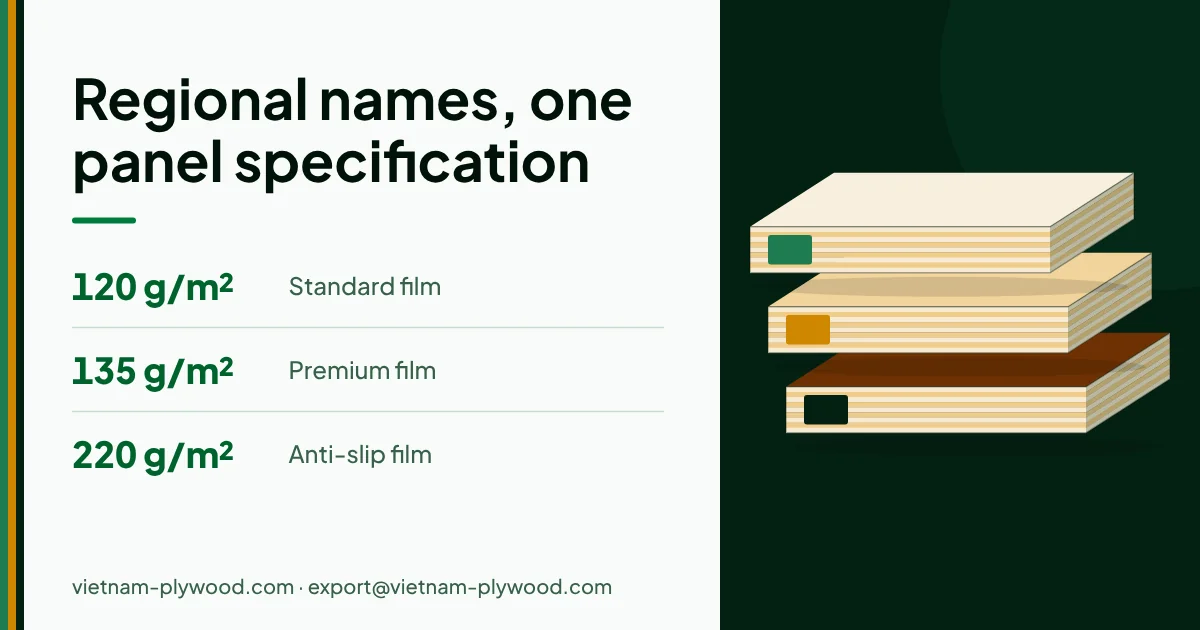
Our construction line offers phenolic or melamine film, including a textured anti-slip option. Its standard film is 120 g/m², premium film 135 g/m², and anti-slip film 220 g/m² only. The glue schedule is separate: melamine MR (moisture resistant) uses a 12-hour boil description; phenolic WBP (weather and boil proof) uses a 72-hour boil description.
These are the specified adhesive descriptions, not an automatic claim about structural capacity or exposure performance of every installation. For the concrete-contact face, ask whether the desired finish is smooth or textured and how cut edges will be treated. Our film-faced plywood product page covers the available surface choices.
What is the difference between shuttering and formwork?
Shuttering commonly means the temporary mould or face that holds fresh concrete in position; formwork can describe the whole mould assembly. Neither term alone specifies a plywood thickness, glue or design load.
The Concrete Society’s 2025 Design of formwork guidance says that vertical formwork must resist concrete pressure and soffit formwork must account for wet concrete and construction loads. That is why panel selection must follow the temporary works design, rather than a merchant’s regional name. See the Concrete Society’s design guidance.
Plywood shuttering is the plywood facing used in such a mould. Formwork stability and load resistance belong to the engineered assembly, with panel properties documented for its intended role.
Why do Indian and Gulf quotations say shuttering plywood?
Shuttering plywood is a familiar regional buying phrase for concrete mould panels in Indian and Gulf construction trade. A purchaser comparing international offers should translate the term into the same fields used for film-faced plywood.
For example, “18 mm shuttering plywood” leaves the film weight, core, bond and dimensional tolerance unanswered. Add the concrete finish, edge treatment and required testing to avoid comparing different builds as if they were equal.
What do centering and shuttering mean on a job?
Centering usually refers to temporary support beneath horizontal or curved concrete work, while shuttering refers to the forming faces that contain fresh concrete. Local bills of quantities sometimes combine the terms for the temporary forming operation.
The Concrete Society’s 2025 explanation of falsework defines the support structure beneath formwork while concrete gains strength. That distinction matters when a buyer is quoting plywood: a facing sheet cannot replace the designed support arrangement. See the Concrete Society’s falsework definition.
For panel removal, surface care and repeat use, read formwork stripping and panel life. Stripping schedules should follow the concrete’s actual strength and the temporary works design, not the trade name printed on the invoice.
What is Pourform plywood in a purchase order?
Pourform plywood is a commercial description of plywood intended as a contact face for poured concrete. A purchasing team should treat it as an application label and attach a complete construction schedule.
A pour-facing sheet may be specified for a smooth concrete surface, whereas a textured film can suit grip-oriented uses. Do not substitute one face for the other because both are called construction plywood.
Which HCPLY line builds these panels?
Our construction line presses the film-faced family, with acacia or eucalyptus cores and unsanded construction. The other lines build different products even when a buyer requests the same nominal thickness.
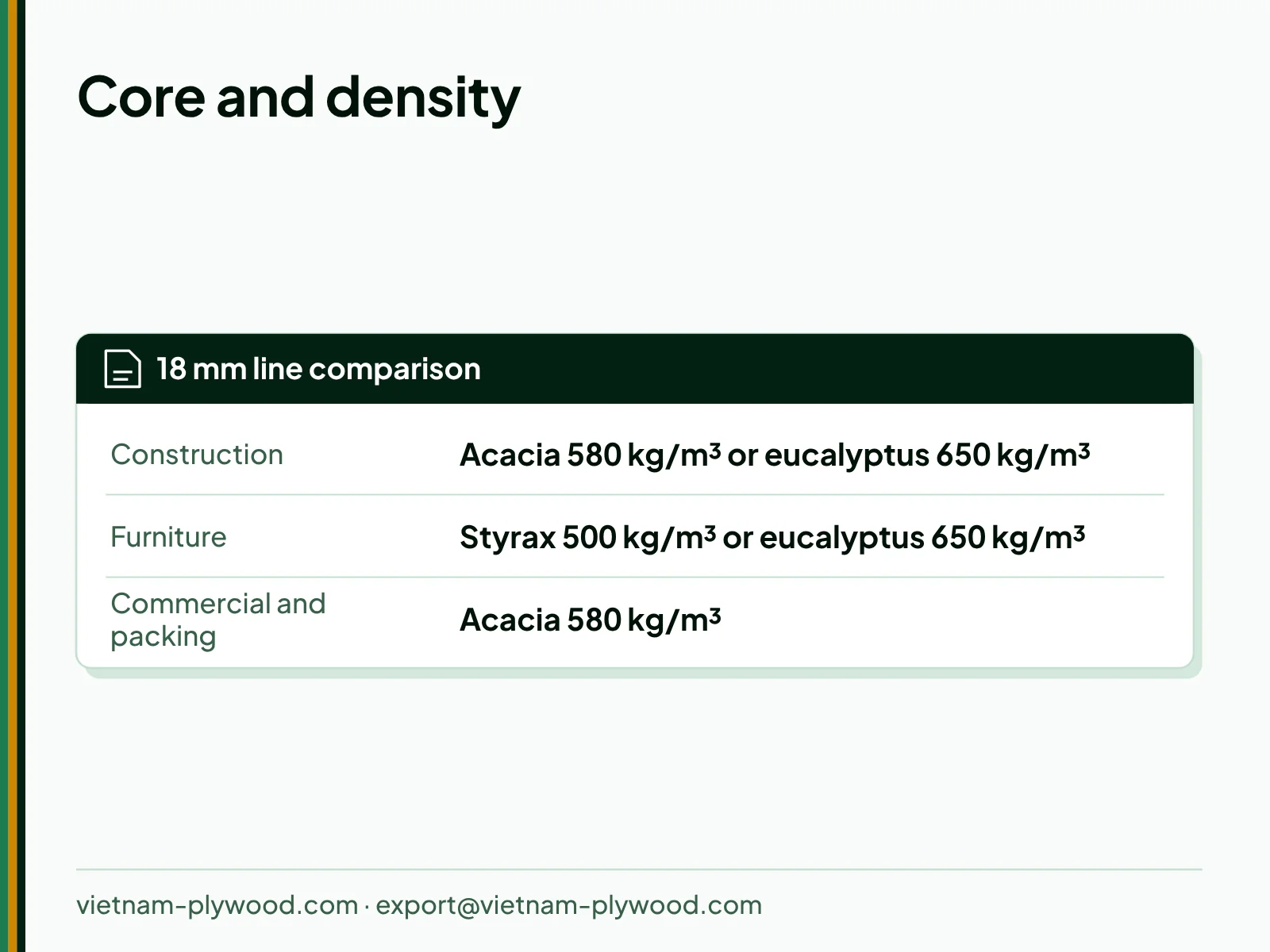
| 18 mm line comparison | Core and density | Surface and glue schedule | Thickness tolerance | Appropriate use |
|---|---|---|---|---|
| Construction | Acacia 580 kg/m³ or eucalyptus 650 kg/m³ | Phenolic or melamine film; MR or WBP as specified | ±0.5 mm | Concrete-contact panels |
| Furniture | Styrax 500 kg/m³ or eucalyptus 650 kg/m³ | Sanded veneer, full stitched core, E0/E1 emission class | ±0.2 or ±0.3 mm as ordered | Furniture and cabinet production |
| Commercial and packing | Acacia 580 kg/m³ | MR glue; unsanded or light-sanded | ±0.5 mm; packing ±0.5–1.0 mm | Packing and commercial applications |
E0/E1 describes the furniture-line emission specification, while MR or WBP describes an adhesive choice. For adjacent purchases, see packing or commercial plywood and plywood supply programmes for distributors.
How do film, glue and core change the buying decision?
Film controls the concrete-contact surface, glue describes the veneer bond, and core species affects weight. Specify each separately, then add thickness, tolerance, size and any agreed test requirement.
For 18 mm sheets at 1220 × 2440 mm, the acacia-core construction option weighs 31.08 kg per sheet; eucalyptus weighs 34.83 kg. These are core-density calculations excluding film weight. The acacia version is lighter for handling and shipment, while the eucalyptus option carries a higher calculated sheet mass at the same dimensions.
With proper handling, release agent on every pour and sealed edges including cuts, melamine-glue film-faced panels deliver about 12–15 pours; phenolic-glue panels reach up to about 25 pours. These conditional figures guide a lifecycle comparison, while the project’s surface acceptance and handling practice still control the buying decision. See sealing plywood edges for the maintenance detail.
How does a mixed container affect the quote?
The core choice changes container payload arithmetic even when dimensions match. For 18 mm, 1220 × 2440 mm sheets, the full 40HC lookup gives 880 acacia sheets at 27.35 t, or 795 eucalyptus sheets at 27.69 t, excluding film weight. Both sit within the 28.5 t payload limit in the core-only calculation.
Specifications can be mixed within one 40HC, subject to that payload limit. A mixed load must be checked by summing the cubic metres of each core build multiplied by its density, then allowing for actual film and packing mass. The container loading calculation owns the detailed pallet and sheet-count method.
If a quote switches core species while keeping the same nominal thickness, the total sheet count and freight allocation need another look before the purchase order is signed.
What can an inspector witness at the producing factory?
An inspector can match the written film, glue and core schedule against production records and the physical panels. At the producing factory, the buyer can check face appearance, cut-edge construction, measured thickness and pallet identification before loading. The inspector should also match the agreed test reports to the build being shipped.
HCPLY coordinates on-site quality control and export documentation. Buyers can visit the factory office and inspect goods at the producing factory. Certificates held by member factories, including FSC, CARB P2, ISO 9001 and CE where relevant, are shown with factory details masked, on request; the presence of a document must be matched to its scope.
After loading, the draft shipping documents come to you for approval. This ties the regional sales name back to the physical lot and the written acceptance schedule.
How should a regional quote be rewritten for approval?
Rewrite a regional quote as a single panel schedule with application, surface, bond, core and dimensions stated independently. Put any mandatory structural classification in its own field, supported by the project’s accepted evidence.
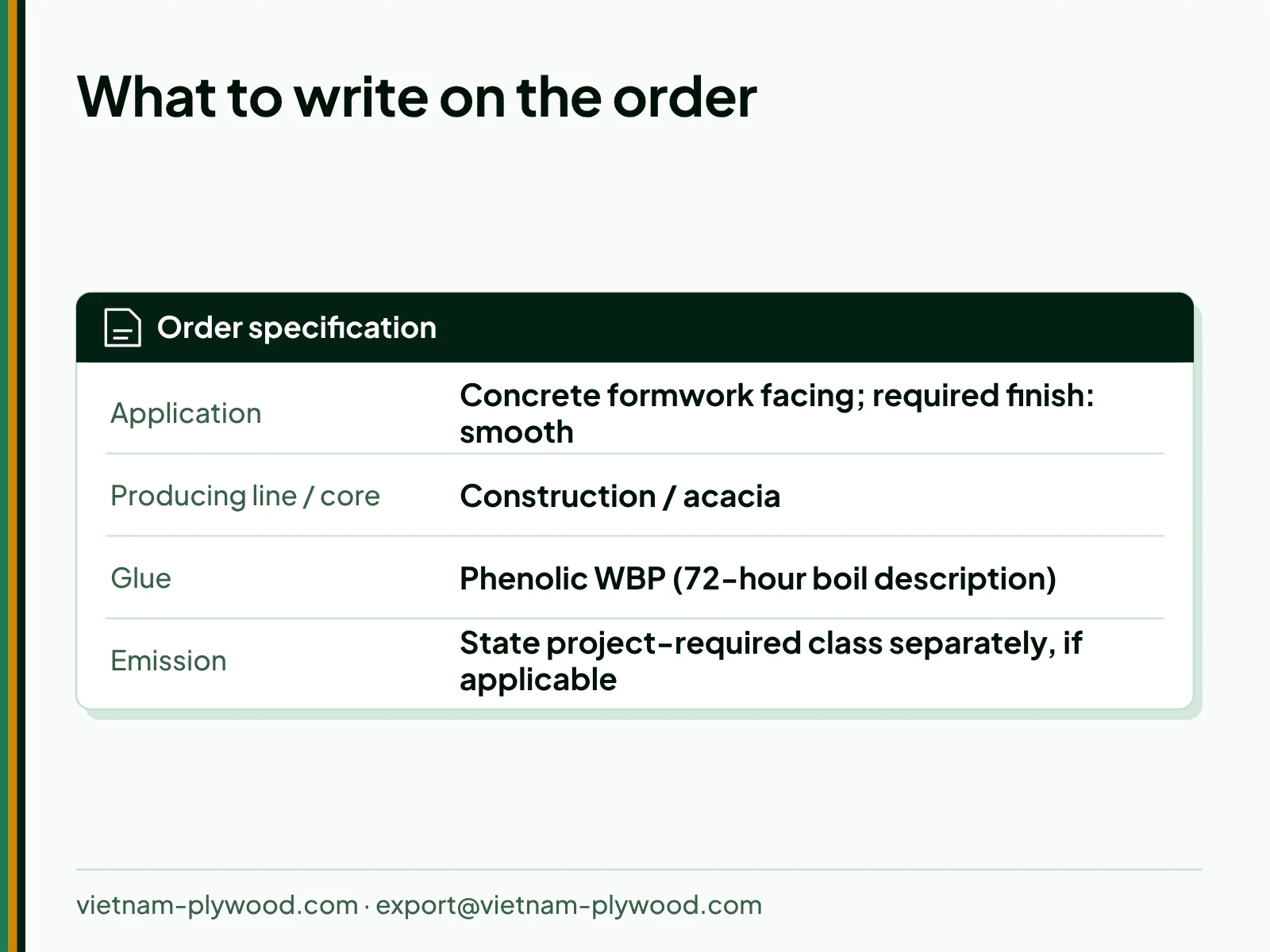
For a standard construction-line enquiry, start with the film weight and glue type, then select acacia or eucalyptus. Record the requested thickness within 3–40 mm, a ±0.5 mm construction tolerance and one of the available sheet sizes.
HCPLY quotes the agreed construction build against its written specification. The following request is ready for Lucy at export@vietnam-plywood.com; arrange a factory visit after the scope is aligned.
Application: Concrete formwork facing; required finish: smooth
Producing line / core: Construction / acacia
Glue: Phenolic WBP (72-hour boil description)
Emission: State project-required class separately, if applicable
Face and grade: Phenolic film, 120 g/m²; film grade per agreed sample
Thickness and tolerance: 18 mm, ±0.5 mm
Size: 1220 × 2440 mm
Quantity: One 40HC; final mix and payload schedule to be agreed
Destination port: [buyer to enter]
Required evidence: Project acceptance criteria and agreed test reports
Next step: book a visit to the producing factory.