





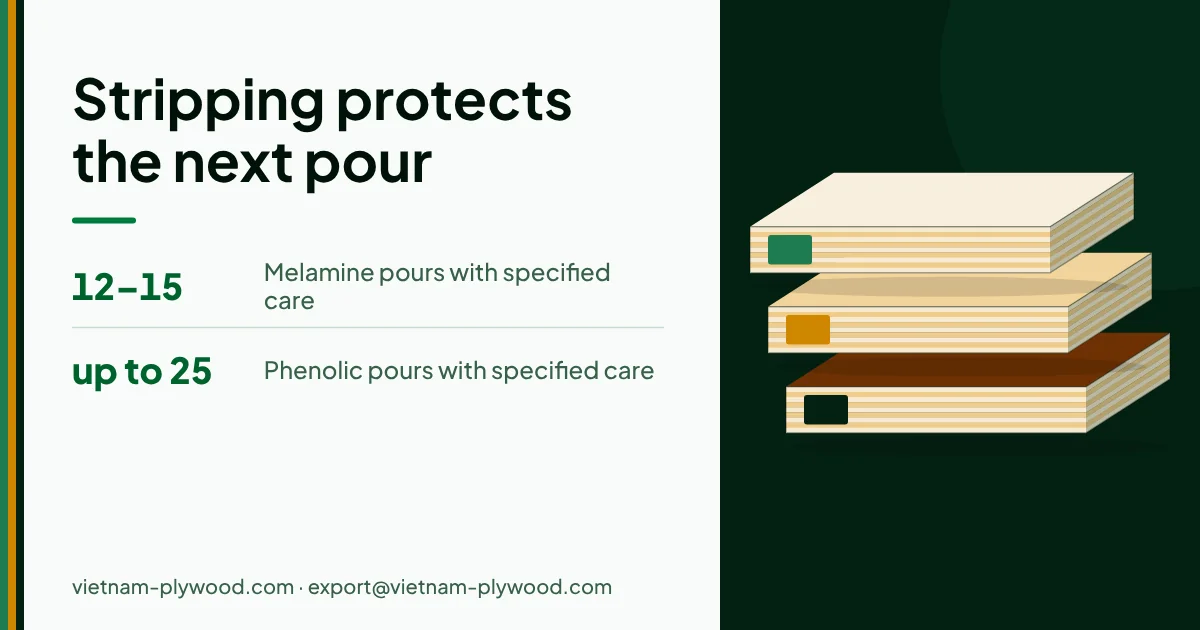
Formwork stripping damage begins when panels are removed before concrete is ready or separated with excessive force. That mistake can destroy usable film, raise replacement cost and delay the next pour. HCPLY supplies construction-line film-faced plywood whose useful life depends on authorized striking, protected faces and sealed edges.
Striking formwork means releasing the forms after the concrete meets the project’s removal conditions. The schedule and the panel-life calculation must be managed together.
What controls formwork stripping?
Formwork stripping starts only after the specified concrete-strength conditions are met and the responsible site team authorizes removal. The United States Occupational Safety and Health Administration (OSHA), under 29 CFR 1926.703(e), requires sufficient strength to carry self-weight and imposed loads, established through the plans and specifications or appropriate compressive-strength testing. This is a United States regulatory rule, rather than a universal calendar schedule.
The 1996 OSHA rule also separates form removal from reshoring removal. OSHA’s cast-in-place concrete regulation states the applicable requirements. Project engineers set the release procedure for the local code, structural system, loads and test evidence.
A planned pour rotation should therefore carry two records: the structural release authorization and the panel-condition inspection. The first controls site safety; the second controls whether the film-faced sheet is fit for another pour. Refer to the complete concrete formwork plywood specification guide when matching the panel to the formwork system.
When can wall and column forms be struck?
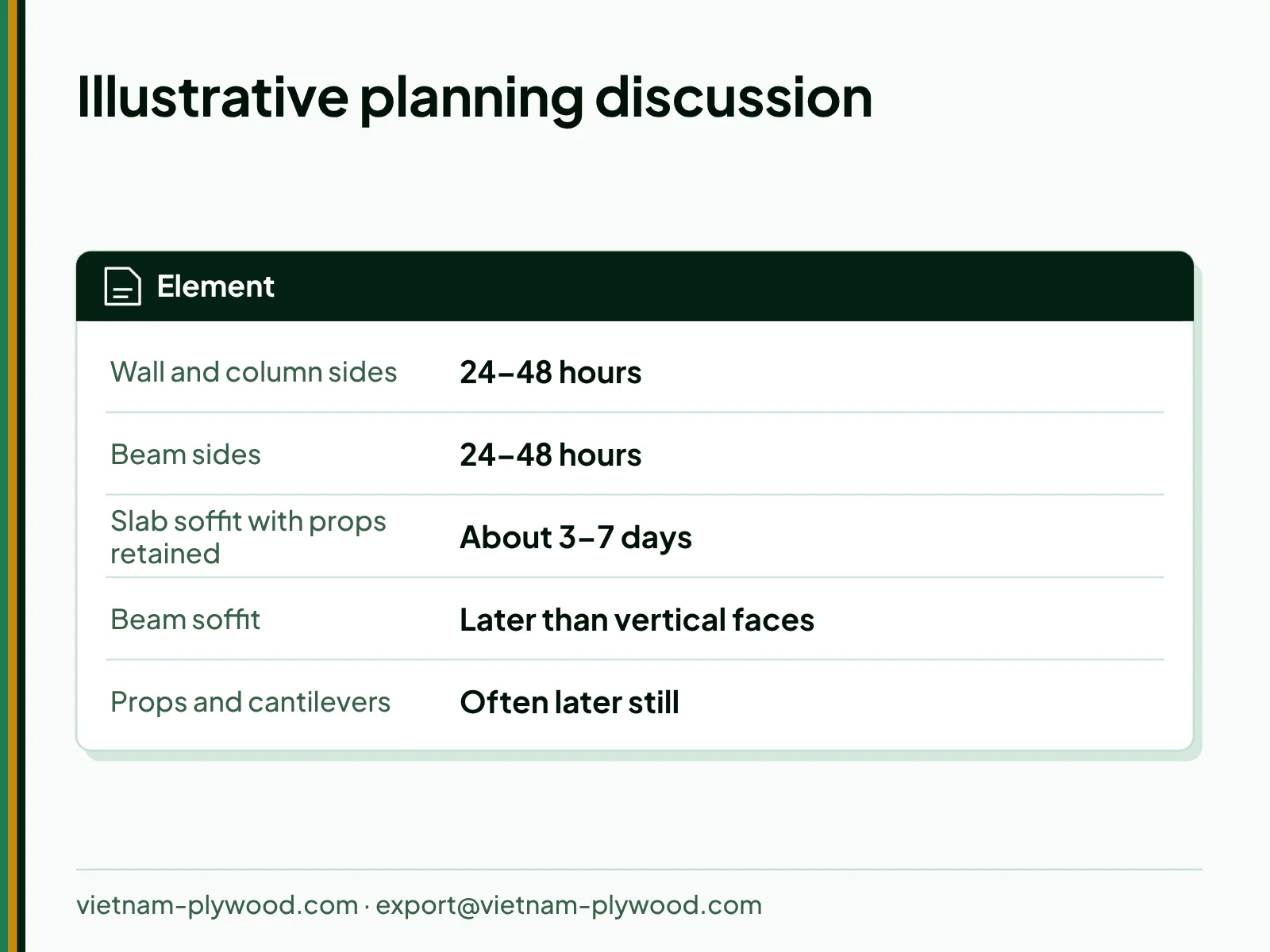
Wall and column side forms are usually scheduled earlier than supported slab soffits, but release still follows the project’s strength criteria. Industry planning discussions commonly mention 24–48 hours for vertical faces; that range is an illustration from the 2026 formwork removal discussion, not an instruction to strike at that age.
Walls, columns, beam sides and footing sides are vertical-face cases only where the panel no longer carries a required structural support function. A deep wall, unusual geometry or an exposed architectural finish can change the approved sequence. Check corners and reveals for fragile concrete before separating a large face.
Crews should release clamps and ties in the approved order, keep the sheet supported and use suitable wedges at designed separation points. Pulling a face abruptly while green concrete grips the film can tear the surface or break a corner. Document the condition of the concrete and panel after the first trial strike.
How long before slab soffit panels come off?
Slab soffit panels come off only when the engineer-approved stripping and support sequence permits their removal. Published industry planning examples mention roughly 3–7 days for a deck with props retained, or around seven days, but these are not release thresholds. The actual sequence turns on concrete strength, span, loading and reshoring design.
Removing the plywood deck and removing the props are different operations. A soffit may be designed for early panel recovery while an independent support arrangement remains. Conversely, a conventional system can require the deck and its supports to remain together. Never assume that a reusable panel can be taken out without changing the support path.
Beam soffits, cantilevers and stairs with supported undersides require their own release checks. Additional floors being cast above can impose construction loads on young concrete. OSHA 1926.703(b)(10) calls for reshoring when original forms and shores are removed and the concrete must carry loads beyond its capacity. Keep the approved support drawings accessible to the stripping crew.
What does the element-by-element schedule mean?
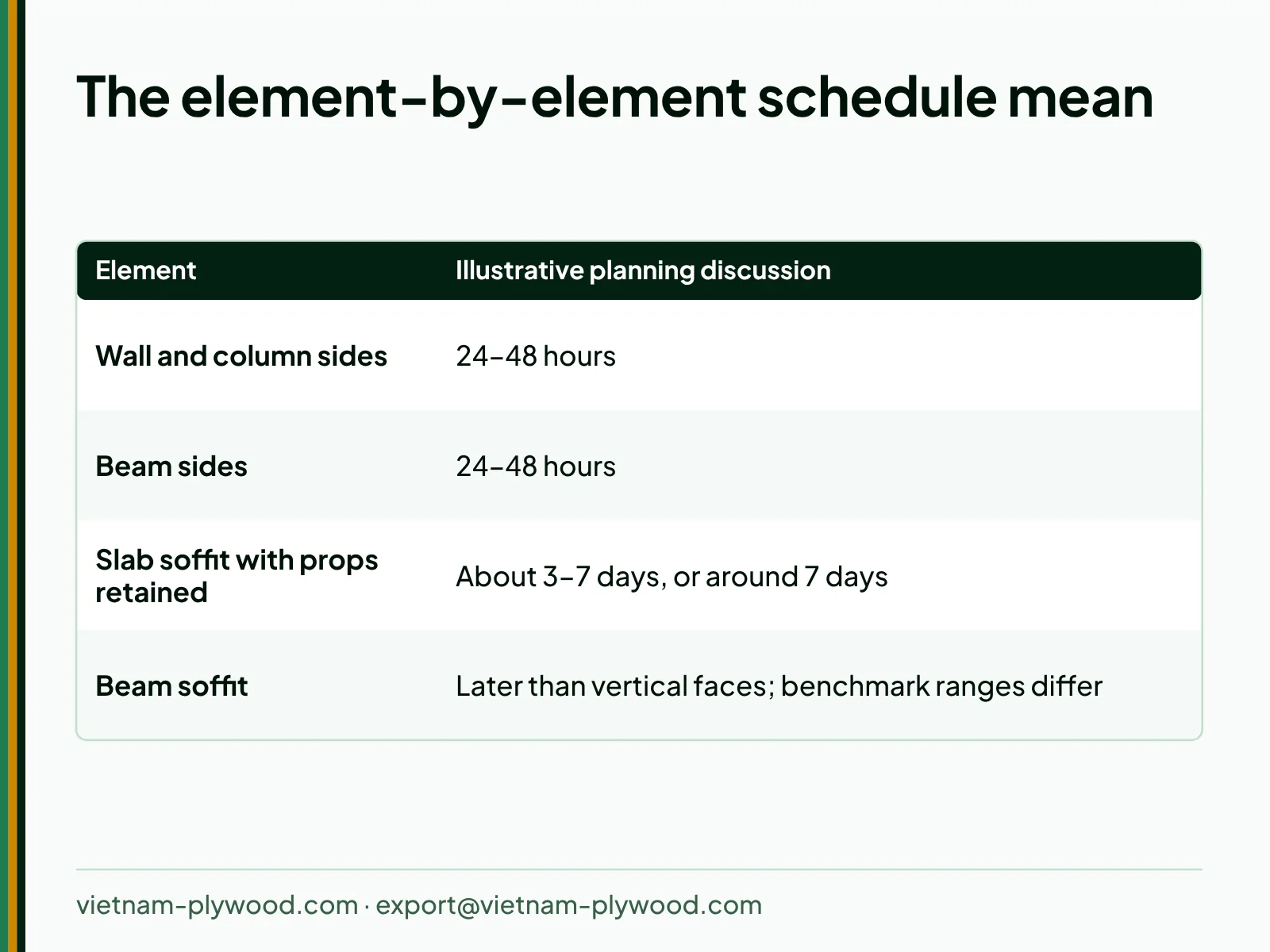
An element table is a planning conversation starter; the approved release decision remains strength-based. The ranges below are reported by the opened 2026 industry benchmarks, while the release criterion comes from OSHA for applicable United States work.
| Element | Illustrative planning discussion | Decision before removal |
|---|---|---|
| Wall and column sides | 24–48 hours | Concrete retains shape; approved vertical-face release |
| Beam sides | 24–48 hours | Side form released separately from soffit support |
| Slab soffit with props retained | About 3–7 days, or around 7 days | Approved deck-removal and reshoring method |
| Beam soffit | Later than vertical faces; benchmark ranges differ | Span, strength and retained support verified |
| Props and cantilevers | Often later still | Engineer-approved load and support release |
The industry ranges are drawn from When to Remove Concrete Formwork and the companion removal-time article. They describe different systems and assumptions, so their numbers should never be combined into a single site instruction. Record the actual approval separately for each structural element.
Does early stripping damage the film face?
Early stripping can tear film where fresh concrete remains bonded to the face, particularly at corners, joints and local high-contact areas. An insufficiently cured surface can also chip or spall when the sheet is pried away. Film damage then exposes the veneer beneath to water during later pours.
Release agent on every pour reduces adhesion between concrete and film. It cannot compensate for an unauthorized early release or a tool forced through the face. See the release-agent guide for the separate application decision.
After a difficult strike, inspect the panel under good light. Look for scratches reaching veneer, lifted film at corners, concrete residue and changes in the face texture. Mark affected sheets before they enter the cleaning stack. A visually smooth face alone does not prove that the concrete was ready to lose its supports.
How does rough stripping damage sealed edges?
Rough stripping can crack the edge coating, split veneer at corners and expose cut edges to moisture. Repeated wetting at an open edge promotes swelling and can disturb the bond between adjacent layers. Damage is often concentrated where wedges or steel tools bear directly on the plywood.
Separate the form with controlled force at the frame or designated release points. Do not drive a crowbar tip into the film or use a sheet corner as the lifting point. Support the panel during lowering so its edge cannot strike a slab, tie rod or another panel.
Inspect every factory edge and every field-cut edge after striking. Clean, dry and reseal exposed cuts before the next pour using a coating compatible with the site procedure. Record repeated damage at the same connection: it can indicate a formwork-detail problem rather than a need for heavier film.
How should panels be lowered and cleaned?
Lower panels under control, remove concrete residue promptly and store them flat under cover. The sequence below makes the panel-condition check repeatable between crews and pour cycles.
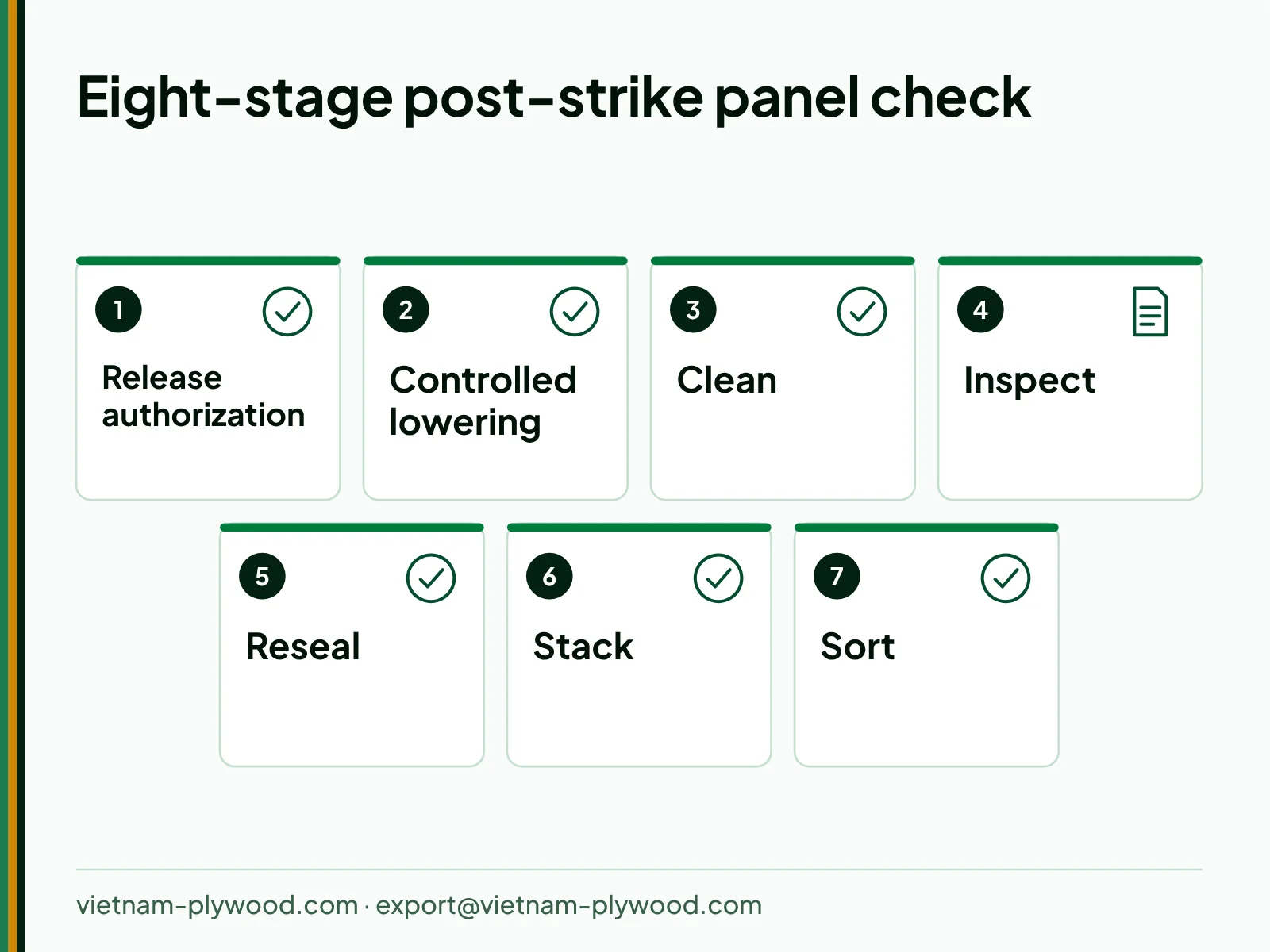
- Obtain the authorized element release and identify which shores remain in place.
- Loosen ties and fittings in the approved sequence while supporting the panel.
- Separate the face with appropriate wedges or designated mechanical release points.
- Lower without dropping, dragging the face or striking exposed corners.
- Remove fresh slurry with non-damaging tools and cleaning methods compatible with the film.
- Check face cuts, edge seal, swelling, core exposure and attachment holes.
- Dry and reseal cut edges, then stack flat on supported bearers under cover.
- Sort sheets for reuse, repair or withdrawal according to the yard’s acceptance rules.
Mechanical or hydraulic stripping systems also need a controlled release sequence; automation does not replace the concrete-strength decision. A formwork pressure and span calculator can help frame specification discussions, but it does not issue structural stripping approval.
Which film and glue build matches the rotation?
Our construction line presses film-faced plywood with acacia or eucalyptus cores and phenolic or melamine glue. The standard film is 120 g/m², premium film 135 g/m² and anti-slip film 220 g/m² only. Film weight describes the surface; glue choice describes the core bond.
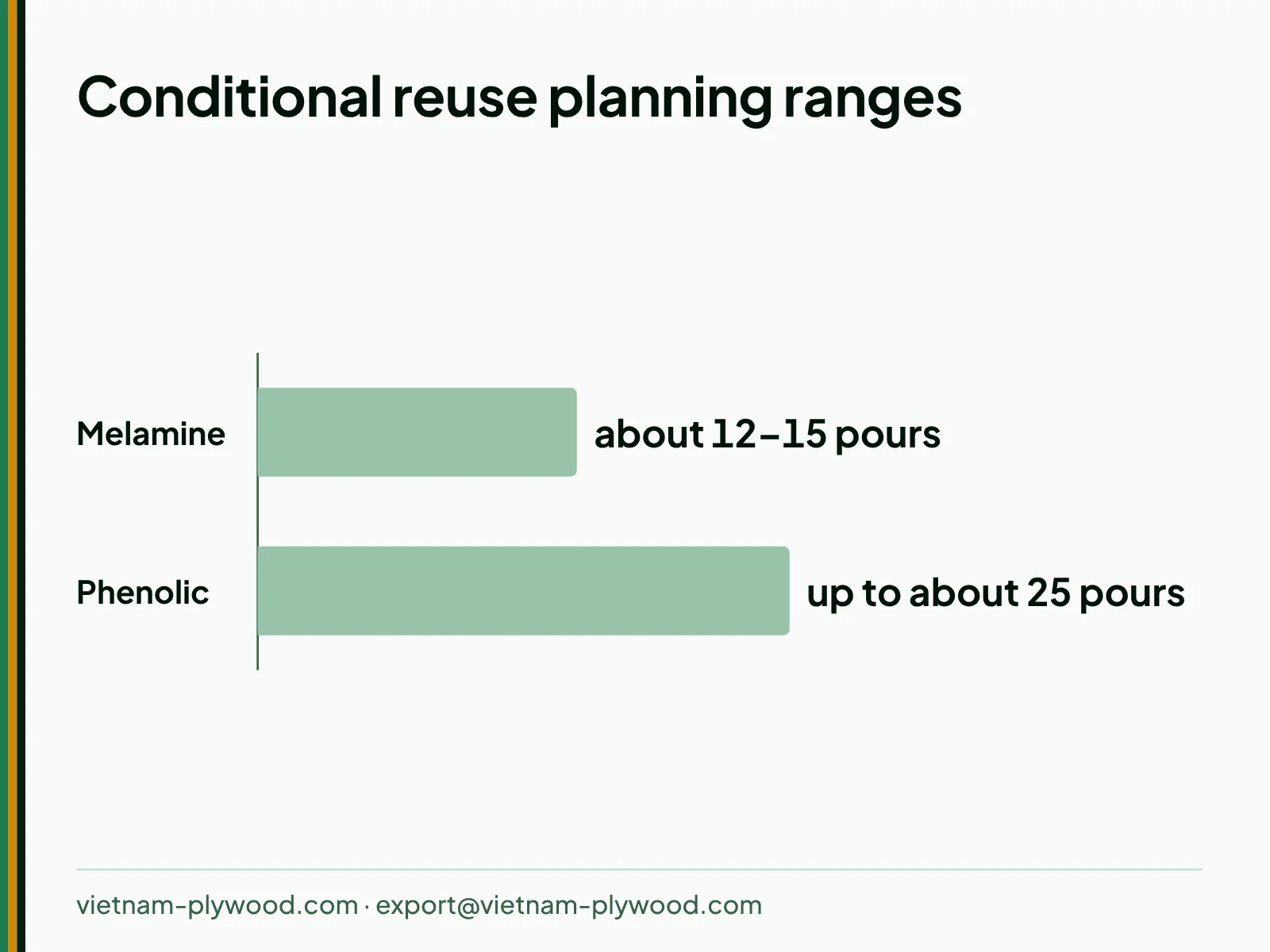
| Ordered construction build | Stated reuse with required care | Buying implication |
|---|---|---|
| Melamine-glue film-faced | About 12–15 pours | Shorter planned rotation |
| Phenolic-glue film-faced | Up to about 25 pours | Longer planned rotation with stricter handling discipline |
Both figures require proper handling, release agent on every pour and sealed edges, including cut edges. They are planning figures under those conditions rather than unconditional site outcomes. A more expensive phenolic build can be economical when the yard actually protects and completes the planned rotations.
For the wider specification see construction plywood and film-faced plywood reuse cycles. HCPLY does not press high-density overlay (HDO), medium-density overlay (MDO), oriented strand board (OSB) or birch-core plywood. Those materials should be specified separately where a project calls for them.
How does stripping practice change the costed pour count?
A damaged sheet reduces the usable pours in the purchasing calculation, even when its initial price remains unchanged. Divide the purchased sheet cost by the number of acceptable pours actually achieved; premature withdrawal raises the panel cost per completed pour. Add cleaning, repairs, handling and rejected-finish costs separately rather than hiding them in the panel price.
A yard planning a phenolic rotation should document the release agent, edge sealing and strike method before choosing the longer reuse assumption. A yard that cuts panels repeatedly or stacks them wet needs to budget for additional replacements. Compare the Vietnam film-faced formwork solutions with the actual form geometry and planned sequence.
For a shipping reference, 18 mm, 1220 × 2440 mm acacia-core sheets weigh 31.08 kg each. A full 40HC reference load is 880 sheets, 47.15 m³ and 27.35 t, excluding film weight; the payload limit is 28.5 t. Mixed specifications can share a container within that limit. See container loading for the owner calculation.
The freight cost per successful pour also rises when damaged sheets require an earlier replacement shipment. A purchase comparison therefore needs a realistic number of completed pours and a written policy for withdrawing damaged sheets.
What can an inspector check at the producing factory?
An inspector can witness film appearance, edge coating, dimensions and the ordered construction before loading. HCPLY assigns the film-faced order to the producing factory on our construction line, where the inspection can compare samples against the agreed written specification.
Our furniture line instead makes full-stitched, sanded styrax- or eucalyptus-core panels with E0/E1 emission classes. Our commercial and packing line makes acacia-core MR panels, unsanded or light-sanded. Neither is a substitute for the ordered construction film surface.
For the construction order, specify acacia or eucalyptus core, film weight, glue system, thickness, tolerance, format and edge treatment. Commercial and film-faced thickness tolerance is ±0.5 mm; length and width tolerance is ±2 mm. A factory inspection cannot establish future site reuse, so the acceptance record should distinguish shipped-panel condition from subsequent stripping damage.
The packing list identifies the shipped quantities and specification breakdown in the export document set. HCPLY handles specification, on-site quality control, documentation and loading, with shipment FOB Hai Phong. After loading, the draft shipping documents come to you for approval.
What should the purchase specification record?
The specification should connect the intended structural application, chosen panel build and planned reuse procedure. A 120 g/m² or 135 g/m² film choice alone cannot tell the yard how many acceptable pours it will achieve. The core, glue, edge treatment and handling method belong beside the film description.
Include whether sheets will be repeatedly cut, which faces contact concrete, the release-agent routine and who authorizes withdrawal after damage. Mark the intended wall, column or slab application because the removal sequence differs. The lead-time guide covers production planning separately from on-site curing and striking time.
Minimum order is one 40HC. Factory lead time runs 15–45 days from receipt of the 30% deposit; the exact figure depends on order size, line loading and what the contract fixes. The remaining 70% is paid on the scan of the bill of lading, by T/T, or by irrevocable sight L/C. We ship FOB Hai Phong, or CFR (CNF) or CIF to your port. For a quotation, describe the film-faced build and the planned site handling rather than requesting an unsupported fixed reuse rating.
What should the buyer send for a trial container?
Send a complete construction-panel specification and a brief account of the planned stripping cycle. Lucy at export@vietnam-plywood.com can use it to prepare the build and inspection discussion.
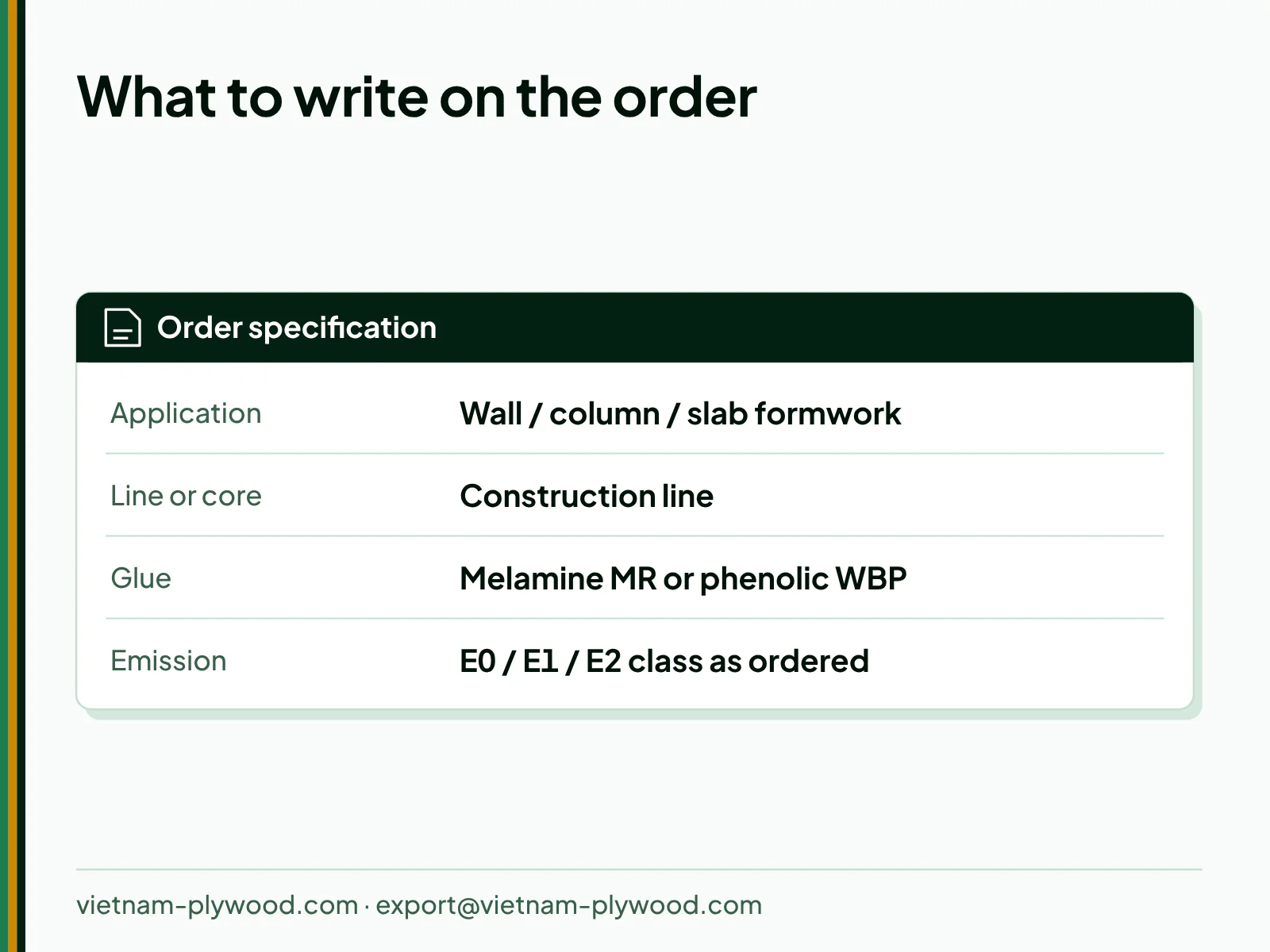
Application: wall / column / slab formwork; planned stripping sequence
Line or core: construction line; acacia or eucalyptus core
Glue: melamine MR or phenolic WBP
Emission: E0 / E1 / E2 class as ordered
Face and grade: 120 g/m² or 135 g/m² film; film finish specified
Thickness and tolerance: 18 mm; ±0.5 mm
Size: 1220 × 2440 mm; length/width ±2 mm
Quantity: one 40HC; sheet count and mixed specifications stated
Destination port: [buyer to specify]
Site protocol: release agent every pour; seal all cut edges
Next step: plan a trial container around the agreed panel build and documented stripping procedure.