





Film faced birch plywood earns its premium when measured formwork performance offsets the higher purchase cost across usable pours. Choosing on species alone can waste money on panels that fail a finish requirement or are retired early. HCPLY builds Vietnamese hardwood-core alternatives, allowing contractors and formwork importers to compare actual specifications rather than labels. The starting point is the concrete formwork specification guide.
Is film faced birch plywood worth its premium?
Birch is worth paying more for when the supplier documents an advantage in bending performance, edge durability or repeated use under the buyer’s forming conditions. A birch name alone cannot establish those outcomes. Match the panel to concrete pressure, support spacing, surface-finish acceptance and stripping practice before deciding which premium is justified.
Compare tested panels in the same form design and record acceptable pours. A premium pays only when extra usable life or reduced remedial work offsets its cost.
The APA – The Engineered Wood Association’s 2026 online concrete-forming guidance explains that form pressure depends on pour rate, temperature, concrete density, vibration and height. A panel comparison therefore needs both the site engineer’s design acceptance and a sample finish trial.
How do birch and hardwood film-faced panels compare?
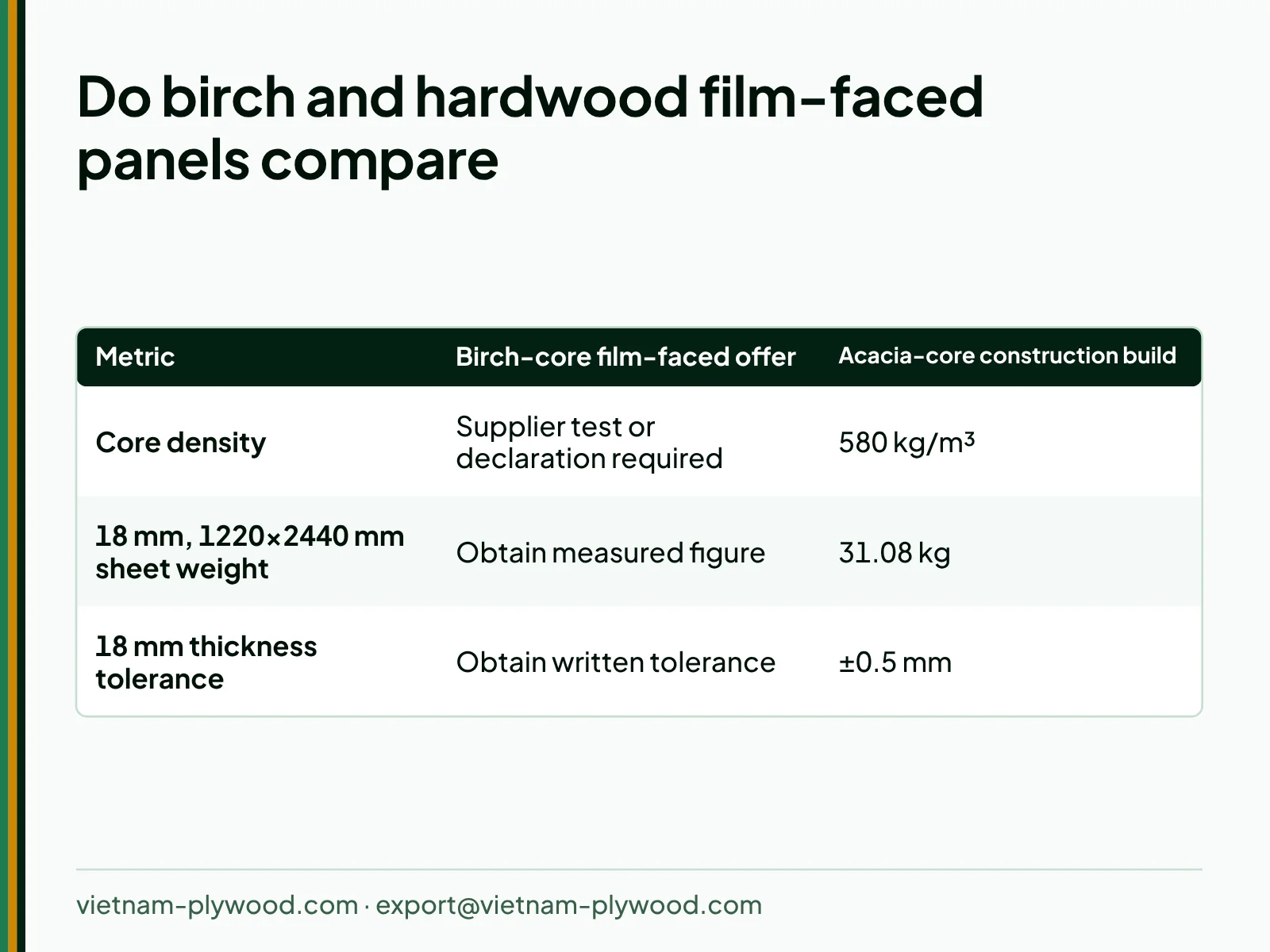
At the same thickness and size, core density sets the handling weight; film color cannot tell you that weight. Usable pour count depends on bonding, overlay, cut-edge protection, concrete mix and site care. Compare birch offers against measured results, then use our specified hardwood figures as a known baseline.
| Metric | Birch-core film-faced offer | Acacia-core construction build | Eucalyptus-core construction build | Verdict by use |
|---|---|---|---|---|
| Core density | Supplier test or declaration required | 580 kg/m³ | 650 kg/m³ | Acacia when handling weight matters |
| 18 mm, 1220×2440 mm sheet weight | Obtain measured figure | 31.08 kg | 34.83 kg | Compare birch by actual sheet weight |
| 18 mm thickness tolerance | Obtain written tolerance | ±0.5 mm | ±0.5 mm | Check form-joint alignment |
| 18 mm sheets in a full 40HC | Obtain loading plan | 880 | 795 | Acacia for more sheets at the specified loading |
| Film weight options | Obtain film specification | 120 or 135 g/m² | 120 or 135 g/m² | Match surface wear requirement |
| Reuse evidence | Site trial and supplier evidence | Glue-specific conditions below | Glue-specific conditions below | Select by acceptable pours, not a label |
| Structural suitability | Project-specific engineering evidence | Project-specific engineering evidence | Project-specific engineering evidence | No automatic species-based approval |
The hardwood weights exclude film weight. Birch density, birch loading quantity and birch reuse results are not assumed here. For a detailed view of stripping and panel life, compare the same release agent and concrete mixture during the trial.
What is phenolic Baltic birch plywood?
Phenolic Baltic birch plywood is a birch-veneer plywood panel supplied with a phenolic-resin film surface for forming or industrial use. The phrase describes a core and overlay combination, but does not independently state the mechanical grade, overlay mass or glue-bond test result.
Buyers also encounter the names phenolic film-faced birch plywood, phenolic coated Baltic birch plywood and black phenolic Baltic birch plywood. Black identifies an appearance, not a verified bending capacity or service life. Ask whether the entire core is birch, whether both faces carry film, and what test evidence accompanies the offered batch.
A dense, uniform birch layup can be attractive where edge fasteners, repeated cutting and tight form joints dominate. That benefit still needs evidence at the specified thickness and support spacing. For visible birch veneers in furniture rather than concrete forming, see birch-faced plywood; a birch face and a birch core are different constructions.
Is there a birch film faced plywood alternative?
A birch film faced plywood alternative is a hardwood-core film-faced panel selected against the same formwork performance requirements. Our construction line uses acacia or eucalyptus core veneers beneath phenolic or melamine film. We do not press birch-core plywood, including birch-core film-faced sheets.
For repeated walls, columns and slabs, start with the concrete finish, pour pressure and panel support layout. Then specify core, glue, film mass and edge treatment. A hardwood substitution can be practical when the engineer accepts its measured properties and the trial produces the required surface.
Our Vietnamese film-faced formwork builds describe the available construction route. A project demanding a named structural grade needs a test report the buyer accepts; a familiar wood species or dark film does not replace that report. We do not press medium-density overlay (MDO) or high-density overlay (HDO) panels.
Which of our lines builds the alternative?
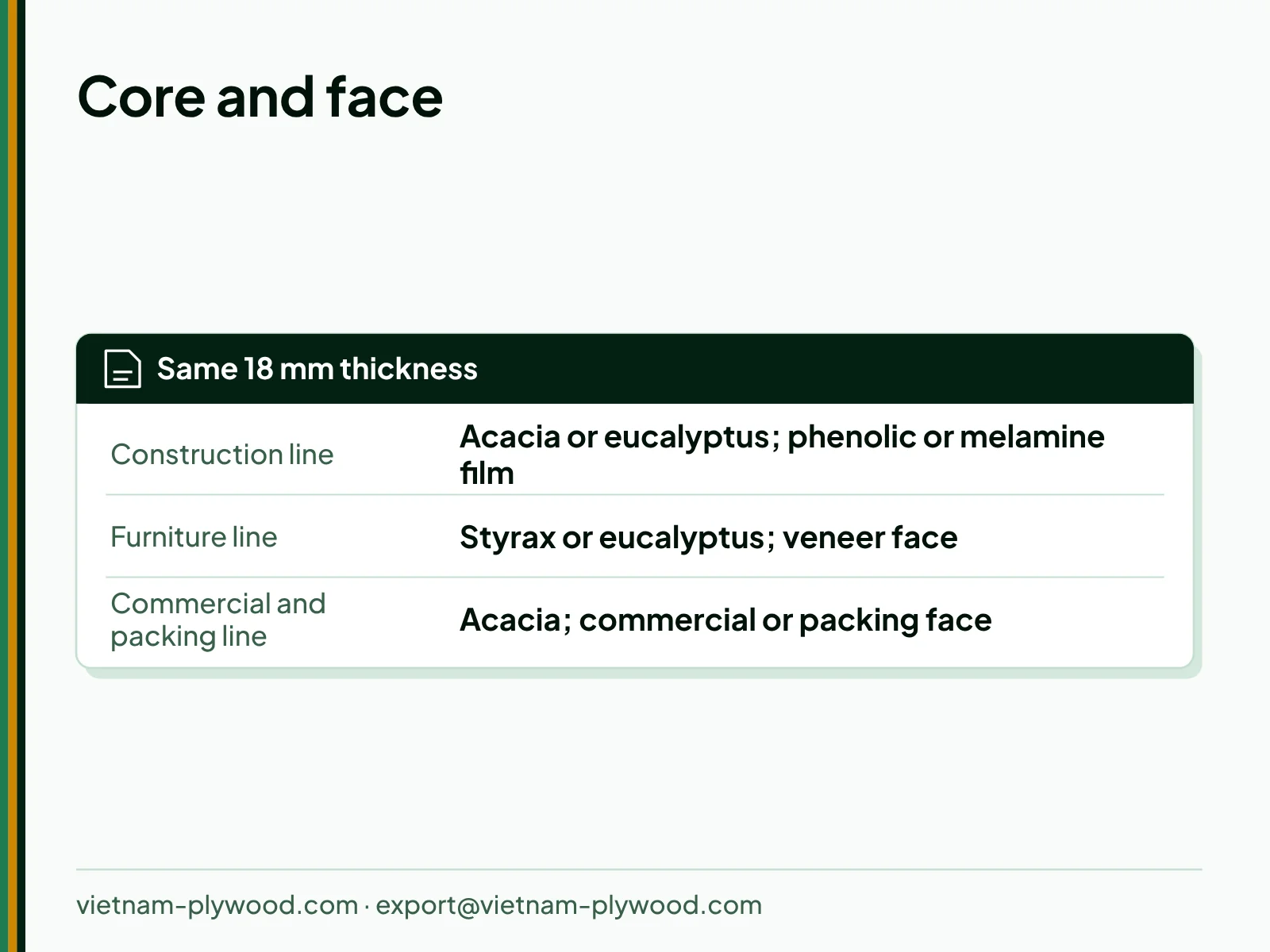
Our construction line presses film-faced plywood with acacia or eucalyptus cores, an unsanded core and the agreed film. Our furniture line instead builds full-stitched, sanded styrax- or eucalyptus-core panels for furniture specifications. Our commercial and packing line builds acacia-core panels with moisture-resistant glue and unsanded or light-sanded faces.
| Same 18 mm thickness | Core and face | Typical order purpose | Thickness tolerance |
|---|---|---|---|
| Construction line | Acacia or eucalyptus; phenolic or melamine film | Concrete form face | ±0.5 mm |
| Furniture line | Styrax or eucalyptus; veneer face | Cabinet and furniture components | ±0.2 or ±0.3 mm as ordered |
| Commercial and packing line | Acacia; commercial or packing face | Packaging and general panels | ±0.5 mm commercial; ±0.5–1.0 mm packing |
These are different builds even when the thickness reads 18 mm. A furniture veneer face does not become a concrete release surface through a change of label. Compare the intended applications in our factory-line grade comparison and packing and commercial plywood overview.
Is eucalyptus or acacia better for formwork?
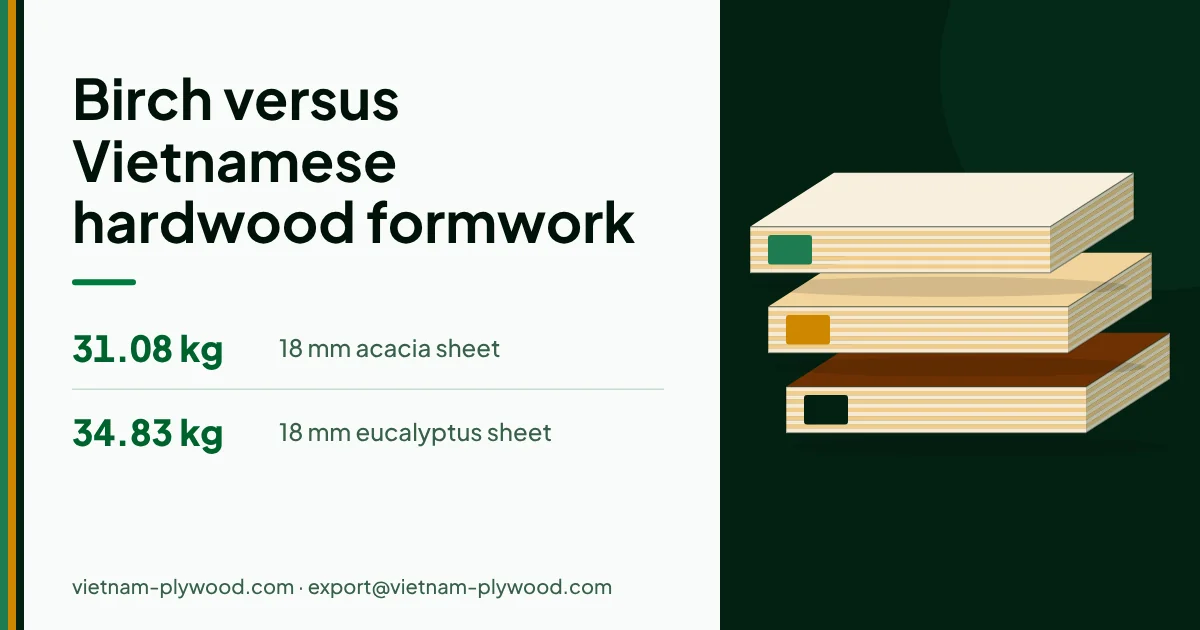
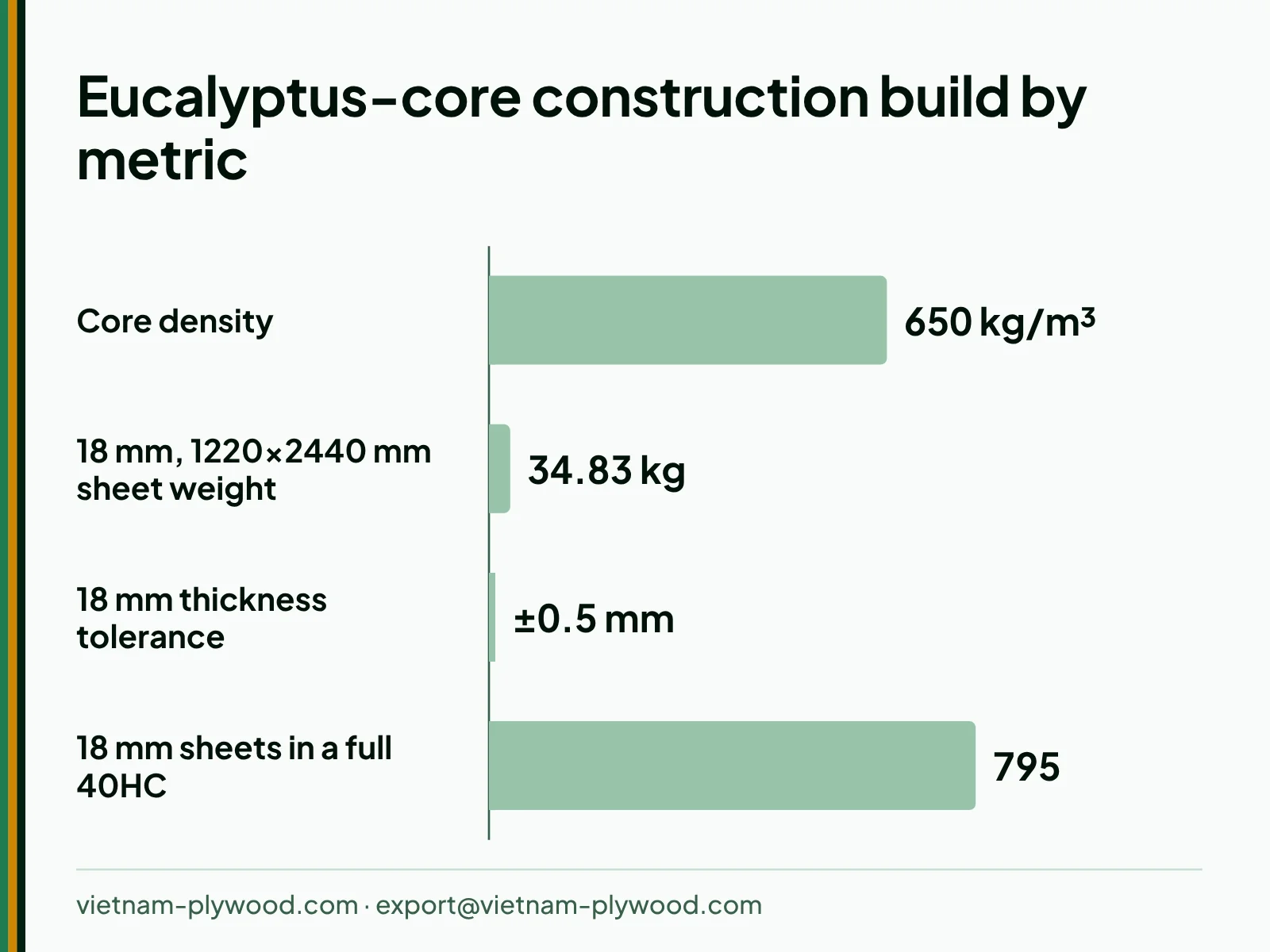
Acacia is the lighter construction core at 580 kg/m³; eucalyptus is denser at 650 kg/m³. At 18 mm and 1220×2440 mm, that corresponds to 31.08 kg versus 34.83 kg per sheet before film. Acacia suits orders prioritizing manual handling and container sheet count; eucalyptus is worth testing where the form designer seeks a denser build.
Density alone is not a measured stiffness, bending strength or fastening result. For heavily loaded forms, the designer should compare actual test reports for the chosen layup. The core veneer thickness is 1.4–2.0 mm, and an 18 mm build has 11–13 plies, so the detailed layup belongs in the written order.
Frequent cutting exposes edges, while wider support spacing raises design demands. Inspect samples with the intended fasteners and finish requirements.
How does core weight change a container order?
For 18 mm, 1220×2440 mm construction panels, a full 40HC holds 880 acacia sheets at 47.15 m³ and 27.35 t, or 795 eucalyptus sheets at 42.60 m³ and 27.69 t. The container payload limit is 28.5 t. These calculated figures exclude film weight, and the actual mixed load needs its own weight check.
The acacia loading uses 16 pallets with 55 sheets per pallet. The eucalyptus loading uses 15 pallets with 53 sheets per pallet. That changes delivered sheet count.
Specifications can be mixed in a container within the payload limit. For example, a buyer can discuss a mixed acacia/eucalyptus formwork order and request a pallet-by-pallet calculation before loading. Other thicknesses or sheet sizes change the count; the dedicated container-load calculation page owns those tables.
Weight arithmetic is part of the buying decision because a dense panel can reach the payload limit with fewer sheets. Ask for a packing list with quantities, dimensions and weights.
Which glue and film should a formwork buyer specify?
Glue and film are separate specifications. Our construction builds use melamine glue, described as moisture-resistant (MR) with a 12-hour boil, or phenolic glue, described as weather-and-boil-proof (WBP) with a 72-hour boil. The film face can be phenolic or melamine; specify its mass separately from the glue.
The standard film mass is 120 g/m², premium film is 135 g/m², and 220 g/m² is reserved for anti-slip film. An anti-slip surface serves a different contact requirement from a smooth concrete finish. Do not substitute it for a smooth film without reviewing the intended face texture.
Emission class is another field: E0, E1 or E2, as ordered. It does not describe the glue chemistry. When a project calls for an emission certificate, agree on the class and the document before production. The producing factory’s relevant certificates can be shown with factory details masked, on request.
The hot-press temperature follows the bonding system: MR 110–120 °C and WBP 130–145 °C. Specify the bond and overlay separately.
How do you protect panel life between pours?
Protecting panel life requires a release agent on every pour, sealed original and cut edges, careful stripping and prompt cleaning. With proper handling, a release agent on every pour and sealed edges (cut edges included), melamine-glue film-faced panels achieve about 12–15 pours; phenolic-glue panels reach up to about 25 pours.
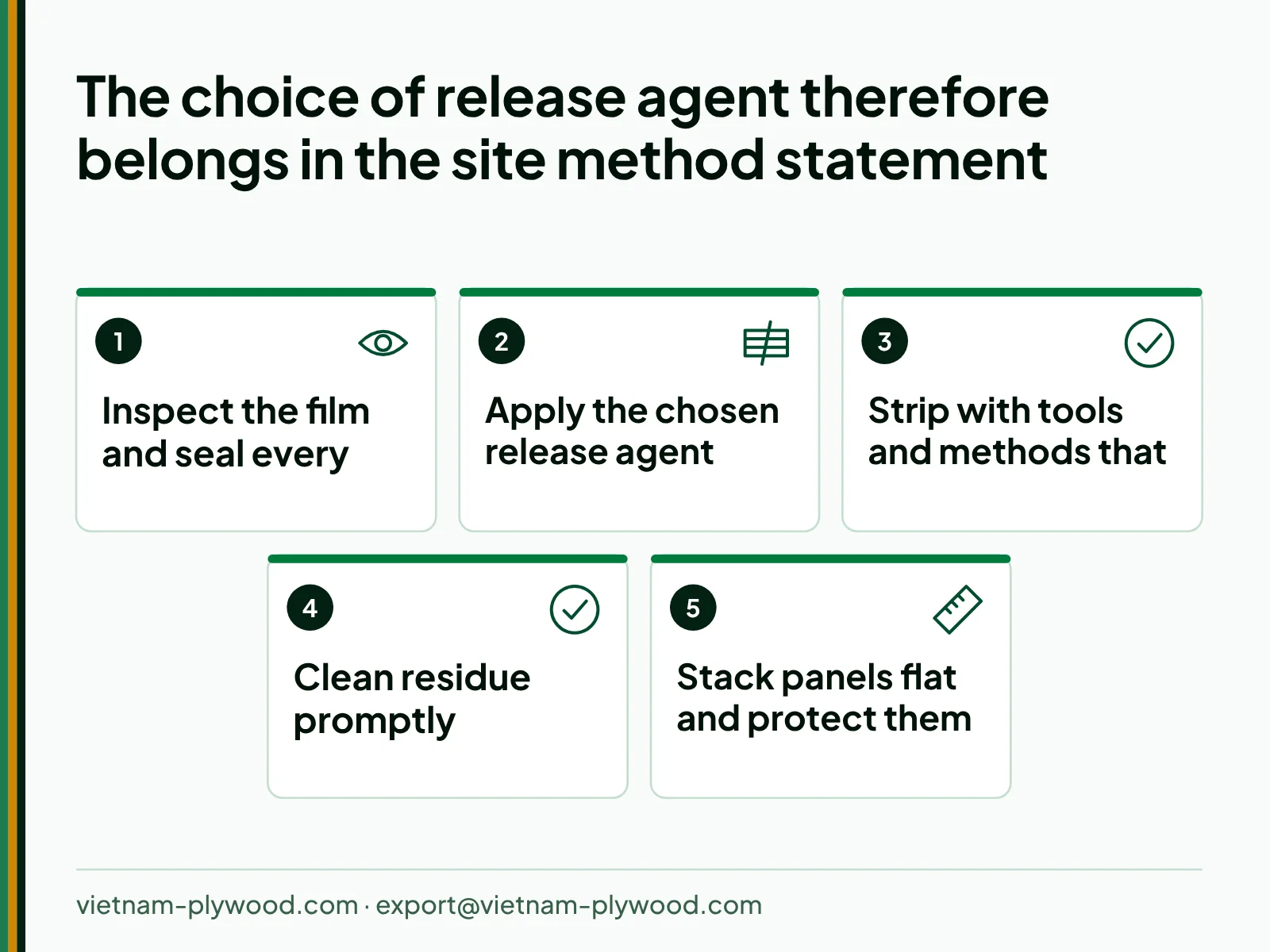
The American Concrete Institute’s form-release-agent guidance explains that release agents help removal and surface appearance. Its guidance distinguishes barrier agents from chemically active agents, especially for architectural finishes. The choice of release agent therefore belongs in the site method statement.
- Inspect the film and seal every exposed cut edge before the first pour.
- Apply the chosen release agent to the face before each concrete placement.
- Strip with tools and methods that avoid gouging corners or lifting the film.
- Clean residue promptly, inspect the face and repair edge sealing before reuse.
- Stack panels flat and protect them from rain, sun and impact between pours.
See the dedicated edge-sealing procedure for cut panels. A pour count without the handling condition is not a useful comparison against a birch supplier’s claimed reuse.
What should an inspector check at the producing factory?
At the producing factory, a buyer or inspector can witness dimensions, edge construction, overlay condition and the agreed sample checks. The inspection should compare production sheets against the approved sample and written tolerance, rather than only reading the bundle label.
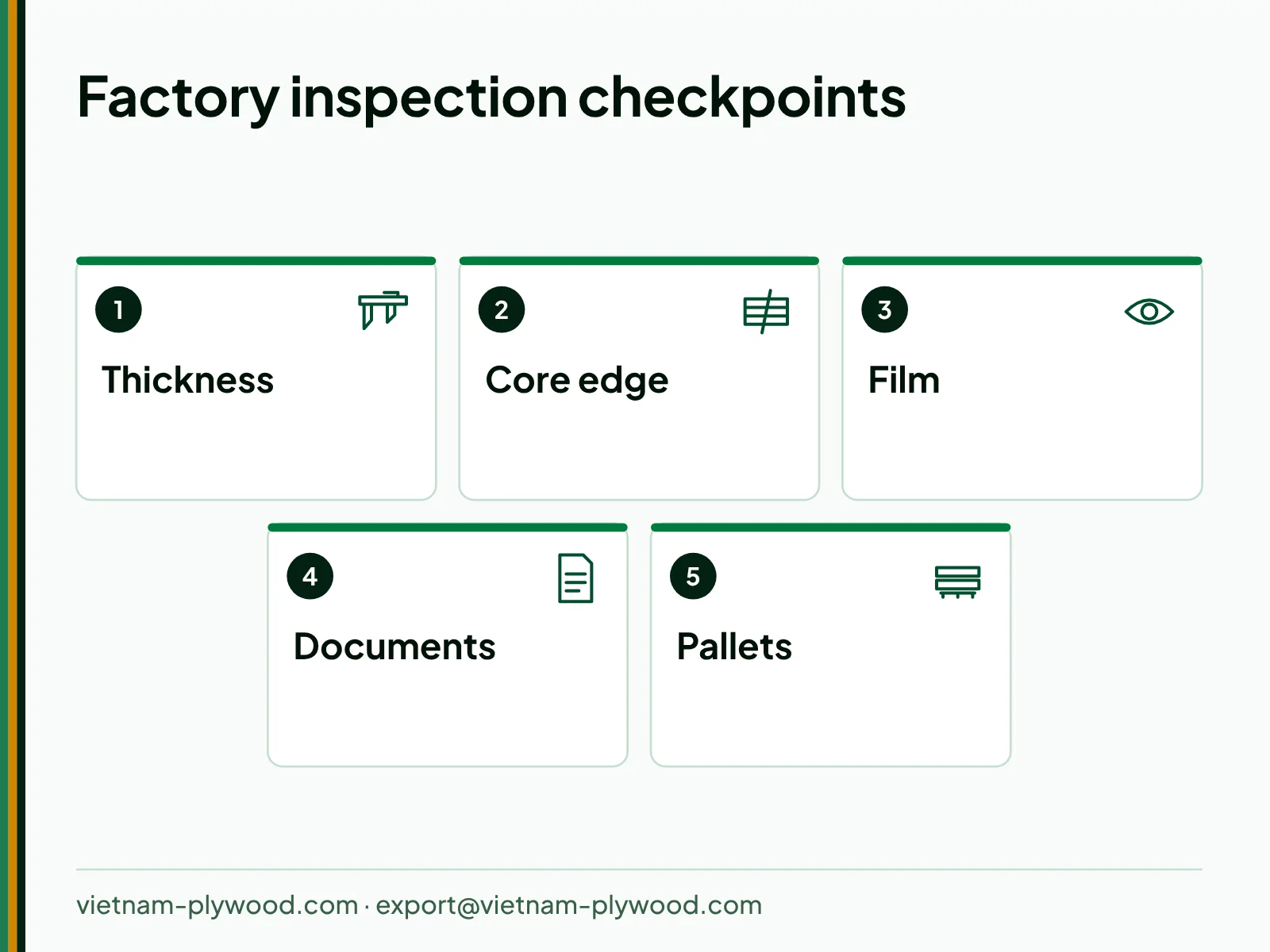
- Measure several panel thickness points against the ordered ±0.5 mm film-faced tolerance; check length and width against ±2 mm.
- Inspect exposed edges for gaps, overlaps and the agreed veneer layup; record the visible ply count.
- Examine both film faces for breaks, contamination and inconsistent coverage; check sealed perimeter edges.
- Match the ordered glue, film mass, core and emission class to production records and agreed test reports.
- Check pallet labels, sheet count, wrapping and draft packing-list entries before loading.
HCPLY runs on-site quality control, export documents and loading for the producing factory. Buyers visit the factory office and inspect the goods where the order is made. For a specified structural application, the buyer’s accepted test report and form designer’s approval remain the technical decision points.
How should price and shipment terms be compared?
The largest price driver is usually the core and its construction: a verified full birch-core offer carries a different raw-material proposition from our Vietnamese hardwood builds. Next compare phenolic versus melamine bonding, film mass, core assembly, tolerance and any required test evidence. A phenolic-glue, premium-film build costs more to produce than a comparable melamine-glue, standard-film build because the specified materials and processing differ.
There is no published starting price here for film-faced panels or birch-core offers. Request a quotation against the written specification, the destination and the intended quantity. Compare cost per accepted pour only after both suppliers’ actual prices and supported service-life results are available.
The minimum order is one 40HC, and specifications can be mixed within the payload limit. Factory lead time runs 15–45 days from receipt of the 30% deposit; the exact figure depends on order size, line loading and what the contract fixes. Balance is 70% against the scanned bill of lading (B/L), by telegraphic transfer (T/T) or irrevocable letter of credit (L/C) at sight.
Delivery terms are FOB Hai Phong, cost and freight (CFR/CNF) or cost, insurance and freight (CIF). Each shipment has a commercial invoice, packing list, B/L, certificate of origin, phytosanitary and fumigation papers, and agreed certificate documents; CIF adds insurance. European Union lots include EUR.1 and the EUTR/EUDR file set. After loading, the draft shipping documents come to you for approval.
What specification should the buyer send?
Send a written build specification that lets the construction line quote the exact formwork panel and prepare matching samples. Include the intended concrete finish and expected reuse method alongside dimensions, core and glue. HCPLY can then compare acacia and eucalyptus samples against the same acceptance criteria.
Application: concrete walls / slabs / columns; design pressure and support spacing
Line or core: construction line; acacia or eucalyptus core
Glue: melamine MR (12-hour boil) or phenolic WBP (72-hour boil)
Emission: E0 / E1 / E2 as ordered
Face and grade: phenolic or melamine film; 120 or 135 g/m²; agreed face condition
Thickness and tolerance: 18 mm; ±0.5 mm
Size: 1220 × 2440 mm; length and width ±2 mm
Quantity: one 40HC minimum; specify acacia/eucalyptus mix and pallets
Destination port: [named port]; FOB Hai Phong / CFR / CIF
Ask Lucy at export@vietnam-plywood.com for an acacia-and-eucalyptus sample set through the contact page. Free samples are available; new buyers book their own courier, and its cost can be credited against a real order.