






Edge sealing plywood for formwork starts with a continuous factory coat and prompt recoating of every site cut. Missed edges can shorten panel life, raise replacement costs and delay a pour. HCPLY applies perimeter edge paint on its construction-line panels, while the site team must protect any new cut before concrete contact.
How does edge sealing plywood protect formwork?
Edge sealing plywood protects the exposed veneer ends from rapid moisture entry during storage, handling and concrete pours. The coating covers the porous core at the perimeter, while the face film protects the broad surfaces. A cut made after delivery removes that perimeter barrier. Recoat the cut before its first pour and inspect the coating after every stripping cycle.
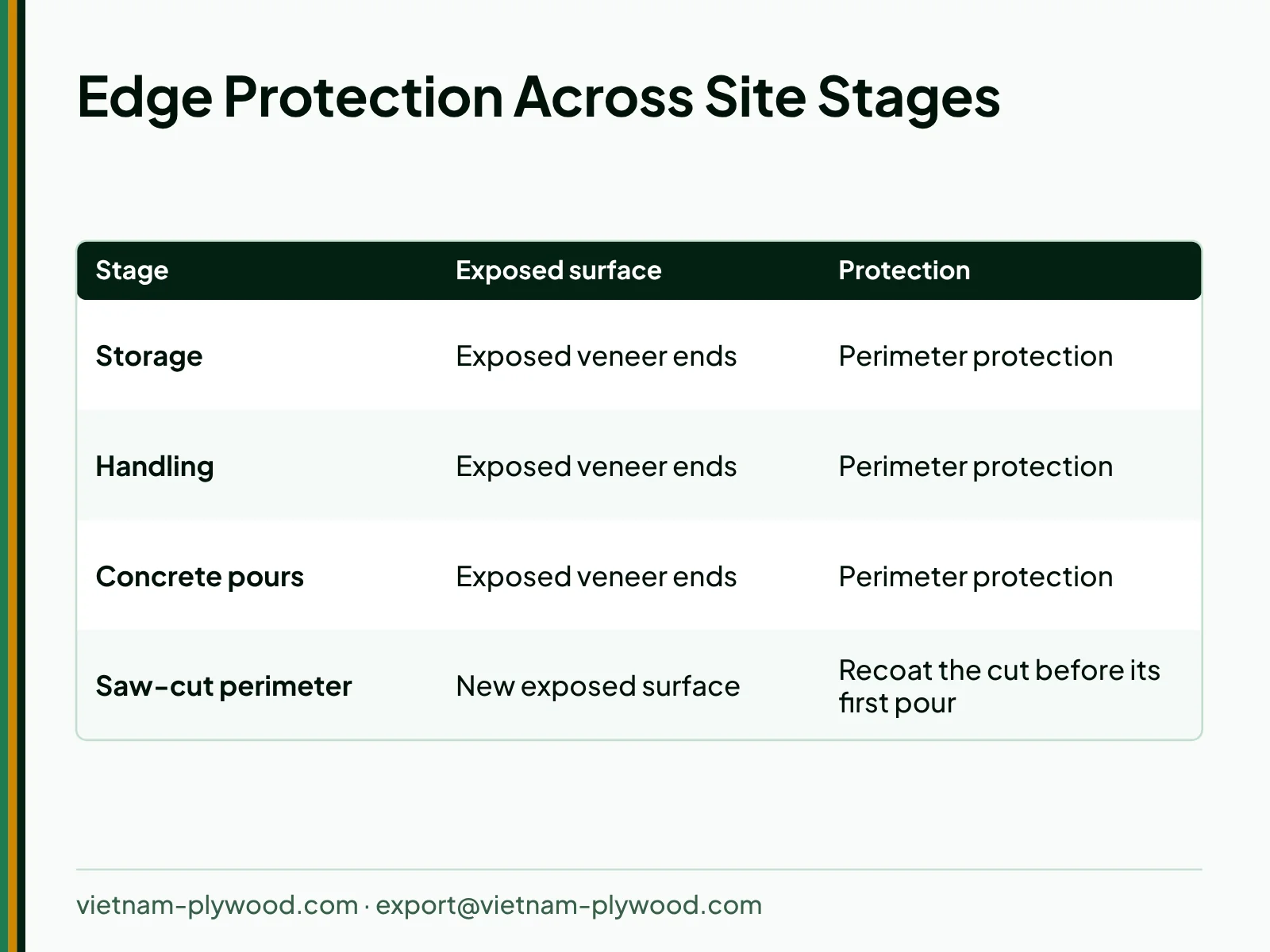
Edge sealing is a perimeter protection measure. It cannot substitute for suitable plywood thickness, bracing, a release agent or sensible stripping practice. Buyers comparing formwork systems should start with the concrete formwork plywood specification guide and then make the edge requirement a separate acceptance point.
The distinction matters when panels arrive in good condition but are resized at the jobsite. The original factory perimeter remains coated; the saw-cut perimeter becomes a new exposed surface. Inspect both before placing concrete.
How do you seal film faced plywood edges after cutting?
Seal film faced plywood edges after cutting by cleaning and drying the exposed core, applying a compatible edge coating across the full cut thickness, and allowing it to cure before concrete contact. The new edge must receive the same attention as the factory perimeter. A face film cannot protect a core newly exposed by a saw.
-
Mark the cut and use a sharp blade to avoid tearing the film or opening veneer joints. Remove sawdust, slurry and loose fragments from the full cut thickness.
-
Let the cut surface dry to the coating maker’s application condition. Do not trap visible water beneath a new film of paint.
-
Brush or roll the specified plywood edge sealer across the full veneer stack, paying attention to corners and cut-outs. Apply additional coats only as directed by that coating’s instructions.
-
Allow the coat to dry and cure under the maker’s stated conditions. Check for missed areas before assembly and the first pour.
-
After stripping, examine cuts and fastener damage again. Clean and recoat worn edges before returning the panel to service.
For repeated cutting, issue the same written repair instruction to the cutting crew and the formwork yard. A uniform method makes disputes over exposed cuts easier to resolve.
Why recoat site cuts before the first pour?
Site cuts expose absorbent veneer ends immediately, so recoating before the first pour closes the most direct wetting route. Waiting until after stripping allows moisture and cement slurry to enter the fresh cut. A factory-coated perimeter does not extend protection to later cuts.
The edge is a cross-section of many veneers. Water reaches end grain and glue lines from the side, even when the film face looks sound. Local swelling can make the panel harder to align in a tight formwork joint.
APA – The Engineered Wood Association, in its online APA Rated Siding guidance (accessed 2026), states: ‘Whether the siding is factory sealed or sealed at the job site, any sealed edges cut during construction should be resealed.’ That statement concerns siding; the same exposed-cut moisture mechanism explains why a formwork cutting procedure needs recoating.
What factory edge paint goes on formwork panels?
Our construction line applies edge paint to the perimeter of film-faced panels as part of the specified factory finish. Buyers should specify coating coverage, compatibility with their site repair material and the acceptance method in the purchase specification. The exact coating chemistry, brand, coat count and dry-film thickness must be agreed for the order.
A factory edge coat is applied to finished panel edges before shipment. It is different from PVC or melamine edge banding used to finish visible furniture edges: a decorative strip is not the normal perimeter protection specified for concrete formwork.
For a formwork purchase, ask the inspector to examine coating continuity at corners and across any exposed veneer gaps. If the buyer requests a particular paint system, agree it against a coated sample before production. No universal paint color establishes coating performance.
Exterior panels used outside formwork also need an exposure-specific coating specification. The film-faced build described here is the construction-line product; HCPLY does not press medium-density overlay or high-density overlay panels.
Which factory line builds the panel?
The construction line presses film-faced formwork panels with acacia or eucalyptus cores and applies the specified edge finish. The other lines make different panel constructions; the edge treatment must follow the actual application rather than the shared nominal thickness.
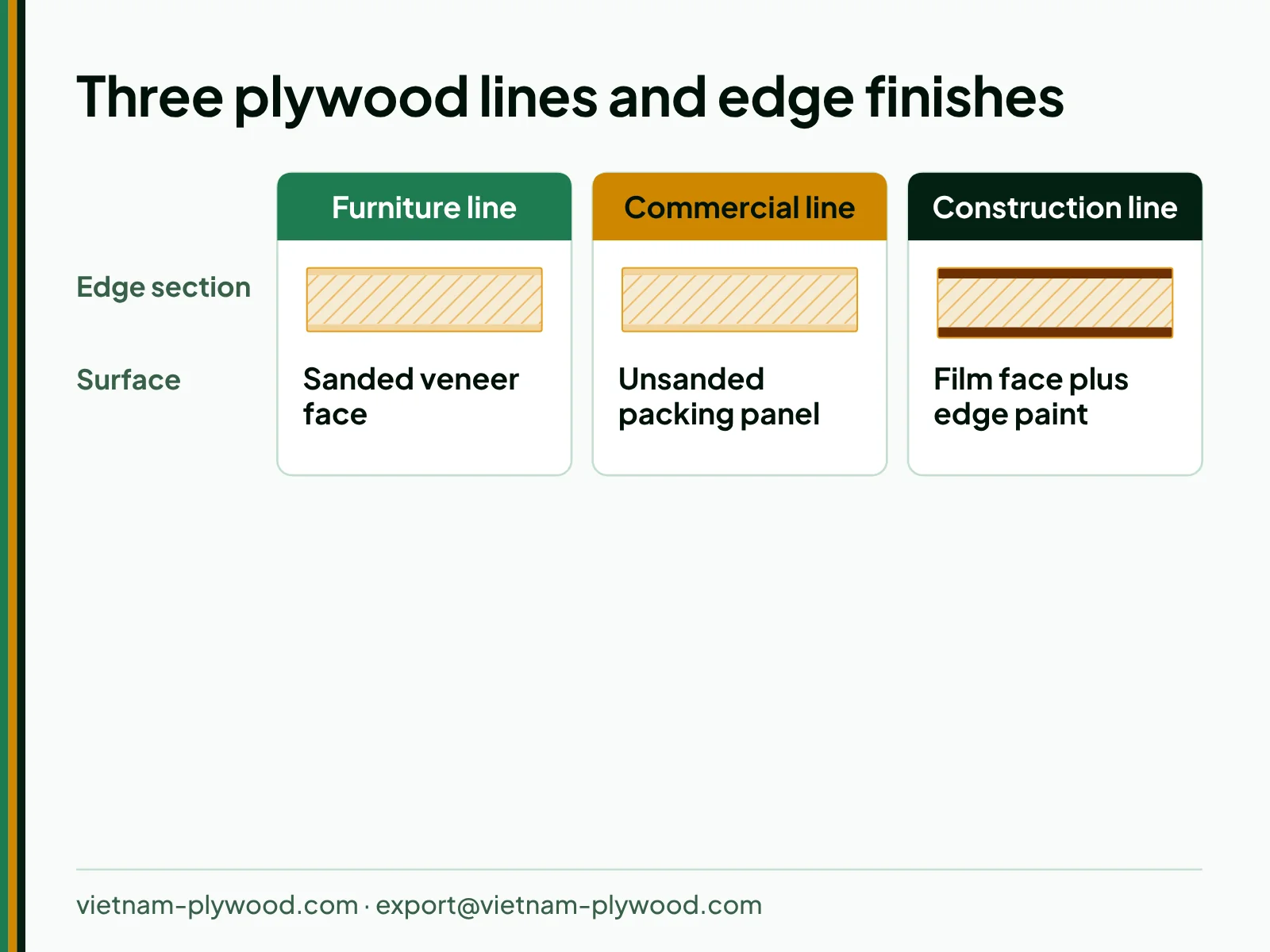
| Line | Typical core and surface | Edge-related buying decision |
|---|---|---|
| Our construction line | Acacia or eucalyptus; phenolic or melamine film, including anti-slip film | Specify perimeter edge paint and field-cut recoating |
| Our furniture line | Styrax or eucalyptus; stitched, sanded, veneer-faced | Specify furniture edge appearance and machining; decorative banding is a separate topic |
| Our commercial and packing line | Acacia; unsanded or light-sanded, moisture-resistant glue | Specify handling exposure and any protective edge finish needed for packing |
The same 18 mm nominal thickness can therefore describe three very different edge conditions. Compare those builds in the factory-line plywood grade comparison, or review commercial and packing plywood for transport-use panels.
What happens when plywood edges stay unsealed?
Unsealed plywood edges absorb water faster than protected faces, increasing the risk of swelling, veneer checking and local bond damage during repeated wetting. Once the edge deteriorates, a fresh coat cannot restore missing veneer or damaged bonding. Remove suspect panels from the formwork cycle for inspection.
The first signs can be rough raised veneer ends, local edge thickness growth, paint cracks or visible separation at a corner. A sound-looking face does not rule out a wet edge. Reject damaged areas for formwork service until the contractor assesses their suitability.
Moisture risk also rises when panels are left in standing water, stored with exposed cut edges facing rain or scraped against metal frames. The edge seal is one part of maintenance, alongside drainage, careful handling and dry storage between cycles.
For decisions about reuse and rejection, see formwork stripping and panel life. A stated pour count assumes the maintenance conditions are followed.
Which coating and repair method should a buyer specify?
Specify an edge coating compatible with the panel, exposure and the site maintenance process. A plywood end grain sealer for exterior wood and a formwork edge paint are descriptions of functions, not interchangeable product specifications. Ask for the coating type, surface preparation, cure condition and a sample repair procedure.
An exterior wood primer, purpose-made panel edge paint and other plywood edge sealants can differ in flexibility, adhesion and drying behavior. Use a coating whose technical instructions cover the intended substrate and exposure. Avoid substituting furniture edge-banding adhesive for a liquid protective coating.
APA’s MDO/HDO panel guidance recommends sealing exposed edges promptly with exterior wood primer. That is guidance for different overlay products, rather than a specification for HCPLY film-faced panels. Its practical lesson is to cover exposed wood promptly and use a compatible coating.
For the repair kit, specify brush or roller, cleaning method, coating identification, storage requirements and a visual acceptance sample. The formwork yard should keep the kit close to its cutting station.
How do glue, film and core affect the edge?
The glue system governs bond resistance, while the face film and edge paint cover different exposed surfaces. HCPLY offers melamine glue for moisture-resistant builds and phenolic glue for weather-and-boil-proof builds. Neither glue choice eliminates the need to reseal cut edges.
Our construction line offers 120 g/m² standard film, 135 g/m² premium film and 220 g/m² anti-slip film. Those values describe face film weight, not edge paint mass or waterproofing of a saw cut.
Acacia core density is 580 kg/m³ and eucalyptus is 650 kg/m³. Density follows the core, rather than the film face. Film choice, core species and glue must be stated separately when evaluating a proposed panel.
For a 1220 × 2440 mm sheet, construction-line thickness tolerance is ±0.5 mm, with length and width ±2 mm. Thickness selection also affects deflection and support design; use the formwork thickness selection guide and formwork plywood calculator for that separate decision.
How is edge sealing checked at loading?
At the producing factory, the buyer or inspector can examine the visible perimeter of sampled panels before wrapping and loading. Check that the edge coat covers the veneer stack continuously, including corners, and record any chips, open joints or bare cut ends. Compare the inspected goods with the approved sample and written acceptance criteria.
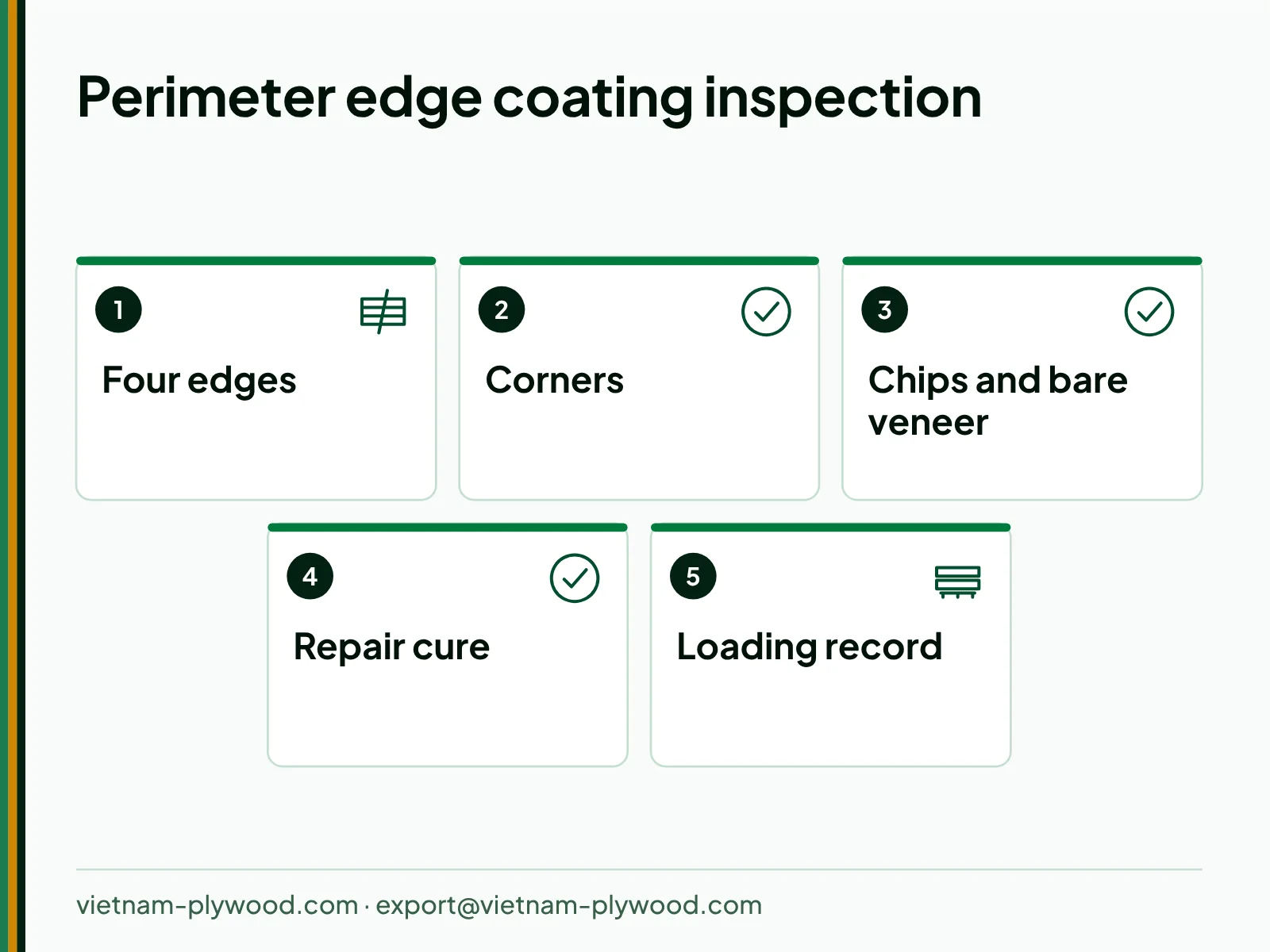
A practical witnessed check begins with the approved sample and the coating specification. The inspector chooses accessible panels across the lot, examines all four edges and corners, and records photos of coverage and any defects. The agreed sampling plan controls how many panels are opened and accepted.
Next, the inspector checks that factory edges remain coated after stacking and strapping. Any exposed edge or damaged corner should be separated for correction before loading. If a repair is made, inspect its coverage and cure state before the panel returns to the pallet.
The packing list links the loaded quantities to the shipment. Draft shipping documents are sent for buyer approval after loading; inspection photographs and the signed checklist provide the more direct evidence of edge treatment. Buyers can inspect at the producing factory’s office and production site.
What site maintenance protects panel life?
Keep the panel perimeter intact during transport, cutting, stripping and storage. Recoat any new cut or abraded edge before reuse, and use a release agent on every pour. With proper handling, release agent on every pour and sealed edges including cuts, melamine-glue film-faced plywood achieves about 12–15 pours; phenolic-glue panels reach up to about 25.
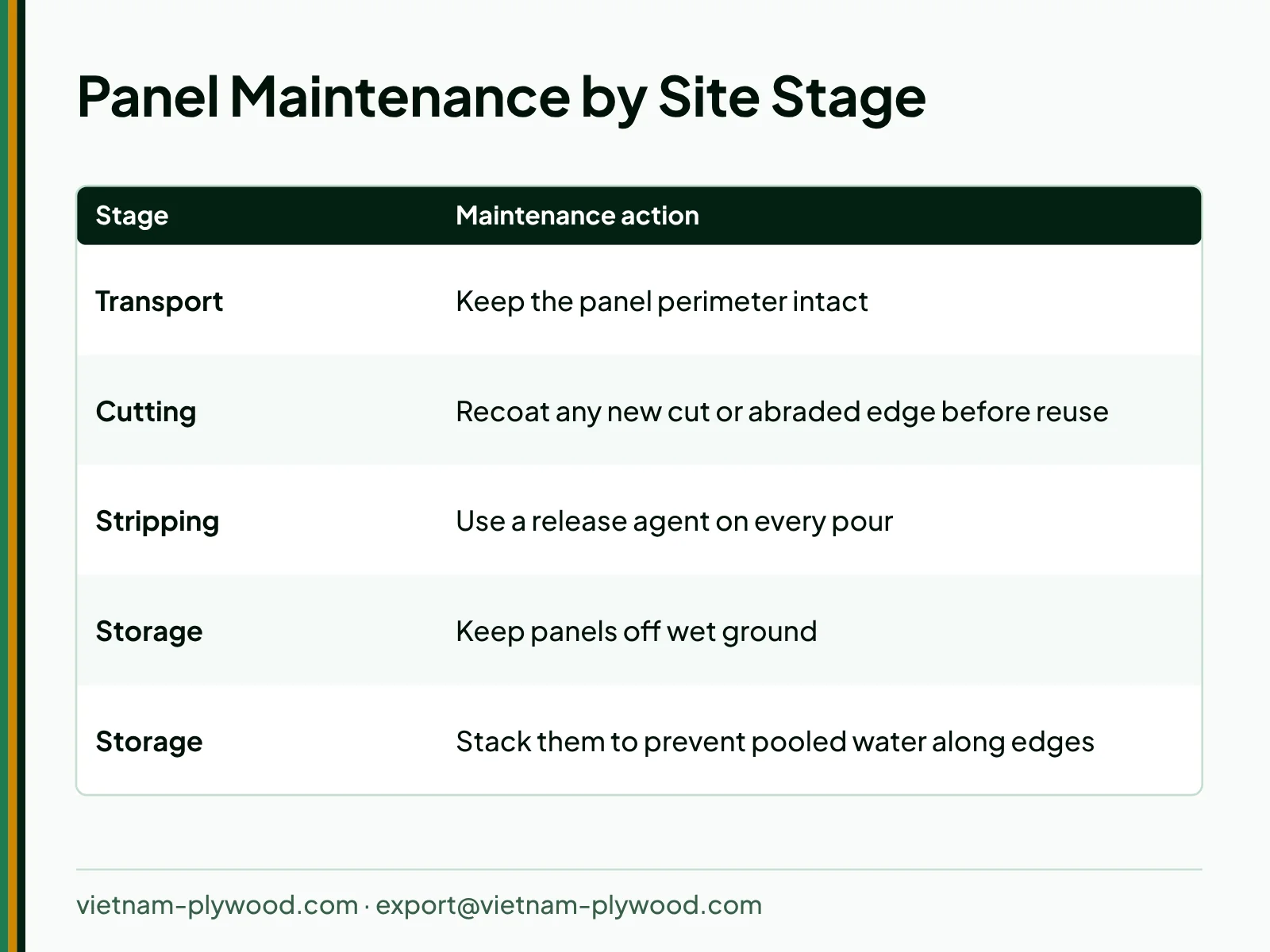
Film-facing can reduce surface contact with wet concrete, but scratches, drilled holes and fresh cuts create new entry points. Avoid levering against panel corners during stripping. Keep panels off wet ground and stack them to prevent pooled water along edges.
The expected life of a panel is also shaped by concrete mix, release practices, stripping method and handling damage. An edge coat does not repair a split core. The shutterply sizes and grades page helps distinguish the panel construction from its maintenance plan.
How should edge sealing appear in the order?
Write the edge treatment into the panel specification and inspection checklist rather than relying on a generic description. The agreed test reports, where applicable, accompany the order documentation, while the packing list identifies the shipped goods. HCPLY manages specification, on-site quality control, documents and loading for export orders.
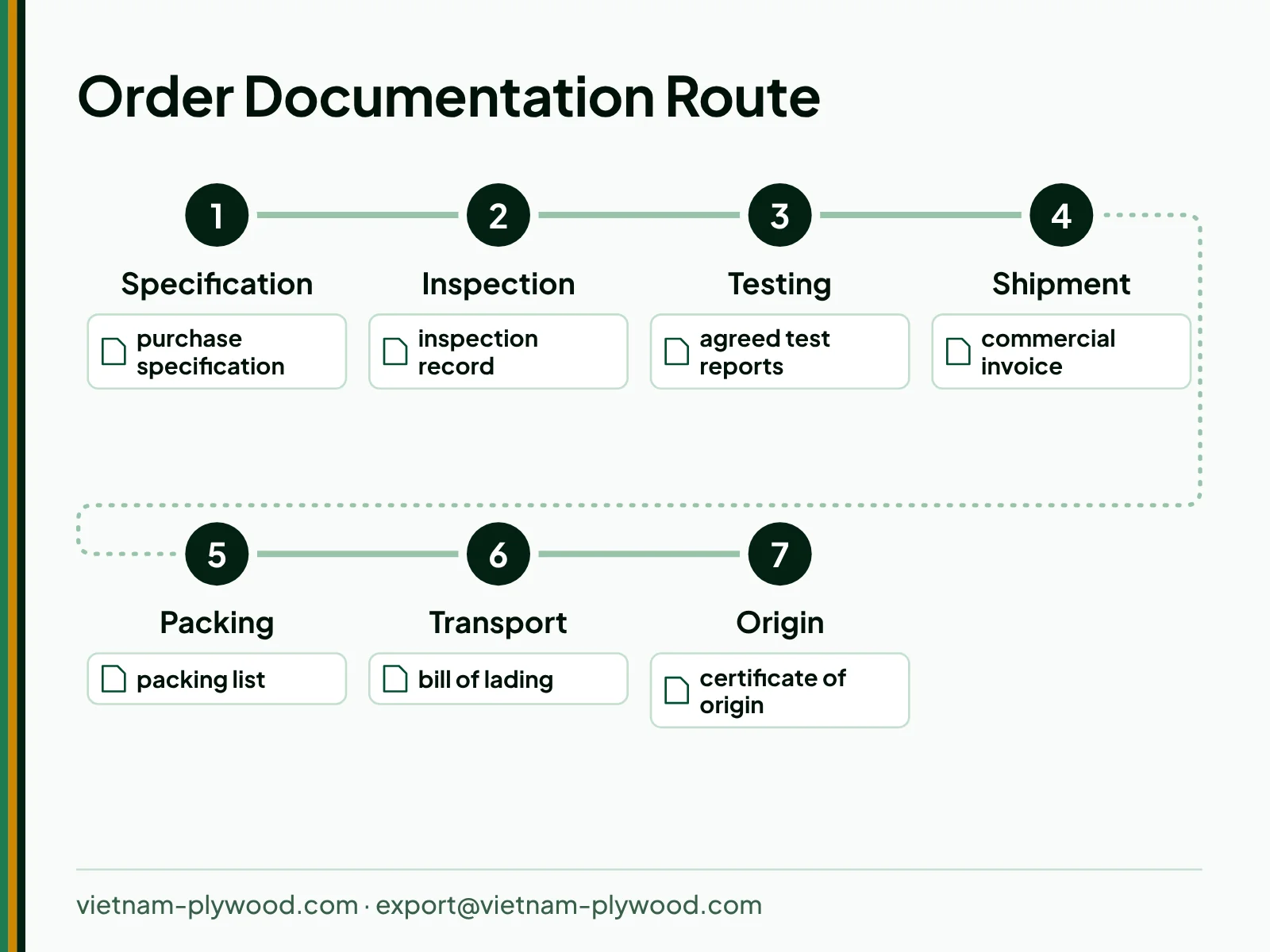
For export, the shipment file includes the commercial invoice, packing list, bill of lading and certificate of origin, plus the documents required for the destination and agreed build. An edge-coating acceptance checklist should be referenced in the purchase specification and inspection record, rather than confused with an emission certificate.
The minimum order is one 40HC, with mixed specifications allowed within the 28.5 t payload limit. A 1220 × 2440 × 18 mm acacia-core load is listed at 880 sheets, 47.15 m³ and 27.35 t, excluding film weight. For other load configurations see container packing.
Factory lead time runs 15–45 days from receipt of the 30% deposit; the exact figure depends on order size, line loading and what the contract fixes. The remaining 70% is paid on the scan of the bill of lading, by T/T, or by irrevocable sight L/C. We ship FOB Hai Phong, or CFR (CNF) or CIF to your port.
What should the purchase request say?
A useful request names the application, core, glue, face, dimensions, edge finish, site-cut repair method and inspection acceptance. Request a factory visit to witness the producing factory’s coating and loading checks before agreeing the final sample.
Ask for a marked photograph of a representative factory edge and a separately marked photograph of a repaired site cut. These should show coating continuity across the entire thickness, rather than only a painted line on the film face.
Our three factories are in Phu Tho and Hai Phong, and each order is produced at the line matched to its specification. Buyers can visit the factory office and inspect goods where they are produced. Lucy at export@vietnam-plywood.com coordinates the inspection and export details.
Application: reusable concrete formwork; factory perimeter coated and all site cuts recoated
Line or core: construction line; acacia or eucalyptus core
Glue: melamine (MR) or phenolic (WBP), as ordered
Emission: E0 / E1 / E2 as specified separately
Face and grade: film-faced, 120 g/m² standard or 135 g/m² premium; anti-slip 220 g/m² if needed
Thickness and tolerance: 18 mm, ±0.5 mm (or specify another available thickness)
Size: 1220 × 2440 mm (or another available size)
Edge treatment: factory coating type and coverage; site-cut repair instructions; inspection sample
Quantity: one 40HC minimum; specify sheet count and mixed builds if needed
Destination port: [name port]
Next step: book a factory visit to inspect edge coating at the producing factory.