





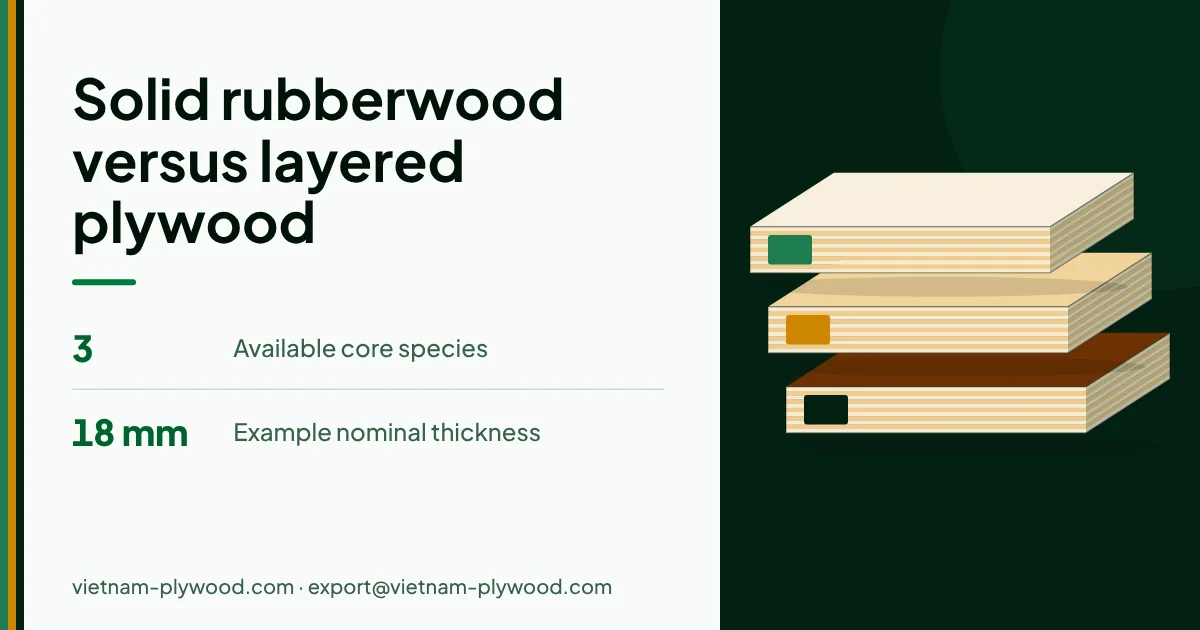
Rubberwood can be solid timber or the core of plywood, while plywood describes a bonded veneer construction. Choosing the wrong material can add machining cost, delay a cabinet run or cause a rejected shipment. HCPLY builds plywood with styrax, acacia or eucalyptus cores, so buyers comparing rubberwood panels need to specify the core and construction rather than rely on the product name alone.
What is the difference between rubberwood and plywood?
The difference between rubberwood and plywood is the distinction between a wood species and a panel construction. Rubberwood comes from the rubber tree and can be sold as solid timber or sliced into veneers. Plywood consists of bonded veneer layers, commonly with alternating grain directions. A rubberwood-core plywood panel therefore combines both descriptions, while a solid rubberwood board does not contain plywood glue lines.
For HCPLY buyers, this distinction determines the purchase specification. A rubberwood core is not among our available cores: we press styrax, acacia and eucalyptus veneers. A decorative face can change the product name without changing the core beneath it. Start with the hardwood plywood guide when comparing species labels with engineered panel constructions.
The US Department of Agriculture Forest Service’s Wood Handbook (2021) separates wood-based composite panels from solid wood and covers moisture-related dimensional change. Its official handbook overview is useful background for distinguishing material and construction. A plywood face alone cannot establish the species, density or quality of the internal veneers.
Which material fits furniture, cabinets and packing?
Solid rubberwood suits components where exposed solid-wood edges, machining depth and timber appearance govern the drawing. Cross-laminated plywood suits broad cabinet parts, partitions and repeatable sheet cutting when the panel build is controlled. For either material, joint design and service moisture still matter; neither name substitutes for a performance test.
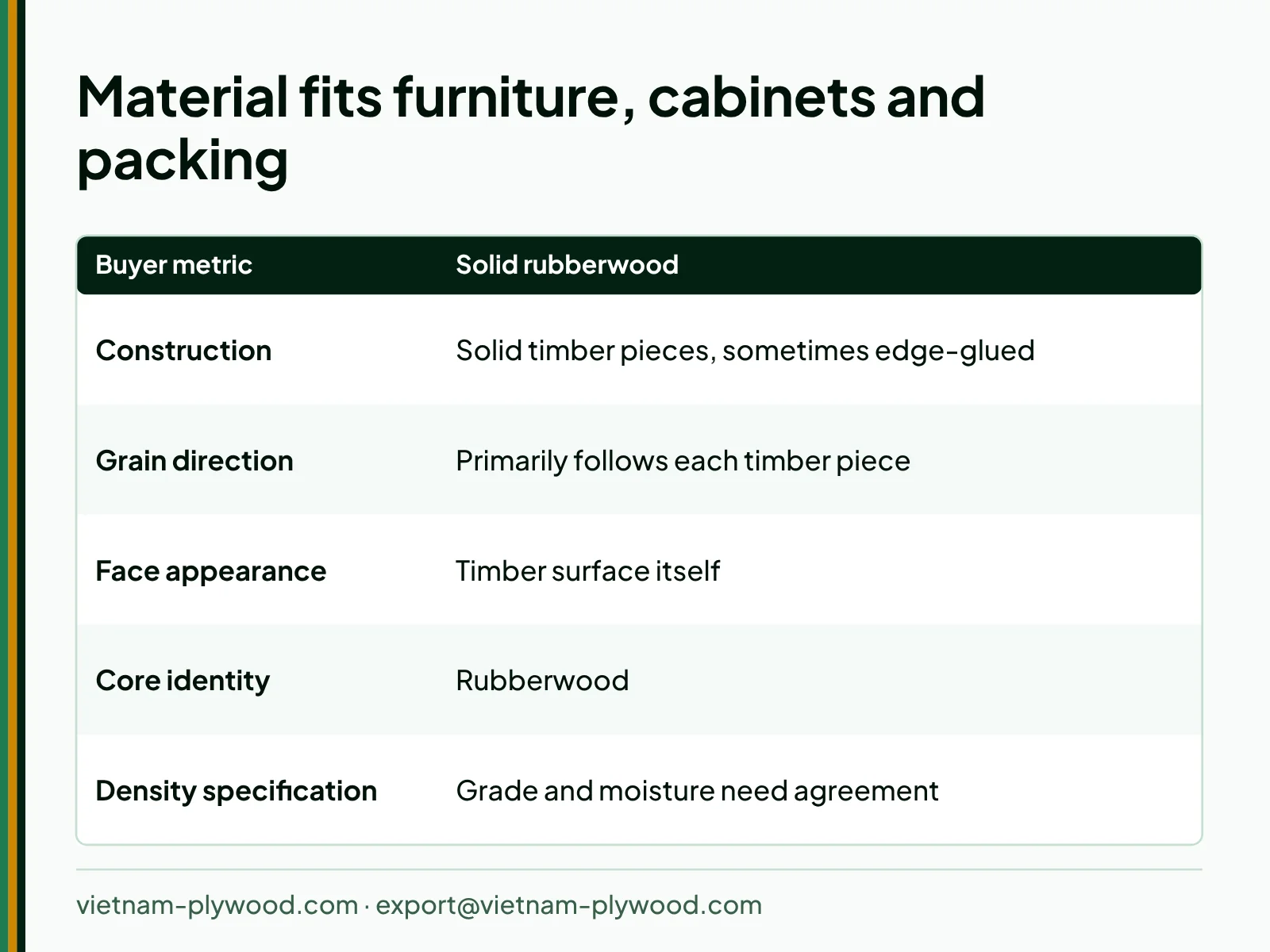
| Buyer metric | Solid rubberwood | Rubberwood-core plywood | HCPLY specified plywood | Verdict by use |
|---|---|---|---|---|
| Construction | Solid timber pieces, sometimes edge-glued | Cross-laid rubberwood veneers | Cross-laid styrax, acacia or eucalyptus core | Solid for exposed shaped edges; plywood for sheet components |
| Grain direction | Primarily follows each timber piece | Alternates across veneers | Veneer lay-up selected by line | Plywood for broad flat cabinet parts |
| Face appearance | Timber surface itself | Determined by face veneer or raw core | Specified veneer and grade | Specify visible cabinet faces separately |
| Core identity | Rubberwood | Rubberwood | Styrax, acacia or eucalyptus | Do not substitute species silently |
| Density specification | Grade and moisture need agreement | Supplier-specific measured value | 500, 580 or 650 kg/m³ by core | Use declared core for load estimates |
| Adhesive | None within a single solid piece; joints may use glue | Bonding resin must be stated | MR or WBP as ordered | Select bond for exposure conditions |
| Inspection | Check pieces, joints and moisture | Check lay-up, voids and bond | Inspect at producing factory | Use acceptance samples for batch release |
A cabinet maker ordering furniture plywood should specify visible faces and machined edges separately. Hidden sofa-frame parts place greater weight on internal veneer continuity and fastening trials. Packing shops can choose a rougher face when the surface will never be displayed.
How would the same 18 mm requirement change across our lines?
An 18 mm nominal thickness means different production choices on each line. Our furniture line presses sanded, full-stitched styrax or eucalyptus panels; our commercial and packing line presses acacia panels; our construction line presses filmed acacia or eucalyptus panels. None uses rubberwood core, even when the buyer’s drawing originally names rubberwood plywood.
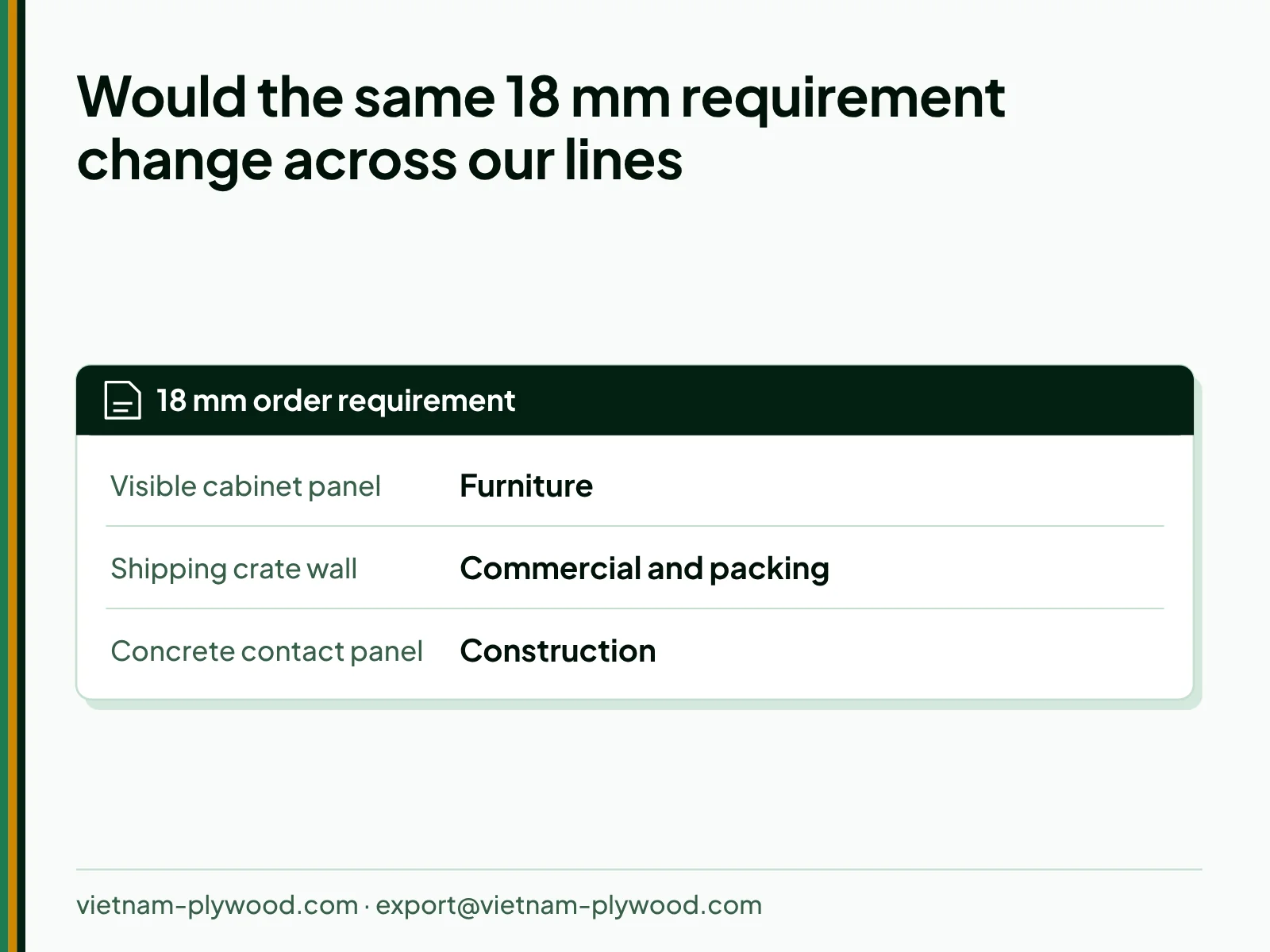
| 18 mm order requirement | Producing line | Core and surface | Thickness tolerance | Appropriate buyer decision |
|---|---|---|---|---|
| Visible cabinet panel | Furniture | Styrax or eucalyptus; specified veneer, sanded | ±0.2 or ±0.3 mm as ordered | Choose for finish and tight assembly |
| Shipping crate wall | Commercial and packing | Acacia; raw or light-sanded | ±0.5 mm commercial; ±0.5–1.0 mm packing | Choose for protective packaging |
| Concrete contact panel | Construction | Acacia or eucalyptus; phenolic or melamine film | ±0.5 mm | Choose for formwork handling |
HCPLY assigns the order to the producing factory suited to its specification. The comparison is about build and inspection criteria, rather than a claim that one panel works equally well in every application. For a broader decision grid, see grades across factory lines.
What belongs in a rubberwood-core plywood specification?
A rubberwood-core plywood specification must explicitly say rubberwood in the core field and separately identify face, glue and emission requirements. That is how a buyer can compare a third-party rubberwood offer with our alternative core builds without mistaking a face label for the panel’s interior.
Write the application first. Record nominal thickness, finished size, allowed variation, face species and grade, core species, veneer construction, adhesive, emission class and required acceptance evidence. The visible face and the core must appear as distinct fields; an engineered veneer face does not identify a rubberwood interior.
For our plywood, thickness spans 3–40 mm, with common choices of 3, 5, 9, 12, 15, 18, 21 and 25 mm. Standard sizes include 1220 × 2440 and 1250 × 2500 mm; custom cutting is available. Length and width tolerance is ±2 mm. At 18 mm, the veneer build uses 11–13 plies, depending on veneer thickness.
A specification can also name the expected edge finish, machining method and permissible visible defects. For related species comparisons, okoume versus birch plywood separates face appearance from use requirements.
How do core lay-up and glue affect performance?
Core continuity and bond selection govern the relevant acceptance tests. Full-stitched veneers reduce gaps for precise furniture cutting; stitched outer layers with edge-trimmed inner veneers, finger-jointed veneers and loose-laid veneers represent progressively more economical constructions. An inspector should identify the actual build from an edge section, rather than accept a product nickname.
Our furniture line uses full-stitched, sanded construction and E0 or E1 emission classes. The commercial and packing line uses acacia core with moisture-resistant (MR) glue and a rougher surface. The construction line uses filmed panels, with the film selected for concrete contact or anti-slip service.
Melamine MR adhesive is associated with a 12-hour boil specification, while phenolic weather-and-boil-proof (WBP) adhesive is associated with a 72-hour boil specification. These describe different bond requirements, not emission classes. E0, E1 and E2 describe emission classes; CARB P2 and TSCA Title VI address US emissions compliance through third-party certification. Ask for the test report matching the ordered construction and market.
What should the factory inspector actually check?
The inspector should compare the production sample with the signed order before checking random finished sheets. At the producing factory, buyers can observe veneer lay-up, face sorting, edge condition and thickness measurements. This is particularly useful when a proposed rubberwood substitution would change core species.
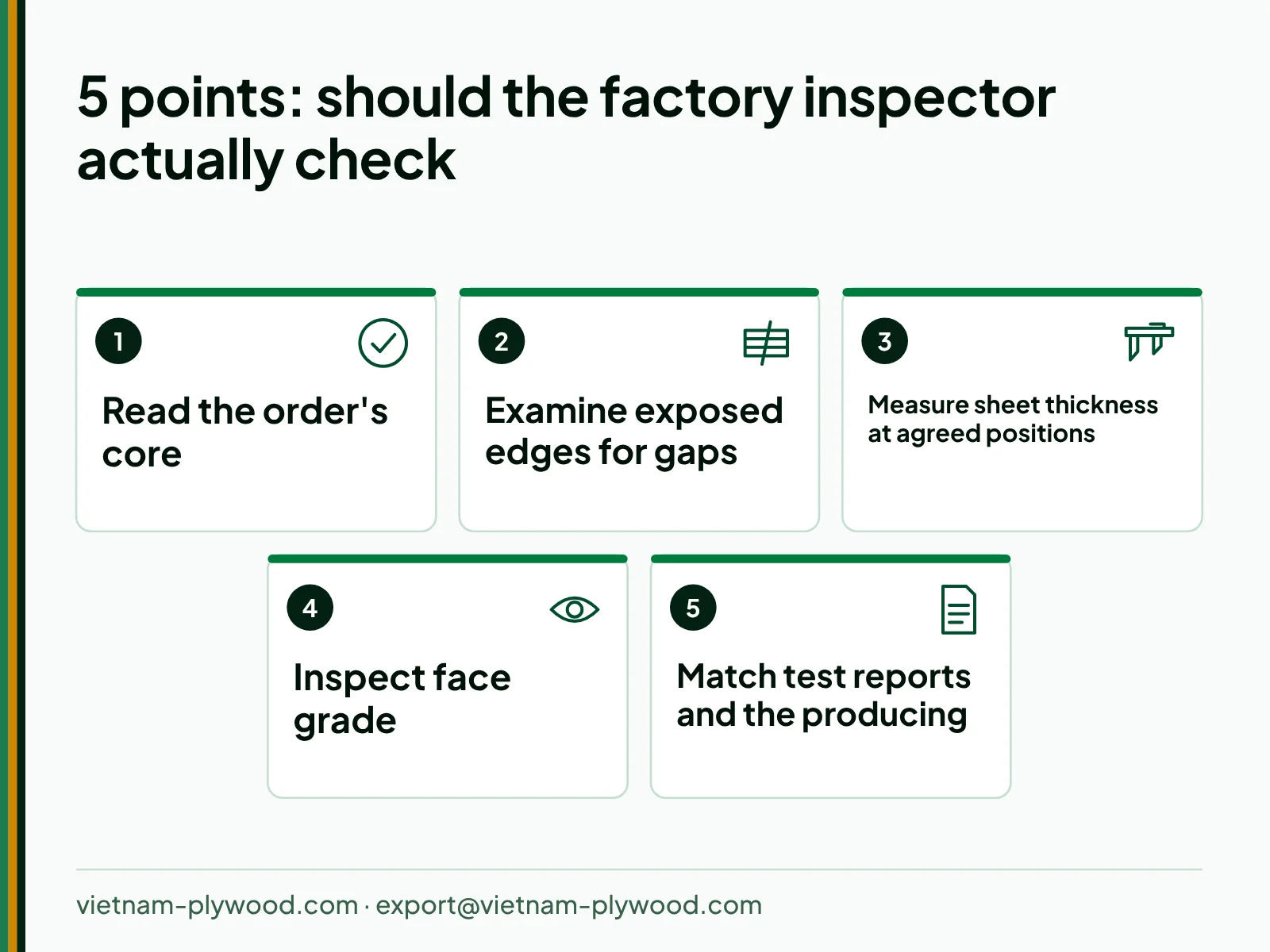
- Read the order’s core, face, glue and emission fields aloud against the approved sample.
- Examine exposed edges for gaps, overlaps, repairs and the agreed veneer construction.
- Measure sheet thickness at agreed positions and record the ordered tolerance.
- Inspect face grade, sanding, corner damage and panel dimensions against the acceptance sample.
- Match test reports and the producing factory’s certificate documents to the actual build and destination requirements.
For HCPLY, member-factory FSC, CARB P2, ISO 9001 and CE documents, plus EUDR/EUTR documents where relevant, are shown with factory details masked, on request. A label on a quotation is less useful than the matching document and observed construction. The buyer can inspect goods at the producing factory and visit its factory office.
How much does core selection change container weight?
Core selection changes payload before the buyer changes the sheet dimensions. For 18 mm, 1220 × 2440 mm panels, the calculated sheet weights are 26.79 kg with styrax, 31.08 kg with acacia and 34.83 kg with eucalyptus. Those figures use core density and exclude film weight.
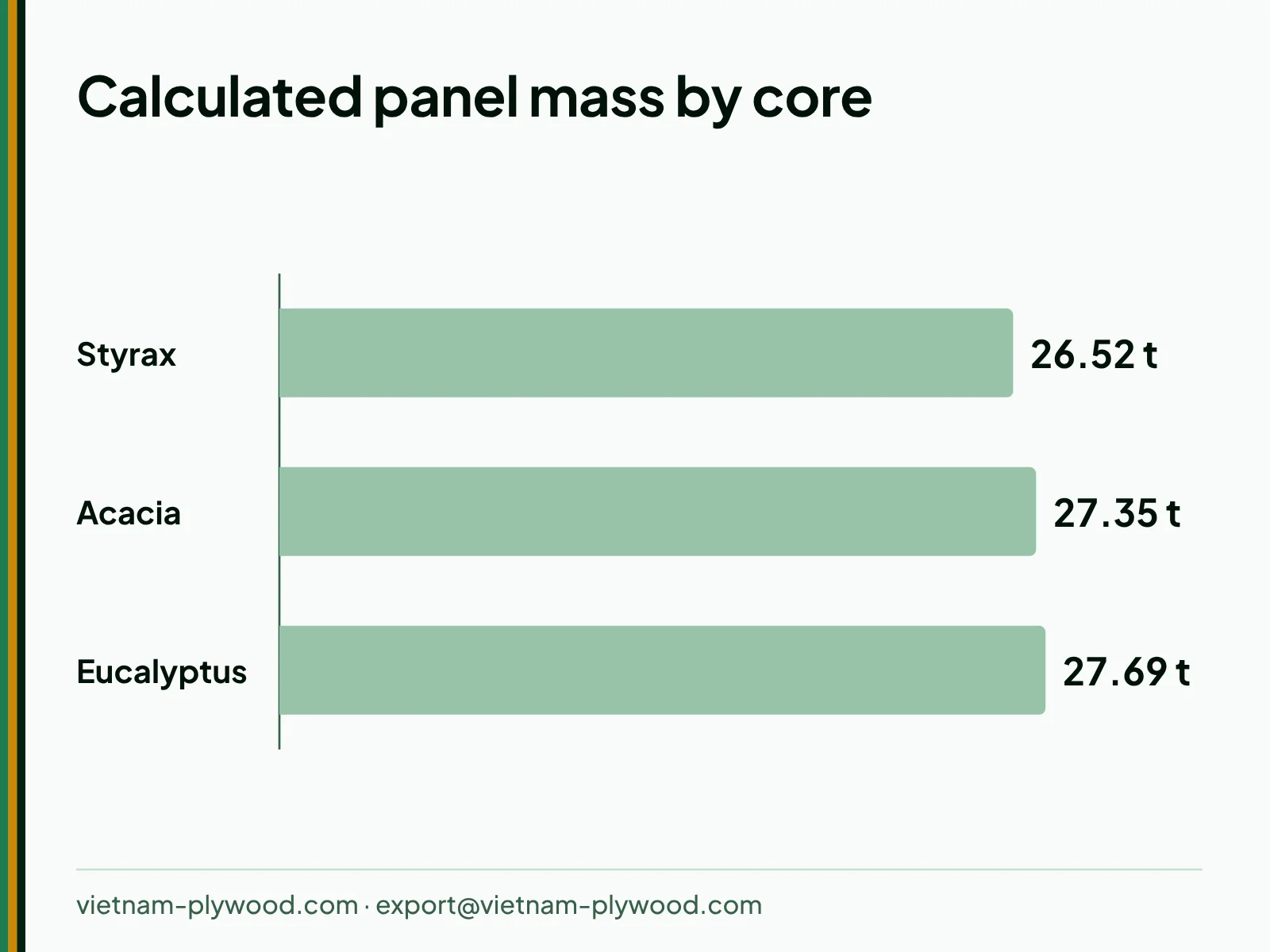
| Core | Density | Sheets per pallet | Full 40HC sheets | Calculated panel mass |
|---|---|---|---|---|
| Styrax | 500 kg/m³ | 55 | 990 | 26.52 t |
| Acacia | 580 kg/m³ | 55 | 880 | 27.35 t |
| Eucalyptus | 650 kg/m³ | 53 | 795 | 27.69 t |
The planning payload limit is 28.5 t. An order can mix specifications within that limit, but a mixed load needs its own pallet and weight schedule. For example, eight acacia pallets at 55 sheets each contribute 440 sheets and approximately 13.68 t; eight styrax pallets at 55 sheets each contribute 440 sheets and approximately 11.79 t. The combined 880 sheets contribute approximately 25.47 t of panel mass, before pallets and other packing materials.
Read the mixed-container planning page for specification combinations and the container loading reference for full-load counts. The weight arithmetic helps decide whether a proposed face or core substitution changes the shipping plan.
What is the rubberwood plywood price?
Rubberwood plywood price is driven first by the core and construction, then by adhesive, face quality, thickness, finishing and order composition. There is no rubberwood-core quotation in our range. For our alternative panels, a full-stitched sanded furniture build costs more to make than a rougher packing build because veneer preparation, face selection and finishing require additional work.
For a reference within our range, commercial plywood starts from US$250/m³ FOB Hai Phong (October 2026), and furniture plywood starts from US$350/m³ FOB Hai Phong (October 2026). These are category starting prices, rather than rubberwood plywood prices. A comparison should hold thickness, face, tolerance, glue, destination and packing constant before evaluating the quotation.
A premium face and tighter thickness tolerance raise processing demands relative to a raw, loose-laid packing panel. Phenolic bonding and specialty film also change the production specification. Ask Lucy for a written quotation against the exact bill of materials, instead of applying a generic price per sheet to dissimilar builds.
How are veneer faces and finishes identified?
The face identifies the product’s visible surface, while the core identifies its interior mass and construction. Our face options include bintangor, okoume, engineered veneer (EV), gurjan, pine, poplar, eucalyptus, birch and sapele. A matt panel is an unfaced raw core; it does not acquire a hardwood species simply because the quotation calls it plywood.
Common face veneer thickness is 0.2–0.4 mm. A/B are the usual face-grade labels; birch faces use D/E/F designations. Buyers should attach an approved visual sample because grade letters alone cannot capture grain matching, colour range or the appearance of repairs.
Melamine paper, high-pressure laminate and other decorative laminates are separate surfacing topics, not HCPLY product lines. A buyer planning to laminate after delivery should specify the substrate’s sanding and bond compatibility with their own finishing process. For species terminology, see luan plywood and meranti plywood.
Which documents and order terms close the specification?
The written order should identify the producing line, finished build and acceptance evidence before production starts. HCPLY handles specification, on-site quality control, export documents and loading, with shipment directly from the producing factory. Delivery is available FOB Hai Phong, CFR (CNF) or CIF.
The minimum order is one 40HC, with specifications mixed inside the payload limit. Factory lead time runs 15–45 days from receipt of the 30% deposit; the exact figure depends on order size, line loading and what the contract fixes. The balance is 70% against the scanned bill of lading (B/L), by telegraphic transfer (T/T) or irrevocable letter of credit (L/C) at sight. Samples cost nothing: a first-time buyer pays the courier, and that charge comes off the first confirmed order.
The shipment document set includes commercial invoice, packing list, B/L, certificate of origin, phytosanitary and fumigation papers, plus agreed certificates and test reports. EU lots include EUR.1 where applicable and the EUTR/EUDR file set; CIF shipments include insurance. After loading, the draft shipping documents come to you for approval. The packing list identifies the actual quantities and weights tied to the core decision.
How should an importer turn this comparison into an order?
An importer should choose a material by its intended use, then lock each technical field before asking for a production slot. If solid rubberwood edges are essential, keep solid timber in that component’s drawing. If broad sheet yield, consistent faces and controlled thickness matter more, evaluate the specified plywood alternative.
Use the furniture plywood specification as a starting point for cabinet components and contact Lucy with drawings, tolerances and intended market. Request the sample build that will be inspected, including an exposed edge section and face acceptance reference. This makes later discussions about price or replacement panels specific.
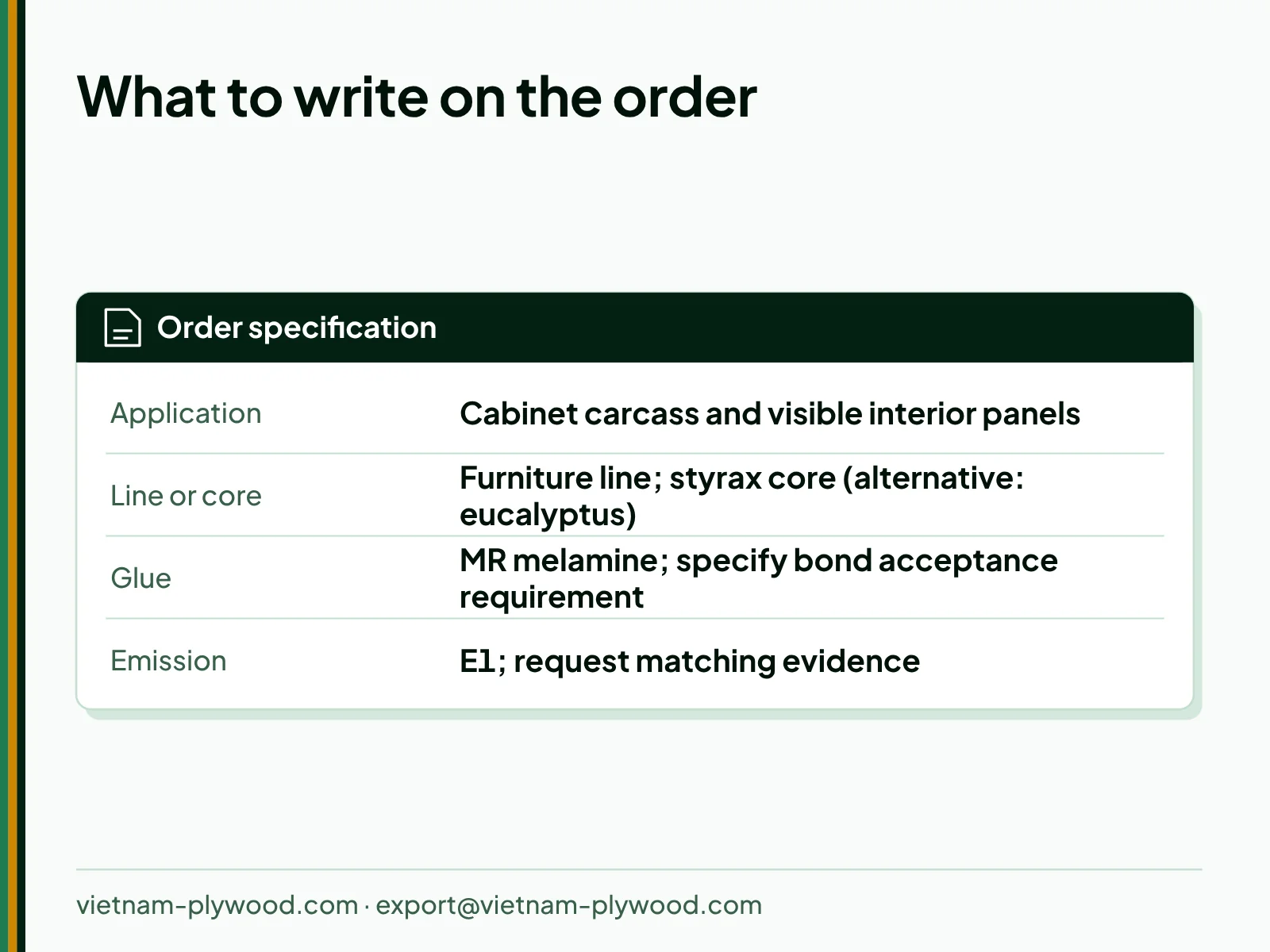
Send the following order brief to export@vietnam-plywood.com:
Application: cabinet carcass and visible interior panels
Line or core: furniture line; styrax core (alternative: eucalyptus)
Glue: MR melamine; specify bond acceptance requirement
Emission: E1; request matching evidence
Face and grade: EV face, A/B; approve visual sample
Thickness and tolerance: 18 mm; ±0.2 mm
Size: 1220 × 2440 mm
Quantity: one 40HC; specify any mixed builds
Destination port: [buyer to insert port]
Next step: plan a trial container with Lucy against the approved sample and inspection checklist.