





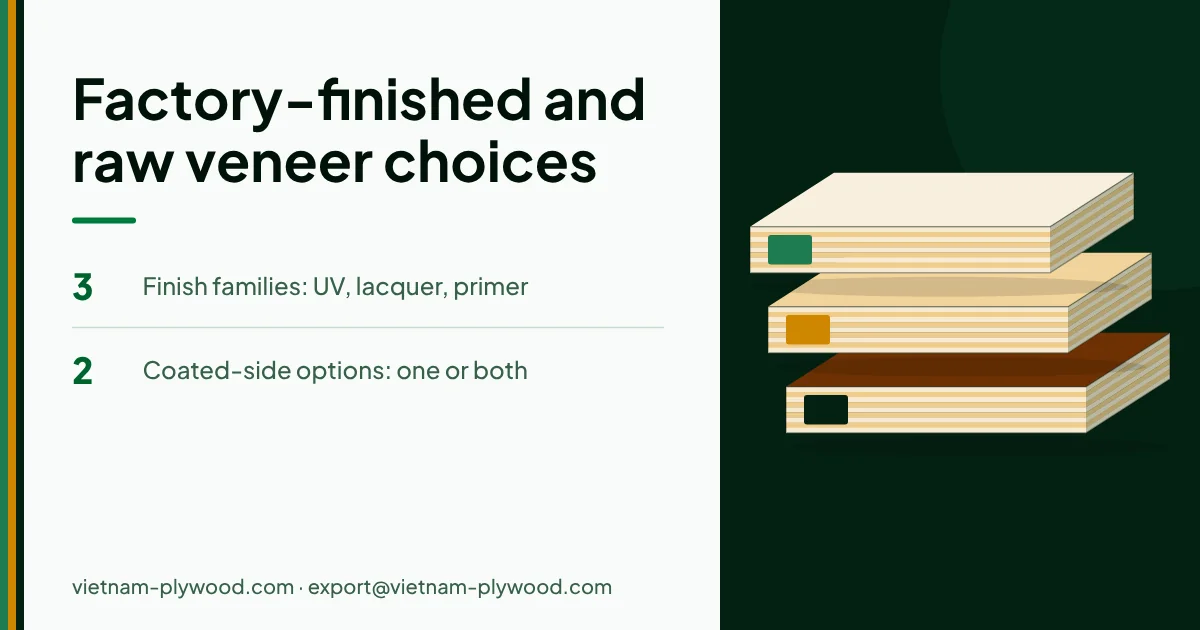
Finished plywood is a factory-coated decorative panel ordered by veneer, coating and surface acceptance criteria. Choosing the wrong coating or coated-side schedule can add rework costs and delay a cabinet shipment. HCPLY specifies UV, lacquer and primer faces on our furniture line, with the raw sanded option kept open when finishing after machining makes more sense.
What is finished plywood?
Finished plywood is a veneer-faced panel with a coating applied before shipment, so a cabinet or furniture maker receives a prepared visible surface. Prefinished plywood can reduce finishing work after cutting, but the order must distinguish a clear coated face from a primed surface that still needs painting. The face, coating, back and exposed edges remain separate specification decisions.
At HCPLY, factory finishing is specified on our furniture line, where full-stitched, sanded styrax or eucalyptus cores support decorative faces. For background on the material itself, see the plywood definition buyer guide and the Plywood Types category. A coating cannot correct open core gaps or a mismatched veneer grade.
Which factory coatings can a buyer specify?
Specify ultraviolet-cured (UV) coating, lacquer or primer by the finished appearance and downstream process. A UV-coated face suits repeatable cabinet interiors and exposed shelving where a consistent factory finish is wanted. Lacquered plywood suits a defined clear or coloured appearance. Primer is an intermediate surface for a buyer’s later paint system, so it should never be treated as a final decorative coat.
For clear coatings, state whether the grain remains visible and whether the surface is matt, satin or gloss. For coloured lacquer, provide a physical approved colour reference and viewing conditions. Primer requires the next coating chemistry and an agreed adhesion trial. A UV-coated plywood overview explains that coating family in more detail.
A veneer finish describes treatment of the wood surface. Melamine-faced boards, high-pressure laminate (HPL) and decorative laminate are separate facing systems, discussed for comparison rather than offered as HCPLY lines. A film-faced construction sheet is also a different product: its phenolic or melamine film is specified for formwork duty, not a cabinet’s visible lacquer finish.
What must the finish specification state?
The finish specification must name the coating system, sheen, colour reference, coated sides and acceptance sample. State whether the face alone receives coating or both face and back do; the reverse face can otherwise be mistaken for a second decorative surface. Record grain direction and whether a visible face must match across adjacent panels.
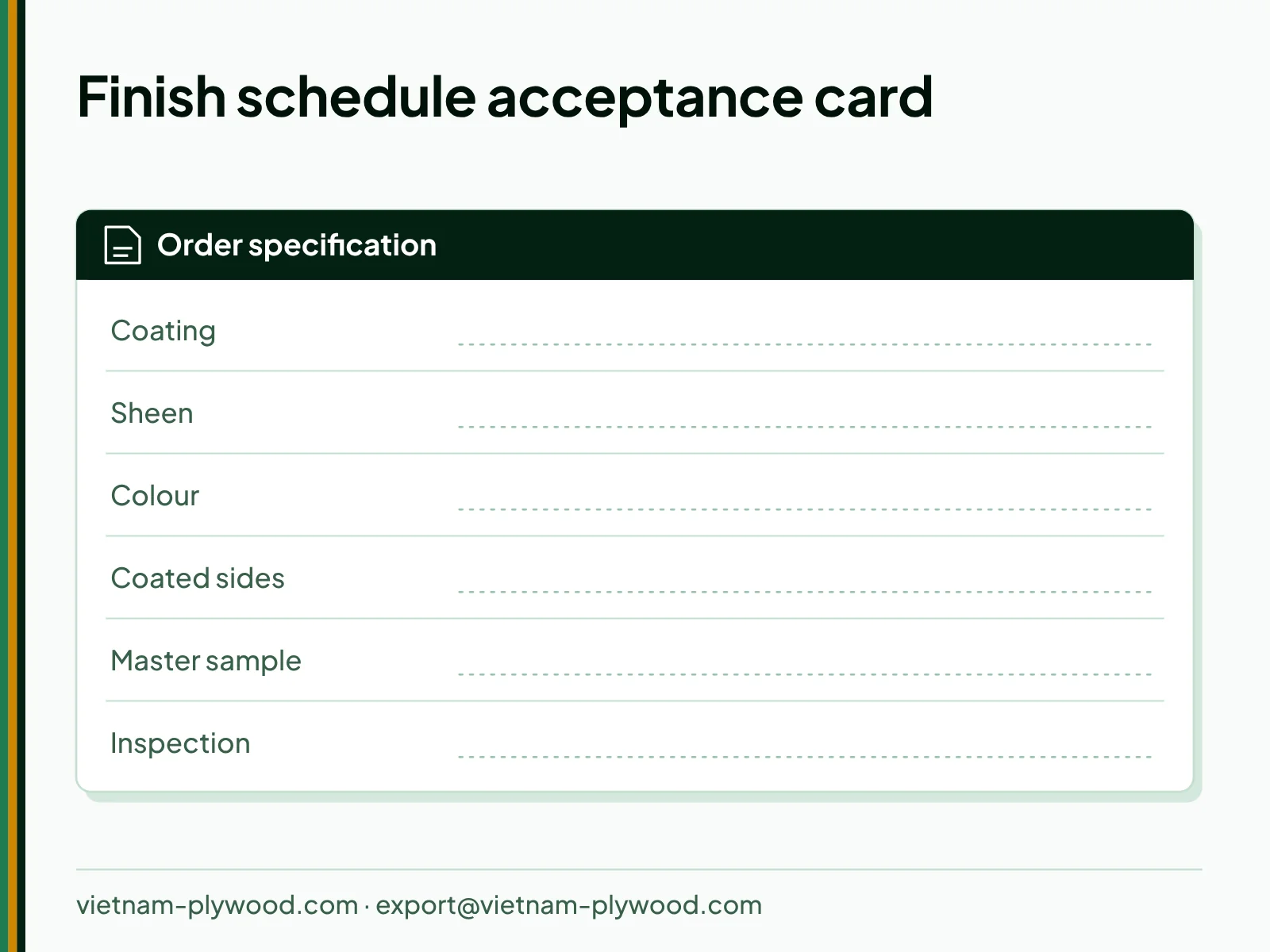
Write the veneer species and face grade independently from the finish. Our furniture line can use bintangor, okoume, engineered veneer (EV), gurjan, pine, poplar, eucalyptus, birch or sapele faces, with A/B face grades except birch D/E/F. A common face veneer thickness is 0.2–0.4 mm. See the wood veneer sheet guide and EV plywood for face selection.
Specify core, bonding and emissions as different fields. Styrax and eucalyptus are furniture-core choices; glue can be melamine moisture-resistant (MR) or phenolic weather-and-boil-proof (WBP), while E0 or E1 describes an emission class. A finish appearance alone says nothing about the adhesive or emissions category.
Finally define the inspection method: approved master sample, viewing distance and lighting, permissible colour range, sheen measurement method if used, coating coverage, scratches and adhesion criteria. Put any requested coating thickness or performance test into the purchase specification and agreed report rather than assuming a universal value.
How do the three production lines differ?
Our furniture line builds the sanded, decorative substrate for a factory-applied coating. Our commercial and packing line builds acacia-core MR plywood with unsanded or light-sanded faces, while our construction line builds film-faced acacia or eucalyptus panels for concrete work. Choosing a line by appearance alone can put the wrong core construction beneath an attractive surface.
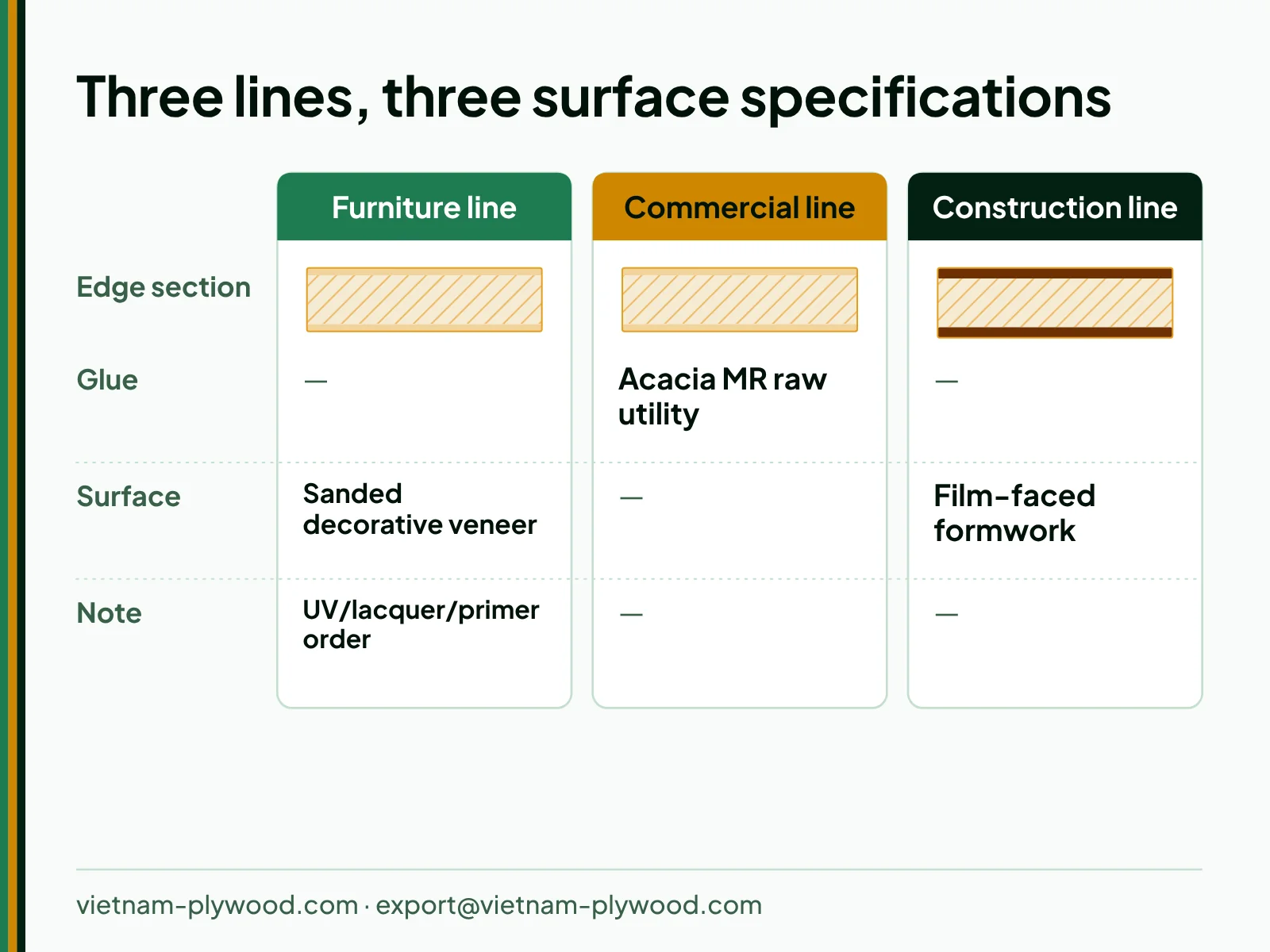
| Order feature | Furniture line | Commercial and packing line | Construction line |
|---|---|---|---|
| Typical surface | Sanded veneer for UV, lacquer or primer specification | Raw, unsanded or light-sanded | Phenolic or melamine film, including anti-slip |
| Core | Styrax or eucalyptus | Acacia | Acacia or eucalyptus |
| Typical decision | Visible cabinet and furniture panels | Packing or non-decorative utility | Formwork and site handling |
| 18 mm tolerance | ±0.2 or ±0.3 mm as ordered | Commercial ±0.5 mm; packing ±0.5–1.0 mm | ±0.5 mm |
These are different builds, even when nominal thickness matches. For a formwork purchase, use plywood supply for construction projects rather than a decorative finishing specification.
How are coated plywood faces packed for export?
Coated faces need interleaving that prevents direct face-to-face abrasion, plus dry, clean contact materials and stable pallet restraint. Agree the separator material and whether each panel, each pair or each stack layer is protected. Specify corner and edge guards, pallet wrapping, stack orientation and a photograph record before container closure.
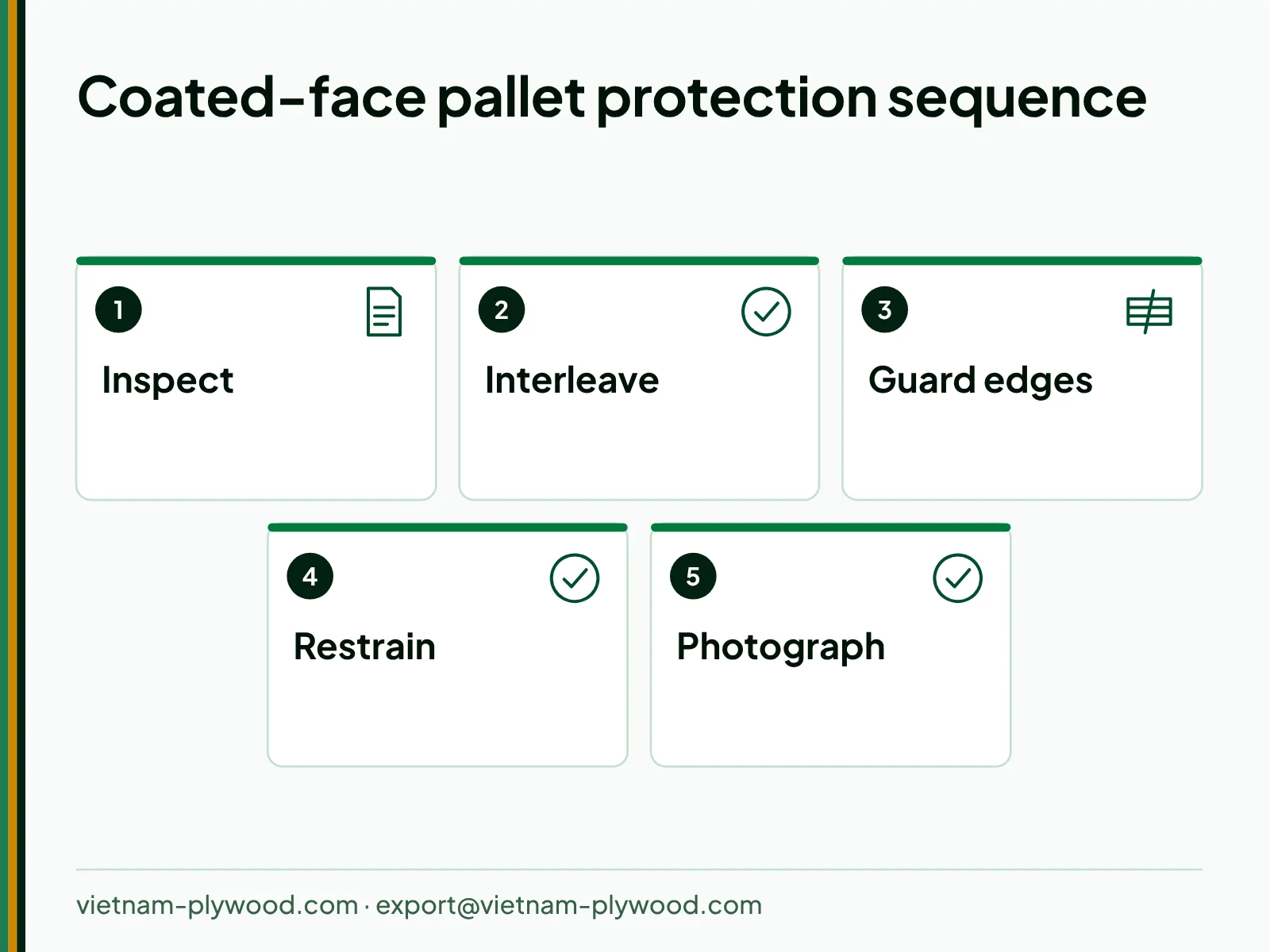
A practical packing sequence is:
- Inspect and segregate panels with surface marks before stacking.
- Place the approved non-marking separator against each protected face.
- Align edges, add protective corners and restrain the pallet without crushing its top sheets.
- Mark the bundle with finish code, face orientation and lot identification.
- Photograph the packed pallets and container loading for the buyer’s records.
These are order controls to agree and witness at the producing factory, rather than a claim that every coating uses identical packaging. A finished surface can be scratched by grit trapped under a separator; packing approval therefore belongs beside the finish sample approval.
Can finished and raw panels share a container?
Finished and raw specifications can share one 40HC within its 28.5 t payload limit, provided the packing plan separates their surfaces and identifies each lot. The core density changes the weight calculation: styrax is 500 kg/m³, acacia 580 kg/m³ and eucalyptus 650 kg/m³. The face name does not change the core-density basis.
For 18 mm sheets measuring 1220 × 2440 mm, the lookup gives 26.79 kg per styrax sheet, 31.08 kg per acacia sheet and 34.83 kg per eucalyptus sheet. A full same-core reference load is respectively 990, 880 or 795 sheets, excluding any added coating weight. Mixed loads require a revised pallet and weight plan, including coating and protective packing weights; the container packing calculator covers the full-load topic.
When comparing mixed furniture finishes, reserve protected pallet positions for coated faces and identify raw sheets separately. That makes the receiving count and damage inspection workable for an importer or distributor.
When is a raw sanded panel the better buy?
A raw sanded panel is the better purchase when the maker must colour-match finished assemblies, machine complex profiles or apply a proprietary coating after fabrication. It also suits production that will cut many exposed edges and needs one continuous finishing operation across faces and edges. Prefinished panels suit repeat flat parts with an approved finish and limited post-cut surface work.
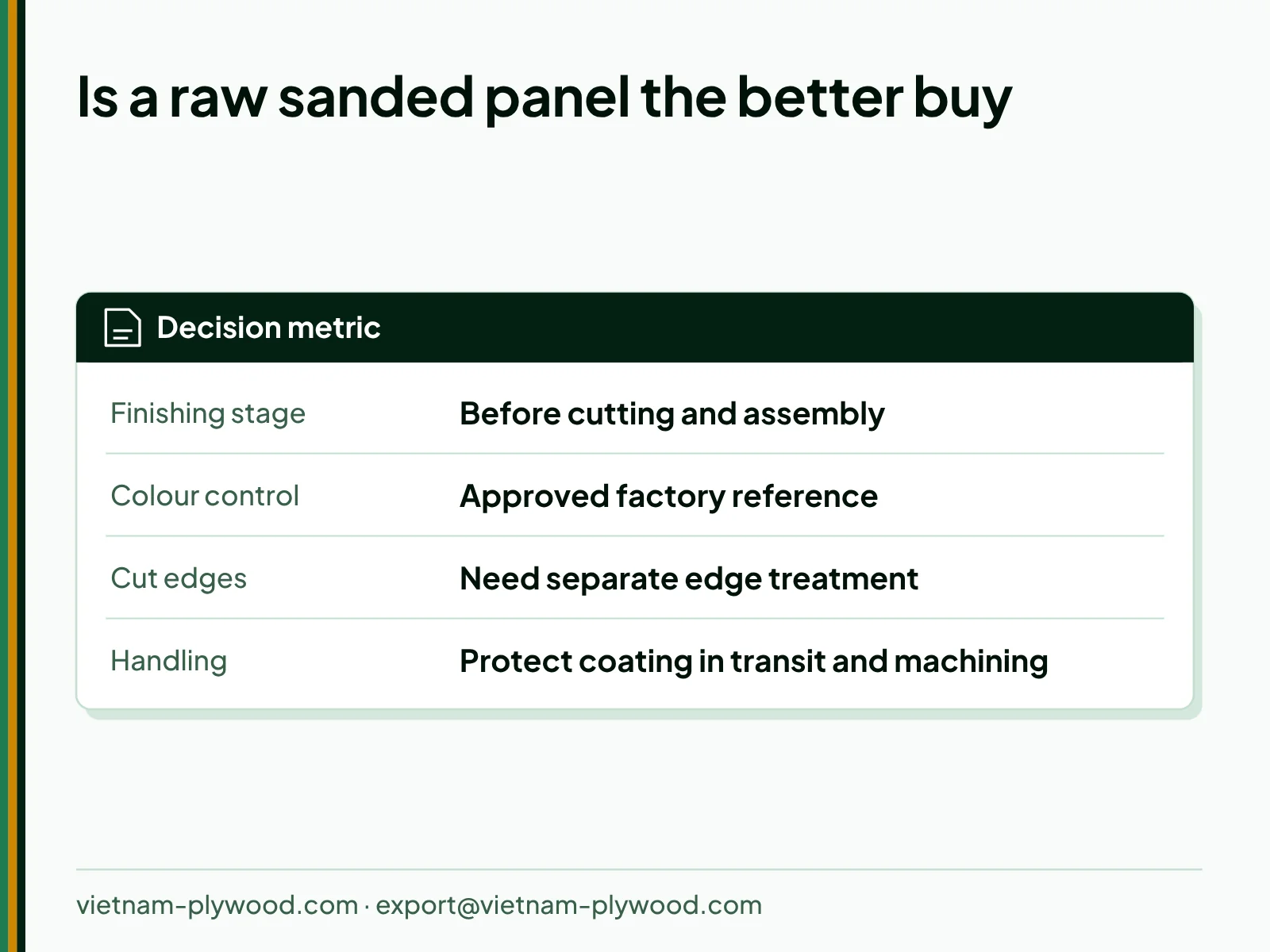
| Decision metric | Factory-finished face | Raw sanded face | Better fit |
|---|---|---|---|
| Finishing stage | Before cutting and assembly | After machining | Finished for repeat flat parts; raw for complex profiles |
| Colour control | Approved factory reference | Maker’s finishing batch | Raw for matching existing assemblies |
| Cut edges | Need separate edge treatment | Can be coated with the assembled part | Raw for many exposed cuts |
| Handling | Protect coating in transit and machining | Protect veneer until finishing | Finished when downstream finishing capacity is limited |
| Cost structure | Coating and protective packing added | Downstream labour, coating and drying added | Compare total delivered-and-finished cost |
The raw-versus-finished choice should be made against a parts list, not only a sheet quotation. A finish applied before routing can be damaged by clamping, while a late finish adds handling and curing work. Neither route eliminates the need for a documented acceptance sample.
Does a coated face make plywood waterproof?
A coated face does not make an entire plywood panel waterproof. Moisture can enter through cuts, drilled holes, edges or an unsuitable bond line. State the exposure class, glue requirement and edge-sealing process separately; do not substitute a glossy appearance for a water-resistance test.
The buyer should also distinguish a cabinet finish from construction film. For demanding exterior or marine specifications, acceptance must be against a test report the buyer accepts. Coating performance should be evaluated on the actual proposed substrate and with the planned edge treatment.
What can an inspector check at the producing factory?
An inspector can compare production panels with the signed finish master and observe the surface and packing controls before dispatch. The visit should cover both appearance and the underlying board: a polished face can conceal a wrong core or thickness.
Check the lot identification against the approved build, then examine sheen and colour under agreed lighting. Inspect face and back designation, visible defects, edge condition and representative thickness readings. Review the agreed adhesion or abrasion test report where the order calls for one, and witness separator placement on packed pallets.
Furniture panels are sanded to ±0.2 or ±0.3 mm thickness tolerance as ordered, and length and width tolerance is ±2 mm. Buyers visit the factory office and inspect goods at the producing factory. HCPLY handles on-site quality control and the export process, so the inspection record can follow the order through loading.
Which documents should accompany the order?
The commercial invoice and packing list identify the shipped goods and quantities; the agreed finish specification and inspection record identify what those goods must look like. The shipment document set also includes the bill of lading (B/L), certificate of origin, phytosanitary and fumigation papers, and order-specific certificates or test reports. Insurance is included under cost, insurance and freight (CIF) terms; European Union lots include EUR.1 and the EUTR/EUDR file set.
For US-bound decorative plywood, emission compliance is a separate question from the coating. The US Environmental Protection Agency’s 2024-era TSCA Title VI guidance states: “Under Title VI of the Toxic Substances Control Act (TSCA), three composite wood products are regulated: hardwood plywood, medium-density fiberboard (MDF, including thin-MDF), and particleboard.” See the EPA’s formaldehyde standards FAQ. Ask for the applicable third-party evidence for the agreed panel build; member-factory FSC, CARB P2, ISO 9001 and CE documents are shown with factory details masked, on request.
After loading, the draft shipping documents come to you for approval. Keep finish acceptance criteria attached to the purchase order so a shipping description does not have to carry every appearance detail.
How should buyers compare quotations and delivery terms?
Compare quotes on the same veneer, grade, core, coating, coated sides, packaging and inspection basis. Two panels of identical thickness can carry different finishing labour and rejection exposure. A two-sided coloured lacquer build typically costs more to finish than a single primed face because it requires additional coating operations; the actual quotation follows the written build.
For context, furniture plywood starts from US$350/m³ FOB Hai Phong (October 2026). That is a dated starting figure for furniture plywood, not a finished-coating price. Coated orders need a quotation against the exact finish schedule and protective packing method.
The minimum order is one 40HC, with specifications mixed within its payload limit. Factory lead time runs 15–45 days from receipt of the 30% deposit; the exact figure depends on order size, line loading and what the contract fixes. The remaining 70% is paid on the scan of the bill of lading, by T/T, or by irrevocable sight L/C. We ship FOB Hai Phong, or CFR (CNF) or CIF to your port. Free samples are available; a first-time buyer pays the courier, and that charge comes off the first confirmed order.
For ongoing assortments, see plywood supply programmes for distributors. A repeat order benefits from keeping the same signed finish reference and recording any approved change as a new finish code.
What should go into the first specification request?
Send a written panel build and a finish schedule that can be matched to a physical sample. Specify the destination port and intended use so packaging and export documents follow the actual order. HCPLY’s furniture line handles the decorative panel specification, and Lucy can coordinate the factory inspection and quotation at export@vietnam-plywood.com.
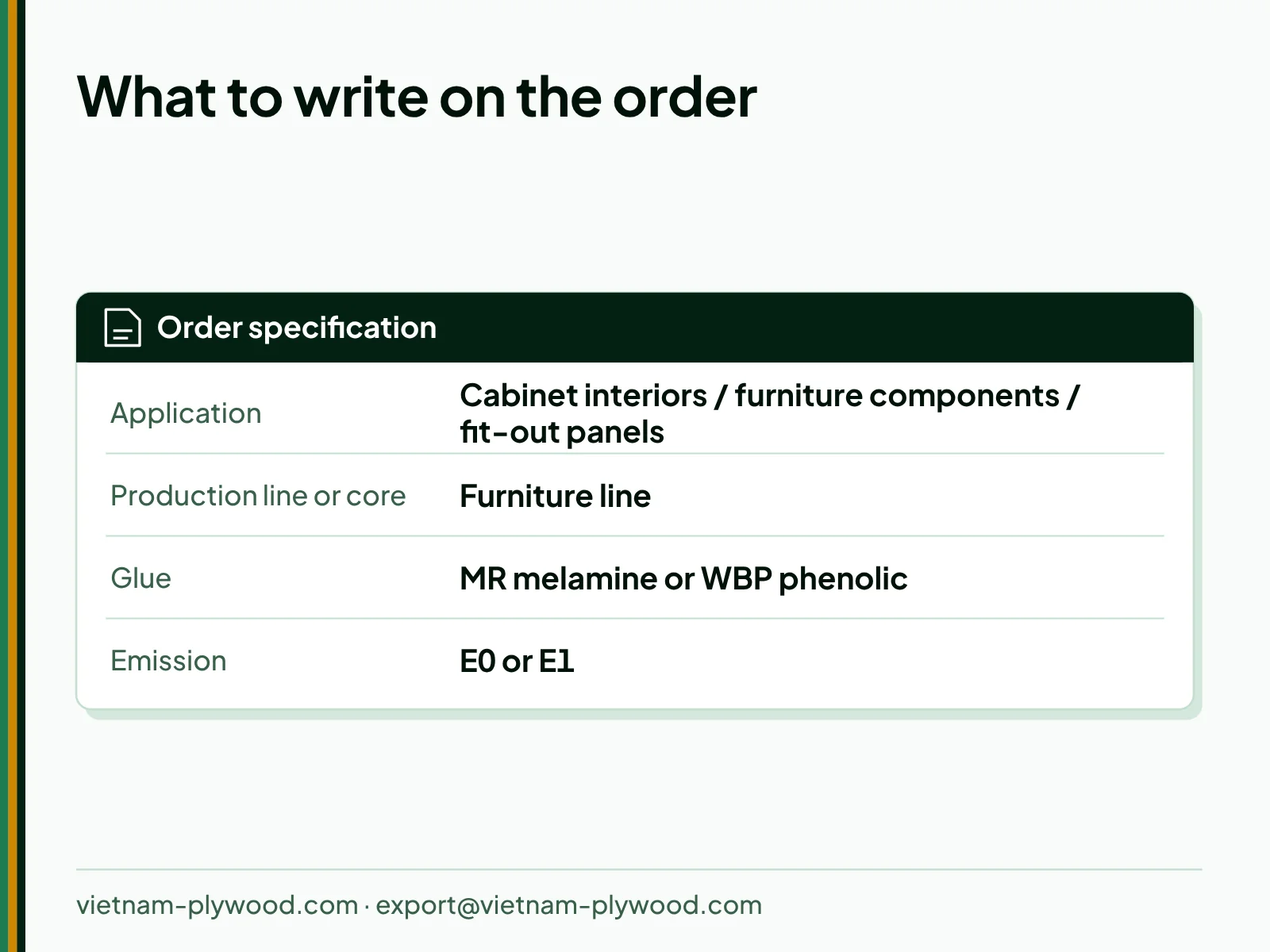
Application: cabinet interiors / furniture components / fit-out panels
Production line or core: furniture line; styrax or eucalyptus
Glue: MR melamine or WBP phenolic, as specified
Emission: E0 or E1; destination-specific evidence requested
Face and grade: species or EV; A/B (birch D/E/F)
Finish: UV / lacquer / primer; sheen; colour reference; one or both sides
Finish acceptance: signed master sample; test and visual criteria
Thickness and tolerance: ___ mm; ±0.2 or ±0.3 mm as ordered
Size: ___ × ___ mm; grain direction ___
Packing: separator type; protected sides; pallet and edge protection
Quantity: ___ sheets / pallets; mixed specifications if applicable
Destination port: ___; delivery term: FOB Hai Phong / CFR / CIF