





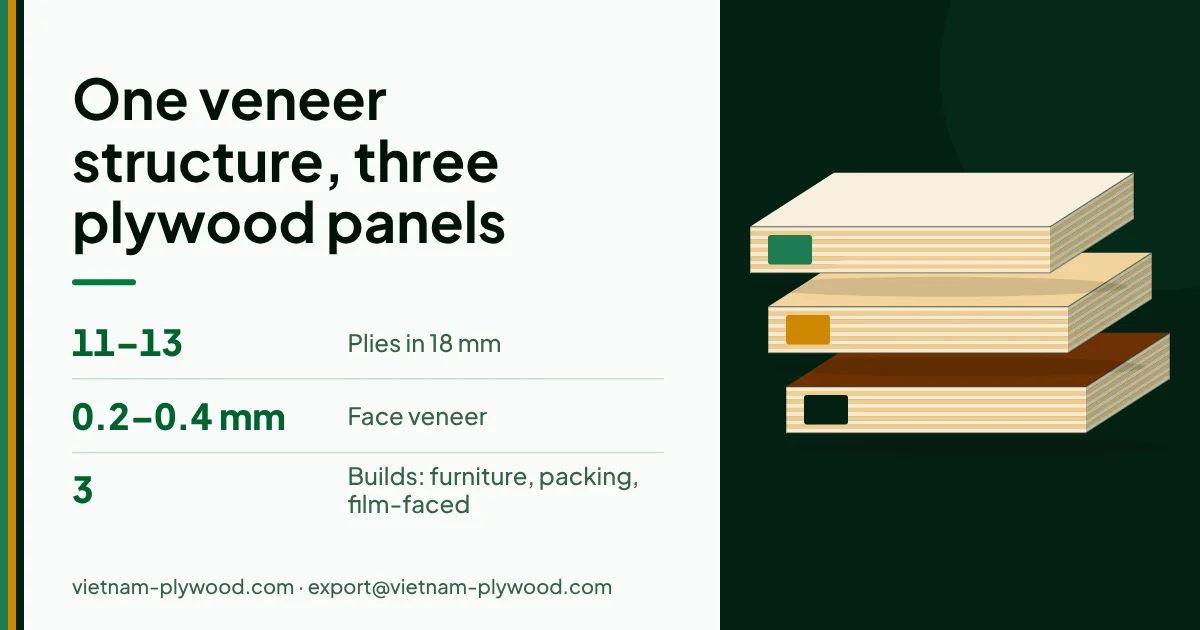
Plywood is a panel of thin wood veneers glued with the grain of each layer turned at right angles to the next. At HCPLY that single structure leaves the press as a sanded furniture panel, an unsanded packing panel or a film-faced form panel, depending on face, glue and press. Order the wrong one and a cabinet maker sands through a packing face, or a formwork yard loses panels early.
What is plywood?
Plywood is an engineered wood panel built from an odd number of veneer layers, each glued with its grain at right angles to the layer beside it, then pressed hot into one sheet. The crossed grain makes the sheet stable in both directions, resistant to splitting and available far wider than any board cut from a log.
The plywood meaning in English is literal: “ply” for a layer, “wood” for the material. A buyer who asks what plywood means usually wants the next answer, though, which is what separates one plywood from another. The structure is common to all of them. The face, the core species, the glue, the press and the finish are what change.
US regulation gives a formal version. The EPA formaldehyde rule at 40 CFR 770.3, as published by Cornell’s Legal Information Institute (2026), defines hardwood plywood as a panel composed of layers or plies of veneer joined by an adhesive with a lumber, particleboard, MDF, hardboard, veneer or other core. The same rule is what sets the emission limit a US importer must meet.
Why the crossed grain works
Wood is strong along its grain and weak across it. A board bends, splits and swells mostly across the grain, because the fibres run one way. Plywood puts fibres in both directions: each ply restrains the plies on either side of it, so the sheet behaves almost the same along and across its length.
The layout also puts material where the load is. When a panel bends, the outer plies carry most of the stress, one in tension and one in compression, and the core holds them apart. A thicker core spreads the faces further and makes the sheet stiffer, which is why an 18 mm panel spans further than a 12 mm one under the same load. The plywood material is the same wood as a board; the arrangement is what changes its behaviour.
Plywood information for a buyer therefore comes in three layers: the structure (veneers crossed and glued), the build (core, glue, face, finish) and the use (what the panel will do once it leaves the container). This page takes them in that order. It belongs with our other articles on plywood types.
What does “ply” mean in plywood?
A ply is one layer of veneer, and plywood is named for its plies. The word ply comes from the French verb for folding, and in a panel it means each sheet of veneer laid down in turn. Count the layers at a cut edge and you have the ply count.
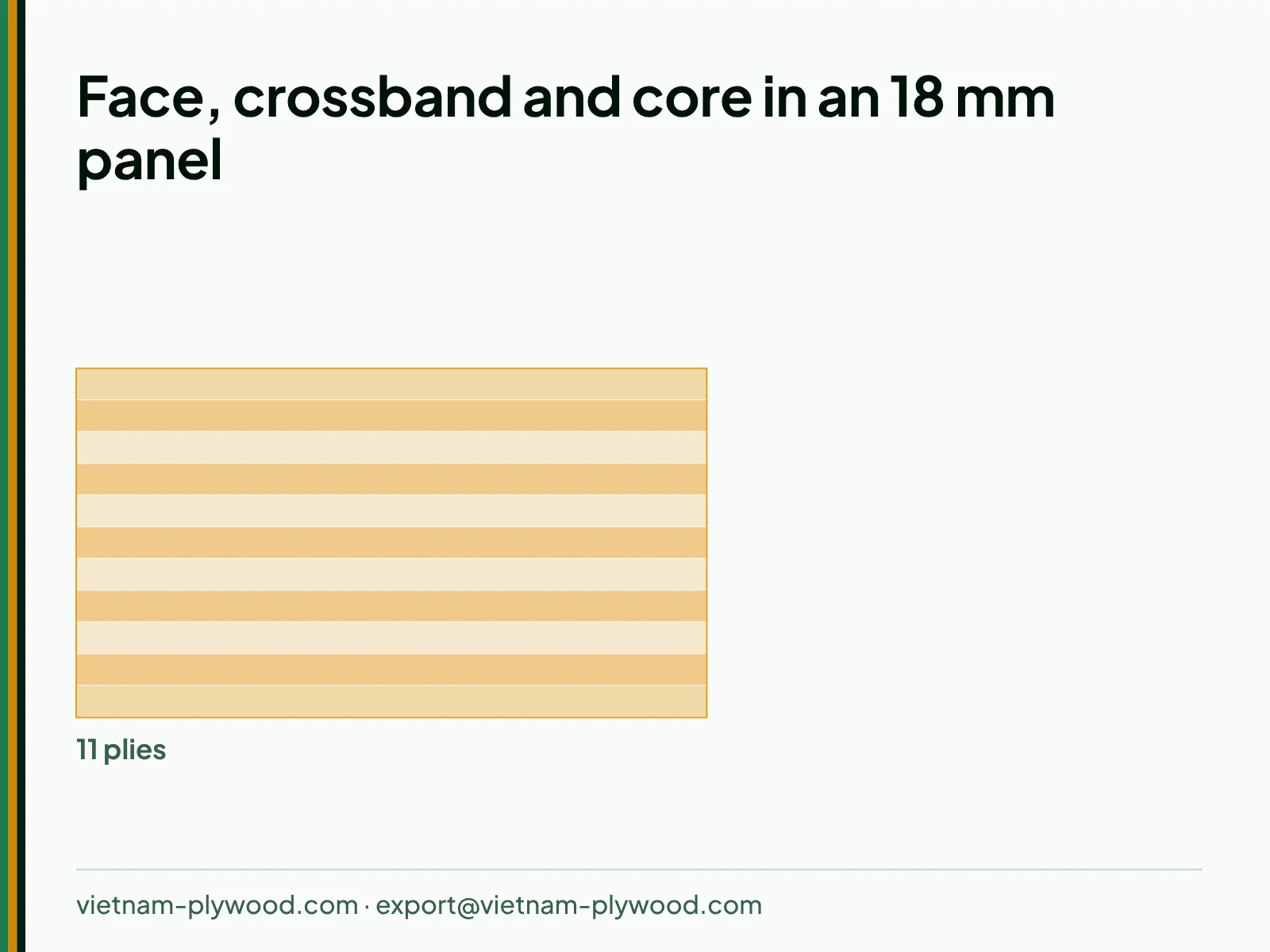
Panels are built with an odd number of plies, so that the two outer faces run in the same direction and the core sits in the middle. That balance keeps the sheet flat as it dries and as the air around it changes. An even-ply panel tends to pull one way.
The ply count follows the thickness and the core veneer. Our core veneers run 1.4–2.0 mm thick, so an 18 mm panel holds 11–13 plies. The face veneer on each side is thinner, 0.2–0.4 mm being common in Vietnam, because its job is appearance and a smooth surface rather than strength.
Three terms come up around the plies:
- Face and back. The two outer plies. The face carries the species name and the grade, such as okoume grade A or birch grade E.
- Core. Every ply between face and back. Its species sets the density: acacia 580, eucalyptus 650, styrax 500 kg/m³.
- Crossband. The plies directly under the face and back, laid with the grain across the face. They hold the face flat and give the panel its strength across the sheet.
What is plywood made of?
Plywood is made of wood veneer and glue, plus a film or overlay on some panels. In Vietnam the core is one of three plantation hardwoods, the face is chosen for its look, and the glue is chosen for where the panel will live.
Veneer
Veneer is a thin sheet peeled or sliced from a log. The same US rule (40 CFR 770.3) defines veneer as a sheet of wood or woody grass with a maximum thickness of 6.4 mm, cut by rotary peeling, slicing or sawing. Our core veneers sit at 1.4–2.0 mm and our faces at 0.2–0.4 mm, well inside that limit.
Core species in Vietnam are acacia, eucalyptus and styrax. There are no gurjan, birch or hopea cores in Vietnamese plywood. The face is a separate choice: bintangor, okoume, EV (engineered veneer), gurjan, pine, poplar, eucalyptus, birch or sapele, or matt, which is the unfaced raw core. A plywood is named by its face, so “okoume plywood” says nothing about its core.
EV is worth a line of its own. It is a veneer made by dyeing and gluing leaves of veneer into a block, then slicing the block again, which gives a face that repeats sheet after sheet. Furniture buyers use it when every cabinet door must match.
Glue
Glue is the second ingredient, and it decides how the panel survives water. Melamine glue (MR) is for interior and dry use and passes a 12-hour boil test. Phenolic glue (WBP) is for wet sites and repeated use and passes a 72-hour boil test. The press runs at 110–120 °C for MR and 130–145 °C for WBP.
Emission class
Emission is a separate field from glue. E0, E1 and E2 are emission classes of the finished panel. CARB P2 / TSCA Title VI is the US limit, met with third-party certification. A quote that reads “E0 glue” merges two fields; write the glue and the class on two separate lines.
Film and overlay
Film-faced panels add a resin film over the face, described by weight: 120 g/m² standard, 135 g/m² premium and 220 g/m² anti-slip only. Melamine, HPL and laminate faces exist on the market too, applied by panel processors; they are surface finishes and sit outside our product lines.
The wood veneer sheet guide goes deeper on face species and veneer cuts. For the core choice between the two denser species, see acacia vs eucalyptus core.
How is plywood made?
Plywood is made in nine steps from log to graded sheet. The structure is fixed by step 4; everything after it decides which of the three panels the sheet becomes.
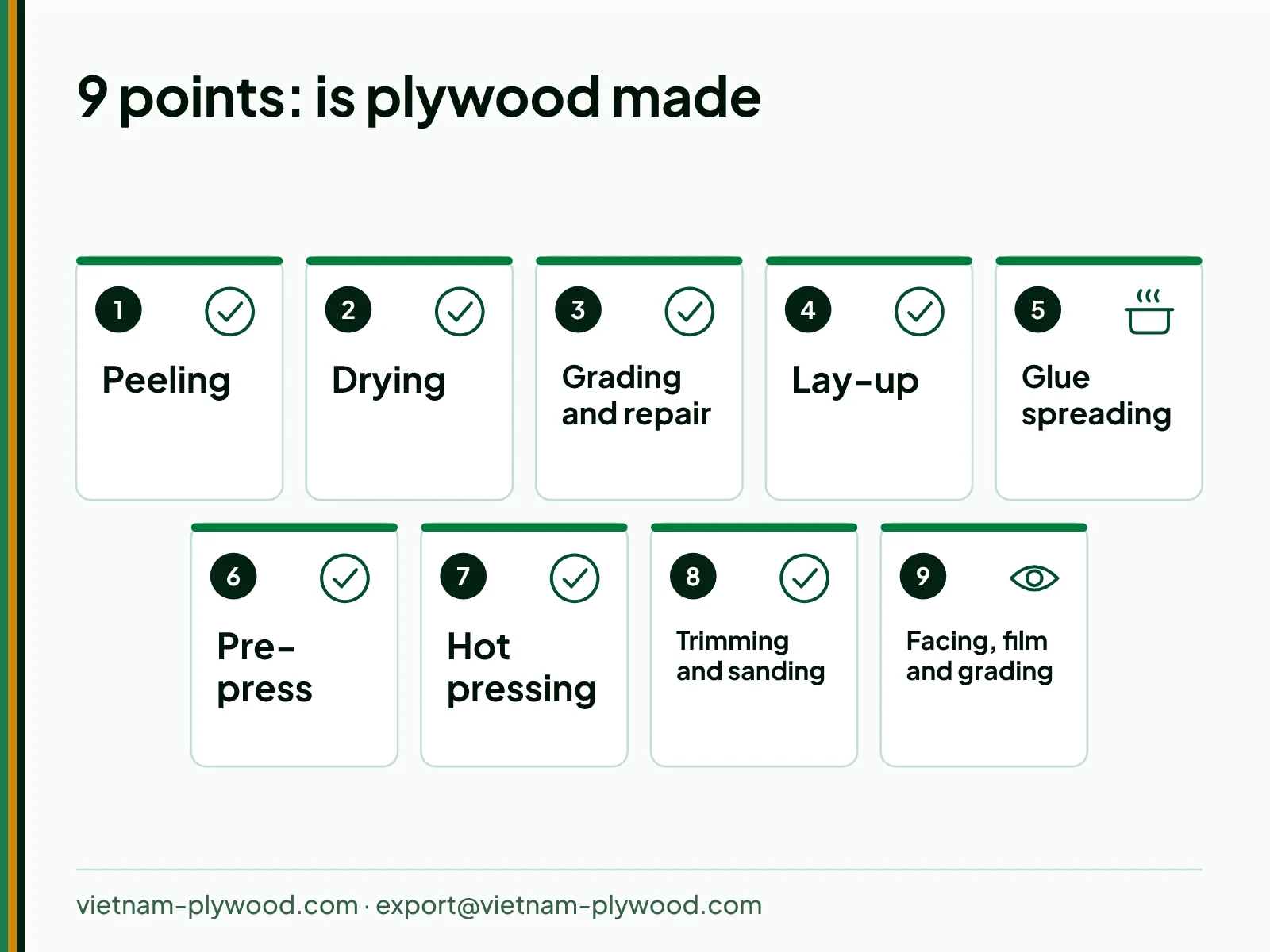
- Peeling. Logs are turned against a long knife on a rotary lathe, which unrolls a continuous sheet of veneer at the set thickness.
- Drying. Green veneer is dried so the glue can bond and the panel does not move after pressing.
- Grading and repair. Veneers are sorted into face, crossband and core grades. Split or short core sheets are jointed or patched.
- Lay-up. Core veneers are laid with grain alternating at right angles, in an odd number. The core construction step is set here: full stitched, stitched outer layers with edge-trimmed inner, finger-jointed, or loose-laid, from best to cheapest.
- Glue spreading. Glue (MR or WBP) is spread on the core veneers before they are stacked.
- Pre-press. The stack is pressed cold so it holds together on the way to the hot press.
- Hot pressing. Heat and pressure cure the glue: 110–120 °C for MR, 130–145 °C for WBP.
- Trimming and sanding. Edges are trimmed to size within ±2 mm. Furniture panels are sanded to ±0.2 or ±0.3 mm; commercial and film-faced panels are held to ±0.5 mm; packing to ±0.5–1.0 mm.
- Facing, film and grading. The face veneer or film goes on, the sheet is graded against the order, and it is stacked by pallet.
Step 4 is the one buyers overlook. Two panels with the same face, thickness and glue behave differently if one has a full stitched core and the other a loose-laid one. Gaps and overlaps in a loose-laid core show up as soft spots, edge voids and shadows under a lacquered face.
How does the same veneer structure become a furniture, packing or film-faced panel?
The same crossed-veneer structure becomes three different panels through four choices: core, glue, surface and tolerance. Our three factories each press one product group, so each build runs on the line set up for it. The table holds thickness and size constant at 18 mm and 1220×2440 mm and follows one panel through each line.
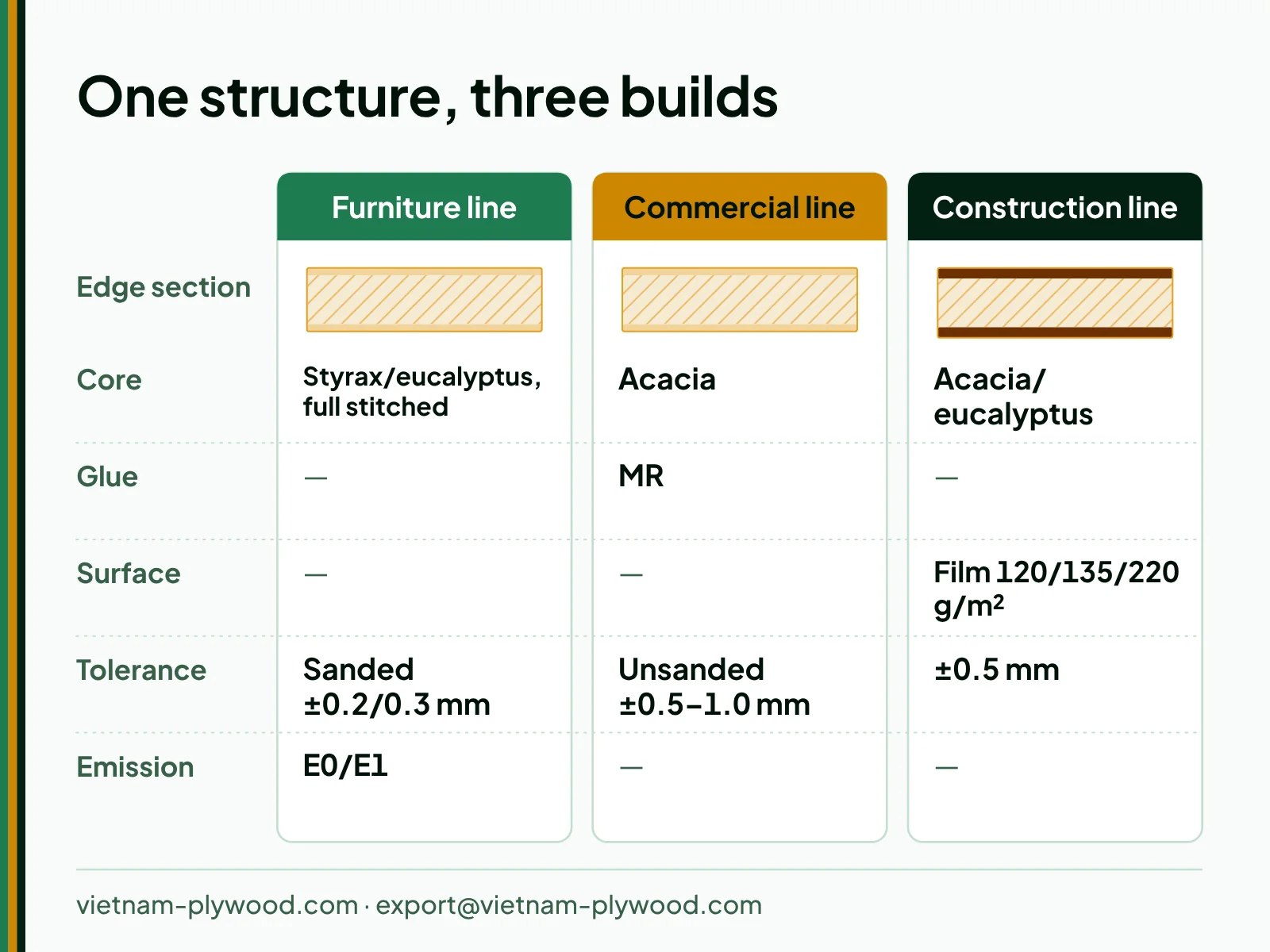
| Build step (18 mm, 1220×2440 mm) | Furniture panel | Packing panel | Film-faced form panel |
|---|---|---|---|
| Line | Our furniture line | Our commercial and packing line | Our construction line |
| Core species | Styrax (500 kg/m³) or eucalyptus (650 kg/m³) | Acacia (580 kg/m³) | Acacia (580 kg/m³) or eucalyptus (650 kg/m³) |
| Core construction | Full stitched | Written on the order | Written on the order |
| Glue | MR or WBP, as ordered | MR (12-hour boil) | MR or WBP; WBP for wet sites |
| Emission | E0 or E1 | Class written on the order | Class written on the order |
| Surface | Sanded; face A or B | Unsanded or light-sanded | Phenolic or melamine film, 120 / 135 / 220 g/m² |
| Thickness tolerance | ±0.2 or ±0.3 mm | ±0.5–1.0 mm | ±0.5 mm |
| Sheet weight | 26.8 kg (styrax), 34.8 kg (eucalyptus) | 31.1 kg | 31.1 kg (acacia), 34.8 kg (eucalyptus) |
| What it is for | Cabinets, carcasses, fit-out | Crates, pallets, boxes | Concrete formwork, scaffold boards (anti-slip) |
Sheet weight follows the formula length × width × thickness × core density: 1.22 × 2.44 × 0.018 × 500 = 26.8 kg for styrax. The face adds almost nothing, which is why density follows the core.
The furniture panel
Our furniture line takes the structure to its tightest build. A full stitched styrax or eucalyptus core leaves no gaps to print through a lacquer, and sanding to ±0.2 or ±0.3 mm lets a CNC router nest parts without reshimming. The panel is pressed to E0 or E1. The furniture plywood page covers the faces and sizes in this group.
The packing panel
Our commercial and packing line uses the same structure for a different job. An acacia core with MR glue, unsanded or light-sanded, carries load in a crate and holds nails at its edges. A sanded face and a tight tolerance would add cost and nothing else here. If the same buyer asked the furniture line for a packing panel, it would build a sanded, full stitched panel that costs more for no gain in a crate.
The film-faced form panel
Our construction line puts a resin film over the face and chooses glue for the pour. With proper handling, a release agent on every pour and sealed edges (cut edges included), melamine-glue film-faced lasts about 12–15 pours and phenolic-glue up to about 25 pours. On the furniture line, the same request would come out as a sanded panel with no film, which concrete would ruin on the first pour.
The types of plywood by manufacturer classification page names every face and grade within these three groups.
What is plywood used for?
Plywood is used wherever a stable, wide, light sheet of wood is needed: furniture, packing, concrete forms, floors and fit-out. What plywood is used for decides the build, so the table pairs each use with the build it needs.
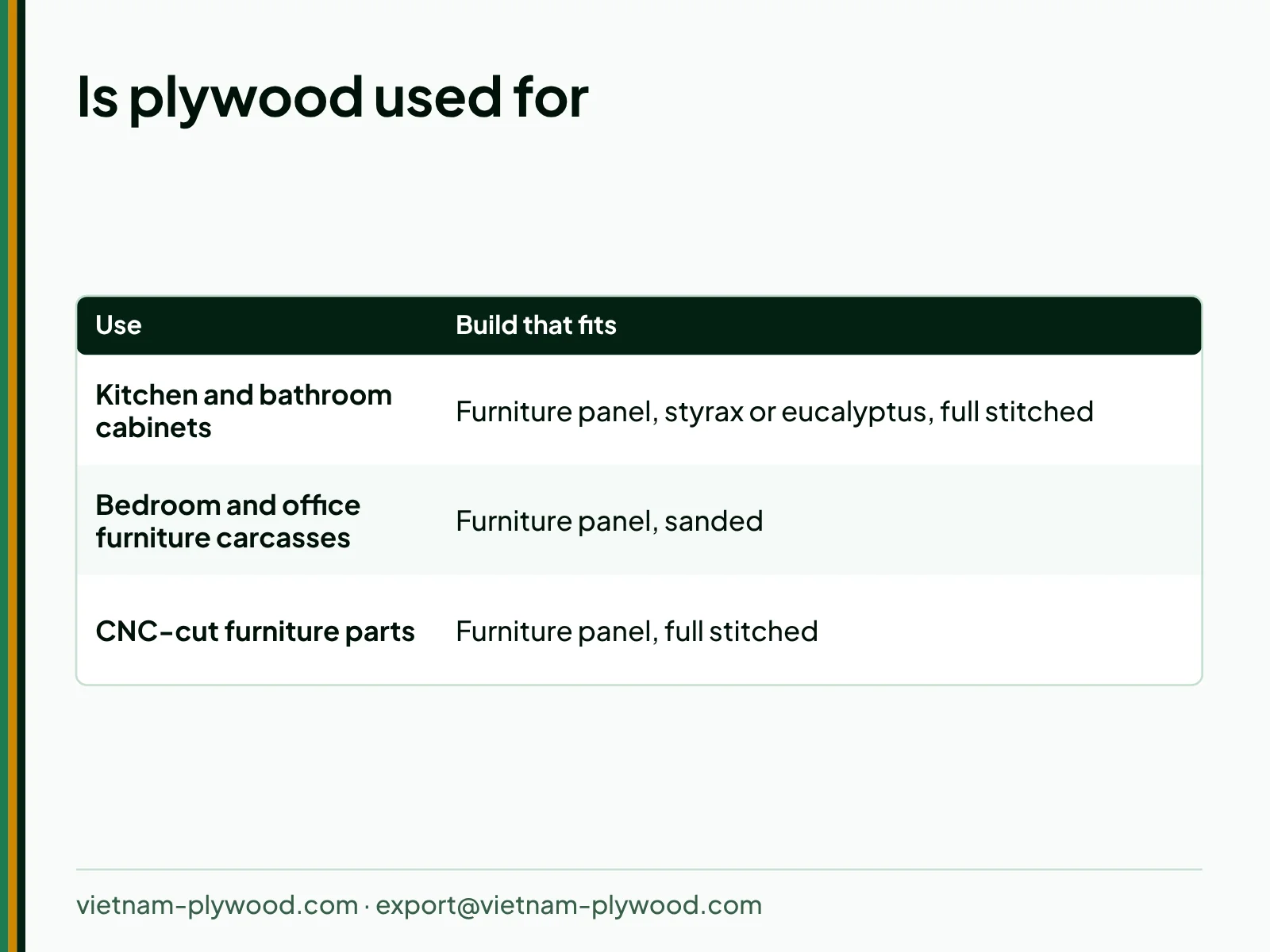
| Use | Build that fits | Field to write on the order |
|---|---|---|
| Kitchen and bathroom cabinets | Furniture panel, styrax or eucalyptus, full stitched | Emission class E0 or E1; tolerance ±0.2 mm |
| Bedroom and office furniture carcasses | Furniture panel, sanded | Face grade A/B; tolerance ±0.3 mm |
| CNC-cut furniture parts | Furniture panel, full stitched | Tolerance ±0.2 mm; core construction |
| Painted furniture parts | Furniture panel with birch (D/E/F) or poplar face | Face grade against sample |
| Export crates and boxes | Packing panel, acacia, MR | Tolerance ±0.5–1.0 mm |
| Pallet decks and cable-drum flanges | Commercial or packing panel, acacia | Thickness and size, custom cutting |
| Wall and slab formwork | Film-faced form panel, WBP | Film weight 120 or 135 g/m² |
| Scaffold boards and walkways | Anti-slip film-faced, 220 g/m² | Film weight; glue |
| Floor bases and fit-out linings | Commercial panel, light-sanded | Glue; emission class |
Structural and marine uses deserve a plain line. A “marine” or structural grade is a claim that needs a test report the buyer accepts. Ask for that report before you order plywood for a boat, a load-bearing floor or a stress-graded frame.
The history of plywood shows the same pattern of use deciding build. Moulded furniture came first, then packing cases, then aircraft and formwork. Each new use pushed a new glue or face.
What is the difference between plywood and solid wood?
Solid wood is a single piece sawn from a log, so it swells, shrinks and splits along and across one grain direction. Plywood crosses its grain in every layer, so it moves far less across the sheet, holds nails at its edges and comes in wide sheets. The table compares them on the measures a buyer cares about, with a verdict for each use.
| Measure | Plywood | Solid wood | Verdict by use |
|---|---|---|---|
| Movement across the width | Low: each ply holds the next in the other direction | High: wood swells and shrinks across its grain | Plywood for wide panels and carcasses |
| Splitting at nailed or screwed edges | Low: crossed grain resists splitting | Higher along the grain | Plywood for crates and boxes |
| Largest single piece | Sheets of 1220×2440 or 1250×2500 mm, custom cut | Width limited by the log; wide panels must be glued up | Plywood for anything wider than a board |
| Weight per sheet | Known from core density: 26.8–34.8 kg at 18 mm, 1220×2440 | Varies with species and moisture | Plywood when freight and handling are planned |
| Edge appearance | Visible layers; edge banding often used | One grain on every face | Solid wood for exposed edges and carved parts |
| Repair and refinish | Limited by a 0.2–0.4 mm face | Can be planed and sanded many times | Solid wood for heavy-wear surfaces refinished over years |
| Use of the log | Rotary peeling unrolls most of the log into veneer | Sawing loses kerf and offcuts | Plywood when timber yield matters |
“Solid plywood” is a separate term. Buyers use it for plywood made of veneer all the way through, as opposed to blockboard with a lumber-strip core or panels with an MDF or particleboard core. All plywood we press is veneer-core plywood in that sense.
Plywood also differs from other panels in the engineered wood family. MDF and particleboard are made of fibres or chips, OSB of oriented strands, and LVL of veneers laid all in one direction for beams. We do not press MDF, OSB, chipboard, blockboard, bamboo, MDO, HDO, 3-ply spruce panels or birch-core plywood. The engineered wood meaning page places plywood among these panels.
When was plywood invented?
Layered wood is ancient, but plywood as an industrial material is about 170 years old. According to the V&A museum’s 2024 short history, the technique dates as early as 2600 BC in ancient Egypt, and plywood was not used on an industrial scale until the 1850s.
The milestones a buyer will meet in plywood facts and timelines, all from the V&A account:
| Period | What happened | Why it matters today |
|---|---|---|
| About 2600 BC | Layered veneer used in ancient Egypt | The crossed-layer idea is older than the panel |
| 1850s–1890 | Moulded plywood used mostly for furniture; a chair-back moulding technique patented in New York in 1858 | Furniture was the first industrial use |
| 1880s | Flat plywood boards made on a large scale, with tea chests and packing cases as the most successful products | Packing panels are among the oldest flat plywood uses |
| 1907–09 | Over 2500 plywood cases carried an Antarctic expedition’s supplies | Packing plywood earned its name for strength and lightness |
| From 1917 | Moulded canoes with a water-resistant glue | The start of water-resistant glues |
| From the 1920s | Modernist designers used curved plywood for furniture | Furniture plywood as a design material |
The packing case is the link to today’s trade: the panel that carried supplies to Antarctica is the ancestor of the acacia packing panel on our commercial and packing line. Read the timeline as a list of builds. Each period added a use, and each use asked for a different glue, face or press, which is still how the three panels on this page differ.
What sizes, thicknesses and grades does plywood come in?
Plywood comes in standard sheets, a wide thickness range and face grades set by species. Our standard sizes are 1220×2440, 1250×2500, 1220×2135, 1220×1830, 915×2440, 915×2135 and 915×1830 mm, with custom cutting available. The thickness range runs 3–40 mm, most often 3, 5, 9, 12, 15, 18, 21 and 25 mm.
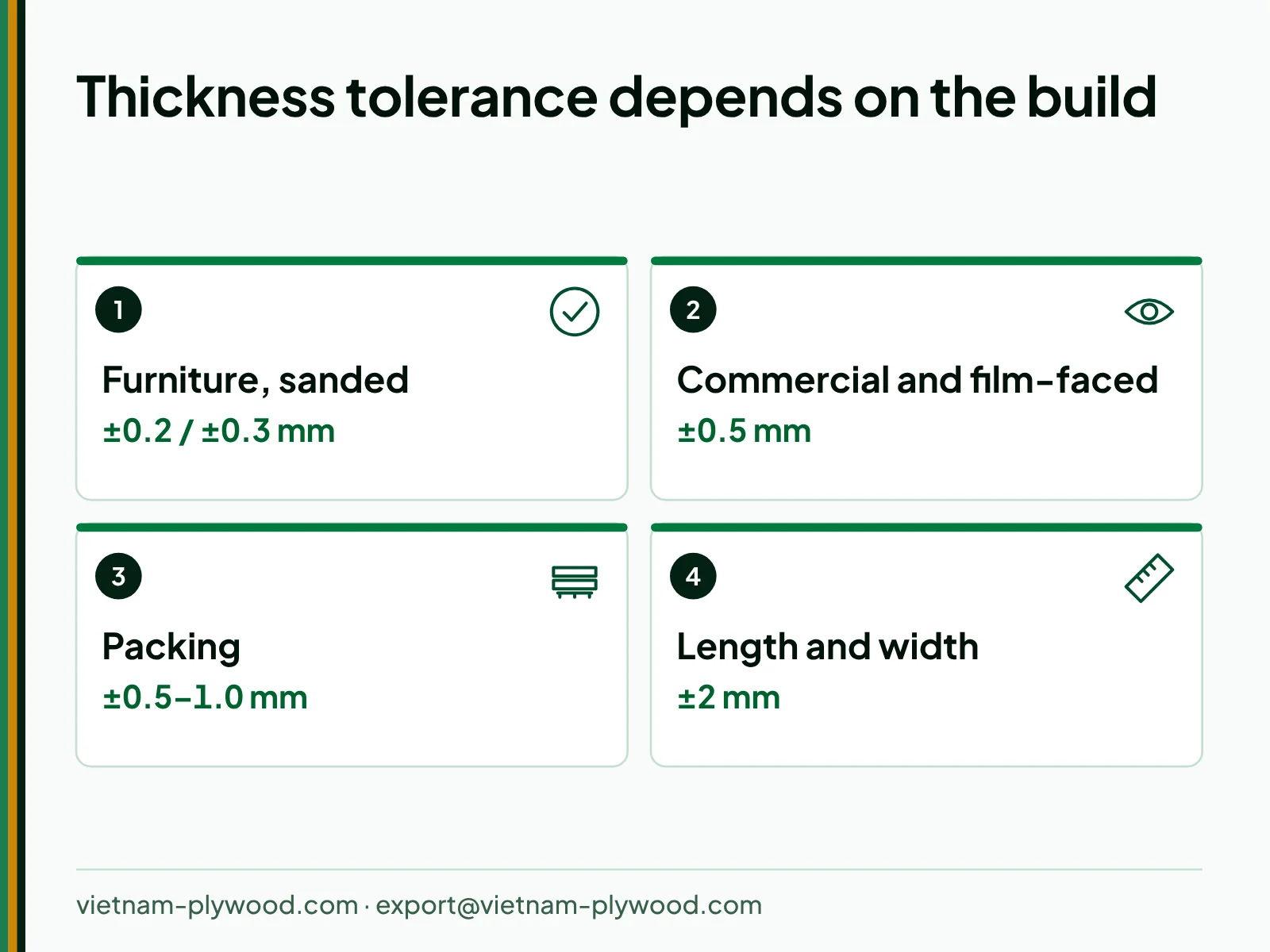
Thickness tolerance depends on the build:
- Furniture, sanded: ±0.2 or ±0.3 mm, as ordered.
- Commercial and film-faced: ±0.5 mm.
- Packing: ±0.5–1.0 mm.
- Length and width: ±2 mm on every build.
Face grades are A and B for most species. Birch is graded D, E or F, a different scale, so a birch face is never “A” in this system. Film-faced panels are graded by film weight: 120, 135 or 220 g/m².
Sheet weight follows the core. At 1220×2440 mm, a 12 mm sheet weighs 17.9 kg on styrax, 20.7 kg on acacia and 23.2 kg on eucalyptus; at 18 mm, 26.8, 31.1 and 34.8 kg. The core construction step (full stitched, stitched outer layers with edge-trimmed inner, finger-jointed, loose-laid) is the grade buyers forget to write, and the one that most changes a panel’s behaviour.
For containers, an 18 mm load at 1220×2440 mm holds 990 styrax, 880 acacia or 795 eucalyptus sheets in a 40HC, all within the 28.5 t payload limit. Other thicknesses and sizes are on our container load tool.
How do you read a plywood specification line?
A plywood specification line is read field by field, in the order the panel was built: use, core, glue, emission, face, thickness, size. Each field answers one of the questions above, and a missing field is the one the producing factory will fill with its cheapest option.
Take a line that reads “18 mm okoume, MR, E1, 1220×2440, BB/CC”. It names a face, a glue, a class and a size, and leaves out the core species, the core construction step, the sanding and the tolerance. HCPLY reads such a line as a question, not an order. A furniture buyer and a packing buyer could both send that line and receive panels that differ by 8 kg a sheet and by a full grade of core.
The complete version names everything:
- Use: what the panel is for, which tells the factory which line presses it.
- Core: species (acacia, eucalyptus or styrax) and construction step.
- Glue: MR or WBP.
- Emission: E0, E1, E2 or CARB P2 / TSCA Title VI.
- Face and grade: species and grade, or film weight.
- Thickness and tolerance: for example 18 mm ±0.3 mm, sanded.
- Size and quantity: sheet size, and quantity in sheets, m³ or containers.
Distributors who stock several of these builds for resale can read how plywood supply programmes for distributors keep the same lines repeating from order to order.
How do you specify plywood for your first order?
Specify plywood by writing the use first and letting each field follow from it. Furniture plywood starts from US$350/m³ FOB Hai Phong (October 2026) and commercial plywood from US$250/m³ FOB Hai Phong (October 2026); film-faced and other builds are quoted against the written specification. The minimum order is one 40HC, and specifications can be mixed in it.
A cabinet maker would send lines like these:
Application:       kitchen cabinet carcasses, lacquered
Line / core:       furniture line, styrax core, full stitched
Glue:              MR (12-hour boil)
Emission:          E0
Face and grade:    EV (engineered veneer) face A / back B
Thickness:         18 mm sanded, ±0.2 mm
Size:              1220 × 2440 mm
Quantity:          one 40HC (990 sheets at 18 mm on styrax)
Destination port:  [your port], FOB Hai Phong
Samples cost nothing: a first-time buyer pays the courier, and that charge comes off the first confirmed order. Once your lines are written, request the spec sheet for the build you picked, and compare it field by field with the panel you use today.