





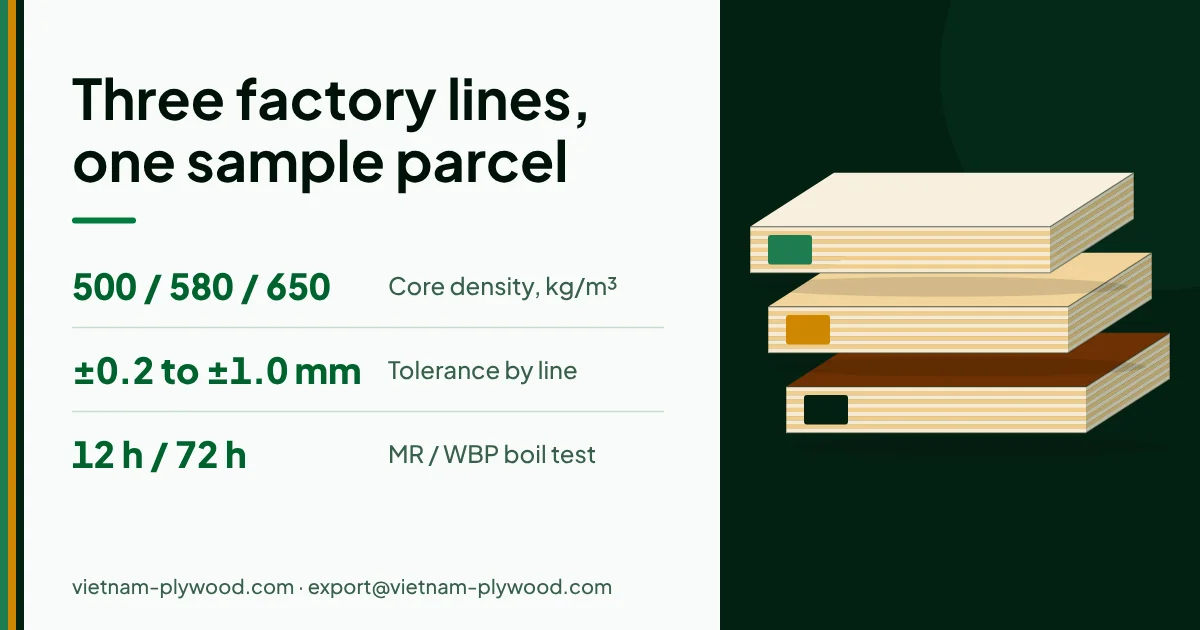
HCPLY’s plywood samples are free, and one parcel can carry panels from all three of our factory lines, each tested for the property its line is built to deliver. Skip those tests and the first 40HC becomes the test instead, with a 30% deposit paid, a production slot used and a load you may have to reject.
The sections below set out what is in a sample set, how it travels, what to measure on each panel and how the sample you approve becomes the yardstick at pre-shipment inspection. Contract steps after sampling sit on the plywood MOQ, negotiation and ordering guide.
Are plywood samples free?
Yes. Plywood samples are free; a first-time buyer pays the courier, and that charge comes off the first confirmed order. You pay nothing for the panels themselves, and the shipping you pay up front comes back once a container is ordered on the specification you tested.
That arrangement puts the decision about speed and service in your hands. You choose the courier, the service level and the account, so the parcel moves on terms your own logistics team knows. It also keeps sample requests honest on both sides: a buyer who books a courier has a real specification in mind, and we can send panels built to it.
What a free sample set does not include is a laboratory report for your market. Emission, bond and fire tests are run by a laboratory you choose, on pieces from the set. Factory certificates (FSC, CARB P2, ISO 9001, CE and EUTR/EUDR documents) belong to the member factories and are shown with factory details masked, on request.
The sample is a reference, not a quotation. Prices follow the written specification: commercial plywood from US$250/m³ FOB Hai Phong (October 2026) and furniture plywood from US$350/m³ FOB Hai Phong (October 2026). Every other build is quoted against the specification you approve.
Can samples from furniture, packing and construction plywood be sent in one parcel?
Yes. One sample set can hold panels from our furniture line, our commercial and packing line and our construction line, so you compare cores, glues and surfaces on the same bench before you commit a container to one of them.
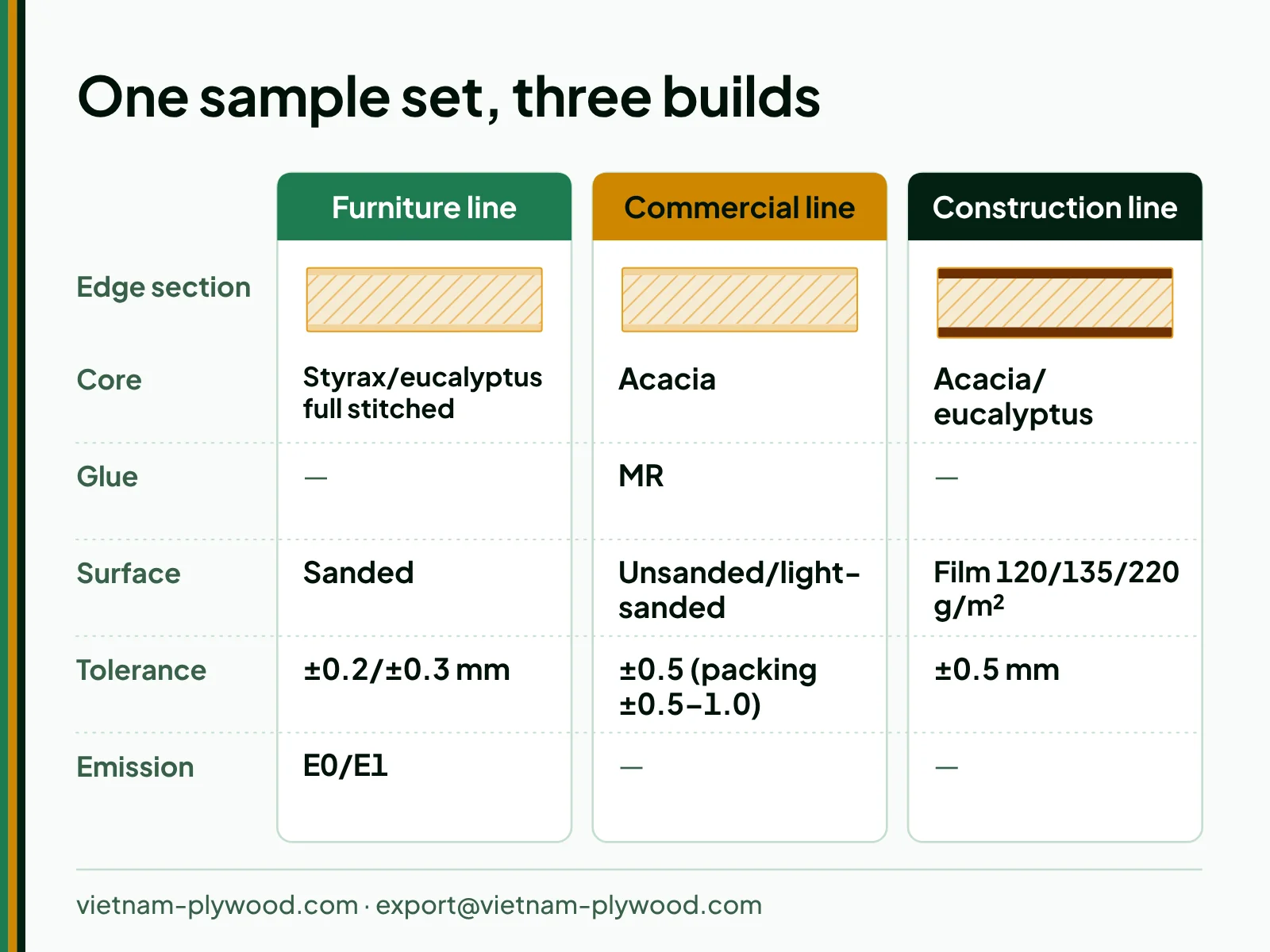
This matters because the face name does not tell you the build. An “18 mm okoume” panel can come from any of our lines, and each one presses it differently. The table shows what a single thickness looks like on each line, so you know what to look for when the parcel opens.
| What you compare | Furniture line | Commercial and packing line | Construction line |
|---|---|---|---|
| Core species | Styrax or eucalyptus | Acacia | Acacia or eucalyptus |
| Core build | Full stitched | Per order | Per order |
| Glue | Per order | MR (melamine) | Phenolic or melamine |
| Surface | Sanded | Unsanded or light-sanded | Phenolic or melamine film, anti-slip film |
| Emission class | E0 / E1 | Per order | Per order |
| Thickness tolerance | ±0.2 or ±0.3 mm as ordered | ±0.5 mm; packing ±0.5–1.0 mm | ±0.5 mm |
| Density by core | 500 (styrax) or 650 (eucalyptus) kg/m³ | 580 kg/m³ | 580 or 650 kg/m³ |
| Sheet weight, 18 mm, 1220×2440 mm | 26.8 or 34.8 kg | 31.1 kg | 31.1 or 34.8 kg |
Ask for the same thickness from each line if you are choosing a line. Ask for the same line in two or three faces if you have already chosen it. The second request is common for furniture and cabinet makers who need to see bintangor, okoume and birch side by side on one sanded core.
Write the end use on the request. “Kitchen carcass, edge-banded, CNC drilled” gets you a different set from “pallet decks, nailed” or “slab formwork, crane-handled”. The use decides which line’s panels are worth testing at all.
What should be tested on a plywood sample?
Test each panel for the property its line is built to deliver: tolerance and face on furniture panels, bond and thickness range on packing panels, film and boil resistance on film-faced panels. Five checks work on any sample with a caliper, a scale and a pot of water.
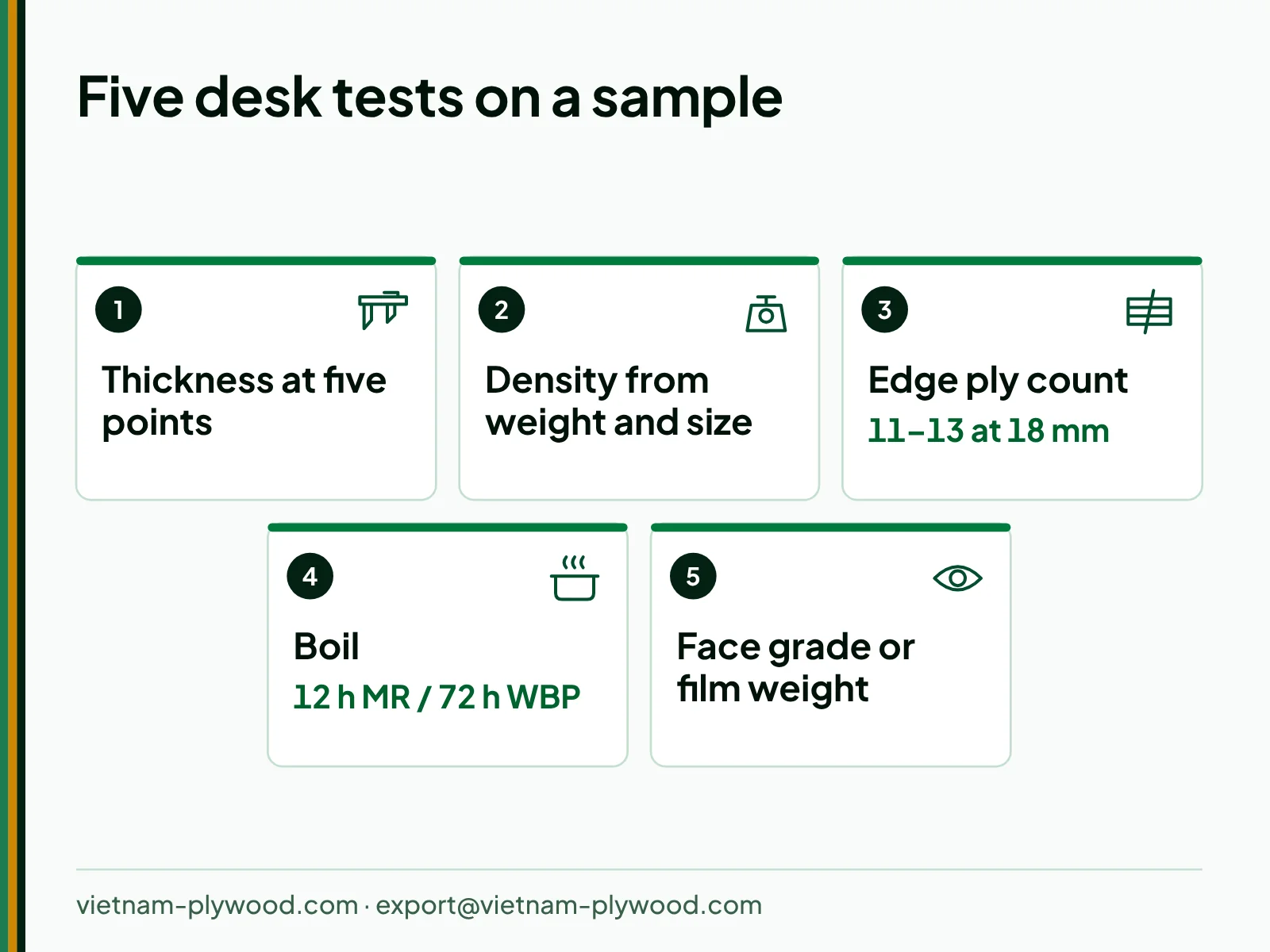
- Thickness at several points. Measure at least the four corners and the centre. Compare against the ordered tolerance: furniture sanded ±0.2 or ±0.3 mm; commercial and film-faced ±0.5 mm; packing ±0.5–1.0 mm.
- Density from weight and size. Weigh the piece, measure length, width and thickness, and divide. Our cores are acacia 580 kg/m³, eucalyptus 650 kg/m³ and styrax 500 kg/m³. A 300 × 300 mm piece at 18 mm should weigh about 0.81 kg on styrax, 0.94 kg on acacia and 1.05 kg on eucalyptus.
- Edge and ply count. Plane or sand one edge and count the plies. Ply count follows core veneer thickness (1.4–2.0 mm), so 18 mm reads 11–13 plies. Look for gaps and overlaps in the inner plies.
- Glue class by boil test. Melamine (MR) glue is rated to a 12-hour boil; phenolic (WBP) glue to a 72-hour boil. Boil an offcut for the period of the glue you ordered, then try to split the plies with a chisel.
- Face grade or film weight. Face grades are A/B; birch is graded D/E/F. Film-faced panels are described by film weight: 120 g/m² standard, 135 g/m² premium, 220 g/m² anti-slip only.
Then run the test that matches your own process. Furniture shops should edge-band, drill and paint or laminate an offcut. Packing buyers should nail and screw near the edge. Formwork contractors should cut a piece and check how the cut edge takes sealant.
⚠️ Important: Glue and emission are two separate fields. MR and WBP describe the glue; E0, E1 and E2 describe emission. A boil test tells you nothing about formaldehyde.
Which tests need a laboratory, and which can you run yourself?
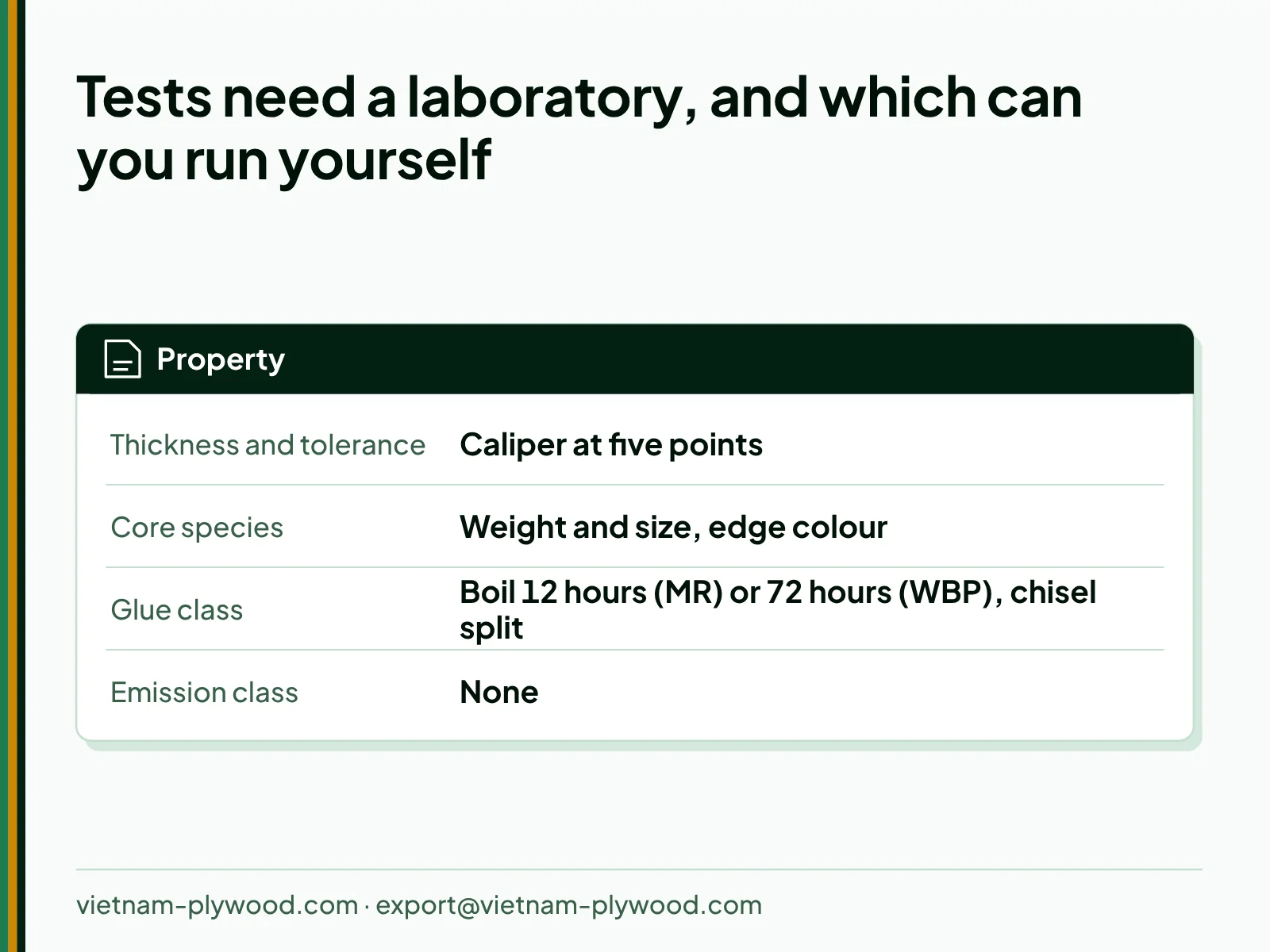
Thickness, weight, ply count, a boil test and a face check need nothing more than a workshop. Formaldehyde emission and any structural or marine claim need a laboratory, and only its report settles them.
For US buyers, the emission limit is set in law. The US Code of Federal Regulations at 40 CFR 770.10 (TSCA Title VI, in force since 2018) sets, “For hardwood plywood made with a veneer core or a composite core, 0.05 parts per million (ppm) of formaldehyde.” The same section says these standards apply to products “manufactured (including imported) on or after June 1, 2018 in the United States.” A sample cut from a CARB P2 / TSCA Title VI build can go to the laboratory your compliance team uses; the certification itself is third-party, held by the member factory.
| Property | Desk test | Laboratory test | What decides it |
|---|---|---|---|
| Thickness and tolerance | Caliper at five points | Not needed | Ordered tolerance |
| Core species | Weight and size, edge colour | Wood identification | Density 500 / 580 / 650 kg/m³ |
| Glue class | Boil 12 hours (MR) or 72 hours (WBP), chisel split | Bond test to the buyer’s standard | Glue ordered |
| Emission class | None | Chamber or desiccator test | E0 / E1 / E2 or CARB P2 / TSCA Title VI |
| Face grade, film weight | Visual, film weight from the order | Film weight by mass | Grade A/B, birch D/E/F; 120 / 135 / 220 g/m² |
| Marine or structural performance | None | Full test programme | A test report the buyer accepts |
Keep the sample pieces you send to a laboratory labelled with the sample number. When the report comes back, the number ties it to the panel you approved and, later, to the inspection of your production.
What to test on a furniture-line sample
A furniture-line sample is built for sanded faces and tight tolerance, so measure those first. Our furniture line uses a styrax or eucalyptus core, full stitched, sanded, at E0 or E1, with a tolerance of ±0.2 or ±0.3 mm as ordered.
Core construction runs, best to cheapest: full stitched; stitched outer layers with edge-trimmed inner; finger-jointed; loose-laid. On a furniture sample, a sanded edge should show the full stitched build with no open gaps in the inner plies. A gap that shows on a cut edge will also show when a CNC router cuts a hinge cup.
Check the face under raking light. Face veneer on our panels is 0.2–0.4 mm, so heavy sanding marks or sand-through show quickly. If you laminate or paint, do it on the sample: a face that looks clean bare can telegraph core gaps under a high-gloss finish.
For wood veneer samples, name the faces you want on the request. Our faces are bintangor, okoume, EV (engineered veneer), gurjan, pine, poplar, eucalyptus, birch and sapele; matt means an unfaced raw core. Several faces on the same core and thickness make the cleanest comparison. The furniture plywood page lists the builds this line presses.
What to test on a commercial and packing sample
A commercial and packing sample is built for a stable bond at a lower cost, so test the glue and the thickness range. Our commercial and packing line presses an acacia core with MR glue, unsanded or light-sanded, at ±0.5 mm for commercial grade and ±0.5–1.0 mm for packing.
Boil an offcut for 12 hours and try to split it. MR glue is rated to that test, which is what a packing crate stored in a humid warehouse needs. Phenolic (WBP) is rated to a 72-hour boil; if your packing has to stand outdoors, order and test that glue instead.
Weigh the piece. Acacia at 580 kg/m³ puts an 18 mm 1220×2440 mm sheet at 31.1 kg. A piece that reads much heavier or lighter than acacia density points to a different core than the one on the request, and that is worth raising before the quotation.
Nail and screw near the edge of the sample, at the spacing your crate drawing uses. Splitting at the edge tells you more about a packing panel than a face inspection does.
What to test on a film-faced construction sample
A film-faced sample is built for repeat pours, so test the film, the glue and the edges. Our construction line presses phenolic or melamine film, or anti-slip film, on an acacia or eucalyptus core, unsanded, at ±0.5 mm.
Check the film weight on the order against what you need: 120 g/m² standard, 135 g/m² premium, 220 g/m² anti-slip only. Then boil an offcut for the period that matches the glue. A phenolic-glue panel should take the 72-hour boil; a melamine-glue panel is rated to the 12-hour boil.
Cut the sample and seal the cut edge with the sealant your site uses. Reuse depends on that step. With proper handling, a release agent on every pour and sealed edges (cut edges included), melamine-glue film-faced about 12–15 pours, phenolic-glue up to about 25 pours. A sample cannot prove a pour count, but it shows you how the edge and the film behave before you plan a site.
Contractors comparing film-faced plywood free samples for a project should also read the plywood supply for construction projects page, which covers how panels are scheduled for a building programme.
How are plywood samples shipped from Vietnam?
By international courier on an account you book. New buyers book their own courier, and the courier cost can be credited against a real order. We pack the set, label every panel and hand it to the courier you name.
For US imports, label the parcel for the declaration the law asks for. The US Lacey Act, as amended in 2008 at 16 U.S.C. 3372(f), requires an import declaration that lists “the scientific name of any plant (including the genus and species of the plant) contained in the importation”, together with value, quantity and the country of harvest. A sample of 18 mm okoume on an acacia core holds two species, and the label should name both. Ask your courier how it files that declaration for a sample parcel.
Write on the request:
- Courier and account number, or the name of your freight forwarder.
- Panels wanted, by line, face, core, glue, thickness and size.
- End use for each panel.
- Destination address and the import contact who will receive it.
A complete request lets us pack the set in one go. If you are comparing panels for a range you plan to stock, the plywood supply programmes for distributors page explains how sample sets feed a stocking programme.
How does an approved sample become the reference at pre-shipment inspection?
You sign off one numbered sample against written specification lines, and that pair becomes the yardstick. At pre-shipment inspection at the producing factory, the inspector checks production against the lines first and the approved sample second, before anything is loaded.
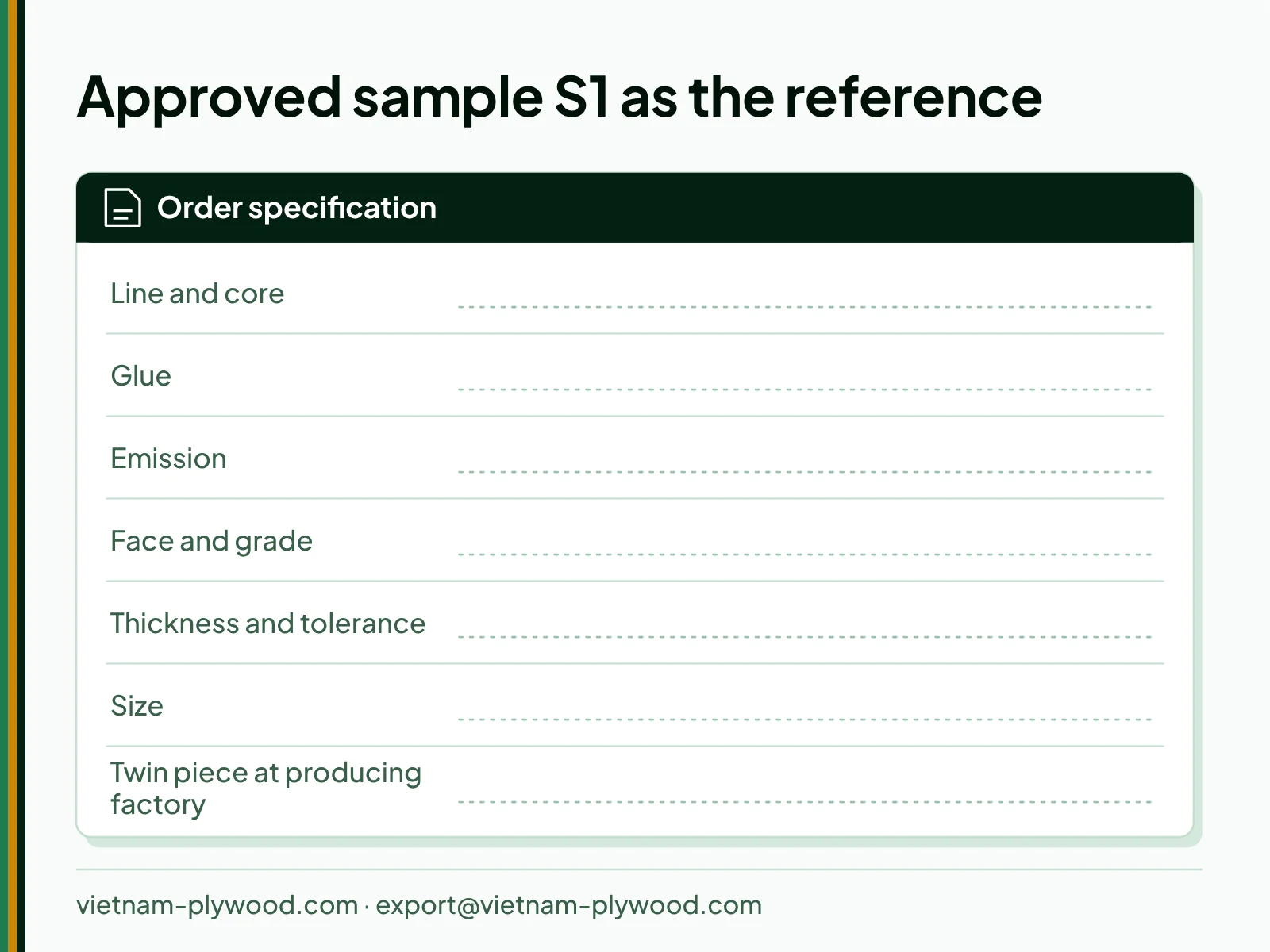
The approval works in five steps:
- Number every panel in the sample set and record its specification lines: line, core, glue, emission class, face and grade, thickness and tolerance, size.
- Test and choose. Run the checks above and mark the panel you accept.
- Split the reference. Keep one piece of the approved panel; ask for a twin piece to stay at the producing factory, labelled with the same number.
- Write the number into the contract, next to the specification lines it matches.
- Inspect against both. The inspector compares thickness, weight, edge, glue test results and face or film with the lines and the sample before loading.
| Property on the sample | How it is recorded | How the inspector checks production |
|---|---|---|
| Thickness | Measured value and ordered tolerance | Caliper on sheets drawn from each pallet |
| Core | Density from weight and size | Weigh full sheets: 26.8 / 31.1 / 34.8 kg at 18 mm for styrax / acacia / eucalyptus |
| Ply build | Ply count and core build on a cut edge | Cut edge on an offcut from production |
| Glue | Boil period passed | Boil test on offcuts from your production |
| Face or film | Grade, or film weight | Visual grade, film weight from the order |
| Size | Length and width | ±2 mm against 1220×2440 or the ordered size |
Buyers visit the factory office and inspect goods at the producing factory, so the inspection happens where your panels are pressed. HCPLY runs the export end to end, including on-site QC and loading, which means the twin sample and the production sit in the same place.
The balance 70% falls due against the scanned B/L, after loading. That gives the inspection weight: a mismatch found against the approved sample is settled before the container is closed. The plywood order payment terms page follows the money through the same order.
What can a trial container hold after the samples are approved?
The minimum order is one 40HC, and one container can carry several specifications as long as the payload limit holds, so a trial order can carry each panel you approved. The limit is 28.5 t for a 40HC, and the sheet arithmetic follows the core.
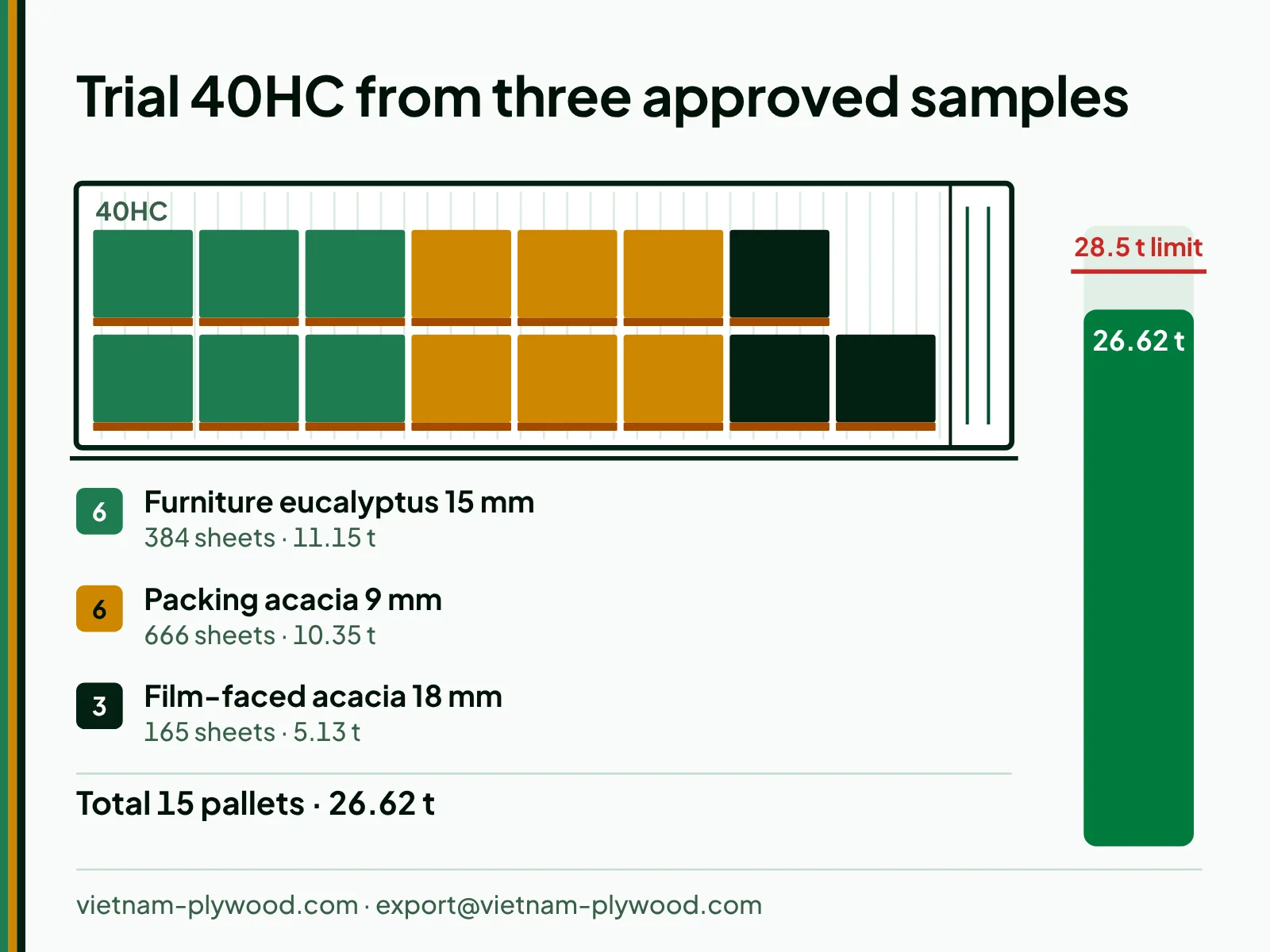
A trial mix of three approved samples, all at 1220×2440 mm:
Furniture, eucalyptus core, 15 mm: floor(970 ÷ 15) = 64 sheets × 6 pallets = 384 sheets
  384 × 1.22 × 2.44 × 0.015 = 17.15 m³ × 650 kg/m³ = 11.15 t
Packing, acacia core, 9 mm: floor(1000 ÷ 9) = 111 sheets × 6 pallets = 666 sheets
  666 × 1.22 × 2.44 × 0.009 = 17.84 m³ × 580 kg/m³ = 10.35 t
Film-faced, acacia core, 18 mm: floor(1000 ÷ 18) = 55 sheets × 3 pallets = 165 sheets
  165 × 1.22 × 2.44 × 0.018 = 8.84 m³ × 580 kg/m³ = 5.13 t
Total: 15 pallets, 1,215 sheets, 43.83 m³, 26.62 t (payload limit 28.5 t)
The film weight is not in that total, so keep some headroom when film-faced pallets go in. Pallet planning for mixed loads is covered in mixed container loads of plywood, and full-load counts per thickness sit on the container loading calculator.
Once the mix is set, production runs 15–45 days from the 30% deposit, set by order size, line loading and the contract. The plywood production lead time page explains what moves that window, and the CIF vs FOB pricing comparison helps you choose the delivery term for the quote.
What should a sample request state?
A sample request should read like a short purchase specification: one block per panel, with the end use, line, glue, emission class, face, thickness, size and the port the order would ship to. Panels requested that way are panels you can order without retesting.
Copy one block per panel you want in the set:
Sample no.:           S1
Application:          kitchen carcass / pallet decks / slab formwork
Line and core:        furniture, styrax / commercial and packing, acacia / construction, eucalyptus
Glue:                 MR (12-hour boil) or WBP (72-hour boil)
Emission class:       E0 / E1 / E2; CARB P2 / TSCA Title VI for the US
Face and grade:       okoume B / bintangor A / birch D / film 120, 135 or 220 g/m²
Thickness, tolerance: 18 mm, ±0.3 mm sanded / ±0.5 mm / ±0.5–1.0 mm
Size:                 1220×2440 mm or 1250×2500 mm
Order quantity:       e.g. one 40HC, mixed
Destination port:     port of discharge; FOB Hai Phong, CFR (CNF) or CIF
Courier:              courier name and account number
Send the blocks to Lucy at export@vietnam-plywood.com or through the contact page and ask for a sample set. Each panel arrives numbered against the block you wrote, ready to test and approve.