





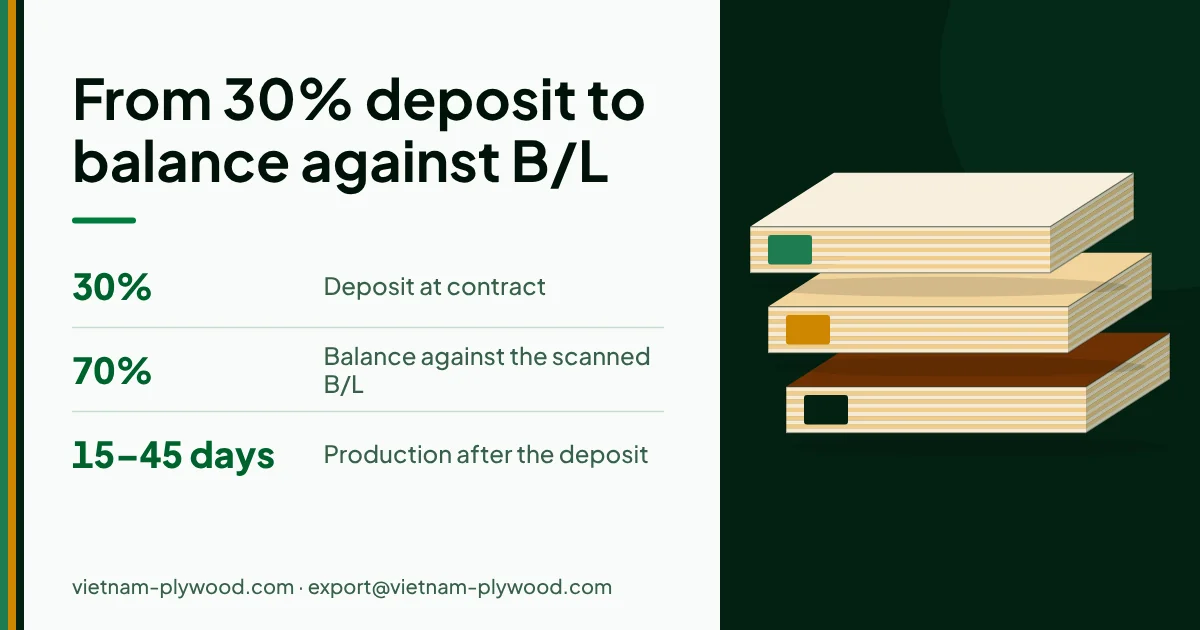
If you are asking what payment terms do Vietnamese plywood suppliers usually accept, HCPLY’s are a 30% deposit at contract, then the The remaining 70% is paid on the scan of the bill of lading, by T/T, or by irrevocable sight L/C. A badly drafted payment clause costs you twice: bank fees and lost days when an L/C does not match the contract, or a deposit at risk with no inspection right written in.
This page follows the money through one plywood order: what the deposit pays for, when the balance falls due, which document triggers each payment, and where you can stop a shipment that does not match the specification. Minimum order, quotation and contract steps sit on the parent page, the plywood MOQ, negotiation and ordering guide.
What payment terms do Vietnamese plywood suppliers usually accept?
Our stated terms are a 30% deposit when the contract is signed and the The remaining 70% is paid on the scan of the bill of lading, by T/T, or by irrevocable sight L/C. Production runs 15–45 days from the 30% deposit, set by order size, line loading and the contract. We ship FOB Hai Phong, or CFR (CNF) or CIF to your port.
Those are the terms we state for every product line, from sanded furniture panels to film-faced formwork. Other exporters publish other splits and other triggers. Before you compare quotations, line up the same three facts for each one: the deposit percentage, the event that makes the balance due, and the payment instrument.
The trigger matters more than the split. “Balance before shipment” means you pay before the container is loaded and before a bill of lading exists. “Balance against the scanned B/L” means the goods are already on board and the carrier has issued its receipt before you pay. The second version gives you a document that proves loading, a date that proves sailing and an inspection window before either happens.
Our terms also do not change with the destination. A buyer in Northern Europe waits 30–40 days at sea and a buyer on the US West Coast 20–30 days at sea, but the balance falls due on the same event: the scanned B/L. Transit time changes your cash cycle, while our payment trigger stays fixed.
How do T/T, L/C, documentary collection and open account compare?
The US International Trade Administration’s Trade Finance Guide (2022) sorts international payment into cash-in-advance, letters of credit, documentary collections, open account and consignment. Each one moves risk to a different side. The table below places each method against the same plywood order and states which ones are inside our stated terms.
| Method | When the buyer pays | Who carries most risk | Document that releases money | In our stated terms? |
|---|---|---|---|---|
| T/T deposit, T/T balance against scanned B/L | 30% at contract, 70% after loading | Shared: buyer on the deposit, seller until the balance clears | Signed contract; scanned B/L | Yes |
| T/T deposit, irrevocable L/C at sight for the balance | 30% at contract, 70% when complying documents reach the bank | Shared; the bank’s promise replaces the buyer’s for the balance | Signed contract; documents listed in the L/C | Yes |
| Full payment before loading | 100% before goods leave | Buyer | Proforma invoice | Not stated |
| Documentary collection (D/P) | When the buyer’s bank presents the documents | Seller, after shipment | Draft plus shipping documents | Not stated |
| Open account | 30, 60 or 90 days after delivery, as ITA describes it | Seller | Commercial invoice | Not stated |
Two lines on ITA’s methods of payment page explain why plywood exporters prefer a split T/T or an L/C. On cash in advance, it says full prepayment “is the least attractive option for the buyer, because it creates unfavorable cash flow.” On open account, it calls the method “one of the highest risk options for an exporter.” A deposit plus a balance against the B/L sits between the two ends of that range.
If you need documentary collection, open account or a usance L/C, write the request into your enquiry. We do not state those terms, so they are a matter for the contract and not a standing offer.
What deposit is expected when I place a plywood order?
The deposit is 30% of the contract value, paid by T/T after both sides sign the contract. Production is counted from the day the deposit arrives: 15–45 days from the 30% deposit, set by order size, line loading and the contract.
The deposit is not a fee. It turns your specification into materials that fit no other order. A furniture order on our furniture line needs styrax or eucalyptus core veneer, full stitched, sanded to ±0.2 or ±0.3 mm and pressed to E0 or E1. A film-faced order on our construction line needs film of the weight you ordered, 120 g/m² standard, 135 g/m² premium or 220 g/m² anti-slip. Once that veneer is peeled and that film is bought, the materials belong to your order.
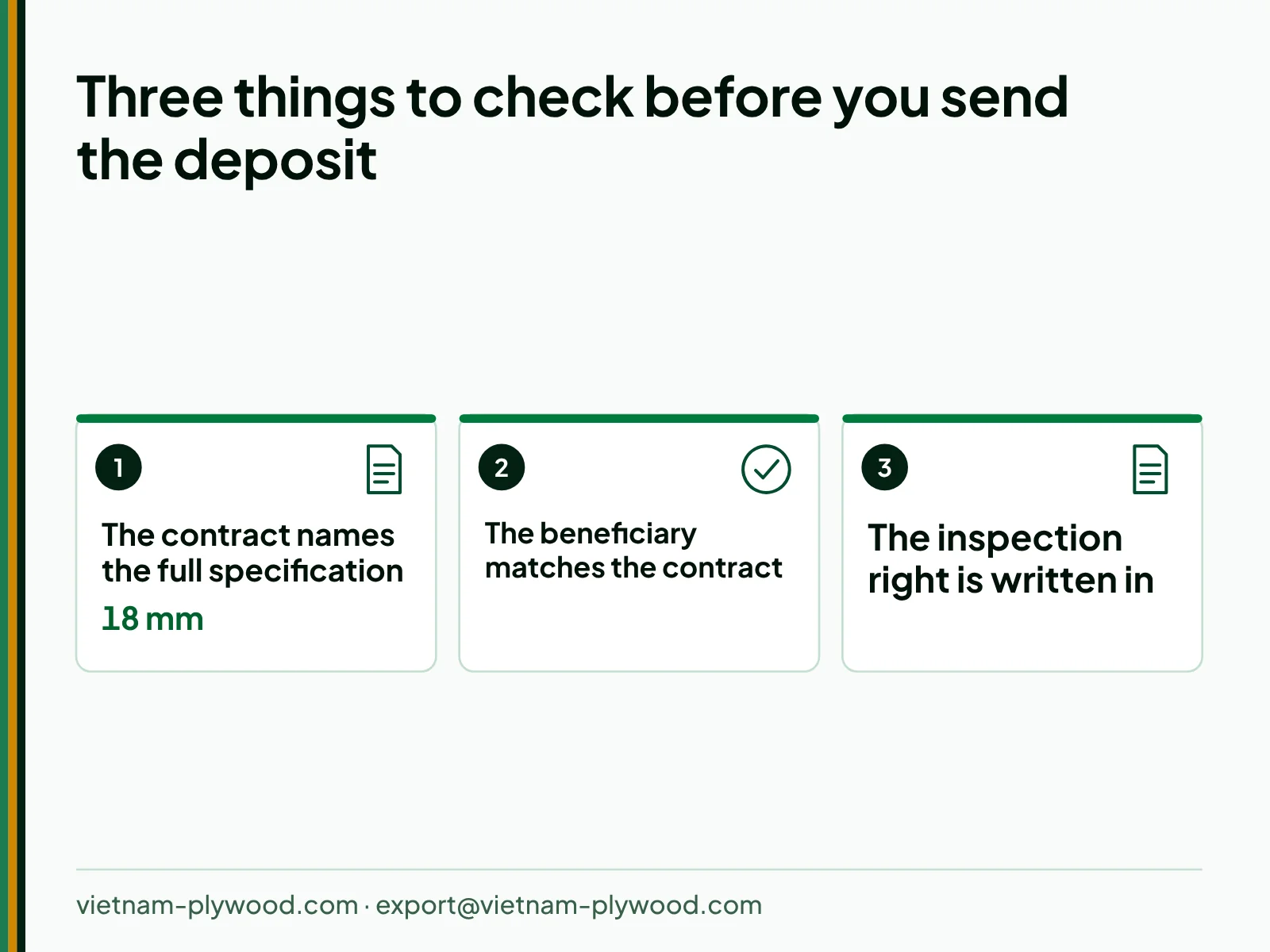
Three things to check before you send the deposit:
- The contract names the full specification. Application, core, glue, emission class, face and grade, thickness and tolerance, size, quantity and port. A deposit against a vague line (“18 mm plywood”) gives neither side a basis for inspection.
- The beneficiary matches the contract. The bank account holder on the proforma invoice should be the same company that signs the contract. A change of bank details by email is a reason to stop and call.
- The inspection right is written in. Name who inspects, where (the producing factory) and against what (the contract specification and the approved sample).
A first order often starts with samples. Samples cost nothing: a first-time buyer pays the courier, and that charge comes off the first confirmed order. The plywood sample request page explains what to test before you pay any deposit.
How does the balance 70% against the scanned B/L work?
The balance falls due when we send you the scanned B/L, the carrier’s receipt that the container is on board. You pay the 70% by T/T, or the bank pays under an irrevocable L/C at sight once the documents comply.
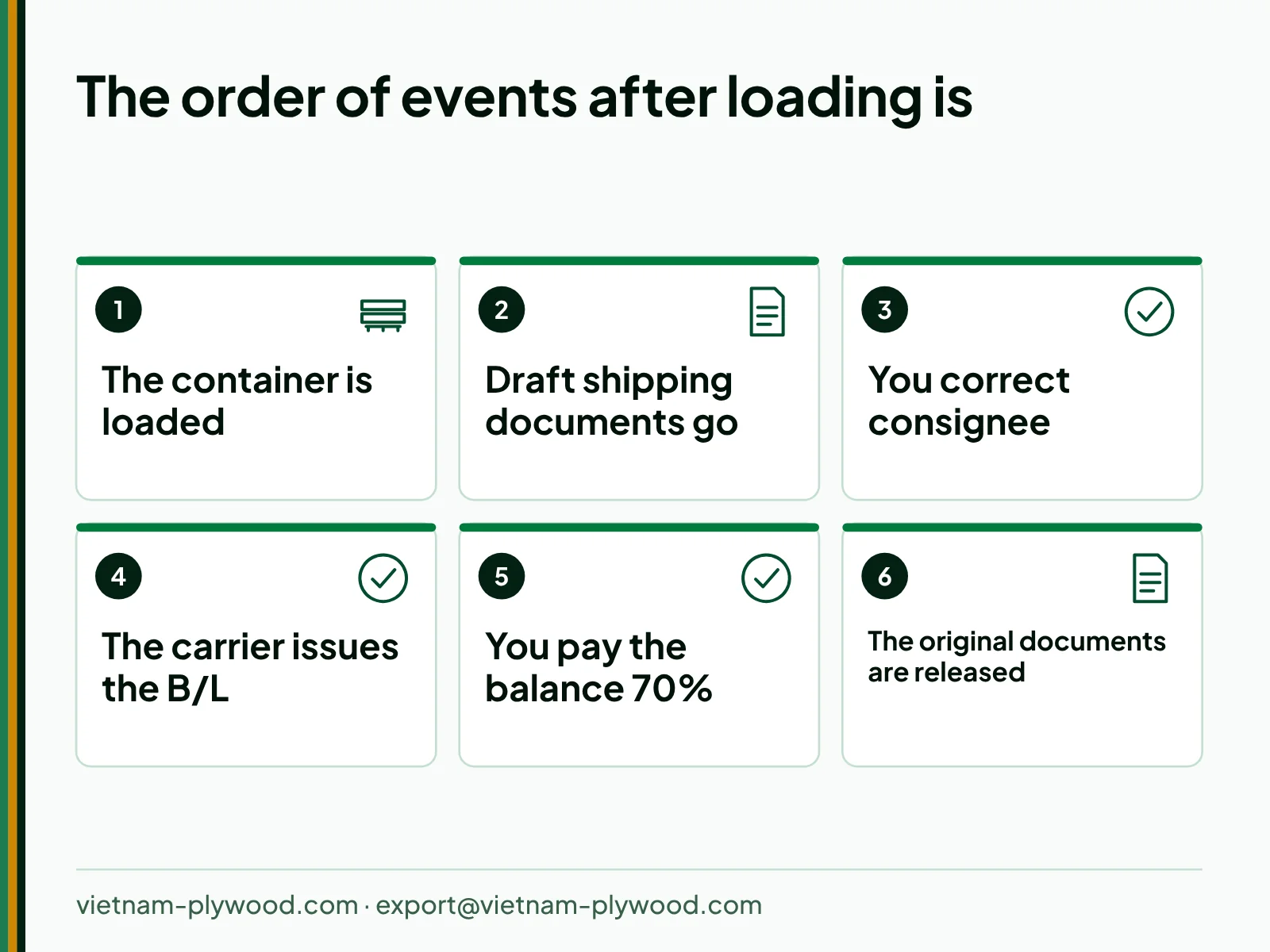
The order of events after loading is:
- The container is loaded at the producing factory and trucked to Hai Phong.
- After loading, the draft shipping documents come to you for approval: commercial invoice, packing list and the B/L draft.
- You correct consignee, notify party, description or marks on the drafts. This is the step that prevents most bank discrepancies and customs holds.
- The carrier issues the B/L after the vessel loads, and we send you the scan.
- You pay the balance 70% by T/T, or present-and-pay runs under the L/C.
- The original documents are released to you for customs clearance.
The scanned B/L gives you three facts before you pay: the vessel, the date on board and the container and seal numbers. Check them against the booking. If anything is wrong, raise it before the T/T leaves your bank.
On a CIF order, the insurance document is part of the same set. On FOB Hai Phong, your forwarder books the vessel and you insure the cargo, so the B/L comes from your side of the chain. The FOB meaning page for plywood shipments explains where risk passes under each term, and the CIF vs FOB pricing comparison shows how the choice changes your quote.
Can I pay by T/T or by L/C?
Yes, both work: T/T for the deposit and either T/T or an irrevocable L/C at sight for the balance 70% against the scanned B/L. Choose by how much paperwork you can manage and how much a bank’s promise is worth to you.
T/T is quick and low in cost. You send money from your bank to ours, and the cost is a wire fee on each side. It relies on trust in the documents you receive, which is why the scanned B/L and the draft approval step carry the weight.
An L/C replaces your promise with your bank’s. ITA’s guide states the rule plainly: “In LC transactions, banks deal in documents only, not goods.” The bank does not look at a plywood sheet. It checks whether the invoice, packing list, B/L and certificates match the L/C text word for word. The same guide warns that “because LCs have opportunities for discrepancies, which may negate payment to the exporter, documents should be prepared by trained professionals or outsourced.”
For a plywood L/C, the clauses that cause most discrepancies are the ones that describe the goods. Keep them short and identical to the contract:
| L/C field | What to write | Common mistake |
|---|---|---|
| Description of goods | Product, face, core, glue, emission class, thickness, size, quantity in m³ and sheets | Adding test results the documents cannot show |
| Latest shipment date | A date that fits 15–45 days after the 30% deposit, plus trucking and booking | A date set before production has started |
| Port of loading | Hai Phong | A different Vietnamese port |
| Documents required | Commercial invoice, packing list, B/L, certificate of origin (EUR.1 for EU lots), phytosanitary and fumigation papers, insurance under CIF | Asking for a document the order does not carry |
| Partial shipments and transshipment | State whether allowed | Leaving it silent when the carrier routes via a hub |
An L/C is irrevocable unless it says otherwise; ITA’s guide puts it this way: “Unless the conditions of the LC state otherwise, it is always irrevocable, which means the document may not be changed or cancelled unless the importer, banks, and exporter agree.” Send us the L/C draft before your bank issues it. An amendment after issue costs bank fees and days on both sides.
Who pays which bank charges, and whether a confirmation is needed, are contract points. Our terms do not set them, so put them in the contract.
How is risk shared between order, factory inspection and shipment?
Risk moves in four steps. The buyer carries the deposit from contract to inspection; the factory carries materials and press time until the balance arrives; inspection before loading and the original B/L are the two controls that keep both positions covered.
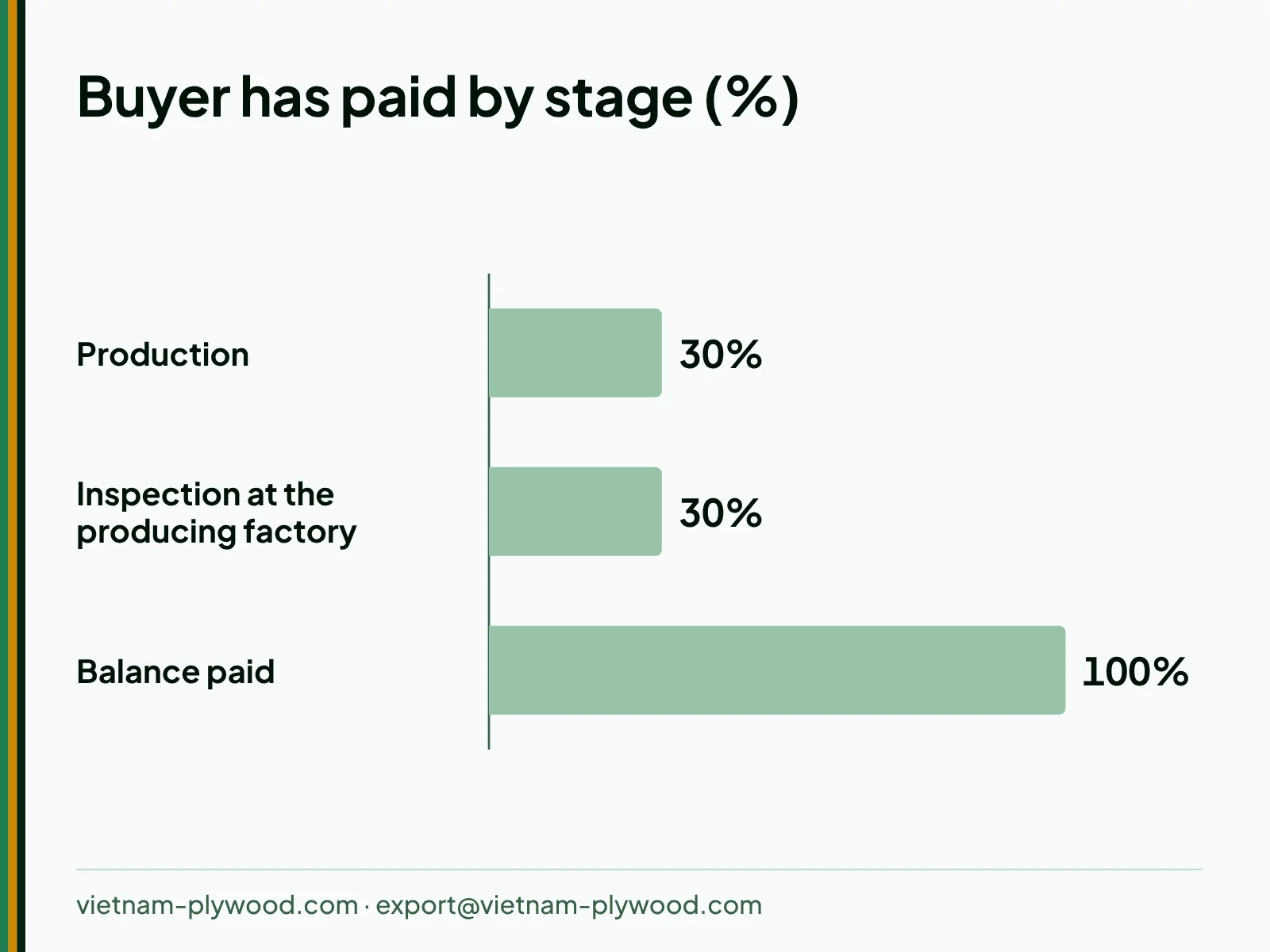
| Stage | Buyer has paid | Factory has committed | Buyer’s control | Document |
|---|---|---|---|---|
| Contract signed | 30% deposit | Veneer, glue and film for your specification | Specification and inspection clause in the contract | Signed contract, proforma invoice |
| Production | 30% | Press time, sanding, cutting | Production updates; sample as the reference | Contract specification |
| Inspection at the producing factory | 30% | Finished goods for your order only | Accept or reject before loading | Inspection report |
| Loading and sailing | 30% until the balance is paid | Goods and freight booking | Draft document approval; scanned B/L | Draft documents, B/L |
| Balance paid | 100% | Nothing left unpaid | Original documents for clearance | Original B/L and the document set |
The deposit is the buyer’s exposure. It is at risk for the production period, which runs 15–45 days from the 30% deposit, set by order size, line loading and the contract. The inspection clause is what protects it: without it, the deposit is a bet on photographs.
The factory’s exposure is larger in material terms and later in time. Between loading and the balance, a full container of goods made to your specification is on the water, with 70% of its value unpaid. The original B/L is the seller’s control during that window.
Under FOB Hai Phong, risk in the goods passes to you when they are on board, which is before the balance is due. That is why cargo insurance under FOB or CFR is your decision from the moment of loading, and why the insurance line in a CIF document set matters.
Can I inspect the goods at the factory before paying the balance?
Yes. You or your inspector check the goods at the producing factory before loading, and the balance 70% falls due only against the scanned B/L, so 70% of the contract is still unpaid while you inspect.
Buyers visit the factory office and inspect goods at the producing factory. HCPLY runs the export end to end, from specification and on-site QC to documents and loading, so the inspection, the loading and the paperwork happen in one place for each order.
Checks that tie the inspection to the payment terms:
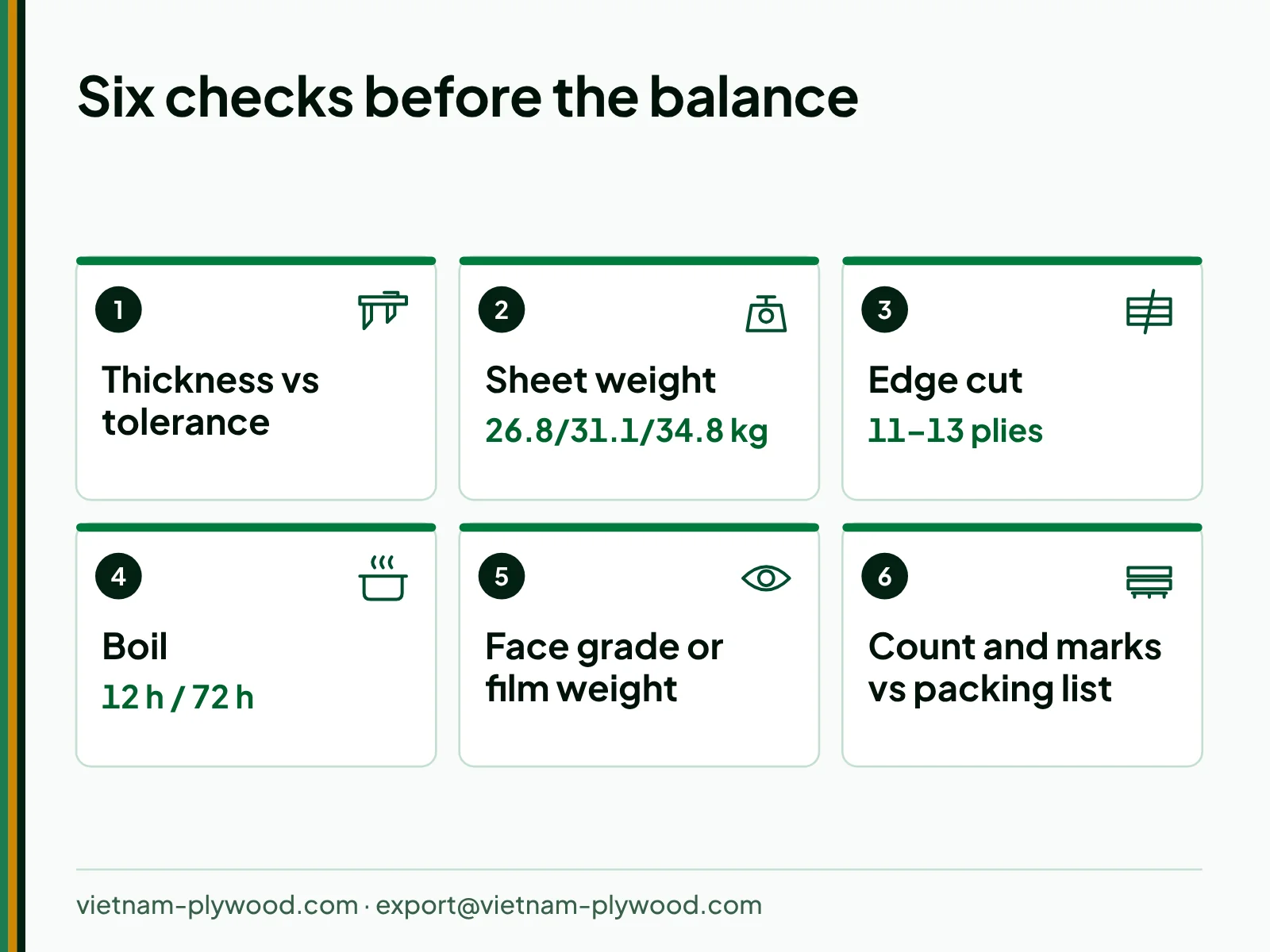
- Thickness against the ordered tolerance. Furniture sanded ±0.2 or ±0.3 mm as ordered; commercial and film-faced ±0.5 mm; packing ±0.5–1.0 mm; length and width ±2 mm.
- Sheet weight against the core. An 18 mm sheet at 1220×2440 mm weighs about 26.8 kg on styrax (500 kg/m³), 31.1 kg on acacia (580 kg/m³) and 34.8 kg on eucalyptus (650 kg/m³). A scale shows a core change faster than a face inspection does.
- Edge cut and ply count. At 18 mm, 11–13 plies, depending on core veneer thickness of 1.4–2.0 mm.
- Glue test. Melamine (MR) for a 12-hour boil, phenolic (WBP) for a 72-hour boil, on offcuts from your production.
- Face grade or film weight. Face grades A/B, birch D/E/F; film 120, 135 or 220 g/m².
- Count and marks. Pallets, sheets per pallet and pallet marks against the packing list draft.
Agree in the contract what happens on a failed check: rework, replacement or a price change, and how the loading date moves. Write that before the deposit is paid, because after loading the remedy becomes a claim.
How does a mixed container change the deposit and the balance?
It does not change them. Specifications can be mixed in a container within the payload limit, so one 40HC with several products is one contract, with one 30% deposit and one balance 70% against one scanned B/L.
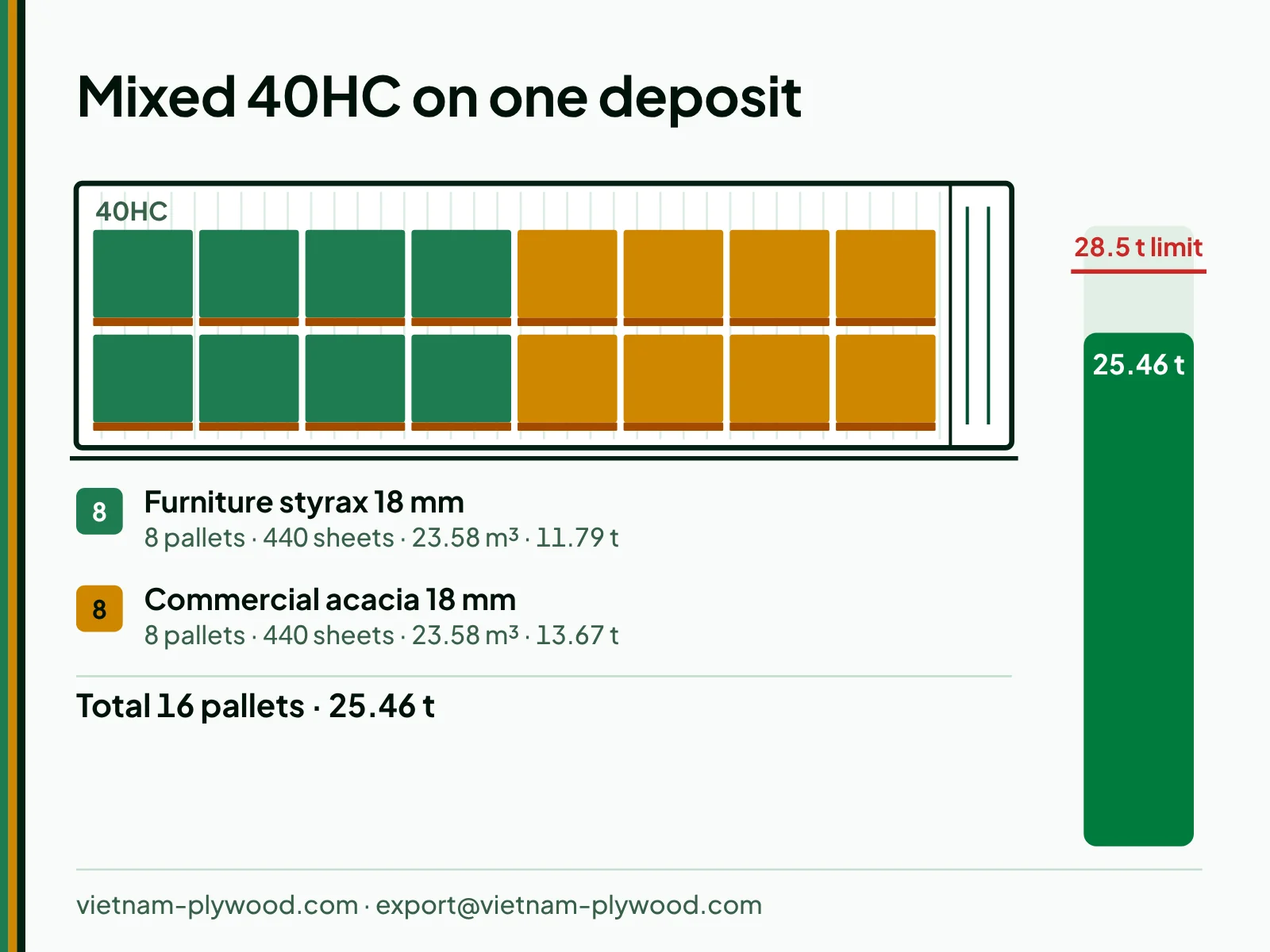
The payload limit is 28.5 t for a 40HC. A worked mix, 18 mm at 1220×2440 mm, using the pallet stack heights in our loading data:
Furniture, styrax core, 18 mm: 8 pallets × floor(1000 ÷ 18) = 8 × 55 = 440 sheets
  440 × 1.22 × 2.44 × 0.018 = 23.58 m³ × 500 kg/m³ = 11.79 t
Commercial, acacia core, 18 mm: 8 pallets × 55 = 440 sheets
  440 × 1.22 × 2.44 × 0.018 = 23.58 m³ × 580 kg/m³ = 13.67 t
Total: 16 pallets, 880 sheets, 47.15 m³, 25.46 t (payload limit 28.5 t)
For payment, a mixed load has one practical effect: the L/C description and the packing list must show each specification on its own line, with its own quantity in sheets and m³. A single line covering two cores invites a discrepancy and a weak inspection report.
The furniture half of that load is the kind of panel shown on the furniture plywood page, quoted from US$350/m³ FOB Hai Phong (October 2026). How mixed loads are planned pallet by pallet is covered in mixed container loads of plywood, and buying several panel types from one supplier is set out in one supplier for several plywood types. Full-load sheet counts per thickness sit on the container loading calculator.
Which export document triggers each payment?
Two documents trigger money on our terms: the signed contract with its proforma invoice for the 30% deposit, and the scanned B/L for the balance 70%. Every other document in the set protects the buyer at clearance.
The documents per shipment are the commercial invoice, packing list, B/L, certificate of origin (EUR.1 for EU lots), phytosanitary and fumigation papers and insurance under CIF. On top of those come the order’s certificate documents: the FSC claim on sales documents, the emission certificate and test reports for the agreed build, plus the EUTR/EUDR file set for EU lots. Certificates belong to the member factories and are shown with factory details masked, on request.
| Document | Payment role | What to check before paying |
|---|---|---|
| Contract and proforma invoice | Triggers the 30% deposit | Full specification, beneficiary, inspection clause |
| Inspection report | Your go or no-go for loading | Results against the contract and the approved sample |
| Draft invoice, packing list, B/L | Approval after loading | Consignee, description, quantities, marks |
| Scanned B/L | Triggers the balance 70% | Vessel, date on board, container and seal numbers |
| Certificate of origin, phytosanitary and fumigation papers | Clearance at destination | Origin form for your market; EUR.1 for EU lots |
| Insurance (CIF only) | Cover for the voyage | Insured value and named risks |
| FSC claim, emission certificate, test reports, EUTR/EUDR file set | Market access for the order | Claim and test scope match the ordered build |
Under an L/C, the documents in the “documents required” clause become payment documents as well. Keep that list to the papers this order carries.
What are the typical payment terms for first-time buyers?
A first order runs on our same stated terms: a 30% deposit and the The remaining 70% is paid on the scan of the bill of lading, by T/T, or by irrevocable sight L/C. What a first-time buyer adds is preparation, because nothing in the payment clause can fix a specification that was never written down.
A first order usually goes in this order:
- Samples. Free; you book your own courier, and the courier cost can be credited against a real order.
- Written specification. The fields in the closing block of this page.
- One 40HC. The minimum order is one 40HC, and specifications can be mixed in it within the payload limit, so a first order can test two or three products at once.
- Contract with an inspection clause. Name the inspector and the reference sample.
- Deposit, production, inspection, loading, balance. As described above.
If your bank or your credit policy requires an L/C on any new supplier, say so in the first enquiry. We can then quote with the L/C document list in mind. Production timing for a first order, and what shifts it inside the 15–45 days after the 30% deposit, is covered on the plywood production lead time page.
Some buyers ask for credit terms after a few containers. We publish no repeat-buyer credit terms, so treat any such request as a contract negotiation.
Can trade credit insurance cover a deposit paid to a Vietnamese supplier?
Usually not in the form most buyers mean. Export credit insurance protects a seller against a buyer who does not pay, while a buyer’s deposit is protected by a bank instrument posted by the seller, or by a prepayment cover your own insurer may sell.
ITA’s Trade Finance Guide (2022) describes export credit insurance as cover for “commercial risks that could result in non-payment by the foreign buyers, such as insolvency of the buyer, bankruptcy, currency devaluation or protracted defaults (slow payment).” That is the seller’s side of the risk.
For the buyer’s side, the same guide names the standby letter of credit. It says “Standby LCs are often posted by exporters in favor of importers as well because they can serve as bid bonds, performance bonds, and advance payment guarantees.” An advance payment guarantee lets the buyer claim the deposit back from a bank if the seller does not perform.
If your company needs deposit cover:
- Ask your credit insurer whether your policy covers prepayments to overseas suppliers, and what evidence it needs from the supplier.
- Ask your bank what an advance payment guarantee or standby L/C for a 30% deposit would cost, and who is expected to pay for it.
- Write the instrument into the contract before the deposit is sent, with the amount, expiry and the bank that issues it.
Whether we post a guarantee for a given order is a contract point, not part of our stated terms. Raise it with Lucy at the quotation stage.
What should the contract and the order state?
The payment clause works only when the specification under it is complete. Put the payment terms and the delivery term in one paragraph, then the specification lines, then the inspection clause.
A payment paragraph in our standard form reads: 30% deposit by T/T on signing; The remaining 70% is paid on the scan of the bill of lading, by T/T, or by irrevocable sight L/C; delivery FOB Hai Phong, CFR (CNF) or CIF; inspection at the producing factory before loading against the contract specification and the approved sample.
The specification lines that go under it:
Application:          furniture / packing / concrete formwork
Line and core:        furniture line, styrax or eucalyptus core / commercial line, acacia core / construction line, acacia or eucalyptus core
Glue:                 MR (melamine, 12-hour boil) or WBP (phenolic, 72-hour boil)
Emission class:       E0 / E1 / E2; CARB P2 / TSCA Title VI if for the US
Face and grade:       e.g. okoume B, bintangor A, birch D/E; or film 120 / 135 / 220 g/m²
Thickness, tolerance: e.g. 18 mm, ±0.3 mm sanded
Size:                 1220×2440 mm (or 1250×2500, custom cut)
Quantity:             m³ and sheets per specification line
Destination port:     port, delivery term FOB Hai Phong / CFR / CIF
Payment:              30% deposit; balance 70% against the scanned B/L, T/T or L/C at sight
Send these lines to Lucy at export@vietnam-plywood.com or through the contact page, and request the spec sheet for the products you are quoting. The spec sheet gives you the build details to copy into the contract and, if you pay by L/C, into the description of goods.