





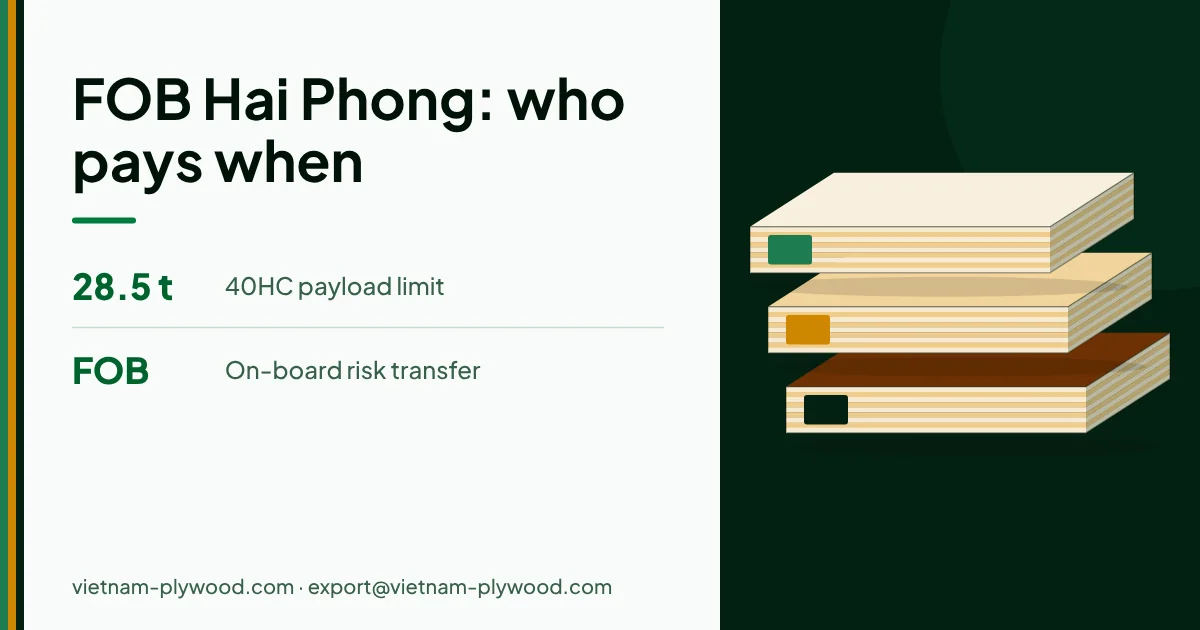
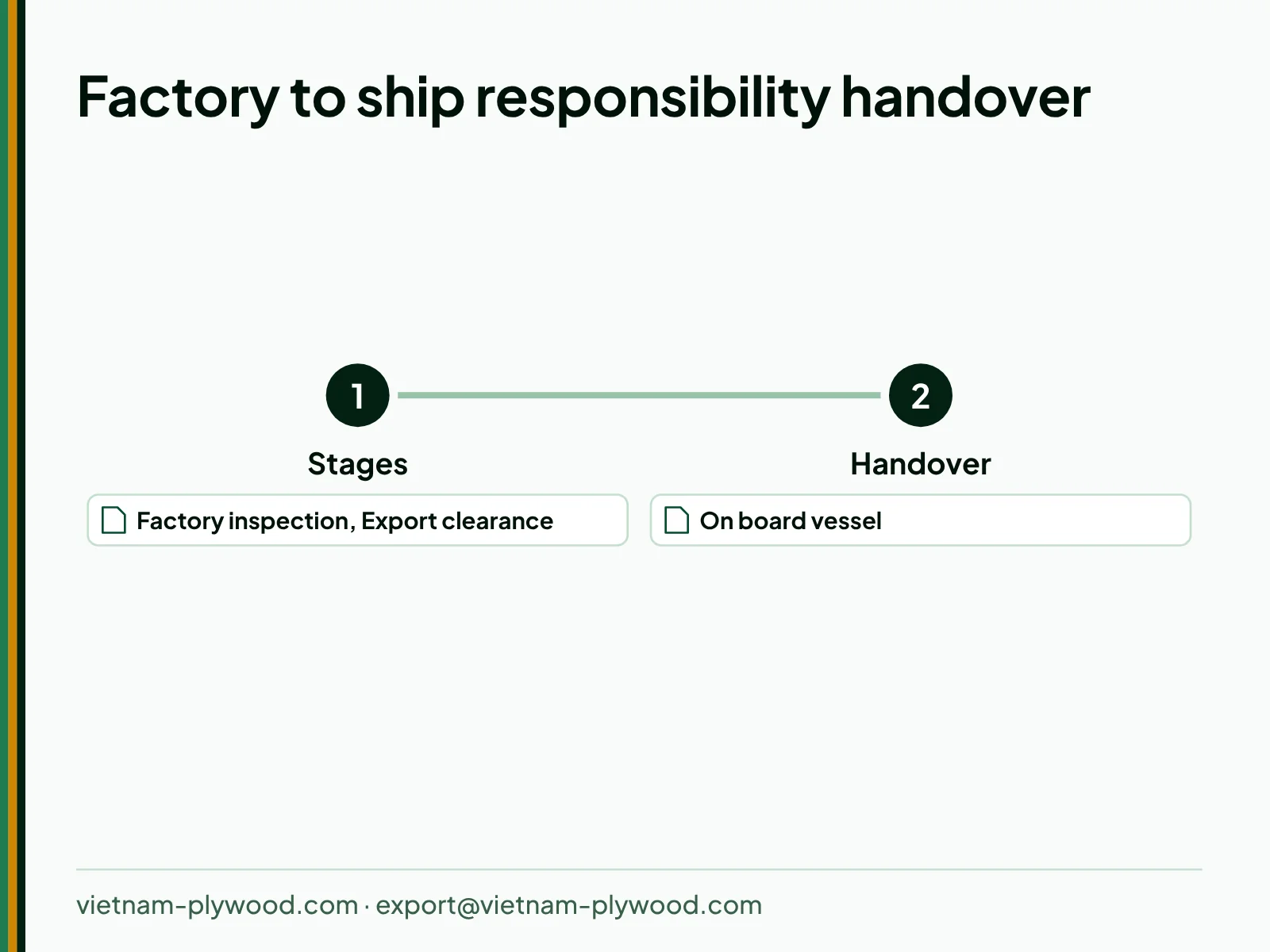
Free on board is the formal FOB shipping term: HCPLY delivers the plywood on board the buyer-nominated vessel at Hai Phong, where transport risk passes to the buyer. Misreading that handover can add freight charges, delay a shipment or leave a damaged load without the expected insurance. The freight on board meaning is therefore a cost-and-risk boundary, rather than a promise of delivery to the buyer’s warehouse.
What is the freight on board meaning for plywood buyers?
Freight on board meaning in a plywood purchase is the allocation of delivery costs and transport risk at the named shipment port. Under the International Chamber of Commerce (ICC) Incoterms® 2020 rule, the seller delivers when the goods are on board the buyer-nominated vessel. Risk passes at that point; the buyer pays the onward carriage. For HCPLY, the named port is Hai Phong.
The formal term is Free On Board (FOB). “Freight on board” is a common expansion used in searches and conversations, but it is not the ICC rule’s name. Put FOB Hai Phong, Incoterms® 2020 in the purchase contract and quotation. The ICC’s 2020 FOB explanatory notes describe delivery on the vessel and the corresponding transfer of risk.
For an importer, the practical distinction is that an FOB quotation includes the agreed product and the seller’s export-side delivery obligations. It does not purchase the sea voyage to the destination.
Who pays which costs before loading at Hai Phong?
The seller pays the costs required to deliver the agreed plywood on board at Hai Phong and clear it for export under FOB. HCPLY produces the panels at the producing factory, checks the agreed specification, packs the load, arranges export-side movement and coordinates the loading documents. The buyer nominates the vessel and books the main carriage.
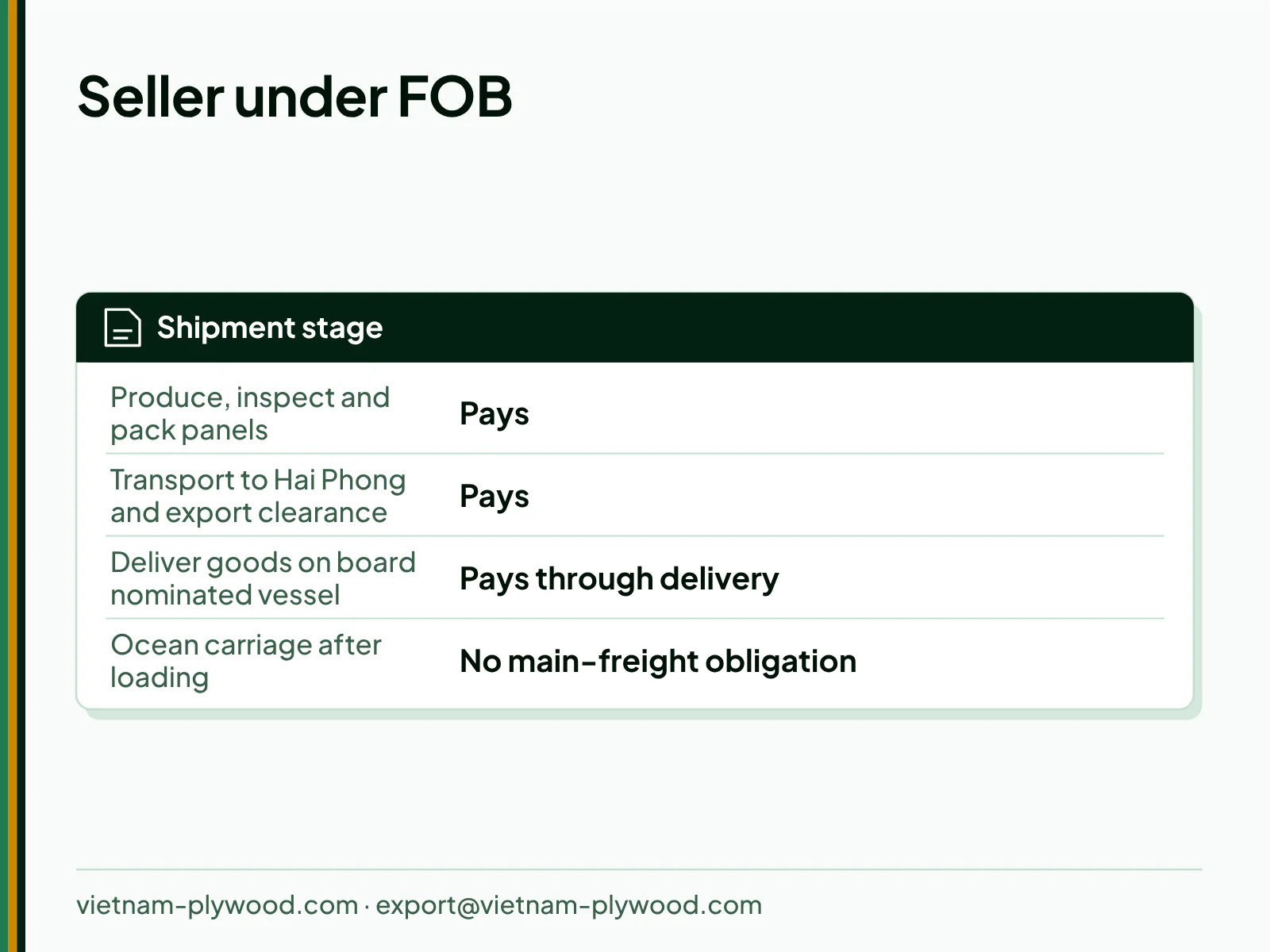
| Shipment stage | Seller under FOB | Buyer under FOB | Practical check |
|---|---|---|---|
| Produce, inspect and pack panels | Pays | Reviews agreed specification | Inspection report and packing marks |
| Transport to Hai Phong and export clearance | Pays | Supplies requested shipping instructions | Export entry and booking details |
| Deliver goods on board nominated vessel | Pays through delivery | Nominates vessel and provides timely notice | On-board shipping evidence |
| Ocean carriage after loading | No main-freight obligation | Contracts and pays | Carrier booking and freight invoice |
| Cargo insurance | No obligation to purchase | Decides and arranges cover | Policy scope and insured value |
| Destination unloading, import and inland delivery | No import obligation | Arranges and pays | Local charges and customs plan |
Under the ICC 2020 FOB rule, delivery-related seller costs run through on-board delivery; destination-side charges belong to the buyer. Record any separately agreed exceptions in the sale contract.
How does a plywood order reach the vessel?
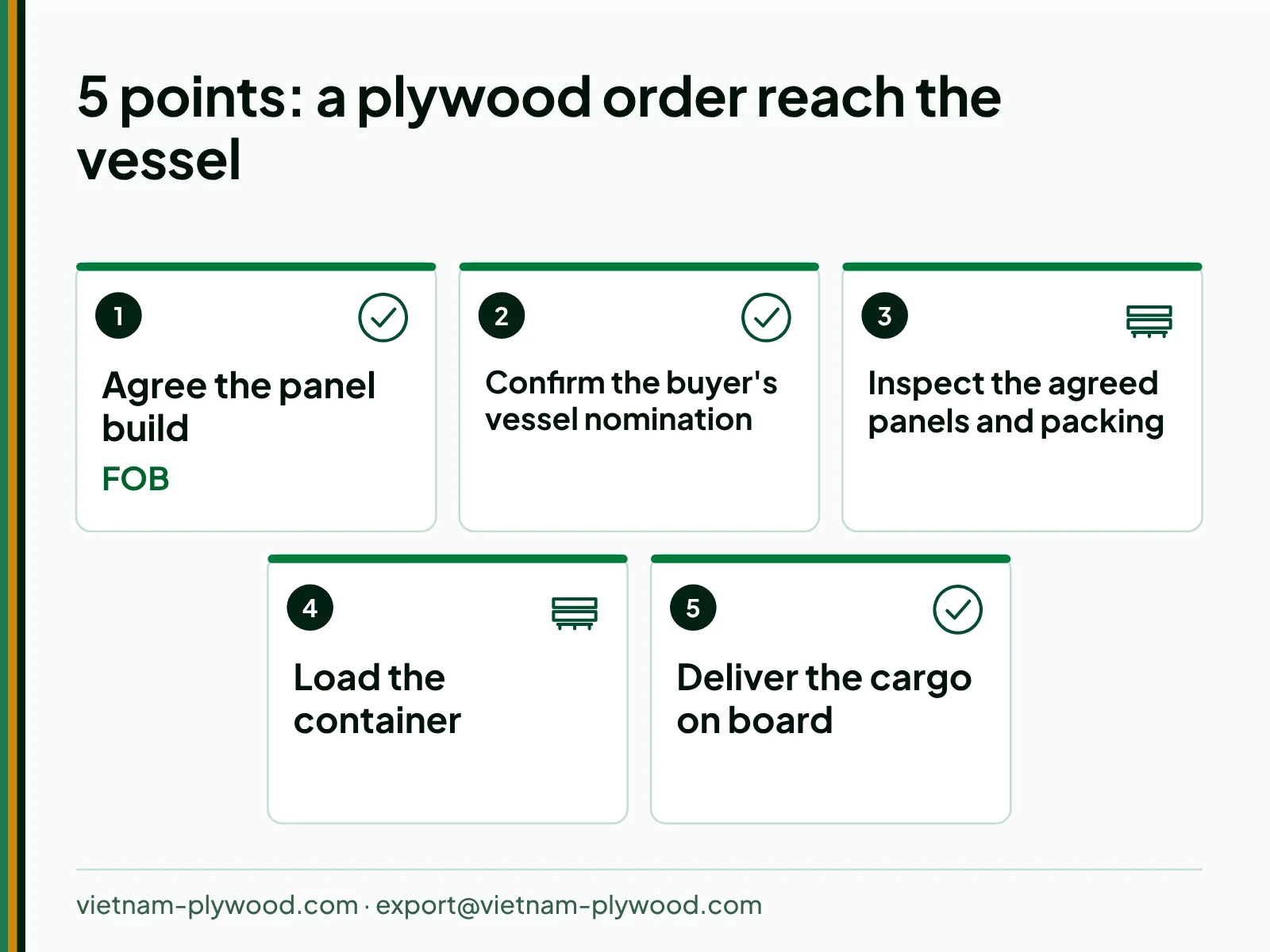
The order travels from the appropriate producing factory to Hai Phong, with the factory specification attached to the shipping instructions. HCPLY has a furniture line in its three factories, a commercial and packing line, and a construction line. Each order is produced at the line that fits its build and shipped directly from that factory.
- Agree the panel build, tolerance, quantity, packing marks and FOB port in writing.
- Confirm the buyer’s vessel nomination, forwarder contact, shipping window and documentation instructions.
- Inspect the agreed panels and packing at the producing factory before dispatch.
- Load the container, record its seal and prepare the export paperwork for shipment.
- Deliver the cargo on board at Hai Phong and obtain the transport evidence needed for the document exchange.
Buyers can visit the factory office and inspect goods where they are made. A buyer-appointed inspector can witness thickness measurements, face grading, pallet counts and container seal recording.
Does the same 18 mm panel mean the same FOB cargo?
An 18 mm label alone does not define a shipment. Core density, sanding, face, glue and packing alter the goods offered under the same delivery term. The three production lines therefore need separate specifications even when the port and Incoterm are identical.
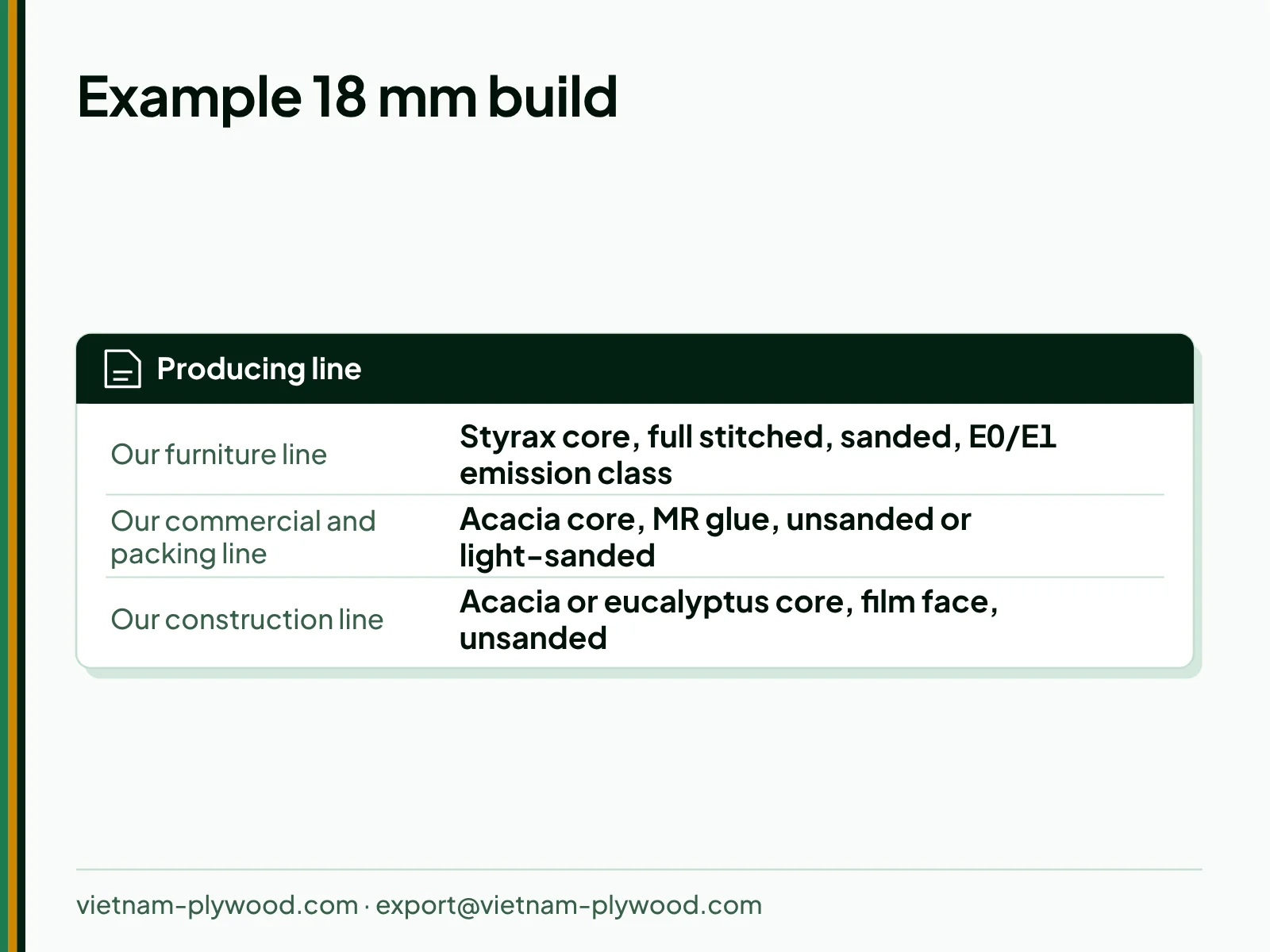
| Producing line | Example 18 mm build | Core density | Thickness tolerance | Buyer use |
|---|---|---|---|---|
| Our furniture line | Styrax core, full stitched, sanded, E0/E1 emission class | 500 kg/m³ | ±0.2 or ±0.3 mm as ordered | Cabinet and furniture parts |
| Our commercial and packing line | Acacia core, MR glue, unsanded or light-sanded | 580 kg/m³ | ±0.5 mm commercial; ±0.5–1.0 mm packing | General panels and export packing |
| Our construction line | Acacia or eucalyptus core, film face, unsanded | 580 or 650 kg/m³ | ±0.5 mm | Concrete formwork |
The factory-line comparison sets out the product differences. On a furniture order, the furniture line presses the sanded, full-stitched panel; the packing line would make an acacia-core utility panel instead, while the construction line would make film-faced shuttering plywood. FOB does not erase those differences.
How does container weight affect the FOB quote?
Container planning affects the FOB unit calculation because the quoted volume and loaded sheet count must describe the same shipment. For 1220 × 2440 × 18 mm panels, the provided 40HC loading figures differ by core: styrax 990 sheets and 26.52 t, acacia 880 sheets and 27.35 t, eucalyptus 795 sheets and 27.69 t. The stated payload limit is 28.5 t.
For example, an acacia-core 18 mm order uses 55 sheets per pallet and 16 pallets, totalling 880 sheets and 47.15 m³. A styrax-core furniture load uses 55 sheets per pallet and 18 pallets, totalling 990 sheets and 53.05 m³. A mixed order can combine specifications within the payload limit, but the final packing plan must use the actual pallet mix.
Use mixed-container planning when buying more than one grade. The full container-loading reference owns detailed sheet-count questions. In an FOB comparison, ask each supplier to show the proposed loaded quantity, cubic metres and packing basis beside the quoted unit price.
What must the buyer arrange after the panels are on board?
The buyer arranges and pays the international voyage, any chosen cargo insurance, destination handling, import clearance and onward transport. The buyer also supplies timely vessel nomination and shipping instructions before the loading event. Missing a vessel cutoff can create storage, amendment or rescheduling costs that need to be allocated under the contract and applicable rule.
Ask the forwarder for a freight quotation covering the destination port, routing, transit assumptions, carrier surcharges, release procedure and destination charges. Insurance is especially worth evaluating because transport risk passes at loading under FOB, while the seller has no FOB obligation to buy a cargo policy.
A shipment to Northern Europe has a stated sea-transit range of 30–40 days from Hai Phong by carrier and route; the US West Coast range is 20–30 days. Those ranges describe the sea leg, not the production period or destination customs processing. Match the planned vessel to the order schedule before committing to downstream cabinet or distribution dates.
Which documents connect the factory and the FOB handover?
The commercial invoice and packing list identify the goods sold and loaded; the bill of lading (B/L) records the carriage and can provide on-board evidence. The certificate of origin supports the declared origin, with EUR.1 used for EU lots. The shipment file also includes phytosanitary and fumigation papers, and the agreed product certificate documents.
For EU shipments, the export file includes the EUTR/EUDR documents. Where a certificate such as FSC, CARB P2, ISO 9001 or CE is relevant to the agreed order, member-factory documents are shown with factory details masked, on request.
After loading, HCPLY sends draft shipping documents to the buyer for approval. Check consignee, notify party, container and seal references, product description, quantity, port names and origin details against the contract. The payment-terms guide covers the separate question of when documents and funds change hands.
What does FOB plywood pricing include and exclude?
An FOB plywood price includes the agreed panel build and seller-side obligations through delivery on board at the named port. It excludes the buyer’s ocean freight, optional cargo insurance, destination import charges and inland distribution. Comparing FOB quotations requires matching the same face, core, glue, emission class, dimensions, tolerance and packing basis.
For commercial plywood, the indicative starting point is from US$250/m³ FOB Hai Phong (October 2026). For furniture plywood, it is from US$350/m³ FOB Hai Phong (October 2026). Film-faced or other specifications need a written quotation rather than an assumed extension of those starting points.
Core construction is a major price driver: full stitched requires more controlled veneer assembly than stitched outer layers with edge-trimmed inner layers, finger-jointed or loose-laid cores. Face veneer selection and grading come next, followed by glue system, sanding and tighter tolerance. A premium film weight or special cutting adds specification-specific cost. Send the written build before asking for a plywood order quotation.
Is FOB always the right rule for a container?
FOB is a sea and inland-waterway rule whose formal delivery point is on board the vessel. The ICC’s 2020 explanatory notes caution that FOB is not appropriate where container goods are handed to the carrier at a terminal before loading; Free Carrier (FCA) is the rule to consider in that case.
If the container is accepted by a terminal operator days before vessel loading, write down who carries risk during that interval. The Incoterm should reflect the agreed actual handover, with the sales contract recording any additional allocation.
HCPLY offers FOB Hai Phong, Cost and Freight (CFR/CNF) and Cost, Insurance and Freight (CIF) delivery terms. Under CFR the seller contracts and pays for the ocean freight, but risk still transfers on board. Under CIF the seller also arranges the required marine insurance; the ICC 2020 default is minimum cover.
How do FOB, CFR and CIF change the buyer budget?
FOB gives the buyer control of the ocean freight contract; CFR includes seller-arranged ocean freight; CIF adds seller-arranged insurance. All three maritime rules transfer risk when the cargo is on board, so the person paying the freight is not automatically the person bearing voyage risk.
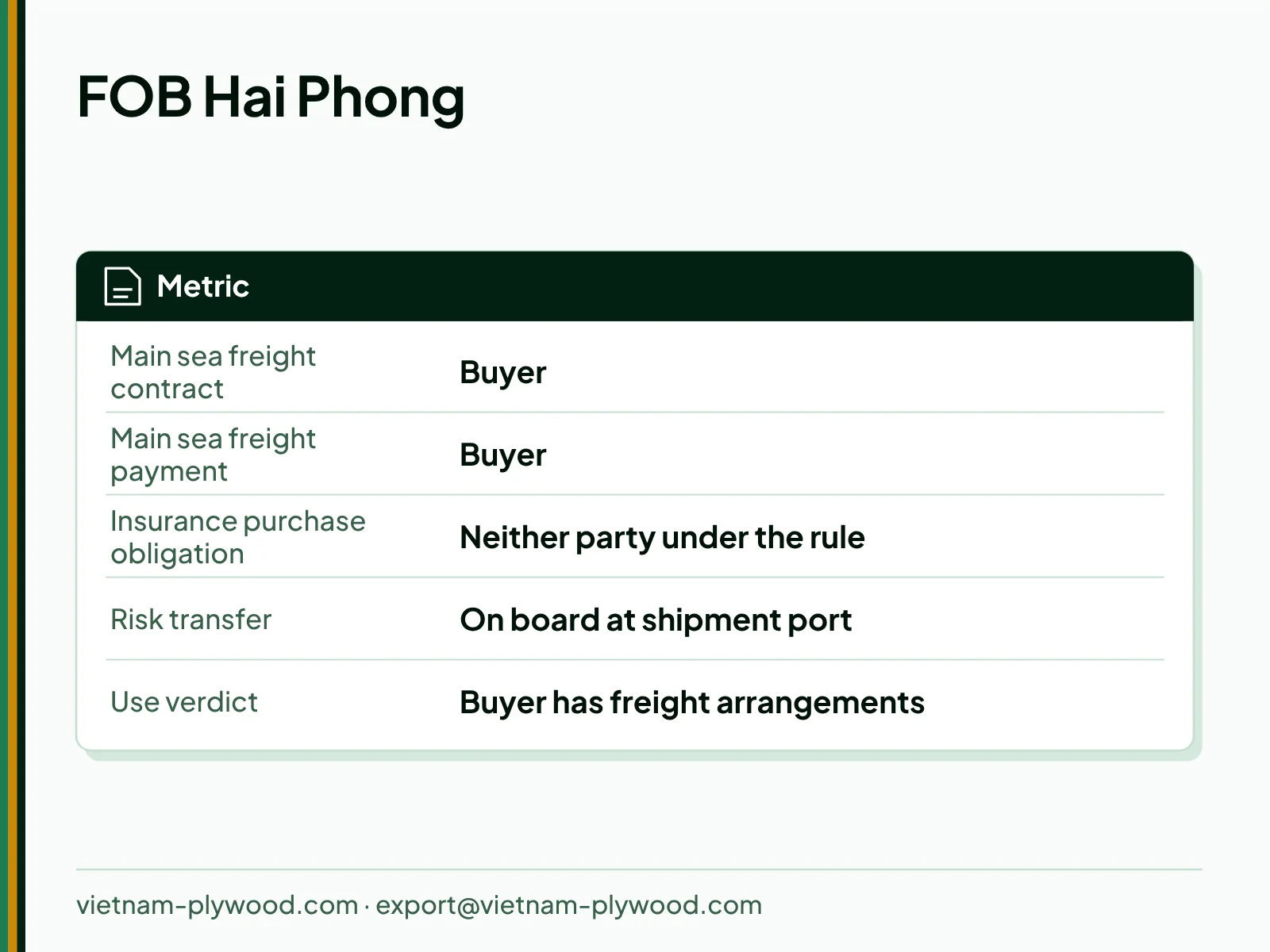
| Metric | FOB Hai Phong | CFR destination port | CIF destination port |
|---|---|---|---|
| Main sea freight contract | Buyer | Seller | Seller |
| Main sea freight payment | Buyer | Seller | Seller |
| Insurance purchase obligation | Neither party under the rule | Neither party under the rule | Seller, minimum cover by default |
| Risk transfer | On board at shipment port | On board at shipment port | On board at shipment port |
| Use verdict | Buyer has freight arrangements | Buyer wants seller-booked freight | Buyer wants seller-booked freight and required cover |
An Ex Works (EXW) comparison shifts many export-side tasks to the buyer, while Delivered at Place (DAP) addresses delivery farther along the route.
How should payment and vessel timing be coordinated?
Payment milestones and FOB risk transfer are separate contract questions. The stated production period is 15–45 days from the 30% deposit, set by order size, line loading and the contract. The remaining 70% is paid on the scan of the bill of lading, by T/T, or by irrevocable sight L/C.
A buyer should align the booking window with the production schedule and arrange any inspection before the container leaves the producing factory.
The minimum order is one 40HC, and specifications can be mixed within the payload limit. Samples cost nothing: a first-time buyer pays the courier, and that charge comes off the first confirmed order. The sample-request process helps settle the accepted build before container production.
What should be written before a trial FOB container?
A trial FOB container should start with a written specification and an agreed port-and-risk term. Ask for the producing line, face and core construction, glue and emission class, tolerance, packing layout, vessel instructions and document requirements in the same order file. HCPLY can coordinate specification, on-site QC, export documents and loading through the producing factory.
Request inspection against the accepted face grade, thickness and packing marks before dispatch. Then reconcile the final packing list with the carrier’s loaded container details and the invoice.
The factory office is available for buyer visits, and inspection takes place at the producing factory. For a written FOB quotation or a trial order, contact Lucy at export@vietnam-plywood.com through the contact page.
Application: cabinet components / distribution / packing / formwork
Producing line or core: furniture styrax / commercial acacia / construction acacia or eucalyptus
Glue: melamine MR or phenolic WBP, as specified
Emission: E0 / E1 / E2, or applicable agreed limit
Face and grade: species, A/B or birch D/E/F; film weight if applicable
Thickness and tolerance: __ mm; __ mm
Size: __ × __ mm
Quantity: __ sheets / __ m³; pallet mix __
Destination port: __
Trade term: FOB Hai Phong, Incoterms 2020
Next step: plan a trial container against the written specification and buyer-nominated sailing.