





What are the uses of plywood in construction?
The uses of plywood in construction include concrete formwork, temporary floor protection, site partitions, packing, and specified floor, wall or roof assemblies. Each application places different demands on bending resistance, surface finish, moisture exposure and handling. HCPLY routes film-faced work to its construction line and site protection panels to its commercial and packing line. Structural assemblies require a separately accepted engineering specification.
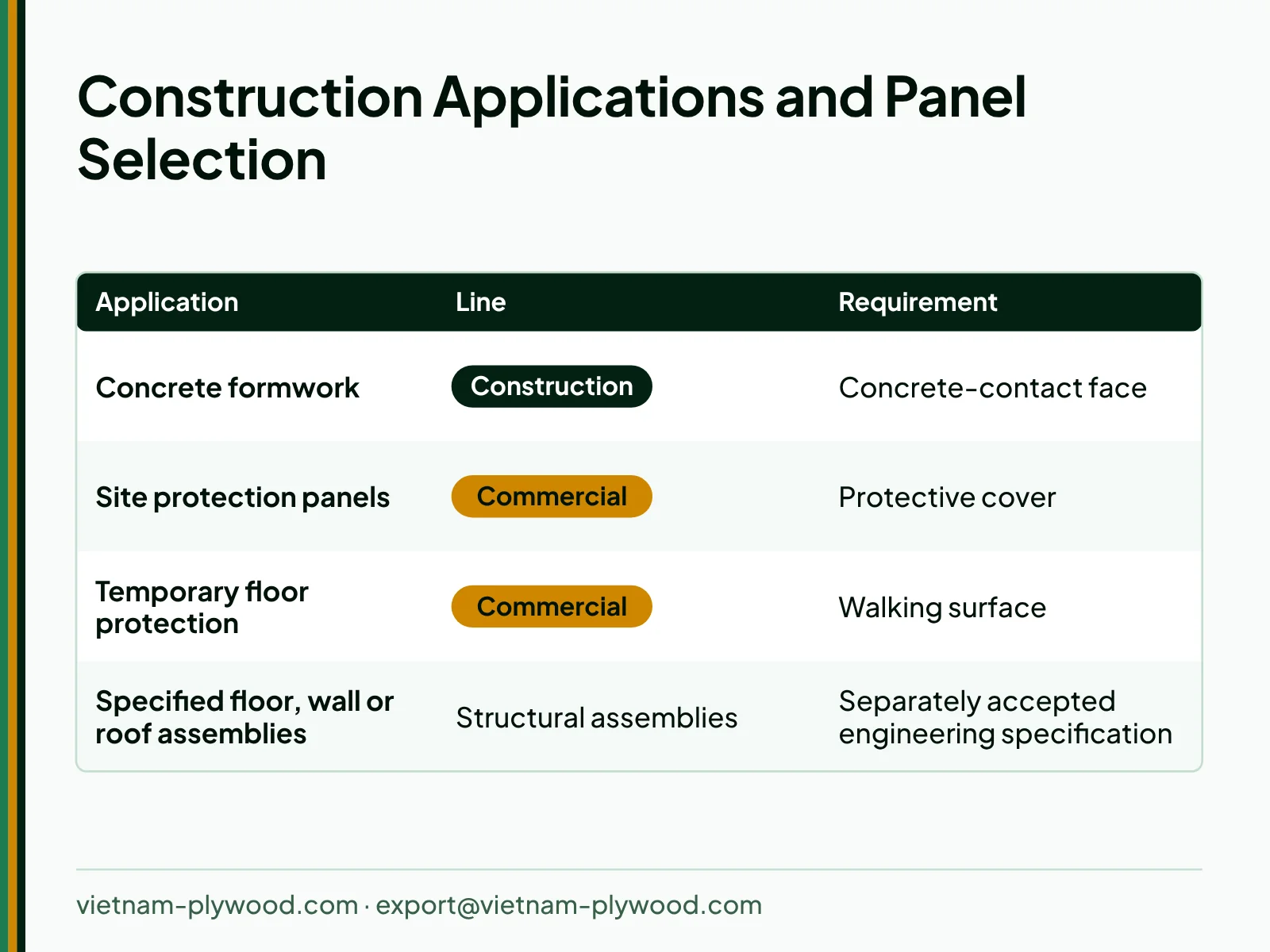
A contractor purchasing plywood sheets construction crews will cut, carry and reuse should distinguish a concrete-contact face from a walking surface and a protective cover. Using an unsanded packing panel as a concrete form can damage the finish and interrupt the pour. Using smooth formwork film where a textured walking face is specified creates another mismatch.
The construction plywood range starts with concrete-contact applications. The project supply overview addresses the broader schedule of site materials.
Which types of plywood are used in construction?
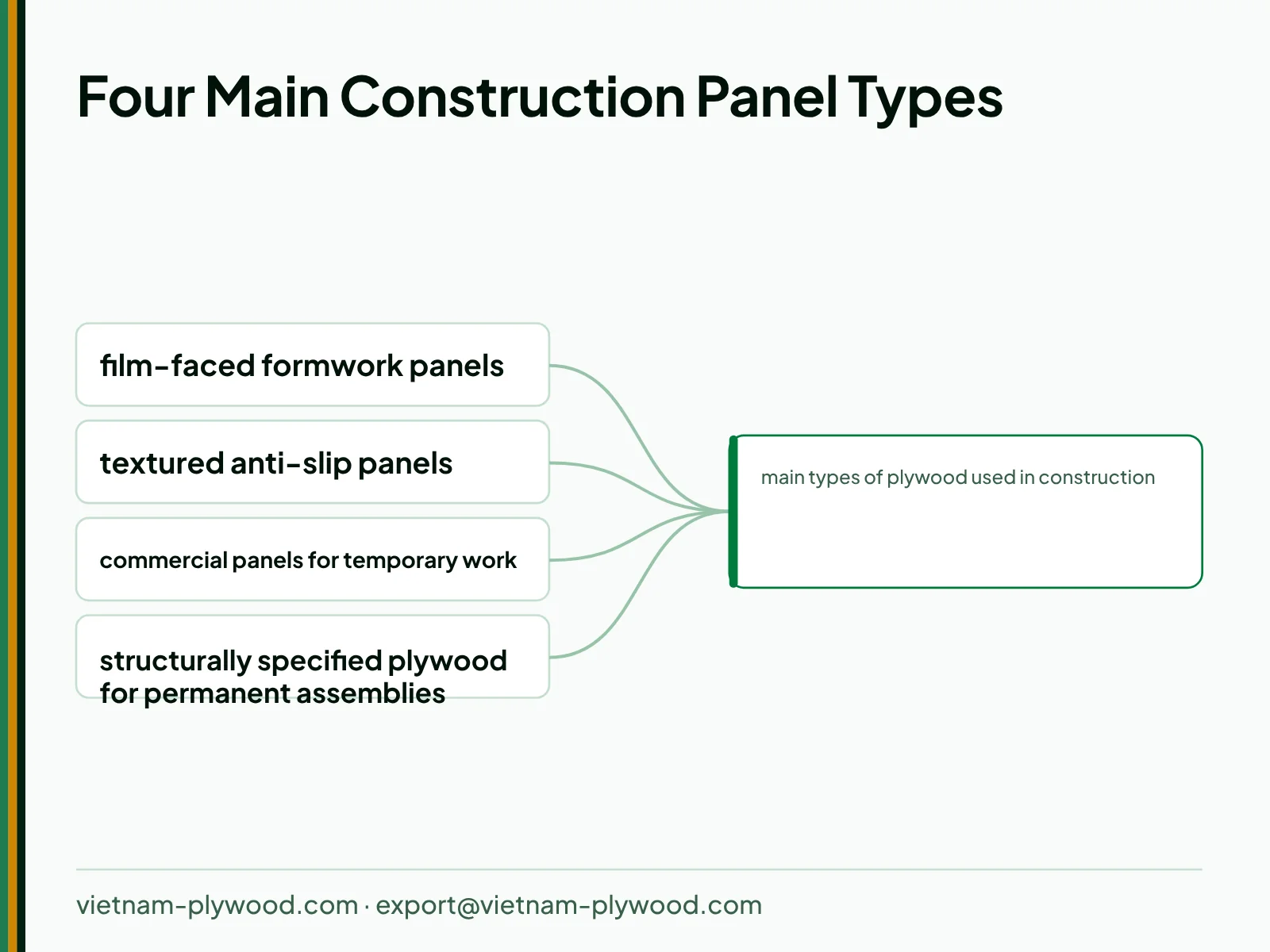
The main types of plywood used in construction are film-faced formwork panels, textured anti-slip panels, commercial panels for temporary work and structurally specified plywood for permanent assemblies. They differ in purpose even at identical nominal thickness.
| Application | Panel build and producing line | Buying decision |
|---|---|---|
| Concrete walls, columns and slabs | Film-faced, acacia or eucalyptus core; our construction line | Select concrete finish, glue and support design |
| Specified temporary walking surface | 220 g/m² anti-slip film; our construction line | Select texture and obtain project slip assessment |
| Temporary partitions, protection and packing | Acacia-core MR, unsanded or light-sanded; our commercial and packing line | Select handling resistance and cut size |
| Finished site-office fit-out | Styrax or eucalyptus core, full stitched and sanded; our furniture line | Select face appearance and emission class |
| Structural wall, roof or floor assembly | Project-specific plywood with accepted structural test report | Engineer checks strength, span, fixing and exposure |
A plywood panel named for its face does not reveal the density of its core. For example, a decorative veneer face can cover a styrax or eucalyptus core. The structural versus non-structural plywood distinction must be resolved before an assembly is designed.
Oriented strand board (OSB), medium-density fibreboard (MDF), chipboard, blockboard, bamboo panels and birch-core plywood are outside our pressed range. OSB remains a separate structural-panel category, rather than a plywood face grade.
Which plywood should a contractor use for formwork?
Film-faced plywood from our construction line is the starting point for concrete formwork. The panel forms the contact surface while the supporting formwork system carries fresh-concrete pressure. Specify panel thickness, span, bracing and pour conditions with the formwork engineer.
Our construction line presses 120 g/m² standard film, 135 g/m² premium film and 220 g/m² anti-slip film. Smooth film is appropriate for a specified concrete-contact finish; anti-slip texture is selected for a working surface, rather than a smooth concrete imprint. The line uses acacia or eucalyptus cores, with unsanded construction beneath the film.
For bonding, melamine MR means a 12-hour boil condition, while phenolic weather and boil proof (WBP) means a 72-hour boil condition. Glue is separate from an E0, E1 or E2 emission class. Film finish, edge sealing, release-agent practice and site handling influence repeated use.
With proper handling, a release agent on every pour and sealed edges, including cut edges, melamine-glue film-faced panels achieve about 12–15 pours; phenolic-glue panels achieve up to about 25 pours. Those conditions belong in the site method statement, not merely the purchase order.
APA — The Engineered Wood Association, in its Engineered Wood Construction Guide (revised 2019), treats concrete formwork separately from floor, wall and roof construction. Its construction guide identifies these as distinct design systems. Our panels should be evaluated against the engineer’s project requirements.
Which panels suit temporary site works?
Acacia-core commercial plywood is the line choice for temporary partitions, surface protection and protective packing that do not carry engineered structural loads. Our commercial and packing line uses MR glue and an unsanded or light-sanded finish, avoiding the film surface cost when concrete contact is absent.
Temporary uses include shielding finished surfaces from site traffic, separating clean and dusty work zones, and protecting components in transit. Specify the fixing method and likely wetting before choosing a panel. If workers or equipment will stand on the assembly, the contractor must assess the entire support and slip arrangement; an ordinary protective sheet is not automatically a load-rated deck.
For crates and shipment protection, consult commercial and packing plywood. These uses call for a different surface and inspection plan than repeated formwork pours.
Which factory line makes each panel?
The producing factory follows the specification rather than a generic construction label. HCPLY has a furniture line, a commercial and packing line and a construction line in Phu Tho and Hai Phong. Each order is produced in the factory suited to its build and shipped directly from it.
For the same 18 mm nominal thickness, our furniture line can press a full-stitched sanded panel with a styrax or eucalyptus core; our commercial and packing line makes an acacia-core MR panel; our construction line makes a film-faced acacia or eucalyptus panel. Their tolerances and intended surfaces differ despite matching thickness.
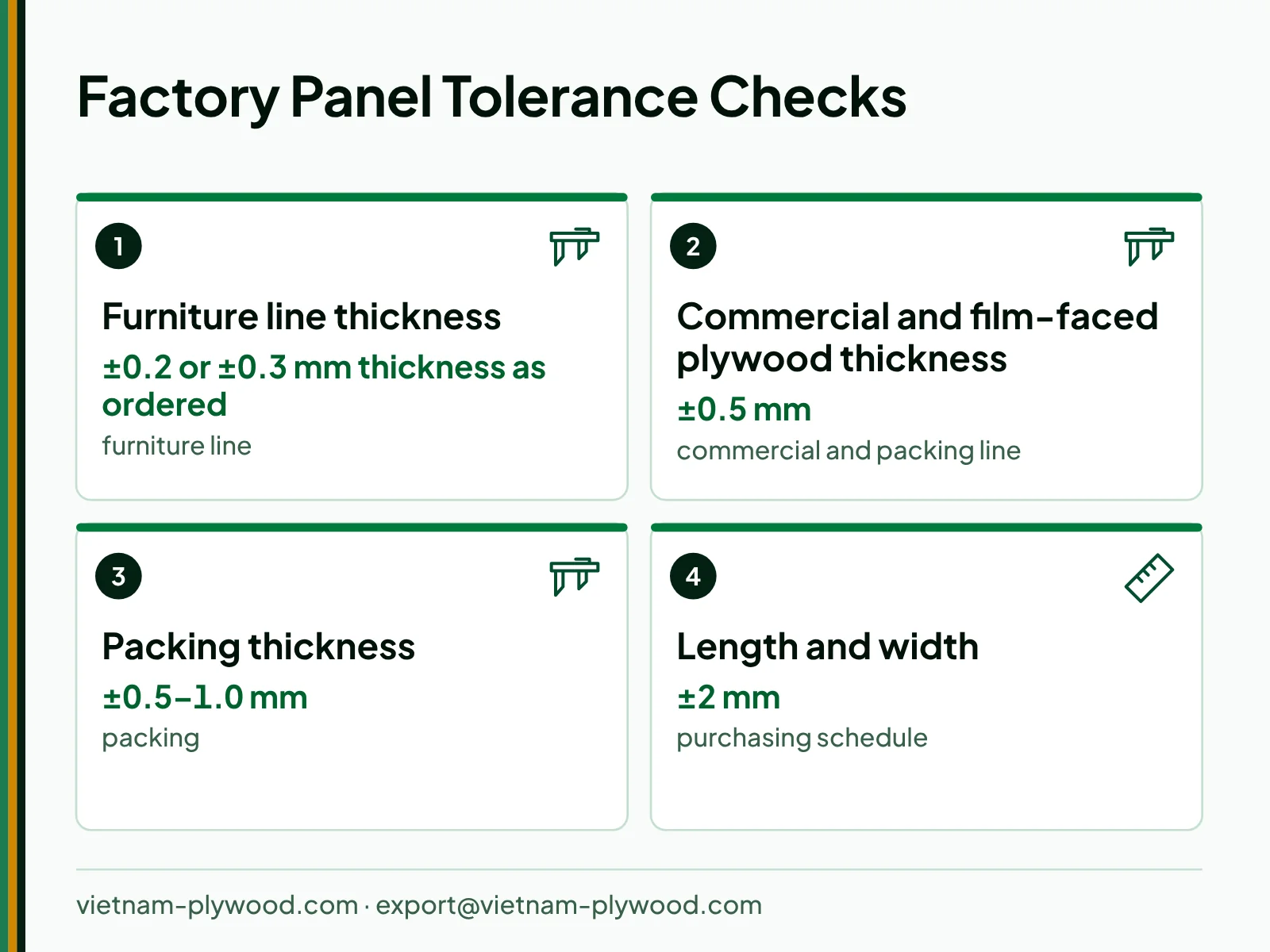
The furniture line works to ±0.2 or ±0.3 mm thickness as ordered. Commercial and film-faced plywood use ±0.5 mm, while packing uses ±0.5–1.0 mm. Length and width tolerance is ±2 mm. A purchasing schedule should name the finish and tolerance on every item rather than using one blanket instruction.
How do exterior and structural specifications change the choice?
Exterior exposure and structural duty require separate decisions about bond durability, mechanical performance and the governing building specification. A phenolic bond describes moisture resistance; it does not establish a structural span rating. The engineer must accept a test report for any structural grade claimed for a particular build.
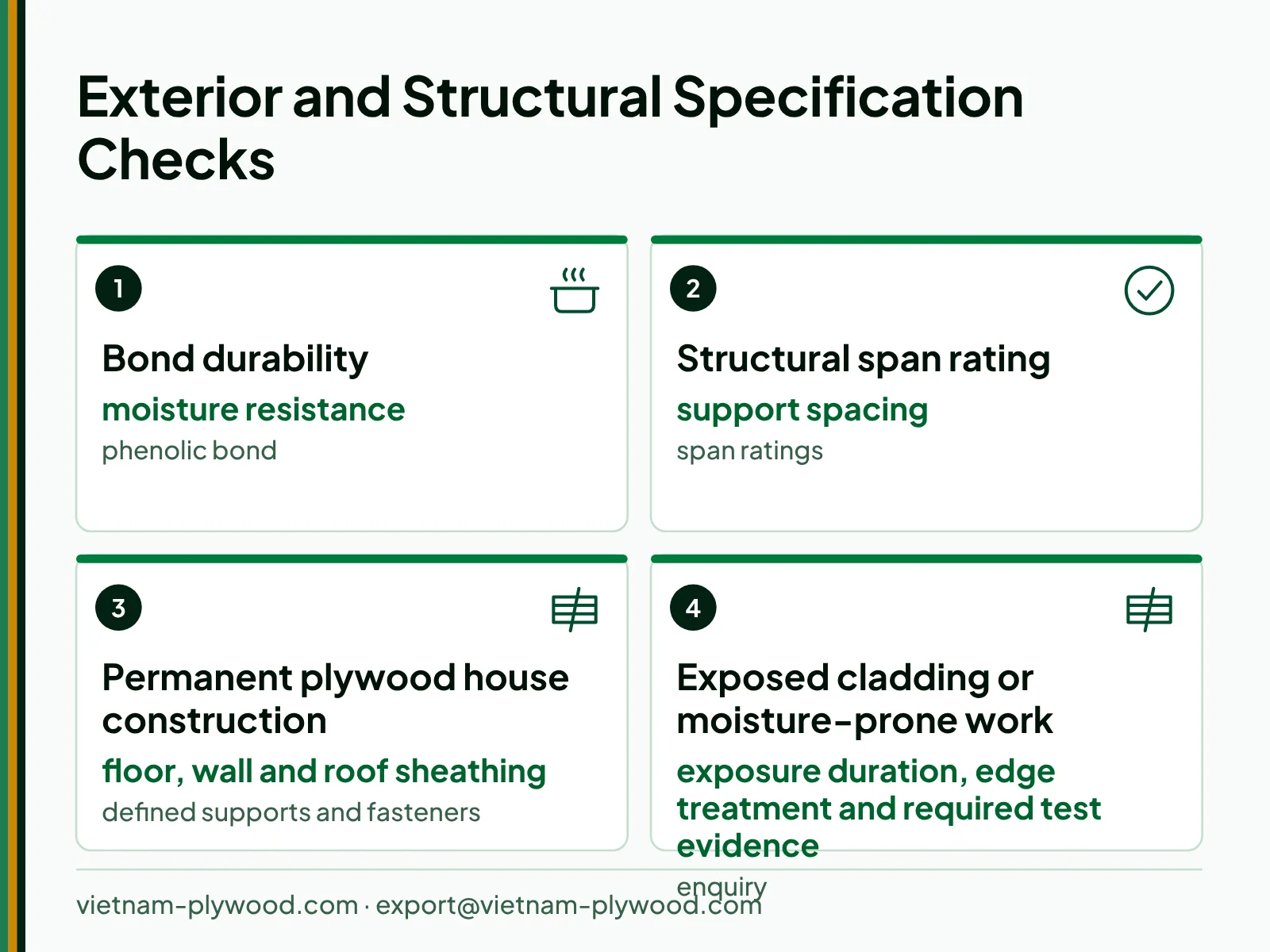
For permanent plywood house construction, floor, wall and roof sheathing is designed as an assembly with defined supports and fasteners. The APA plywood technical overview distinguishes Exterior bond classification from Exposure 1 and explains that span ratings address support spacing. That distinction matters when buyers compare a general plywood sheet with a code-specified structural panel.
For exposed cladding or moisture-prone work, write the exposure duration, edge treatment and required test evidence into the enquiry. Read the exterior plywood specification and tongue-and-groove subfloor requirements for the separate assemblies. We do not press 3-ply spruce panels or high-density and medium-density overlay (HDO/MDO) panels.
Can a contractor load every panel for one job in a single container?
A contractor can mix film-faced, commercial and furniture-line specifications in one 40HC container within the 28.5 t payload limit. HCPLY plans the mix against pallet space and core weight, rather than assuming all 18 mm sheets weigh the same.
At 1220 × 2440 × 18 mm, an acacia-core sheet weighs 31.08 kg and a styrax-core sheet weighs 26.79 kg; a eucalyptus-core sheet weighs 34.83 kg. A full single-core 40HC reference load is 880 acacia sheets at 27.35 t, 990 styrax sheets at 26.52 t or 795 eucalyptus sheets at 27.69 t, excluding film weight. A mixed load requires a new pallet allocation and allowance for films and packing.
For instance, a site schedule can pair formwork sheets with acacia-core partition sheets and sanded panels for a temporary site office. The buyer sends separate line items, and we check the combined payload before finalizing quantities. Use the container packing calculation for full-load planning; the mix must also fit the physical pallet arrangement.
The minimum order is one 40HC. Specifications can be mixed in a container within the payload limit. That makes a job-based purchasing schedule practical without assigning every use to the same grade.
What can an inspector check at the producing factory?
An inspector can witness panel dimensions, thickness, surface condition, edge quality, bundle identity and loading against the agreed specification. Buyers visit the factory office and inspect goods at the producing factory; our on-site quality-control team follows the order through loading.
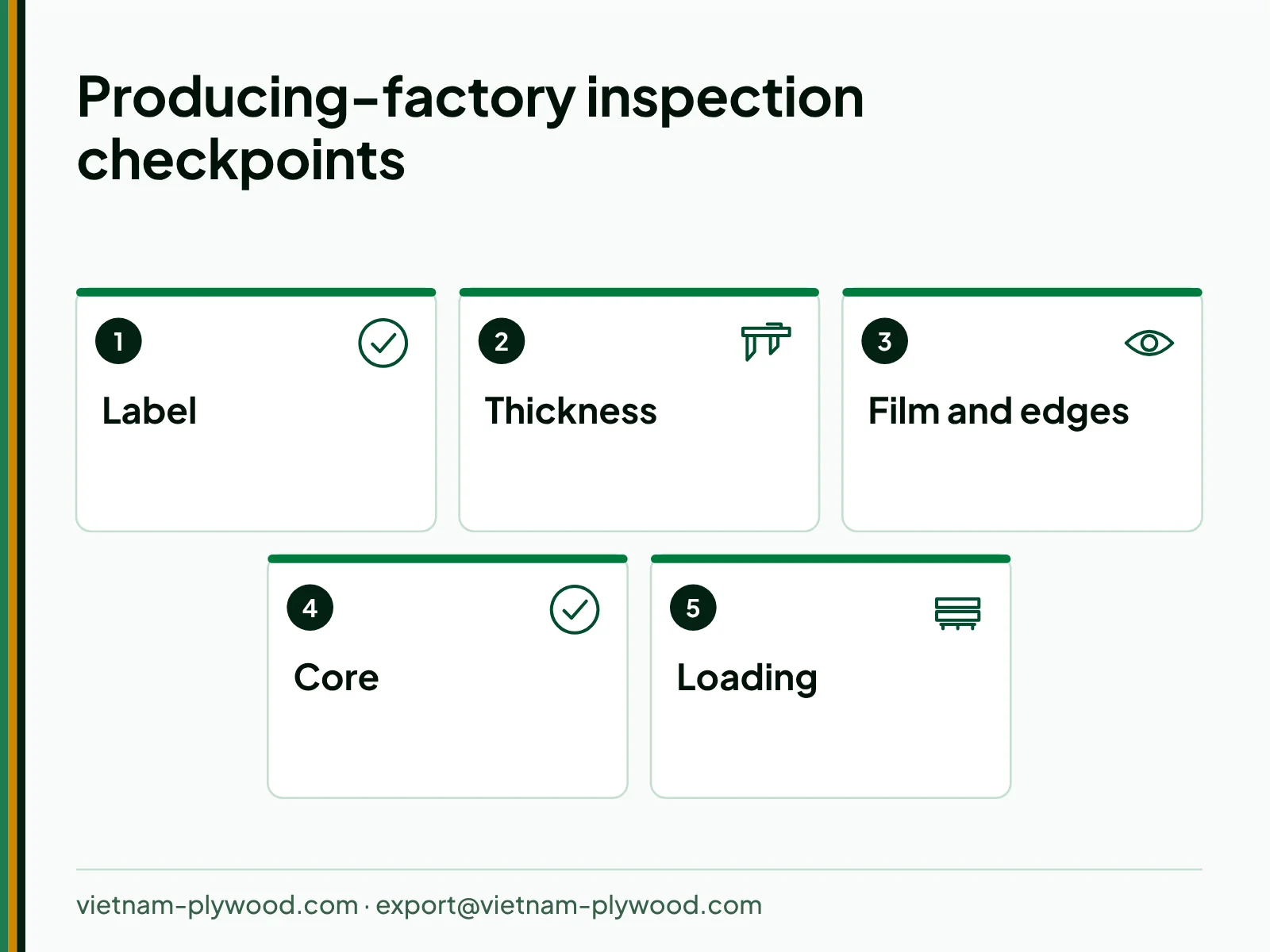
- Match bundle labels and the production schedule to the ordered core, face and film specification.
- Measure thickness at agreed positions and check length and width against the purchase order.
- Inspect film continuity, visible surface damage and cut edges; record sealing requirements for formwork.
- Examine accessible panel edges for gaps and compare representative pieces with the agreed core construction.
- Count bundles, check pallet identification and witness container loading against the packing list.
A visual check does not replace a mechanical test report for a structural application. Where a contract specifies an emission certificate, bonding test or structural test, review the agreed build and its supporting documents as separate acceptance items.
What should the purchase order say about size and build?
A useful construction order names the use first, then core, glue, face, thickness, dimensions and tolerance. HCPLY offers 3–40 mm thicknesses, including common 3, 5, 9, 12, 15, 18, 21 and 25 mm builds. Standard sheet sizes include 1220 × 2440, 1250 × 2500, 1220 × 2135 and 915 × 1830 mm, with custom cutting available.
For a concrete-form panel, record whether the finish is standard or premium smooth film and whether phenolic bonding is required. For site protection, record whether an unsanded surface is acceptable and which edges will be cut on site. For an interior fit-out, specify face species and appearance grade; the furniture line uses A/B face grades, while birch faces use D/E/F.
Core construction is another buying field. Full stitched is the highest tier in our core-construction sequence, followed by stitched outer layers with edge-trimmed inner layers, finger-jointed, then loose-laid. The selected core arrangement affects the inspection sample and the quotation.
How should a contractor compare quotations?
Compare quotations against identical applications, core constructions, glue choices, faces, tolerances and delivery terms. A phenolic-glue film-faced build costs more than a comparable melamine-glue build because its bonding specification is higher. Premium film adds a surface requirement beyond standard film; a sanded full-stitched furniture panel involves more finishing than an unsanded commercial panel.
The indicative starting price for commercial plywood is from US$250/m³ FOB Hai Phong (October 2026). Furniture plywood starts from US$350/m³ FOB Hai Phong (October 2026). For film-faced and other construction grades, request a quotation against the written build, quantity and shipment terms rather than applying either starting figure.
We ship FOB Hai Phong, or CFR (CNF) or CIF to your port. Production takes 15–45 days from the 30% deposit, set by order size, line loading and the contract. The balance is 70% against the scanned bill of lading (B/L), by telegraphic transfer (T/T) or irrevocable letter of credit (L/C) at sight.
Which shipment documents cover construction plywood?
The export document set records what was sold, loaded and shipped, with additional certificates tied to the agreed panel build. It includes a commercial invoice, packing list, B/L, certificate of origin, phytosanitary and fumigation papers, and insurance under CIF.
European Union lots include EUR.1 and the European Union Timber Regulation / Deforestation Regulation (EUTR/EUDR) file set. Order-specific papers can include an FSC claim on sales documents, an emission certificate or test reports for the agreed build. Member-factory FSC, CARB P2, ISO 9001 and CE certificates, plus EUTR/EUDR documents, are shown with factory details masked, on request.
After loading, the draft shipping documents come to you for approval. For mixed-site orders, the packing list is the document that identifies quantities and bundles across the different specifications.
What specification should the buyer send?
Send an application-based schedule that separates concrete formwork from temporary protection and any engineered structural assembly. The request should include the destination port so our export team can quote the required delivery term and prepare the appropriate shipment papers.
Application: concrete formwork / temporary site protection / site-office fit-out
Line or core: construction—acacia or eucalyptus / commercial—acacia / furniture—styrax or eucalyptus
Glue: melamine MR or phenolic WBP, as specified
Emission: E0 / E1 / E2 or required certificate basis
Face and grade: film 120 or 135 g/m²; anti-slip 220 g/m²; or named veneer and grade
Thickness and tolerance: ___ mm; ___ mm tolerance
Size: ___ × ___ mm
Quantity: ___ sheets by specification; mixed 40HC if applicable
Destination port: ___; delivery term: FOB Hai Phong / CFR (CNF) / CIF
Request the construction plywood specification sheet from Lucy at export@vietnam-plywood.com.