





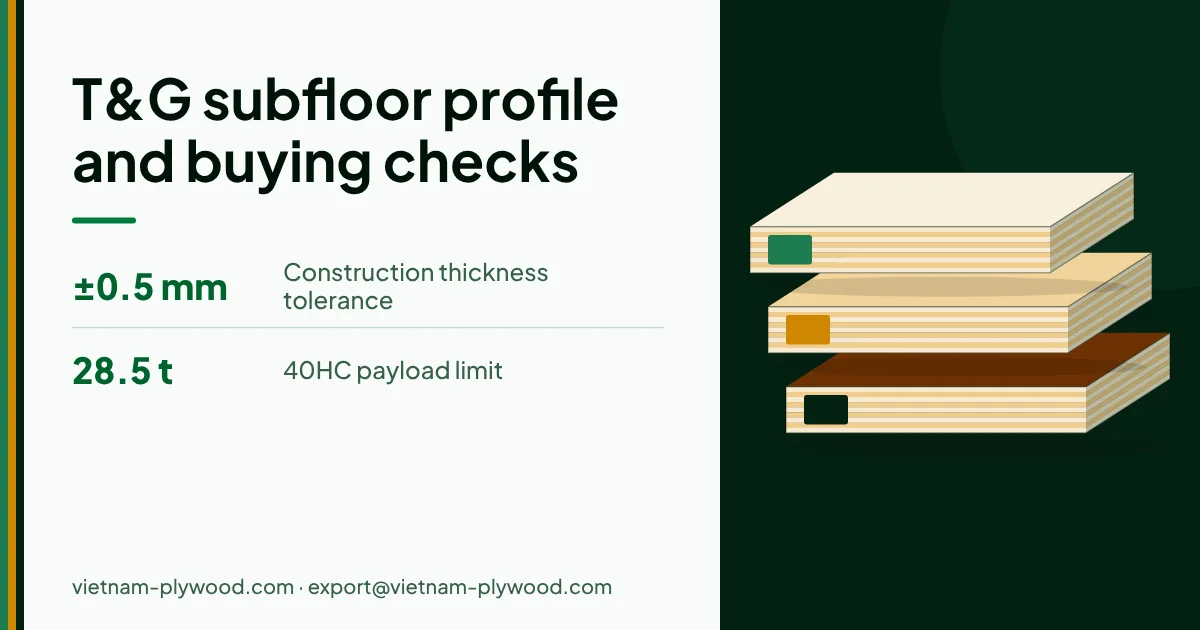
Tongue groove plywood is a panel with mating profiled edges, but a floor order also needs an accepted structural performance basis. A mismatched profile or unsupported floor rating can mean rejected material, re-machining expense and delayed installation. HCPLY starts an export discussion with the floor assembly, hardwood-core build and the exact edge drawing rather than thickness alone.
What is tongue groove plywood?
Tongue groove plywood is plywood machined with a projecting ridge along one panel edge and a corresponding recess along the adjacent edge. When assembled, the tongue enters the groove and helps neighboring sheets remain aligned. For subfloors, the profile can provide edge support within an engineered assembly, but the joint geometry alone cannot establish a permissible joist span or floor load.
A tongue and groove plywood floor usually hides beneath finished flooring. The surface may instead form a roof deck, wall lining or industrial platform, but each application needs its own performance criteria. A decorative tongue and groove ply board differs from rated flooring plywood.
Buyers also call it T&G or t g plywood. Neither abbreviation identifies the tested floor performance.
Which plywood build does a T&G floor panel start from?
Our construction line is the starting point for a hardwood-core floor inquiry needing an exterior-type phenolic bond. Its acacia or eucalyptus core can be specified with an unfaced raw surface where the finished flooring will cover the panel. The line also makes film-faced construction panels, but a film face is a separate surface choice and is not automatically appropriate beneath floor finishes.
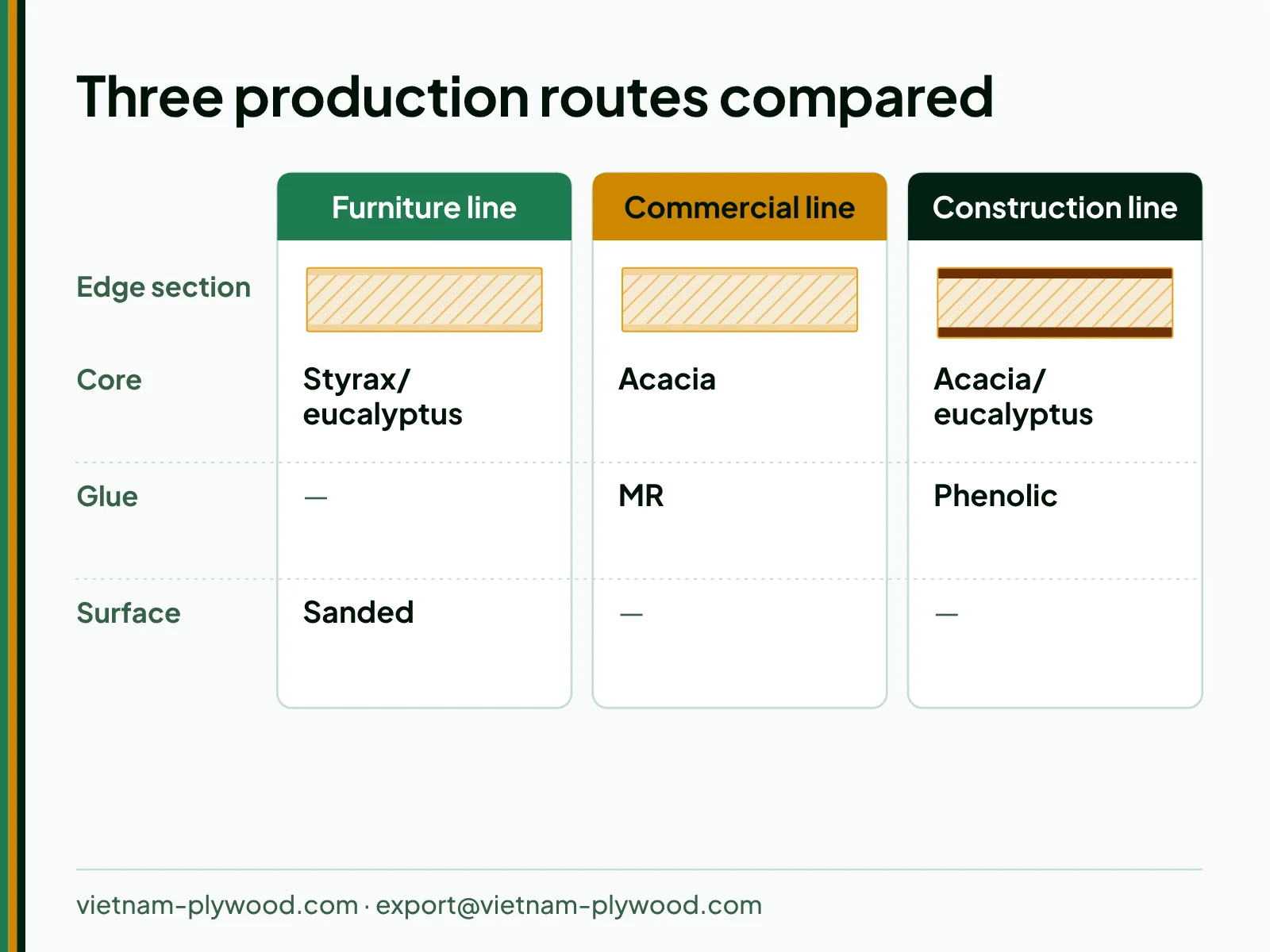
The three production routes serve different buying purposes. An identical nominal thickness can produce different core construction, surface preparation and bonding choices, as the comparison shows.
| Manufacturing route | Core and preparation | Bond or surface | Purchasing verdict |
|---|---|---|---|
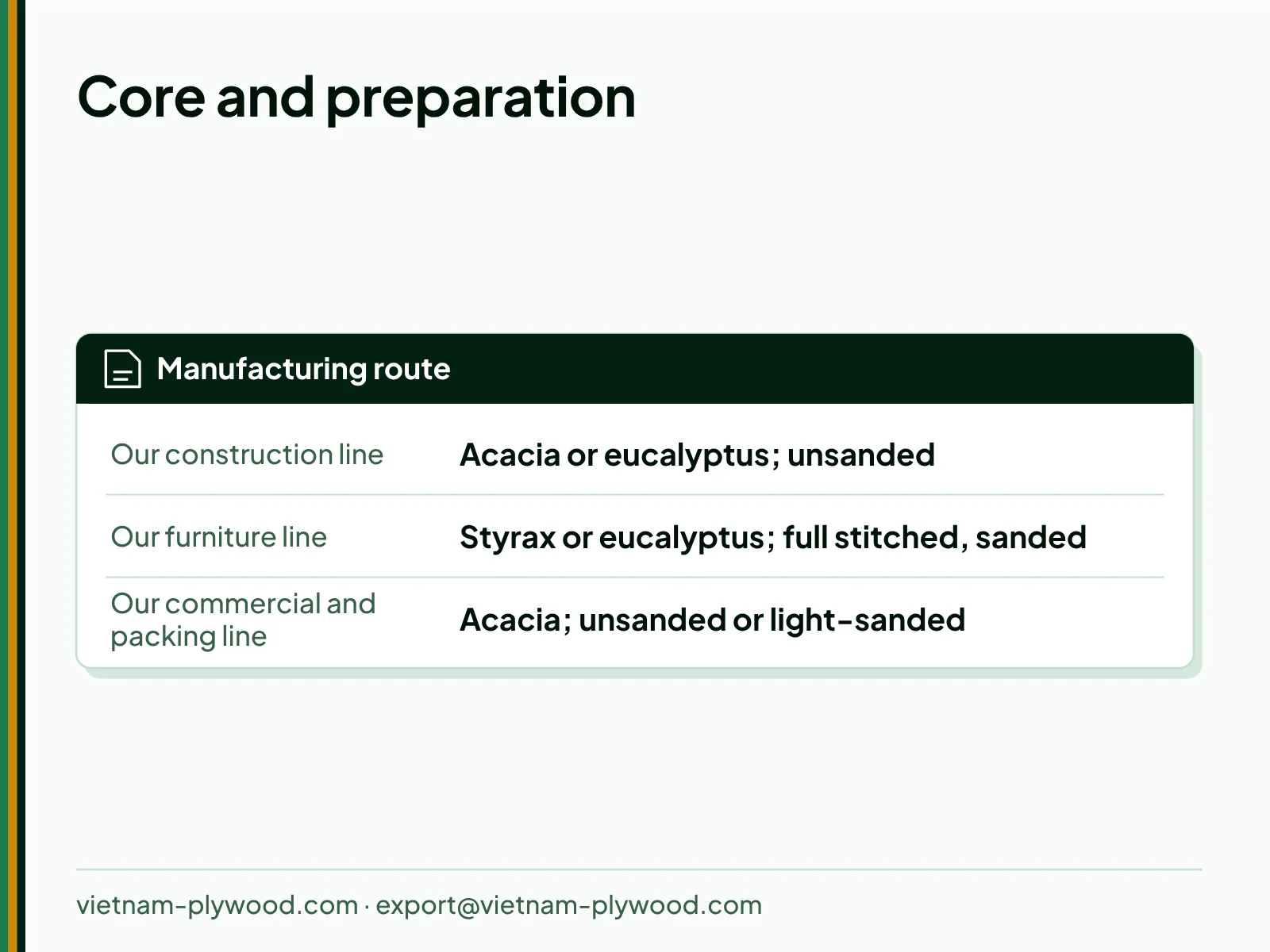
| Our construction line | Acacia or eucalyptus; unsanded | Phenolic weather-and-boil-proof bond; construction surface selected for the order | Starting route for a T&G subfloor proposal with separate structural evidence |
| Our furniture line | Styrax or eucalyptus; full stitched, sanded | E0 or E1 emission specification; appearance veneer as ordered | Better suited to visible or precision interior panels, rather than assumed structural subfloor stock |
| Our commercial and packing line | Acacia; unsanded or light-sanded | Moisture-resistant glue | Suited to commercial and packing panels, rather than an exterior-bond floor proposal |
A birch face does not make the core birch: we do not press birch-core plywood. See the wider construction plywood range and the distinction between structural and non-structural plywood.
How is the tongue and groove profile specified in an order?
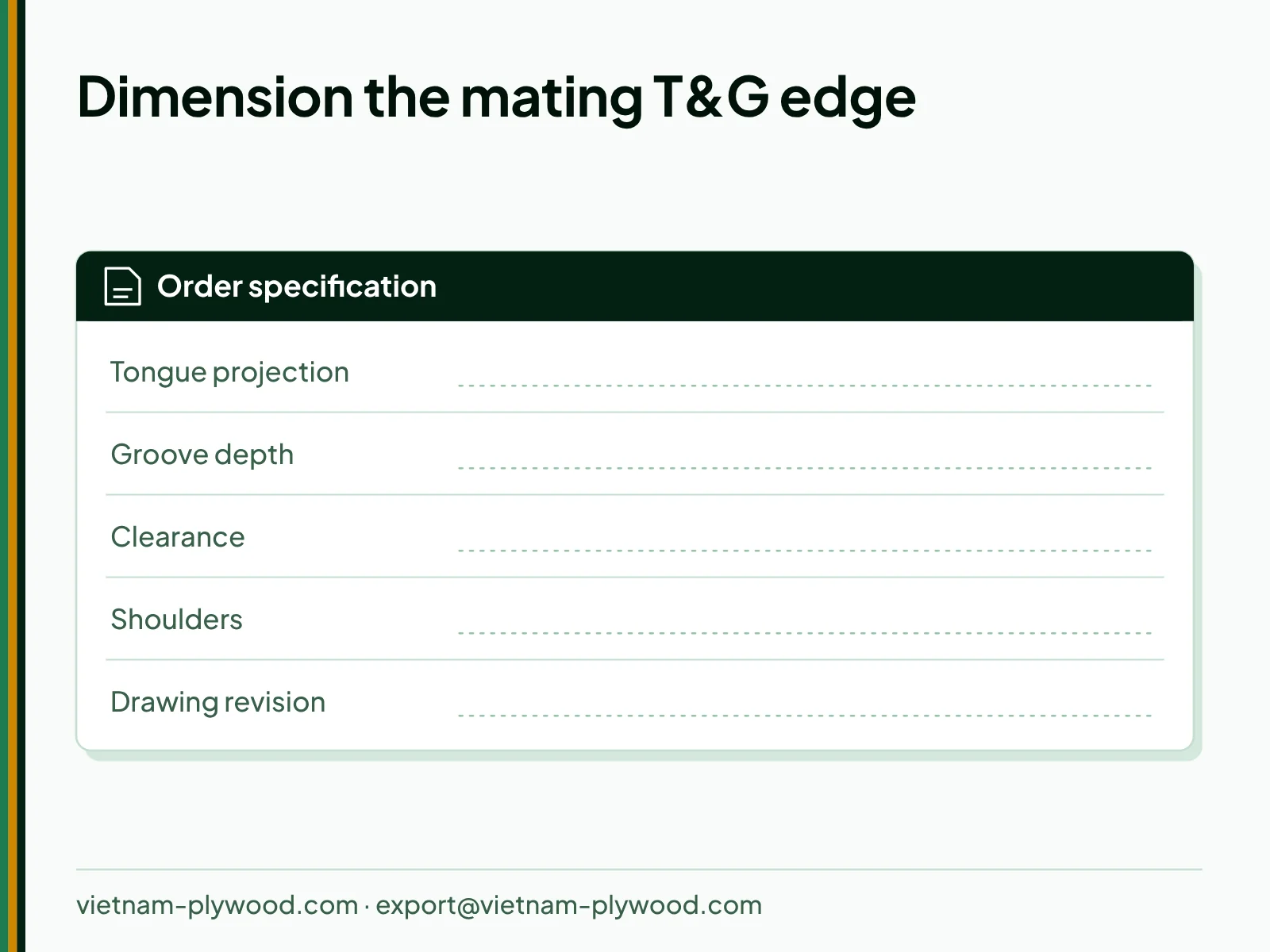
The order should contain a dimensioned edge cross-section and a mating-joint acceptance method. A label such as “T&G long sides” leaves too many decisions to the cutting stage. Profile shape controls whether panels seat without binding, leave the intended movement space and maintain adequate material around the groove.
- Mark the profiled edges on a plan view: two long edges, two short edges or a specifically approved arrangement. Show the face that points upward.
- Draw the tongue projection, tongue thickness, groove depth, groove opening and shoulder geometry in millimetres. Include the datum for each measurement.
- Specify fit clearance and the permitted joint gap after assembly, with a drawing of the fully seated condition.
- State finished overall sheet dimensions, net coverage after engagement, edge squareness and machining tolerance separately from panel thickness tolerance.
- Approve a physical mating sample and identify how inspectors will check pieces drawn from the production lot.
Our panel length and width tolerance is ±2 mm. That tolerance does not define groove clearance or cutter accuracy; those belong on the approved profile drawing. Custom cutting is available, with the agreed profile checked at the producing factory.
A tongue cut too thick can jam before the shoulders meet. A groove cut too wide can leave an unstable fit. Inspectors can place two production panels together, check the seating line with a gauge and compare the joint against the approved sample.
What glue is used in tongue and groove floor plywood?
Phenolic weather-and-boil-proof (WBP) glue is the exterior-bond starting specification for the construction route. The stated factory process uses a 72-hour boil classification for phenolic glue and a hot-press range of 130–145 °C. These describe the adhesive system and process, not an assigned floor strength grade.
Melamine moisture-resistant (MR) glue is a different bond option, with a 12-hour boil classification and 110–120 °C hot pressing. Its designation should not be substituted for a project requirement for an exterior bond. The distinction is developed further under exterior plywood supply.
Glue and formaldehyde emission are separate specification fields. E0, E1 and E2 are emission classes; they do not describe the adhesive chemistry. Where US hardwood plywood emission rules apply, the US Environmental Protection Agency’s 2016 final rule and its 2026 update explain the TSCA Title VI framework and third-party certification requirements on the EPA’s official page.
Certificates associated with the member factories, including CARB P2, are shown with factory details masked, on request. A buyer should match the certificate’s covered product and producer to the specific order, while keeping structural tests as a separate requirement.
Does a T&G subfloor panel need a structural rating?
Yes, where the intended floor is load-bearing and the destination’s rules call for rated structural panels. A tongue and groove joint provides a connection detail; it does not supply the panel’s bending capacity, stiffness, fastener performance or allowable support spacing.
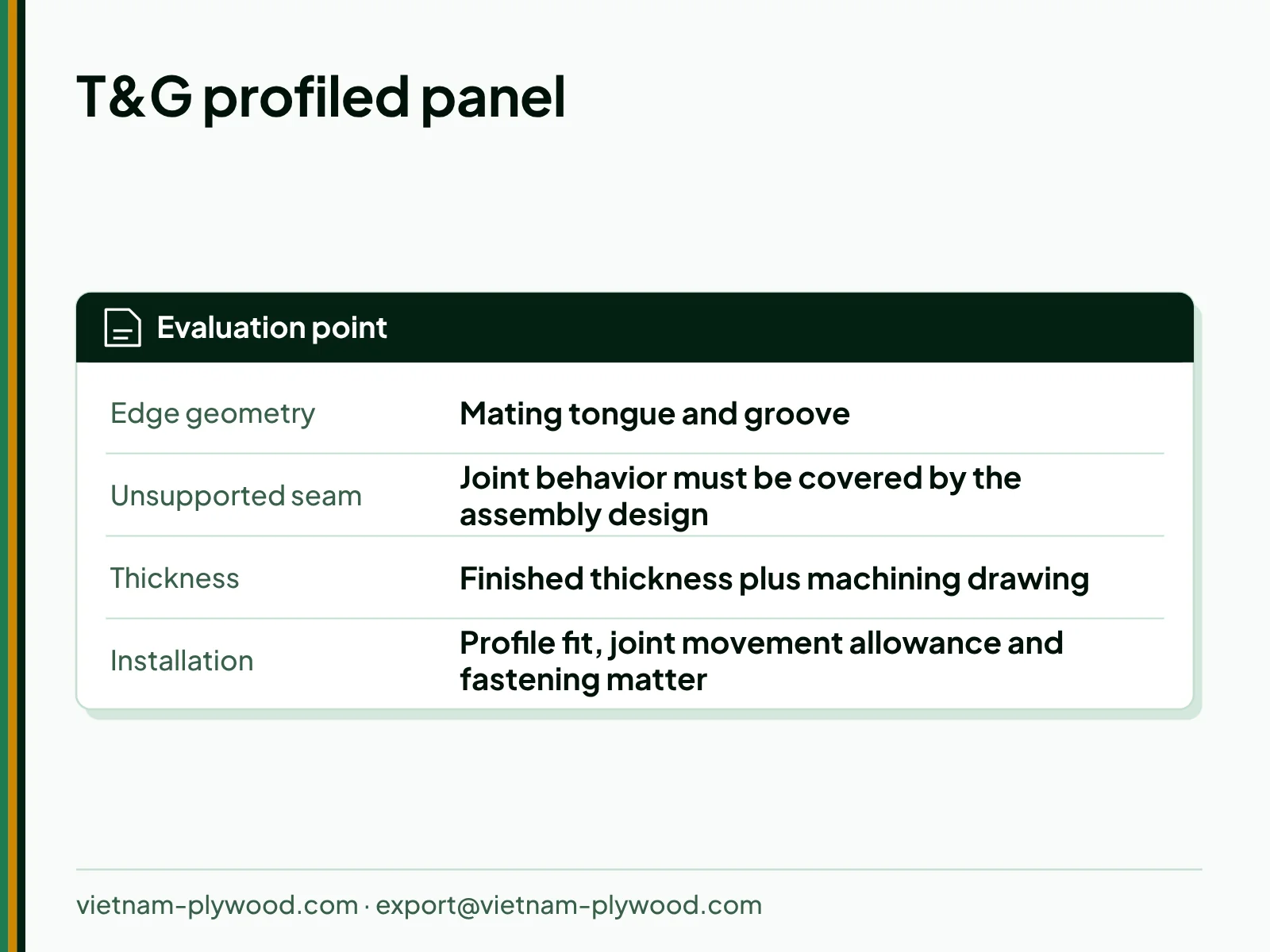
A structural report must identify the tested construction, thickness, relevant loading and test method. It should also address the intended joist spacing, edge support, fastener schedule and the finished floor assembly. A report for a different core, bond or panel construction cannot simply be transferred to the proposed order.
| Evaluation point | T&G profiled panel | Square-edge panel | Buying decision |
|---|---|---|---|
| Edge geometry | Mating tongue and groove | Straight edges | Choose T&G where the approved design relies on interlocking edge support |
| Unsupported seam | Joint behavior must be covered by the assembly design | Blocking or another approved support arrangement may be required | Follow the structural design, not a generic sales label |
| Thickness | Finished thickness plus machining drawing | Finished thickness | Neither thickness alone establishes allowable span |
| Installation | Profile fit, joint movement allowance and fastening matter | Edge bearing and fastening matter | Use the accepted floor-system instructions |
| Acceptance | Report covers the proposed profiled build | Report covers the square-edge build | Do not substitute one report for the other |
Underlayment supports a finish; the structural subfloor transfers loads to framing. A combination panel needs evidence for both functions. Our broader construction applications page separates these uses.
On what basis are US, Canadian and AU/NZ orders quoted?
A US, Canadian or Australian/New Zealand subfloor order is quoted only against a test report the buyer’s market accepts. The importer identifies the governing standard, the applicable edition, the acceptance authority and the tested build before commercial terms are agreed.
For a US project, request the applicable code and required panel performance designation, span, exposure and emission documents. The importer should identify the required panel marking and acceptance route; quotation proceeds against a test report the buyer accepts.
For Canada, specify the provincial or project code basis, the panel standard cited in the design and the evidence that the authority will accept. For Australia or New Zealand, request the project’s relevant structural panel standard and the report acceptance route. We do not claim an AS/NZS stress grade for our panels.
The same principle applies when a buyer requests a named structural grade: quotation proceeds against a test report the buyer accepts. A material description, an adhesive boil classification and a decorative face grade are insufficient substitutes for that report.
Can 3/4 or 5/8 inch T&G plywood be ordered from a metric factory?
Yes. The inquiry must translate the market’s nominal inch name into a specific finished metric dimension, rather than assuming the inch fraction is the actual sheet thickness. Three-quarter inch equals 19.05 mm and five-eighths inch equals 15.875 mm mathematically.
The factory’s common thicknesses include 15, 18 and 21 mm, within an overall 3–40 mm range. A nominal 3/4 tongue and groove plywood label can refer to a different actual thickness in the destination market. Likewise, 5/8 plywood tongue and groove should not automatically be entered as 15 mm on the purchase order.
For construction panels the standard thickness tolerance is ±0.5 mm. Specify the finished thickness, its tolerance and the measurement point clear of the profiled edge. If a floor designer requires an exact market thickness, the drawing and acceptance report must use that dimension.
Typical sheet formats include 1220×2440 and 1250×2500 mm, alongside narrower options. A market request for 4×8-foot flooring sheets should identify the required millimetre dimensions and the net cover width after joint engagement.
What must the producing factory inspector check?
The inspector should compare production panels against the approved build, edge drawing and market test-report scope. Inspection begins before loading, because profile faults become expensive after panels reach a distributor’s warehouse.
First, record the actual thickness and face dimensions at the stated measuring points. Then inspect exposed edge veneers for voids, broken tongues, split groove lips and incomplete bonding. Check whether the core arrangement matches the approved construction and whether the profile leaves adequate material at both shoulders.
Next, mate representative panels from different bundles on a flat reference surface. Record engagement, straightness, joint gap and any interference against the agreed drawing. Finally, reconcile bundle labels, quantities and the test-report identification with the shipment specification.
Buyers can visit the factory office and witness these checks at the producing factory. HCPLY manages specification, on-site quality control, export documents and loading; the producing line handles the agreed panel build.
How should importers plan the first container?
Start with one 40HC trial container and a controlled specification, then expand only after the sample fit and required reports are accepted. The minimum order is one 40HC; specifications can be mixed within the 28.5 t payload limit.
For a weight reference, 18 mm, 1220×2440 mm acacia-core panels weigh 31.08 kg per sheet, excluding any film. The computed full acacia load is 880 sheets, 47.15 m³ and 27.35 t. These are flat-panel core calculations; profiled-edge machining, packaging and any face treatment must be accounted for in the final packing plan. The container loading reference covers loading arithmetic.
Mixed construction specifications need a compatible weight and handling plan. Our film-faced plywood and shuttering plywood pages describe separate construction surfaces; do not treat them as interchangeable with a rated floor panel.
Production takes 15–45 days from the 30% deposit, set by order size, line loading and the contract. The 70% balance is against the scanned bill of lading, by telegraphic transfer or irrevocable letter of credit at sight. We ship FOB Hai Phong, or CFR (CNF) or CIF to your port.
Which paperwork carries the floor specification?
The order’s agreed test report and certificate documents connect the panel build to its intended market acceptance. The commercial invoice and packing list identify the shipped goods, while the bill of lading records carriage. For relevant destinations, certificate of origin and the applicable compliance file also matter.
A shipment document set includes the commercial invoice, packing list, bill of lading, certificate of origin, phytosanitary and fumigation papers, and insurance under CIF. Order-specific documents can include emission certificates and reports for the agreed build; European Union lots also have EUR.1 and EUTR/EUDR files. After loading, the draft shipping documents come to you for approval.
A profile sketch alone is not the report. The buyer’s purchase specification should identify the report reference, the drawing revision and the actual production build, so receiving inspection can compare all three.
What specification should an importer send first?
Send a dimensioned profile and a floor-performance requirement together with the commercial panel specification. This gives the factory a concrete basis for evaluating the build and the buyer a consistent acceptance checklist.
Catalogue naming should remain separate from the tested-use detail on the purchase order.
Application: Structural subfloor; destination code and accepted test report: [identify]
Line or core: Construction line; acacia or eucalyptus [select]
Glue: Phenolic WBP; required bond acceptance: [identify]
Emission: [required class and market documents]
Face and grade: [surface and grade; unfaced matt if specified]
Thickness and tolerance: [finished mm] / [acceptance tolerance]
Size: [finished length x width mm; net coverage after engagement]
T&G profile: [drawing revision; edges; groove/tongue dimensions; fit criteria]
Quantity: [sheets and pallet breakdown; one 40HC trial]
Destination port: [port and country]
Plan a trial container with Lucy at our contact page by sending the profile drawing and the structural acceptance requirements together.