





Structural plywood is specified for a documented load-bearing duty; non-structural plywood is selected for furniture, lining and packing without a structural grade. A wrong substitution can mean a rejected shipment, extra testing costs or unsafe loading. At HCPLY, structural vs non structural plywood starts with the intended application and the evidence accepted in the destination market.
What is the difference between structural and non-structural plywood?
Structural plywood has verified strength, stiffness and bond performance under the standard specified for its intended use. Non-structural plywood can be well made and suitable for demanding joinery, but its appearance grade or adhesive description does not establish a design load. A buyer must match the panel’s evidence to the required use, market and installation conditions.
A panel can look smooth and have tight edges while lacking a structural stress grade. Conversely, a structurally graded sheet may have visible face repairs that are acceptable under its specification. The difference between structural and non structural plywood is therefore documented performance, rather than a visual inspection alone.
Which panel wins for each use?
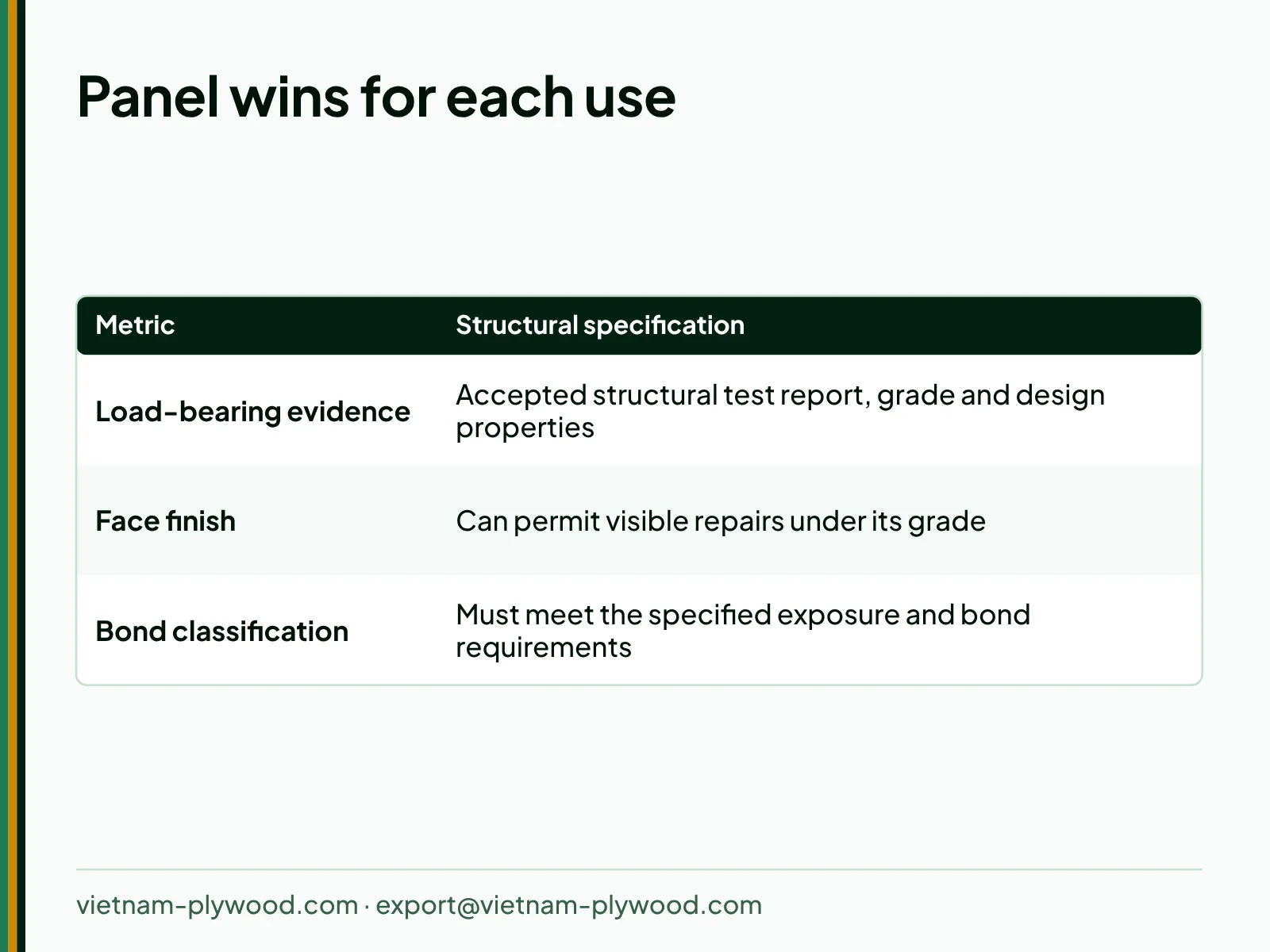
For structural plywood vs non structural plywood, the decision changes with the load path and acceptance documents. The comparison below separates panel characteristics from the verdict for the actual job.
| Metric | Structural specification | Non-structural specification | Verdict by use |
|---|---|---|---|
| Load-bearing evidence | Accepted structural test report, grade and design properties | No building structural grade assigned | Structural for engineered floors and bracing |
| Face finish | Can permit visible repairs under its grade | Decorative faces and sanding can be prioritized | Non-structural for visible cabinetry |
| Bond classification | Must meet the specified exposure and bond requirements | MR adhesive can serve protected interior applications | Select by service exposure, then duty |
| Core construction | Defect limits and strength properties follow the accepted standard | Core selection follows fit-out or packing requirements | Structural where core performance is designed |
| Thickness | Design uses tested properties and support spacing | Dimensional fit and machining govern selection | Thickness alone decides neither grade |
| Inspection metric | Traceability to tested build and specified grade | Thickness, faces, edges and core quality | Use the matching acceptance checklist |
| Price driver | Testing, grade control and specified bond can add cost | Decorative veneer and calibration can also add cost | Compare written builds, not category labels |
| Typical purchase | Roof, wall or engineered floor panel | Cabinet component, interior lining or crate | Buy to the declared application |
The market’s design professional decides the required structural class. A thicker decorative board is not an automatic substitute for a thinner engineered panel. Likewise, structural grade alone does not make a rough face suitable for visible furniture.
Which of our three factories presses each build?
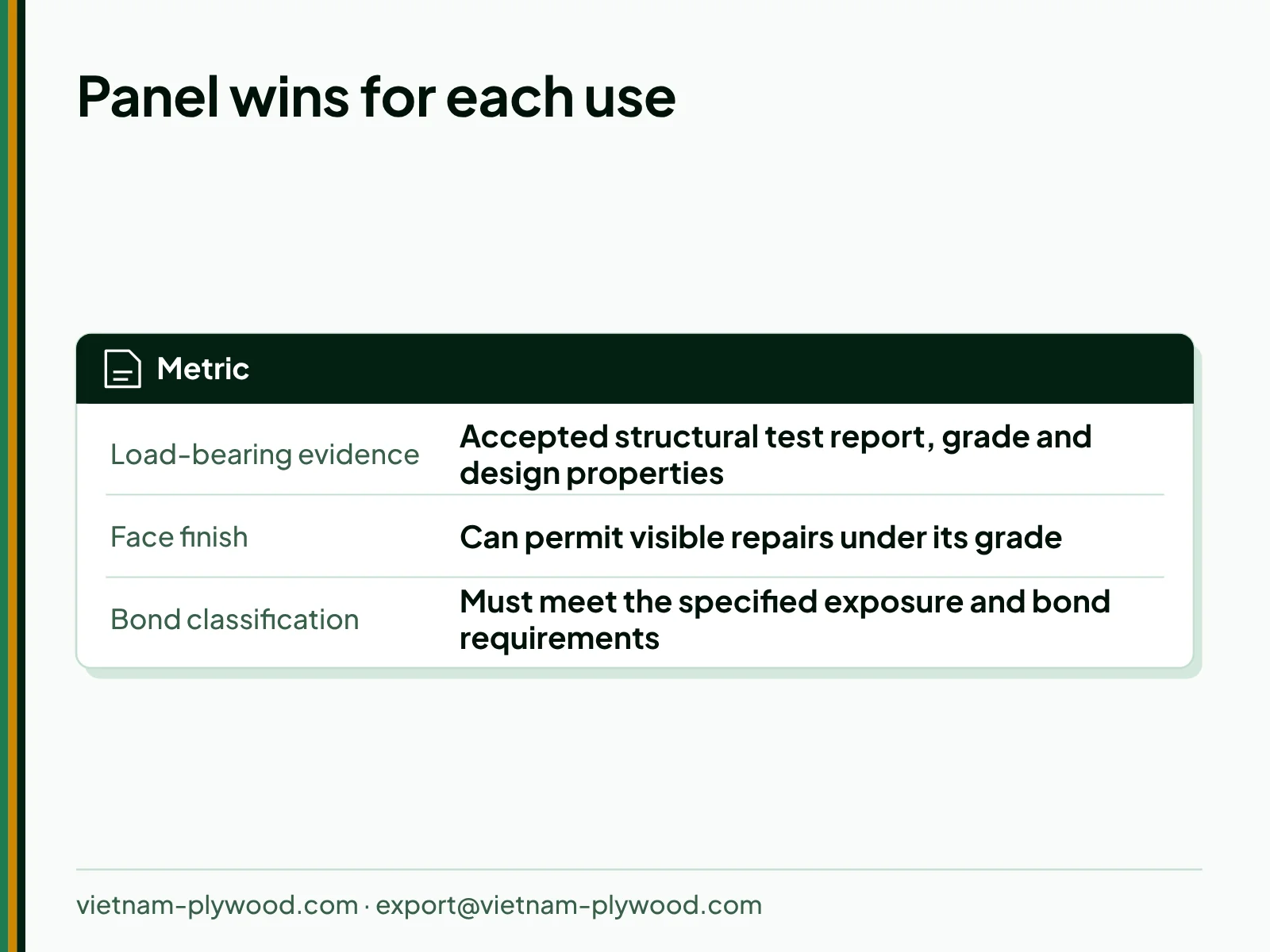
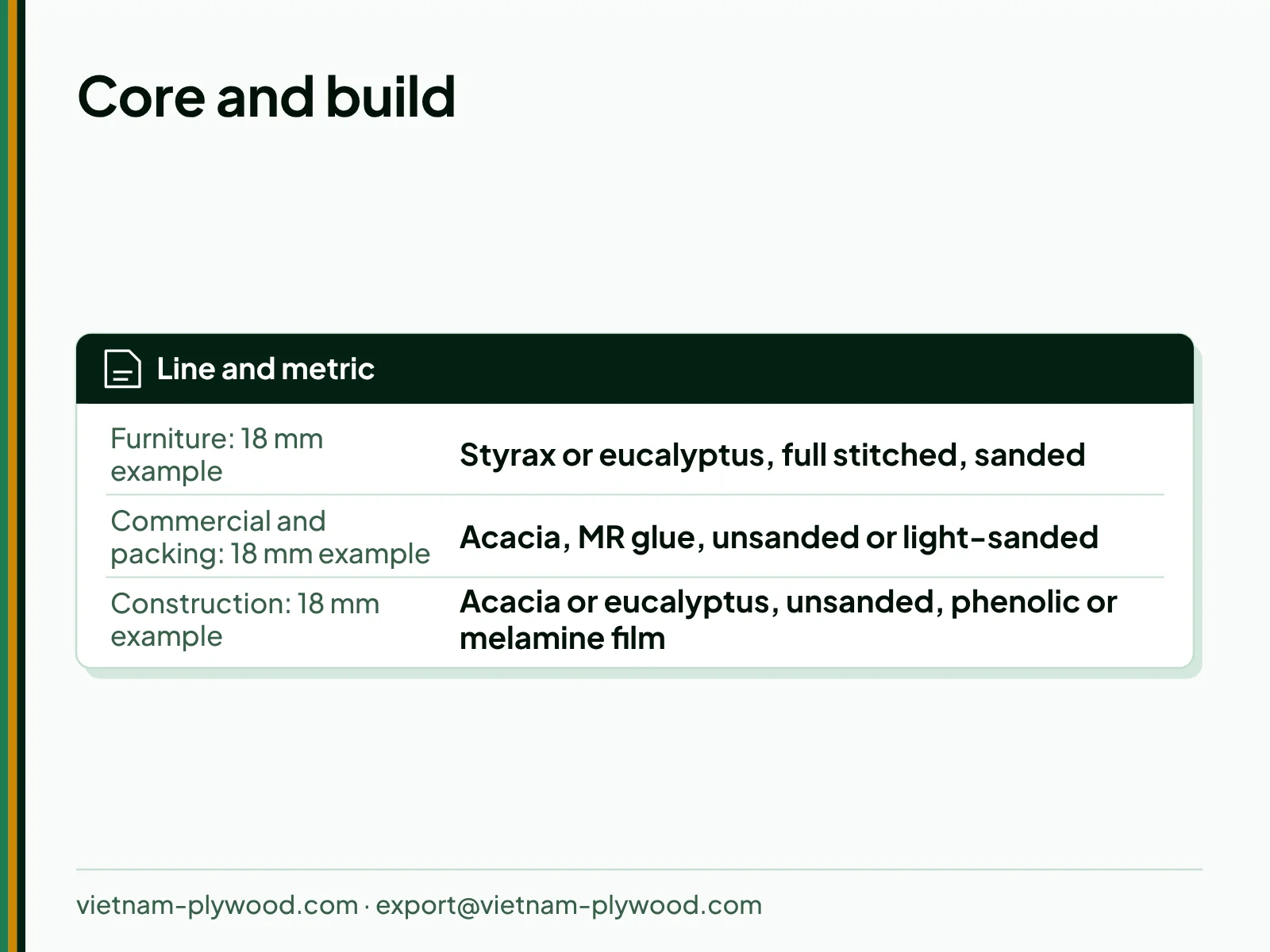
Our furniture line and our commercial and packing line make non-structural panels; our construction line handles construction applications and structural-use enquiries against a test report the buyer accepts. The line choice follows the written specification, rather than the appearance of a sample.
| Line and metric | Core and build | Typical face or surface | Intended verdict |
|---|---|---|---|
| Furniture: 18 mm example | Styrax or eucalyptus, full stitched, sanded | Decorative veneer, A/B face grade where applicable | Cabinet and fit-out components |
| Commercial and packing: 18 mm example | Acacia, MR glue, unsanded or light-sanded | Utility or matt surface | Crates, dividers and protected non-structural use |
| Construction: 18 mm example | Acacia or eucalyptus, unsanded, phenolic or melamine film | Film-faced or anti-slip film | Formwork; structural duty only with accepted report |
The same nominal 18 mm does not create equivalent load ratings across these builds. Our construction plywood range explains film-faced construction panels, while packing or commercial plywood covers utility uses. For load-bearing enquiries, the construction-grade structural-use specification is the closer starting point.
What makes a plywood panel structural?
A structural designation requires evidence for the exact panel construction under the market’s applicable standard. The glue, veneer species, layup, defects, thickness and test methods together affect the declared mechanical properties.
The buyer should distinguish bending strength from bending stiffness: strength concerns failure resistance, while stiffness concerns deflection under load. Shear capacity, fastening, moisture exposure and span conditions can also govern the design. None is established simply by seeing a dense core or a waterproof-sounding adhesive label.
Our glue choices include melamine MR with a 12-hour boil description and phenolic weather-and-boil-proof (WBP) with a 72-hour boil description. Those are adhesive specifications, not structural stress grades. Emission class is another separate field: E0, E1 and E2 describe emissions, while CARB P2 and TSCA Title VI relate to US emission requirements.
An inspector should check the ordered bond and emission fields independently. A test report for a different core, thickness or production construction should not be substituted for the order being assessed.
Which standard or mark proves a structural claim?
The accepted evidence must identify the standard, grade, product and producing factory for the destination market. An unexplained logo, a seller’s description or a generic laboratory result does not replace the agreed conformity route.
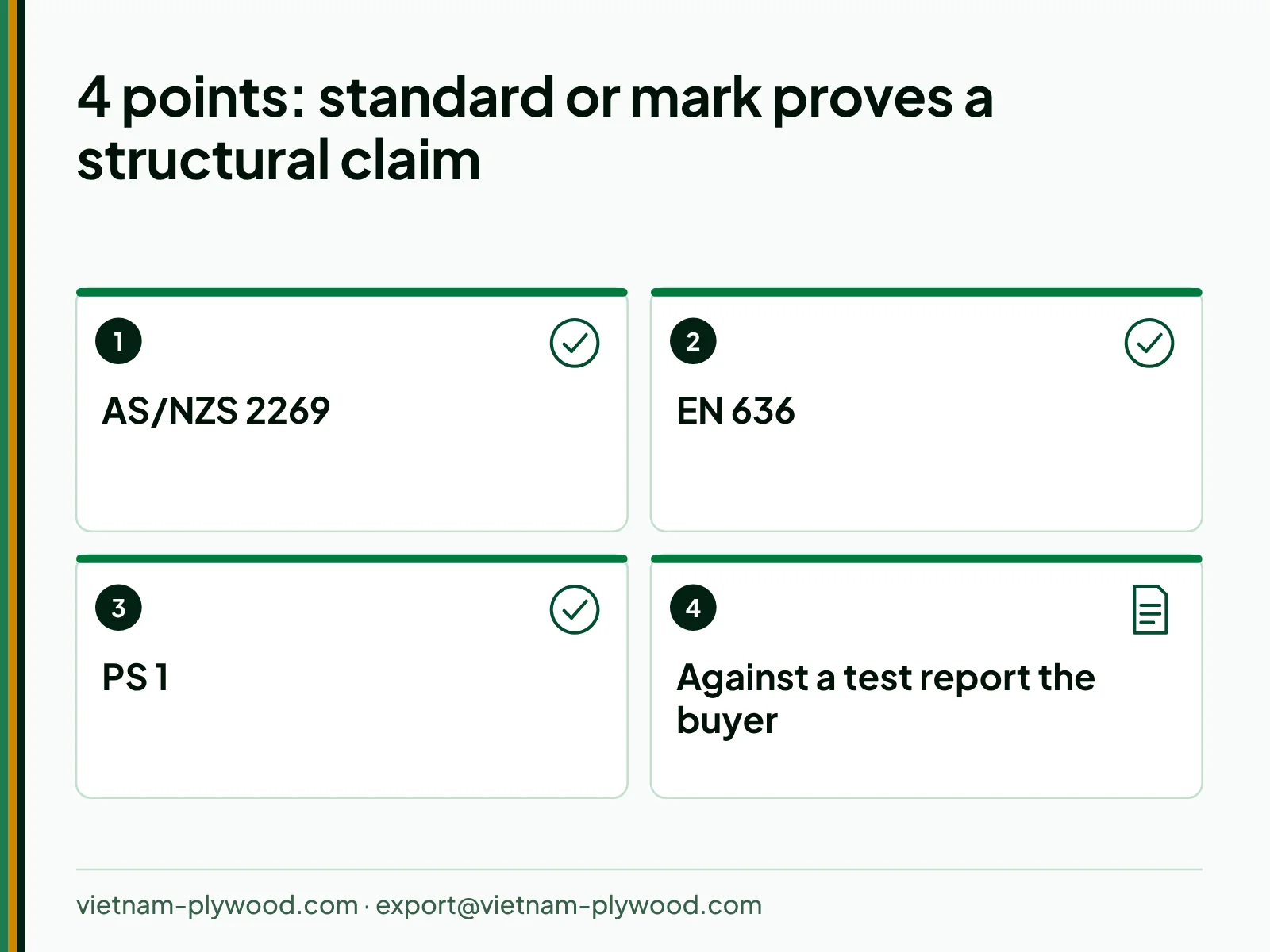
For Australian and New Zealand orders, AS/NZS 2269 concerns structural plywood; the buyer should request the specified stress grade and bond classification with the corresponding report and permitted identification. For European orders, EN 636 describes plywood service-use requirements; it is not a standalone design-capacity certificate. Mechanical property declarations and the relevant construction-product route, including EN 13986 where applicable, need separate attention.
For US orders, PS 1 addresses structural plywood requirements. APA — The Engineered Wood Association, in its 2023 description of PS 1-22, identifies veneer grading, adhesive bonds, panel construction, dimensions, testing, marking and certification as elements of the standard (PS 1-22 overview). Its plywood guidance also distinguishes Exposure 1 from Exterior classifications (plywood selection guidance).
HCPLY quotes structural-grade work only against a test report the buyer accepts. We do not offer an AS/NZS stress-grade mark or a PS 1 stamp on our panels. Buyers requiring those marks must identify the exact approved evidence and marking route before ordering; an alternative test report is acceptable only when their project authority accepts it.
How do Australian structural and non-structural grades differ?
An Australian structural order specifies a stress-grade framework and bond requirements, whereas a non-structural furniture order can specify appearance and machining without an F-grade claim. A letter describing face appearance is not interchangeable with a structural F-rating.
An Australian buyer should record the engineer’s required grade, intended exposure, span, support arrangement and the identification needed at receipt. If a project specification calls for a particular marked structural panel, the purchaser must source that compliant panel rather than substitute a decorative or film-faced sheet on appearance alone.
Non-structural cabinet orders instead emphasize surface defects, veneer matching, edge quality, machining and emission class. Our furniture line can supply common 0.2–0.4 mm face veneer, with grade and finish set in the order. These details improve the fit-out purchase without implying structural compliance.
What is non-structural plywood used for?
Non-structural plywood is used for cabinet carcasses, furniture components, interior fit-out panels, protective packaging and crates where no building structural rating is specified. The correct build follows surface, machining, moisture and handling demands.
Furniture buyers often prefer full-stitched cores and sanded faces because visible edges and repeatable thickness matter. Our furniture line uses styrax or eucalyptus cores with E0/E1 emission options; sanded thickness tolerance is ±0.2 or ±0.3 mm as ordered. This is distinct from a stress-grade requirement.
Packing buyers often favor an acacia core, MR glue and a utility surface. Our commercial and packing line uses ±0.5 mm commercial tolerance, while packing tolerances run ±0.5–1.0 mm. For a wet-exposure question, see exterior plywood selection; exterior durability and structural performance still need separate specification.
Does film-faced formwork plywood count as structural?
Film-faced plywood serves concrete formwork, but the film surface itself does not establish a structural grade. Formwork designers must match concrete pressure, support spacing, deflection limits and the tested panel construction.
Our construction line uses acacia or eucalyptus cores with phenolic or melamine film and can build an anti-slip surface. Standard film weight is 120 g/m², premium is 135 g/m² and anti-slip film is 220 g/m² only. Film weight describes the surface, rather than a measured load capacity.
For repeated pours, with proper handling, a release agent on every pour and sealed edges including cut edges, melamine-glue film-faced plywood gives about 12–15 pours; phenolic-glue plywood reaches up to about 25. Those are handling-dependent reuse figures, separate from structural approval. See construction project supply and anti-slip plywood for their distinct uses.
How do core density and container weight affect a mixed order?
Core density changes freight weight, but it does not by itself establish a structural grade. Our Vietnam core densities are styrax 500 kg/m³, acacia 580 kg/m³ and eucalyptus 650 kg/m³; face species does not change the core-density basis.
For 18 mm, 1220 × 2440 mm sheets, the core-only lookup is 26.79 kg for styrax, 31.08 kg for acacia and 34.83 kg for eucalyptus. A full 40HC lookup gives 990 styrax sheets at 26.52 t, 880 acacia sheets at 27.35 t, or 795 eucalyptus sheets at 27.69 t. Film weight is excluded from these figures.
A 40HC payload limit is 28.5 t. Specifications can be mixed within that limit, so a cabinet order and a construction order can share a container after pallet, loading and weight checks. Use mixed-container planning for combinations and container load calculations for the detailed count.
What can a buyer witness at the producing factory?
A buyer or appointed inspector can witness the physical checks that connect the approved sample to the production lot. HCPLY runs specification control, on-site quality checks, documents and loading from the producing factory.
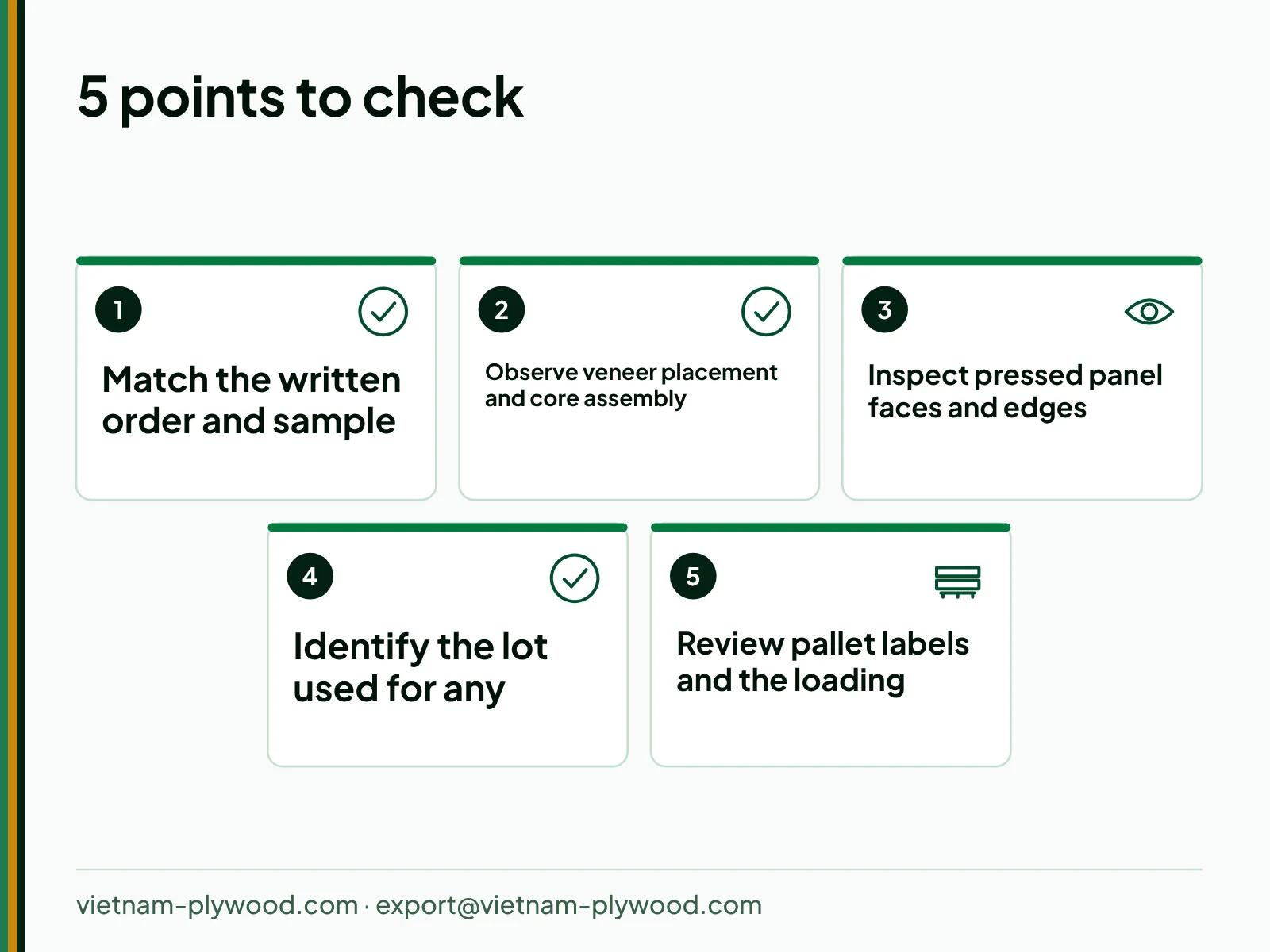
- Match the written order and sample to the factory production sheet, including core, face, adhesive and emission fields.
- Observe veneer placement and core assembly; examine stitched joints, gaps and edge construction before pressing.
- Inspect pressed panel faces and edges, then measure thickness and dimensions against the agreed tolerance.
- Identify the lot used for any buyer-accepted structural test report and compare its construction with the shipment.
- Review pallet labels and the loading tally against the packing list before dispatch.
Our construction line has commercial and film-faced thickness tolerance of ±0.5 mm, with length and width tolerance ±2 mm. Dimensional acceptance and structural testing remain separate checks. Buyers visit the factory office and inspect goods at the producing factory.
What should an importer request before ordering?
An importer should request a written build specification, the destination’s accepted structural evidence and a sample inspection plan before committing to a structural application. The order should state the consequence of a missing mark or unacceptable report at arrival.
For structural duty, request the standard edition, required grade, test methods, test specimen identification, production traceability and design acceptance from the project authority. For non-structural duty, specify veneer face grade, core construction, thickness tolerance, emission class and visible defect limits. For both, record the port and packaging requirements.
Certificates associated with member factories, including FSC, CARB P2, ISO 9001 and CE, and EUDR/EUTR documents are shown with factory details masked, on request. They are distinct from an order-specific structural test report. A shipment’s commercial invoice, packing list, bill of lading, certificate of origin and agreed certificate documents carry the commercial and conformity record; after loading, the draft shipping documents come to you for approval.
The minimum order is one 40HC. We ship FOB Hai Phong, or CFR (CNF) or CIF to your port. Factory lead time runs 15–45 days from receipt of the 30% deposit; the exact figure depends on order size, line loading and what the contract fixes; the 70% balance is against the scanned B/L, by T/T or irrevocable L/C at sight. Free samples are available; new buyers book their courier and that courier cost can be credited against a real order.
What specification should you send for a line decision?
A usable enquiry separates intended duty from appearance and lists the evidence the receiving market accepts. Send the fields below to Lucy at export@vietnam-plywood.com; we will match the build to the appropriate production line and review the requested documentation.
Application: cabinet / packing / formwork / engineered structural use
Line or core: furniture—styrax or eucalyptus / commercial—acacia / construction—acacia or eucalyptus
Glue: melamine MR or phenolic WBP; required bond classification
Emission: E0 / E1 / E2; destination compliance requirement
Face and grade: veneer species and appearance grade / film type and weight
Thickness and tolerance: ___ mm; ___ mm
Size: ___ × ___ mm
Quantity: ___ sheets / ___ 40HC
Structural evidence if required: standard, edition, grade, accepted test report and marking requirement
Destination port: ___
The next step is to book a factory visit to inspect the proposed build and its production checks.