





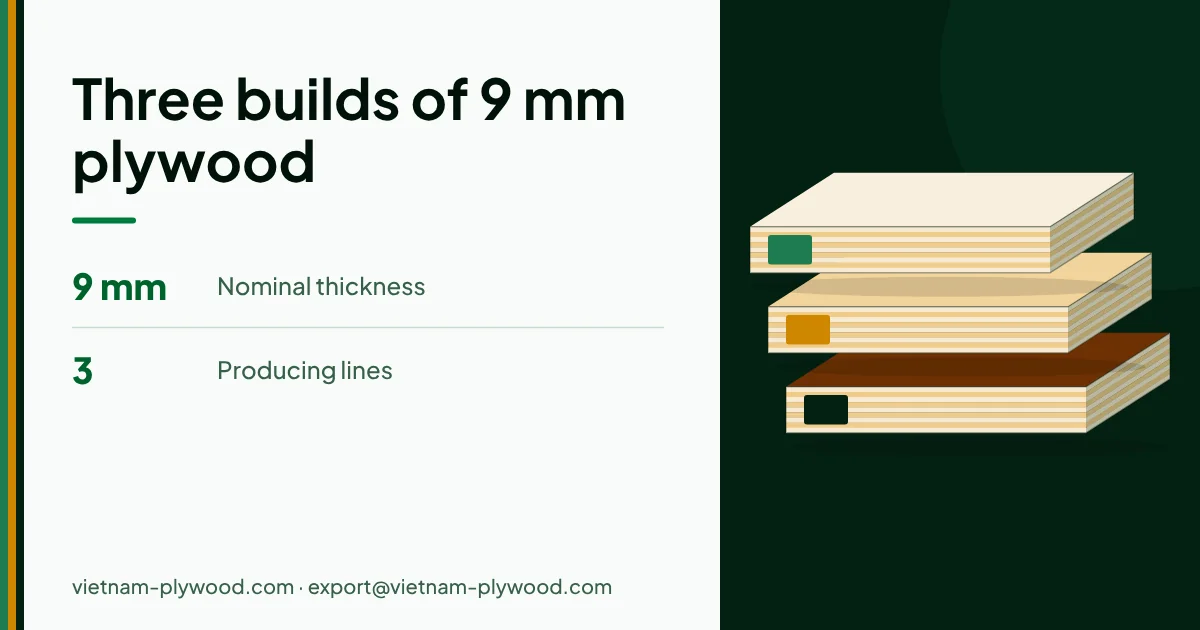
9 mm plywood changes from a sanded furniture panel to a practical packing sheet or film-faced form liner according to its core, face and glue. Choosing the wrong build can mean rejected panels, rework and delayed loading. HCPLY produces each version on the line suited to its specification; the 9mm ply label alone does not define the delivered product.
Which sizes and tolerances apply to 9mm ply?
9mm ply comes in several sheet sizes, with the tolerance determined by the production line. HCPLY builds furniture, packing and film-faced versions at the producing factory selected for the written specification. A nominal 9 mm callout alone does not describe the panel a receiving inspector should accept.
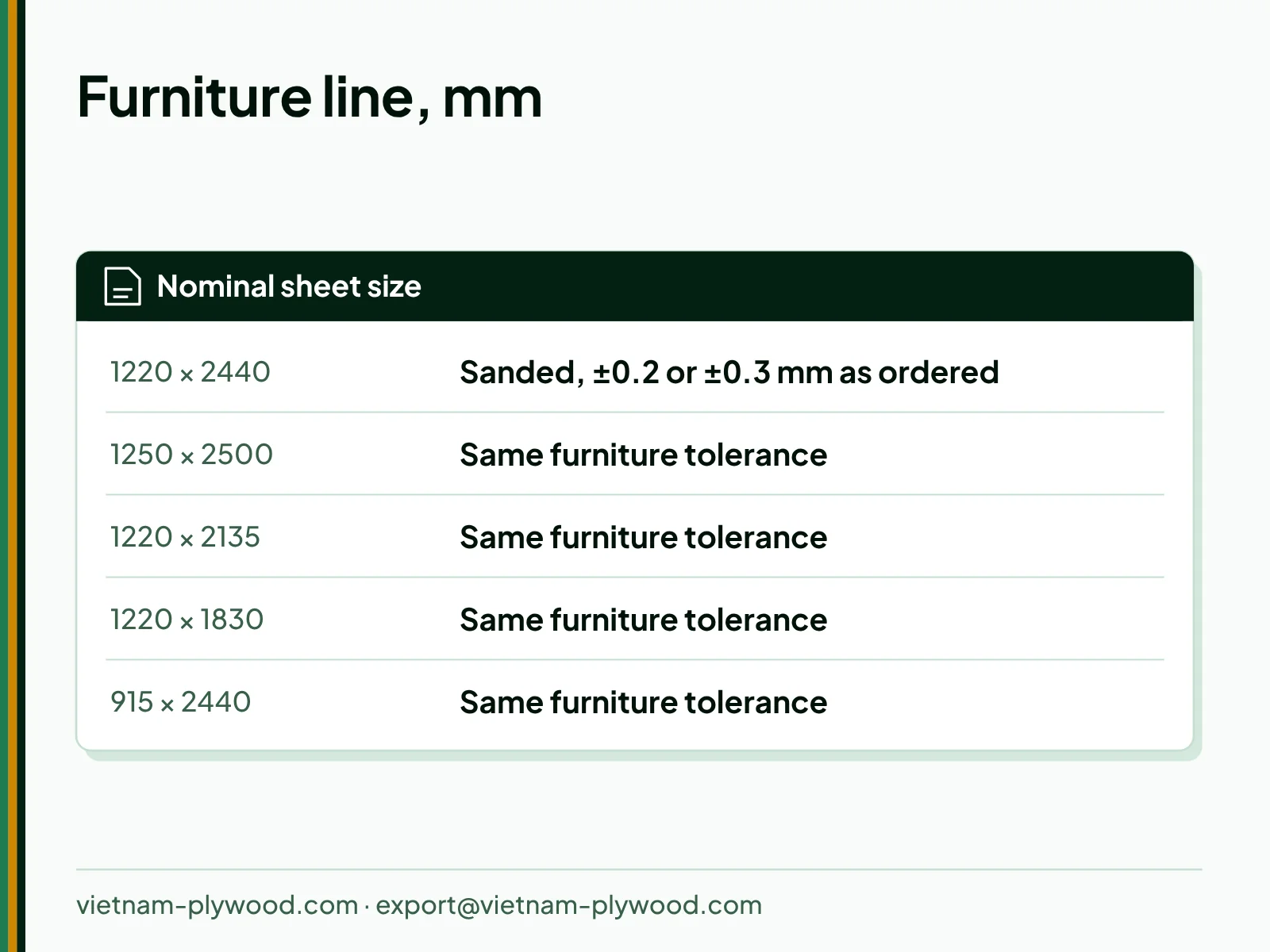
| Nominal sheet size (mm) | Furniture line | Commercial and packing line | Construction line |
|---|---|---|---|
| 1220 × 2440 | Sanded, ±0.2 or ±0.3 mm as ordered | Commercial ±0.5 mm; packing ±0.5–1.0 mm | Film-faced ±0.5 mm |
| 1250 × 2500 | Same furniture tolerance | Same commercial or packing tolerance | Same film-faced tolerance |
| 1220 × 2135 | Same furniture tolerance | Same commercial or packing tolerance | Same film-faced tolerance |
| 1220 × 1830 | Same furniture tolerance | Same commercial or packing tolerance | Same film-faced tolerance |
| 915 × 2440 | Same furniture tolerance | Same commercial or packing tolerance | Same film-faced tolerance |
| 915 × 2135 | Same furniture tolerance | Same commercial or packing tolerance | Same film-faced tolerance |
| 915 × 1830 | Same furniture tolerance | Same commercial or packing tolerance | Same film-faced tolerance |
Length and width tolerance is ±2 mm across these builds; custom cutting is available. The nominal thickness is measured against the agreed tolerance rather than inferred from the trade name. For the broader size range and thickness choices, see the plywood sizes and thickness specification guide.
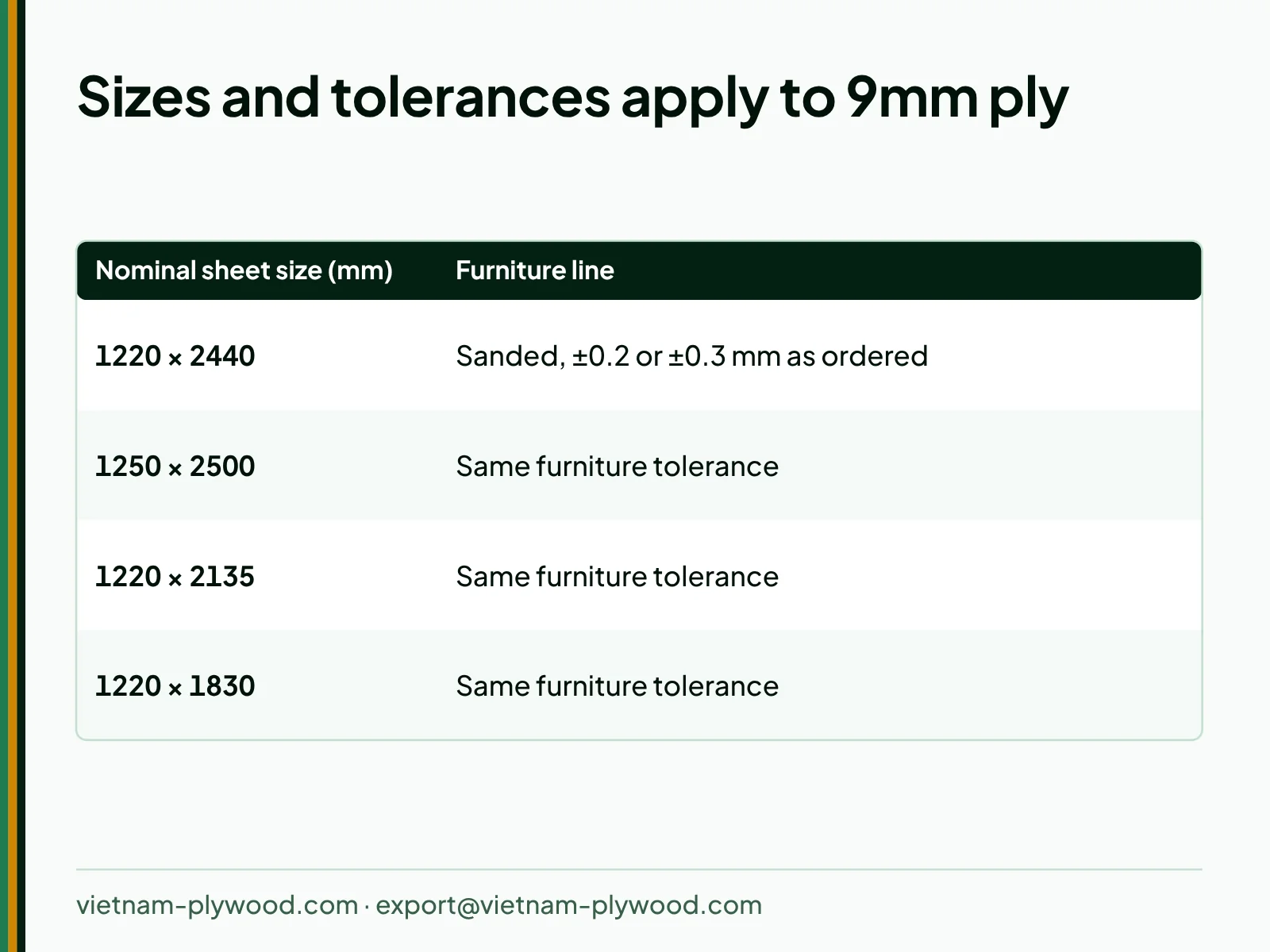
The familiar 8 × 4 foot description refers to approximately 2440 × 1220 mm. A buyer asking for hardwood ply 9mm 2400 x 1200 should write the exact required cut dimensions instead of assuming the two sizes are interchangeable. This distinction matters when panels fit a fixed cabinet opening or crate pattern.
How do the three 9 mm builds compare?
The three builds differ in core preparation, surface, adhesive selection and inspection priorities. The furniture panel is intended for visible or machined interior parts; packing prioritizes a practical crate panel; film-faced stock serves concrete-contact liners and selected formwork applications.
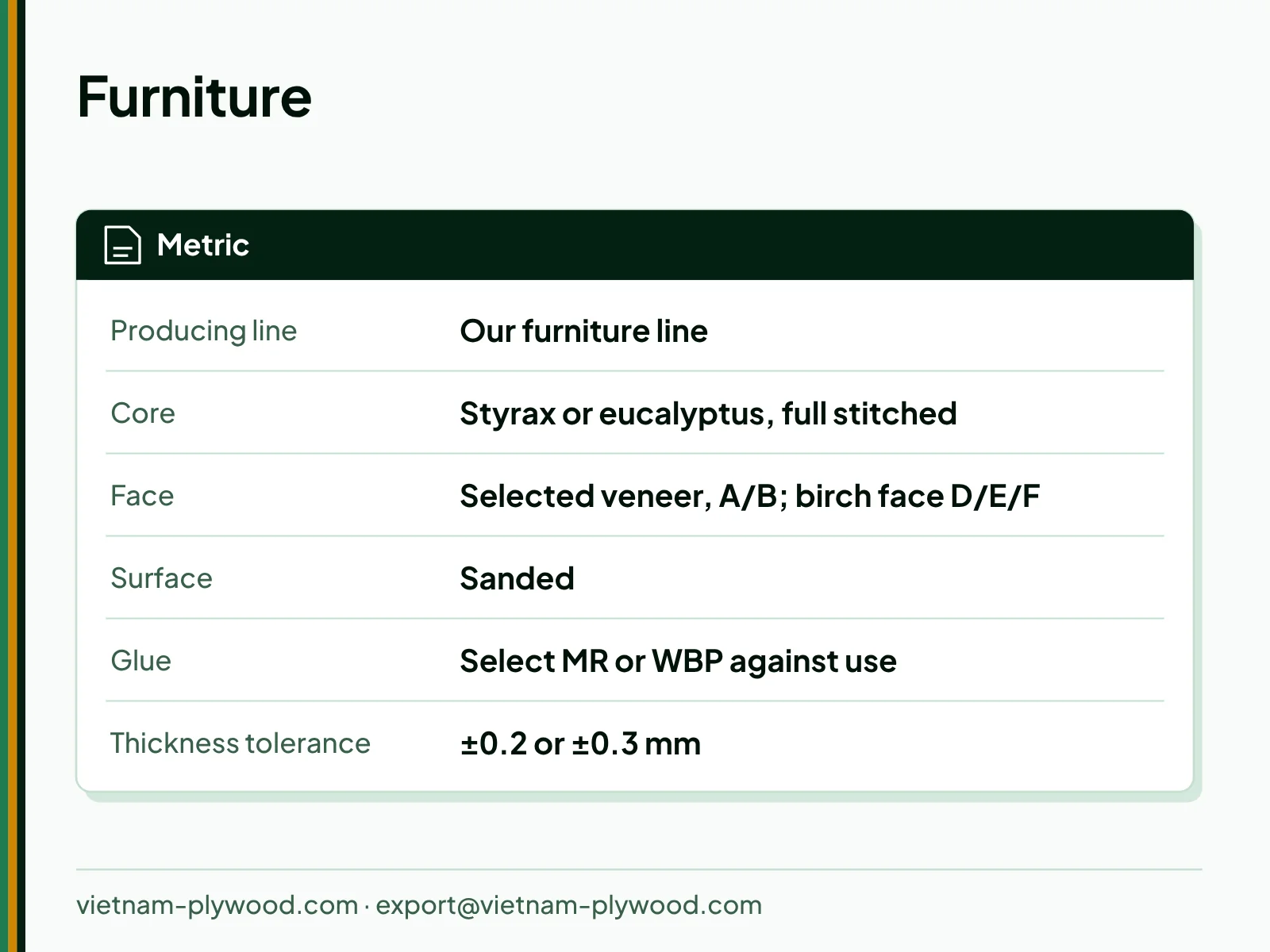
| Metric | Furniture | Commercial and packing | Construction film-faced |
|---|---|---|---|
| Producing line | Our furniture line | Our commercial and packing line | Our construction line |
| Core | Styrax or eucalyptus, full stitched | Acacia, with packing core construction specified | Acacia or eucalyptus |
| Face | Selected veneer, A/B; birch face D/E/F | Raw or selected veneer as specified | Phenolic or melamine film |
| Surface | Sanded | Unsanded or light-sanded | Unsanded beneath film |
| Glue | Select MR or WBP against use | MR | Select melamine or phenolic system |
| Thickness tolerance | ±0.2 or ±0.3 mm | ±0.5 mm commercial; ±0.5–1.0 mm packing | ±0.5 mm |
| Verdict by use | Drawer sides, backs and cabinet lining | Crates and protective packing | Form liners and supported curved work |
A furniture order often places greater value on face selection, stitching and a consistent sanded thickness. Packing orders place more weight on crate design, edge treatment and economical core assembly. The construction specification adds film choice and glue exposure requirements, which changes both material cost and the acceptance checks.
Our three factories are in Phu Tho and Hai Phong. The order is pressed on the line matching its build and shipped directly from that producing factory, with HCPLY managing specification, on-site quality control, documents and loading.
What is 9 mm plywood used for?
9 mm plywood is a thin panel for supported cabinet parts, packaging and selected formwork liners. Furniture and cabinet makers use it for drawer sides, backs, dividers and interior lining where span and fixing design suit the thickness. Fit-out buyers can specify a face that will remain visible or receive a later finish.
Crate makers use commercial plywood 9mm for sides, partitions and protective panels when the packing design supports the load. The panel should be selected alongside the crate’s framing, fasteners and handling conditions. A nominally thicker panel does not correct a poorly supported shipping crate.
Construction buyers consider film-faced 9 mm sheets for liners, shaped surfaces and supported curved formwork. Radius, backing spacing, wet-concrete pressure and fixing layout determine whether a particular bend is practical. We do not assign a universal bending radius or concrete pressure rating to this thickness.
For permanent load-bearing work, the structural specification and accepted test report govern the choice. The construction project plywood supply page covers the wider procurement context.
Is 9 mm the same as 3/8 inch?
9 mm and 3/8 inch are close nominal sizes but are not dimensionally identical. Three-eighths of an inch is 9.525 mm, a difference of 0.525 mm from 9.000 mm. That gap can exceed a furniture order’s stated thickness tolerance.
Importers should put the metric nominal thickness and tolerance on the purchase specification. A receiving team should never accept a 3/8-inch label as a substitute for the ordered 9 mm measurement. The cut list, router settings and slot dimensions should all refer to the same unit system.
For neighboring thickness comparisons, see 8 mm plywood and 10 mm plywood. These are separate nominal products, rather than alternative labels for the same sheet.
Which core, face and glue belong in the specification?
Core species sets much of the panel’s weight, while the face names its appearance. HCPLY uses styrax at 500 kg/m³, acacia at 580 kg/m³ and eucalyptus at 650 kg/m³. A birch-faced or okoume-faced panel does not thereby become a birch-core or okoume-core panel.
The furniture line uses full-stitched styrax or eucalyptus core with sanded faces. Options for the face include bintangor, okoume, engineered veneer, gurjan, pine, poplar, eucalyptus, birch and sapele; matt means an unfaced raw core. Common face veneer thickness is 0.2–0.4 mm. Face grades are A/B, except birch face uses D/E/F.
A request for hardwood plywood 9mm, hardwood ply 9mm 8x4 or hardwood ply 9mm 4x8 still needs an explicit core and face. The commercial and packing line uses acacia core and moisture-resistant (MR) glue. Packing construction can be selected from full stitched, stitched outer layers with edge-trimmed inner layers, finger-jointed or loose-laid core, in descending construction quality.
Glue and formaldehyde emission are separate specification fields. Emission classes include E0, E1 and E2; CARB P2 and TSCA Title VI refer to a US emissions limit and third-party certification. The furniture plywood page addresses the appearance-oriented build in more detail.
Is 9 mm plywood available with WBP glue?
A 9 mm build can be specified with phenolic weather-and-boil-proof (WBP) glue where the producing line and application call for it. WBP refers to the adhesive performance category, rather than a structural grade or a promise that exposed edges need no protection.
The available adhesive descriptions are melamine MR, with a 12-hour boil specification, and phenolic WBP, with a 72-hour boil specification. MR hot pressing runs at 110–120 °C; WBP pressing at 130–145 °C. These are manufacturing process specifications, not a finished-panel structural test result.
For film-faced sheets, film and glue should be written as separate fields. A phenolic film face does not alone establish the glue used between veneers. Buyers requesting wbp plywood 9mm should state phenolic WBP explicitly and identify the exposure and inspection criteria.
Where a project asks for marine plywood, BS 1088 or a structural grade, acceptance must be against a test report the buyer accepts. HCPLY does not press birch-core plywood, medium-density fiberboard, oriented strand board, chipboard or blockboard.
How much does a 9 mm sheet weigh and load?
At 1220 × 2440 × 9 mm, a styrax-core sheet weighs 13.40 kg, an acacia-core sheet 15.54 kg and a eucalyptus-core sheet 17.41 kg. These figures use core density and exclude film weight. They help an importer compare packing plans before choosing the final face and film.
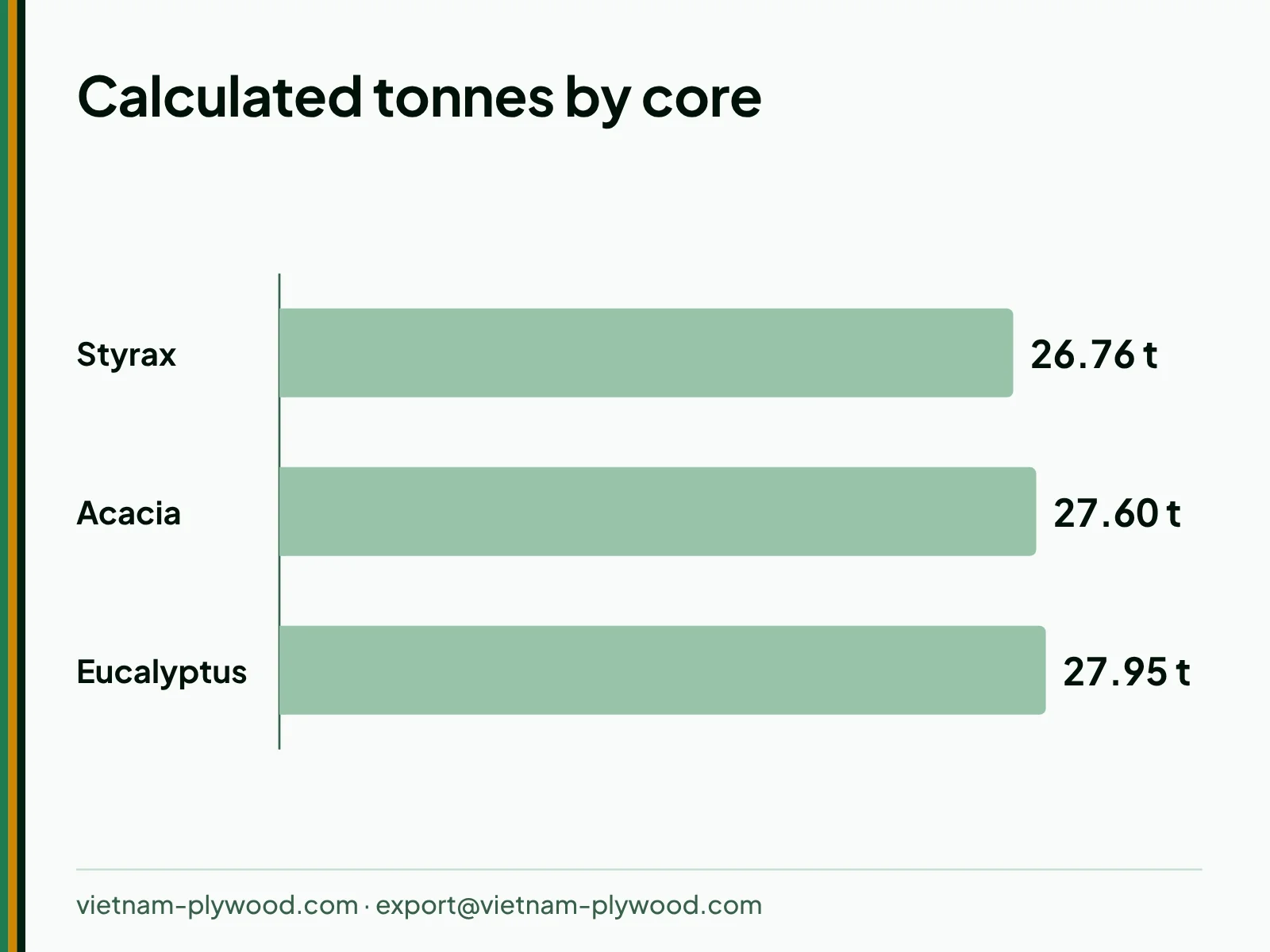
| Core | Sheets per pallet | Full 40HC sheets | Volume | Calculated tonnes |
|---|---|---|---|---|
| Styrax | 111 | 1,998 | 53.53 m³ | 26.76 t |
| Acacia | 111 | 1,776 | 47.58 m³ | 27.60 t |
| Eucalyptus | 107 | 1,605 | 43.00 m³ | 27.95 t |
The 40HC payload limit is 28.5 t. The respective full-load pallet counts are 18, 16 and 15, using the specified pallet stacking heights. The different sheet totals follow from both pallet counts and stacking height, rather than face veneer names.
Specifications can be mixed within one 40HC provided the total payload remains within that limit. For example, a furniture order can share space with acacia packing panels when the pallet and weight plan is calculated for the actual mix. Use the container loading reference for load planning across thicknesses; the figures above describe full single-core loads.
Why does the price of 9 mm plywood differ?
Core assembly and face finishing usually create the first major price difference between 9 mm builds. A full-stitched, sanded furniture panel with selected veneer costs more to make than a basic unsanded packing panel. Film-faced construction adds a surface material and the adhesive and handling specification, so it needs its own quotation.
Next come core species and density, face grade, glue selection, thickness tolerance and order mix. A tighter sanded tolerance requires a different finishing process from an unsanded packing sheet. Film selection changes the material specification again: 120 g/m² is the standard film, 135 g/m² the premium film and 220 g/m² is reserved for anti-slip film.
For the commercial category, the indicative starting point is from US$250/m³ FOB Hai Phong (October 2026). For furniture plywood, it is from US$350/m³ FOB Hai Phong (October 2026). These are category starting prices, not a fixed quotation for every 9 mm face or core. A film-faced 9 mm order is quoted against its written build, with no generic price assigned.
Importers comparing a plywood sheet 9mm quotation should ask for the same dimensions, core, glue, face, tolerance and trade term. Otherwise a lower unit price can represent a different panel and a different receiving standard.
Can 9 mm film-faced plywood line curved forms?
9 mm film-faced plywood can be considered for supported curved form liners, but the radius and backing design must be evaluated for the particular panel. A thin sheet is easier to position around some forms than a thicker panel, yet film damage, veneer fracture and spring-back remain practical concerns.
The construction line presses film-faced panels with acacia or eucalyptus core. The standard film is 120 g/m², premium film is 135 g/m² and anti-slip film is 220 g/m². Anti-slip texture is a separate application choice; a smooth concrete-contact surface calls for an appropriate smooth film.
A sample bend trial should use the intended support spacing, fastener pattern and form radius. Inspectors can check for surface cracking, edge splitting and film damage before the sheet is approved for repeated use. Cut edges should be sealed before exposure to wet concrete.
With proper handling, a release agent on every pour and sealed edges, including cut edges, melamine-glue film-faced plywood gives about 12–15 pours; phenolic-glue film-faced plywood reaches up to about 25 pours. These conditional reuse figures do not replace a job-specific bending trial.
What can the buyer inspect at the producing factory?
The buyer can witness the agreed 9 mm dimensions, face condition and core construction at the producing factory. Start with a marked sample from the actual production lot and compare it against the signed specification before loading begins.
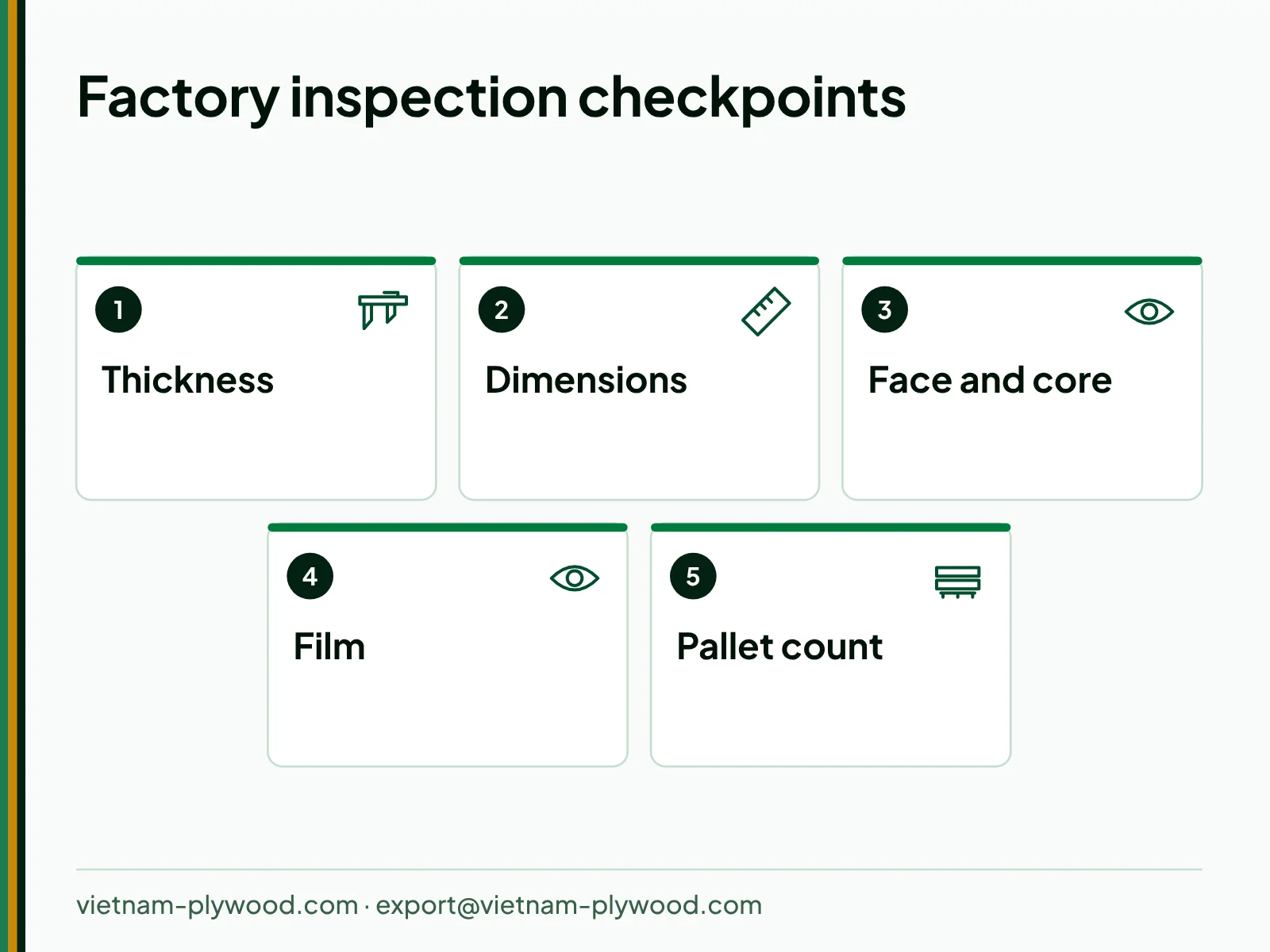
- Measure thickness at agreed locations and record the reading against the line-specific tolerance.
- Measure length and width against the ±2 mm allowance and inspect squareness for the intended cutting plan.
- Inspect the veneer face, edge gaps, core stitching and sanding condition for the selected build.
- For film-faced sheets, examine film continuity, surface texture and sealed cut edges; record any agreed bend trial.
- Match pallet labels and counted sheets to the packing list before container loading.
Buyers visit the factory office and inspect goods at the producing factory. HCPLY handles on-site quality control and coordinates the final loading check. Certificates for the member factories, including FSC, CARB P2, ISO 9001 and CE, and EUDR/EUTR documents are shown with factory details masked, on request.
For EU construction products, the European Commission’s 2026 Construction Products Regulation overview explains that product obligations apply when a harmonised standard or European assessment document is cited in the Official Journal. See the European Commission’s Construction Products Regulation overview. A project-specific structural requirement should therefore be checked against the relevant accepted test report and intended market rules.
Which export details belong on the order?
The order should identify the producing line, core, face, adhesive, emission class, nominal thickness and inspection tolerance. For distributors, consistent wording across repeat purchase orders matters as much as the first sample approval.
Minimum order is one 40HC. Factory lead time runs 15–45 days from receipt of the 30% deposit; the exact figure depends on order size, line loading and what the contract fixes. Balance is 70% against the scanned bill of lading, by telegraphic transfer (T/T) or irrevocable letter of credit at sight. We ship FOB Hai Phong, or CFR (CNF) or CIF to your port.
Samples cost nothing: a first-time buyer pays the courier, and that charge comes off the first confirmed order. For shipment, the document package includes commercial invoice, packing list, bill of lading, certificate of origin (EUR.1 for EU lots), phytosanitary and fumigation papers, insurance under CIF, and the order’s agreed certificate documents. EU lots also carry the EUTR/EUDR file set. After loading, the draft shipping documents come to you for approval.
The packing list is the document that connects the accepted 9 mm build to the shipped pallet and sheet counts. Distributors planning repeat mixed specifications can also review plywood supply programmes.
What should a 9 mm buyer send for a specification sheet?
A complete enquiry identifies the use first, then the panel construction and shipment destination. This lets Lucy route the specification to the relevant line and return a comparable quotation and inspection basis.
Application: drawer sides / crate sides / supported curved form liner
Line or core: furniture–styrax / packing–acacia / construction–eucalyptus
Glue: MR melamine / WBP phenolic
Emission: E0 / E1 / E2 / agreed US requirement
Face and grade: selected veneer A/B (birch D/E/F) / raw / film weight
Thickness and tolerance: 9 mm; ±0.2 / ±0.3 / ±0.5 / ±0.5–1.0 mm
Size: 1220 × 2440 mm or exact cut size
Quantity: sheets and pallet mix within one 40HC
Destination port: [port and country]
Request the 9 mm specification sheet from Lucy at HCPLY or export@vietnam-plywood.com.