





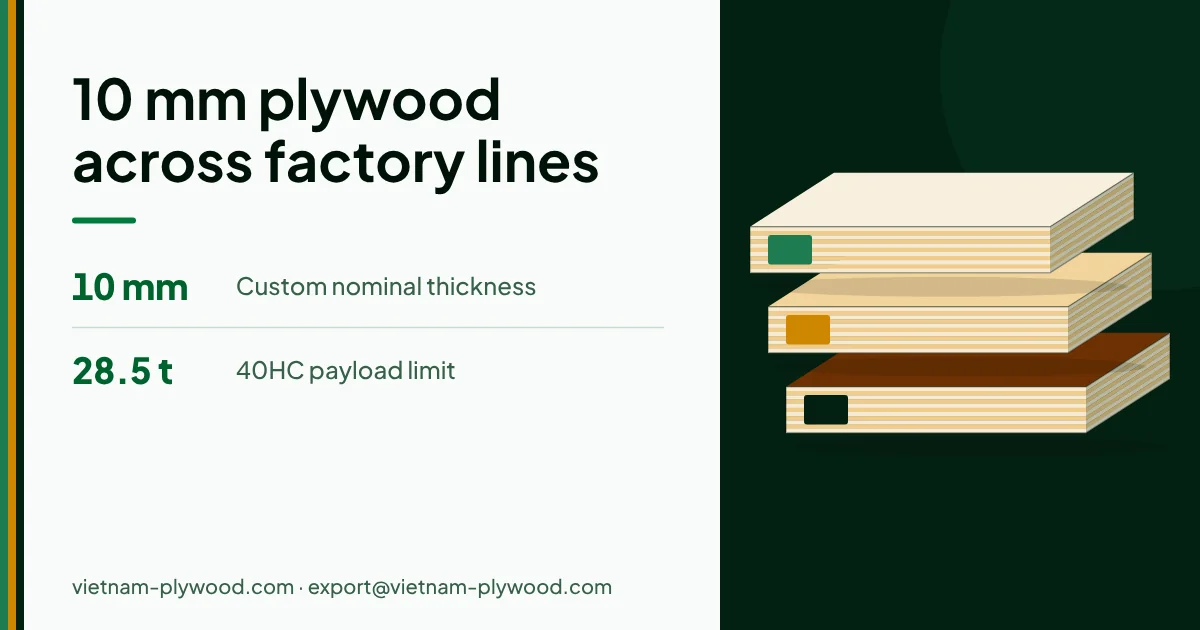
10 mm plywood is a less common custom thickness on two HCPLY lines, rather than a routine stock size. Choosing a substitute thickness without checking the cabinet drawing can waste machining time or cause rejected panels. A 10mm ply order should define the producing line, layup, finished tolerance and container mix before production begins.
Which sheet sizes and lines can take a 10 mm order?
HCPLY can specify 10 mm plywood within its 3–40 mm thickness range, but 10 mm is outside the commonly ordered thickness list. The first decision is the producing line and the finished panel dimensions.
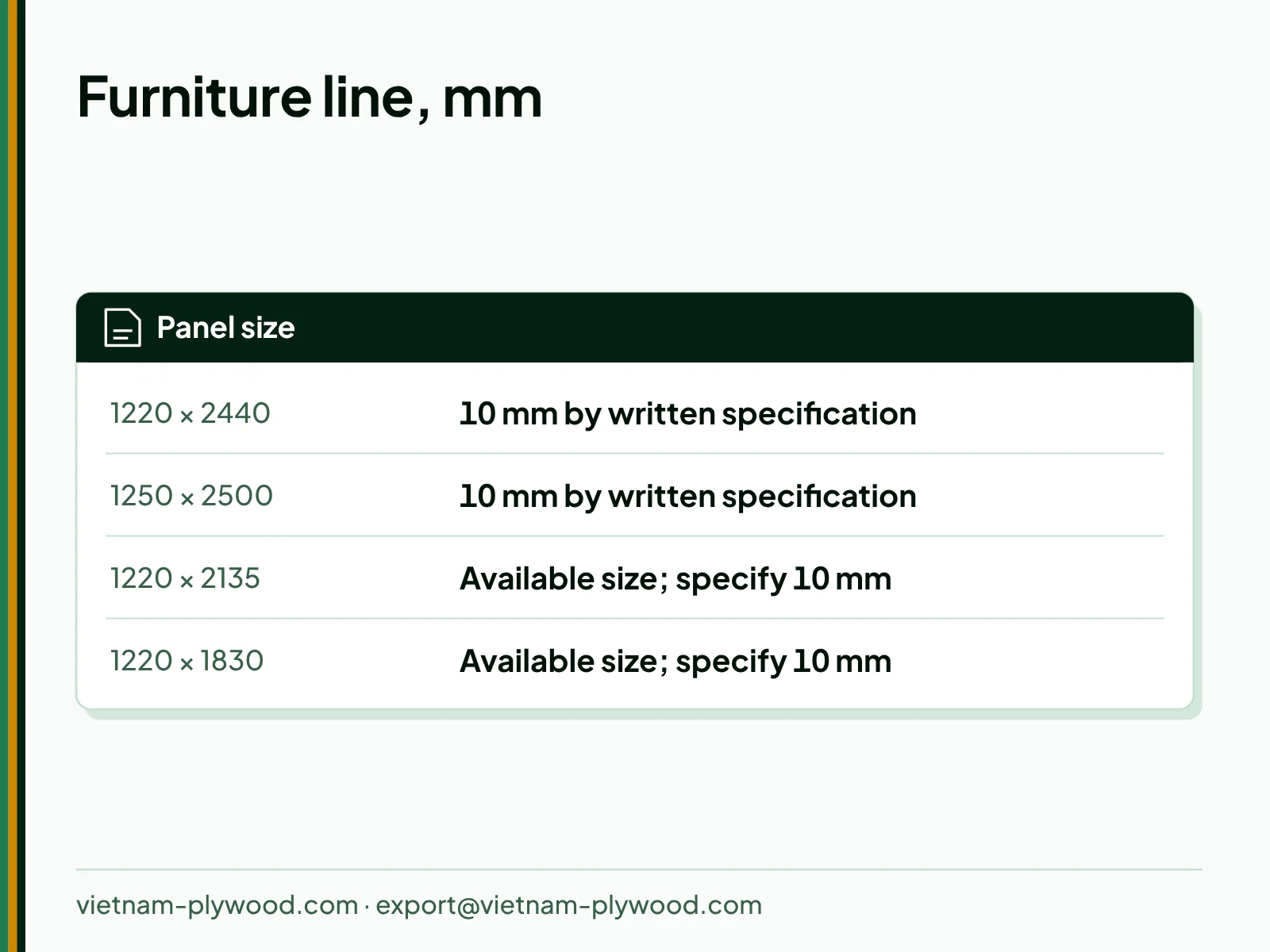
| Panel size (mm) | Our furniture line | Our commercial and packing line | Our construction line |
|---|---|---|---|
| 1220 × 2440 | 10 mm by written specification | 10 mm by written specification | Discuss a film-faced build separately |
| 1250 × 2500 | 10 mm by written specification | 10 mm by written specification | Discuss a film-faced build separately |
| 1220 × 2135 | Available size; specify 10 mm | Available size; specify 10 mm | Specify film and application first |
| 1220 × 1830 | Available size; specify 10 mm | Available size; specify 10 mm | Specify film and application first |
| 915 × 2440 | Available size; specify 10 mm | Available size; specify 10 mm | Specify film and application first |
| 915 × 2135 | Available size; specify 10 mm | Available size; specify 10 mm | Specify film and application first |
| 915 × 1830 | Available size; specify 10 mm | Available size; specify 10 mm | Specify film and application first |
These are available sheet dimensions, rather than evidence that every size and thickness combination runs routinely. Length and width tolerance is ±2 mm. Custom cutting can be specified where the cabinet cutting list requires another dimension.
For a broader selection of nominal sizes, see the plywood sizes and thickness specification guide. Record the panel size in millimetres, because a trade name such as “10 ply board” does not define either dimension.
Is 10mm ply a standard plywood thickness?
10mm ply is an orderable thickness, but it is less common than the regular 9 mm and 12 mm specifications on our lines. A purchasing team should treat it as a distinct nominal build with an agreed tolerance and layup. Substituting 9 mm or 12 mm without approval can change the fit of cabinet components.
Our regular thickness sequence includes 3, 5, 9, 12, 15, 18, 21 and 25 mm. A request for plywood 10mm therefore needs a written manufacturing specification rather than a catalogue assumption. A cabinet drawing that calls for a 10 mm groove needs the measured panel thickness, not a rounded merchant description.
Thickness labelling also changes between markets and standards. APA – The Engineered Wood Association explained in its 2013 technical topic on panel thickness tolerances and labeling that structural-panel performance categories and thickness labels have defined dimensional rules. That publication concerns structural panels; it does not establish the tolerance for this furniture or packing order.
Which of our lines makes 10 mm plywood?
Our furniture line and our commercial and packing line are the practical starting points for a 10 mm inquiry. Neither should be described as a standing 10 mm production programme without an agreed order schedule. Our construction line instead concentrates on film-faced panels for formwork applications.
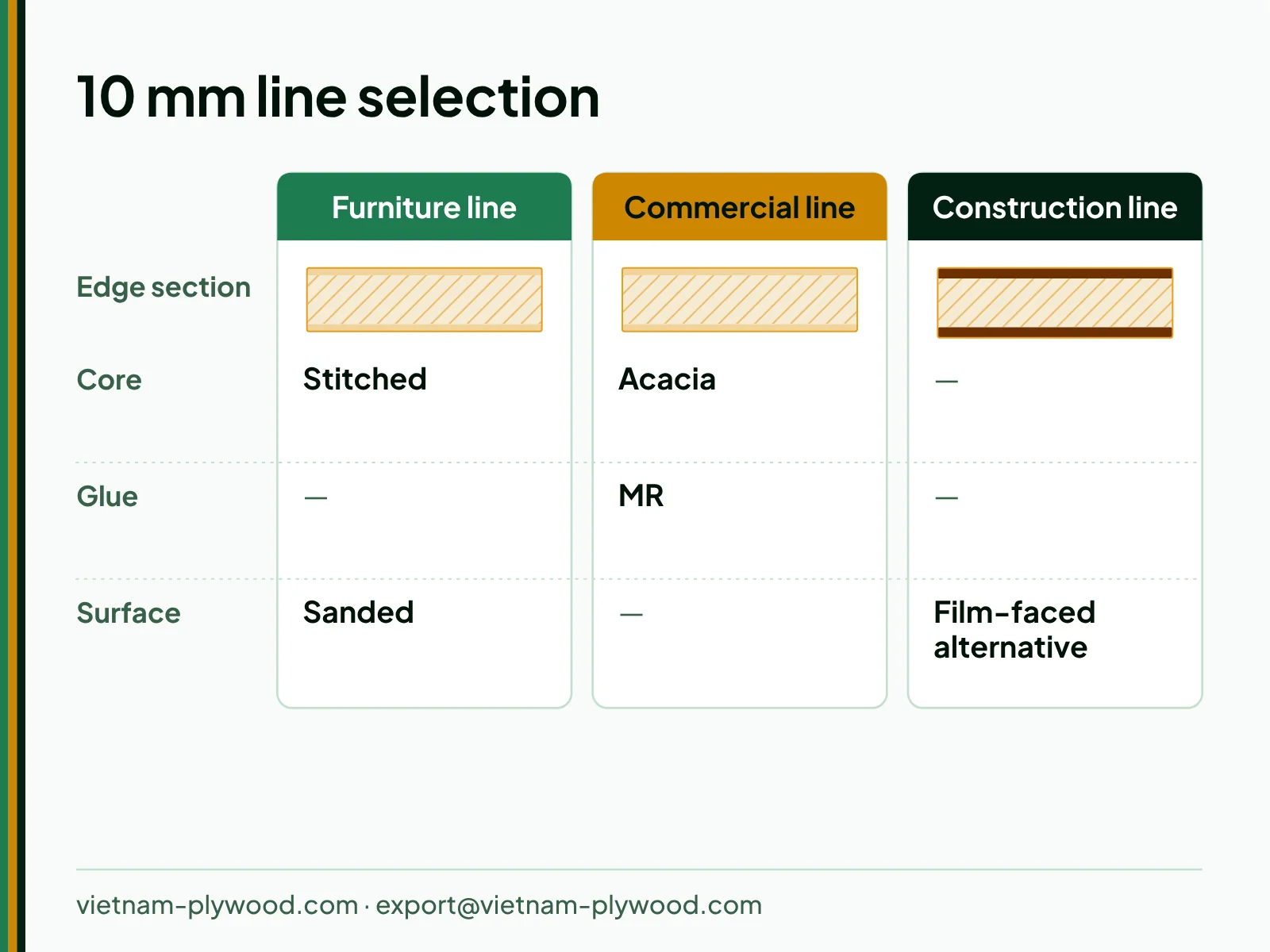
| Build decision | Furniture | Commercial and packing | Construction |
|---|---|---|---|
| Core | Styrax or eucalyptus | Acacia | Acacia or eucalyptus |
| Surface | Sanded veneer face | Raw, unsanded or light-sanded | Phenolic, melamine or anti-slip film |
| Core assembly | Full stitched | Specify jointing and core assembly | Specify film-facing build |
| Thickness tolerance | ±0.2 or ±0.3 mm as ordered | ±0.5 mm; packing ±0.5–1.0 mm | ±0.5 mm |
| Buyer use | Cabinet components and fit-out | Packing panels and commercial applications | Formwork or site panels |
For decorative cabinet panels, the furniture plywood specification gives the relevant product family. For protective crates and industrial panels, start with packing or commercial plywood. A film-faced panel belongs to a separate build discussion, even if its nominal thickness is identical.
What ply count should the order state?
A 10 mm order should state the required layup or an agreed ply-count range after the core veneer schedule is selected. There is no fixed 10 mm ply count in our manufacturing figures. Core veneers are 1.4–2.0 mm thick, and final thickness also reflects pressing and sanding.
The documented reference point is 18 mm plywood with 11–13 plies. Copying that count into a 10 mm order would create a conflicting specification. The buyer should instead agree the veneer schedule and inspect a section from the trial build.
A useful acceptance method is to record nominal thickness, ply count as approved from the sample, and permitted core gaps. For furniture, full-stitched construction matters when a routed edge or exposed cabinet edge will be visible. The ply count explanation covers how veneer thickness affects layer count.
What tolerance belongs on 10mm thick plywood?
Write the tolerance next to the nominal 10 mm thickness and the line selected for production. For a sanded furniture panel, specify either 10.0 ±0.2 mm or 10.0 ±0.3 mm. For commercial panels, specify 10.0 ±0.5 mm; packing builds use ±0.5–1.0 mm as agreed.
Our construction line uses ±0.5 mm for film-faced plywood. A film surface is a separate specification from the underlying wood thickness, so the inspection sheet should name the finished panel being measured. Keep the length and width tolerance of ±2 mm in a different field.
For conditioning and moisture inspection, consult plywood moisture content standards and testing. A thickness check and a moisture check answer different acceptance questions.
Can plywood 11mm be ordered instead?
Yes, 11 mm can be requested as a custom thickness within our 3–40 mm range. It is also outside the regular thickness list, so the order needs a separate layup, tolerance and approval. An 11 mm request must not be silently converted into 10 mm.
An 11 mm panel is not a tolerance variant of 10 mm furniture plywood. Even the wider commercial tolerance does not turn one nominal size into the other. Put each thickness on its own purchase-order line and pallet label.
Which core, glue and face should be written?
A 10 mm cabinet specification starts with the required surface, then selects the core and bond for its application. Our furniture line uses styrax or eucalyptus cores, full-stitched construction and sanded faces. Our commercial and packing line uses acacia cores and moisture-resistant (MR) glue.
Specify glue and emissions as separate fields. Melamine MR glue has a 12-hour boil description; phenolic weather-and-boil-proof (WBP) glue has a 72-hour boil description. E0, E1 and E2 are emission classes, not adhesive names. Furniture production uses E0 or E1 as specified.
Available veneer faces include bintangor, okoume, engineered veneer (EV), gurjan, pine, poplar, eucalyptus, birch and sapele. Face grade A/B applies to the listed veneer range except birch, for which the available grades are D/E/F. A matt panel is an unfaced raw core.
Can a small 10 mm lot share a container?
Yes. A small 10 mm lot can be combined with regular thicknesses in one 40HC order, provided the loading plan stays within the 28.5 t payload limit. The minimum order is one 40HC, and specifications can be mixed within that limit.
A useful planning reference is 18 mm, 1220 × 2440 mm plywood. A full styrax load is 990 sheets, 53.05 m³ and 26.52 t; an acacia load is 880 sheets, 47.15 m³ and 27.35 t; eucalyptus is 795 sheets, 42.60 m³ and 27.69 t. These are separate full-load examples, not quantities to add together.
For an actual mixed load, calculate each pallet group from its dimensions, sheet count and core density, then sum the weights. The core density references are styrax 500 kg/m³, acacia 580 kg/m³ and eucalyptus 650 kg/m³. The 10 mm pallet allocation needs its own loading calculation rather than borrowing an 18 mm count.
Our three factories can contribute specifications to a planned export order, with production assigned to the factory suited to each build. Use the mixed-container loading procedure to organise pallet groups. The container loading reference addresses full-load quantities in more detail.
What should a buyer compare before approving the build?
Compare the required finished tolerance, visible face and core construction before comparing unit quotations. A sanded, full-stitched furniture panel is a different cost build from a light-sanded acacia packing panel, even at the same nominal 10 mm thickness.
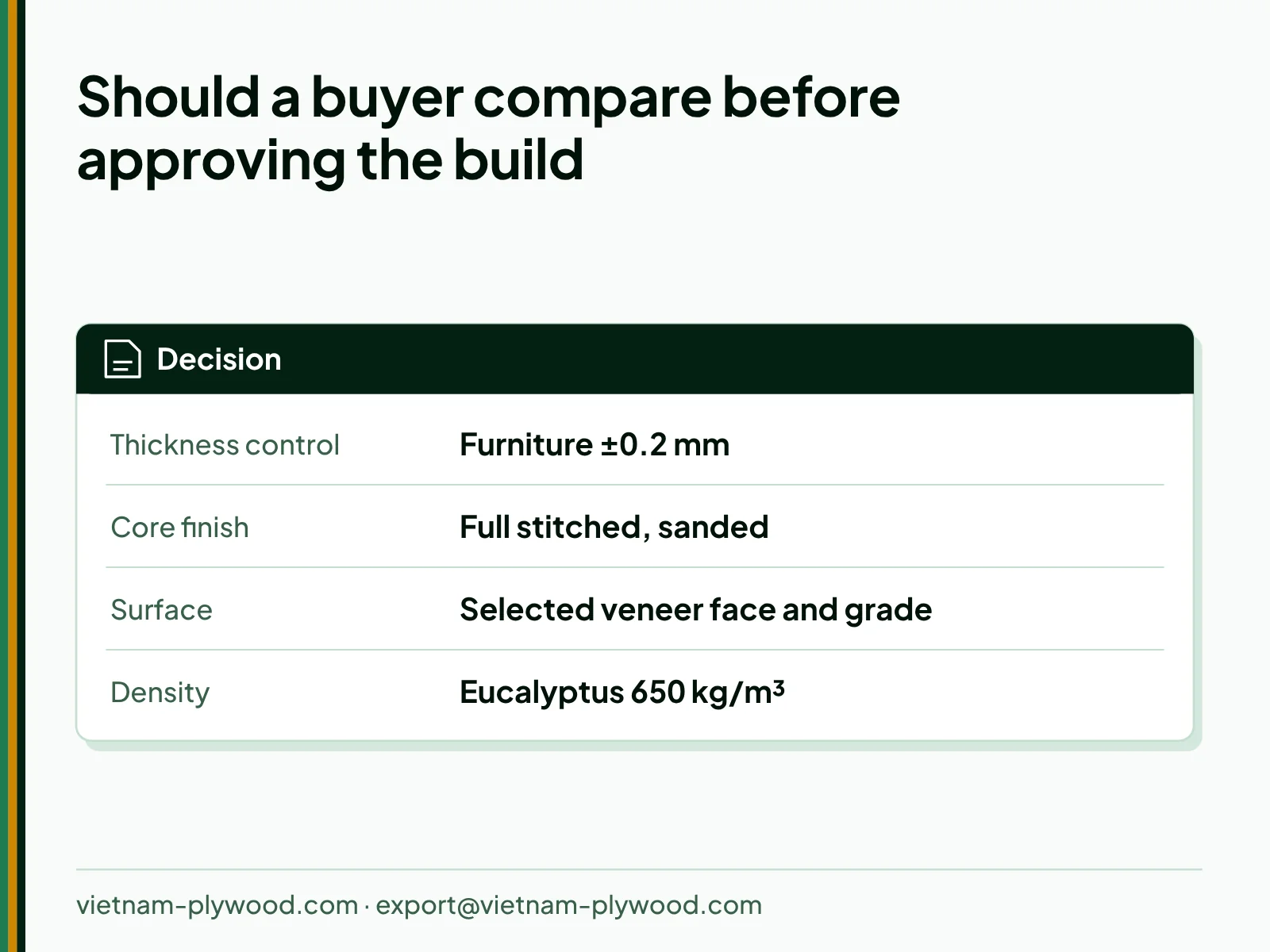
| Decision | Higher-spec choice | Alternative | Verdict by use |
|---|---|---|---|
| Thickness control | Furniture ±0.2 mm | Commercial ±0.5 mm | Tight cabinet machining: furniture |
| Core finish | Full stitched, sanded | Packing core, unsanded | Visible or routed edges: furniture |
| Surface | Selected veneer face and grade | Matt raw core | Finished cabinetry: veneer; protective packing: raw |
| Density | Eucalyptus 650 kg/m³ | Styrax 500 kg/m³ | Choose by component requirements and freight weight |
The first cost driver is core construction and finishing, followed by face selection, tolerance and the production arrangement for a non-routine thickness. A tighter furniture tolerance requires closer finishing control than an unsanded packing build. Request a quotation against the written specification rather than comparing unlike sheets under the same thickness name.
What can an inspector check at the producing factory?
An inspector can check 10 mm finished thickness against the agreed tolerance at the producing factory. Sampling points should cover more than one sheet and pallet, with the recorded measurements tied to the purchase-order line.
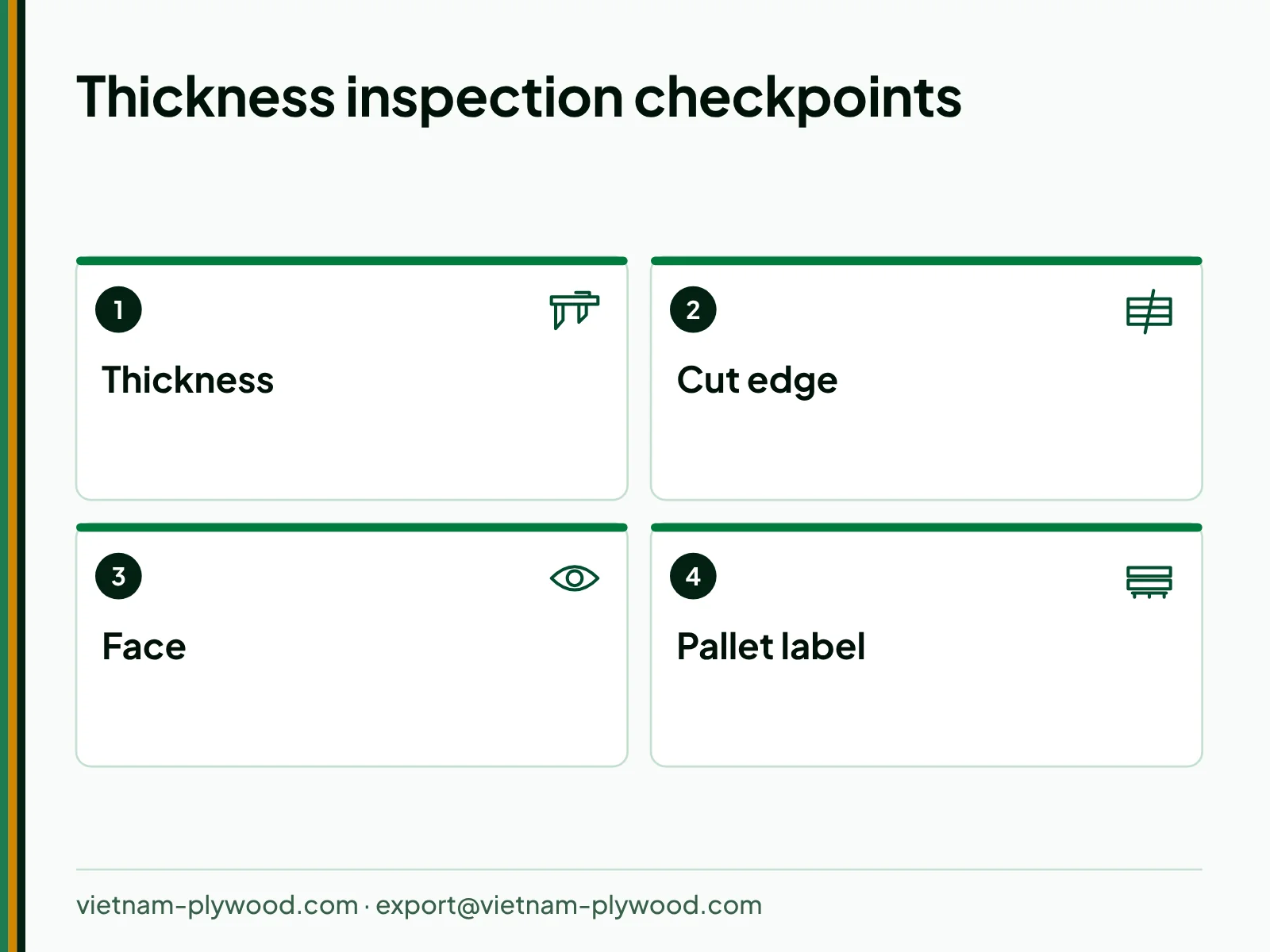
- Read the approved specification and identify the 10 mm pallet group by core, face and intended application.
- Measure finished thickness at the agreed sheet locations with a calibrated instrument and record individual readings.
- Examine a cut edge for the approved ply arrangement, voids and jointing pattern.
- Check face grade, sanding and sheet dimensions against the signed sample and packing list.
- Record any 11 mm panels under their separate order line before loading.
Buyers can visit the factory office and inspect the goods where they are produced. HCPLY handles on-site quality control, shipment documents and loading.
Which shipping documents identify the 10 mm lot?
The packing list identifies the thickness and quantities for each pallet group in the shipment. The commercial invoice records the sold goods, while the bill of lading (B/L) records carriage details. After loading, the draft shipping documents come to you for approval.
The shipment document set includes a certificate of origin, phytosanitary and fumigation papers, and insurance under cost, insurance and freight (CIF) terms. For European Union lots, the origin document is EUR.1 and the EUTR/EUDR file set is included. Order-specific certificate documents, emission certificates and agreed test reports accompany the build where applicable.
For European shipments, the European Union’s 2026 consolidated Regulation (EU) 2023/1115 states in Article 9 that product descriptions for wood-derived products include common and scientific species names. That is a separate traceability requirement from the 10 mm thickness field on the packing list.
Member-factory FSC, CARB P2, ISO 9001 and CE certificates, and EUDR/EUTR documents, are shown with factory details masked, on request. Do not substitute a generic certificate heading for the specific evidence requested by the destination buyer.
How should a 10 mm trial container be specified?
A trial container should separate the 10 mm cabinet or packing line from the regular-thickness pallet groups. This gives production and inspection a clear basis for sampling, packing and freight planning.
HCPLY offers FOB Hai Phong, cost and freight (CFR/CNF), or CIF delivery. Factory lead time runs 15–45 days from receipt of the 30% deposit; the exact figure depends on order size, line loading and what the contract fixes. The balance is 70% against the scanned B/L, by telegraphic transfer (T/T) or irrevocable letter of credit at sight.
Samples cost nothing: a first-time buyer pays the courier, and that charge comes off the first confirmed order. Send the component drawing and the proposed split by thickness to Lucy at export@vietnam-plywood.com. For a commercial 10 mm specification, the indicative starting point is from US$250/m³ FOB Hai Phong (October 2026); furniture plywood starts from US$350/m³ FOB Hai Phong (October 2026). The written build determines the quotation.
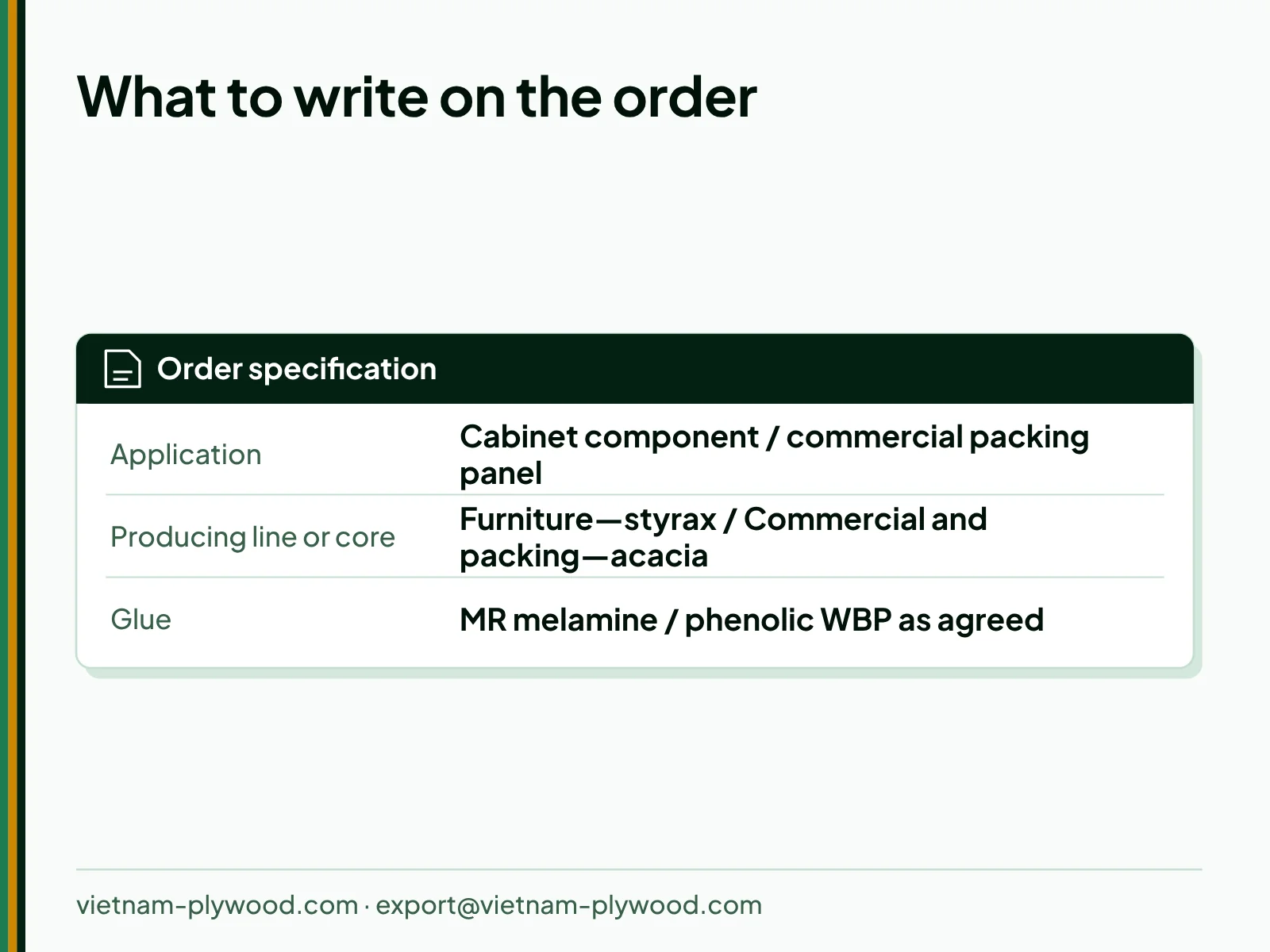
Application: Cabinet component / commercial packing panel
Producing line or core: Furniture—styrax / Commercial and packing—acacia
Glue: MR melamine / phenolic WBP as agreed
Emission class: E0 / E1 / E2 as applicable
Face and grade: Specify veneer and A/B; birch D/E/F; or matt
Thickness and tolerance: 10.0 mm ±0.2 mm / ±0.3 mm / ±0.5 mm as selected
Sheet size: 1220 × 2440 mm or selected available size
Quantity: 10 mm sheets and separate standard-thickness pallet groups
Destination port: [port and country]
Next step: plan a trial container with Lucy using the approved 10 mm specification and the other thicknesses to be loaded.