





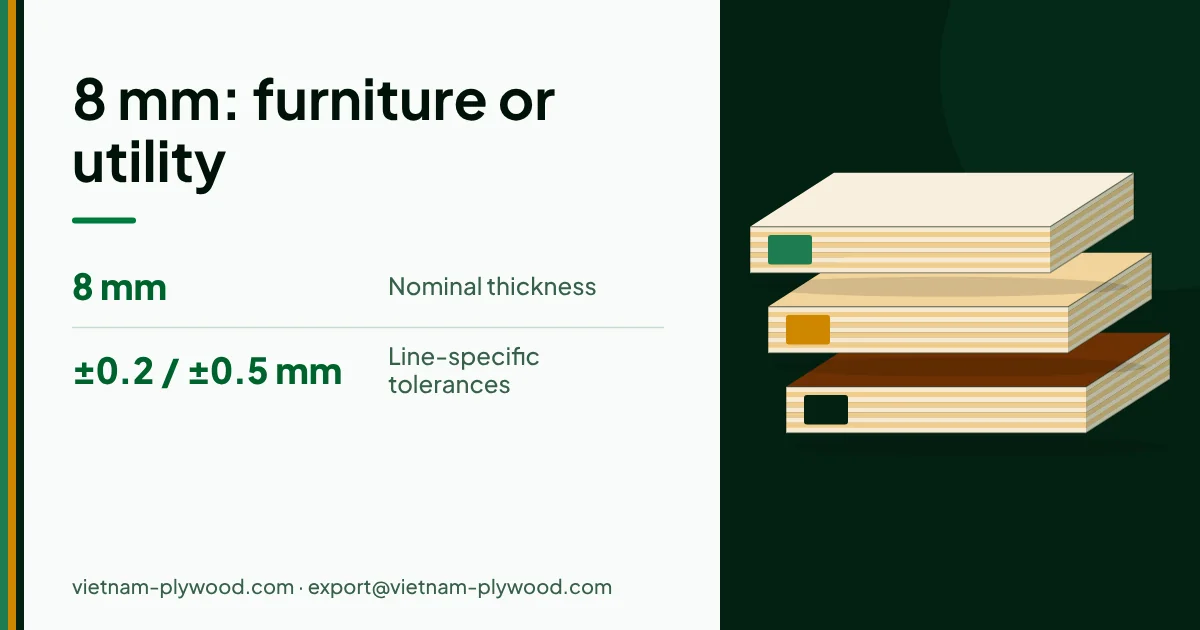
HCPLY makes 8 mm plywood as a finish-grade furniture panel or an acacia-core utility panel, selected by its intended use. Choosing the wrong build can waste finishing labor, delay assembly or lead to rejected incoming sheets. The thickness alone says little about surface appearance, core preparation or the inspection standard. Buyers should specify the face, core, tolerance and use together.
What sizes and tolerances can be ordered?
The standard sheet sizes below can be specified across our furniture, commercial and packing, and construction lines, with custom cutting available. The nominal 8 mm thickness falls within our 3–40 mm range, although it is outside the list of common stock thicknesses. The plywood sizes and thickness specification guide explains how to record dimensions on a purchase order.
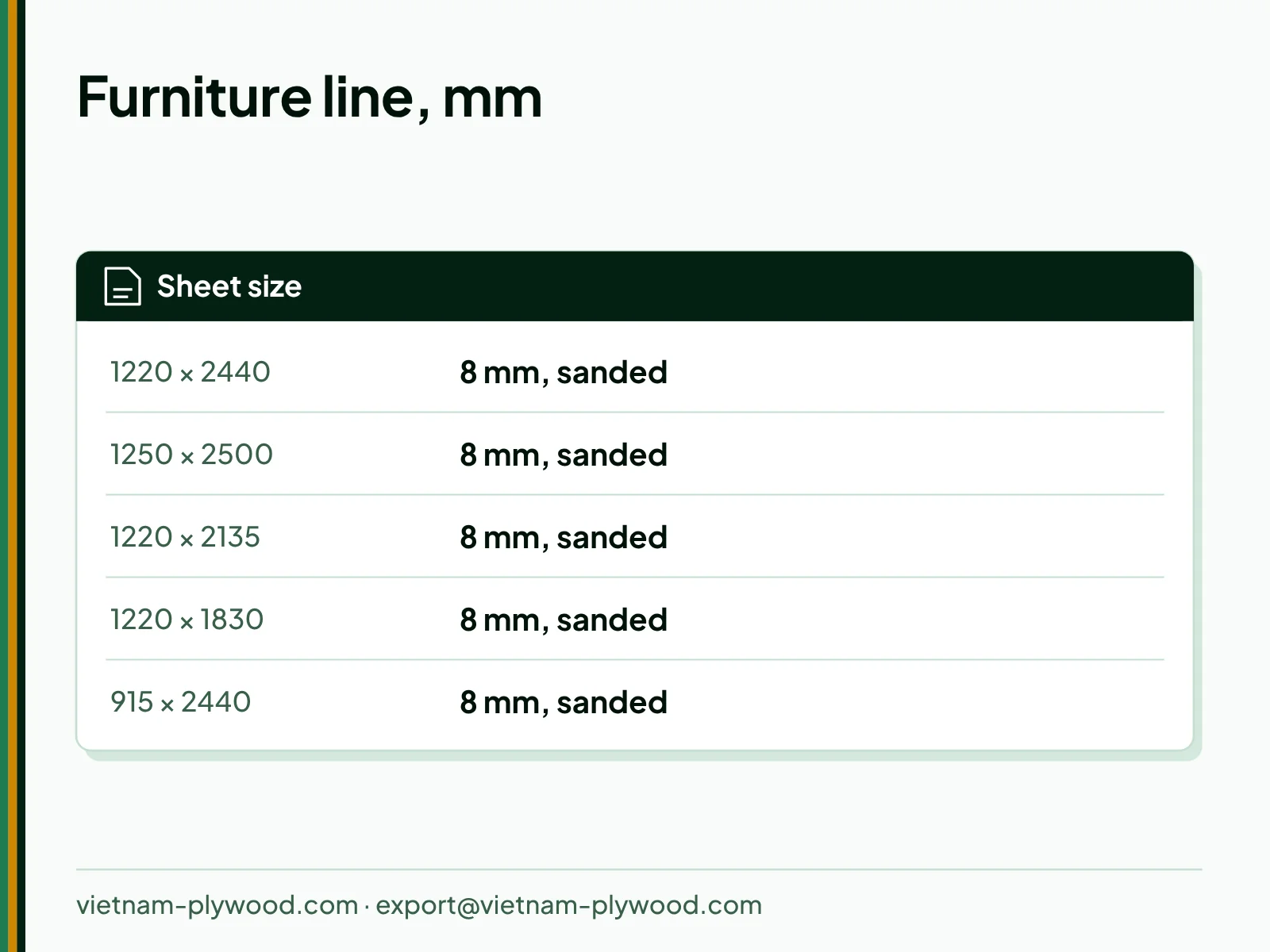
| Sheet size (mm) | Furniture line | Commercial and packing line | Construction line |
|---|---|---|---|
| 1220 × 2440 | 8 mm, sanded | 8 mm, utility | 8 mm, film-faced |
| 1250 × 2500 | 8 mm, sanded | 8 mm, utility | 8 mm, film-faced |
| 1220 × 2135 | 8 mm, sanded | 8 mm, utility | 8 mm, film-faced |
| 1220 × 1830 | 8 mm, sanded | 8 mm, utility | 8 mm, film-faced |
| 915 × 2440 | 8 mm, sanded | 8 mm, utility | 8 mm, film-faced |
| 915 × 2135 | 8 mm, sanded | 8 mm, utility | 8 mm, film-faced |
| 915 × 1830 | 8 mm, sanded | 8 mm, utility | 8 mm, film-faced |
Furniture sanding tolerance is ±0.2 or ±0.3 mm as ordered. Commercial and film-faced tolerance is ±0.5 mm; packing tolerance is ±0.5–1.0 mm. Length and width tolerance is ±2 mm. Record the applicable tolerance on the specification rather than assuming that all 8mm plywood sheets have the same measured thickness. A nominal 8 mm dimension also needs an agreed measuring procedure and acceptance sample.
What is plywood 8 mm used for?
8 mm plywood is used for cabinet backs, drawer components, furniture partitions and lightweight fit-out panels when the supporting design suits this thickness. A utility build serves packaging inserts, separators and non-decorative backing where appearance is secondary. Neither selection should be treated as a load-bearing design approval.
For visible interior components, the face grade and sanding consistency affect the finishing operation. Concealed backing can use a simpler face. Furniture makers should send a cutting layout and identify which side will be exposed. Packaging buyers should describe the expected handling and fastening method.
Span and attachment detail govern whether 8mm ply is suitable. Compare 12 mm plywood where greater panel stiffness is needed. Evaluate deflection and fastener retention before specifying thickness.
How do furniture and utility 8 mm builds compare?
The furniture build is the better choice for a visible or finish-sensitive part; the utility build is the economical choice for concealed packaging or backing. The table compares the same nominal 8 mm thickness against purchasing criteria rather than treating thickness as a grade.
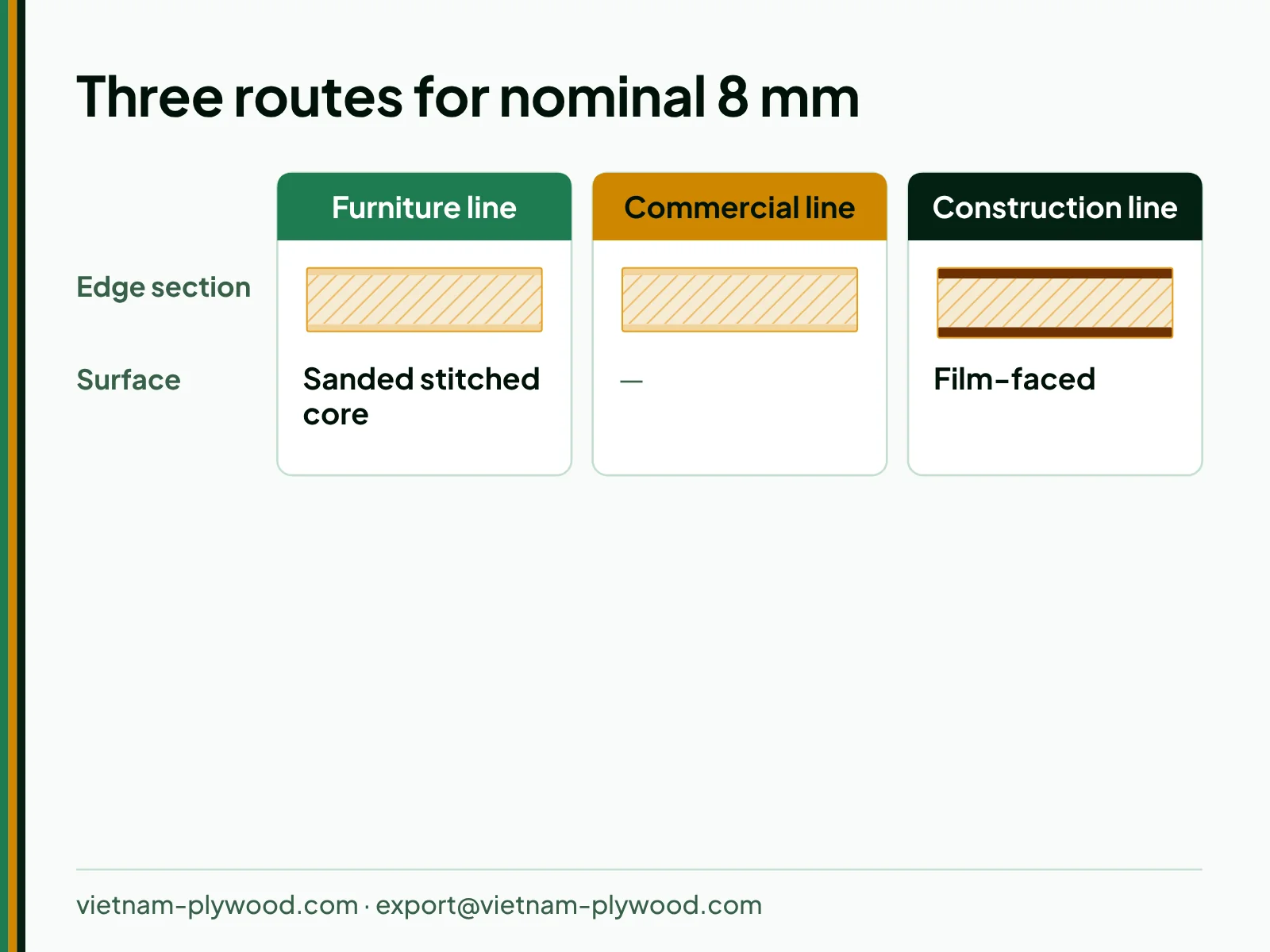
| Metric | Furniture build | Utility build | Verdict by use |
|---|---|---|---|
| Face | Selected A/B veneer, commonly 0.2–0.4 mm | Functional veneer or raw matt face | Furniture for visible finish; utility for concealed work |
| Core | Full-stitched styrax or eucalyptus | Acacia, with core construction specified | Furniture for prepared surfaces; utility for packing |
| Surface | Sanded | Unsanded or light-sanded | Furniture for finishing and tight fitting |
| Thickness | 8 mm ±0.2 or ±0.3 mm | 8 mm ±0.5 mm; packing ±0.5–1.0 mm | Furniture for close assembly clearances |
| Core density | Styrax 500 or eucalyptus 650 kg/m³ | Acacia 580 kg/m³ | Select by weight and assembly requirement |
| Price position | Higher for face selection, stitching and sanding | Lower for a functional surface and simpler preparation | Utility for non-visible applications |
Surface preparation creates much of the price difference. A low unit price does not compensate for repeated sanding or rejected decorative parts. Conversely, paying for a decorative face on disposable separators adds expense without improving their function. Our furniture plywood and commercial plywood pages explain the respective product families.
Which factory line presses 8 mm plywood?
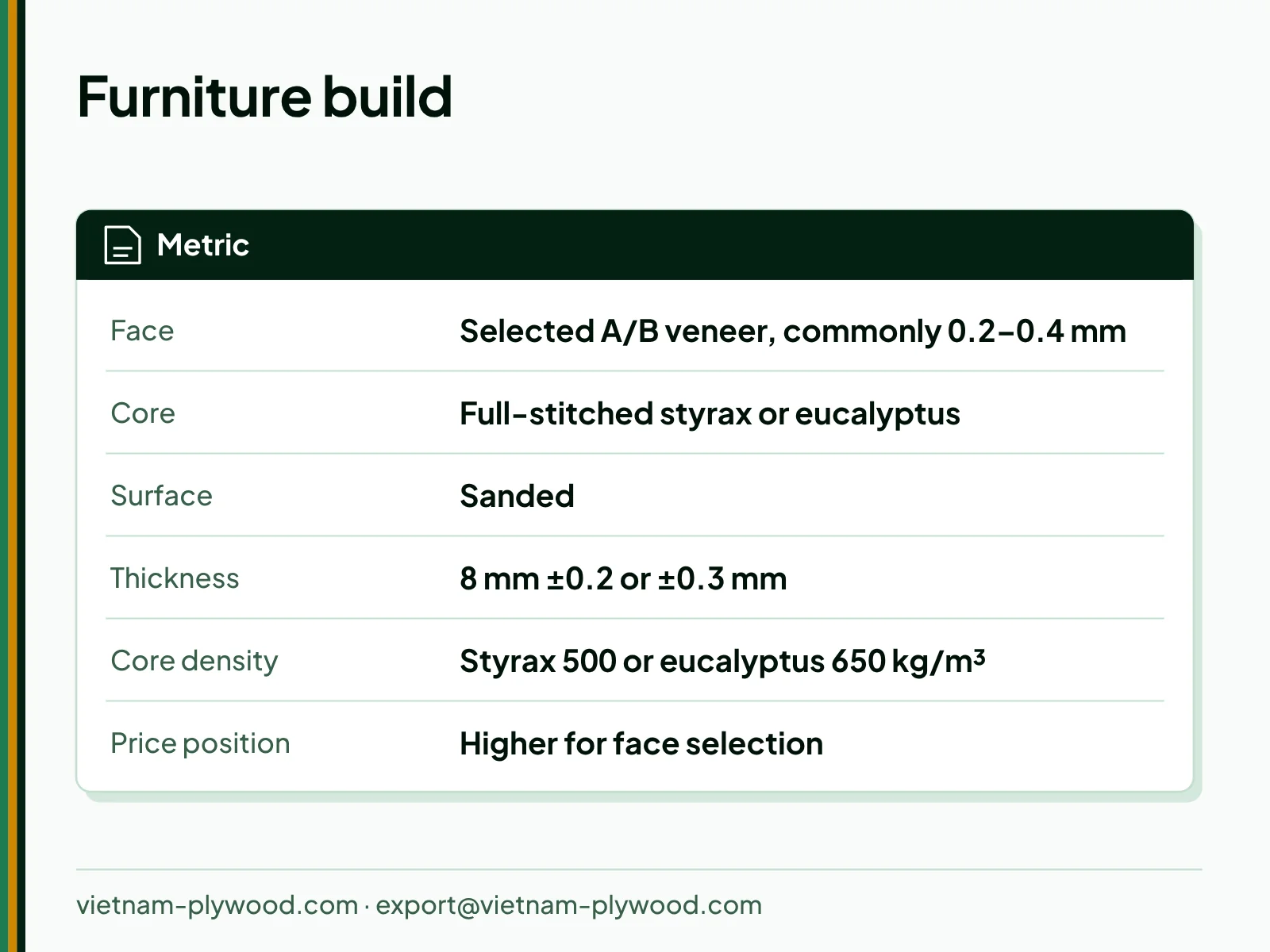
Our furniture line presses the finish-grade 8 mm build, while our commercial and packing line presses the acacia-core utility version. Our construction line builds phenolic- or melamine-film panels with acacia or eucalyptus cores for formwork-related specifications. These are distinct production routes even when the nominal thickness matches.
The producing factory is selected for the written build. HCPLY operates three member factories in Phu Tho and Hai Phong; each order is made and dispatched from the factory suited to the specification. Buyers can visit the factory office and inspect goods at the producing factory. Inspectors can compare the order against the actual production route.
A film face changes the surface purpose and inspection criteria. It should not be substituted for a furniture veneer merely because both are described as 8 mm. For furniture, discuss veneer appearance and flatness; for packing, discuss core gaps and handling; for film-faced sheets, discuss film continuity and edge sealing.
Is 5/16 inch plywood the same as 8 mm?
No: 5/16 inch equals 7.9375 mm, which is 0.0625 mm below nominal 8 mm. The US National Institute of Standards and Technology explains in its 2009 SI Units – Length resource that the standard inch is exactly 25.4 mm, under the 1959 definition. See NIST’s length reference and the millimetre-to-inch tool.
A drawing labelled 5/16 plywood should therefore be checked for its actual permitted thickness interval. The numerical difference is small compared with many plywood manufacturing tolerances, but a cabinet groove or machined slot can still be sensitive to the specified fit. Record whether the purchase order controls nominal metric thickness or an inch-based finished dimension.
For US orders, distinguish the nominal size from the acceptance tolerance. The inspector should measure multiple locations away from damaged edges and document the reading method. The order should also define grade and bonding.
Which face and core should a buyer specify?
Specify the face by appearance and the core by the panel’s weight and construction requirements. Furniture faces include bintangor, okoume, engineered veneer (EV), gurjan, pine, poplar, eucalyptus, birch and sapele. Birch face grades are D/E/F; other veneer faces use A/B. Matt denotes an unfaced raw core.
For cabinet backs, a selected bintangor or okoume face can provide a finish-ready appearance when the chosen grade matches the finish. For an internal drawer component, the buyer can identify the visible side and allow a different back grade. For separators and packing panels, a functional face is usually more relevant than decorative matching.
Core density follows the wood core rather than the decorative face. A birch-faced sheet is therefore not necessarily a birch-core sheet; HCPLY does not press birch-core plywood. Core construction also matters: full stitched is the highest of our stated construction options, followed by stitched outer layers with edge-trimmed inner layers, finger-jointed and loose-laid. Select a permitted construction before comparing quotes.
How should glue and emissions be specified?
Glue and formaldehyde-emission class must be written as separate fields. Melamine moisture-resistant (MR) glue has a 12-hour boil specification; phenolic weather-and-boil-proof (WBP) glue has a 72-hour boil specification. Furniture panels use E0 or E1 emission classes, while E2 is another emission class in the specification vocabulary.
The buyer should identify the required test method and documentary evidence for the destination market. CARB P2 and TSCA Title VI concern US emission limits with third-party certification; they do not describe an adhesive recipe. Factory certificates for FSC, CARB P2, ISO 9001 and CE, and EUTR/EUDR documentation, are shown with factory details masked, on request.
An 8mm laminated plywood enquiry also needs clarification of what “laminated” means. A decorative veneer face, a film surface and a separate melamine, high-pressure laminate (HPL) or laminate face are different constructions. We explain the latter surfaces as categories but do not offer melamine-, HPL- or laminate-faced panels as an HCPLY product line.
What can an inspector check at the producing factory?
An inspector can witness thickness measurement, face grading, core preparation and final packing at the producing factory. For an 8 mm furniture order, the priority is the sanded surface and the ordered thickness interval. For utility sheets, examine veneer joins, edge gaps and the accepted surface grade.
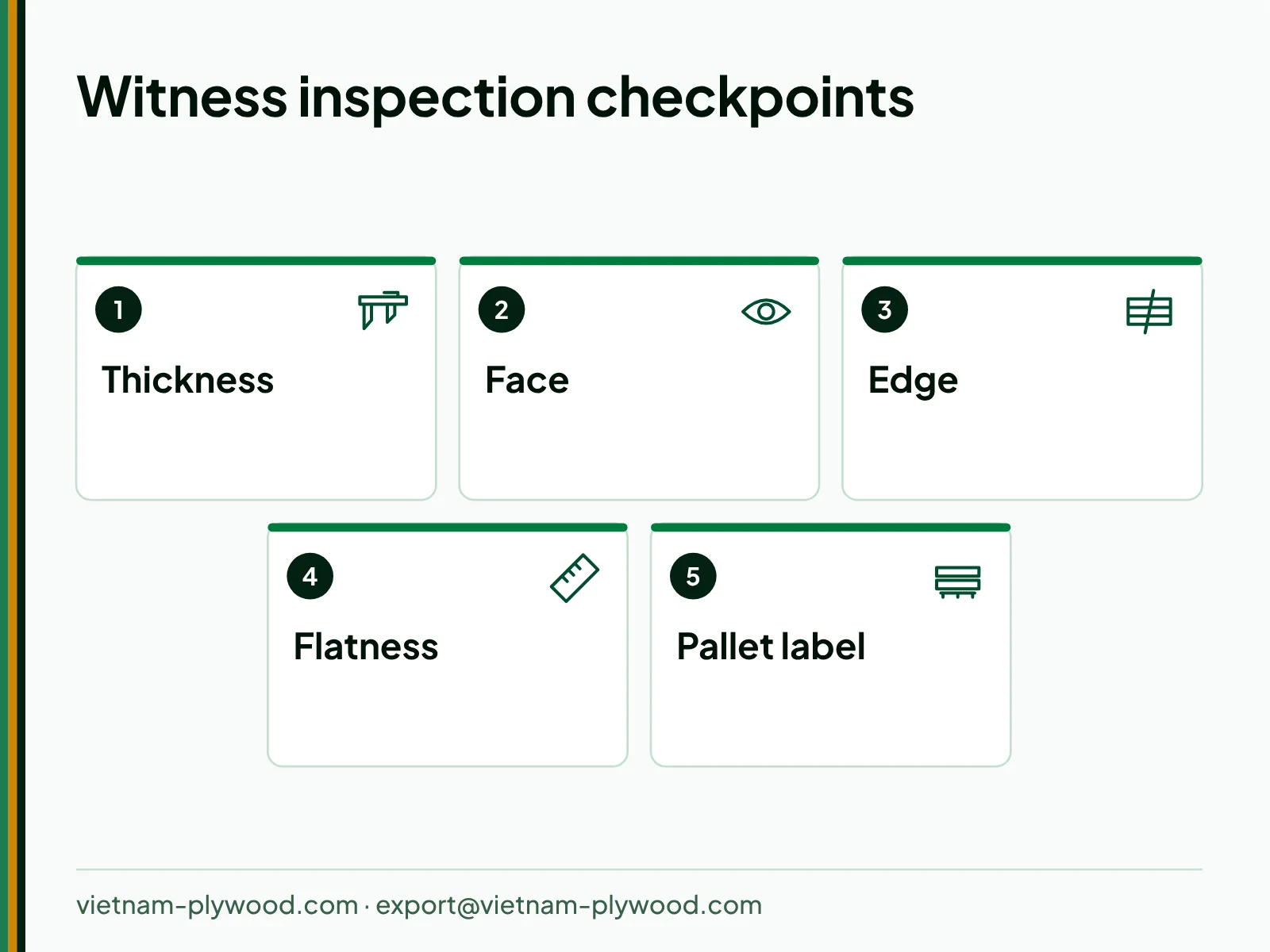
- Compare the approved sample, purchase order and production label for face, core, glue and emission class.
- Measure thickness at agreed positions and record readings against the applicable tolerance.
- Inspect both faces under consistent light, noting patches, splits and sanding marks against the accepted grade.
- Review representative edges for core gaps and layer alignment; check panel flatness on a defined reference surface.
- Match pallet labels, sheet dimensions and quantities to the packing list before loading.
Inspection records should show actual readings, locations and the agreed acceptance method. Flatness needs a stated test setup and limit; the thickness tolerance alone does not establish a flatness tolerance. Witness checks can identify unsuitable surfaces early. The final inspection criteria belong in the order.
How should 8 mm sheets be planned for shipment?
Plan mixed 8 mm loads by weight and pallet geometry rather than by nominal thickness alone. The 40HC payload limit is 28.5 tonnes. For reference, at 18 mm and 1220 × 2440 mm, the core-only full-container lookup is 990 styrax sheets (26.52 t), 880 acacia sheets (27.35 t) or 795 eucalyptus sheets (27.69 t). Do not apply those counts to 8 mm.
A furniture batch and a utility batch can share a container when the combined payload stays within the limit. For a mixed order, add the calculated mass of each specified batch before adding pallet tare, packaging and surface layers. Loading arrangement also needs to be included in the shipment plan. The container loading reference covers the full pallet method and other thicknesses.
At 8 mm, the actual count per pallet follows the stack-height allowance divided by ordered thickness, rounded down to whole sheets. Different core types also have different pallet allocations. Mixed loads need separate packing-list lines and weight checks.
What drives the price difference?
Face selection and core preparation drive the largest difference between the furniture and utility quotations; sanding and tolerance control follow. The furniture build costs more because its face selection, full stitching and surface preparation add work. The utility build costs less when appearance and finishing tolerances can be relaxed.
An 8 mm quote should compare like with like: identical sheet dimensions, face grade, core construction, glue, emission class and order volume. Asking for a single “8mm plywood price” without these fields combines unlike products. The two indicative starting prices apply to their broader categories: furniture plywood from US$350/m³ FOB Hai Phong (October 2026), and commercial plywood from US$250/m³ FOB Hai Phong (October 2026). These are category starting prices, not a separate 8 mm grade quotation.
For a precise 8 mm offer, send the application and written specification. Face, tolerance and packing mix determine the quote. A utility sheet with a higher face grade can narrow the gap.
Which documents accompany the order?
The commercial invoice, packing list and bill of lading (B/L) identify the shipment, its goods and transport record. The certificate of origin accompanies the shipment, with EUR.1 for applicable EU lots. Phytosanitary and fumigation papers, insurance under CIF, and agreed certificate documents are included as applicable.
The shipment’s certificate documents can include an FSC claim on sales documents, an emission certificate and test reports for the agreed build. EU lots also carry the EUTR/EUDR file set. After loading, the draft shipping documents come to you for approval. This gives the buyer a defined point to compare the documented 8 mm specification and quantities against the loaded pallets.
HCPLY manages the export work from specification and on-site quality control through documents and loading. We ship FOB Hai Phong, or CFR (CNF) or CIF to your port. The minimum order is one 40HC, with mixed specifications permitted within the payload limit. Factory lead time runs 15–45 days from receipt of the 30% deposit; the exact figure depends on order size, line loading and what the contract fixes. The remaining 70% is paid on the scan of the bill of lading, by T/T, or by irrevocable sight L/C; see production lead time.
How should a buyer request an 8 mm specification?
Send a specification that identifies the final use and acceptance criteria before requesting the 8 mm spec sheet. The written fields below distinguish the furniture build from the utility alternative and let the producing factory prepare a comparable offer.
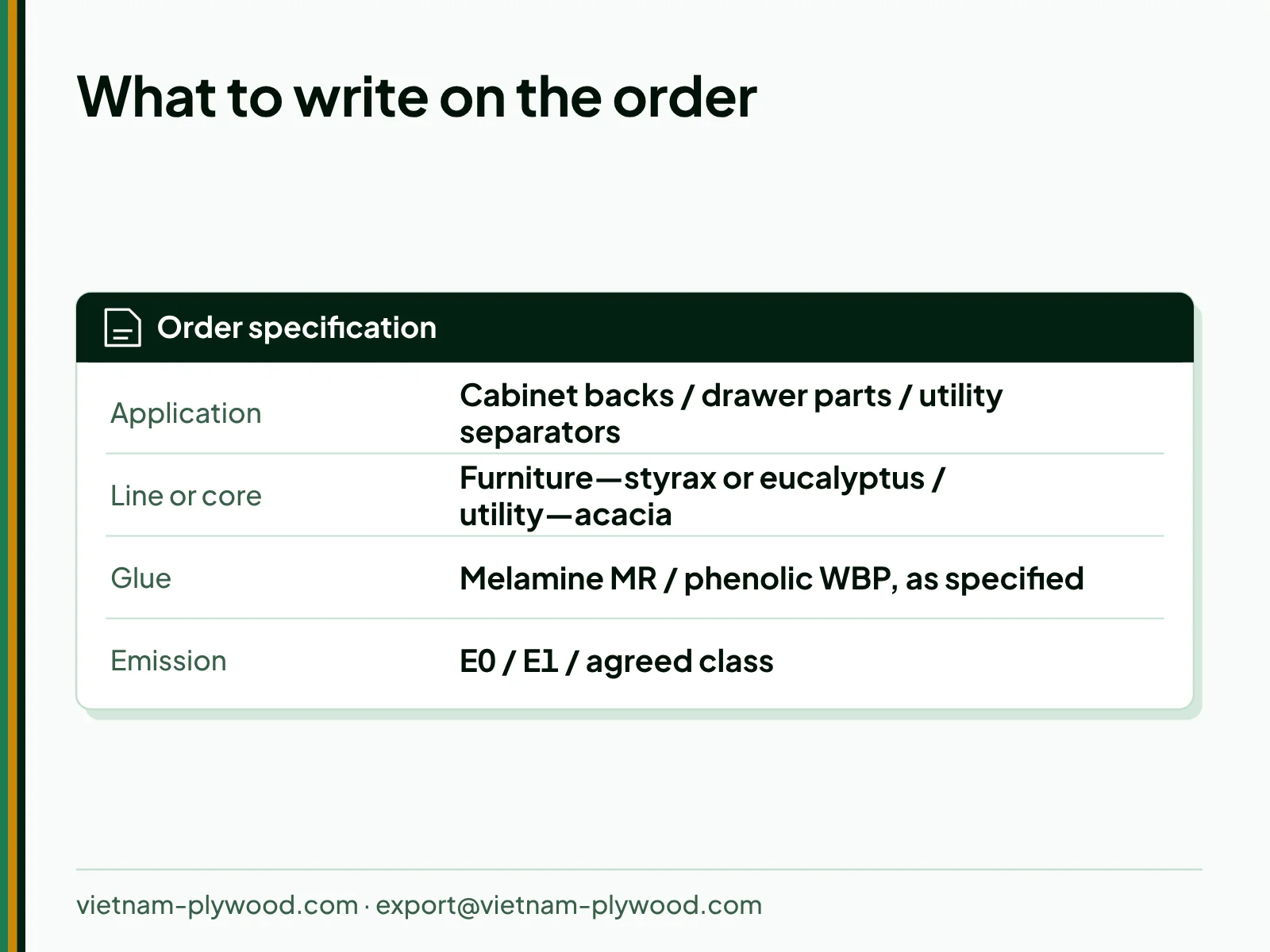
If a finish-sensitive component has a strict groove dimension, attach the machining drawing and approved surface sample. If the order mixes furniture and packing sheets, show quantities separately. For a new buyer, samples are free; the buyer books the courier, and its cost can be credited against a real order.
Application: cabinet backs / drawer parts / utility separators
Line or core: furniture—styrax or eucalyptus / utility—acacia
Glue: melamine MR / phenolic WBP, as specified
Emission: E0 / E1 / agreed class
Face and grade: species, A/B (birch D/E/F), both sides
Thickness and tolerance: nominal 8 mm; agreed ± mm
Size: length × width in mm
Quantity: sheets and pallet split by build
Destination port: [port and country]
Request the 8 mm specification sheet from Lucy at export@vietnam-plywood.com through contact.