





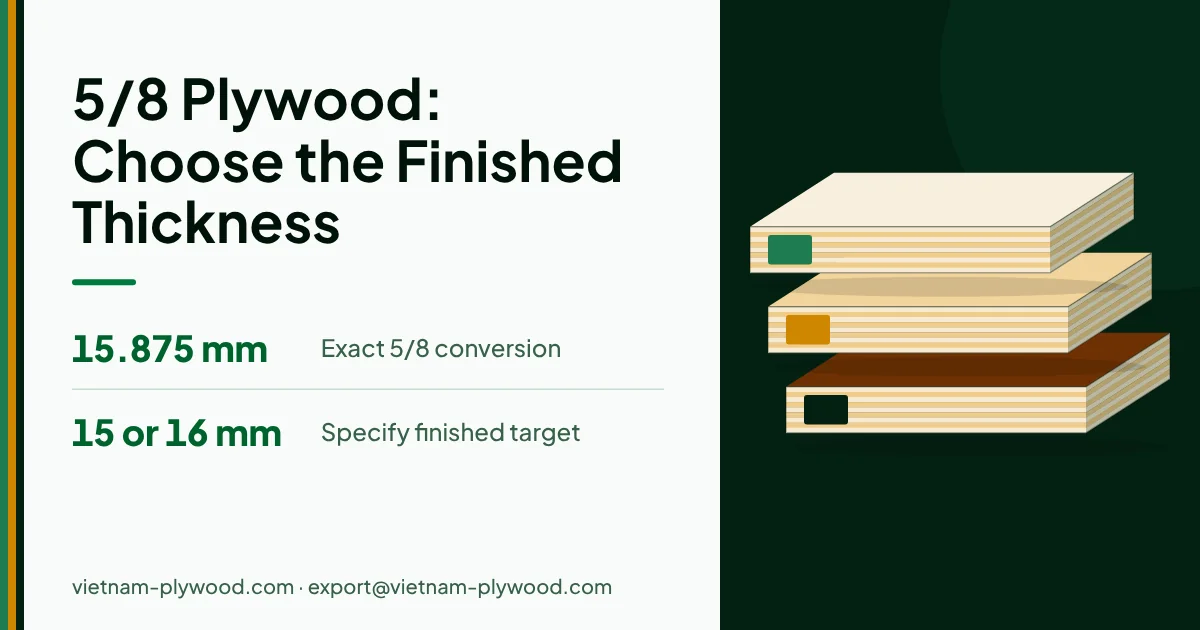
5/8 plywood converts to 15.875 mm, so a US order must choose a defined 15 mm or 16 mm finished build. Choosing the wrong target can mean rejected cabinet components, revised machining and extra freight expense. HCPLY makes the distinction at specification stage, before the producing factory presses the order.
What is 5/8 plywood in millimeters?
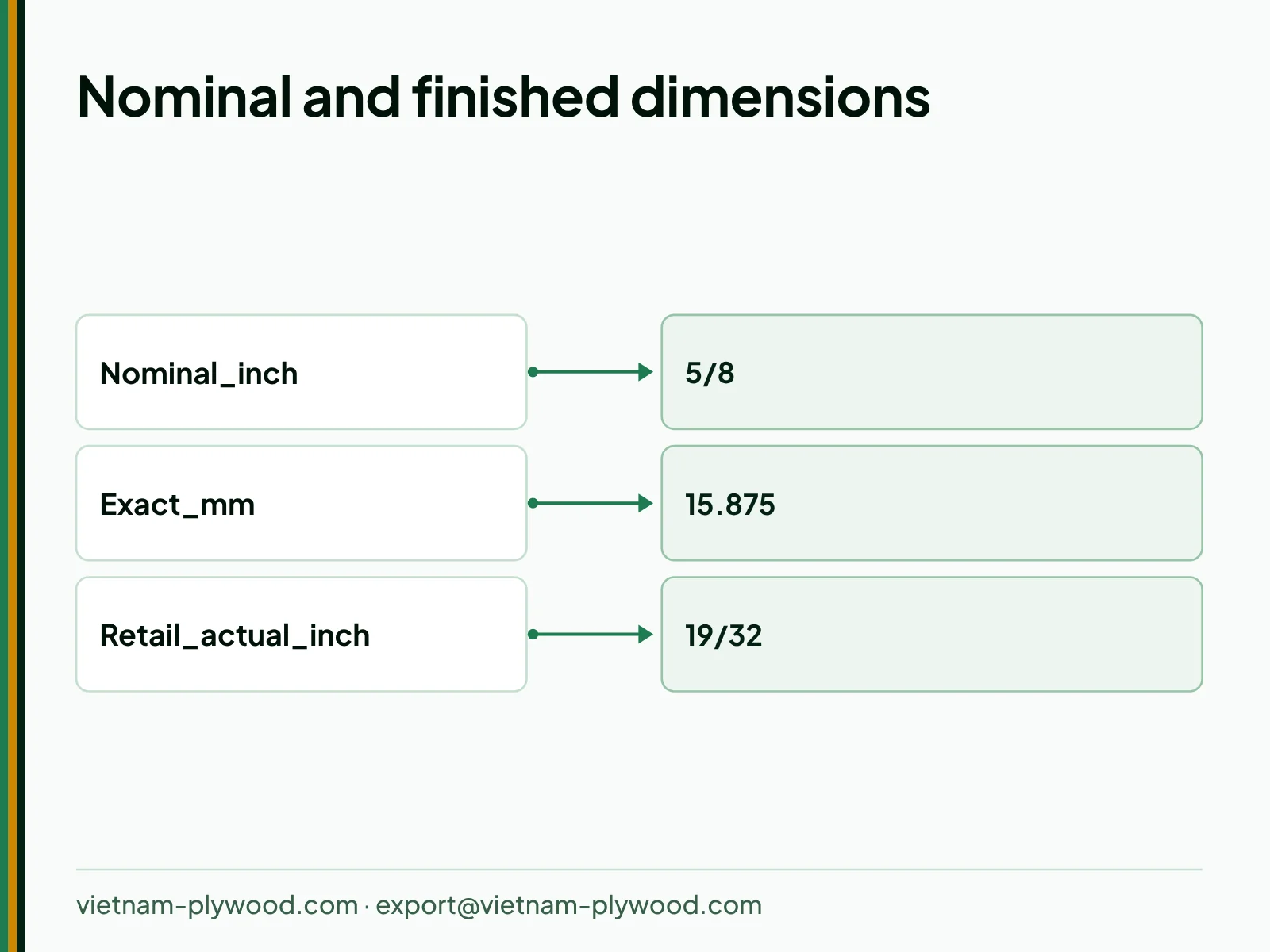
5/8 plywood is nominally 15.875 mm thick because five-eighths of the exact 25.4 mm inch equals 15.875 mm. For an export purchase order, that conversion is a reference dimension, while the agreed finished thickness controls inspection. A 15 mm panel and a 16 mm panel therefore cannot be treated as identical when a cabinet drawing calls for a precise slot or flush joint.
The US National Institute of Standards and Technology (NIST), in its 1959 inch-definition history, states that the inch is exactly 25.4 mm (NIST length guidance). Our plywood thickness specification guide explains how nominal names and ordered dimensions should appear together. Use the millimeter-to-inch conversion tool when checking drawings received in mixed units.
Is 5/8 inch plywood 15 mm or 16 mm?
Both labels appear in purchasing discussions, but the mathematical conversion is closer to 16 mm. At HCPLY, 15 mm is a common production thickness; 16 mm should be written as an explicit target when that finished dimension is required. The order must identify its own tolerance rather than assuming a retail nominal-size convention.
A North American buyer might also encounter 19/32 inch as an actual-thickness retail description. That fraction equals 15.08125 mm, and it is a different number from 15.875 mm. It should never silently replace the drawing’s finished-thickness requirement. Ask the receiving team whether the drawing describes nominal stock, measured finished stock, or a machining allowance.
For cabinet components, a 15 mm panel with an ordered sanded tolerance of ±0.2 mm spans 14.8–15.2 mm. A 16 mm panel with the same tolerance spans 15.8–16.2 mm. Those intervals do not overlap. Choose the interval that fits the joinery and cutting program.
How do the three production lines interpret this order?
Our furniture line is the natural route for sanded cabinet and fit-out panels near this thickness. Our commercial and packing line builds acacia-core panels for less appearance-sensitive work, while our construction line makes film-faced formwork panels. Each route has a different surface, core and inspection target.
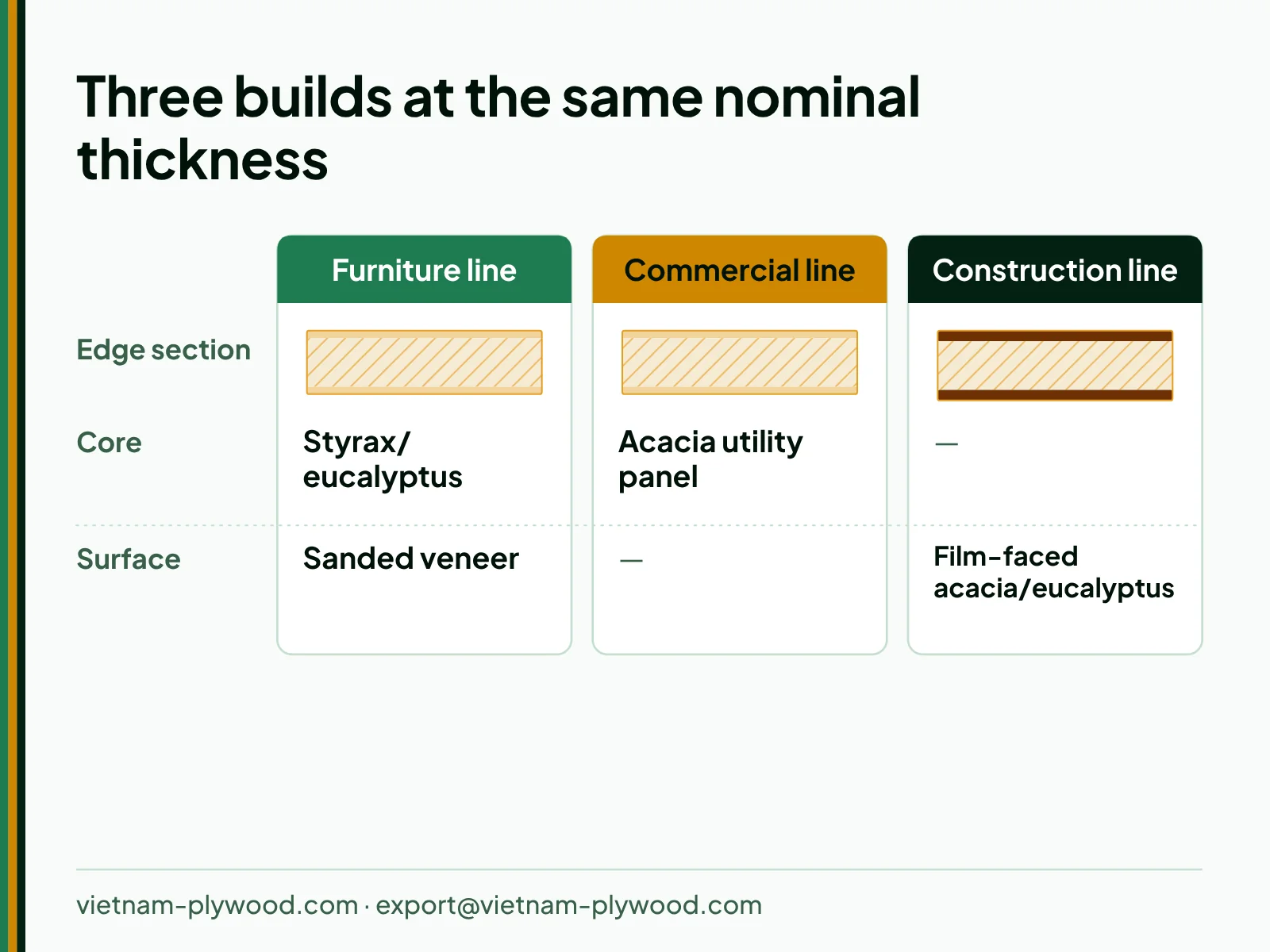
| Metric | Furniture line | Commercial and packing line | Construction line |
|---|---|---|---|
| Typical build near 5/8 | 15 mm sanded face veneer | 15 mm unsanded or light-sanded | 15 mm film-faced |
| Core | Styrax or eucalyptus | Acacia | Acacia or eucalyptus |
| Surface | Decorative veneer, A/B face options | Utility surface | Phenolic or melamine film |
| Thickness tolerance | ±0.2 or ±0.3 mm as ordered | Commercial ±0.5 mm; packing ±0.5–1.0 mm | ±0.5 mm |
| Verdict by use | Cabinet and furniture components | Packing or concealed utility panels | Concrete forms, not rated sheathing |
The same nominal thickness does not establish an interchangeable product. A US sheathing schedule requiring a rated structural panel calls for its specified qualification and test evidence; these lines should not be represented as bearing an APA or PS 1 stamp. A construction film surface is also different from a decorative cabinet veneer. HCPLY does not press MDO or HDO panels.
Is 5/8 plywood thicker than 1/2 plywood?
Yes. Five-eighths inch is 15.875 mm, compared with 12.7 mm for one-half inch. The nominal difference is 3.175 mm. For a furniture drawing, the extra thickness changes slot dimensions, edge profiles and the finished component’s mass.
A thicker panel is not automatically approved for a longer structural span. For roof or floor sheathing, the designer must use the applicable rated product and span information rather than infer capacity from thickness alone. For cabinet sides, check hinge boring depth and shelf-support details against the actual finished panel.
If a project switches from 12 mm or 15 mm to a thicker sheet, revise its cut list before the next production release. The 8 mm plywood comparison and 25 mm plywood options provide context for other thickness steps.
How does 15 mm versus 16 mm change sheet weight?
At identical dimensions and core density, a 16 mm sheet contains 16/15 times the wood volume of a 15 mm sheet. That is about 6.67% more volume and theoretical core mass. Face and glue construction can alter measured shipping weight, so compare like-for-like builds.
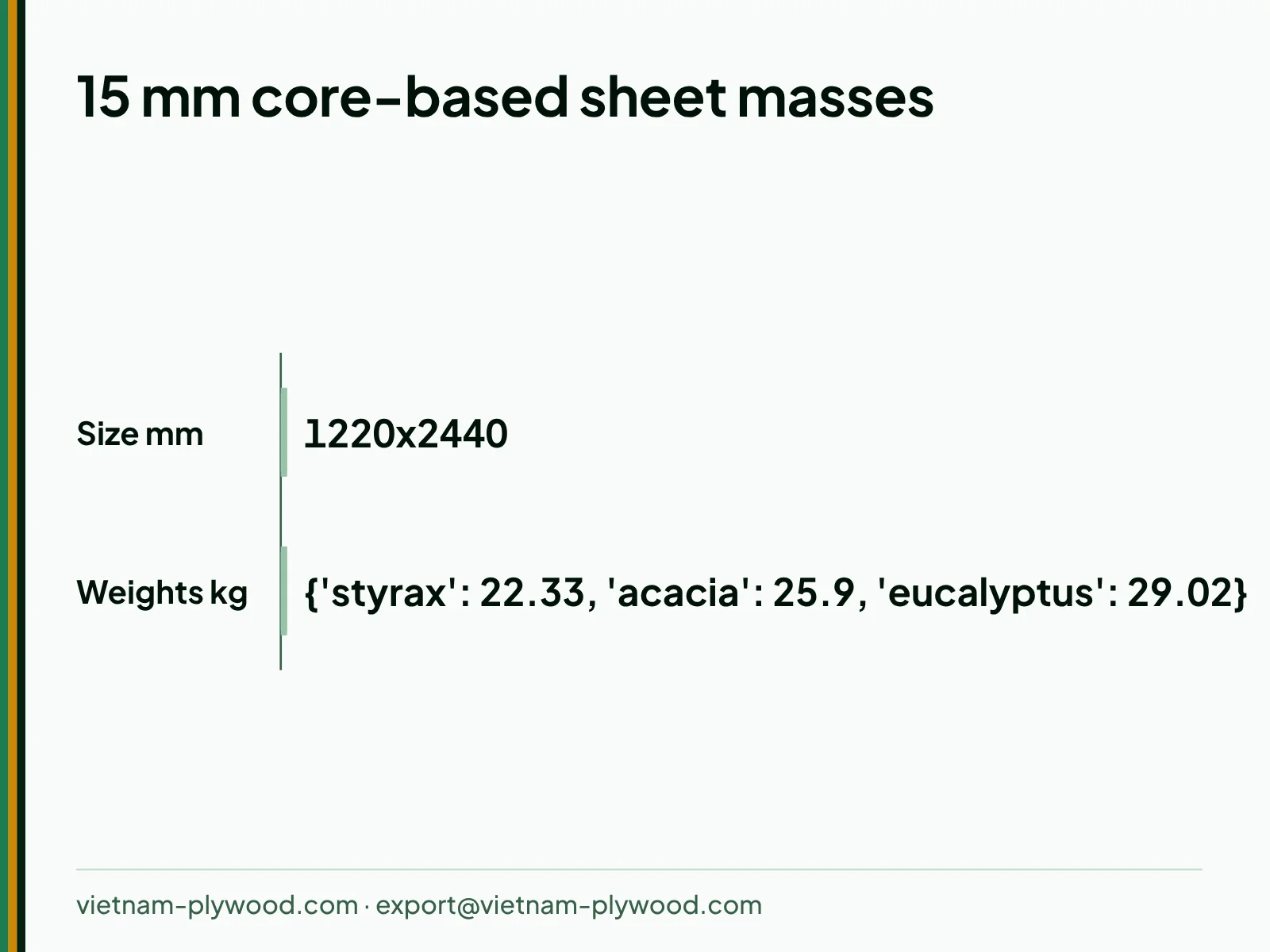
For a 1220 × 2440 mm, 15 mm panel, the published HCPLY core-based lookup gives 22.33 kg with styrax, 25.90 kg with acacia and 29.02 kg with eucalyptus. These are core-density calculations rather than a weighed finished-panel guarantee. The core determines the density assumption, even if the visible face is birch, pine or okoume.
A 16 mm order requires its own confirmed packing calculation and measured production sample. We do not use the 15 mm lookup as a 16 mm loading figure. For other panel sizes, the same principle applies: keep dimensions, density basis and finished thickness explicit.
What does the thickness choice do to a container?
For 15 mm sheets at 1220 × 2440 mm, the 40HC planning lookup is 1,188 styrax-core sheets at 26.52 t, 1,056 acacia-core sheets at 27.35 t, or 960 eucalyptus-core sheets at 27.86 t. These figures use the stated pallet patterns and a 28.5 t payload limit. They do not include extra film weight.
An importer can combine different specifications within that payload limit. The packing plan should show the core of each item, pallet count, sheet count and resulting mass before loading. The mixed-container ordering guide explains the purchasing arrangement, while container loading calculations cover the detailed sheet-count question.
For a mixed load, the 15 mm baseline is useful for planning the portion already specified. A 16 mm portion needs a separate pallet and weight schedule, so the booking reflects the final build rather than a nominal label.
Does the extra millimeter raise the plywood price?
A 16 mm build ordinarily consumes more veneer volume than the otherwise identical 15 mm build, so its material component is higher. The strongest price drivers are core construction and face quality, then glue and emission requirements, followed by the added thickness and order mix. A change in thickness alone cannot establish the final quotation.
For a furniture-grade starting reference, the allowed indication is from US$350/m³ FOB Hai Phong (October 2026). For commercial plywood, it is from US$250/m³ FOB Hai Phong (October 2026). Neither figure is a 16 mm unit quotation or a fixed 5/8 sheet price.
Request the same face grade, core, glue and emission class on both thickness alternatives to compare their cost fairly. The quote should state cubic-meter pricing and the resulting quantity against the selected packing schedule. A thicker sheet can change the landed cost per usable cabinet part even when the price per cubic meter is unchanged.
Which face, glue and emission fields belong on the order?
For a cabinet order, choose the visible veneer independently of the core. Bintangor, okoume, engineered veneer, gurjan, pine, poplar, eucalyptus, birch and sapele are face options; matt identifies an unfaced raw core. Common face veneer thickness is 0.2–0.4 mm. A/B is the face-grade vocabulary for most listed faces, while birch uses D/E/F.
Glue and formaldehyde emission must occupy separate fields. Melamine glue is an MR bond with a 12-hour boil description; phenolic glue is a weather-and-boil-proof bond with a 72-hour boil description. E0, E1 and E2 describe emission classes, while CARB Phase 2 and TSCA Title VI refer to US emissions limits and third-party certification requirements.
Our furniture panels use stitched, sanded cores and E0/E1 options. For US distribution, state the exact documentation required for the finished build and ask to see the relevant member-factory certificate with factory details masked, on request. A certificate for one configuration does not replace the order’s face, core and emission fields.
What can the buyer inspect at the producing factory?
The buyer can witness a finished-thickness check against the signed tolerance at the producing factory. Select sheets across the lot, measure at agreed positions with a calibrated gauge, and record the readings against the target interval. Compare the measured panel to the approved sample and machining drawing.
The inspector should also check veneer face grade, surface sanding, edge construction, panel dimensions and pallet labels. Length and width tolerance is ±2 mm. For a furniture build, a full stitched core is the highest listed construction tier; stitched outer layers with edge-trimmed inner veneers, finger-jointed and loose-laid cores are different alternatives.
Buyers visit the factory office and inspect the goods where they are produced. HCPLY handles on-site quality control and the export paperwork, while the factory matching the order presses and ships the panels directly. Record any agreed deviation before loading so the shipment documents reflect the accepted specification.
How should I write a 5/8 plywood purchase specification?
Write the actual finished thickness in millimeters first, then show 5/8 inch as the buyer’s nominal reference. A complete line states the allowed thickness range, face, core, bonding, emission, dimensions, quantity and destination. It should also identify the intended cabinet or sheathing use so the product family is selected correctly.
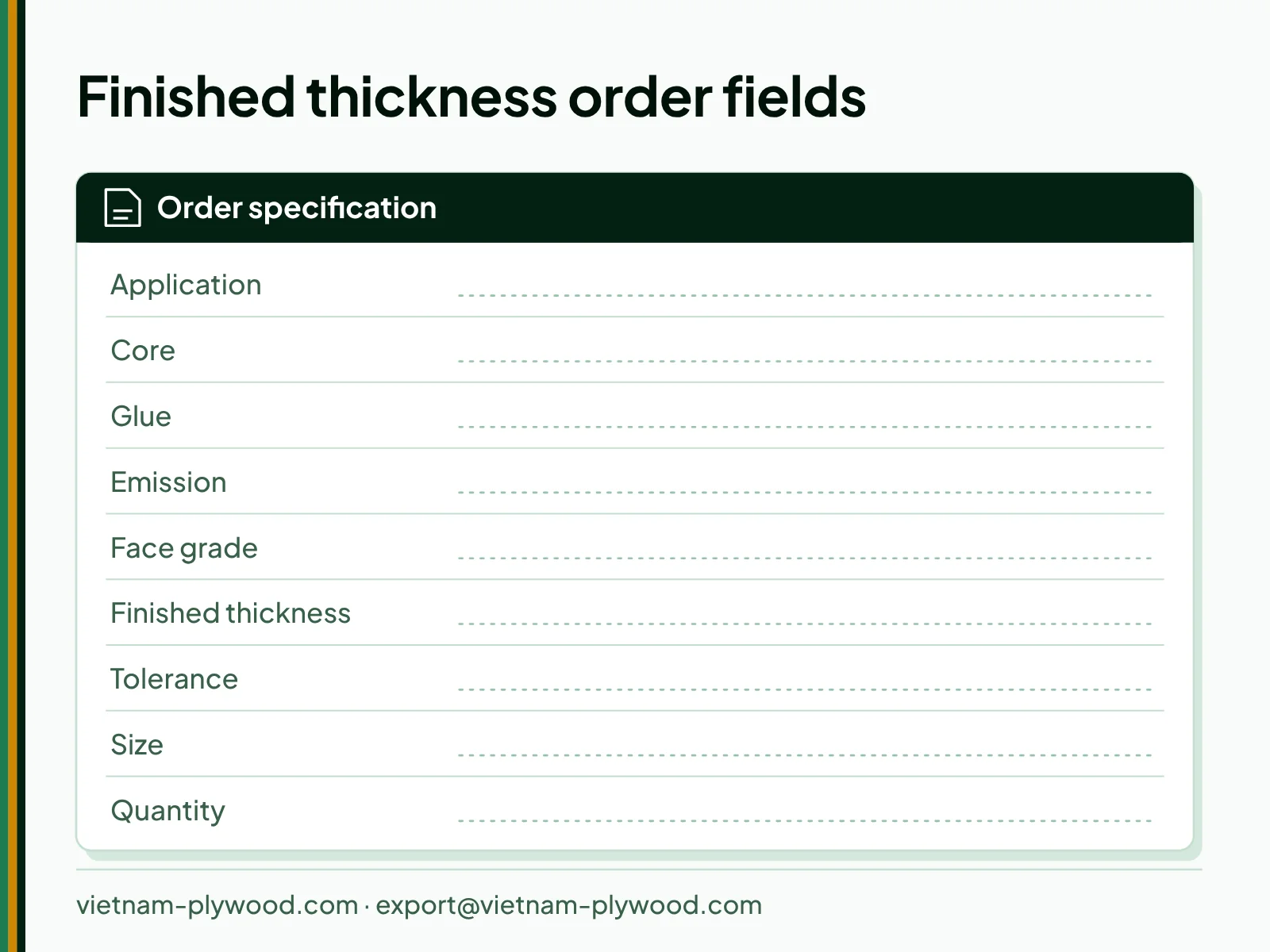
Use these steps when releasing the purchase order:
- Decide whether the drawing accepts 15 mm finished stock or requires 16 mm finished stock.
- Select the relevant production line and core construction for the application.
- Set a measurable thickness tolerance and surface condition.
- Record face grade, glue and emission requirements as separate fields.
- Approve the sample and inspection points before confirming the final loading schedule.
The furniture plywood range is the starting point for a sanded cabinet specification. For unusually thick components, compare the 30–40–50 mm thickness discussion before choosing a different construction.
What shipping terms and documents follow the specification?
The minimum order is one 40HC, with mixed specifications allowed within the payload limit. Production takes 15–45 days from the 30% deposit, set by order size, line loading and the contract. The balance is 70% against the scanned bill of lading, by telegraphic transfer or irrevocable letter of credit at sight.
Available delivery terms are FOB Hai Phong, CFR (CNF) and CIF. Each shipment has a commercial invoice, packing list, bill of lading, certificate of origin, phytosanitary and fumigation papers, and agreed order certificates or test reports. CIF adds insurance; EU lots use EUR.1 and the applicable EUTR/EUDR file set. After loading, the draft shipping documents come to you for approval.
For this thickness decision, the packing list records the accepted size and shipped quantity. The agreed specification and inspection record establish the finished thickness being purchased. See the production lead-time explanation when scheduling a machining program around arrival.
What should the final request to Lucy say?
A usable request names the chosen 15 mm or 16 mm finished target and its tolerance. It also tells the factory whether the panels will become cabinet components or another application. A vague “5/8 plywood 4x8 sheets” description leaves both the finished thickness and panel construction open.
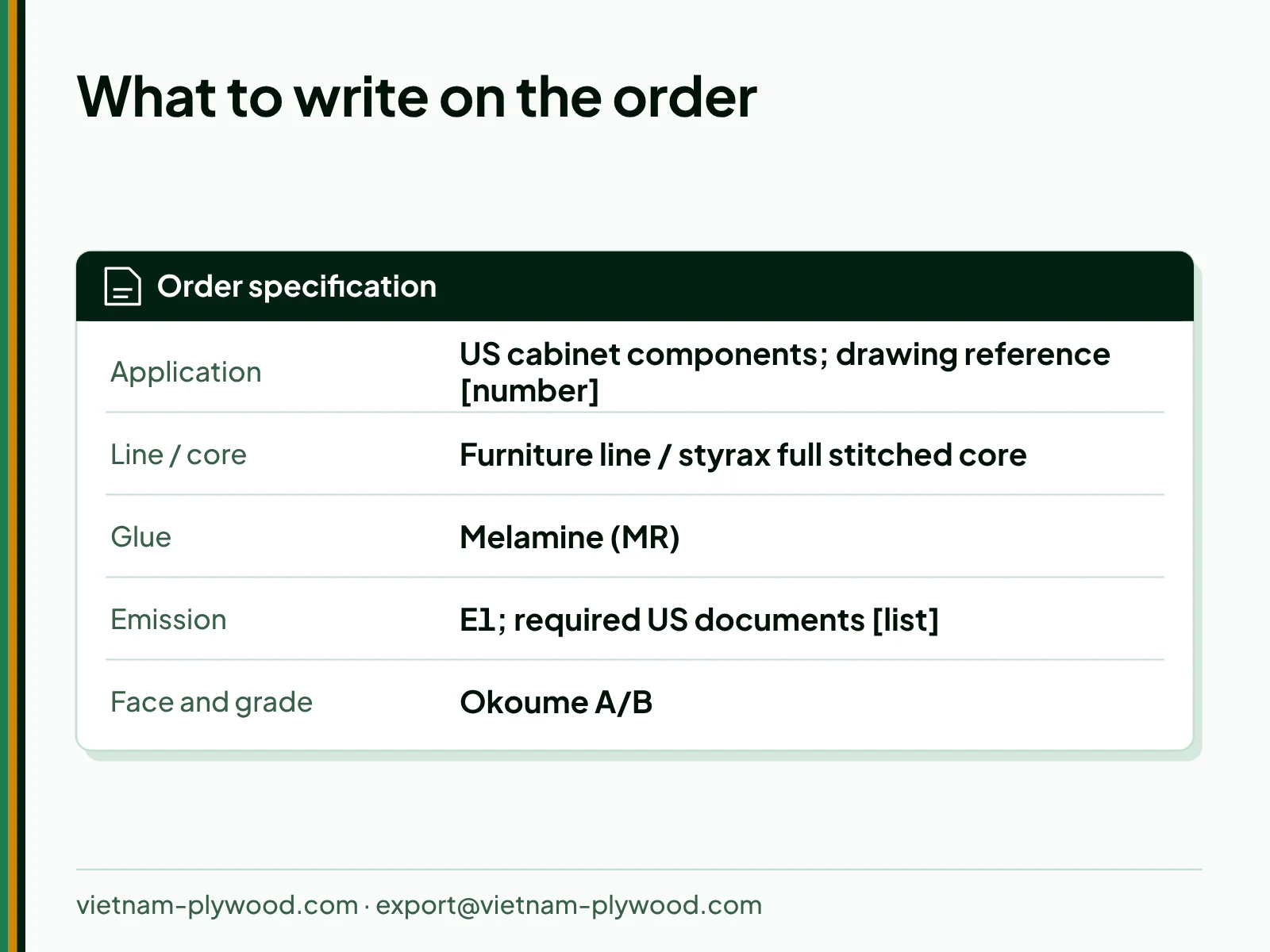
The following sample is for a sanded furniture panel; replace the bracketed fields with the drawing’s approved values. The 1220 × 2440 mm format is a metric export sheet close to the US 4 × 8 foot label, rather than an exact 48 × 96 inch dimension. Send the completed request to Lucy at export@vietnam-plywood.com.
Application: US cabinet components; drawing reference [number]
Line / core: furniture line / styrax full stitched core
Glue: melamine (MR)
Emission: E1; required US documents [list]
Face and grade: okoume A/B
Finished thickness and tolerance: 15.0 mm ±0.2 mm (5/8 nominal reference)
Alternative for quote: 16.0 mm ±0.2 mm, same construction
Size: 1220 × 2440 mm
Quantity: [sheets / pallets], within one 40HC
Destination port: [US port]
Next step: book a factory visit to inspect the proposed build and its thickness checks.