





19/32 inch plywood is approximately a 15 mm metric sheet, and HCPLY can build the specified thickness for different industrial uses. Choosing the wrong thickness can cause rejected loads, re-machining costs or lost production days. The order should translate 19/32 in inches into a finished millimeter target and a measurable tolerance before production begins.
Which sheet sizes and factory lines answer this order?
Our furniture line, our commercial and packing line, and our construction line can address a 15 mm thickness request with different builds. The correct line follows the end use and the written specification.
| Line and use | Core and finish at 15 mm | Thickness tolerance | Typical purchasing decision |
|---|---|---|---|
| Furniture: cabinet and fit-out parts | Full-stitched, sanded styrax or eucalyptus core; selected veneer face | ±0.2 or ±0.3 mm, as ordered | Choose for machined joints and visible faces |
| Commercial and packing: liners, crates and general panels | Acacia core, MR glue, unsanded or light-sanded | ±0.5 mm for commercial; ±0.5–1.0 mm for packing | Choose for packing or utility panels |
| Construction: concrete form faces | Acacia or eucalyptus core, phenolic or melamine film, unsanded | ±0.5 mm | Choose for formwork specifications |
Standard formats include 1220×2440 and 1250×2500 mm, with 1220×2135, 1220×1830, 915×2440, 915×2135 and 915×1830 mm also in the size range. Length and width tolerance is ±2 mm; custom cutting is available. See the plywood sizes and thickness specification guide for the wider selection framework.
What is 19/32 in inches?
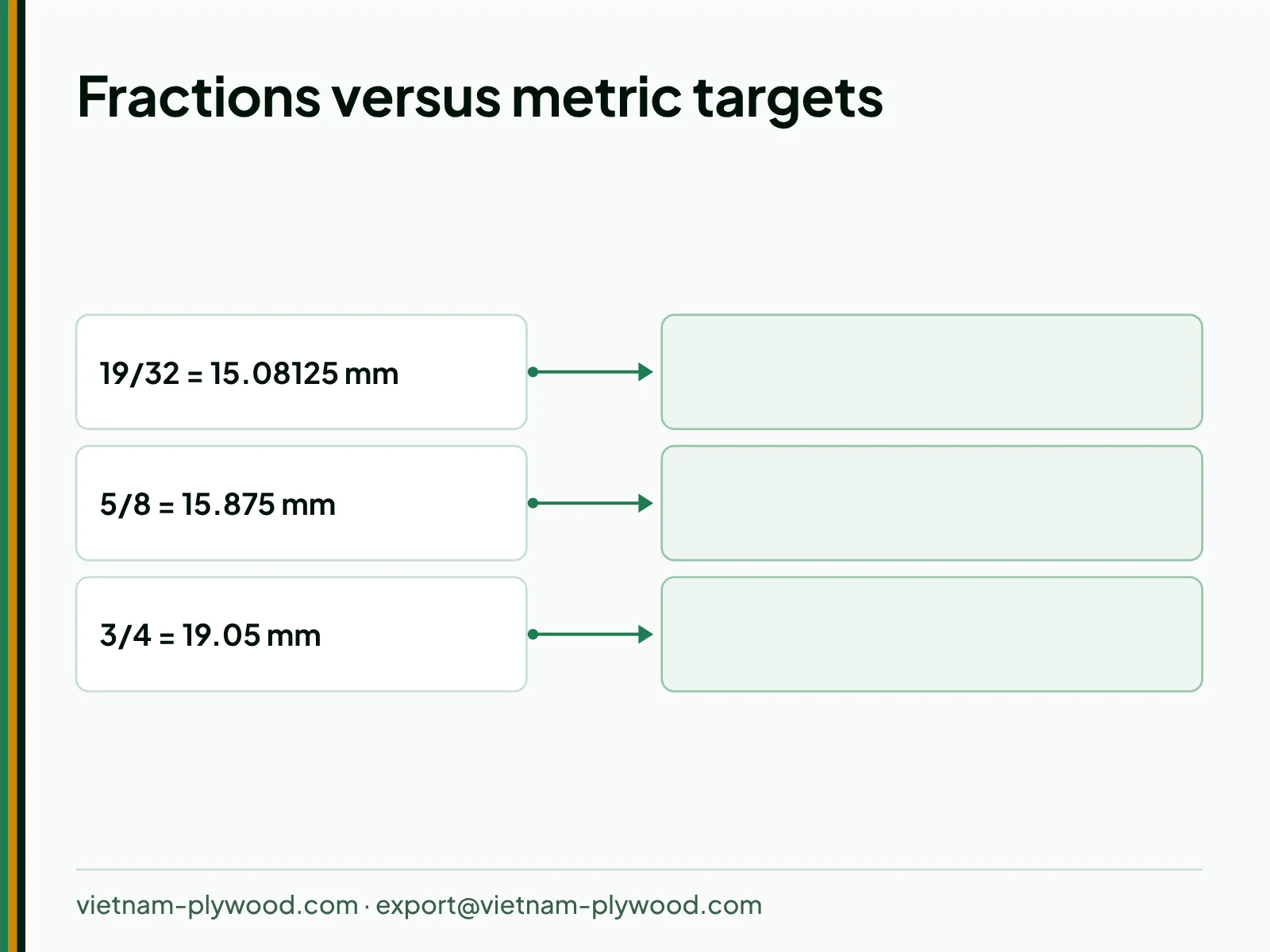
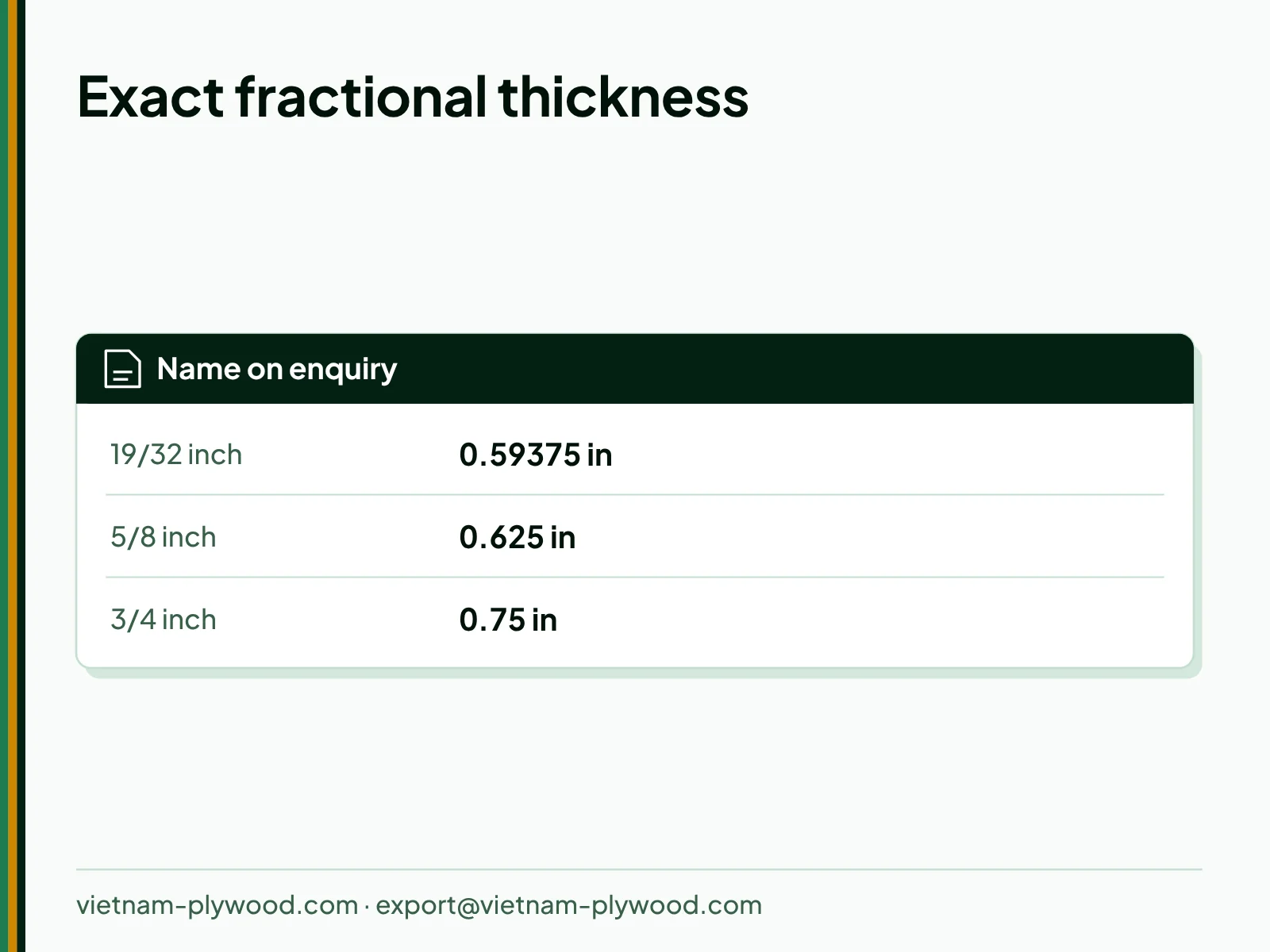
19/32 in inches is exactly 0.59375 inch, or 15.08125 mm. It describes a fractional thickness close to a 15 mm metric panel. HCPLY builds the metric specification on the producing line selected for the application. Distinguish this conversion from a North American performance category and the finished thickness accepted at inspection.
The fraction describes thickness alone; it says nothing about face quality, bonding, span capacity or emission class. A purchase order that simply says “19/32 plywood” leaves too much interpretation to the production and receiving teams.
Is 19/32 the same as 5/8 plywood?
No as exact fractions: 19/32 is 0.59375 inch, while 5/8 is 0.625 inch. Their difference is 1/32 inch, equivalent to 0.79375 mm. In some purchasing conversations, 19/32 is used as an actual-thickness reference for nominal 5/8 sheathing, but the two labels cannot replace a written acceptance band.
The standards context matters. APA – The Engineered Wood Association explains on its current plywood guidance that panels carry performance-category and decimal-thickness designations for building-code reference. A performance category is a product classification, not permission to relabel a 15 mm export panel as a structural-rated sheet. The receiving drawing and applicable test report must govern structural use. APA plywood guidance makes that distinction useful for import specifications.
What is the actual thickness of 5/8 plywood?
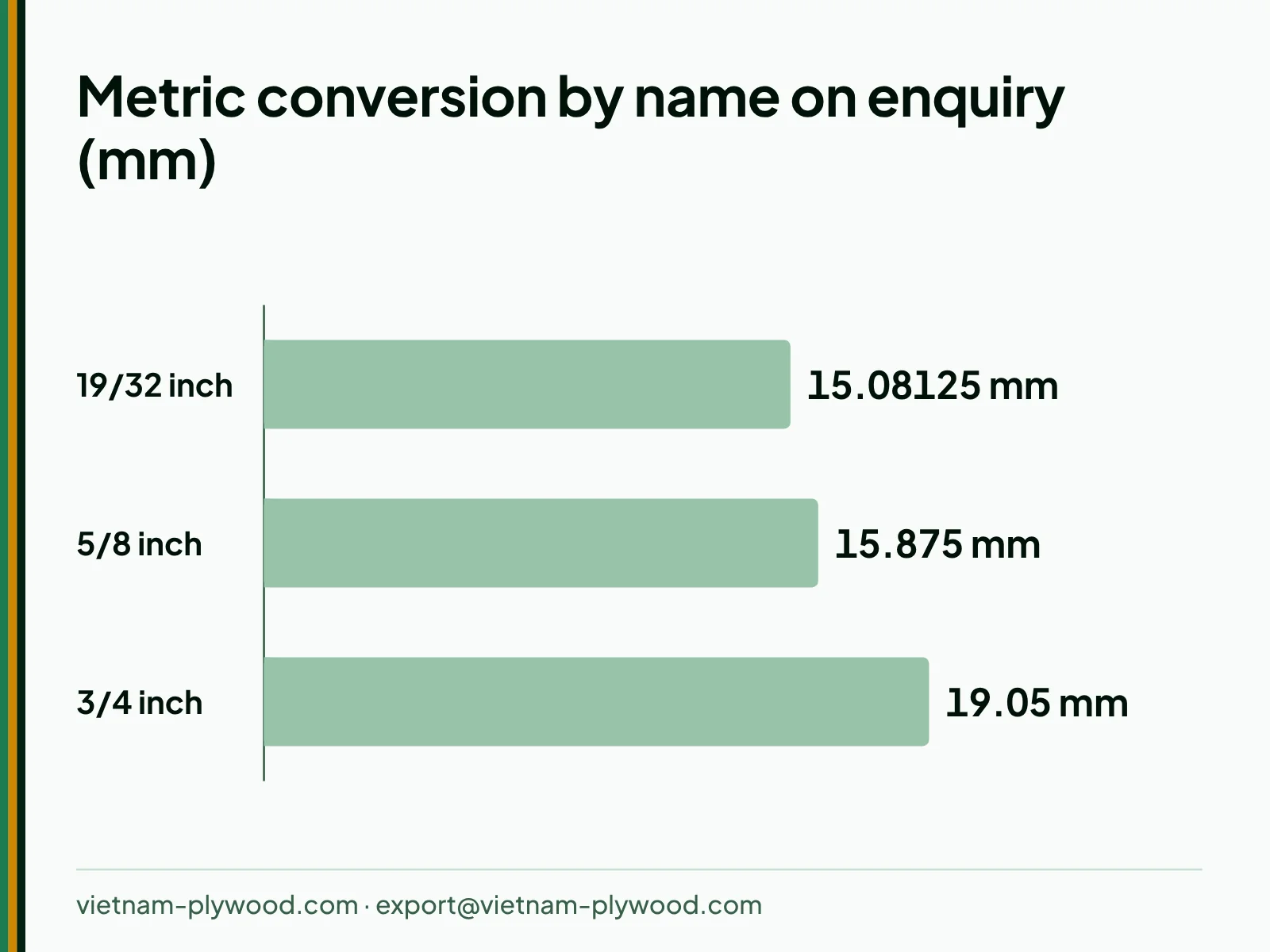
The exact arithmetic for 5/8 inch is 15.875 mm; the measured thickness of a marketed 5/8 panel is governed by its declared standard and manufacturing tolerance. A 19/32 fraction converts to 15.08125 mm. A 15 mm panel measures nominally 0.59055 inch before its tolerance is applied.
| Name on enquiry | Exact fractional thickness | Metric conversion | Purchasing verdict |
|---|---|---|---|
| 19/32 inch | 0.59375 in | 15.08125 mm | 15 mm is the nearest stated HCPLY common thickness |
| 5/8 inch | 0.625 in | 15.875 mm | Request 16 mm if the drawing requires nearly 15.9 mm |
| 3/4 inch | 0.75 in | 19.05 mm | Do not substitute 15 mm; assess a separate thicker build |
These are dimensional conversions, not strength equivalences. A panel’s actual measured value also reflects the selected sanding and inspection method.
Is 19/32 the same as 3/4?
No. Three-quarter inch is 19.05 mm, almost 4 mm thicker than the exact 19/32 fraction. Substituting 15 mm for a 3/4-inch cabinet component changes groove engagement, edge fastening geometry and assembled dimensions.
When the receiving bill of materials calls for a heavier panel, check its actual millimeter requirement rather than moving automatically to a nearby category. Our 25 mm plywood guide addresses another thicker purchasing class; the 10 mm plywood guide covers a thinner alternative. Neither replaces an engineering decision about stiffness or span.
Which metric sheet answers a 19/32 or 5/8 order?
Start with 15 mm for a request written as 19/32 inch and specify its measured acceptance band. For a literal 5/8-inch target of 15.875 mm, discuss a 16 mm build rather than assuming that a 15 mm sheet passes. Both thicknesses fall within our 3–40 mm manufacturing range; 15 mm is a common thickness.
The furniture line presses a sanded panel for cabinet and fit-out work. The commercial and packing line instead builds an acacia-core utility panel, while the construction line applies film for formwork. For the furniture build, specify face veneer and grade, core and emission class alongside the thickness. Explore furniture plywood and commercial or packing plywood for those distinct builds.
A furniture face can be bintangor, okoume, engineered veneer, gurjan, pine, poplar, eucalyptus, birch or sapele. The face names the product; density follows the core. A raw, unfaced panel is described as matt. The buyer’s drawing determines whether a decorative surface or utility finish is appropriate.
What tolerance band should a 15 mm order state?
For a sanded furniture panel, specify 15.0 ±0.2 mm or 15.0 ±0.3 mm, as ordered. That produces acceptance intervals of 14.8–15.2 mm or 14.7–15.3 mm. For commercial and film-faced panels, 15.0 ±0.5 mm gives 14.5–15.5 mm; packing at ±0.5–1.0 mm needs the agreed band stated explicitly.
The 15 mm ±0.2 mm furniture band reaches 15.2 mm at its upper edge, so it does not meet a minimum of 15.875 mm. Conversely, a component designed around 15 mm can bind in a slot machined for a different nominal thickness if the mating dimensions are left undefined.
State whether measurement takes place on the finished, sanded face or over a film surface. Agree sampling locations, instrument and rejection rule before production. The inspector can witness thickness readings across panels at the producing factory, then compare them with the signed specification.
When should a buyer ask for 16 mm instead?
Ask for 16 mm when the assembly drawing calls for 5/8 inch as a physical target, the groove or mating part expects that dimension, or the customer’s minimum thickness excludes the 15 mm tolerance band. Specify a 16 mm target and a separately agreed tolerance rather than borrowing the 15 mm tolerance without discussion.
The decision is different for a purchase description that uses “5/8” merely as a stock category. Obtain the downstream customer’s actual acceptance limits first. A 16 mm nominal sheet is 0.125 mm above the exact 5/8 fraction, whereas 15 mm is 0.875 mm below it. That difference can determine whether cabinet parts fit or a load is rejected.
For structural sheathing, roof decks or subfloors, thickness alone is insufficient. The receiving engineer must specify span, load, bond and the structural evidence accepted for the project. HCPLY panels should only be discussed against a test report the buyer accepts for any structural grade. The construction-project plywood overview explains the application distinction.
What can a buyer check at the producing factory?
A buyer or appointed inspector can check the signed thickness band on finished panels, inspect face and core construction, and review pallet labels against the order. For a sanded cabinet lot, caliper readings across the panel are especially useful because machining tolerances accumulate in the final assembly.
Also check face grade, dimensions, glue and emission fields separately. Furniture builds use E0 or E1 emission classes; the commercial and packing line uses moisture-resistant (MR) glue. Phenolic weather-and-boil-proof (WBP) glue belongs to a different bonding requirement. Neither glue name substitutes for an emissions certificate.
Ply count follows core veneer thickness rather than the fractional sales name. Core veneers are 1.4–2.0 mm, so the build schedule needs inspection alongside the finished thickness. See how many plies are in plywood for the construction principle.
How does a 15 mm order affect container planning?
At 1220×2440×15 mm, the lookup weights per sheet are 22.33 kg for styrax, 25.90 kg for acacia and 29.02 kg for eucalyptus cores. These figures exclude any film weight. Core density, rather than the decorative face, explains the difference.
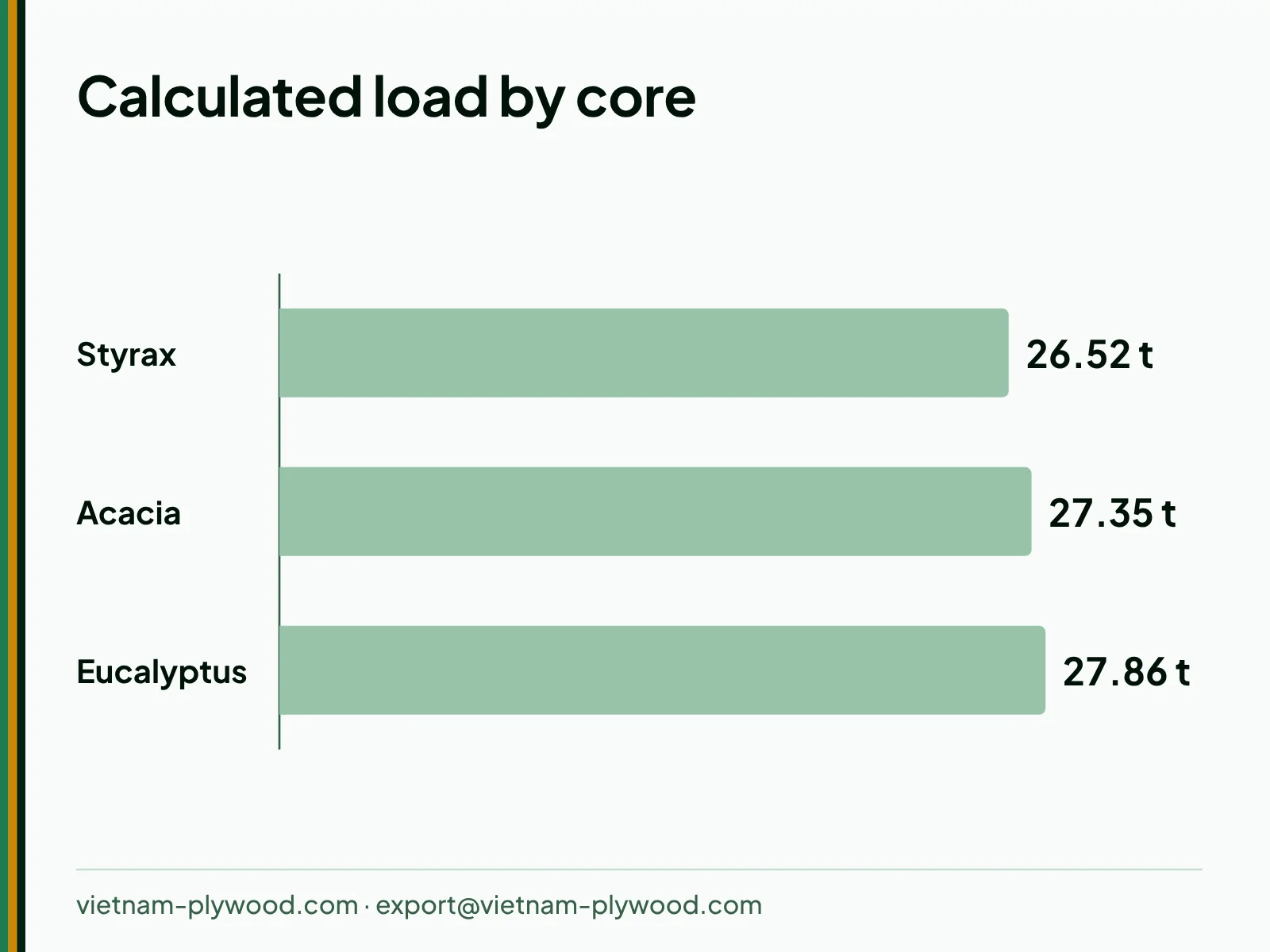
| Core | Sheets per pallet | Full 40HC sheets | Calculated load |
|---|---|---|---|
| Styrax | 66 | 1,188 | 26.52 t |
| Acacia | 66 | 1,056 | 27.35 t |
| Eucalyptus | 64 | 960 | 27.86 t |
The 40HC payload limit is 28.5 t. A minimum order is one 40HC, and specifications can be mixed within that payload limit. Use the container loading and packing reference for the complete loading topic. A mixed specification must be calculated against the actual cores and sizes before loading.
Which export details should the order carry?
The order should identify application, producing line, core, glue, emission class, face and grade, finished thickness, tolerance, sheet size, quantity and destination port. That separates the marketing fraction from the manufacturing target and the receiving inspection rule.
HCPLY coordinates specification, on-site quality control, documents and loading for FOB Hai Phong shipments; CFR (CNF) and CIF are also delivery terms. Factory lead time runs 15–45 days from receipt of the 30% deposit; the exact figure depends on order size, line loading and what the contract fixes. The balance is 70% against the scanned bill of lading, by telegraphic transfer or irrevocable letter of credit at sight.
The shipment document set includes commercial invoice, packing list, bill of lading, certificate of origin, phytosanitary and fumigation papers, plus agreed certificate and test documents. EUR.1 and the EUTR/EUDR file set apply to European Union lots; insurance applies under CIF. After loading, the draft shipping documents come to you for approval. Member-factory FSC, CARB P2, ISO 9001 and CE certificates are shown with factory details masked, on request.
What should the buyer send before production?
Send the metric thickness target and acceptance band with the application drawing. If the customer’s order says “5/8,” state whether that means the 19/32 market shorthand, the exact 15.875 mm dimension or a separate performance category. That clarification protects machining and receiving inspection.
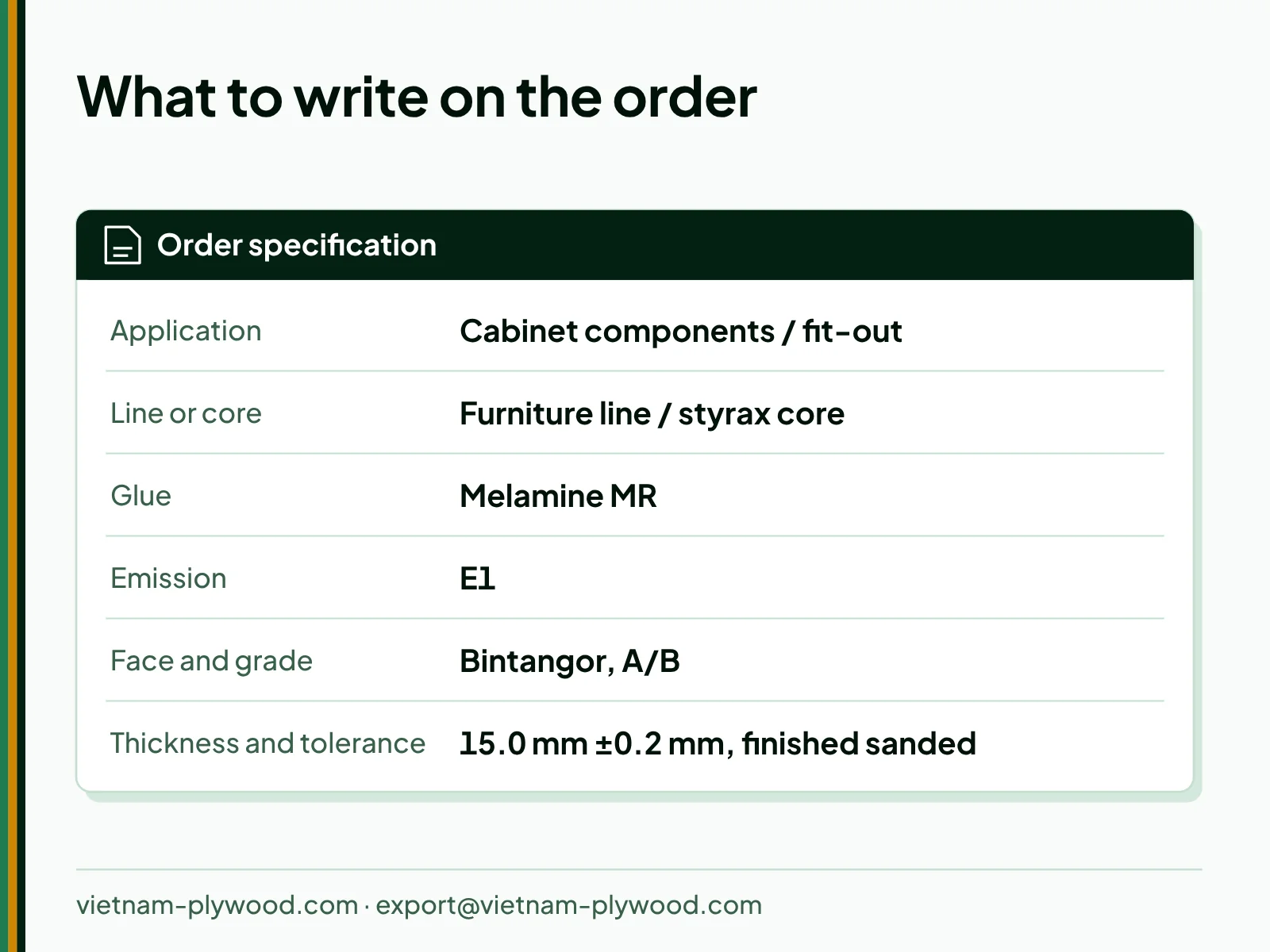
For a 15 mm furniture enquiry, use this starting specification and change the fields to match the intended build:
Application: cabinet components / fit-out
Line or core: furniture line / styrax core, full stitched
Glue: melamine MR
Emission: E1
Face and grade: bintangor, A/B
Thickness and tolerance: 15.0 mm ±0.2 mm, finished sanded
Size: 1220 × 2440 mm
Quantity: one 40HC, final mix by payload
Destination port: [buyer to specify]
Book a factory visit through Lucy at HCPLY (export@vietnam-plywood.com) to inspect the producing factory and agree the finished-panel measurement method.