





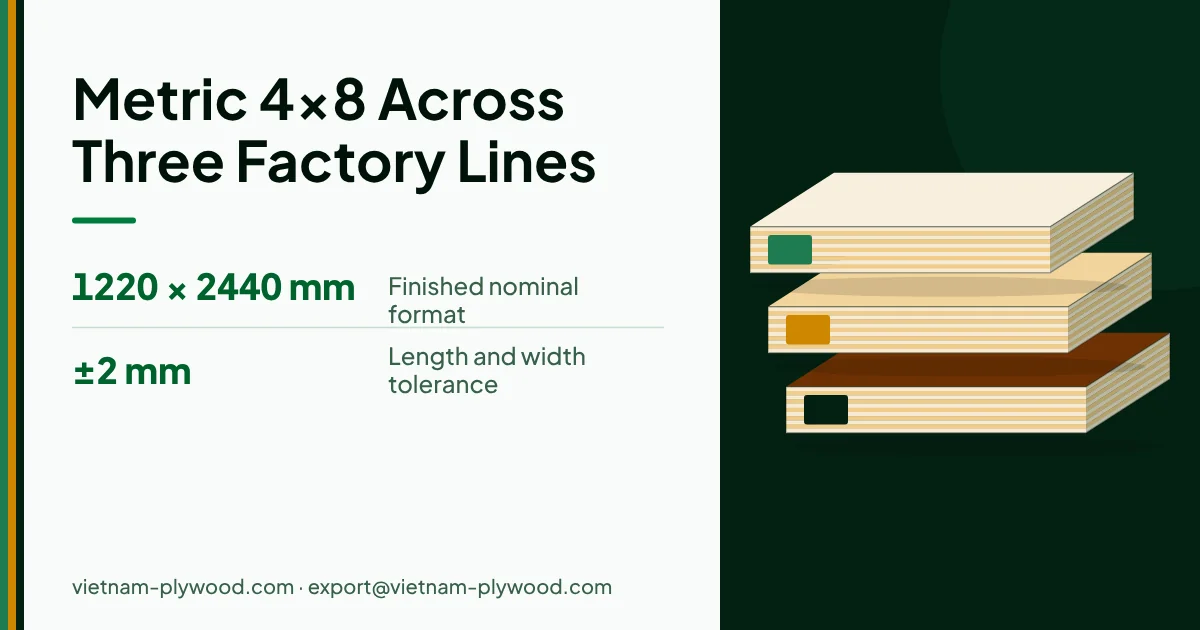
Asia presses 1220 x 2440 mm panels because the metric 4x8 format fits established cutting and distribution requirements. Choosing the wrong finished size can waste cutting stock, delay production or cause a rejected load. HCPLY makes 2440 x 1220 plywood through distinct furniture, commercial and construction builds, so the dimensions alone cannot define the order.
Is 2440 x 1220 plywood the same as 4x8?
2440 x 1220 plywood is the metric trading format commonly called 4x8 plywood. Its finished dimensions are 1220 mm wide and 2440 mm long. Four feet by eight feet converts to 1219.2 by 2438.4 mm, so the names are close but not dimensionally identical. Specify the metric finished size on purchase orders and inspection sheets.
The panel covers 2.9768 m² before trimming. The length and width tolerance for our panels is ±2 mm. A factory drawing should identify the nominal dimensions, allowed deviations and whether the buyer measures the finished panel before any subsequent cutting.
For dimensional terminology and adjacent formats, see plywood sheet dimensions and the focused 4x8 actual-size comparison. These distinctions matter when a nesting program expects millimetres but an order contains only the words “four by eight.”
Which line presses the 1220 x 2440 build?
The application determines the producing line, even when the finished size and nominal thickness are identical. HCPLY has three member factories in Phu Tho and Hai Phong, with the order produced and inspected at the factory matching its specification.
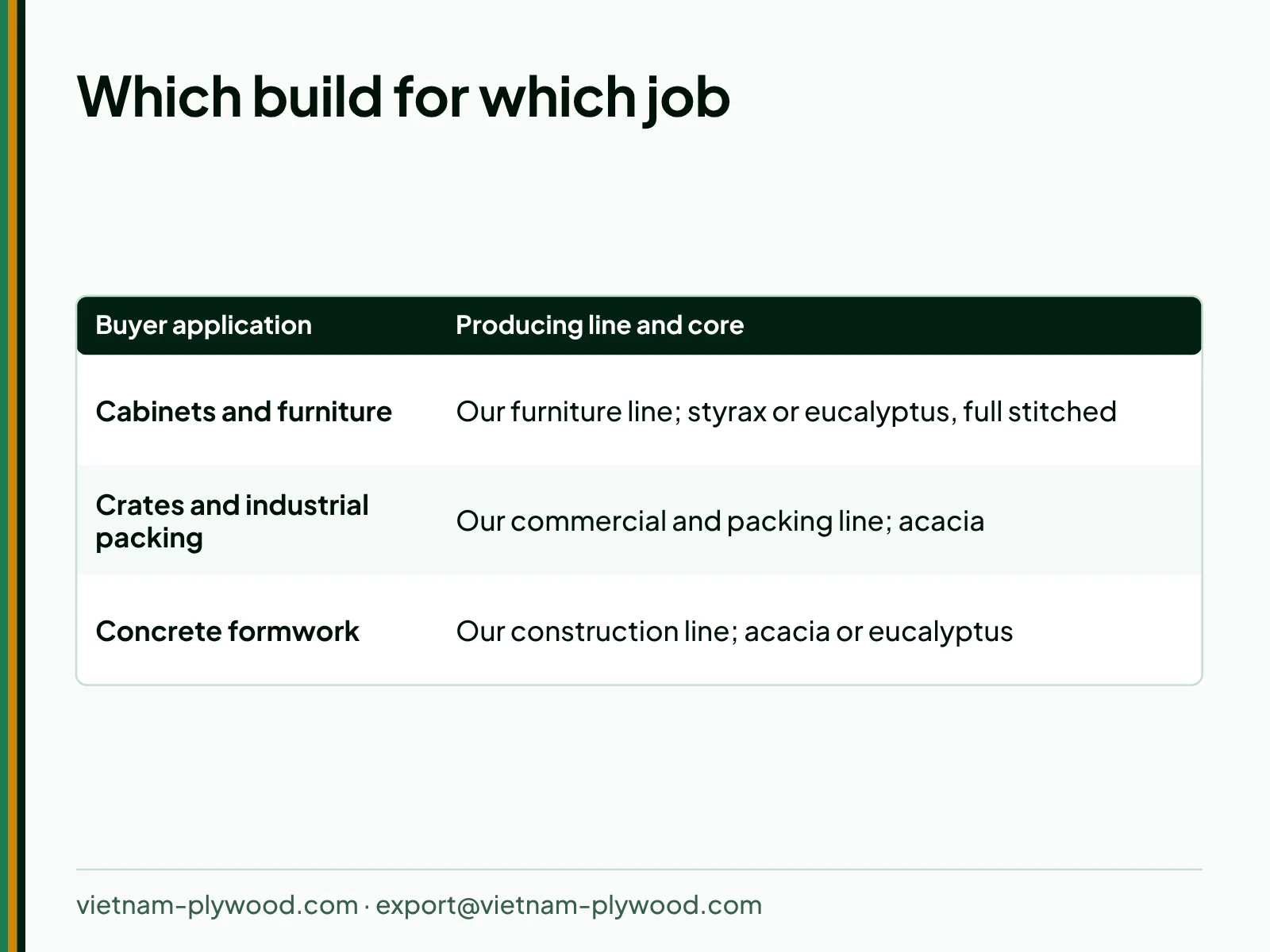
| Buyer application | Producing line and core | Face and finish | Thickness tolerance | Buying verdict |
|---|---|---|---|---|
| Cabinets and furniture | Our furniture line; styrax or eucalyptus, full stitched | Sanded decorative veneer | ±0.2 or ±0.3 mm as ordered | Choose for visible components and calibrated cutting |
| Crates and industrial packing | Our commercial and packing line; acacia | Raw matt or specified commercial face, unsanded or light-sanded | Commercial ±0.5 mm; packing ±0.5–1.0 mm | Choose for packaging and non-decorative parts |
| Concrete formwork | Our construction line; acacia or eucalyptus | Phenolic or melamine film, including anti-slip film | ±0.5 mm | Choose for form-contact surfaces or grip requirements |
A buyer asking for sanded cabinet faces should start with our furniture line. The commercial line would instead build an acacia-core packing or utility panel; the construction line would build a film-faced panel for formwork. These products cannot be substituted solely because all three measure 1220 x 2440 mm.
What thickness and ply construction should buyers write?
HCPLY produces thicknesses from 3 to 40 mm; common orders use 3, 5, 9, 12, 15, 18, 21 or 25 mm. Cabinet backs and drawer components can call for thinner panels, while cabinet carcasses, shelving and work surfaces often require a thicker construction selected against their loading and fixing details.
For 18 mm panels, the build uses 11–13 plies because individual core veneers are 1.4–2.0 mm thick. Ply count alone does not describe the quality of the inner layup. Full-stitched core construction offers a different edge and machining result from stitched outer layers with edge-trimmed inner veneers, finger-jointed construction or loose-laid cores.
Specify both the finished thickness and its tolerance. A nominal 18 mm sheet with a packing-grade tolerance is a different purchase from a sanded cabinet panel ordered at ±0.2 mm. A cabinet CNC line should check its tooling clearance and edge-banding allowance against the finished thickness range.
Which face, core and glue belong on the specification?
Face veneer names the visible product; core species determines the density used for loading calculations. Available faces include bintangor, okoume, engineered veneer (EV), gurjan, pine, poplar, eucalyptus, birch and sapele. Matt denotes an unfaced raw core. Common decorative face veneer thickness is 0.2–0.4 mm.
Face grades are A/B, except birch faces, which use D/E/F. A birch face therefore does not imply a birch core: we do not press birch-core plywood. The core choices are styrax, acacia and eucalyptus, with densities of 500, 580 and 650 kg/m³ respectively.
Write glue and emission as separate fields. Melamine glue is moisture resistant (MR) with a 12-hour boil designation; phenolic glue is weather and boil proof (WBP) with a 72-hour boil designation. E0, E1 and E2 are emission classes, while CARB P2 / TSCA Title VI concerns a US emission limit and third-party certification.
The furniture line uses E0/E1 options. A buyer requesting a specific emission outcome should identify the agreed build and relevant evidence rather than treating a glue label as an emission certificate.
How does 1220 x 2440 compare with 1250 x 2500?
The 1250 x 2500 mm panel provides more surface area, but a 1220 x 2440 mm panel can give higher usable cutting yield when parts and equipment are designed around 4x8 stock.
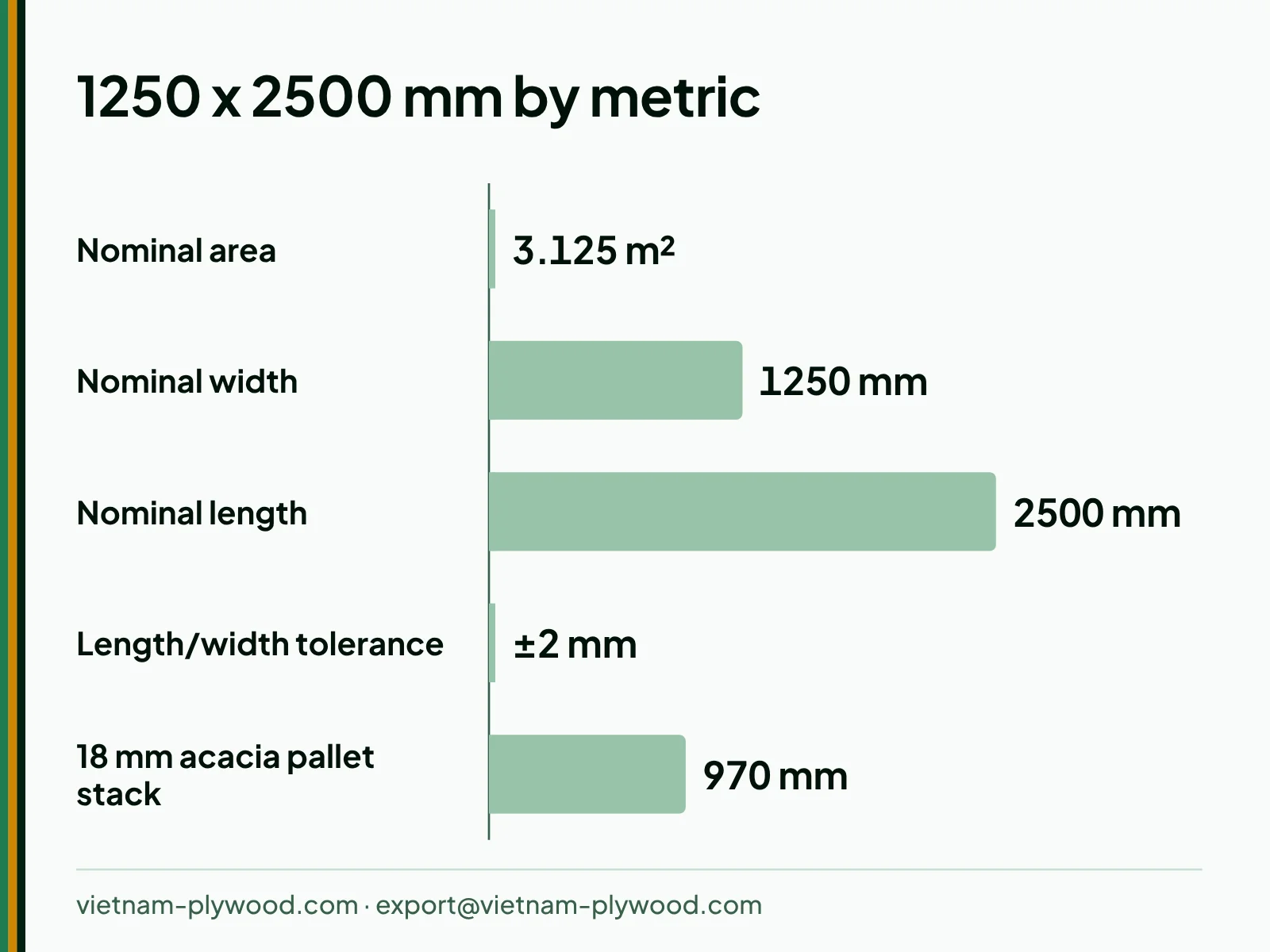
| Metric | 1220 x 2440 mm | 1250 x 2500 mm | Decision by use |
|---|---|---|---|
| Nominal area | 2.9768 m² | 3.125 m² | Larger sheets give more gross area |
| Nominal width | 1220 mm | 1250 mm | Match saw bed and nesting layout |
| Nominal length | 2440 mm | 2500 mm | Match longest component and trim allowance |
| Length/width tolerance | ±2 mm | ±2 mm | Include the tolerance in drawings |
| 18 mm acacia pallet stack | 1000 mm | 970 mm | Loading plan differs by format |
Run the same parts list through both nesting layouts. Compare finished usable pieces, offcuts, edge-trimming requirements and machine handling rather than selecting the larger area automatically. For other formats, see 5x10 plywood sheets and sheet sizes by market.
What changes when core density enters the container plan?
An 18 mm 1220 x 2440 sheet weighs 26.79 kg with styrax core, 31.08 kg with acacia and 34.83 kg with eucalyptus, excluding film weight. The heavier core changes how many pallets can be loaded within the 28.5 t 40HC payload limit.
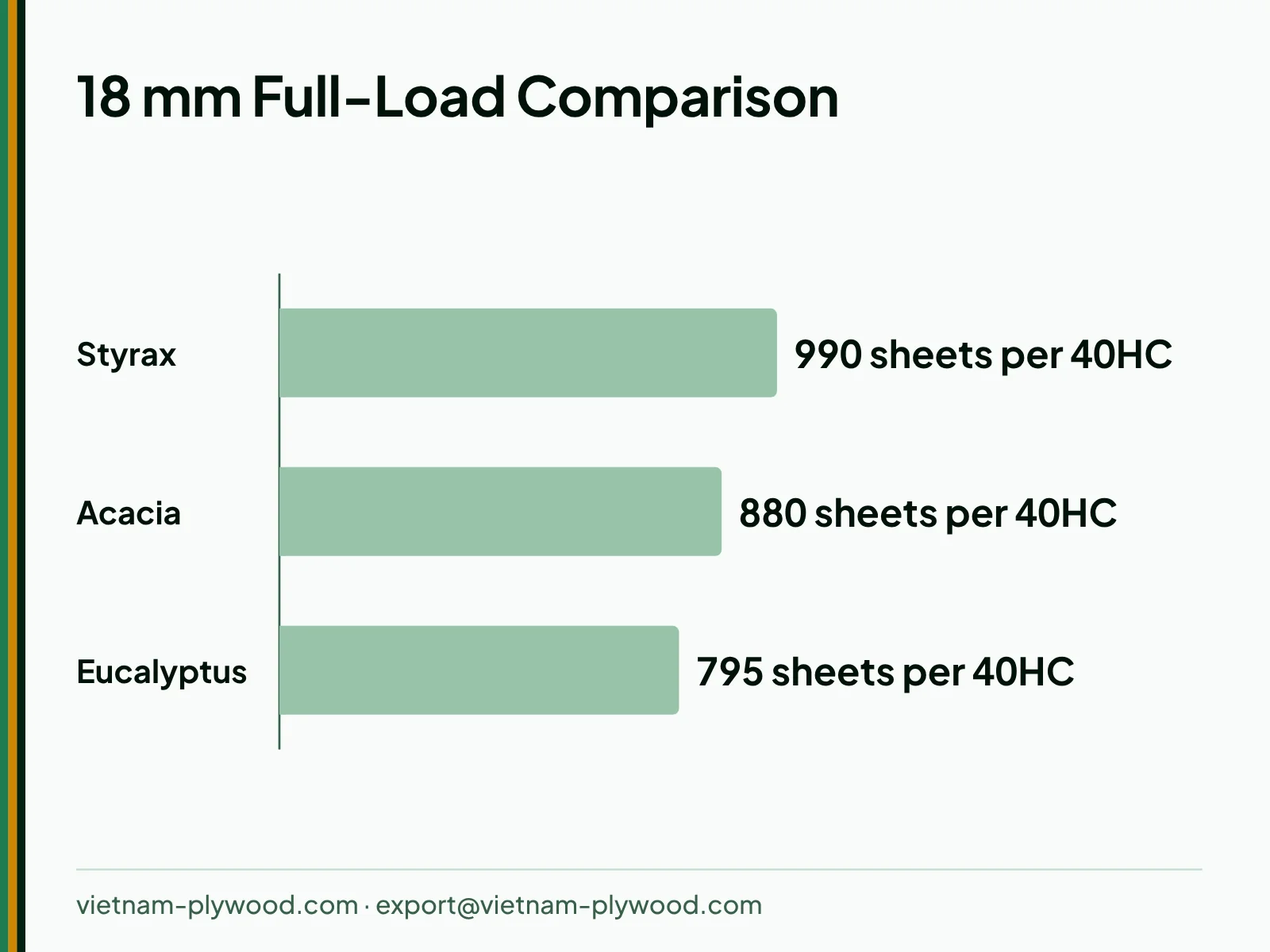
The calculated full 40HC loads are 990 sheets and 26.52 t for styrax, 880 sheets and 27.35 t for acacia, or 795 sheets and 27.69 t for eucalyptus. These are distinct full-load cases, rather than quantities to add together. The corresponding pallet counts are 18, 16 and 15.
Mixed specifications can share a container, but the sum of their panel and packing weights must remain within the payload allowance. For a mixed trial, start with the per-sheet weights, multiply each by its allocated sheet count, and review the pallet arrangement. The mixed-container planning page covers specification combinations; the container-load reference owns full packing calculations.
How should a factory inspection check the order?
A factory inspection should compare the signed specification against panels from the actual producing run. Buyers visit the factory office and inspect goods at the producing factory, where dimensions, face grade and core edges can be examined together.
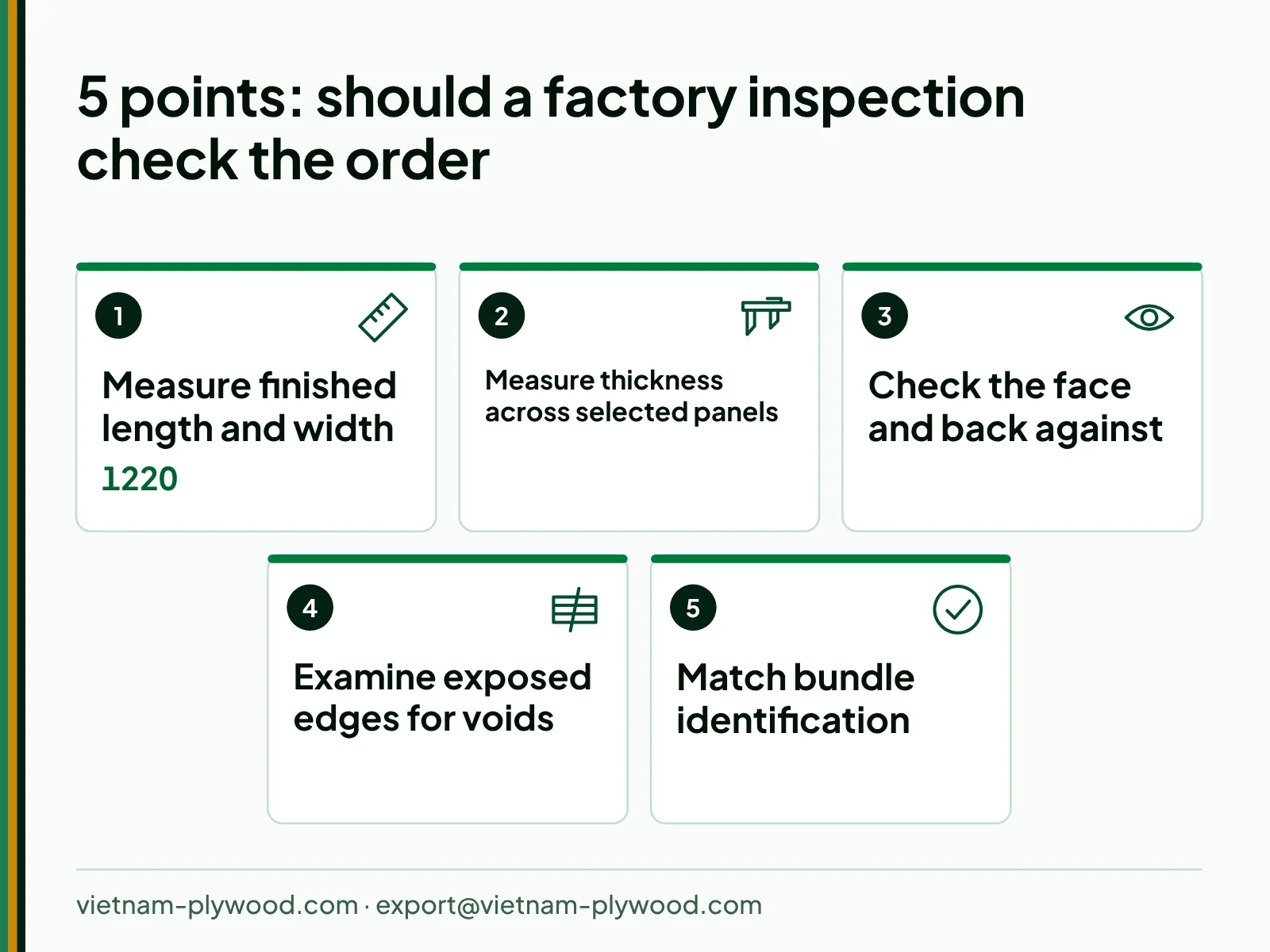
- Measure finished length and width at several positions and compare them with 1220 x 2440 mm and the ±2 mm tolerance.
- Measure thickness across selected panels, using the tolerance written for the line and finish.
- Check the face and back against the agreed veneer species, face grade, sanding or film description.
- Examine exposed edges for voids, overlaps and the agreed core construction; compare any retained sample with the production lot.
- Match bundle identification, panel counts and the loading record against the packing list before dispatch.
For film-faced panels, distinguish the 120 g/m² standard film, 135 g/m² premium film and 220 g/m² anti-slip film. Inspect cut edges and handling conditions separately from film appearance. Flat, supported storage under cover helps protect finished faces and edges while awaiting use.
What documents support the shipment and destination?
The shipment’s packing list records the quantities and dimensions that the buyer checks against the loaded bundles. The export document set also includes the commercial invoice, bill of lading (B/L), certificate of origin, phytosanitary and fumigation papers, and agreed product certificate documents. Insurance is included under CIF; EU lots include EUR.1 and the EUTR/EUDR file set. After loading, the draft shipping documents come to you for approval.
For US-bound decorative plywood, emission documentation should be matched to the actual agreed panel build. For EU-bound goods, keep the timber traceability documents linked to the relevant shipment and buyer requirements. The 2026 US Code of Federal Regulations, Title 15, Part 746, lists plywood and veneered panels in multiple 4412 tariff descriptions; a tariff heading describes a product category rather than certifying its performance (US Government Publishing Office, 2026).
FSC, CARB P2, ISO 9001 and CE documents belong to the relevant member factories and are shown with factory details masked, on request. For structural or marine applications, any grade claim must be evaluated against a test report the buyer accepts.
What sets the quotation for a metric 4x8 panel?
Commercial plywood starts from US$250/m³ FOB Hai Phong (October 2026); furniture plywood starts from US$350/m³ FOB Hai Phong (October 2026). The written build determines which starting category applies and what the final quotation covers.
The largest specification differences are the intended line and core construction, followed by decorative face selection, sanding and tighter tolerance, glue system, and the required documentation. A full-stitched, sanded furniture build costs more than a basic unsanded packing build because it needs additional core preparation and finishing. Film-faced construction builds require their own quotation against film weight, glue and core choice.
Minimum order is one 40HC. Factory lead time runs 15–45 days from receipt of the 30% deposit; the exact figure depends on order size, line loading and what the contract fixes. The remaining 70% is paid on the scan of the bill of lading, by T/T, or by irrevocable sight L/C. We ship FOB Hai Phong, or CFR (CNF) or CIF to your port. For scheduling context, see plywood production lead time.
How should a buyer write the cutting and order brief?
The order brief should connect application, factory build and finished-size acceptance criteria. Begin with the parts drawing and required edge finish, then choose the core, face, bond and tolerance. If parts are nested tightly, include saw kerf and trim allowance in the buyer’s own cutting layout.
A 1220 x 2440 panel is also available for custom cutting. State whether the order is for full sheets or pre-cut components, and keep the finished size explicit in either case. Cut-to-size plywood and the Vietnam plywood size overview provide adjacent planning detail.
Free samples are available; a first-time buyer pays the courier, and that charge comes off the first confirmed order. A sample review should cover the exact finish and tolerance that the purchasing team intends to repeat at scale.
What is the next step for a trial container?
A trial container should test one clear specification against the buyer’s cutting and receiving checks. Send the following lines to Lucy at export@vietnam-plywood.com, then agree the factory inspection points and shipment destination.
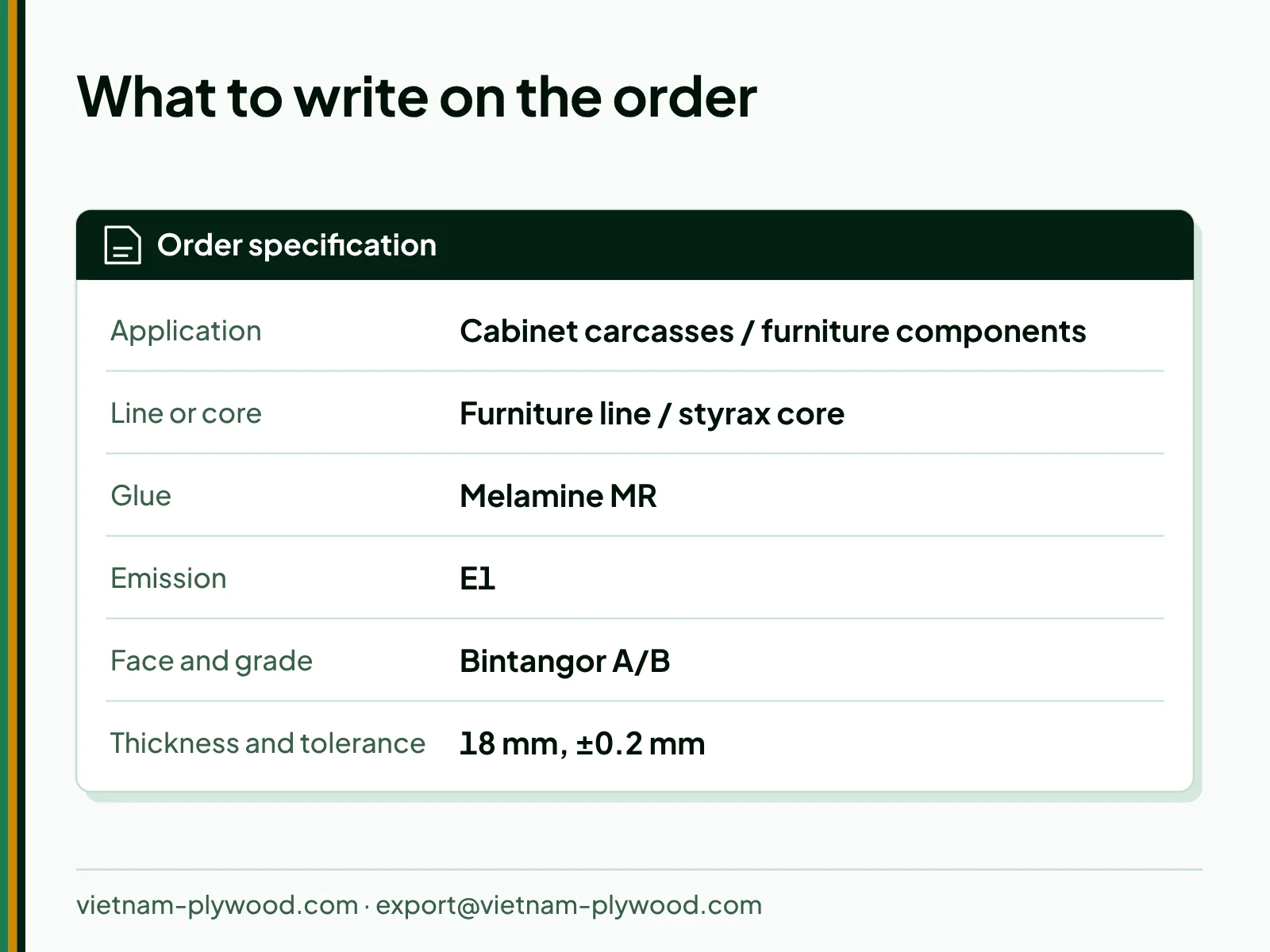
Application: cabinet carcasses / furniture components
Line or core: furniture line / styrax core
Glue: melamine MR
Emission: E1
Face and grade: bintangor A/B
Thickness and tolerance: 18 mm, ±0.2 mm
Finished size: 1220 x 2440 mm, length/width ±2 mm
Quantity: one 40HC, sheet count agreed by load plan
Destination port: [buyer to specify]
Plan a trial container through contact with the cutting drawing and inspection checklist attached.