





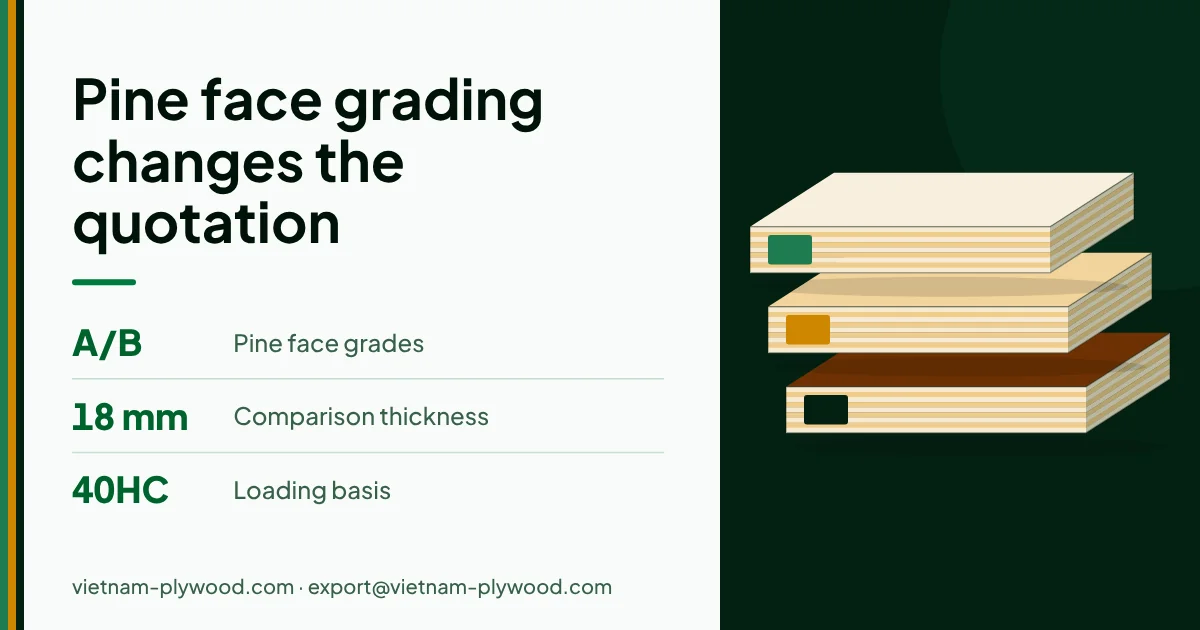
Pine plywood price is driven by knot acceptance, face grade, core build and the amount of usable panel shipped per container. Choosing an unsuitable face rule can add sorting cost or lead to a rejected load. HCPLY quotes pine-faced panels against a written specification rather than a generic sheet label.
What determines pine plywood price?
Pine plywood price follows the face appearance specification first, then the core construction, finishing work and shipment configuration. A clean, tightly controlled pine face costs more to sort than a character face accepting sound knots. Full-stitched sanded furniture construction also costs more to prepare than a simpler commercial core. A meaningful comparison holds thickness, sheet size, face/back rules, glue and emission class constant.
Pine-faced plywood combines a pine veneer with a Vietnamese core; the face name does not mean pine runs through every ply. At HCPLY, the visible veneer is commonly 0.2–0.4 mm, while core veneers are 1.4–2.0 mm. A buyer comparing two pine plywood prices should ask whether both quotes describe the same face, back and core. For broader export-cost categories, see Vietnam plywood export cost factors.
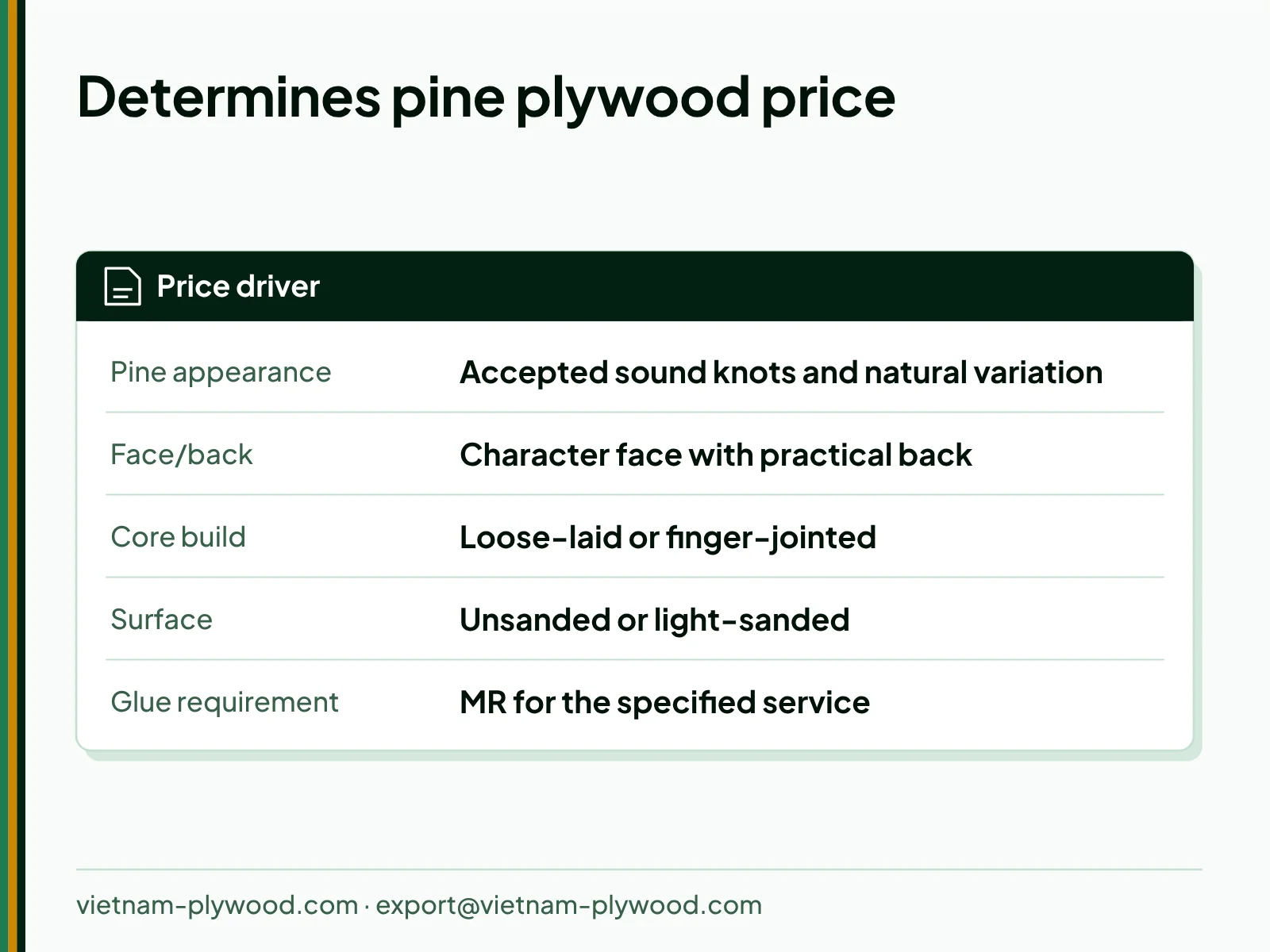
| Price driver | Lower-cost specification | Higher-cost specification | Why the quotation changes |
|---|---|---|---|
| Pine appearance | Accepted sound knots and natural variation | Tighter knot and colour selection | More face sorting and lower veneer yield |
| Face/back | Character face with practical back | A/B appearance requirement on visible faces | More selective veneer allocation |
| Core build | Loose-laid or finger-jointed | Full stitched | Extra preparation and continuity control |
| Surface | Unsanded or light-sanded | Fully sanded and calibrated | Added processing and tighter thickness control |
| Glue requirement | MR for the specified service | Phenolic WBP when required | Different bonding system and process |
| Load composition | One repeatable specification | Several specifications and pallet patterns | Different production and loading arrangements |
These are relative drivers, not fixed surcharges.
Is pine plywood expensive?
Pine-faced plywood is expensive when the buyer pays for cleaner veneer than the finished application needs. A cabinet front with a clear finish calls for more selective face grading than a concealed component. Comparing pine with another face species without holding core, sanding and knot rules constant does not isolate the face premium.
HCPLY’s dated category starting points are from US$250/m³ FOB Hai Phong (October 2026) for commercial plywood and from US$350/m³ FOB Hai Phong (October 2026) for furniture plywood. These are category starting prices, not pine-specific offers. A pine-faced order receives a quotation against its written build; there is no separate pine price figure here.
The furniture-grade plywood cost comparison helps separate appearance requirements from construction requirements.
How does pine face grade change the quote?
Face grade changes price through veneer selection, defect acceptance and matching work. Our pine faces use A/B grades; the buyer should describe the appearance required on each side rather than relying on a grade letter alone. An A face with a controlled visual field needs a different selection process from a B face accepting more character.
For clear-coated doors, specify the permissible knot pattern, colour spread, grain movement and repaired areas.
Record whether natural resin features, mineral streaks, open splits and filled repairs are accepted. The inspection team can then apply the same written rule to the production lot. A grade name without a sample leaves room for a costly disagreement at unloading.
The 2023 APA publication describing PS 1-22 lists veneer grading, panel construction and workmanship among structural plywood standard subjects. That framework illustrates why appearance, construction and bonding are separate specification questions; We’s pine-faced furniture and commercial panels are not presented as PS 1-22 structural-graded products. APA’s 2023 standard overview provides the scope.
How do knot rules affect a pine plywood quote?
Knot rules change the yield of usable pine veneer and the consistency of the visible result. A rule allowing tight, sound knots is easier to meet than a rule excluding every visible knot. Open holes, loose knots and patched defects need their own acceptance limits, because they behave differently under sanding and finishing.
Write knot requirements as observable acceptance criteria: whether knots must remain sound, whether repairs are permitted, where visible knots can occur and how many are acceptable on the exposed face. Do not substitute vague labels such as premium or rustic for these conditions.
A practical factory check places the approved reference beside randomly selected sheets under consistent lighting. Inspectors look across the entire face, then check edges and repairs before recording acceptance. When both sides are specified, turn the sheet and inspect the back against its own rule.
Which production line makes the difference?
Our furniture line presses pine-faced panels on styrax or eucalyptus cores with full stitching, sanding and E0/E1 emission classes. Our commercial and packing line uses an acacia core with moisture-resistant (MR) glue and unsanded or light-sanded surfaces. Our construction line makes film-faced and anti-slip panels for formwork rather than a pine decorative face.
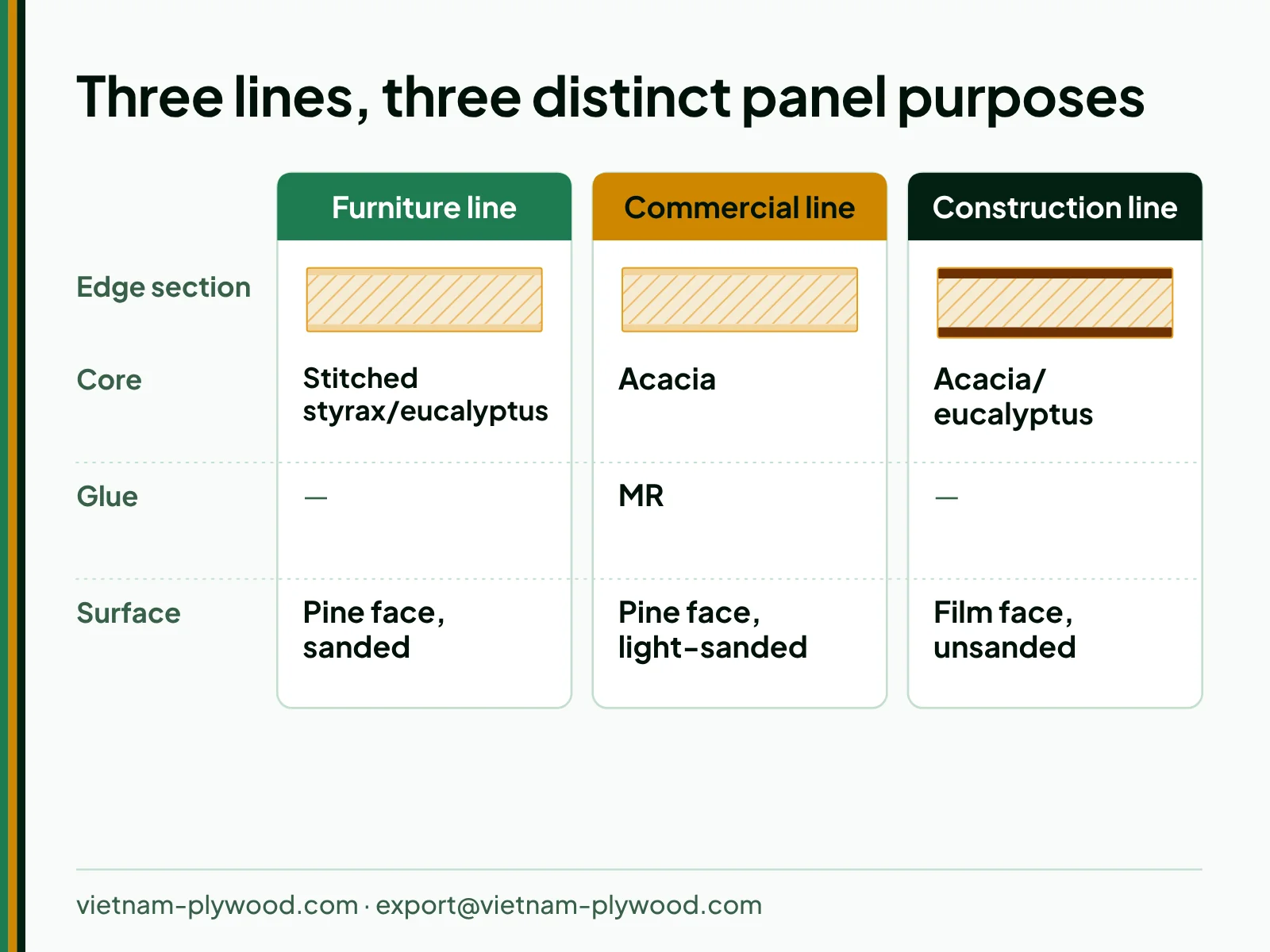
| Same nominal 18 mm need | Core and face route | Surface and tolerance | Appropriate buying decision |
|---|---|---|---|
| Visible cabinet face | Pine on styrax or eucalyptus, furniture line | Sanded, ±0.2 or ±0.3 mm as ordered | Select for visible finish and fitting control |
| Commercial interior or packing component | Pine-faced acacia build on commercial line | Unsanded or light-sanded, ±0.5 mm | Select when appearance rules permit simpler preparation |
| Concrete formwork deck | Acacia or eucalyptus, construction line, film face | Unsanded, ±0.5 mm | Select film surface for release and site handling |
The producing factory follows the specification and loads its own finished order. We coordinates specification, on-site quality control, shipping papers and loading from our three factories in Phu Tho and Hai Phong. Explore our plywood manufacturing scope for the wider range.
Does core species change cubic metres per container?
Core species changes density and therefore the weight of a full container, even when the pine face and nominal thickness stay unchanged. For 18 mm sheets at 1220 × 2440 mm, the 40HC loading reference is 990 styrax-core sheets, 880 acacia-core sheets or 795 eucalyptus-core sheets.
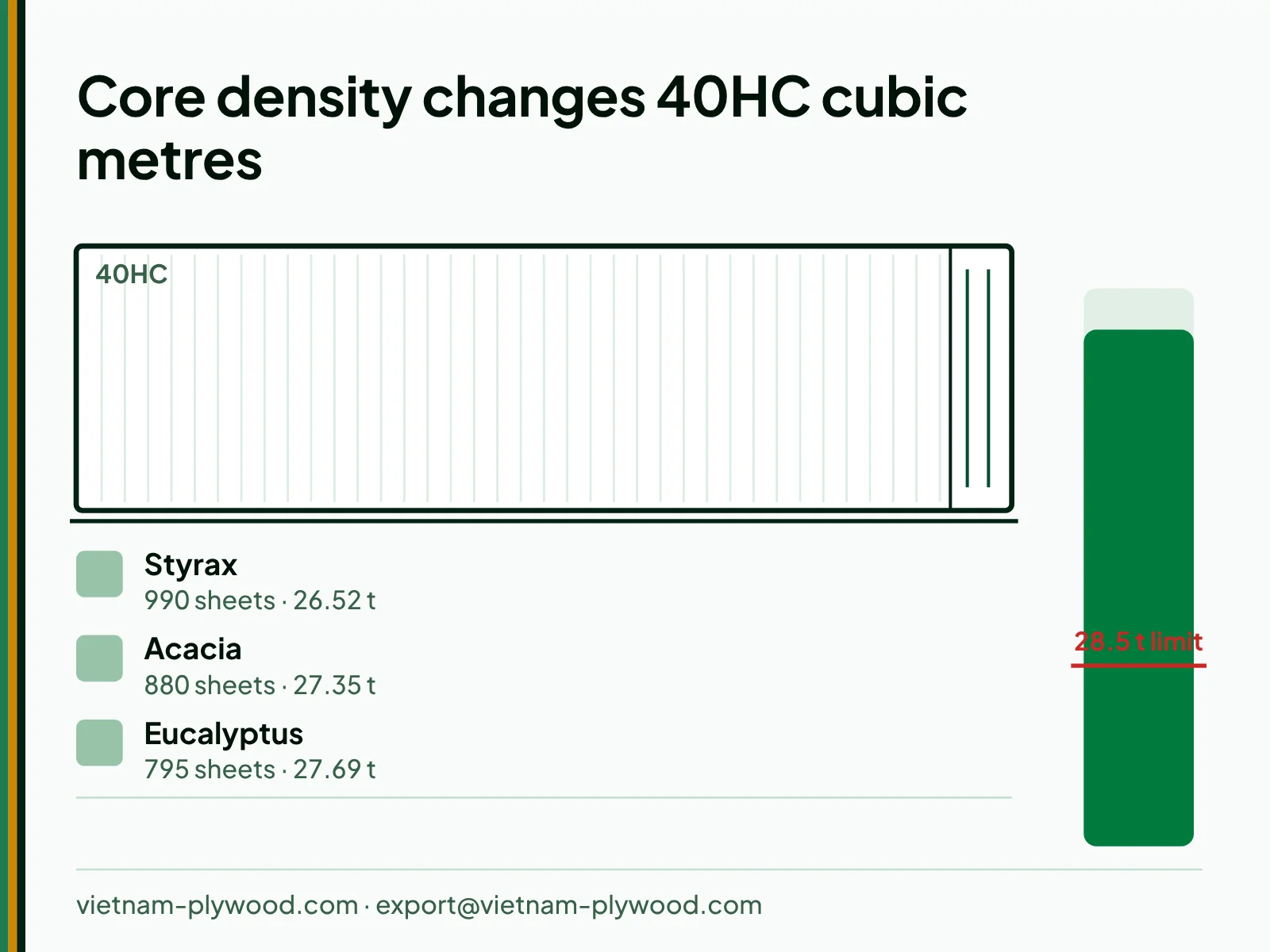
| Core | Density | 18 mm sheet weight | Sheets per 40HC | Volume | Load weight |
|---|---|---|---|---|---|
| Styrax | 500 kg/m³ | 26.79 kg | 990 | 53.05 m³ | 26.52 t |
| Acacia | 580 kg/m³ | 31.08 kg | 880 | 47.15 m³ | 27.35 t |
| Eucalyptus | 650 kg/m³ | 34.83 kg | 795 | 42.60 m³ | 27.69 t |
These reference figures exclude the face film weight and follow the specified pallet patterns. The 40HC payload ceiling is 28.5 t. A buyer should compare total cubic metres delivered alongside the price per cubic metre, because a denser core changes the physical load available for a given container.
The same container can carry mixed specifications within its payload limit. For example, the reference sheet weights allow a buyer to calculate the planned weight of a proposed mix before the pallet layout is fixed; final pallet quantities must also respect the physical stacking pattern. The dedicated container loading guide covers load counts in detail.
How is pine plywood priced per m³ FOB?
A pine plywood FOB price per cubic metre is the quoted goods value for a specified panel build under Free on Board terms at Hai Phong. The buyer should compare the same face grade, core, adhesive, dimensions and tolerance, then check whether the quote is per cubic metre rather than per sheet.
For the order, list sheet length, width and nominal thickness in metres and multiply by the ordered sheet quantity to establish nominal cubic metres. The quoted unit value then applies to that agreed volume.
FOB Hai Phong is different from Cost and Freight (CFR/CNF) or Cost, Insurance and Freight (CIF). An importer comparing landed costs should keep destination charges and route costs in a separate calculation. See UK plywood price considerations when comparing import quotations for that market.
For an 18 mm pine plywood price enquiry, the 18 mm thickness alone is insufficient. State whether the face is visible, which core is required and whether the panel will be machined to close cabinet tolerances.
What do glue, emissions and tolerances add?
Glue performance, emission class and dimensional tolerance are independent fields in a pine plywood specification. Our MR melamine glue is associated with a 12-hour boil condition, while phenolic weather-and-boil-proof (WBP) glue is associated with a 72-hour boil condition. Neither glue name establishes an emission class.
Emission classes E0, E1 and E2 describe a different requirement. CARB Phase 2 and TSCA Title VI concern a US emission limit with third-party certification. The buyer should specify the target market and required evidence, rather than asking for an undefined low-emission glue. Factory certificates for applicable orders are shown with factory details masked, on request.
Furniture sanding supports an ordered thickness tolerance of ±0.2 or ±0.3 mm; commercial plywood uses ±0.5 mm. Length and width tolerance is ±2 mm. A cabinet maker machining repeated components may value the tighter thickness specification, while a less sensitive component can use the commercial finish.
What should a buyer inspect before loading?
The buyer should witness pine-face grading, core construction, thickness measurement and pallet identification at the producing factory. Start with the approved appearance reference, then compare actual panels from different packs. Check the exposed face for knot acceptance, open defects and permitted repairs; inspect the reverse separately.
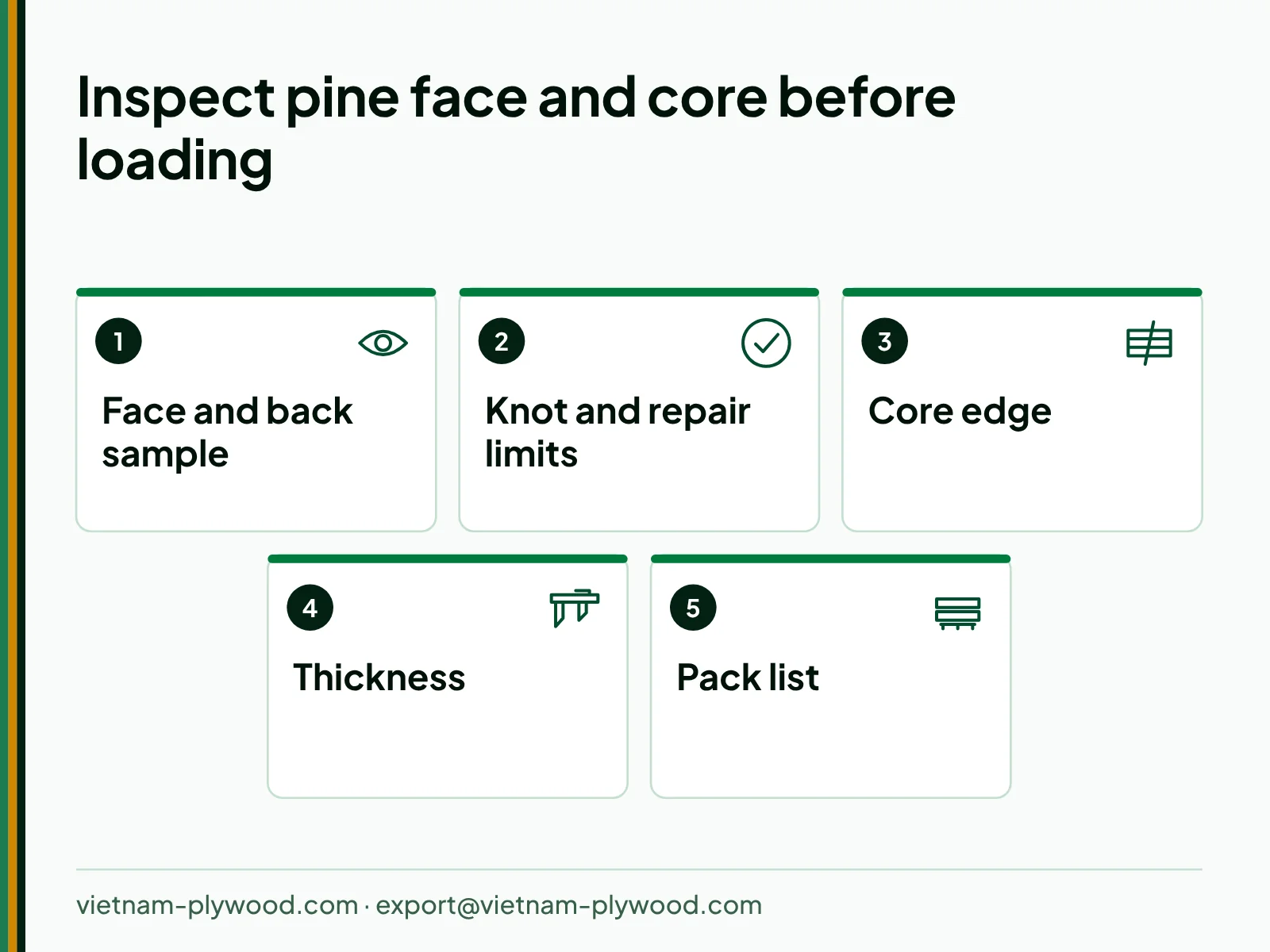
Next, inspect a cut edge to see veneer alignment and the agreed core construction. Measure thickness at agreed locations using a calibrated instrument, recording the specified tolerance. Finally, match pack labels, dimensions and quantities to the packing list before container loading.
We arranges on-site quality control and the buyer can visit the factory office and inspect the goods at the producing factory.
How do ordering and shipping documents work?
A pine-faced order starts at one 40HC, with different specifications able to share the load within the payload limit. Factory lead time runs 15–45 days from receipt of the 30% deposit; the exact figure depends on order size, line loading and what the contract fixes. The balance is 70% against the scanned bill of lading (B/L), by telegraphic transfer (T/T) or irrevocable letter of credit at sight.
The shipment document set includes the commercial invoice, packing list, B/L, certificate of origin, phytosanitary and fumigation papers, and insurance under CIF. It also includes agreed certificate documents and test reports; EU lots include the applicable EUR.1 and EUTR/EUDR file set. After loading, the draft shipping documents come to you for approval.
The packing list is the document that connects the pine specification to shipped pack quantities. For planning the order calendar, see plywood production lead time.
How should pine-faced options be compared?
Compare pine-faced offers by the finished component’s visible requirements and by the loaded volume that reaches the importer. A dense core can serve a different product requirement while reducing cubic metres carried in a full container.
Use the same checklist for every competing offer: face/back appearance, core species, core joining, glue, emission class, thickness tolerance, dimensions, quoted volume and delivery term. If the intended component is painted, compare value-grade plywood alongside pine-faced material. If density or core selection dominates the purchase, the eucalyptus plywood cost comparison offers another angle.
Request a written quotation for the chosen build rather than translating another panel’s category starting price into a pine rate. Free samples are available; a first-time buyer pays the courier, and that charge comes off the first confirmed order. This makes a physical appearance comparison possible before committing to the container.
What specification should go to Lucy?
A quotation request should identify the end use and visible-face acceptance criteria before discussing a unit rate. Include the knot sample or reference photograph, the face/back grade pair and the required core construction. Specify the destination port so FOB and freight-inclusive alternatives can be separated clearly.
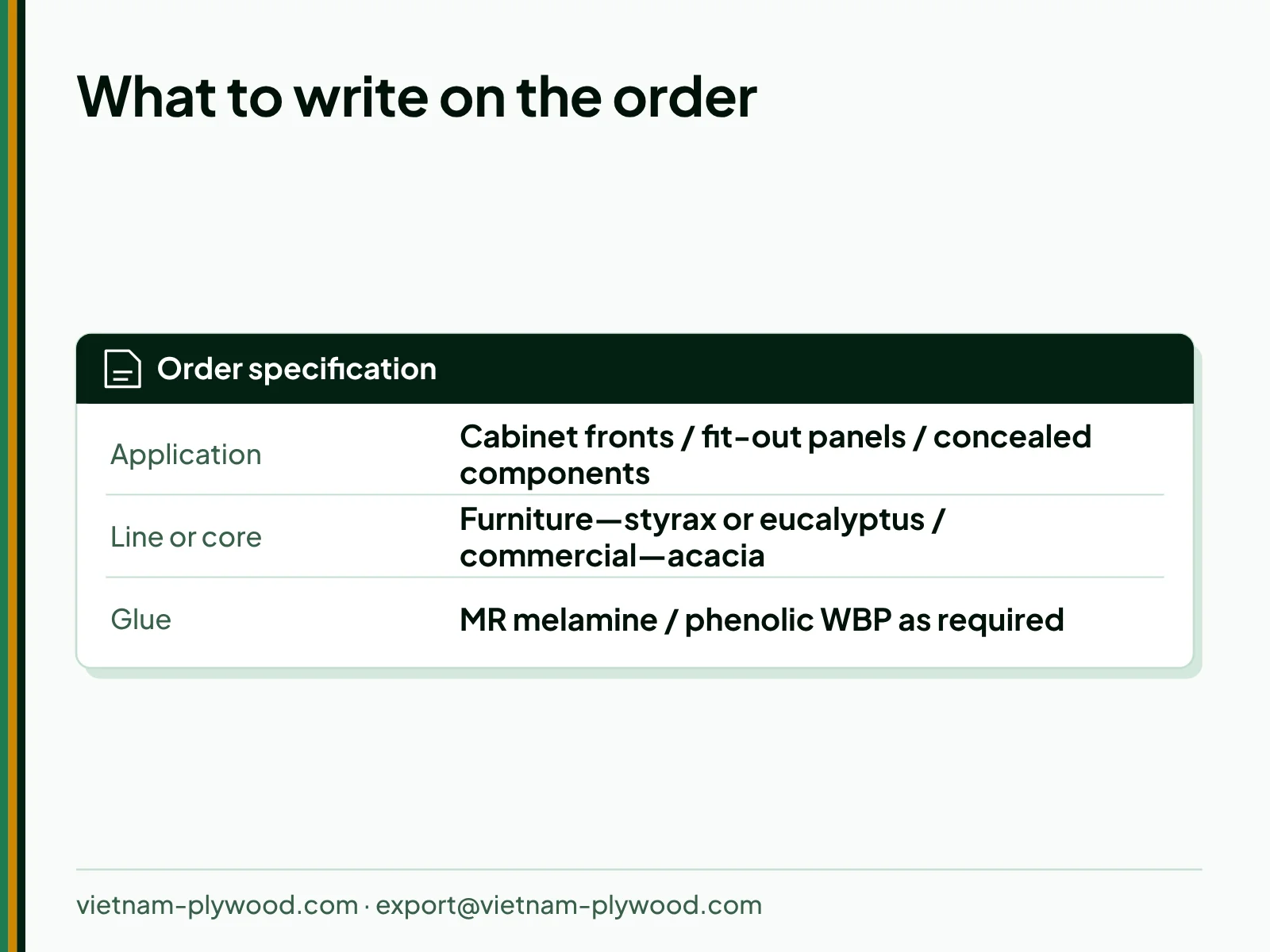
Send the following fields to Lucy at export@vietnam-plywood.com.
Application: cabinet fronts / fit-out panels / concealed components
Line or core: furniture—styrax or eucalyptus / commercial—acacia
Glue: MR melamine / phenolic WBP as required
Emission: E0 / E1 / agreed destination requirement
Face and grade: pine A/B; knot, repair and colour acceptance sample
Thickness and tolerance: 18 mm; ±0.2 / ±0.3 / ±0.5 mm as applicable
Size: 1220 × 2440 mm or agreed available format
Quantity: one 40HC; mix and pallet plan if required
Destination port: [port and country]
Next step: book a factory visit to review the pine face sample and inspect the proposed build at the producing factory.