





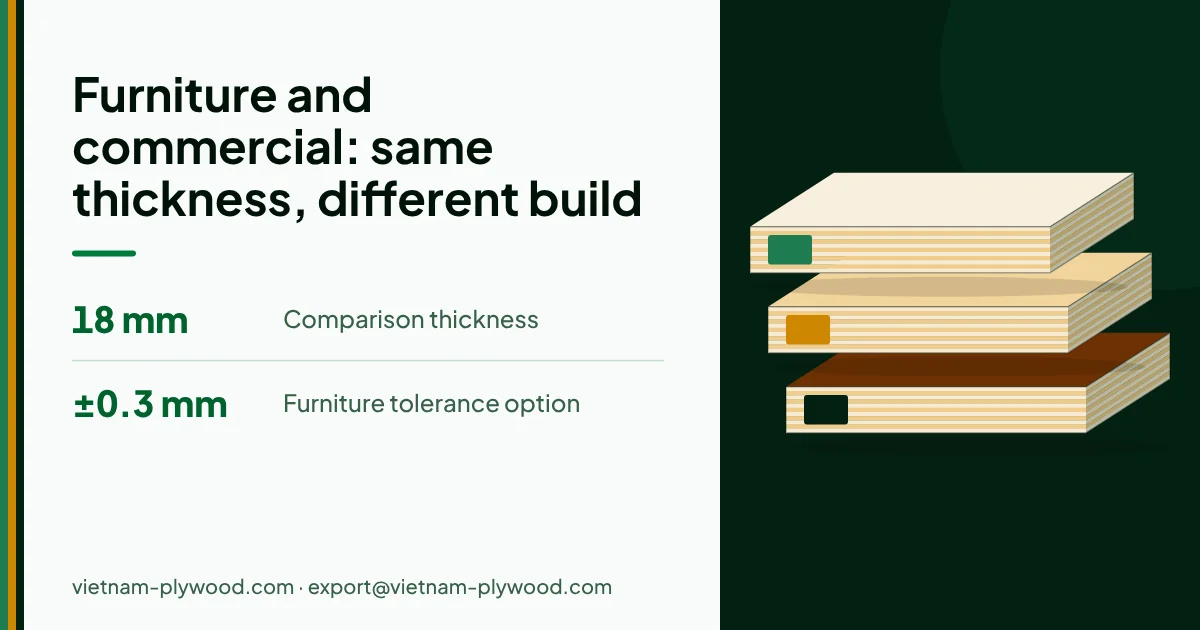
Furniture plywood price is quoted per m³ FOB Hai Phong against the cabinet specification on HCPLY’s furniture line and a comparable commercial-line alternative. Choosing the wrong core, face or calibration can turn an apparent saving into rejected cabinet parts and lost production time. The meaningful comparison holds thickness constant and prices each specification change.
What is the furniture plywood price per cubic metre FOB?
Furniture plywood price is established by a written FOB Hai Phong quotation for the chosen furniture-line build. Request a separate commercial-line quote for the same dimensions, with each core and face stated explicitly. The difference between those two quotes is the usable upgrade cost. A written quotation fixes the face, core, thickness, tolerance and emission requirement before the figures can be compared.
The quoted difference must be traced to the specification. A buyer comparing two 18 mm panels should first hold sheet dimensions, face species, order volume and delivery term constant. Then price the stronger core construction, improved face selection, sanding and emission class separately. Our export cost breakdown explains the broader FOB cost categories.
Ask for separate price alternatives for BB-style face appearance, tighter core gaps, E0 documentation and calibration. Ask for those as separately identified quotation choices.
How do our lines cost the same 18 mm requirement?
Our furniture line presses the stitched, sanded cabinet build; our commercial and packing line presses the lower-processing-cost alternative. Our construction line instead presses film-faced panels for concrete work. The comparison holds thickness at 18 mm.
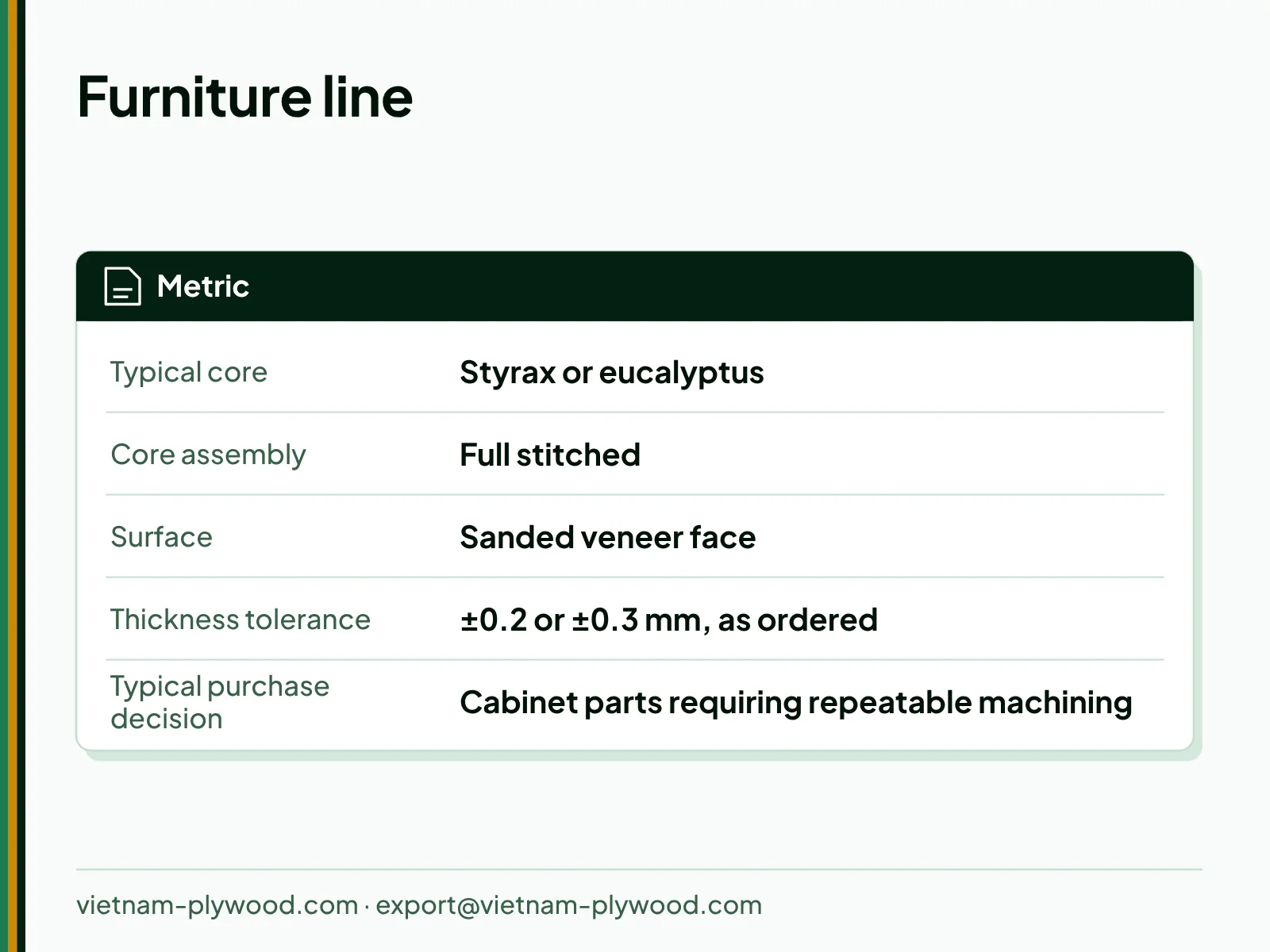
| Metric | Furniture line | Commercial and packing line | Construction line |
|---|---|---|---|
| Typical core | Styrax or eucalyptus | Acacia | Acacia or eucalyptus |
| Core assembly | Full stitched | Specification-dependent, including lower-cost assemblies | Formwork-oriented assembly |
| Surface | Sanded veneer face | Unsanded or light-sanded veneer face | Phenolic or melamine film |
| Thickness tolerance | ±0.2 or ±0.3 mm, as ordered | Commercial ±0.5 mm; packing ±0.5–1.0 mm | ±0.5 mm |
| Typical purchase decision | Cabinet parts requiring repeatable machining | Concealed utility parts and packing | Concrete-facing formwork |
| Verdict by use | Select for visible or precisely machined cabinet parts | Select when the part accepts the wider tolerance and surface | Do not substitute for a decorative cabinet face |
The cross-line grade comparison explains how a written build travels between applications. HCPLY coordinates the specification, on-site inspection, documents and loading at the producing factory.
Which price drivers move the quote most?
The largest meaningful specification changes are the core build and selected face, followed by calibration and emission documentation. That is a practical order for requesting alternatives, not a numerical ranking of factory costs. The table isolates each decision so a quote can show the direction of the change without assigning a universal surcharge.
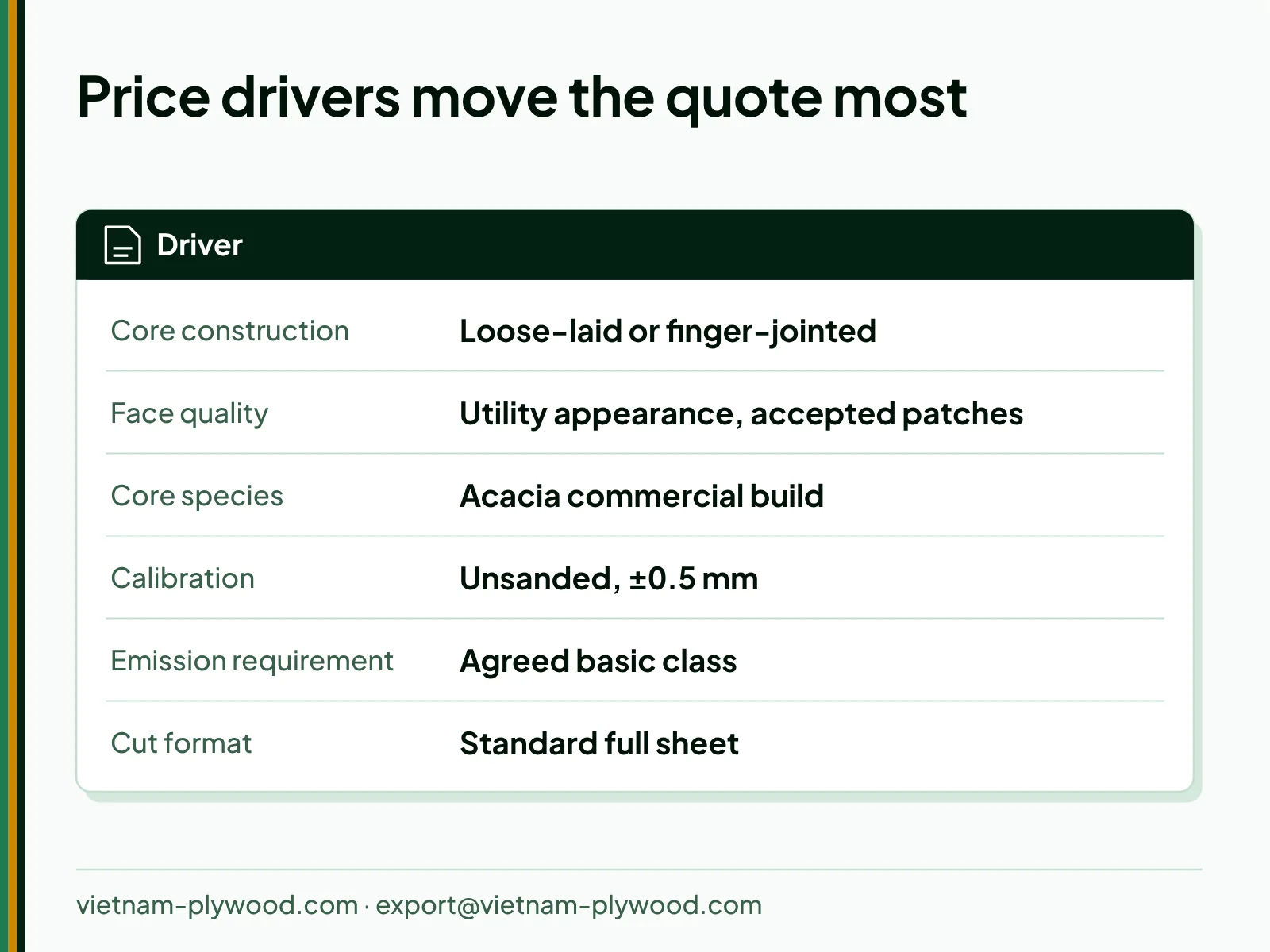
| Driver | Lower-cost specification | Higher-cost specification | What the buyer gains | Quote instruction |
|---|---|---|---|---|
| Core construction | Loose-laid or finger-jointed | Full stitched with controlled gaps | Cleaner exposed edges and more consistent machining | Define allowable gaps and repairs |
| Face quality | Utility appearance, accepted patches | Selected A/B face appearance | Fewer visible repairs and finish defects | Approve a face sample |
| Core species | Acacia commercial build | Styrax or eucalyptus furniture build | Different density and production line | State species, never infer from face |
| Calibration | Unsanded, ±0.5 mm | Sanded, ±0.3 or ±0.2 mm | Closer thickness control | State tolerance and inspection points |
| Emission requirement | Agreed basic class | E0 with supporting documents | Defined emission target | State class and accepted evidence |
| Cut format | Standard full sheet | Custom cut components | Less downstream cutting for suitable layouts | Supply a cut schedule |
A veneer name describes the face; it does not reveal the core. The manufacturer product overview shows the available plywood families. For a kitchen cabinet plywood price comparison, separate exposed doors from concealed carcass parts rather than assigning the same expensive face everywhere.
How much more does a BB face cost than a CC face?
A BB-to-CC face premium cannot be stated without a shared grading definition, veneer species and approved samples. BB and CC are commercial descriptions that buyers encounter in offers; Our stated face grades are A/B, with D/E/F used for birch. We therefore translate a BB or CC request into an observable face-and-back specification before pricing it.
Specify the permitted knots, patches, splits, colour variation and repair visibility on each side. A clear-coated cabinet door needs a different acceptance sample from a painted carcass or hidden back. A face with fewer visible defects usually requires more selective veneer sorting, so the selected appearance build costs more than a utility face of the same species and core.
The premium requires a quote. Ask for photographs of both approved faces under the same lighting, followed by a signed reference sample. Keep the back grade explicit; a premium front with an unspecified back is not a repeatable purchase specification.
What does a void-free core add to furniture plywood cost?
A tighter core-gap requirement raises the build above loose-laid or finger-jointed construction because more veneer preparation and joining are required. “Void-free” should become an agreed edge and cross-section acceptance rule rather than an unmeasured adjective. Our furniture line uses full-stitched core veneers; the buyer can inspect representative cut edges at the producing factory.
For 18 mm panels, the stated construction uses 11–13 plies, with core veneers typically 1.4–2.0 mm thick. A visible edge sample should show the ply arrangement, joint continuity and the types of repaired gaps the buyer accepts. The inspection should include cuts from more than a showcase sheet.
A cabinet maker routing grooves or drilling near edges can lose components when hidden gaps break through. That rework can outweigh a lower incoming sheet cost. However, the exact monetary value requires the buyer’s cutting yield and rejection records; no universal void-free surcharge follows from the core description.
What do calibration and E0 add to a quotation?
Calibration adds sanding and measurement control; an E0 requirement adds an explicit emission specification and supporting evidence. Neither has a standalone published surcharge. A sanded furniture order can specify ±0.2 or ±0.3 mm thickness tolerance, whereas the commercial line is ±0.5 mm. Compare readings across the sheet and across several pallets.
Glue chemistry and formaldehyde emission are separate fields. Melamine glue is described as MR with a 12-hour boil condition, while phenolic glue is WBP with a 72-hour boil condition. E0, E1 and E2 describe emission classes; none is a glue name. Do not infer an emission result from the resin label alone.
For the United States, the US Environmental Protection Agency, in its TSCA Title VI implementation guidance, identifies a hardwood-plywood emission limit of 0.05 parts per million for regulated products and third-party certification requirements. EPA’s official guidance distinguishes the regulatory limit from an E0 label. Factory-member CARB P2 documentation can be shown with factory details masked, on request; the order must identify the documents the importer needs.
Is furniture-grade plywood worth more than commercial grade?
Furniture grade is worth the higher purchase cost when the part needs cleaner edges, controlled thickness or a selected visible face. Commercial grade is a sound alternative when a concealed part tolerates more variation and the buyer has verified the machining yield. Compare the cost of accepted components, rather than the incoming cubic-metre price alone.
For a cabinet factory, run the same cutting pattern on approved samples of each build. Record usable components, chipped or opened edges, re-sanding and finishing rejects. A lower-cost sheet that needs additional preparation can consume machine time and reduce output. Conversely, buying a decorative face for a permanently concealed packing panel adds cost without improving its intended use.
Furniture plywood Vietnam quotations are therefore meaningful only against a complete build. Keep the intended finish, accepted defects and production process visible in the RFQ. Packing-grade price decisions concern a different acceptance threshold.
What is the lowest-cost build that still counts as cabinet grade?
The lowest-cost cabinet build is the least elaborate specification that passes the buyer’s actual cutting, finishing and assembly checks. For a concealed carcass, request a furniture-line stitched core, an economical approved face, E1 or the required emission class, and the wider of the furniture tolerances that the machines can accept. Do not buy a premium face simply because the finished item is a cabinet.
A visible door or exposed shelf needs its own face and back sample. Choose bintangor, okoume, engineered veneer, poplar or another listed face by the finish plan; the species name alone does not establish a face grade. Birch is a face option with D/E/F grading here, not a birch-core panel. HCPLY does not press birch-core plywood, medium-density fibreboard, oriented strand board, chipboard or blockboard.
A practical RFQ asks for two alternatives: a calibrated full-stitched cabinet build and a commercial build accepted for hidden parts. Approve each by component yield and finish result. This makes costs observable.
How does the 40HC load affect the unit comparison?
At 18 mm and 1220 × 2440 mm, a full 40HC planning load is 990 styrax-core sheets, 880 acacia-core sheets or 795 eucalyptus-core sheets. Their corresponding loads are 53.05 m³ and 26.52 t; 47.15 m³ and 27.35 t; and 42.60 m³ and 27.69 t. The payload ceiling is 28.5 t.
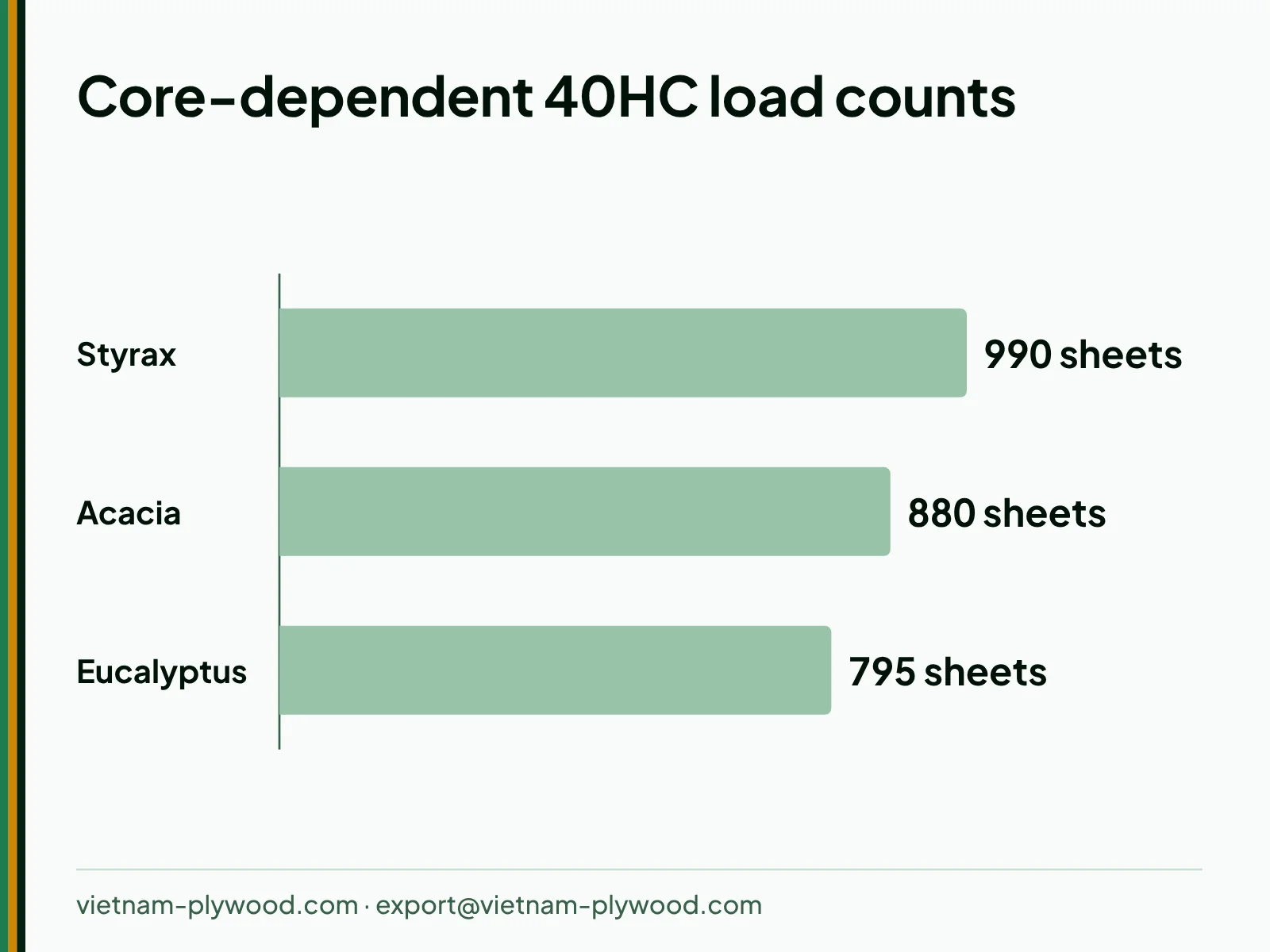
This matters because the same sheet count is not the same freight unit across cores. Styrax is 500 kg/m³, acacia 580 kg/m³ and eucalyptus 650 kg/m³. At the same nominal sheet size and thickness, the respective sheet weights are 26.79 kg, 31.08 kg and 34.83 kg. A higher-density build consumes payload sooner.
The minimum order is one 40HC; one container can carry several specifications as long as the payload limit holds. For a mixed cabinet and commercial load, the loading plan must total the weights of each group rather than copying a full-load count. The container loading reference owns the detailed sheet-count calculations.
What can an inspector verify at the producing factory?
An inspector can verify the agreed face sample, exposed core, thickness readings and pallet identity before loading. The visit should follow the actual furniture production lot, not a generic display panel. HCPLY’s furniture and commercial plywood capacity is up to 100 containers a month; the construction line is up to 140.
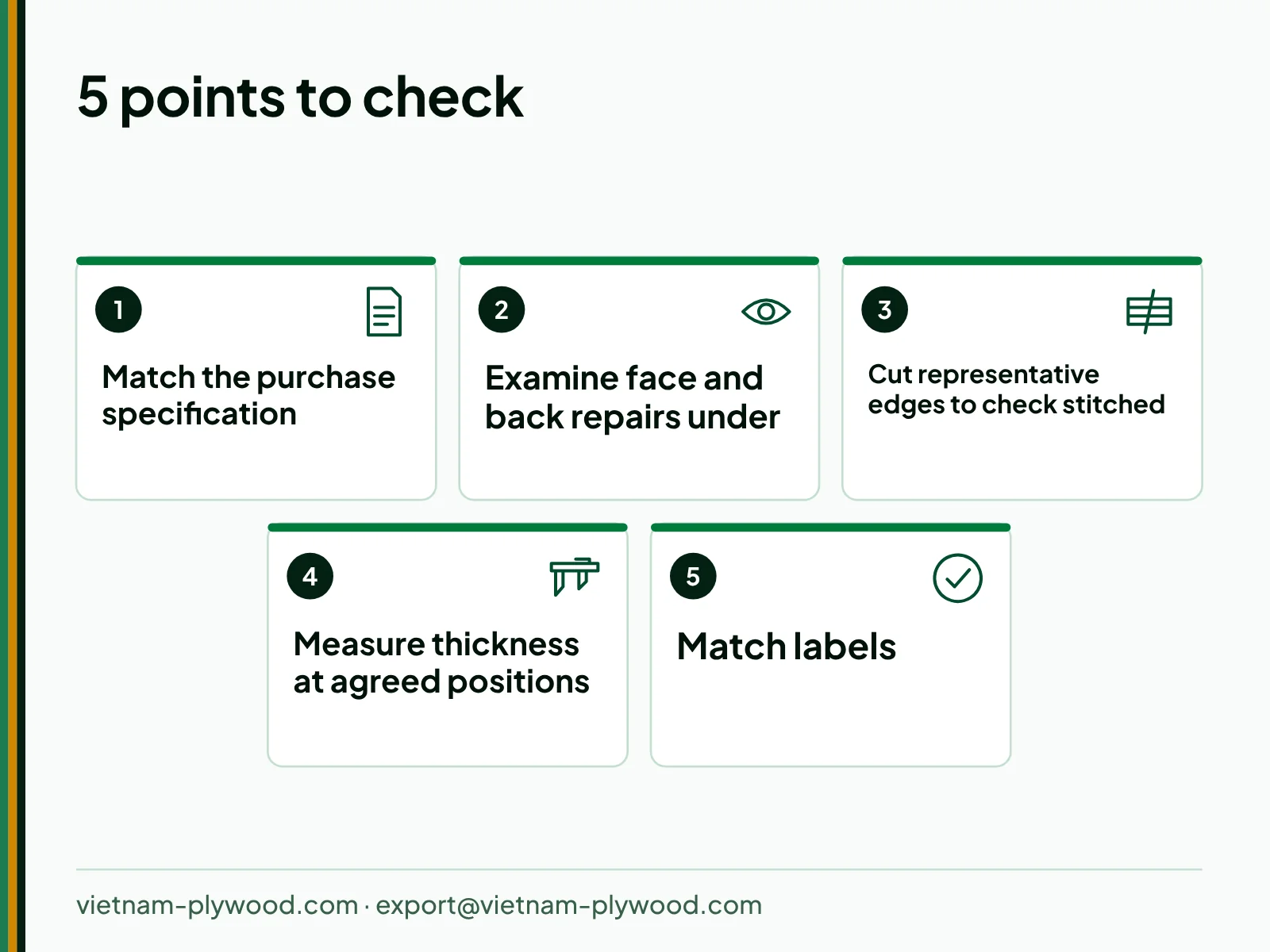
- Match the purchase specification to the production order and retained approved samples.
- Examine face and back repairs under consistent light and compare them with the agreed grade.
- Cut representative edges to check stitched veneers, ply count and permitted core gaps.
- Measure thickness at agreed positions, recording the tolerance against the order.
- Match labels, pallet counts and packing details to the shipment packing list.
The producing factory can show relevant member-factory FSC, CARB P2, ISO 9001 or CE documents with factory details masked, on request. The order’s agreed certificate and test documents join the commercial invoice, packing list, bill of lading and other required export papers. After loading, the draft shipping documents come to you for approval.
How should a buyer compare FOB and delivered quotes?
FOB Hai Phong compares the specified panel at the loading port; CFR (CNF) and CIF add different carriage or insurance responsibilities. Request the same delivery term across offers before interpreting a plywood furniture rate. Sheet prices require matching dimensions and thickness.
Factory lead time runs 15–45 days from receipt of the 30% deposit; the exact figure depends on order size, line loading and what the contract fixes. The remaining 70% is paid on the scan of the bill of lading, by T/T, or by irrevocable sight L/C. Samples cost nothing: a first-time buyer pays the courier, and that charge comes off the first confirmed order.
For European lots, the document set includes EUR.1 where applicable and the EUTR/EUDR file set. Insurance is included under CIF. The production lead-time explanation separates manufacturing from sea transit. A quotation for furniture plywood vietnam price should identify the destination port even when the requested term is FOB.
Which details should go into the furniture plywood RFQ?
A useful RFQ states the cabinet part, core, glue, emission class, face grade, machining tolerance and shipment basis. It should distinguish visible surfaces from concealed parts and request an alternative only where the use allows it. Vague requests obscure costs.
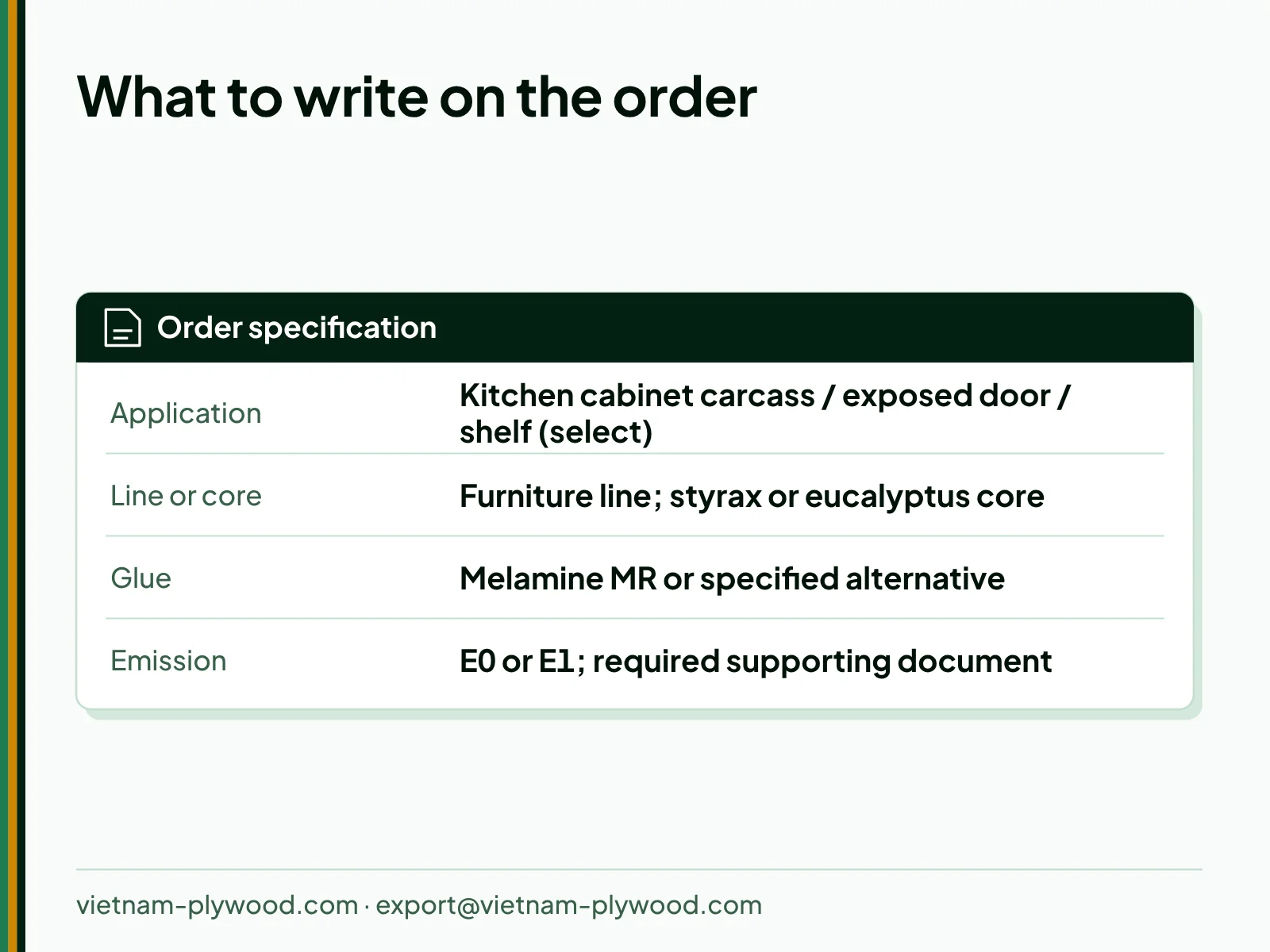
Use the following lines as the starting specification. Send them to Lucy at export@vietnam-plywood.com, with a drawing or sample acceptance sheet where available. The contact page is the route for the written quotation.
Application: kitchen cabinet carcass / exposed door / shelf (select)
Line or core: furniture line; styrax or eucalyptus core
Glue: melamine MR or specified alternative
Emission: E0 or E1; required supporting document
Face and grade: named veneer; A/B face and back acceptance sample
Thickness and tolerance: 18 mm; ±0.3 mm or ±0.2 mm
Size: 1220 × 2440 mm or listed custom cut
Quantity: one 40HC; specify mixed-build quantities if needed
Destination port: [port and country]; quote FOB Hai Phong / CFR / CIF
Next step: book a factory visit to inspect the producing lot and approve the reference build before shipment.