





What is the cost of plywood UK buyers should compare?
For HCPLY, the cost of plywood UK importers compare starts with two factory benchmarks: commercial plywood from US$250/m³ FOB Hai Phong (October 2026) and furniture plywood from US$350/m³ FOB Hai Phong (October 2026). Shuttering plywood requires a specification-based quotation. A wrong build can waste money through rejected sheets or delayed production. A UK merchant sheet price includes a different bundle of services and costs than an export factory price.
The calculation separates product, freight, customs, tax and UK delivery. The relevant comparison is an equivalent panel at an equivalent delivery point, expressed both per cubic metre and per usable sheet. A merchant’s advertised price can be attractive for a small urgent order; a container quotation addresses repeat purchasing and stock replenishment.
The starting figures are volume prices at the Vietnamese port. They exclude the cost of transporting the goods to a UK buyer’s premises. For a broader breakdown of the export price components, see Vietnam plywood export cost factors.
What do UK merchant plywood listings actually price?
UK merchant listings price particular dimensions, faces, grades and purchasing quantities. Compare ex-VAT and inc-VAT sheet prices, bulk breaks, pack quantities and delivery availability when reading a merchant offer. Different faces and specialist grades need separate comparisons. Those differences matter before a buyer draws any conclusion about import savings.
The comparison method is straightforward: record the advertised ex-VAT sheet price, board dimensions, declared performance, delivery charge and volume discount. Convert that sheet to cubic metres using length × width × thickness in metres. Then compare the same delivered quantity, rather than comparing a retail sheet against an FOB cubic-metre quote.
A sheet with a different thickness or face is not a substitute merely because both descriptions say plywood. For a consistent dimensional comparison, consult plywood prices by thickness. An imported panel also needs an agreed inspection standard and an allowance for UK distribution after customs clearance.
How do shuttering, furniture and packing builds differ?
Shuttering panels come from our construction line, furniture-grade panels from our furniture line, and transit protection sheets from our commercial and packing line. These are distinct builds with distinct costs even at the same nominal thickness.
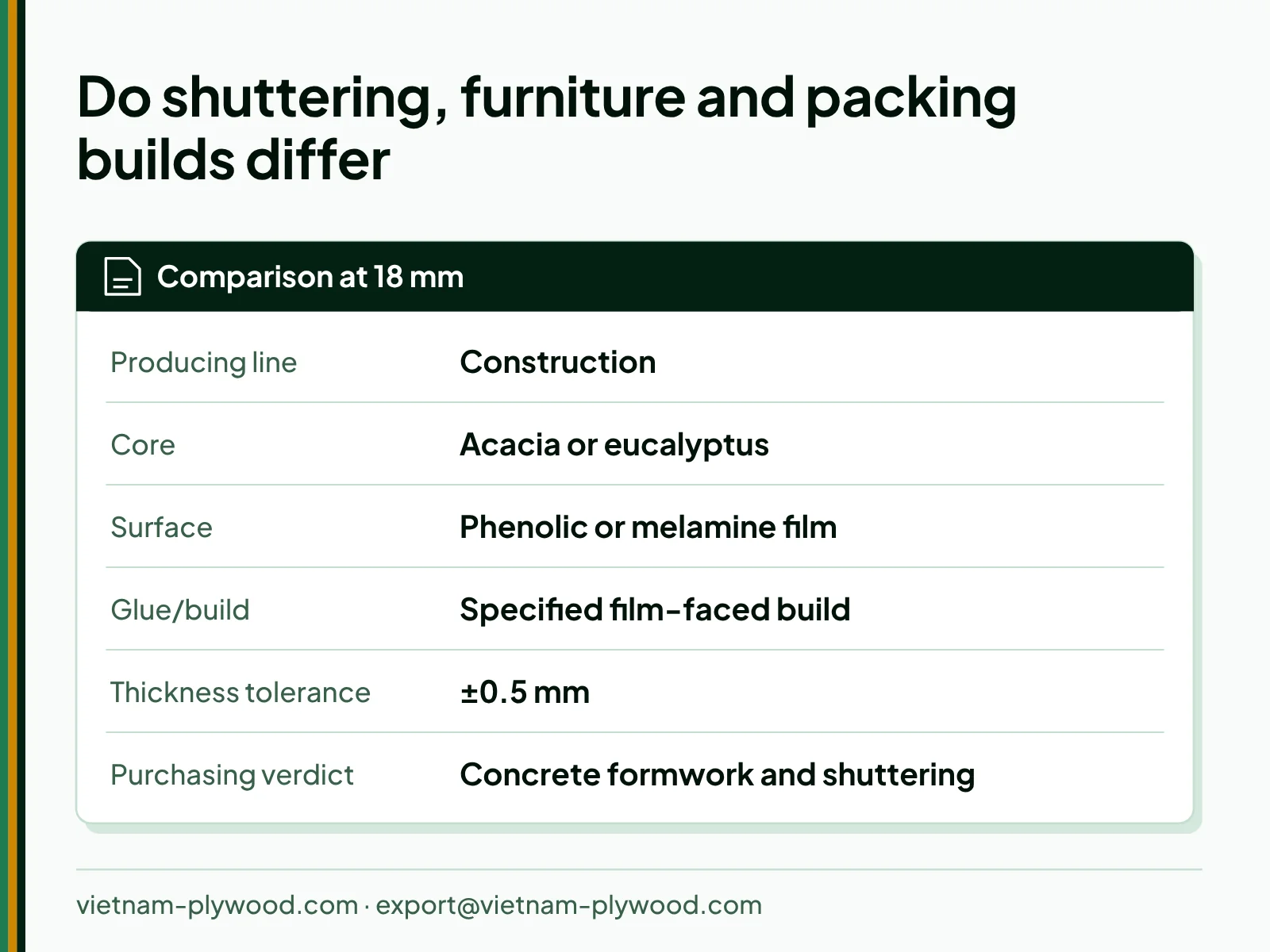
| Comparison at 18 mm | Shuttering | Furniture | Packing |
|---|---|---|---|
| Producing line | Construction | Furniture | Commercial and packing |
| Core | Acacia or eucalyptus | Styrax or eucalyptus | Acacia |
| Surface | Phenolic or melamine film | Sanded veneer face | Unsanded or light-sanded |
| Glue/build | Specified film-faced build | Full-stitched core, E0/E1 emission option | MR glue, packing construction |
| Thickness tolerance | ±0.5 mm | ±0.2 or ±0.3 mm as ordered | ±0.5–1.0 mm |
| Purchasing verdict | Concrete formwork and shuttering | Cabinet and furniture components | Crates and transport protection |
Film-faced construction sheets can be specified with 120 g/m² standard film, 135 g/m² premium film or 220 g/m² anti-slip film. Film weight changes the surface specification and should appear on the quote. Furniture sheets instead earn their price through core preparation, face selection and sanding. Packing sheets direct spending toward protection and handling rather than a decorative finish.
The producing factory can show a buyer the actual face, edge build and thickness measurements before loading. That inspection is more useful than a generic description such as hardwood plywood.
What makes up landed shuttering plywood cost?
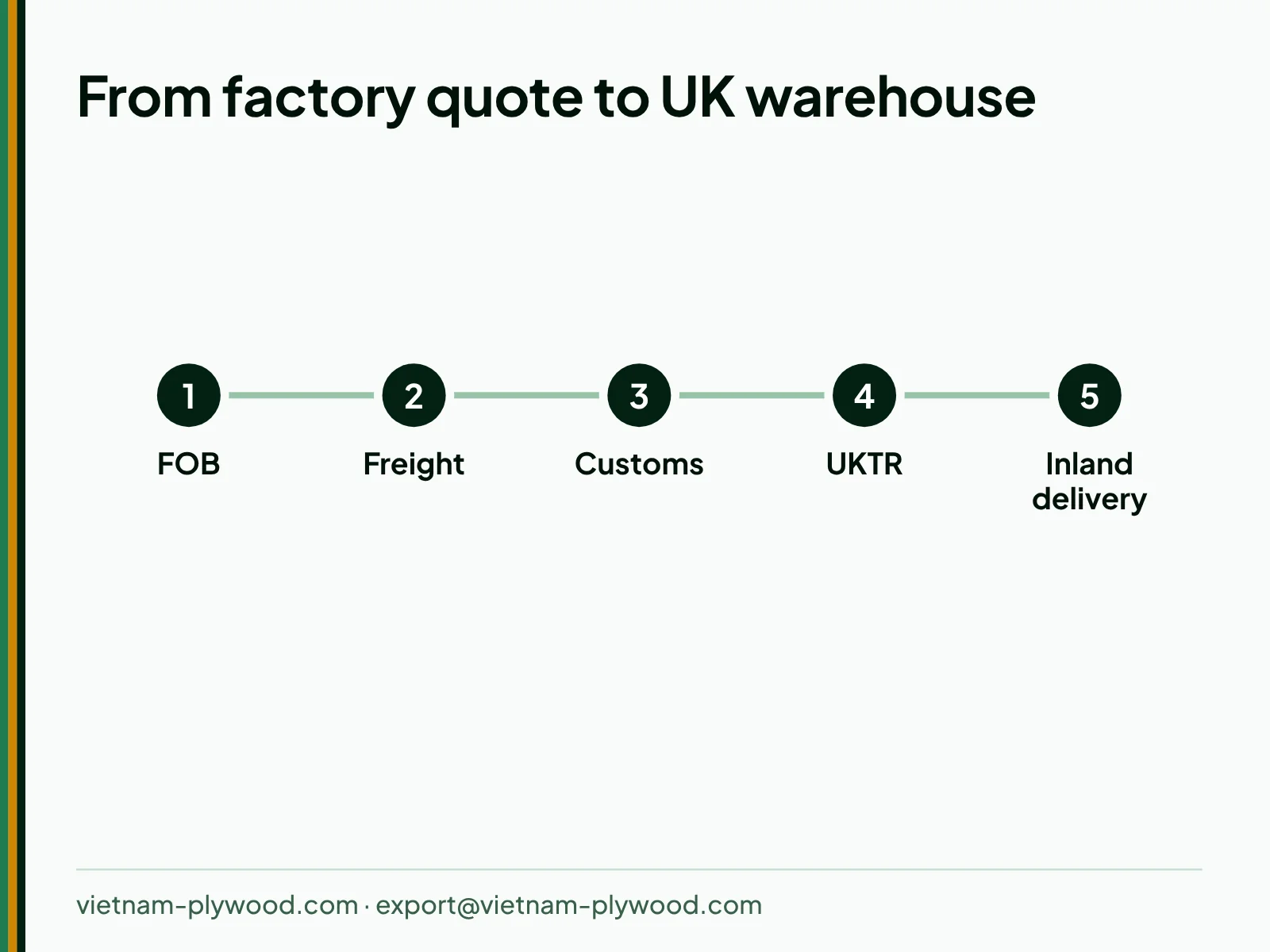
The landed cost of shuttering plywood is the agreed film-faced panel price plus international carriage, insurance where applicable, import duty, customs clearance, port handling and inland transport. UK import VAT must also be handled in the importer’s tax calculation. The film type, core and glue system are the first specification choices.
For repeated concrete pours, the purchase decision should consider usable pours alongside sheet cost. With proper handling, a release agent on every pour and sealed edges (cut edges included), melamine-glue film-faced plywood gives about 12–15 pours; phenolic-glue film-faced plywood gives up to about 25 pours. Site practices and panel damage determine whether that planned reuse is achieved.
A lower initial sheet price can lose its advantage when the formwork operation needs more replacement sheets. Conversely, a premium film is not automatically worthwhile for a short project. Ask the site team for the planned exposure, concrete finish and handling procedure, then specify the build accordingly. There is no universal shuttering price without those choices.
Which factors move the factory price most?
Core construction, face specification, glue system and finishing work drive the factory price before freight enters the calculation. The effect should be assessed against the intended application, rather than by thickness alone.
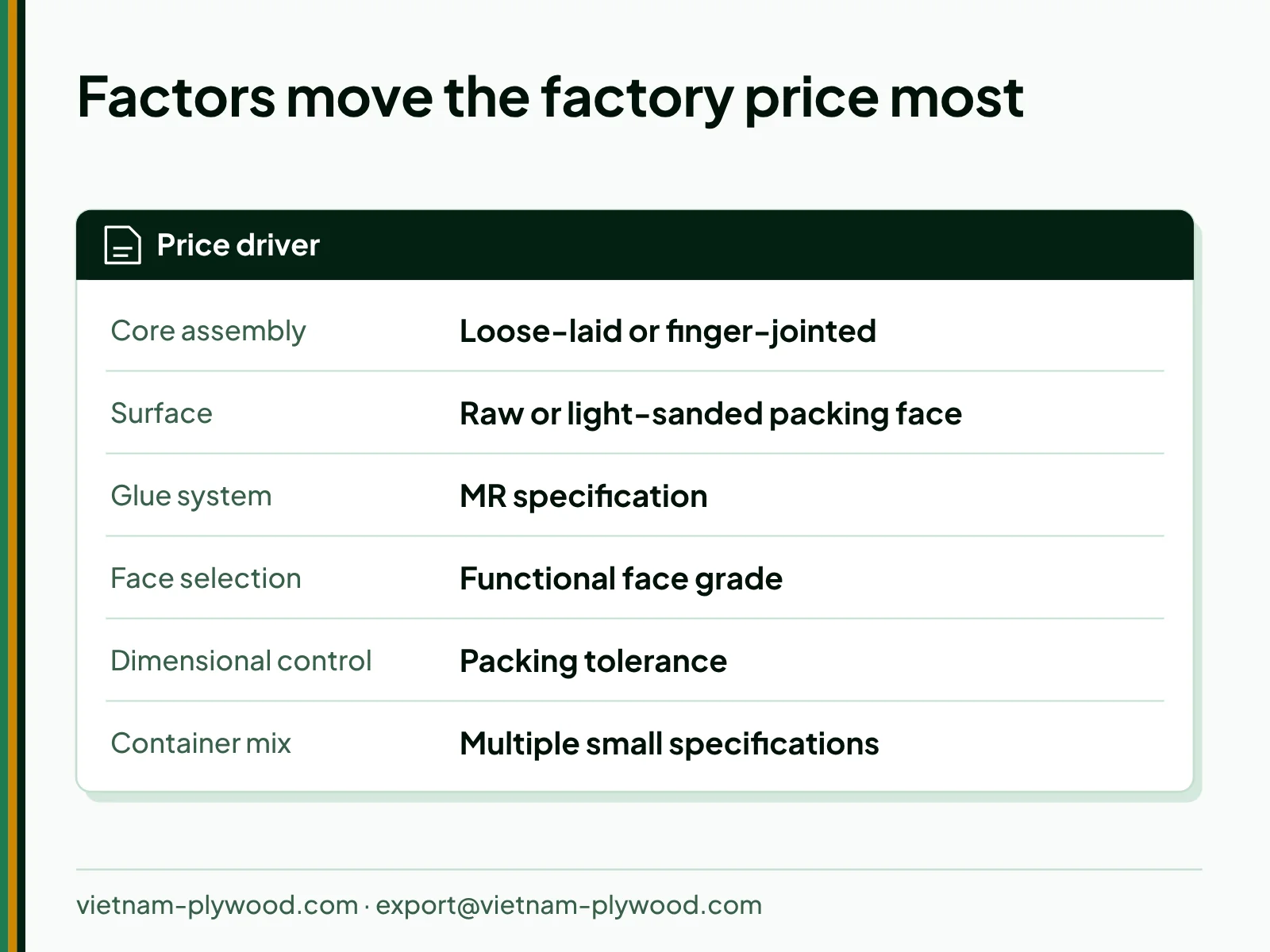
| Price driver | Lower-cost direction | Higher-cost direction | Buyer decision |
|---|---|---|---|
| Core assembly | Loose-laid or finger-jointed | Full-stitched | Match internal quality to machining and visible edges |
| Surface | Raw or light-sanded packing face | Selected veneer, full sanding | Pay for appearance where it remains visible |
| Glue system | MR specification | Phenolic WBP specification | Match moisture and exposure requirements |
| Face selection | Functional face grade | Selected decorative face and grade | Set an acceptance sample |
| Dimensional control | Packing tolerance | Tight sanded furniture tolerance | Check the machining requirement |
| Container mix | Multiple small specifications | Repeated standard build | Compare packing and handling complexity |
Core construction runs from full stitched through stitched outer layers with edge-trimmed inner veneers, finger-jointed and loose-laid. That order explains why identical nominal thicknesses do not necessarily command identical factory prices. Face veneer is commonly 0.2–0.4 mm; the core species determines panel density rather than the visible face.
For the furniture category, see furniture plywood and the separate furniture-grade plywood cost discussion. Packing buyers can compare export and local packing grades.
How does container weight change the sheet comparison?
A 40HC has a 28.5 t payload limit in the loading model, and density changes the quantity of sheets available. At 18 mm and 1220 × 2440 mm, the calculated full loads differ sharply by core.
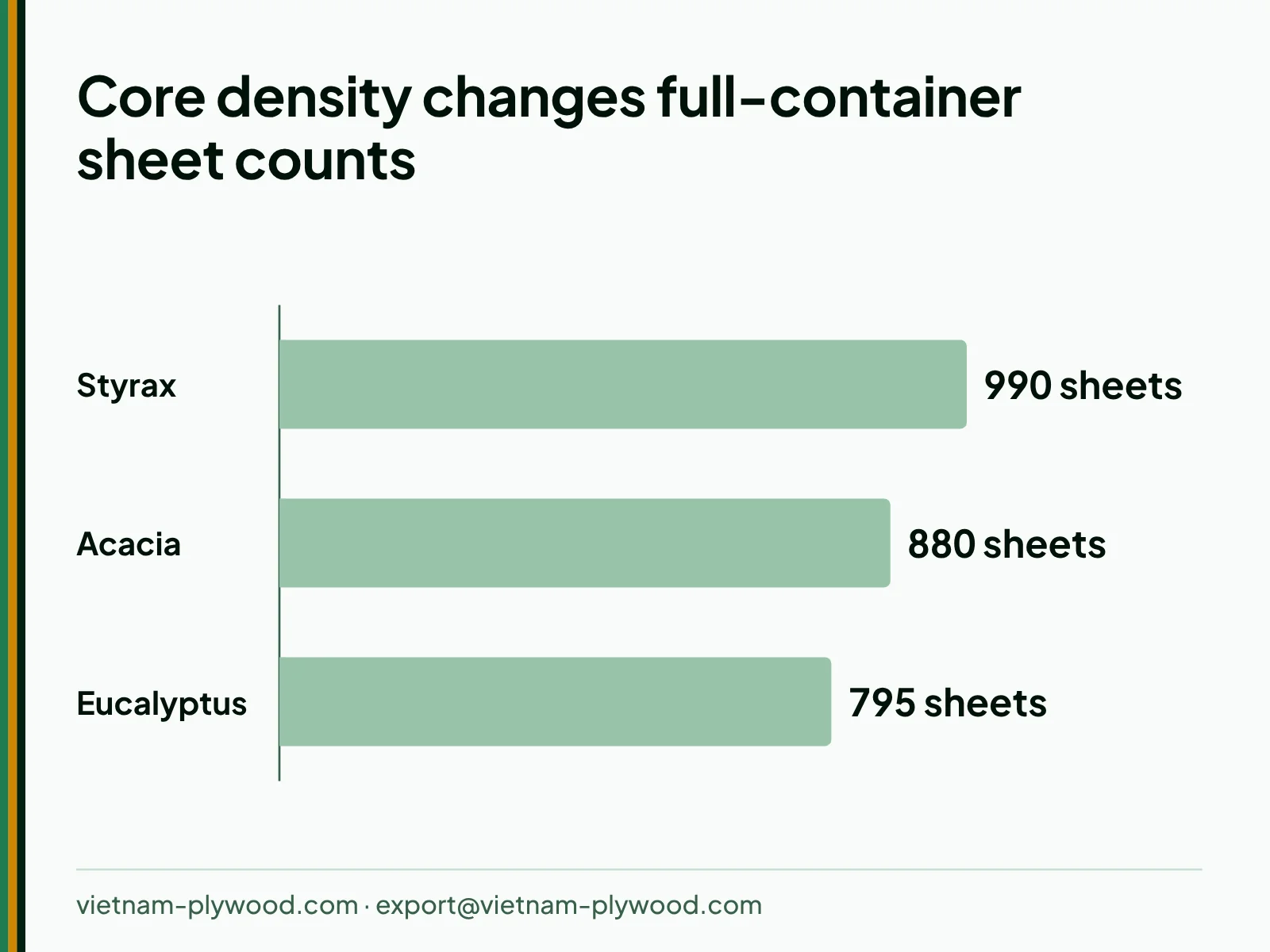
| Core | Sheets per 40HC | Volume | Panel tonnes | Sheet weight |
|---|---|---|---|---|
| Styrax | 990 | 53.05 m³ | 26.52 t | 26.79 kg |
| Acacia | 880 | 47.15 m³ | 27.35 t | 31.08 kg |
| Eucalyptus | 795 | 42.60 m³ | 27.69 t | 34.83 kg |
These figures exclude film weight. The full-load arithmetic shows why comparing freight per container without converting to freight per cubic metre can distort the apparent bargain. A denser core produces fewer sheets within the same payload envelope.
Specifications can be mixed within the container payload limit. For instance, furniture and packing sheets can share the shipment when pallet weights and quantities are planned together. Mixed specifications should be costed as separate line items, then allocated a transparent share of freight and arrival charges. For load planning beyond this example, use the container packing calculator and mixed-container arrangements.
What do UK duty and customs classification add?
UK duty is determined by the actual tariff classification, origin treatment and customs value, rather than a single plywood-wide percentage. HM Revenue & Customs’ 2023 wood-classification guidance places plywood panels under heading 4412, including coated panels intended for shuttering (HMRC guidance).
The UK government’s 2026 Vietnam trade guidance explains that importers should compare the UK–Vietnam agreement, the Comprehensive and Progressive Agreement for Trans-Pacific Partnership and the ordinary applied tariff, then check the applicable origin rules (trade-agreement guidance). A preferential rate is a classification-and-origin calculation, not an assumption based on the port of shipment.
Before ordering, give the customs specialist the precise face species, construction, thickness, coating and intended use. The UK Trade Tariff service identifies the commodity code and applicable duty and VAT treatment (UK Trade Tariff). Build the landed model with the confirmed duty rate and customs value. The same documentation should support the commercial description and origin declaration.
What does UKTR paperwork add to the import budget?
UK Timber Regulations (UKTR) due diligence adds evidence gathering, risk assessment and record management to a Great Britain plywood import. The Office for Product Safety and Standards’ guidance, updated in 2025, requires operators placing timber on the GB market to collect species, quantity, supplier and harvest-country information, assess legality risk and mitigate identified risk (UK timber regulations).
The cost is the importer’s staff or specialist time, any additional supporting evidence and the handling of records. It should be a separate line in a landed-cost worksheet rather than hidden inside the factory unit price. A purchase from Vietnam does not itself replace the operator’s due-diligence process.
We coordinate the export documentation, while the UK operator makes the UKTR assessment. The shipment document set covers the commercial invoice, packing list, bill of lading, certificate of origin, phytosanitary and fumigation papers, CIF insurance where applicable, and the agreed certificate or test documents. After loading, the draft shipping documents come to you for approval. Member-factory FSC, CARB P2, ISO 9001 and CE documents can be shown with factory details masked, on request; assess the exact document against the ordered product and destination requirements.
How do furniture and packing costs compare after landing?
Furniture plywood starts above commercial plywood in the October 2026 FOB comparison, reflecting its prepared core and surface work. The landed gap also reflects each product’s loaded cubic metres, inspection criteria and distribution costs.
Furniture and cabinet makers need a consistent sanded thickness and face acceptance standard. A low landed figure becomes less attractive if machining rejects or visible-face defects consume production time. Packing buyers can often accept a rougher face, but must define load protection, edges and pallet handling before treating the least expensive build as equivalent.
Use a common calculation for both: FOB product value + freight + insurance + customs duty + clearance and port charges + UK inland carriage + UKTR administration. Divide the total by accepted cubic metres or accepted sheets. Handle recoverable import VAT separately from a non-recoverable cost in the buyer’s own accounting model.
This also clarifies the phrase cheap plywood UK buyers encounter in listings: an advertised low sheet price says little about delivered, accepted material per production run. Review the commercial and packing plywood specification before placing two quotes side by side.
Is a container cheaper than buying from a UK merchant?
A container can reduce the unit purchase cost when the landed total, usable yield and stockholding expense beat the equivalent UK merchant order. It is not automatically the lower-cost purchasing route.
The comparison needs the same panel grade and quantity, delivered to the same warehouse. A UK merchant may carry stock locally, offer smaller quantities and absorb some import administration into its selling price. A direct container gives the buyer more control over factory specifications and shipment composition, but requires warehouse space, working capital and import operations.
Calculate two totals: merchant ex-VAT sheets plus delivery, and imported panels plus every landed charge. Then account for rejected sheets, warehouse storage and financing. Test the comparison at the actual consumption rate; a large stock position that sits unused can offset a lower acquisition price.
For the wider commercial context, read Vietnam plywood pricing and market analysis. This comparison is most useful when a buyer has a repeat specification and a documented acceptance sample.
How should a UK importer request comparable quotes?
A comparable quote starts with a written panel specification and a named UK destination port. We produce the order at the line matching the agreed build and ships directly from the producing factory, FOB Hai Phong.
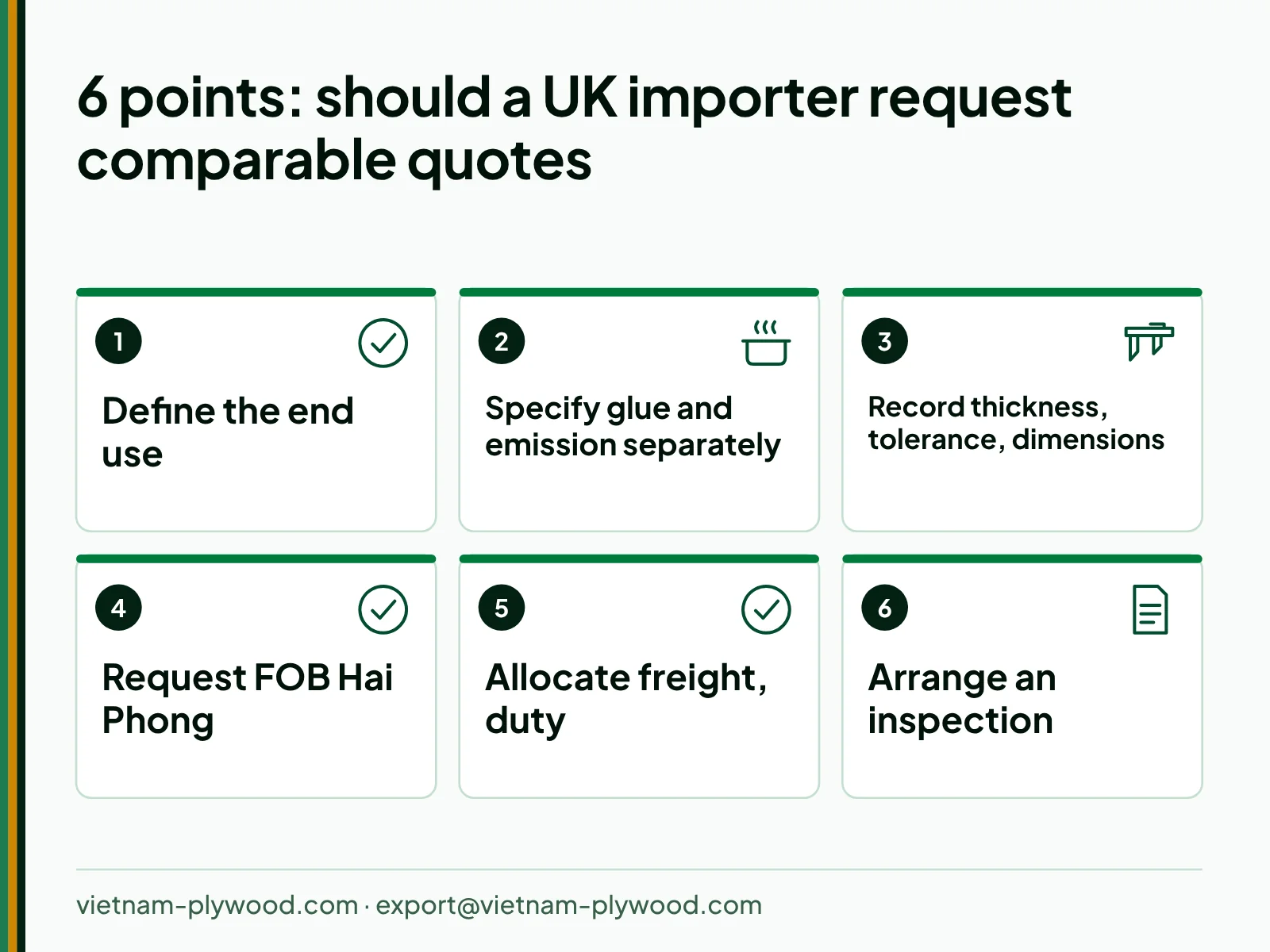
- Define the end use and select the appropriate line, core and face.
- Specify glue and emission separately; MR and phenolic WBP describe bonding, while E0 and E1 describe emission classes.
- Record thickness, tolerance, dimensions, grade and inspection acceptance points.
- Request FOB Hai Phong and, if useful, CFR (CNF) or CIF alternatives for the same build.
- Allocate freight, duty, clearance and inland costs against the expected accepted volume.
- Arrange an inspection of the producing factory’s sample, surface, edges and measured thickness before shipment.
The minimum order is one 40HC. Factory lead time runs 15–45 days from receipt of the 30% deposit; the exact figure depends on order size, line loading and what the contract fixes. The remaining 70% is paid on the scan of the bill of lading, by T/T, or by irrevocable sight L/C. These terms belong in the purchasing calculation alongside the buyer’s inventory cycle.
What should the final UK landed-cost decision record?
The decision record should show a build-specific factory quotation, an itemised landed worksheet and the equivalent merchant offer. That makes the purchasing comparison repeatable when freight, exchange rates or UK resale conditions change.
Keep the factory sample and inspection findings attached to the order specification. Record the UK tariff classification and origin evidence selected by the importer, along with the UKTR due-diligence file. Separate tax cash flow from the economic cost of goods when the importer can recover VAT.
For a first evaluation, HCPLY provides free samples; a first-time buyer pays the courier, and that charge comes off the first confirmed order. Send Lucy at export@vietnam-plywood.com the following specification and request a sample set.
Application: [shuttering / furniture / packing]
Line or core: [construction / furniture / commercial and packing; acacia / styrax / eucalyptus]
Glue: [MR / phenolic WBP]
Emission: [E0 / E1 / E2, as applicable]
Face and grade: [species or film specification; grade]
Thickness and tolerance: [mm; +/- mm]
Size: [length x width, mm]
Quantity: [sheets / m3; container mix]
Destination port: [UK port]
Request a sample set through contact before finalising the landed comparison.