





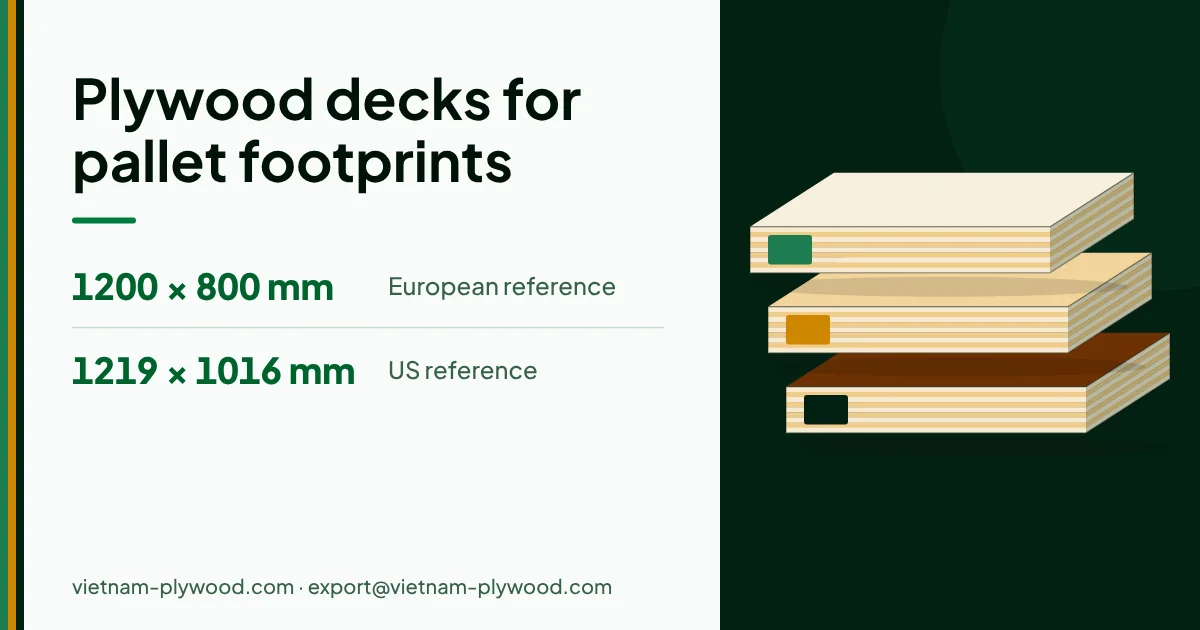
Pallet boards can be plywood deck panels cut to the footprint and support layout of an industrial pallet. An incorrect footprint can cause rejected loads, repacking costs and handling delays. HCPLY cuts acacia-core packing plywood to approved component drawings and coordinates export from the producing factory in Vietnam.
What are pallet boards made from?
Pallet boards are the deck surfaces that support a unit load, made from sawn timber or engineered plywood panels. Sawn decks use individual planks; plywood decks cover the specified footprint with a continuous sheet. Blocks, stringers, fasteners and entry openings complete the pallet assembly.
For plywood deck orders, HCPLY’s commercial and packing line uses an acacia core, moisture-resistant (MR) glue and an unsanded or light-sanded finish. The core density is 580 kg/m³. The cut drawing must show whether the panel is a full deck, partial deck or replaceable component.
Wooden pallets also use softwood or hardwood planks, while engineered components can include laminated veneer lumber (LVL). Timber skids are support runners without the same deck arrangement as a complete pallet. A wooden pallet collar is a separate removable wall frame; its fit and hardware require a different drawing from the deck.
What are standard wooden pallet dimensions by market?
Wooden pallet dimensions describe the assembled footprint, rather than the size of each deck board. Buyers commonly specify 1200 × 800 mm for European distribution, 1219 × 1016 mm (48 × 40 in) for US handling, and 1200 × 1000 mm for many international logistics systems.
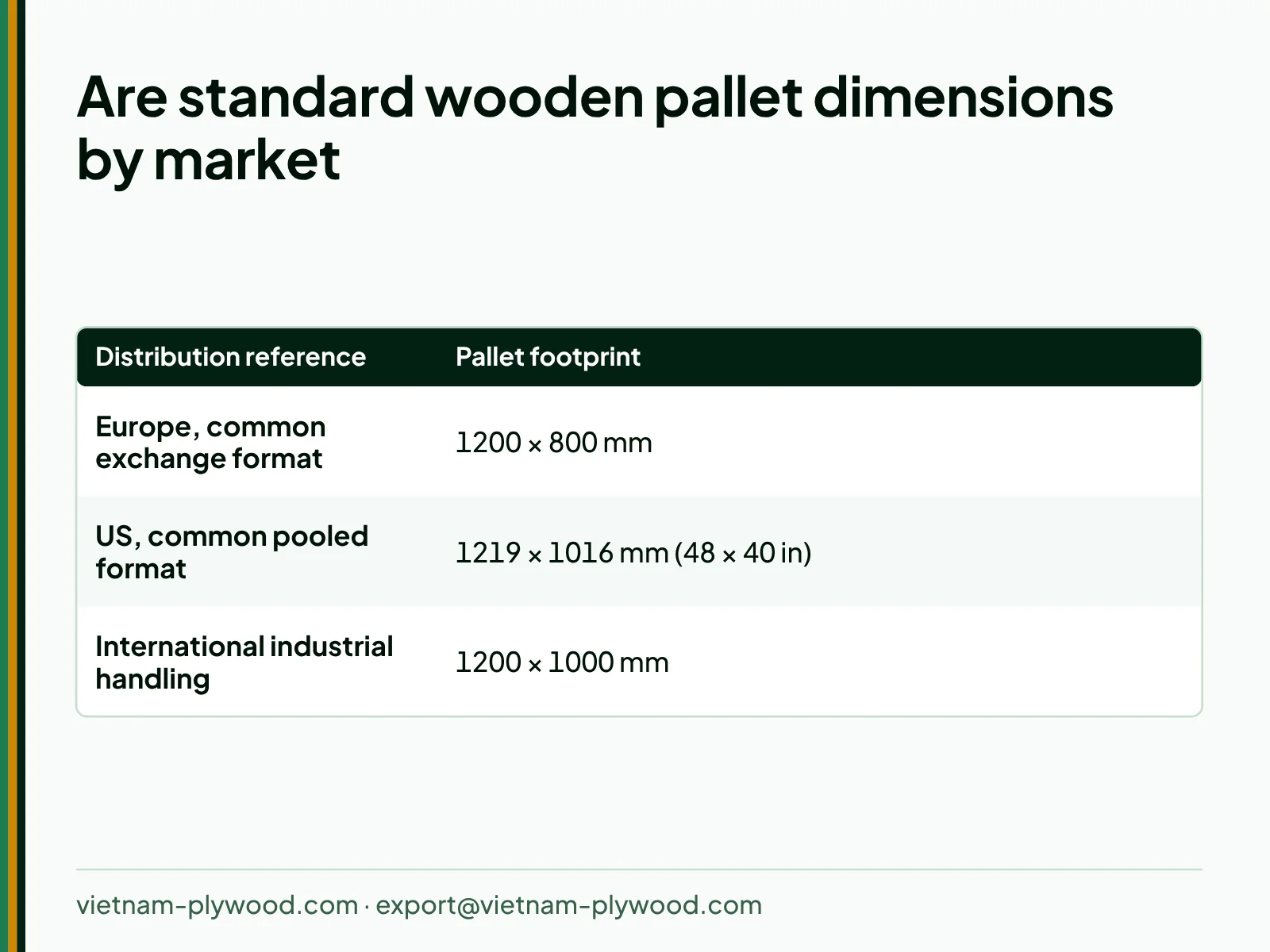
ISO 6780:2003 addresses principal dimensions and tolerances for new flat pallets, including handling clearances and entry features. Buyers should obtain the applicable standard and specify the approved pallet drawing.
| Distribution reference | Pallet footprint | What the cutting drawing must add |
|---|---|---|
| Europe, common exchange format | 1200 × 800 mm | Deck coverage, support positions and entry direction |
| US, common pooled format | 1219 × 1016 mm (48 × 40 in) | Board or panel layout and fork clearance |
| International industrial handling | 1200 × 1000 mm | Load pattern and support spacing |
| Square industrial formats | 1100 × 1100 or 1140 × 1140 mm | Handling-system acceptance and deck cut list |
These are reference footprints, not a universal purchase specification. A pallet-maker must identify the pool, receiving warehouse, load pattern and permitted dimensional deviation. The 1220 × 2440 mm stock sheet is a manufacturing starting point, not a pallet standard.
How strong is a plywood pallet deck compared with sawn boards?
A plywood deck distributes contact across a continuous panel, while sawn boards transfer loads through individual planks and their fasteners. Neither construction has a universal load rating. Deck thickness, support spacing, panel orientation, moisture exposure and fastening details determine performance in the finished pallet.
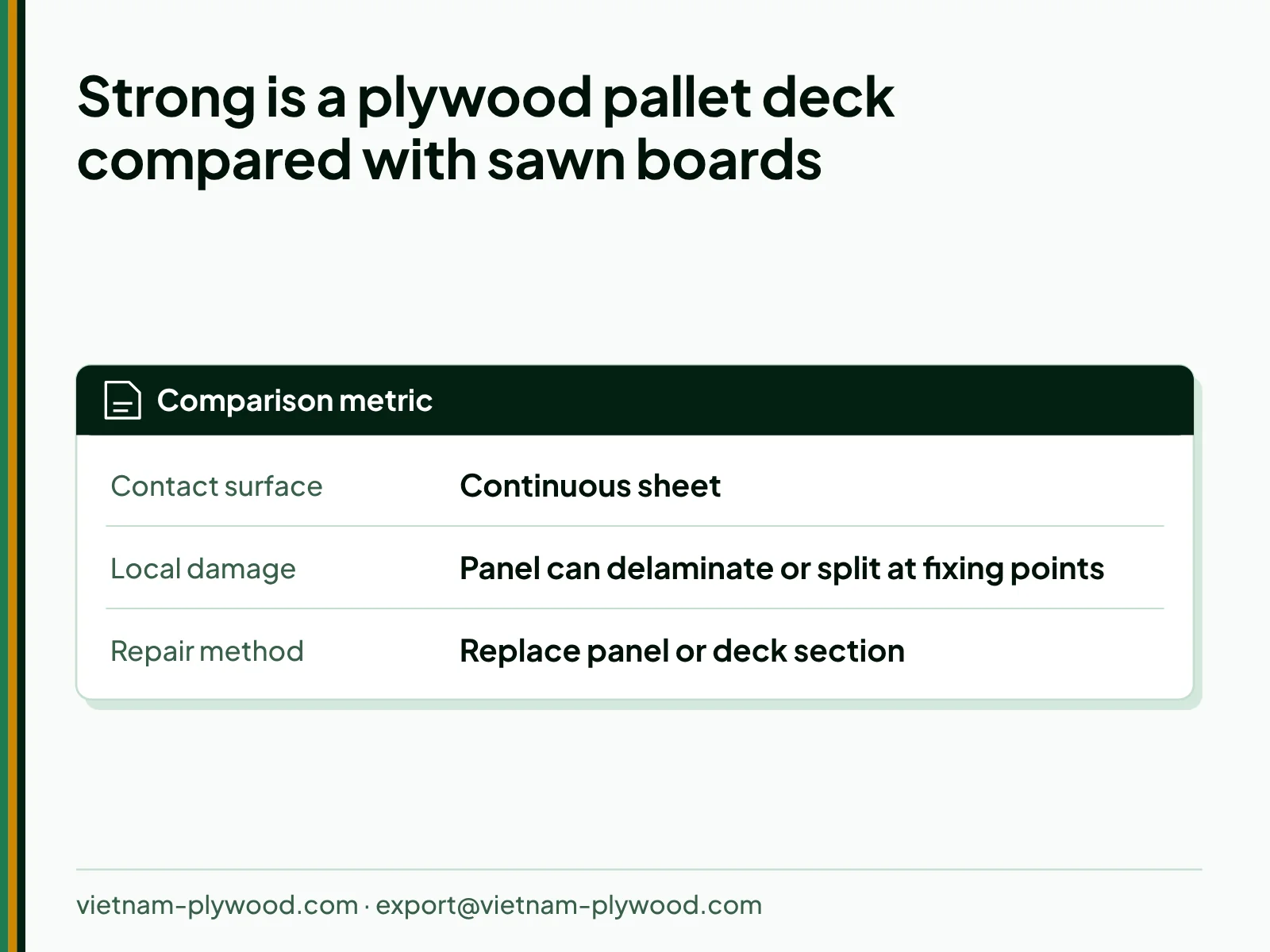
| Comparison metric | Plywood deck | Sawn-board deck | Selection by use |
|---|---|---|---|
| Contact surface | Continuous sheet | Gaps between planks | Plywood for small packages needing broad support |
| Local damage | Panel can delaminate or split at fixing points | Individual board can split or loosen | Inspect the actual failure location |
| Repair method | Replace panel or deck section | Replace selected planks | Boards suit repair systems designed for individual planks |
| Fastener performance | Depends on edge distance and ply construction | Depends on grain, knots and fastener position | Validate joints in assembled pallet |
| Load rating | Requires assembly-level evidence | Requires assembly-level evidence | Test the finished design for its handling case |
Ask for separate evidence for static storage, dynamic movement and rack support. A capacity quoted for a new pooled pallet cannot be transferred to a different plywood deck. Repeated fork impacts, moisture and repairs change the service condition. The design review should include the weakest span between blocks or runners.
Can plywood decks be cut to the pallet footprint at the factory?
Yes. Our commercial and packing line can cut plywood deck panels to an agreed footprint from the available sheet formats. Send a dimensioned drawing with deck outline, cutouts, thickness, tolerance, face orientation and stack identification.
Our listed sheet sizes include 1220 × 2440, 1250 × 2500 and 1220 × 1830 mm. Thicknesses run from 3 to 40 mm, with common choices including 9, 12, 15 and 18 mm. Packing thickness tolerance is ±0.5–1.0 mm, while length and width tolerance is ±2 mm.
A pallet footprint and a finished panel cut size need separate dimensions when gaps, overhangs or hardware matter. A full-sheet rectangle can also require corner relief or entry clearance. The buyer’s drawing governs the cut schedule and offcut allowance.
For the underlying board specification, see packing plywood from Vietnam. A purchasing team can review the wider export wood packaging options before fixing its component list.
How are pallet decks and supports assembled?
Pallet construction follows a dimensioned assembly drawing, with the support layout established before fasteners are selected. The deck alone does not define the pallet’s handling performance.
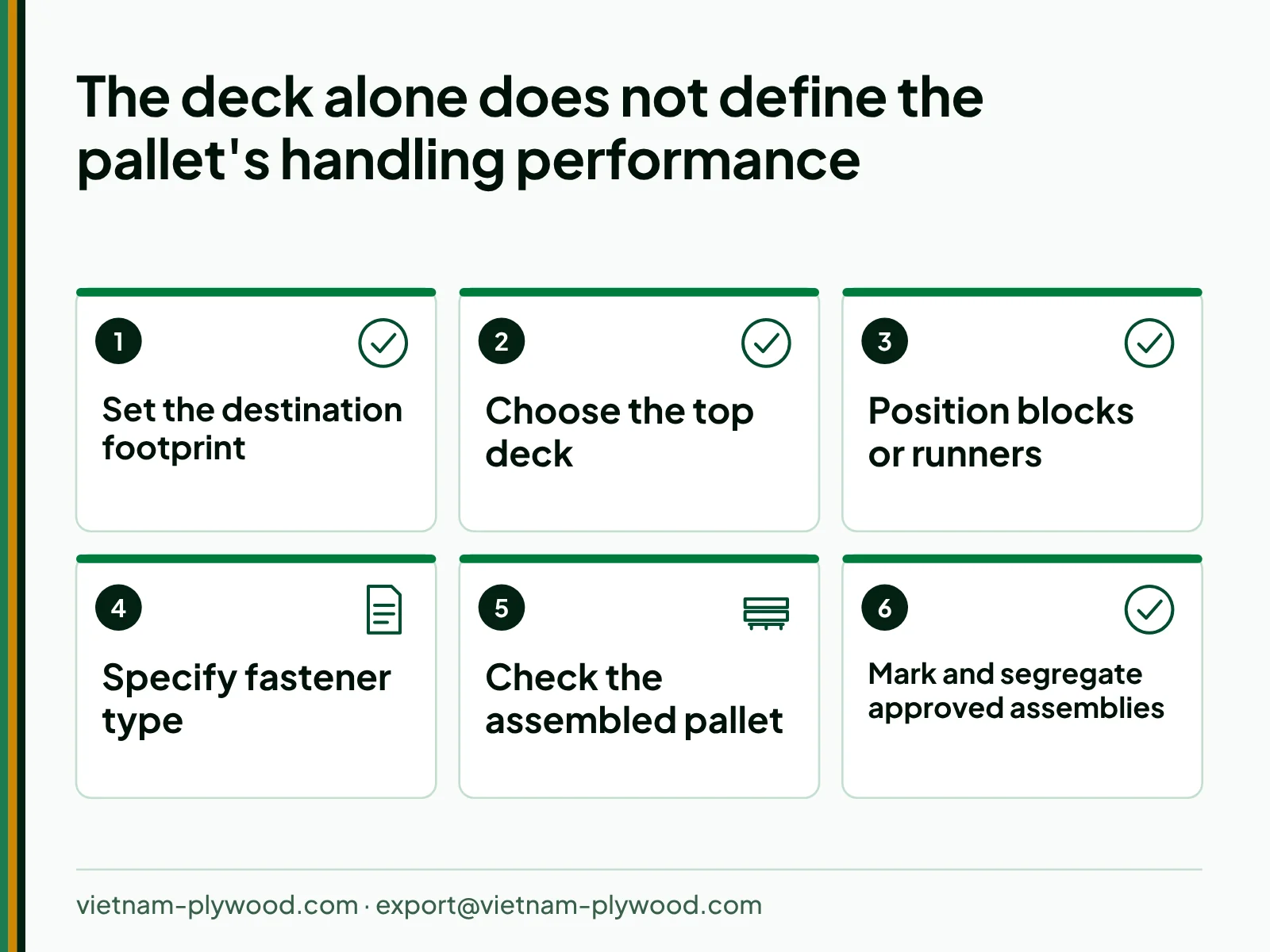
- Set the destination footprint, handling direction and load pattern.
- Choose the top deck as a full plywood panel or a spaced-board arrangement.
- Position blocks or runners to provide fork and pallet-truck access.
- Specify fastener type, spacing, edge distance and joint details.
- Check the assembled pallet for squareness, openings and load performance.
- Mark and segregate approved assemblies by their destination requirements.
A wooden block pallet uses blocks between deck layers to create entry paths. A stringer pallet uses continuous runners; timber skids may omit a full bottom deck. Pallet collars attach above the deck and must be dimensioned around the actual pallet perimeter. The drawing should identify every component independently.
Can LVL be used for pallet blocks and runners?
LVL can be designed as a pallet support component when its cross-section, connection details and load case are tested as an assembly. Laminated veneer lumber is made from bonded veneer layers and can be cut into repeatable support sections. A buyer should distinguish a block from a continuous runner on the bill of materials.
For support geometry, review packing LVL runners. Specify runner length, block height, bearing width, cut direction and fastener locations. The pallet-maker must validate crushing, splitting and connection behavior for the chosen geometry.
HCPLY’s packing-line specification is documented for acacia-core plywood decks. A separate written LVL component drawing and acceptance criteria are needed before including support pieces in the order. No universal LVL block strength or rated pallet capacity follows from the material name alone.
Which factory line should produce a pallet deck?
Our commercial and packing line is the direct fit for acacia-core plywood pallet decks. The other lines serve different surface and finishing requirements, so a nominal 18 mm sheet is not interchangeable across applications.
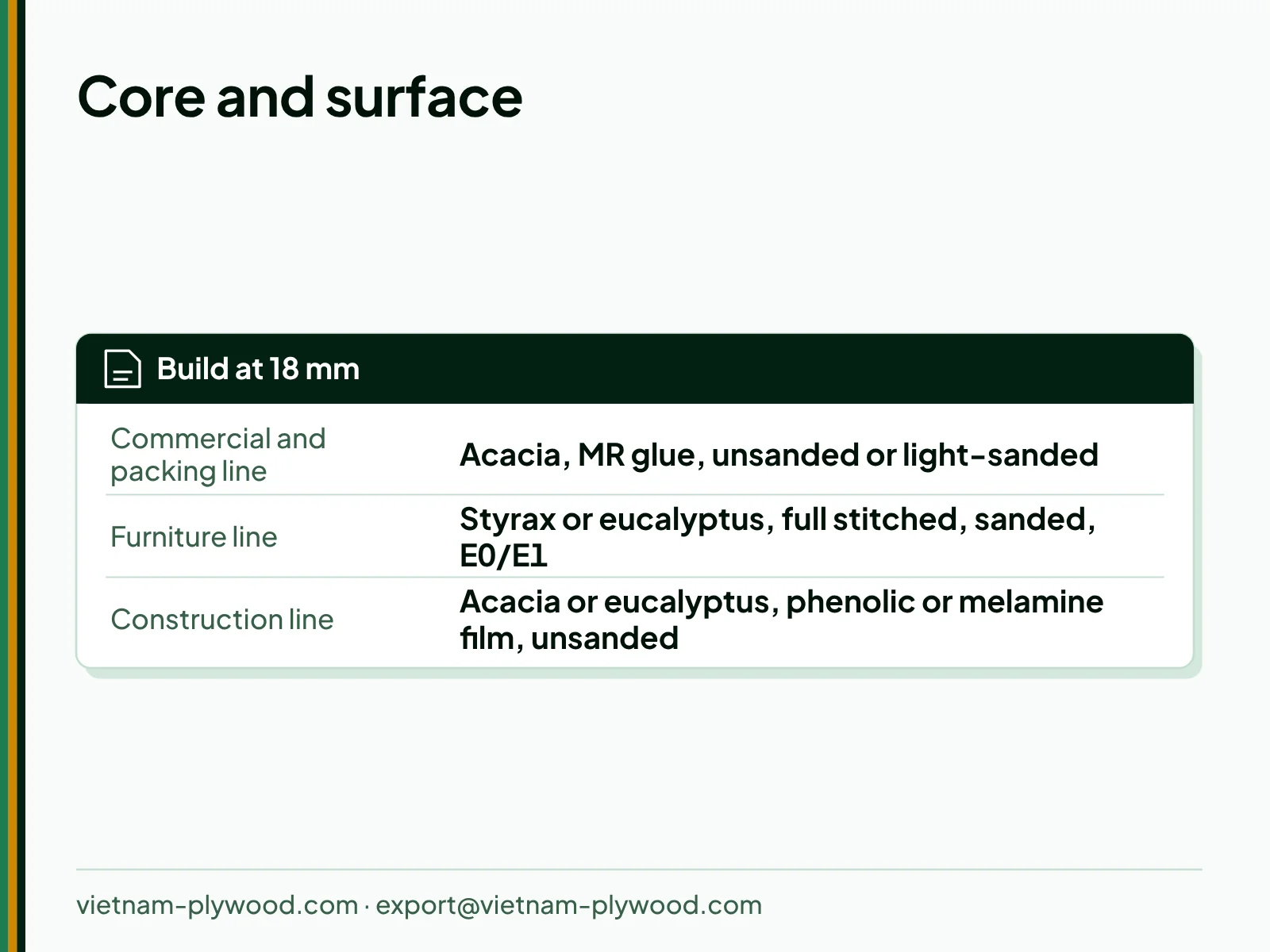
| Build at 18 mm | Core and surface | Tolerance | Intended buyer use |
|---|---|---|---|
| Commercial and packing line | Acacia, MR glue, unsanded or light-sanded | Packing ±0.5–1.0 mm | Cut pallet decks and industrial packing |
| Furniture line | Styrax or eucalyptus, full stitched, sanded, E0/E1 | ±0.2 or ±0.3 mm as ordered | Furniture and cabinet components |
| Construction line | Acacia or eucalyptus, phenolic or melamine film, unsanded | ±0.5 mm | Formwork and construction panels |
This comparison prevents a finish specification from replacing a load-case requirement. Face names describe veneer appearance, while the core controls the stated density. Glue and emission classification are separate specification fields. The producing factory should be selected against the intended component drawing.
Can pallet parts ship with plywood panels in one container?
Yes. Cut deck components and standard plywood panels can share a 40HC shipment when the mixed specification stays within the 28.5 t payload limit. The packing list must distinguish each size, thickness, core and palletized component count.
For a reference load, 18 mm acacia-core 1220 × 2440 mm sheets weigh 31.08 kg each. A full single-specification allocation is 880 sheets on 16 pallets, occupying 47.15 m³ and weighing 27.35 t. A mixed load needs a separate weight and component schedule checked against the payload limit.
This is a reference for budgeting mass, rather than a mixed-load component count. A cut pallet deck has a different area from a full sheet, and blocks or runners require their own measured quantities. The container packing calculations cover full-sheet loads; the mixed order needs a separate loading schedule.
Keep pallet parts and full panels identified by bundle, with protection against movement and damaged edges. For scheduling the production and loading sequence, consult plywood production lead time.
Which standards apply to wooden pallets?
ISO 6780 covers principal pallet dimensions; International Standard for Phytosanitary Measures No. 15 (ISPM 15) governs phytosanitary treatment of regulated raw-wood packaging in international trade. Neither standard, by itself, assigns a load rating to an untested pallet design.
The International Plant Protection Convention’s 2021 ISPM 15 publication describes measures for raw-wood packaging and excludes processed plywood from that standard’s scope. Read the IPPC standard description.
The European Commission’s wood-packaging guidance explains that regulated non-EU wood packaging must be treated, marked and debarked. It also excludes packaging made entirely from processed wood such as plywood; see the European Commission requirements.
A mixed-material pallet needs component-level classification. Raw sawn blocks or collars do not gain the plywood exemption merely because the deck is plywood. The importer should specify the destination’s applicable treatment and marking pathway, and the pallet assembler should maintain its compliance records.
For performance, specify the required pallet test method and acceptance conditions in the purchase contract. ISO 8611 is a relevant family for pallet testing; an actual result must refer to the tested assembly. EPAL exchange-system requirements and US industry specifications are separate from an ordinary custom pallet drawing.
What can the buyer inspect at the producing factory?
The buyer can witness deck dimensions, thickness, surface condition and bundle identification against the approved cut drawing. HCPLY arranges inspection at the producing factory, where the goods and production records can be checked together.
Inspectors can measure cut length and width against ±2 mm, check the ordered packing thickness tolerance, and compare edge quality with the agreed sample. They should also inspect core openings and visible bonding defects at selected edges. A pallet assembly test belongs to the pallet-maker’s agreed test program unless that work is separately specified.
For export, the packing list identifies the cut-part and full-panel quantities, while the commercial invoice records the shipment items. After loading, the draft shipping documents come to you for approval. For construction-related packaging movements, see plywood supply for construction projects.
What should a pallet-board enquiry include?
A useful enquiry identifies the destination footprint, the actual cut component and the intended load case. Specify the deck drawing and the separate runner or block schedule before requesting a quotation.
Pricing is driven first by thickness and material volume, then by core construction, cutting yield, finish and the mix of component sizes. A thicker full deck consumes more wood than a thinner one at the same footprint. Complex cutouts and low-yield patterns add processing and offcut handling. Request a quotation against the written specification.
The minimum order is one 40HC, with specifications mixed within the payload limit. Factory lead time runs 15–45 days from receipt of the 30% deposit; the exact figure depends on order size, line loading and what the contract fixes. The remaining 70% is paid on the scan of the bill of lading, by T/T, or by irrevocable sight L/C. We ship FOB Hai Phong, or CFR (CNF) or CIF to your port.
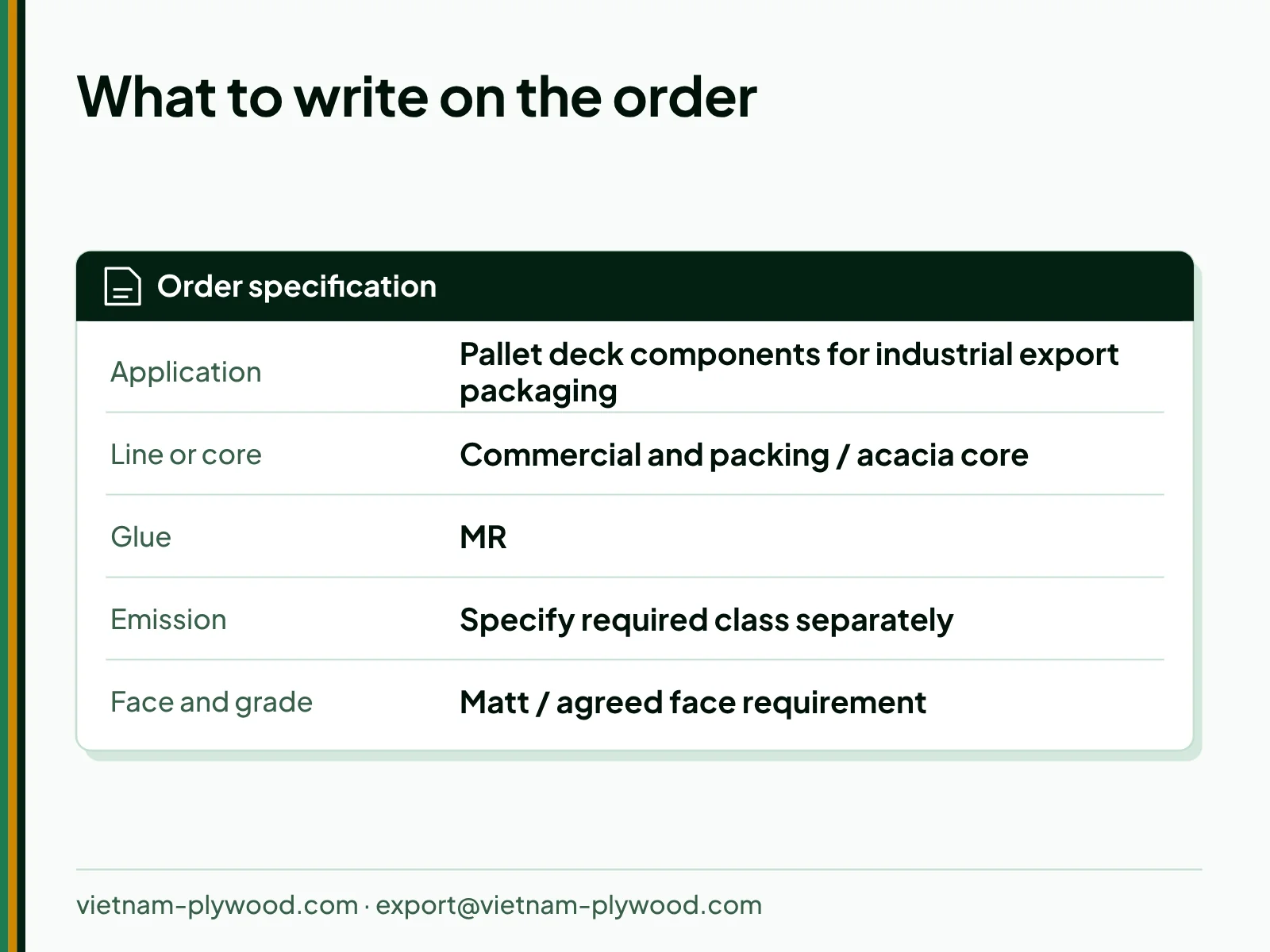
Use the following lines for a first technical enquiry to Lucy at export@vietnam-plywood.com:
Application: pallet deck components for industrial export packaging
Line or core: commercial and packing / acacia core
Glue: MR
Emission: specify required class separately
Face and grade: matt / agreed face requirement
Thickness and tolerance: [mm] / packing ±0.5–1.0 mm as ordered
Size: [finished cut L × W in mm, drawing reference]
Quantity: [pieces by cut size; mixed full-sheet quantities if applicable]
Destination port: [port and country]
Request the pallet-deck specification sheet through contact.