





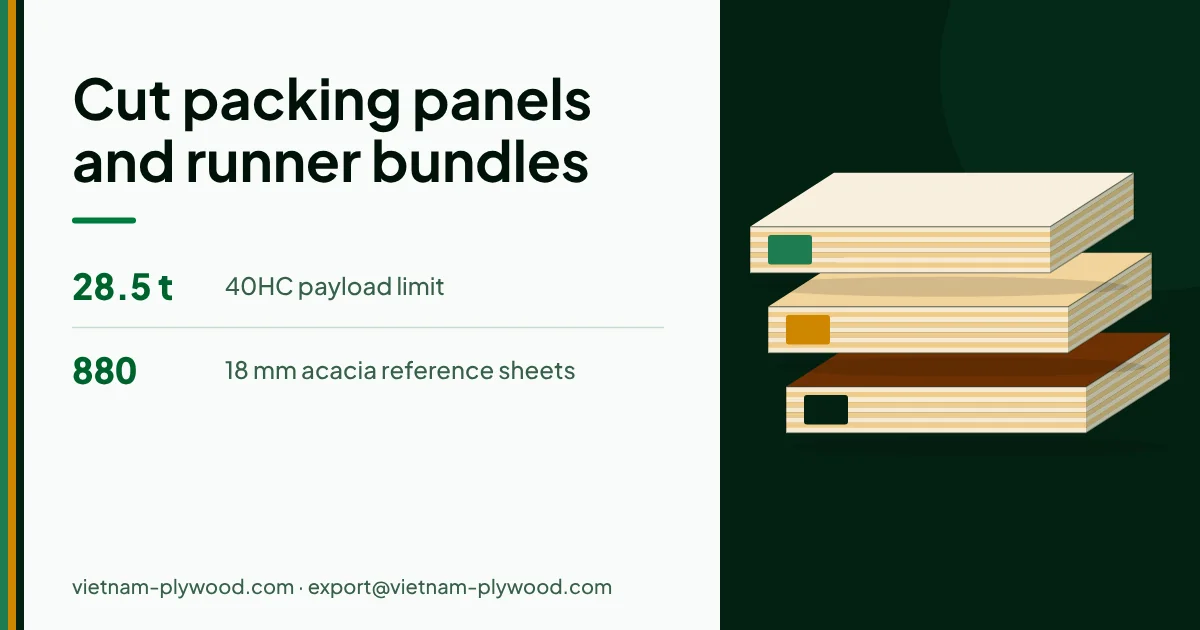
Wood packaging parts can be cut to the approved drawing and shipped together in a 40HC container from HCPLY. Choosing the wrong panel, runner or solid-wood component can add treatment costs, assembly time or a rejected load. Our commercial and packing line makes acacia-core packing plywood, while the buying decision starts with the function of each part.
What counts as wood packaging material?
Wood packaging is the collection of panels, boards, runners, blocks and assembled units used to support, separate, contain or protect freight. Industrial packers commonly order pallet decks, crate walls, box lids, skids, cleats, spacers and internal partitions. The material decision comes before the cutting drawing because strength, treatment and freight weight follow the selected construction.
A crate can combine plywood walls with solid-wood corner posts. A pallet can use sawn boards and runners, or engineered components where the design allows them. Cable drums, kegs and reusable transport frames also belong to the wider category, although their engineering and regulatory requirements differ. For HCPLY, the practical scope is packing plywood, cut panels and packing runners, rather than a finished crate design service.
Which wood packaging suits export: solid wood, plywood or LVL?
Plywood suits broad crate walls, lids and partitions; solid sawn wood suits posts, blocks and conventional pallet members; laminated veneer lumber (LVL) suits specified straight runners. The choice follows the load path, fastening method, destination rules and cutting yield. The table compares design decisions rather than claiming one material replaces every other.
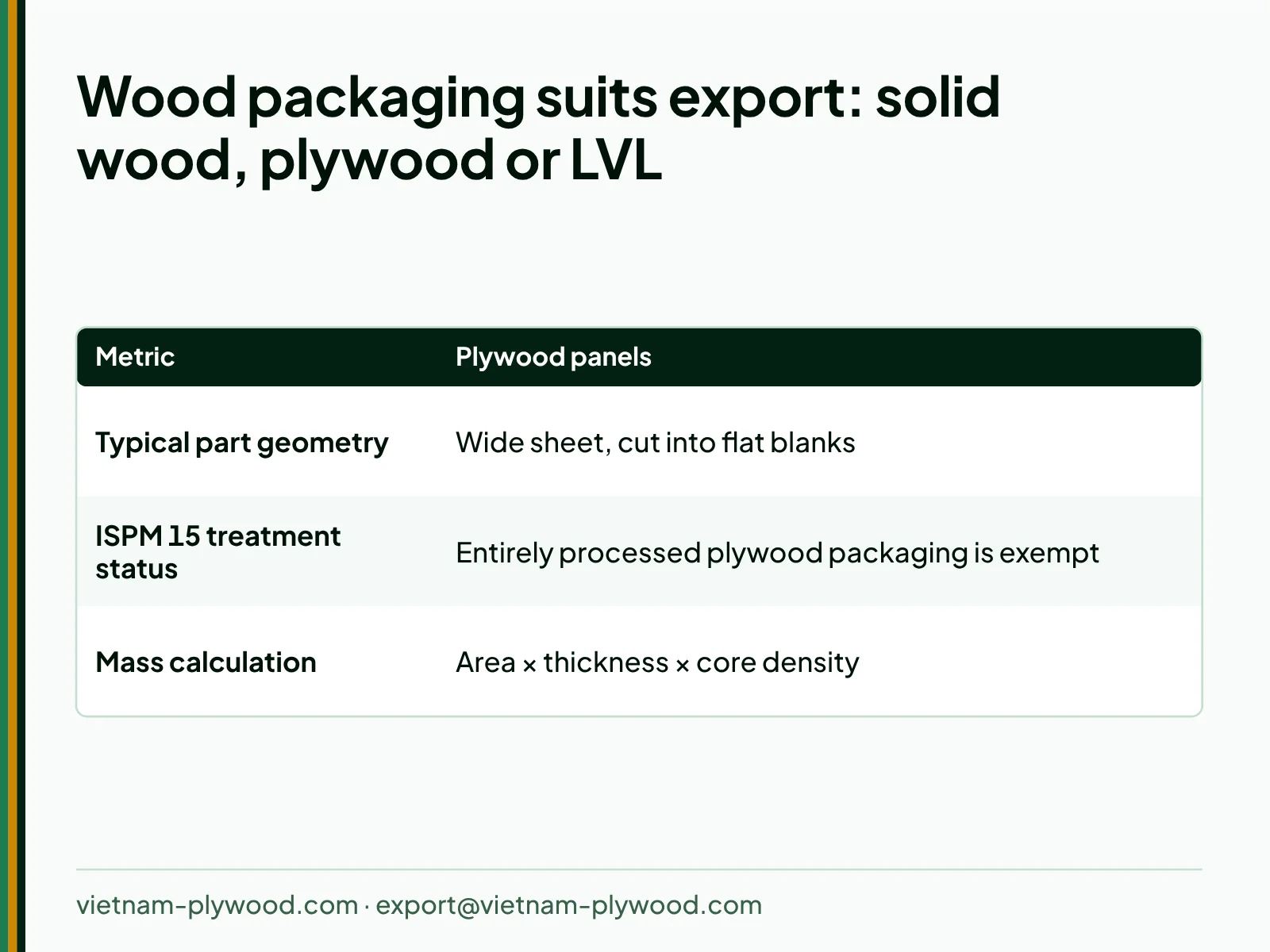
| Metric | Plywood panels | Solid sawn timber | LVL runners | Verdict by use |
|---|---|---|---|---|
| Typical part geometry | Wide sheet, cut into flat blanks | Narrow board or section | Long engineered section | Plywood for walls; timber for posts; LVL for runners |
| ISPM 15 treatment status | Entirely processed plywood packaging is exempt | Regulated raw-wood packaging normally needs treatment and marking | Check whether the finished member qualifies as wholly processed wood | Plywood simplifies the panel treatment decision |
| Mass calculation | Area × thickness × core density | Volume × specified timber density | Volume × documented LVL density | Compare the actual bill of materials |
| Cutting yield | Nest rectangular blanks across sheets | Crosscut and rip from stock sections | Cut runner lengths from supplied sections | Choose by drawing and offcut plan |
| Fastening | Specify edge distance and panel joints | Specify splitting and grain orientation | Specify connector performance and section | Test the complete assembly |
| Buying check | Thickness, voids, dimensions, moisture | Section, defects, treatment mark | Section, bond, traceability | Match inspection to each part |
LVL is veneer laminated into a structural member; its allowable load must come from the specified product and an accepted engineering basis. We do not substitute an assumed LVL strength value for a runner calculation. See the dedicated LVL runner specification and pallet board dimensions for the two distinct components.
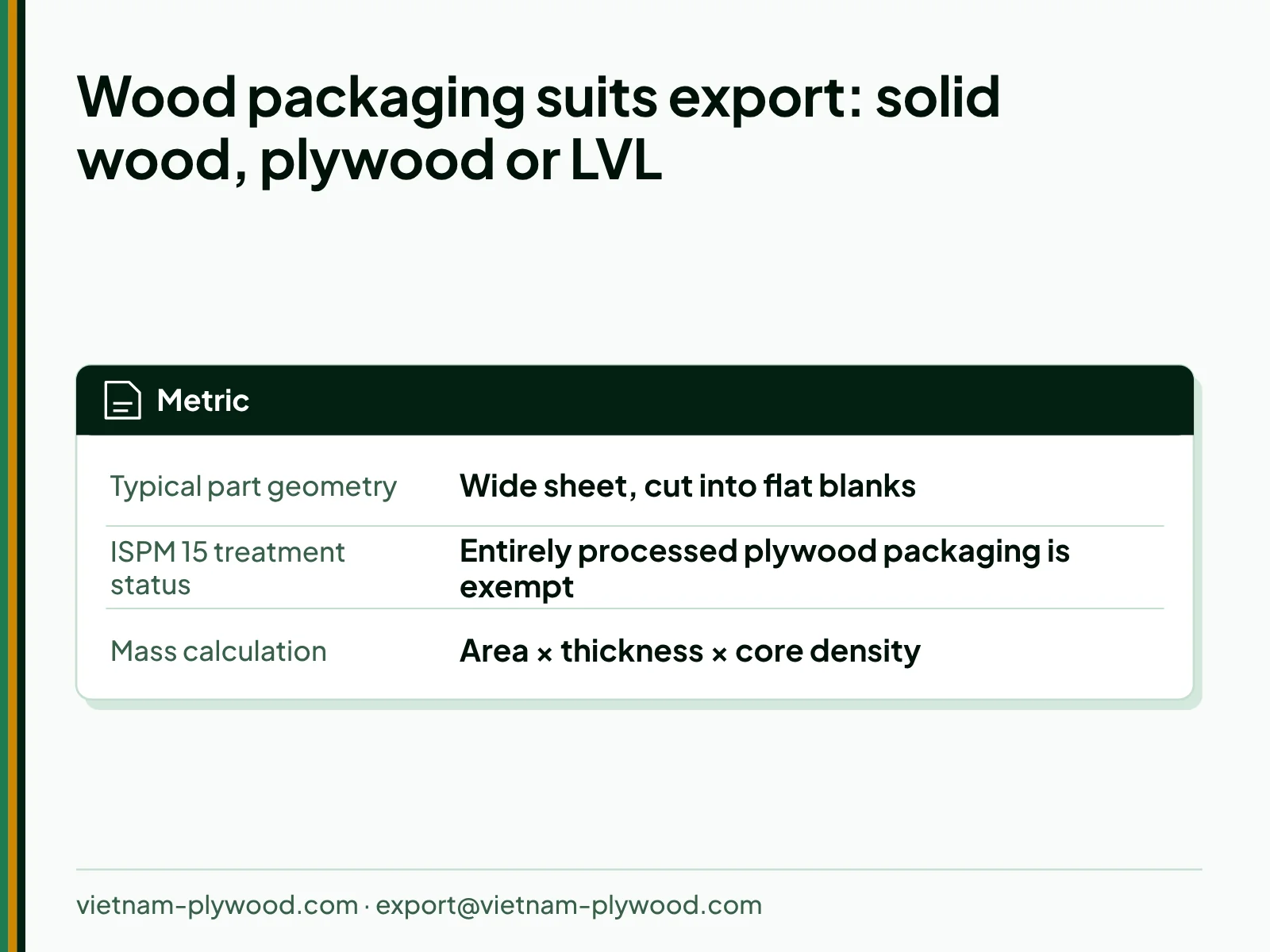
How do plywood and sawn timber differ under ISPM 15?
Plywood packaging made wholly from processed wood is exempt from International Standard for Phytosanitary Measures No. 15 (ISPM 15); raw solid-wood packaging is normally regulated. The International Plant Protection Convention identifies wholly processed plywood packaging among the exclusions. The distinction concerns the material in the finished packaging unit.
The International Plant Protection Convention’s ISPM 15 publication describes the pest-risk measures for raw-wood packaging and the exclusion for processed plywood. The International Plant Protection Convention’s 2021 ISPM 15 publication also distinguishes raw-wood packaging from processed plywood packaging.
A plywood crate with solid-wood cleats is not wholly made of processed wood. Its regulated solid-wood components still need the appropriate treatment and marking route. Likewise, do not assume an LVL runner is exempt solely because the commercial description says LVL: verify its actual manufacture, construction and destination interpretation. A phytosanitary paper accompanying a shipment is not a substitute for an applicable ISPM 15 mark on regulated packaging.
What do weight and cutting yield change?
Weight and yield change with the core density, finished blank dimensions and nesting layout. Our acacia packing core has a density of 580 kg/m³; a 1220 × 2440 × 18 mm sheet weighs 31.08 kg in the specified lookup. This figure describes the plywood sheet, excluding extra hardware, wrapping and solid-wood framing.
For comparison, the same 18 mm footprint in styrax core weighs 26.79 kg and eucalyptus core weighs 34.83 kg. These figures illustrate why a face name alone cannot establish packing mass. Density follows the core. An actual assembled crate also includes runners, fasteners, reinforcement and any moisture barrier.
Cutting yield starts with a dimensioned nesting plan. Two narrow walls cut from one sheet can leave a useful lid blank, whereas a slightly wider wall might force another sheet. Specify kerf allowance, grain or face direction where relevant, cut-edge finish and whether offcuts can become cleats or dividers. Compare usable finished pieces per purchased sheet, rather than square metres bought alone.
The applications library covers other industrial panel uses with different surface requirements.
Which factory line supplies packing panels and runners?
Our commercial and packing line produces acacia-core packing plywood with moisture-resistant (MR) glue and unsanded or light-sanded faces. It is the producing factory for the packing-panel specification; runner construction and availability are checked against the inquiry. Runner construction and section details must be agreed in writing rather than inferred from plywood sheet properties.
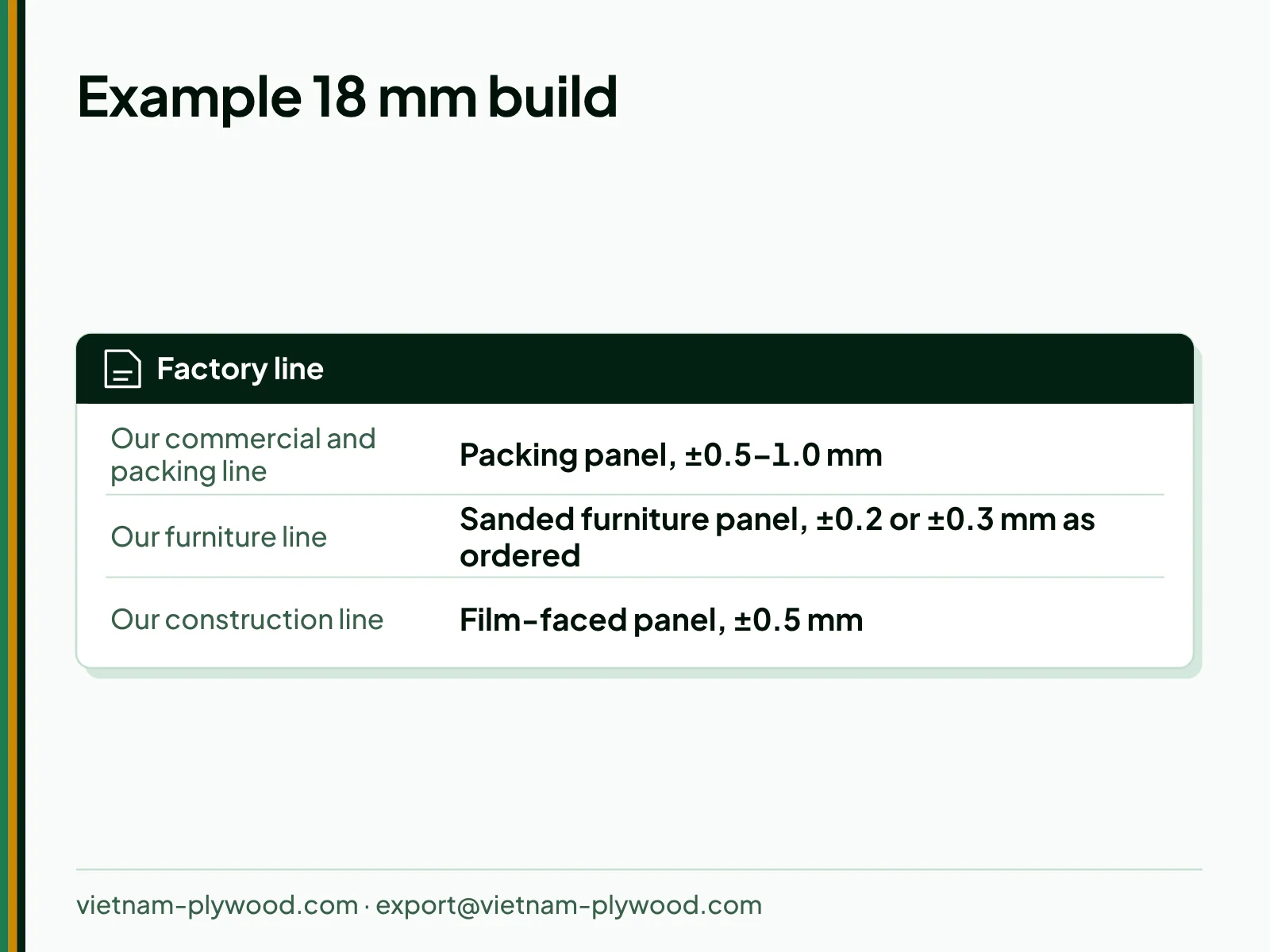
| Factory line | Example 18 mm build | Core or surface | Inspection focus | Appropriate use |
|---|---|---|---|---|
| Our commercial and packing line | Packing panel, ±0.5–1.0 mm | Acacia, MR, unsanded or light-sanded | Dimensions, core openings, cut blanks | Crates and separators |
| Our furniture line | Sanded furniture panel, ±0.2 or ±0.3 mm as ordered | Styrax or eucalyptus, full stitched, E0/E1 | Face and calibrated thickness | Visible furniture parts |
| Our construction line | Film-faced panel, ±0.5 mm | Acacia or eucalyptus, film surface | Film and edge condition | Concrete formwork |
HCPLY allocates production to the factory matching the written specification.
For a packing order, the buyer can inspect at the producing factory and witness dimensions, core construction, sample cutting and the packing count. The factory office is the visit point. We coordinate on-site quality control and loading under the agreed export order.
Which panel build should a packer specify?
Specify an acacia-core MR packing panel when the application needs an economical flat component without a decorative face. The starting build is an unsanded or light-sanded panel, with the thickness and cut dimensions tied to the assembly drawing. Common sheet sizes include 1220 × 2440 mm and 1250 × 2500 mm; custom cutting is available.
Thicknesses run from 3–40 mm, with common choices of 9, 12, 15 and 18 mm for different parts. Packing thickness tolerance is ±0.5–1.0 mm; length and width tolerance is ±2 mm. The buyer should select the permitted tolerance from the actual slot, fastener and assembly fit, rather than request the tightest tolerance by habit.
Core assembly also matters. Full stitched veneer offers more continuous construction than stitched outer layers with edge-trimmed inner layers; finger-jointed and loose-laid builds sit lower in the construction hierarchy. Specify the acceptable core build and an inspection method for voids. A cut edge exposes what a face photograph cannot show.
Can cut packing parts share one container?
Cut packing panels and agreed runner components can be combined within one 40-foot high-cube container when the loading plan stays within the 28.5 t payload limit. The minimum order is one 40HC, and specifications can be mixed within that limit. Final packing counts must follow the actual part list and pallet arrangement.
For a reference load of uncut 18 mm, 1220 × 2440 mm acacia sheets, the lookup gives 55 sheets per pallet, 16 pallets, 880 sheets, 47.15 m³ and 27.35 t. The mixed-load plan must account separately for runners, pallets, wrapping and any other packing materials.
The detailed container-load calculation belongs on the packing calculator page. Here, the purchase decision is whether the panel cutting list and runner list can be combined without creating a weight or handling problem. HCPLY coordinates loading against the agreed quantities.
What happens between drawing and loading?
The order moves from an approved cutting list to production checks, packed bundles and shipment documents. A clear drawing saves rework at the saw and prevents mismatched parts at the packer’s assembly station.
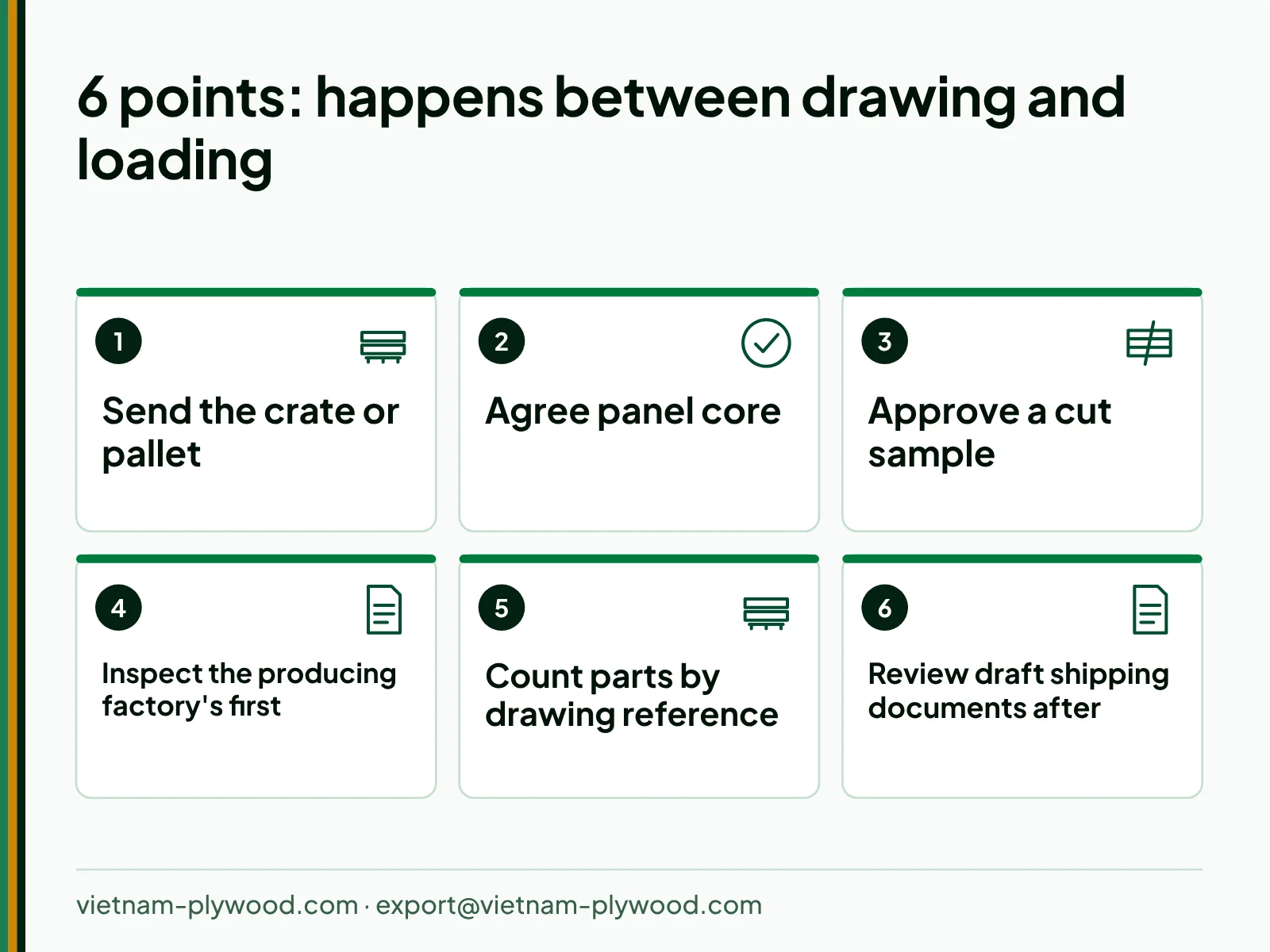
- Send the crate or pallet drawing with each part number, finished dimensions, required quantity and assembly function.
- Agree panel core, MR glue, thickness tolerance, edge condition and runner section or construction requirements.
- Approve a cut sample or dimensioned cutting schedule before the main run.
- Inspect the producing factory’s first pieces, core edges, dimensions and bundle identification.
- Count parts by drawing reference, protect edges, record bundle weights and approve the loading sequence.
- Review draft shipping documents after loading and reconcile the packing list with the ordered part numbers.
The packing list is the export document that connects part counts, bundles and shipment quantities. The commercial invoice records the commercial transaction, while the bill of lading (B/L) records carriage details. Depending on the destination and agreed build, the shipment file also contains origin, phytosanitary or fumigation papers and relevant certificate documents.
For European Union lots, the file includes the EUTR/EUDR documents and EUR.1 where applicable. Factory certificates such as FSC, CARB P2, ISO 9001 and CE are shown with factory details masked, on request. The order’s documents must match the actual producing factory and specified product.
What drives the quotation for packing parts?
The largest quotation drivers are usually material volume and construction, followed by cutting yield, machining and packing complexity. A thicker panel consumes more veneer than a thinner panel of the same area; a more continuous core requires more preparation than a loose-laid construction. Small irregular blanks can consume more sheet area than their finished dimensions suggest.
The next driver is the quantity of distinct part sizes. A repeated rectangular blank is simpler to schedule than a mixed cutting list with many short runs. Runner section, fastening requirements, edge protection and marking add separate work. Freight terms and destination documents affect the delivered comparison.
Ask for the price against a written bill of materials rather than a generic wood packing rate. We quote against the specified build and order quantity. The available delivery terms are FOB Hai Phong, CFR (CNF) or CIF; the production window is 15–45 days from the 30% deposit, set by order size, line loading and the contract.
The remaining 70% is paid on the scan of the bill of lading, by T/T, or by irrevocable sight L/C. Free samples are available; a first-time buyer pays the courier, and that charge comes off the first confirmed order. For scheduling context, see plywood production lead time.
What should the buyer inspect before dispatch?
The buyer should inspect representative parts against the approved drawings, then match their identifiers to the packing list. For panels, check finished length and width, thickness at agreed points, exposed core gaps, edge damage and surface condition. For runners, check section, straightness, cut length and the documented build.
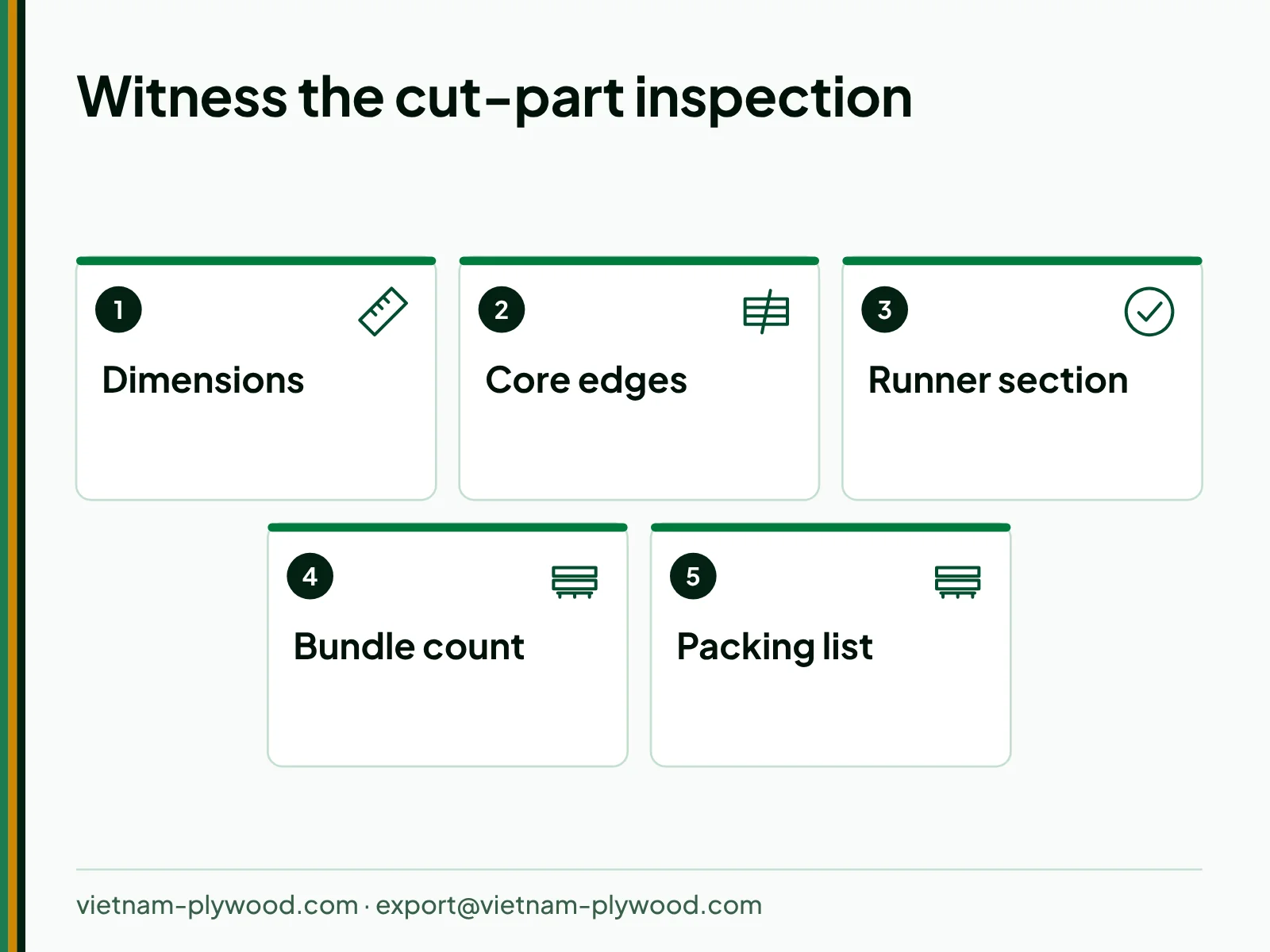
Record the inspection with a dated part-number checklist and photographs of the actual bundles. Check that the quantity per bundle and gross mass reconcile with the loading plan. If solid timber is part of the finished package, review its applicable ISPM 15 treatment and mark evidence separately from the plywood paperwork.
HCPLY manages the specification, factory inspection, shipping documents and loading. Buyers can visit the producing factory to check the material before dispatch. That witness point is more useful than relying on a photograph of a finished crate whose internal edges are hidden.
What specification should the packer send?
Send the assembly application and a part-by-part cutting list, including the intended port and loading constraints. The factory can then match plywood panels to the packing line and assess runner requirements against the drawing. Keep panel emission class and glue designation in separate fields.
A request should state whether the crate will include regulated solid timber supplied elsewhere, since the finished assembly affects the ISPM 15 plan. Include the required labeling and whether parts must arrive bundled by assembly kit or by part number. Mark drawings with their revision date to avoid mixing old and new cuts.
Application: Export machinery crate / pallet / industrial packing parts
Line or core: Commercial and packing line / acacia core; runner build specified separately
Glue: MR (melamine)
Emission: E0 / E1 / E2, as required by buyer specification
Face and grade: Matt/unfaced packing panel; agreed utility face condition
Thickness and tolerance: ___ mm; packing tolerance ±0.5–1.0 mm as ordered
Size: Sheet ___ × ___ mm; finished part list and drawing revision attached
Quantity: ___ panels and ___ runners by part number; one 40HC minimum
Destination port: ___
Next step: request the packing-parts specification sheet from Lucy at export@vietnam-plywood.com.