





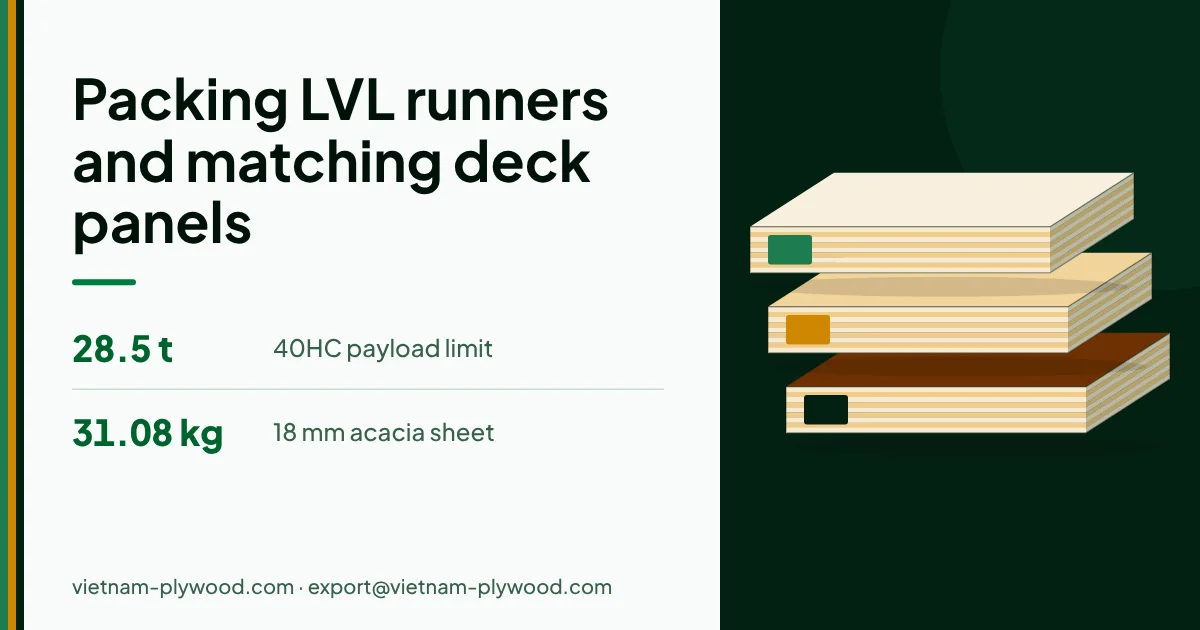
LVL runners replace sawn pallet bearers with bonded veneer sections cut for repeatable industrial packaging builds. Choosing the wrong section can mean damaged cargo, rejected pallets or delayed shipments. HCPLY makes packing LVL alongside packing plywood so buyers can specify runner dimensions, deck panels and loading quantities for one pallet design.
What are LVL runners?
LVL runners are longitudinal pallet bearers made from laminated veneer lumber: thin wood veneers bonded into a continuous engineered section. They support deck panels, carry load toward the floor and create forklift clearance. A runner is different from a pallet block, which supports a deck at discrete points. Both can be specified from a cutting drawing.
A buyer should describe each component by its function before choosing the section. A runner receives bending and shear forces across its span; a block primarily receives compression and local fastener loads. The same material name cannot replace a drawing showing where the load enters the pallet.
We make packing LVL through our commercial and packing line alongside packing and commercial plywood. The purchase specification should identify the runner section, block dimensions, intended pallet geometry and deck material together. For the broader choice among export-packaging materials, see export wood packaging options.
Why choose LVL instead of solid timber bearers?
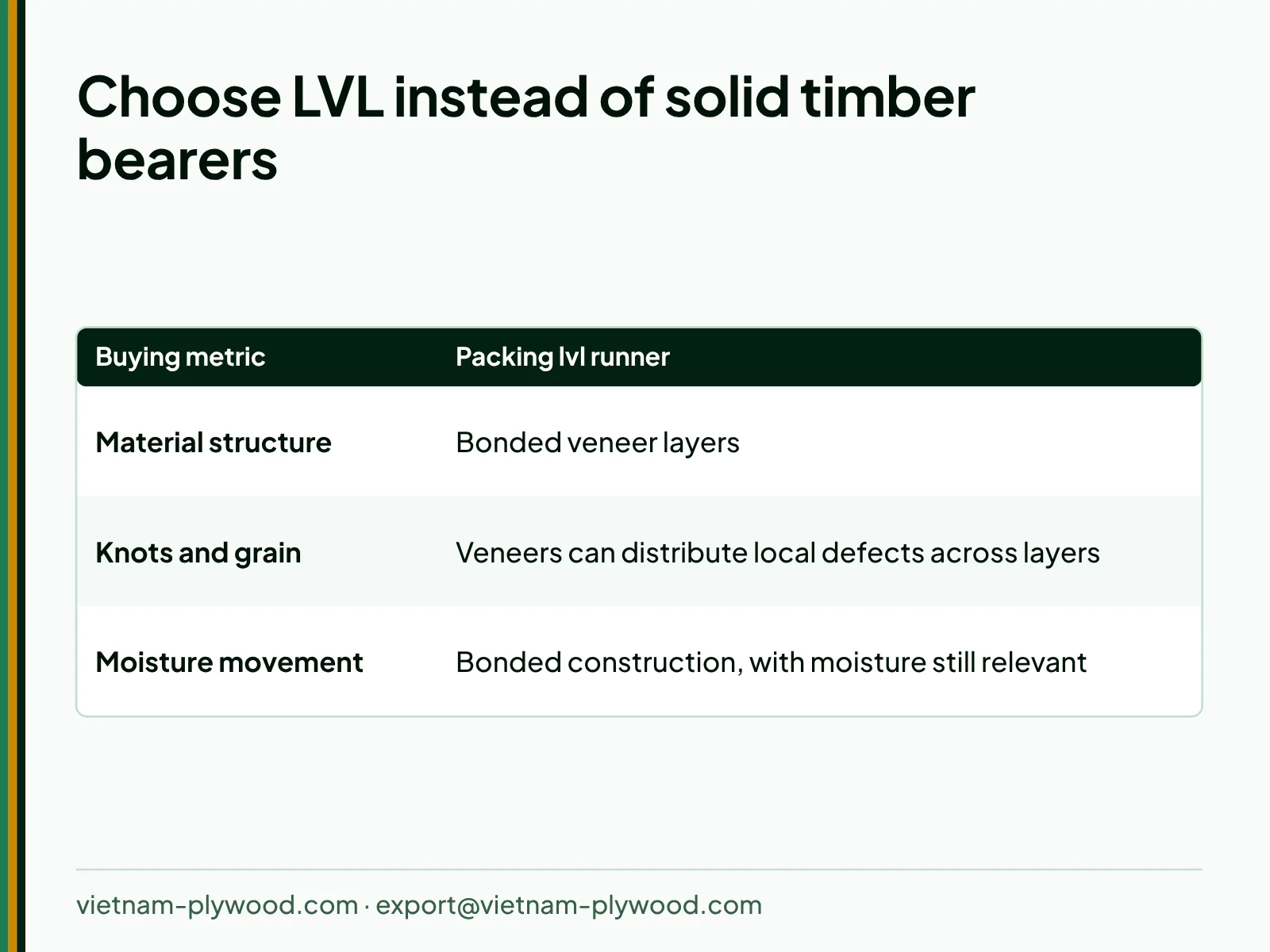
LVL offers a manufactured veneer layup and repeatable cut sections, while sawn bearers retain the natural variation of individual timber pieces. This makes dimensional consistency a practical purchasing reason to compare the two. It does not establish a universal load rating: pallet design and testing still decide safe use.
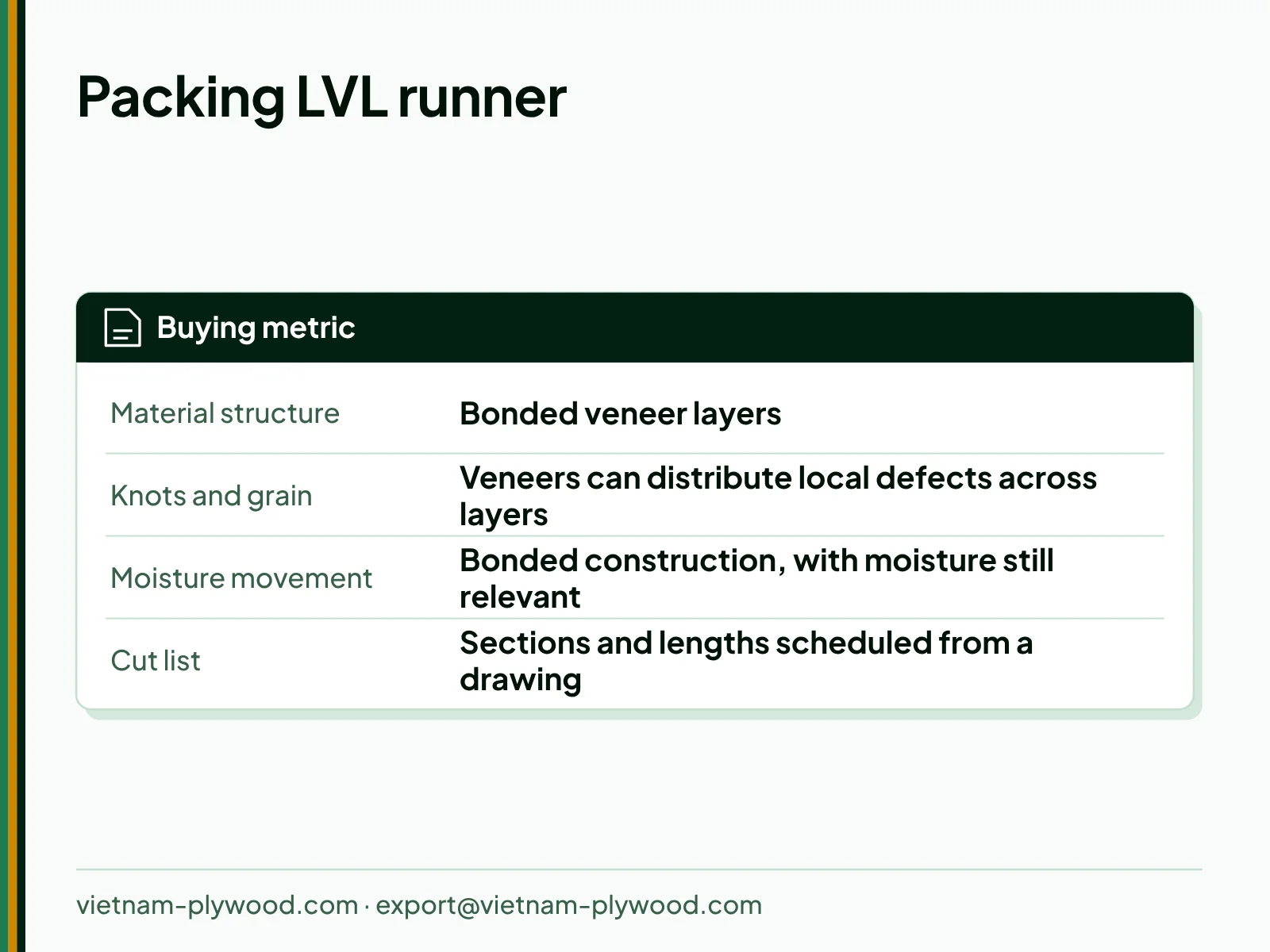
| Buying metric | Packing LVL runner | Sawn timber bearer | Verdict by use |
|---|---|---|---|
| Material structure | Bonded veneer layers | One solid timber section | LVL when repeatable section construction matters |
| Knots and grain | Veneers can distribute local defects across layers | Defects remain within one piece | Compare LVL for production consistency |
| Moisture movement | Bonded construction, with moisture still relevant | Movement follows timber grain and drying history | Specify moisture for either |
| Cut list | Sections and lengths scheduled from a drawing | Sections and lengths scheduled from a drawing | Either works if tolerances and yield fit |
| Pallet capacity | Requires design and loading checks | Requires design and loading checks | Neither wins without the pallet test |
The wrong runner section can bend under stacking load or loosen a deck joint during forklift handling. Too little clearance can bring the fork into contact with the goods. Excess moisture can affect dimensions and fastening. Compare a completed pallet design, rather than treating a material label as a damage-rate guarantee.
For designs with separate blocks, inspect the block-to-deck joint as carefully as the runner span. A compressed chip block is a different material construction from veneer-laminated LVL; do not substitute one on a drawing without checking dimensions, fasteners and compressive performance.
What moisture content and glue should packing LVL use?
Packing LVL moisture must be specified as a measurable acceptance limit at dispatch, with a sampling method agreed before pressing. Set the runner moisture limit against storage and destination conditions. State the destination, storage conditions, wrapping plan and the test method on the purchase specification.
For our commercial and packing line, the documented packing-plywood build uses acacia core and moisture-resistant (MR) melamine glue. The MR description corresponds to a 12-hour boil condition; phenolic weather-and-boil-proof (WBP) glue corresponds to a 72-hour boil condition. These are glue-system descriptions, not a measured moisture-content result or a pallet load test. The runner’s glue build must appear explicitly on its approved specification.
Emission class is a separate field from adhesive choice. E0, E1 and E2 describe emission classes; a buyer should not order an emission class by naming the glue alone. Ask for the relevant factory test report where the end market or buyer specification calls for it.
A moisture reading should identify the instrument, calibration, measuring location, sample selection and acceptance criterion. Record readings at the producing factory before wrapping, and inspect for visible edge separation or wet staining. A stated target without a sampling rule creates avoidable disputes at receipt.
Can runners and blocks follow a cutting list?
Yes: runners and blocks can be specified as cut sections against a packer’s dimensioned list. Send finished width, height, length, permitted deviation, quantity per component and the intended pallet assembly. Mark whether a length is the finished cut or the pre-trim allowance.
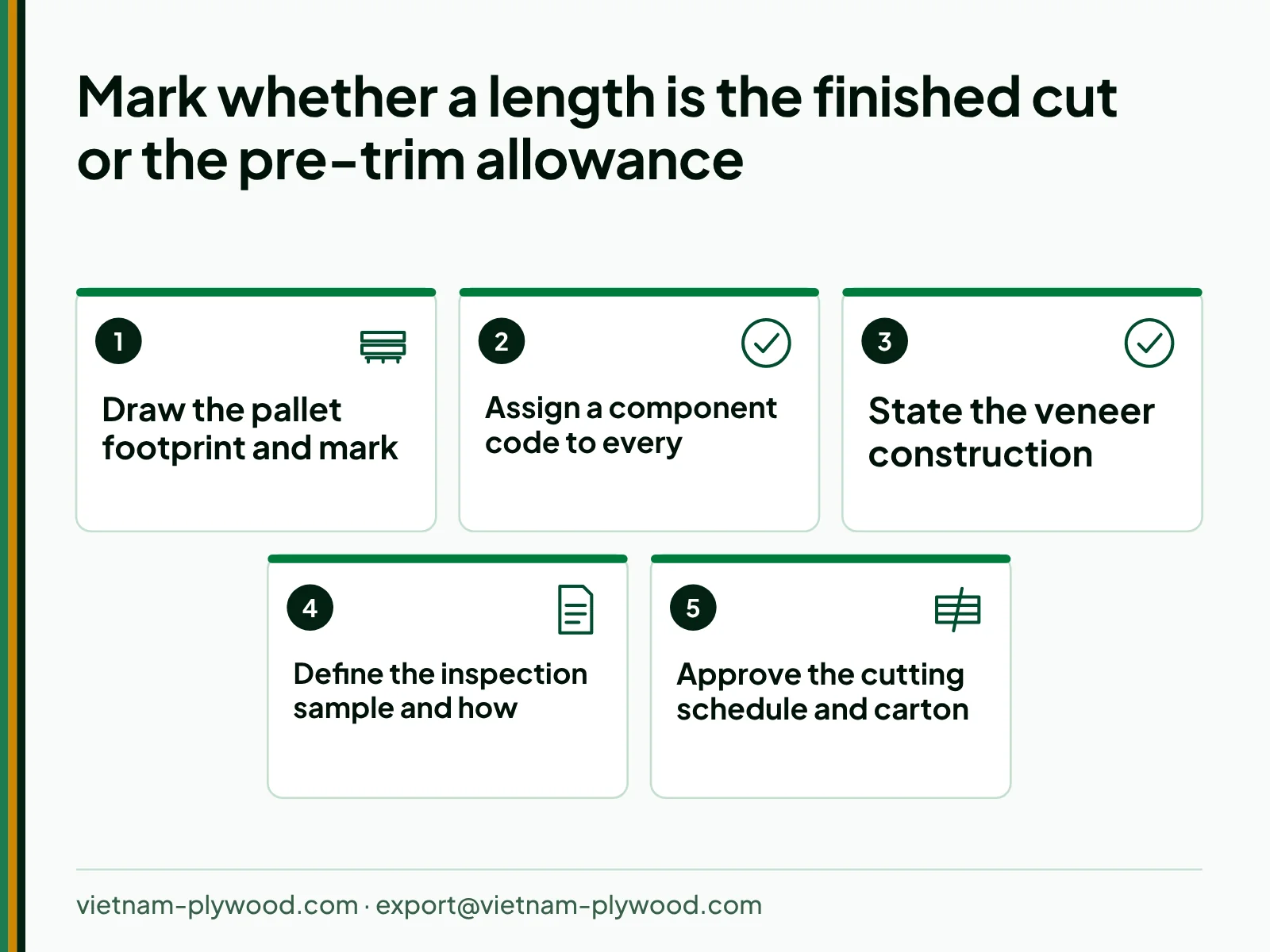
- Draw the pallet footprint and mark runner orientation, block locations and forklift-entry direction.
- Assign a component code to every runner and block, with finished dimensions and quantity per pallet.
- State the veneer construction, glue requirement, moisture acceptance method and any finish or edge condition.
- Define the inspection sample and how out-of-tolerance sections are segregated before packing.
- Approve the cutting schedule and carton or bundle identification before production release.
For a pallet with stringers, include notches or fork-entry clearances in the drawing if they are needed. For a block pallet, give the block placement and deck fastening layout. The pallet types and sizes page explains how these layouts differ.
The cut list should also identify any holes, chamfers or special machining. If the drawing does not specify these operations, a straight-cut section should be the purchasing baseline. A clean label on every bundle lets the assembly plant reconcile delivered pieces with the bill of materials.
Which factory line makes the packing components?
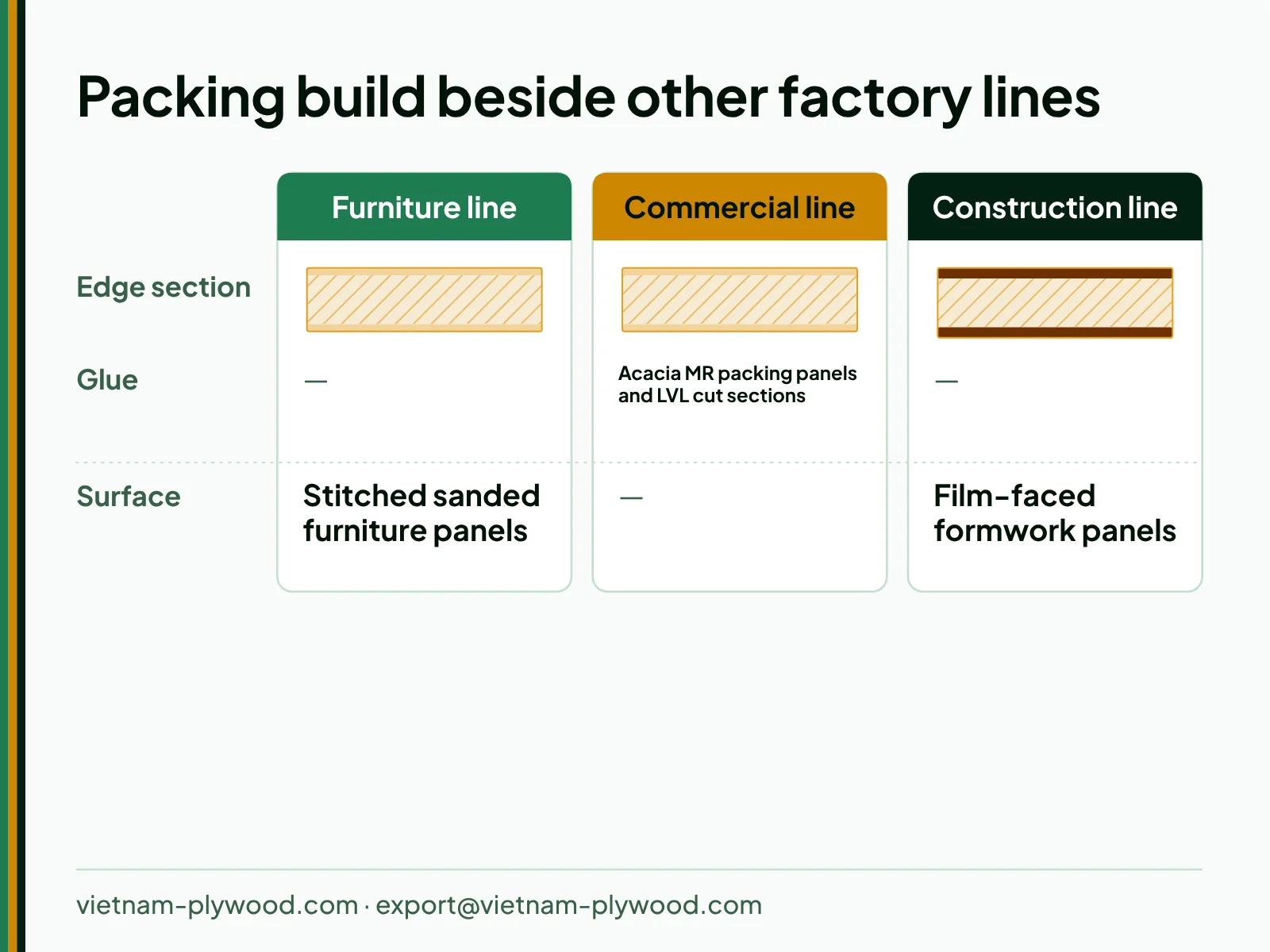
Our commercial and packing line handles packing LVL and the accompanying packing-plywood deck requirement. The furniture and construction lines make different panel builds, so the requested pallet design belongs with the line that handles its packing specification.
| Line | Core and surface build | Relevant buyer application |
|---|---|---|
| Our commercial and packing line | Acacia core; MR glue; unsanded or light-sanded packing plywood, plus packing LVL cut sections | Runners, blocks and matching pallet decks |
| Our furniture line | Styrax or eucalyptus core; full stitched, sanded; E0/E1 | Furniture panels rather than pallet bearers |
| Our construction line | Acacia or eucalyptus core; phenolic or melamine film, including anti-slip film | Formwork panels rather than pallet bearers |
HCPLY operates three member factories in Phu Tho and Hai Phong. The order is made at the producing factory selected for its specification and shipped directly from that factory, FOB Hai Phong. Buyers can visit the factory office and inspect their goods where they are produced.
The packing deck’s tolerance is typically ordered within the packing specification; for packing plywood, the stated thickness tolerance is ±0.5–1.0 mm and length and width ±2 mm. Those panel tolerances must not be silently applied to cut LVL runners. Put the runner’s separate cross-section and length acceptance limits in the cutting schedule.
Can LVL runners and plywood decks share a container?
Yes: mixed specifications can share one 40HC container within its 28.5 t payload limit. That permits packing LVL runner bundles and plywood deck panels to be planned against the same pallet bill of materials. The final load plan needs actual runner-bundle weights and pallet counts.
For a useful weight reference, a 1220 × 2440 × 18 mm acacia plywood sheet weighs 31.08 kg. At the full acacia packing-panel lookup, 880 sheets occupy 47.15 m³ and weigh 27.35 t. A mixed load must remove some deck sheets before adding runner bundles; 27.35 t plus runner weight would otherwise consume the remaining payload allowance.
For a mixed order, request a loading schedule listing deck-sheet counts and weighed LVL bundles separately. Include pallet and packaging weights, bundle dimensions and weight distribution before approving the container plan.
The mixed-container loading page covers the combined-order arrangement. For full-panel container lookup by thickness and core, use the packing calculator. Provide bundle length and lifting method before the loading diagram is approved.
What should an inspector witness at the producing factory?
The inspector should compare cut LVL sections and plywood decks against the approved component schedule before bundling. A factory visit can cover the cut ends, bond lines, measured section sizes, moisture readings and bundle identity in one inspection route.
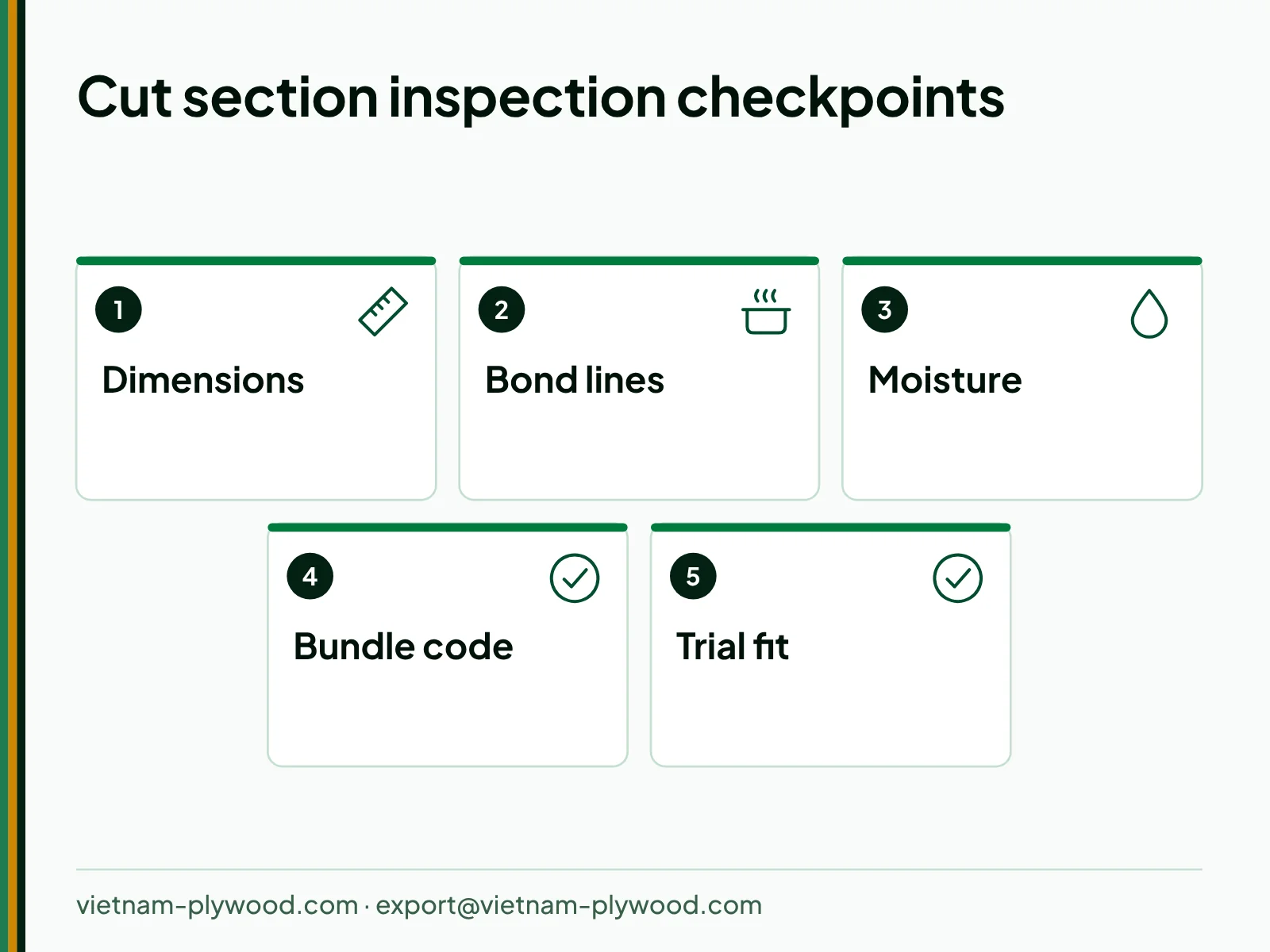
Start with the approved drawing and select pieces across bundles, rather than inspecting only the top layer. Measure width, height and length; check squareness and visible bow; examine veneer edges for gaps or separation. Record the actual values beside the component code and keep photographs of any rejected sections.
Next, check the deck-panel dimensions and surfaces against the pallet drawing. Trial-fit representative runners, blocks and decks to expose interference at fork entries and mismatched fastening positions. A trial assembly is useful, but it does not replace a load test for the finished pallet.
We handle specification review, on-site quality control, shipping documents and loading. The inspector can match the approved cutting schedule to bundle labels and the loading tally. If a test report is required for a specific adhesive or end-use claim, agree the test method and acceptance criteria before manufacture.
Is packing LVL suitable for export pallets?
Packing LVL is suitable as a candidate material for pallet runners and blocks when the finished pallet design meets the buyer’s loading and handling requirements. Confirm static stacking, dynamic movement, racking, fork-entry clearance and fastening performance at pallet level. Material uniformity alone cannot establish a safe working load.
Export-pallet buyers also need to distinguish processed-wood components from raw-wood packaging. The European Commission’s guidance on Regulation (EU) 2016/2031 explains the exception for packaging made entirely from processed wood using glue, heat and pressure. See the European Commission wood-packaging requirements.
The International Plant Protection Convention’s 2021 ISPM 15 publication also excludes packaging processed to be free from pests, including plywood. See the IPPC ISPM 15 publication. The assembled pallet matters: adding raw timber parts changes what must be assessed, and importing-country rules still apply.
The exemption discussion concerns plant-health treatment rules; it is separate from pallet strength, adhesive performance and customs classification. Buyers should provide the complete bill of materials and destination-country requirements before deciding which documents or treatments apply.
What documents and terms accompany the shipment?
The packing list should identify runner bundles and deck panels by specification, quantity and package reference. It is the shipment document that lets the buyer reconcile the mixed pallet-component order against the loading tally.
The export document set includes a commercial invoice, packing list, bill of lading, certificate of origin, phytosanitary and fumigation papers, and the agreed certificate or test documents. EU lots use EUR.1 where applicable and the EUTR/EUDR file set; CIF shipments include insurance. After loading, the draft shipping documents come to you for approval.
Minimum order is one 40HC, with mixed specifications within the payload limit. Factory lead time runs 15–45 days from receipt of the 30% deposit; the exact figure depends on order size, line loading and what the contract fixes. The 70% balance is against the scanned bill of lading, by T/T or irrevocable L/C at sight. We ship FOB Hai Phong, or CFR (CNF) or CIF to your port.
Samples are free; a first-time buyer pays the courier, and that charge comes off the first confirmed order. For certificates held by member factories, FSC, CARB P2, ISO 9001, CE and EUDR/EUTR documents are shown with factory details masked, on request. Specify the exact document needed for the buyer’s market.
What should go on the request for quotation?
A useful quotation request gives the runner drawing and the plywood deck schedule together, including intended pallet loads and destination port. LVL pricing depends on veneer build, section size, cutting yield, glue requirement, moisture testing and bundle preparation; no fixed runner price follows from the material name.
A more demanding veneer or adhesive specification costs more than a simpler packing build because material selection and processing requirements increase. Short pieces with many special cuts can add machining and handling compared with repeated straight lengths. The buyer should ask for a written quotation against one approved cutting schedule.
For an initial HCPLY review, send the component codes, target quantities and destination to Lucy at export@vietnam-plywood.com. Include the proposed deck thickness and whether the pallet will be tested under a buyer-defined protocol. We can then align the packing line’s runner and deck requirements before the order is released.
Application: export pallet runners and blocks; pallet load and handling conditions: [specify]
Line or core: commercial and packing line; acacia for packing plywood; LVL veneer build: [specify]
Glue: [MR melamine / agreed alternative]; moisture target and test method: [specify]
Emission: [required class and evidence]
Face and grade: [deck face/grade; runner finish and veneer requirement]
Thickness and tolerance: [deck thickness/tolerance; runner width/height/length tolerances]
Size: [deck sheet size; runner and block cutting-list codes and dimensions]
Quantity: [deck sheets; runners and blocks by code; total 40HC allocation]
Destination port: [port and country]
Next step: request the packing LVL specification sheet with the drawing and cutting list attached.