





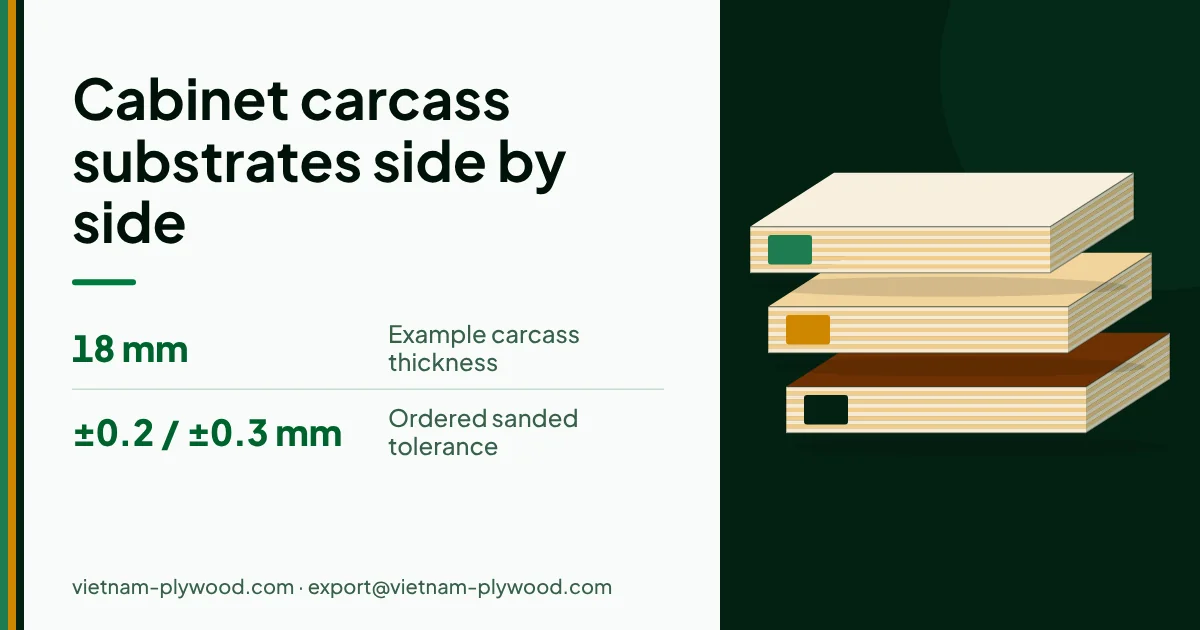
Melamine vs plywood cabinets is a carcass-material decision: plywood replaces a melamine-faced particleboard or MDF substrate while leaving the decorative finish as a separate choice. Choosing the wrong substrate can mean failed hinge joints, swollen cut-outs and rejected cabinet parts. HCPLY offers EV-faced or matt-core plywood from our furniture line for cabinet makers comparing the two routes.
What does melamine vs plywood cabinets actually compare?
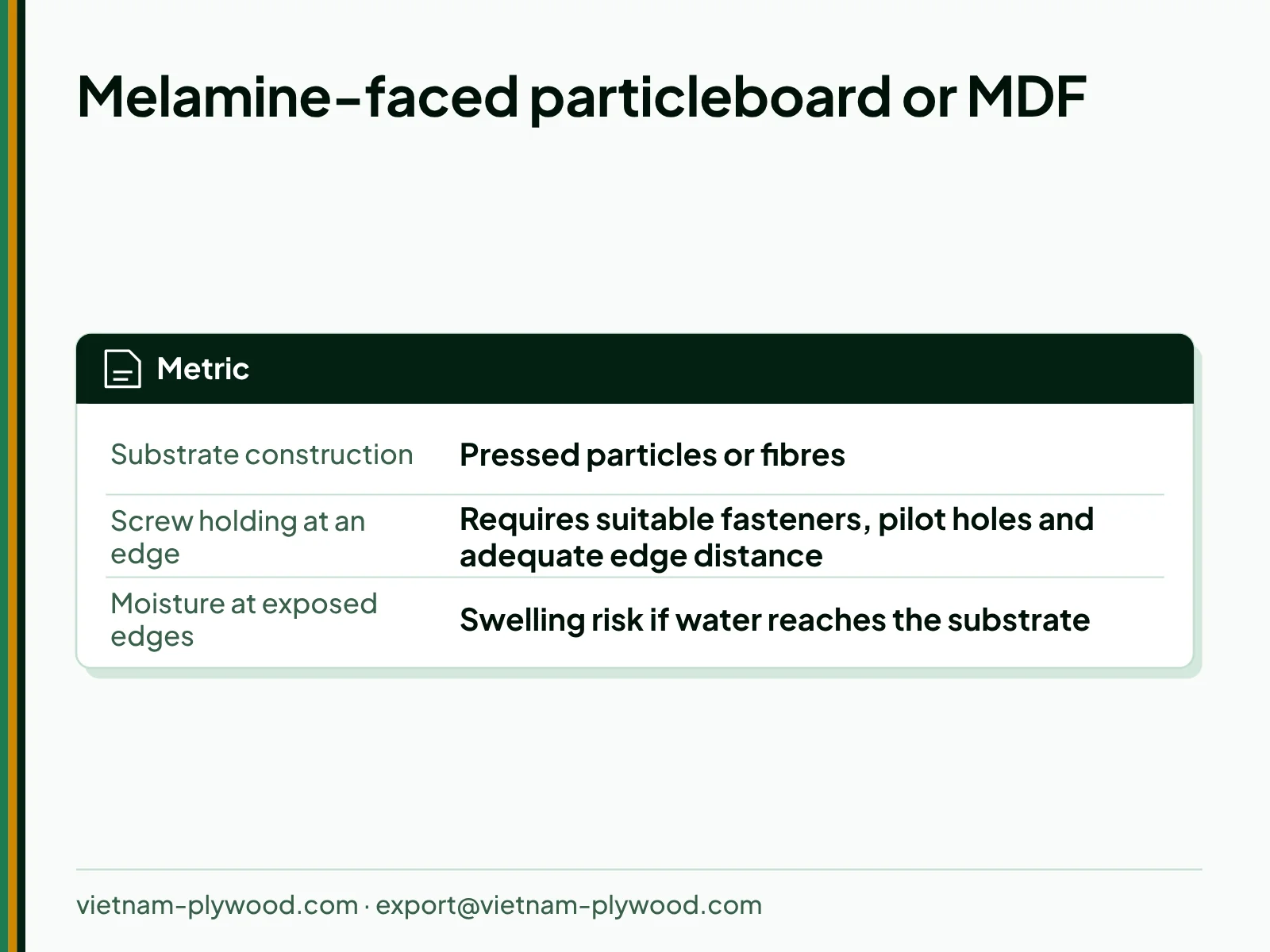
Melamine vs plywood cabinets compares two different things: a decorative melamine surface and the structural board beneath it. In a typical melamine-board carcass, that substrate is particleboard or medium-density fiberboard (MDF); in a plywood carcass, cross-laid veneers form the substrate. The finish alone cannot tell a buyer how a screw joint or exposed edge will perform.
A melamine-faced plywood panel is a third configuration: plywood underneath decorative melamine paper. That is different from a melamine-faced particleboard panel even when both look like white melamine cabinets. Specify substrate and face separately before comparing quotations.
HCPLY’s kitchen cabinet plywood discussion covers the wider cabinet program. This comparison focuses on replacing a board carcass with EV-faced plywood or an unfaced matt-core plywood panel for finishing at the buyer’s plant.
Which board wins each cabinet metric?
For cabinet factories, the verdict changes with the joint, exposure, finish and production route. The table compares a typical melamine-faced particleboard or MDF carcass with furniture-line plywood; it does not assign laboratory strength figures to either material.
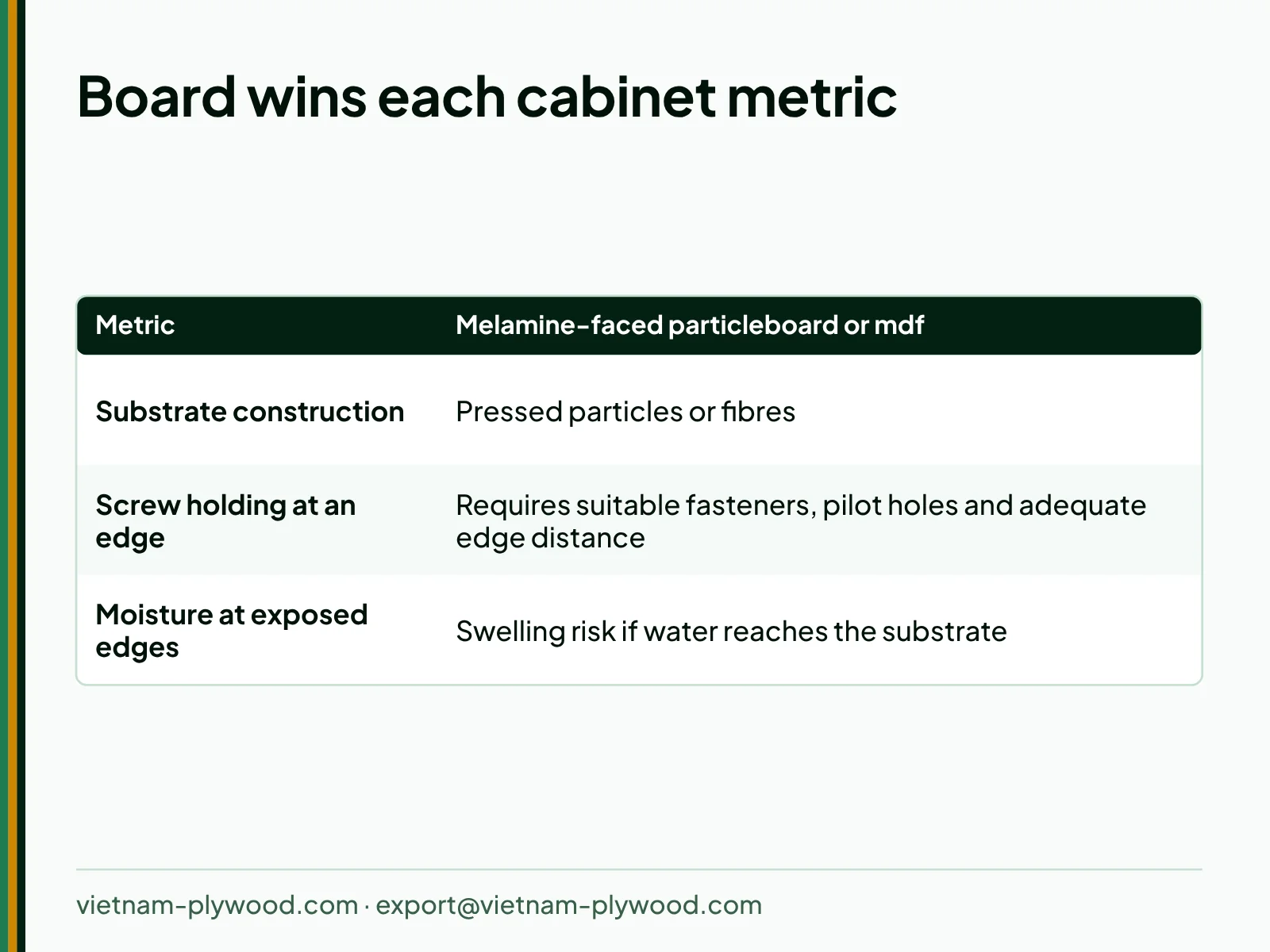
| Metric | Melamine-faced particleboard or MDF | EV-faced or matt-core plywood | Verdict by use |
|---|---|---|---|
| Substrate construction | Pressed particles or fibres | Cross-laid wood veneers | Plywood for repeated edge fastening where the joint design supports it |
| Screw holding at an edge | Requires suitable fasteners, pilot holes and adequate edge distance | Veneer structure offers a different fastening path; voids and drilling still matter | Trial the actual hinge and connector before choosing plywood |
| Moisture at exposed edges | Swelling risk if water reaches the substrate | Veneer and glue selection matter; exposed edges still absorb moisture | Plywood can suit splash-prone carcasses with sealed edges |
| Surface supplied to assembly | Decorative melamine face already applied | EV veneer ready for a specified finishing process, or matt core for buyer lamination | Melamine board for immediate assembly; plywood for controlled finishing |
| Cut-edge appearance | Core usually needs edge banding | Layered edge visible; finishing or banding still needed | Choose by the approved edge detail |
| Shelf span and deflection | Governed by thickness, span, load and board grade | Governed by the same variables and veneer build | Engineer the shelf from load and span, not a material label |
| Machining | Consistent surface; chipping and tool wear need control | Veneer tear-out and core gaps need control | Trial the actual CNC program |
| Material purchase price | Finished decorative surface can reduce downstream finishing work | Veneer construction and separate finishing add steps | Compare finished cabinet cost, not sheet price alone |
Test cut edges and hardware on samples. For dimensions, use the cabinet plywood thickness reference.
Is melamine board stronger than plywood?
A melamine finish does not make a particleboard or MDF substrate structurally equivalent to plywood. Strength must be assessed for the actual substrate, thickness, joint geometry and loading direction. Plywood’s cross-laid veneers can offer an advantage for fastening and handling, while a well-designed engineered-board joint can still meet a cabinet specification.
For hinge screws, compare withdrawal or pull-out performance in the face and edge separately. Run the same screw, pilot-hole diameter, insertion depth and edge distance on both candidate panels. Check for splitting or crushing around the fixing.
Cabinet racking resistance also depends on back panels, connectors and assembly. Specify the test method and acceptance threshold in the purchase agreement rather than assuming a generic melamine vs plywood strength ranking.
What changes at wet edges and sink cut-outs?
A kitchen carcass gains a veneer-based substrate option, but the cut edge remains the exposure point. Seal sink openings, plumbing penetrations, bottom edges and newly machined holes as part of the cabinet maker’s finishing process. Surface resistance to wiping does not establish resistance to standing water entering a cut-out.
Our furniture line uses full-stitched, sanded styrax or eucalyptus cores, with the glue and emission requirements written separately. A melamine glue option is described as MR with a 12-hour boil condition; phenolic glue is WBP, weather and boil proof, with a 72-hour boil condition. Those descriptions concern glue selection, not a claim that an installed cabinet is waterproof.
The bathroom vanity plywood application has more exposure-specific detail. For kitchen orders, agree on edge sealing responsibility between the panel factory and cabinet assembly plant.
Which HCPLY line builds a plywood carcass?
Our furniture line presses the EV-faced or matt-core carcass panel. Its full-stitched veneer construction and sanding specification suit cabinet machining. The other lines make different panels for different end uses, so a common nominal thickness does not imply interchangeable quality.
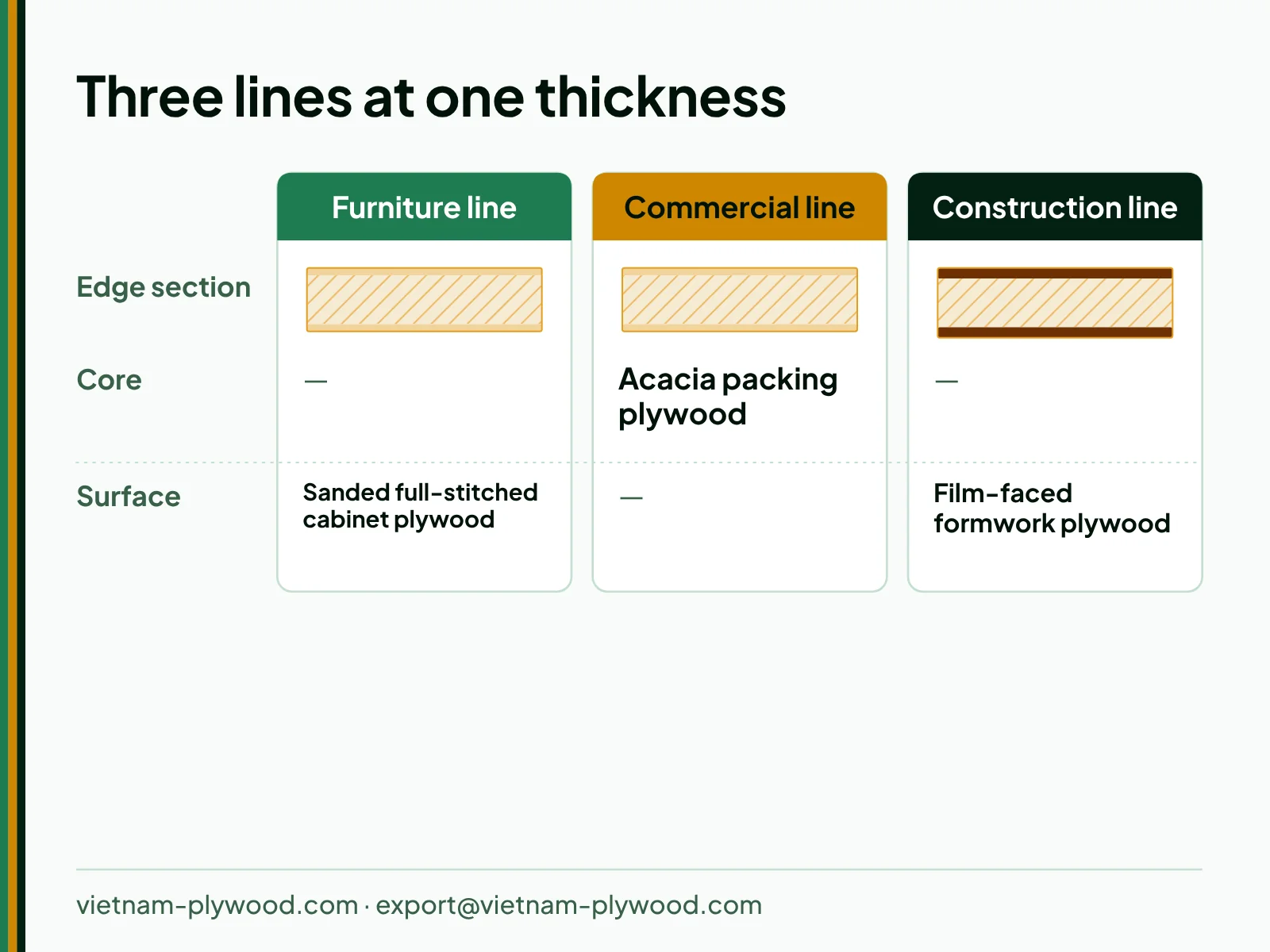
| Line | Example at 18 mm | Core and surface | Cabinet-use verdict |
|---|---|---|---|
| Furniture | EV-faced or matt-core cabinet panel | Styrax or eucalyptus, full stitched, sanded | Select for carcasses and door substrates |
| Commercial and packing | Commercial or packing panel | Acacia, MR glue, unsanded or light-sanded | Select for packing applications, not as a substitute for the furniture specification |
| Construction | Film-faced formwork panel | Acacia or eucalyptus, unsanded | Select for formwork, not decorative cabinet carcasses |
HCPLY does not press MDF, chipboard or OSB. Melamine, high-pressure laminate (HPL) and other laminate faces are finishing topics here, not products offered from our lines. Compare the commercial and packing plywood and construction project plywood applications when a procurement team handles several panel categories.
Can the buyer laminate a matt-core plywood carcass?
Yes. A buyer with its own laminating equipment can order matt-core furniture plywood and apply the selected decorative system at its plant. Matt means an unfaced raw core, not a melamine coating. Agree on surface preparation, moisture conditioning, adhesive compatibility and finishing trials before production.
An EV-faced panel offers an engineered-veneer appearance for a different finish schedule. A buyer wanting white melamine cabinets can instead laminate the raw plywood after verifying the decorative-paper process against its equipment and adhesive. HCPLY supplies the plywood substrate, while the buyer controls the later lamination process.
Face veneer commonly measures 0.2–0.4 mm. Available furniture face grades are A/B; birch faces use D/E/F grades. A plywood product name follows its face, while density follows its core. That distinction matters when comparing an EV-faced panel with a matt-core panel carrying the same thickness on the order.
What plywood specification should a cabinet factory order?
Start with the machine’s actual target thickness and the finished part drawing. HCPLY’s panel range is 3–40 mm, with common cabinet-relevant options including 9, 12, 15 and 18 mm. Furniture-line sanded thickness tolerance is ±0.2 or ±0.3 mm as ordered; length and width tolerance is ±2 mm.
For an 18 mm sheet, the veneer build is 11–13 plies, depending on core veneer thickness. Record the core species, face, grade, glue and emission class as separate fields. E0 and E1 describe emission classes; neither is a glue name. A cabinet-grade plywood specification should also state whether the buyer accepts visible edge joints, repairs and face defects.
Standard sheet formats include 1220 × 2440 mm and 1250 × 2500 mm, with other listed formats and custom cutting available. Confirm machining allowances before choosing sheet size.
Is melamine board or plywood better for shelves?
For shelves, select by span, supported load, deflection limit and edge support. Plywood can be attractive where shelf ends take repeated fasteners or where the edge is part of the design. A melamine-faced board can be efficient when a ready-finished surface and predictable machining are the dominant requirements.
Neither panel should be approved solely from a nominal thickness. Long shelves need load checks with their actual supports.
Ask the cabinet maker to build a representative shelf with the planned span and hardware. Measure initial deflection, sustained-load movement and fastener damage after assembly. Choose against documented performance and finished cost.
Can carcass and door panels ship in one container?
Yes. Furniture-line carcass and door-panel specifications can share a 40-foot high-cube (40HC) shipment within the 28.5-tonne payload limit. For a 1220 × 2440 × 18 mm styrax-core sheet, the lookup weight is 26.79 kg, with a full single-specification load of 990 sheets, 53.05 m³ and 26.52 tonnes.
That leaves 1.98 tonnes below the payload limit in the full-load lookup, before other shipment allowances are assessed. A mixed order needs a pallet-by-pallet calculation using each core, sheet size and thickness; the full-load sheet count cannot simply be applied to every mix. The container load calculation covers the wider packing question.
For instance, the same 18 mm format weighs 34.83 kg per sheet with eucalyptus core, compared with 26.79 kg for styrax. Mixing those cores changes the payload arithmetic even when sheet dimensions match. Identify door and carcass pallets separately on the packing list.
What should an inspector witness before loading?
At the producing factory, an inspector can compare the approved sample against incoming panels and observe measurement, edge examination and packing identification. Check thickness, faces, core and hardware locations.
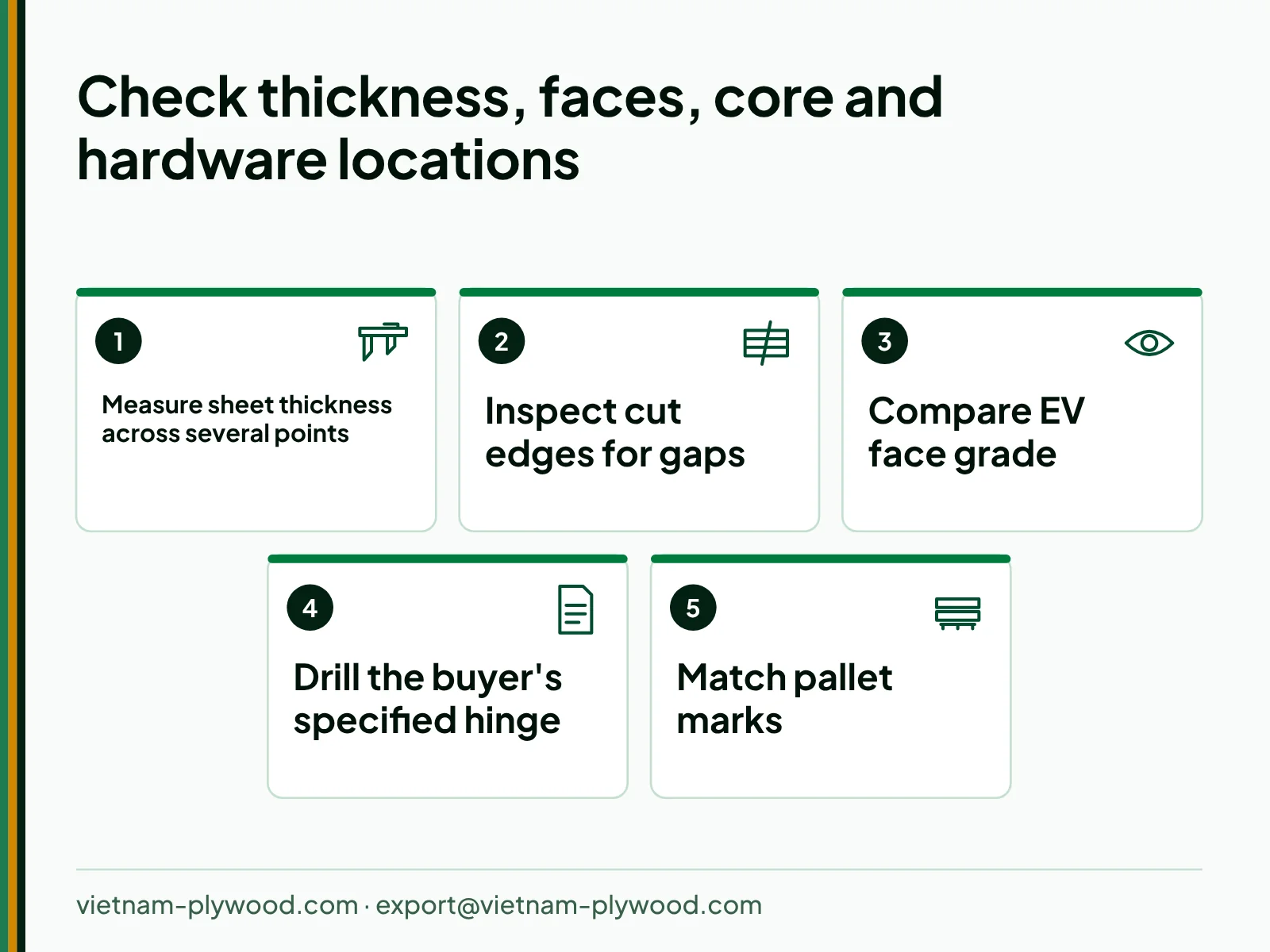
- Measure sheet thickness across several points and compare the agreed sanded tolerance.
- Inspect cut edges for gaps, loose veneers and irregular core joints; record the sample locations.
- Compare EV face grade, colour range and visible repairs with the signed reference panel.
- Drill the buyer’s specified hinge and connector pattern on a sample, then check fit and edge condition.
- Match pallet marks, dimensions and quantities to the packing list before container loading.
HCPLY manages specification, on-site quality control, documents and loading. Buyers can visit the factory office and inspect goods at the producing factory. Our three factories are in Phu Tho and Hai Phong, and orders ship directly from the facility making the agreed panel.
Which emission and export papers matter?
The destination market determines the documentary requirements for a cabinet substrate. The US Environmental Protection Agency’s TSCA Title VI guidance identifies hardwood plywood, MDF and particleboard as regulated composite-wood product categories. The EPA explains that hardwood plywood includes certain laminated products, so buyers should identify the substrate and finished-product treatment before specifying compliance documentation (US EPA guidance).
For EU orders, Regulation (EU) 2023/1115, Article 8, describes due diligence as collecting information, assessing risk and taking mitigation measures (EUR-Lex, 2023). Agree on the applicable timber traceability file and the buyer’s documentary workflow for the destination.
The shipment document set includes the commercial invoice, packing list, bill of lading (B/L), certificate of origin, phytosanitary and fumigation papers, and agreed certificate or test documents. EU lots include the EUTR/EUDR file set and EUR.1 where applicable; CIF shipments include insurance. After loading, the draft shipping documents come to you for approval. Member-factory FSC, CARB P2, ISO 9001 and CE documents are shown with factory details masked, on request.
What changes the landed cabinet-panel cost?
The largest comparison is the complete finishing route: ready-faced melamine board against veneer-faced plywood requiring finishing, or matt-core plywood laminated by the buyer. Next come core construction, selected face grade, thickness control and machining yield. Freight and payload utilization then affect landed cost per usable cabinet part.
Furniture plywood starts from US$350/m³ FOB Hai Phong (October 2026). That starting figure does not price an individual EV-faced or matt-core build; quote those against the written specification. A full-stitched sanded furniture build costs more than a less-finished commercial build; compare lamination and rejection costs too.
The minimum order is one 40HC, with mixed specifications allowed inside the payload limit. Production takes 15–45 days from the 30% deposit, set by order size, line loading and the contract. The 70% balance is against the scanned B/L by T/T or irrevocable letter of credit at sight; delivery can be FOB Hai Phong, CFR (CNF) or CIF. Free samples are available; new buyers book their courier, with that cost creditable against a real order.
How should a cabinet buyer request the plywood spec sheet?
Send the actual carcass drawing, finishing route and hardware plan with the panel specification. HCPLY can then quote the furniture-line build and align pallet identification with the cabinet plant’s receiving sequence. For an initial comparison, request both EV-faced and matt-core alternatives against the same dimensions.
Use the cabinet carcass plywood page for assembly-specific details, and the Vietnam plywood manufacturer page for the production arrangement. The export contact is Lucy at export@vietnam-plywood.com.
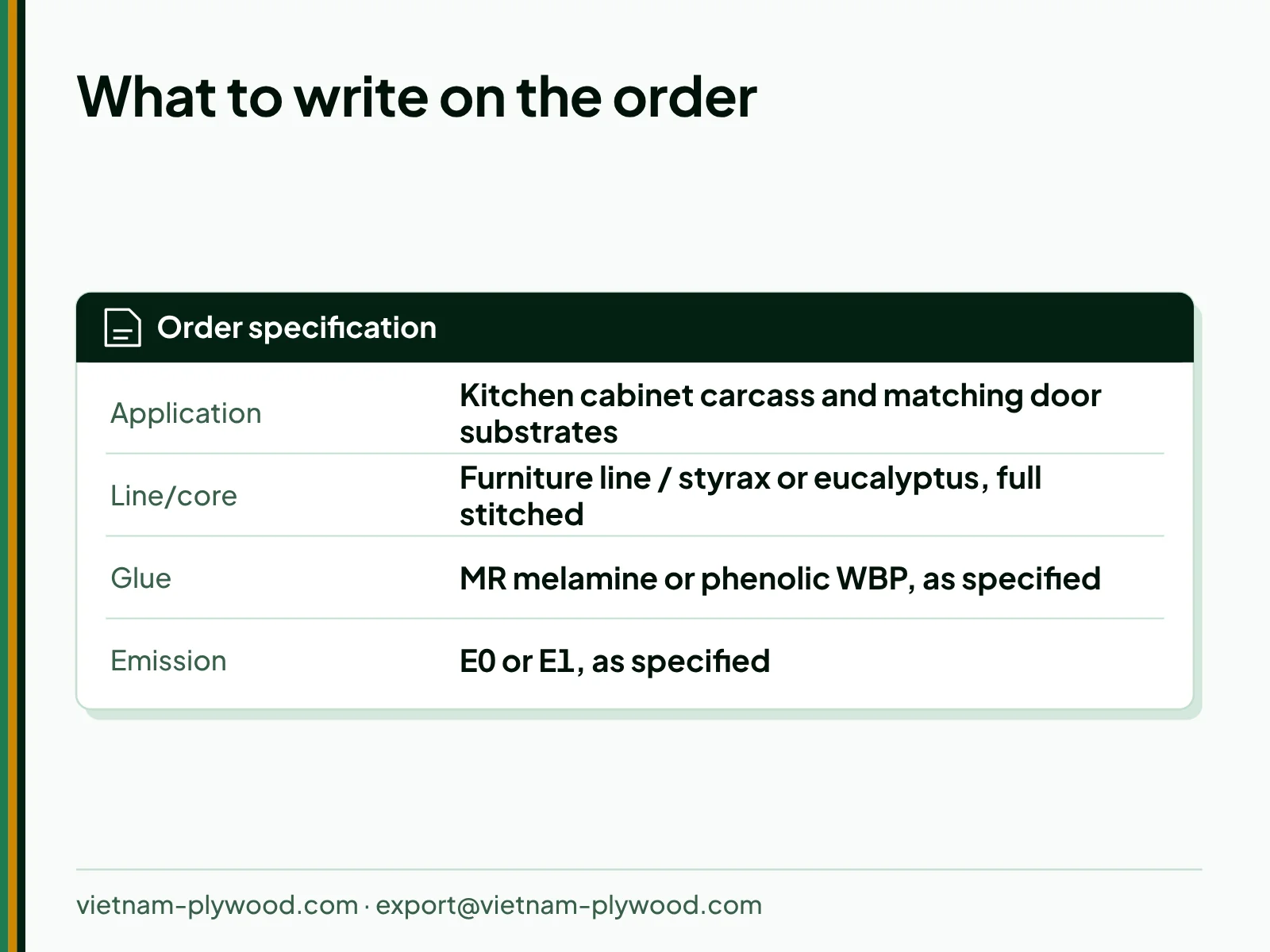
Application: kitchen cabinet carcass and matching door substrates
Line/core: furniture line / styrax or eucalyptus, full stitched
Glue: MR melamine or phenolic WBP, as specified
Emission: E0 or E1, as specified
Face and grade: EV A/B or matt raw core; finish at buyer's plant
Thickness and tolerance: 18 mm; sanded ±0.2 mm or ±0.3 mm
Size: 1220 × 2440 mm, or drawing-specific cut size
Quantity: sheets by carcass and door specification; mixed 40HC
Destination port: [port and country]
Request the cabinet plywood spec sheet with these fields and the planned lamination method.