





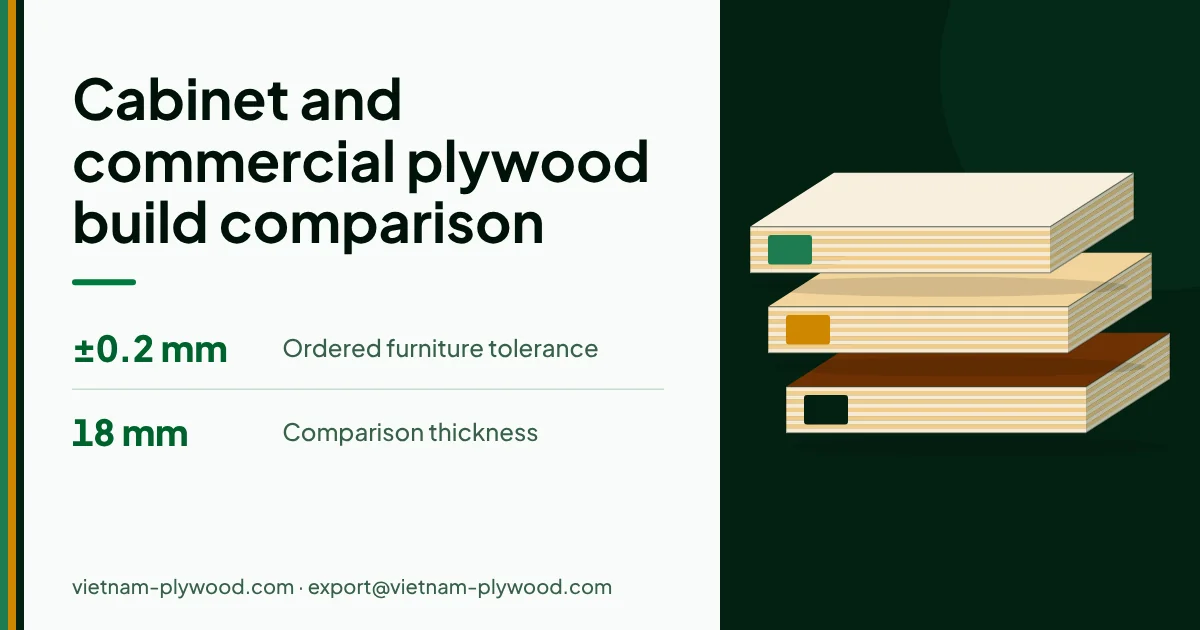
HCPLY cabinet grade plywood is a sanded, full stitched furniture-line panel specified by face, core, thickness and emission class. Choosing a commercial sheet by thickness alone can create rejected cabinet parts, extra finishing work and delivery delays. Our cabinet specification begins with the surfaces a furniture maker will expose and the edges it will machine.
What is considered cabinet grade plywood?
Cabinet grade plywood is a panel purchased against a defined face and back appearance, core construction, thickness calibration and emission requirement. For HCPLY, the cabinet build belongs on our furniture line, with a full stitched, sanded styrax or eucalyptus core. A label alone cannot tell a cabinet factory whether edges will machine cleanly or faces will match its finish schedule.
A wrong choice can cost a cabinet maker rejected cut parts, extra sanding and delayed installation. The purchase specification should state the acceptance limits before production, rather than relying on the phrase “cabinet quality plywood” on an invoice.
Start with the visible application: cabinet doors, exposed end panels, carcass sides, shelves or concealed backs. The visible surfaces drive veneer selection, while the machining plan determines core quality and tolerance. Our kitchen cabinet plywood overview sets this decision in the broader cabinet material selection.
Cabinet grade is a commercial description, not a single worldwide appearance or structural standard. Different grading systems use different letters and numbers. An importer should therefore attach a face reference, back reference and edge sample to the order.
What is the best grade of plywood for cabinets?
The most useful grade is the one that matches the exposed face and the cabinet finish. For a clear-finished visible side, specify an A face; for an interior that remains visible after installation, a B back can be suitable when its permitted repairs and color variation are agreed. Where both faces remain prominent, request A/A.
Our furniture line offers A/B face grading for decorative veneers; birch-faced options are described with D/E/F grading instead. These are different grading vocabularies, so a buyer should never translate an A/B order into birch D/E/F without an approved appearance reference. A grade letter does not replace the sample and inspection agreement.
In broader trade descriptions, A, B, C and D often indicate appearance tiers, while some hardwood systems use numeric back grades. Forest Plywood describes these conventions in its grade explanation. The grading convention should not be assumed to be our contractual grade definition.
Specify the finish alongside the grade. Clear finishes expose grain and color differences; opaque finishes still need a smooth face without telegraphing repairs. For nested cabinet parts, evaluate usable cutting yield as well as visual appearance.
Which face and back pair does a cabinet carcass need?
A cabinet carcass needs a face/back pair chosen by which surfaces remain visible after assembly. An A/B pair is a starting point for a prominent exterior and a less prominent interior. A/A is the more demanding appearance choice when both sides are exposed.
For an enclosed back or concealed component, a buyer can accept a less decorative reverse if its structural and machining requirements are separately written. The face/back designation should state whether patches, discoloration, open splits or veneer joins are acceptable. Agree grain direction and matching expectations for adjacent visible panels.
Bintangor, okoume, engineered veneer (EV), poplar and birch are face choices, not automatic descriptions of the core. A birch face over styrax remains a styrax-core panel. Our birch-faced cabinet plywood discussion expands on that distinction.
Face veneer commonly measures 0.2–0.4 mm in our furniture specification. That thin decorative layer can be damaged by aggressive sanding after receipt. Specify the intended finishing process and inspect the supplied veneer before approving production quantities.
Why does a stitched A-grade core matter?
A full stitched core gives cabinet parts a more continuous edge and reduces the risk of open internal voids appearing during cutting. The A face describes visible veneer quality; it does not establish the quality of the layers beneath it. Both must appear in the written purchase specification.
Our furniture line uses full stitched veneers and sanding. A lower-cost construction can use stitched outer layers with edge-trimmed inner veneers, finger-jointed material or loose-laid veneers. Those alternatives change the probability of gaps at routed edges and can affect edge-banding preparation.
A cabinet maker using computer numerical control (CNC) cutting should inspect sample edges after sawing and routing. Check voids where hinges, fasteners or edge treatment will meet the panel. Compare several cut locations rather than judging only the cleanest factory-cut corner.
Core veneer thickness is 1.4–2.0 mm in our production specifications. An 18 mm panel can have 11–13 plies, so counting layers alone cannot prove grade. The continuity and bonding of those layers matter more to the cabinet shop than a marketing ply count.
How does a furniture sheet differ from a commercial sheet?
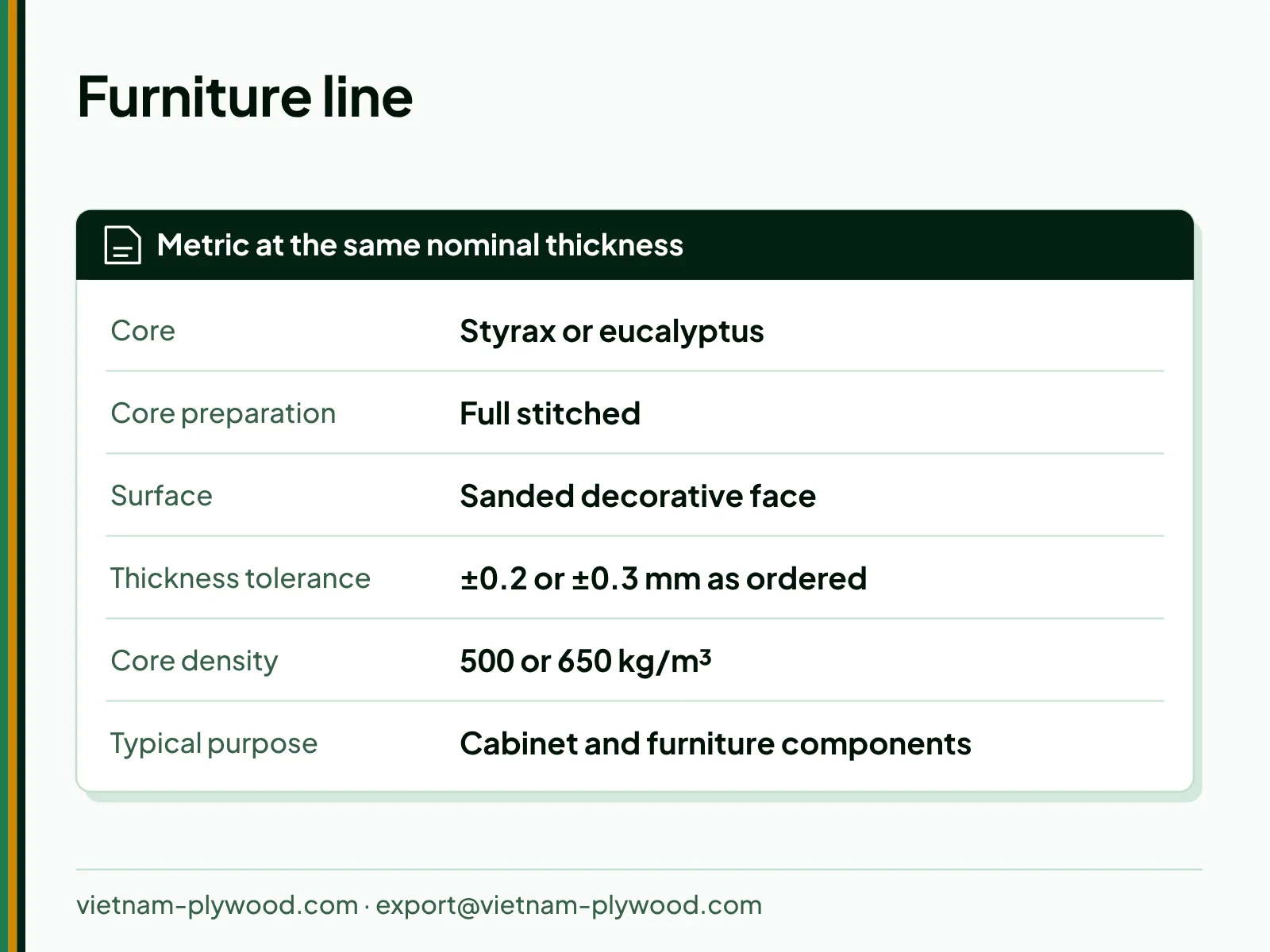
At the same nominal thickness, our furniture sheet is built for visible, machined cabinet parts; our commercial sheet is built around a different core and surface preparation. A third construction build serves film-faced formwork rather than decorative cabinets. The table compares the actual specifications, not an assumed universal grade hierarchy.
| Metric at the same nominal thickness | Furniture line | Commercial and packing line | Construction line | Verdict by use |
|---|---|---|---|---|
| Core | Styrax or eucalyptus | Acacia | Acacia or eucalyptus | Furniture for visible cabinet parts |
| Core preparation | Full stitched | Specified commercial build | Formwork build | Full stitched for routed edges |
| Surface | Sanded decorative face | Unsanded or light-sanded | Phenolic or melamine film | Furniture for cabinet finishing |
| Thickness tolerance | ±0.2 or ±0.3 mm as ordered | Commercial ±0.5 mm; packing ±0.5–1.0 mm | ±0.5 mm | Furniture for calibrated machining |
| Core density | 500 or 650 kg/m³ | 580 kg/m³ | 580 or 650 kg/m³ | Select by handling and application |
| Typical purpose | Cabinet and furniture components | Commercial or packing work | Concrete formwork | Do not substitute by thickness alone |
The construction line uses film surfaces, including anti-slip film, which do not substitute for a decorative veneer. Its film specification is 120 g/m² standard, 135 g/m² premium or 220 g/m² anti-slip only. The commercial line can be a sensible choice for nondecorative uses, but it should not be silently relabelled cabinet grade.
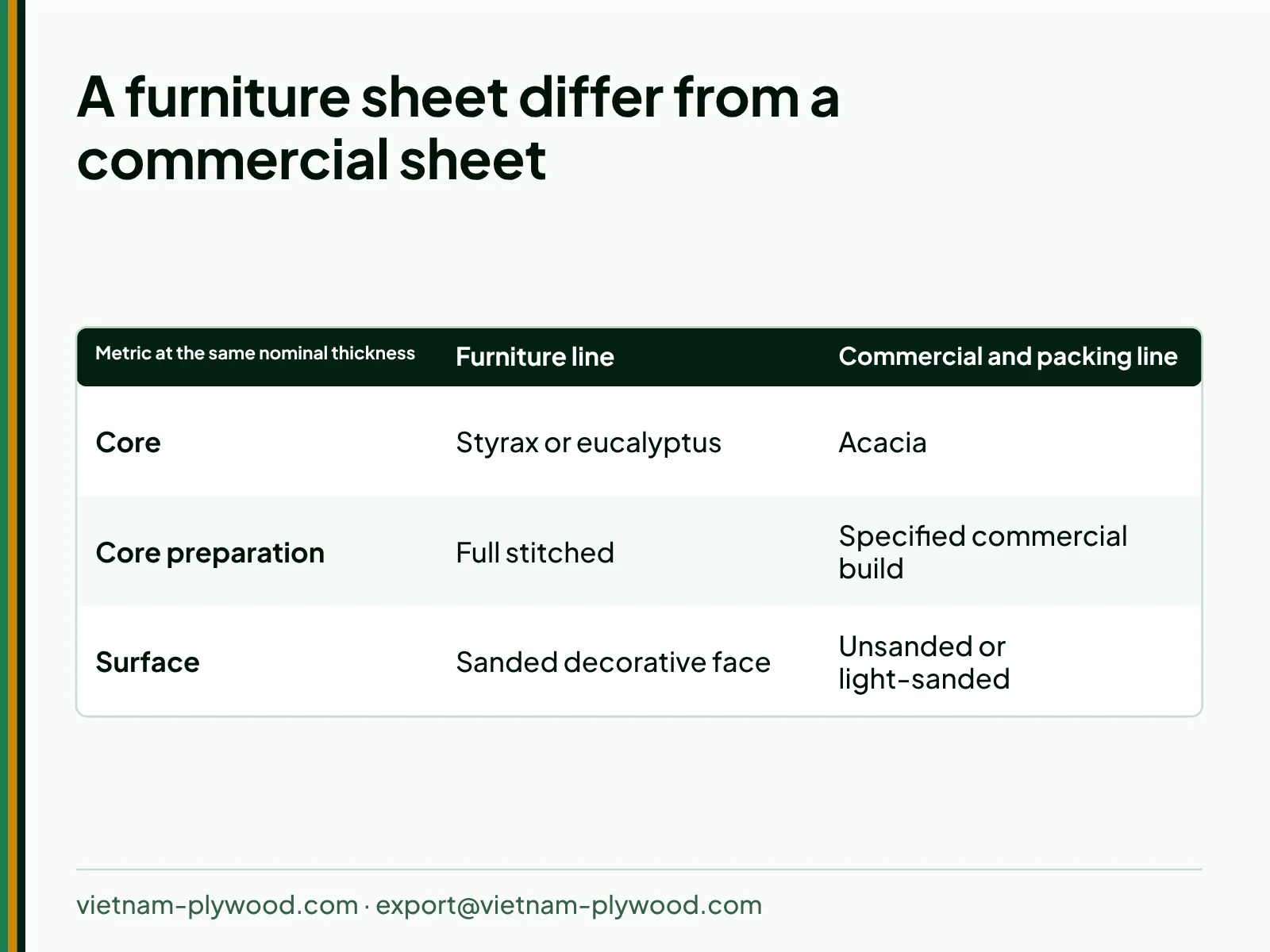
An 18 mm furniture panel and an 18 mm commercial panel can therefore produce different cutting and finishing results. The furniture build usually costs more because of full stitching, sanding and tighter calibration. Compare the written tolerances and face samples before comparing quotations.
Which glue and emission class should the specification name?
A cabinet specification should name the glue system and the emission class as separate fields. Our furniture line lists E0 or E1 emission classes, while melamine moisture-resistant (MR) and phenolic weather-and-boil-proof (WBP) describe adhesive systems. “E0 glue” is not a valid combined specification.
For our production, melamine MR is described by a 12-hour boil condition and phenolic WBP by a 72-hour boil condition. These descriptions concern the glue system; neither is a promise that a cabinet panel is waterproof. Wet-service design still needs edge treatment, exposure planning and an accepted test report for any specialized claim.
For United States orders, the Environmental Protection Agency’s 2025 Code of Federal Regulations, 40 CFR Part 770, §770.15, describes third-party certification of covered composite wood products under Toxic Substances Control Act (TSCA) Title VI. The official regulation makes certification a distinct compliance matter from a factory’s informal emission-class label.
Ask for the emission certificate applicable to the agreed producing factory and product. Member-factory FSC, CARB P2, ISO 9001 and CE documents, and EUTR/EUDR records, are shown with factory details masked, on request. The relevant claim and documents must match the order rather than being inferred from a face species.
How should thickness and size be specified?
Specify nominal thickness, permitted deviation, sheet dimensions and the measurement method in the purchase order. Our sanded furniture tolerance is ±0.2 or ±0.3 mm as ordered, compared with ±0.5 mm for commercial and film-faced sheets. Length and width tolerance is ±2 mm.
Available thicknesses span 3–40 mm, with common choices of 3, 5, 9, 12, 15, 18, 21 and 25 mm. Standard formats include 1220×2440, 1250×2500, 1220×2135, 1220×1830, 915×2440, 915×2135 and 915×1830 mm. Custom cutting is available against an agreed drawing.
For cabinet carcasses, shelf spans, hinge locations and joint designs drive thickness selection. A nominal 18 mm panel is a common comparison point, but the design engineer should validate the intended loads and joinery. The cabinet plywood thickness reference treats component selection separately from this purchasing specification.
Request readings at several positions across a sample sheet. A single measurement near an edge cannot demonstrate calibration across the entire panel. Record the tool, locations and acceptable range on the inspection sheet.
How can a buyer inspect cabinet quality at the producing factory?
A buyer can inspect cabinet quality by checking the approved face sample, cut-edge core, thickness readings and order documents at the producing factory. HCPLY coordinates on-site quality control and loading; the buyer visits the factory office and inspects goods where the order is made.
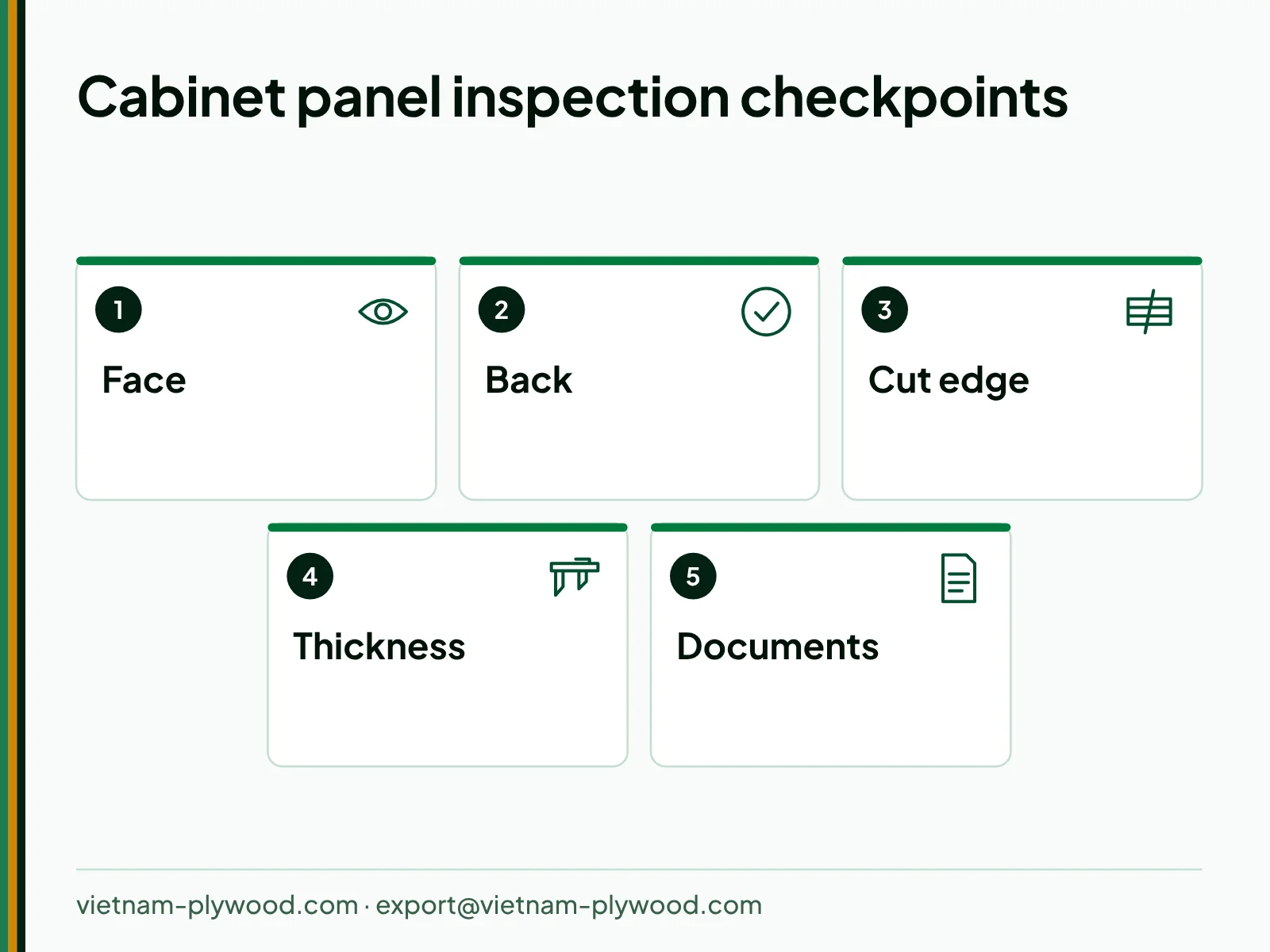
- Match the production lot to the approved specification, veneer reference and face/back pair.
- Inspect both faces under consistent lighting for open defects, repairs, color differences and grain direction.
- Cut representative sample edges and look for voids, unbonded layers and irregular veneer joints.
- Measure thickness at agreed locations and compare the readings with the ordered ±0.2 or ±0.3 mm furniture tolerance.
- Review the specified glue, emission-class evidence and applicable test reports for the agreed build.
- Check pallet labels, dimensions and loading counts against the packing list before dispatch.
An inspector should photograph the face, reverse, cut edge and gauge readings together with the lot reference. When the final cabinet finish is demanding, a sample finishing trial gives more useful evidence than a grade letter alone. Record any deviation and agree its disposition before loading.
For exposed kitchen work, compare plywood with separately specified surface materials in our melamine board versus plywood discussion. Melamine-faced boards, high-pressure laminate (HPL) and other laminate faces are comparison topics, not HCPLY product lines. We do not manufacture medium-density fibreboard (MDF), oriented strand board (OSB), chipboard, blockboard or birch-core plywood.
Can cabinet sheets share a mixed container?
Cabinet plywood can share a 40HC with other agreed plywood specifications, provided the loading plan stays within the 28.5-tonne payload limit. Our furniture line handles cabinet panels, while our commercial and packing line can produce the separately specified nondecorative sheets. The shipment is planned by core density and pallet allocation.
At 1220×2440×18 mm, a styrax-core sheet weighs 26.79 kg, an acacia-core sheet 31.08 kg and a eucalyptus-core sheet 34.83 kg. These sheet weights exclude film, pallets and packing.
Our 40HC loading figures for this size and thickness give 990 styrax sheets, 880 acacia sheets or 795 eucalyptus sheets in single-core loads: 26.52 t, 27.35 t and 27.69 t respectively. Mixed loads need a new sum of sheet mass plus pallet and packing allowances; the single-core sheet counts cannot simply be added together.
The minimum order is one 40HC, and specifications can be mixed within its payload limit. Our mixed-container arrangements explain the ordering approach; the container loading reference owns the full packing calculations. This page uses the weights only to show why the cabinet specification affects logistics.
What does the export document set prove?
The export documents should connect the ordered cabinet specification to the shipment and its producing factory. The commercial invoice and packing list identify the goods and quantities; the bill of lading (B/L) records shipment particulars. The agreed emission certificate or test report addresses the specified technical claim.
HCPLY operates export preparation from specification through on-site inspection and loading. Shipment papers include the commercial invoice, packing list, B/L, certificate of origin, phytosanitary and fumigation papers, plus applicable order certificates. European Union lots include EUR.1 and the EUTR/EUDR file set; insurance is included under CIF terms.
After loading, the draft shipping documents come to you for approval. The same specification wording should appear consistently in the commercial paperwork and inspection record. A document showing a general factory capability cannot replace evidence for the particular cabinet build.
We ship FOB Hai Phong, or CFR (CNF) or CIF to your port. Factory lead time runs 15–45 days from receipt of the 30% deposit; the exact figure depends on order size, line loading and what the contract fixes. The remaining 70% is paid on the scan of the bill of lading, by T/T, or by irrevocable sight L/C.
What drives a cabinet plywood quotation?
Face selection and grading usually drive the largest visible-grade premium, followed by full core stitching, calibration and the specified glue and emission evidence. A furniture sheet costs more than a commercial sheet of the same nominal thickness because its core and surface require more preparation. Final quotations must use the written build and order volume.
A cabinet-specific price needs the approved veneer, tolerance, volume and destination information.
Samples cost nothing: a first-time buyer pays the courier, and that charge comes off the first confirmed order. For recurring purchasing, our plywood supply programmes for distributors explain how to keep the agreed build consistent between shipments.
A sample request should state the intended finish and machining operation. A price comparison without an identical face, back, core and emission specification is unlikely to predict the cabinet factory’s usable yield.
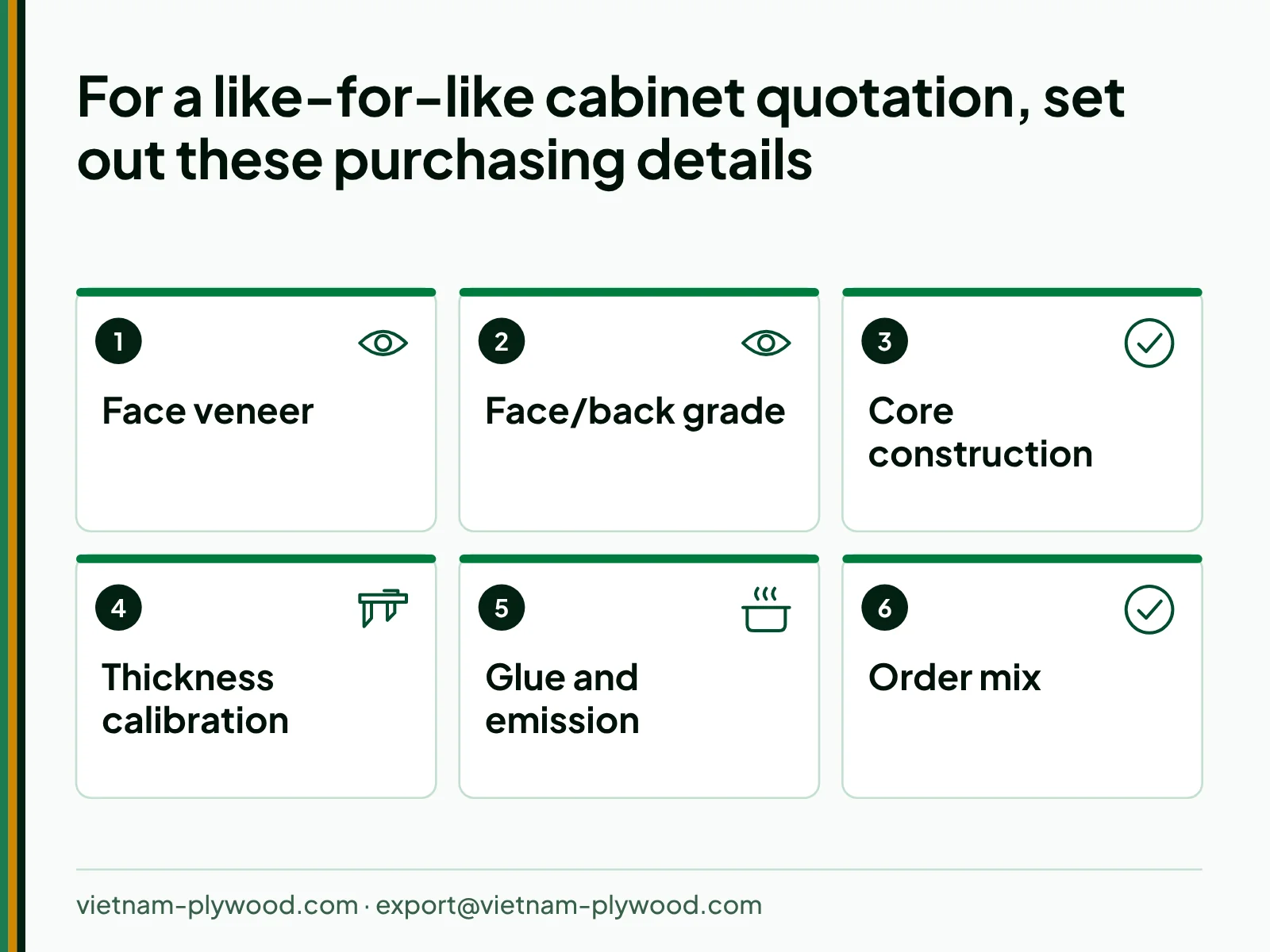
For a like-for-like cabinet quotation, set out these purchasing details:
- Face veneer: Name the decorative species and attach the approved appearance reference.
- Face/back grade: State which surfaces remain visible and the accepted repairs or color variation.
- Core construction: Request the full stitched furniture build and identify styrax or eucalyptus core.
- Thickness calibration: Specify the nominal thickness and the ordered furniture tolerance.
- Glue and emission: Name the adhesive system and emission class in separate fields.
- Order mix: Give sheet dimensions, quantity and destination port for the loading and shipping quotation.
What should go into the first trial-container specification?
The first trial-container specification should describe the application and measurable acceptance conditions before asking for a quotation. Use the sample lines below as a starting purchase brief, then attach face and edge reference photos. A trial should validate cutting, finishing and documentation before repeat orders.
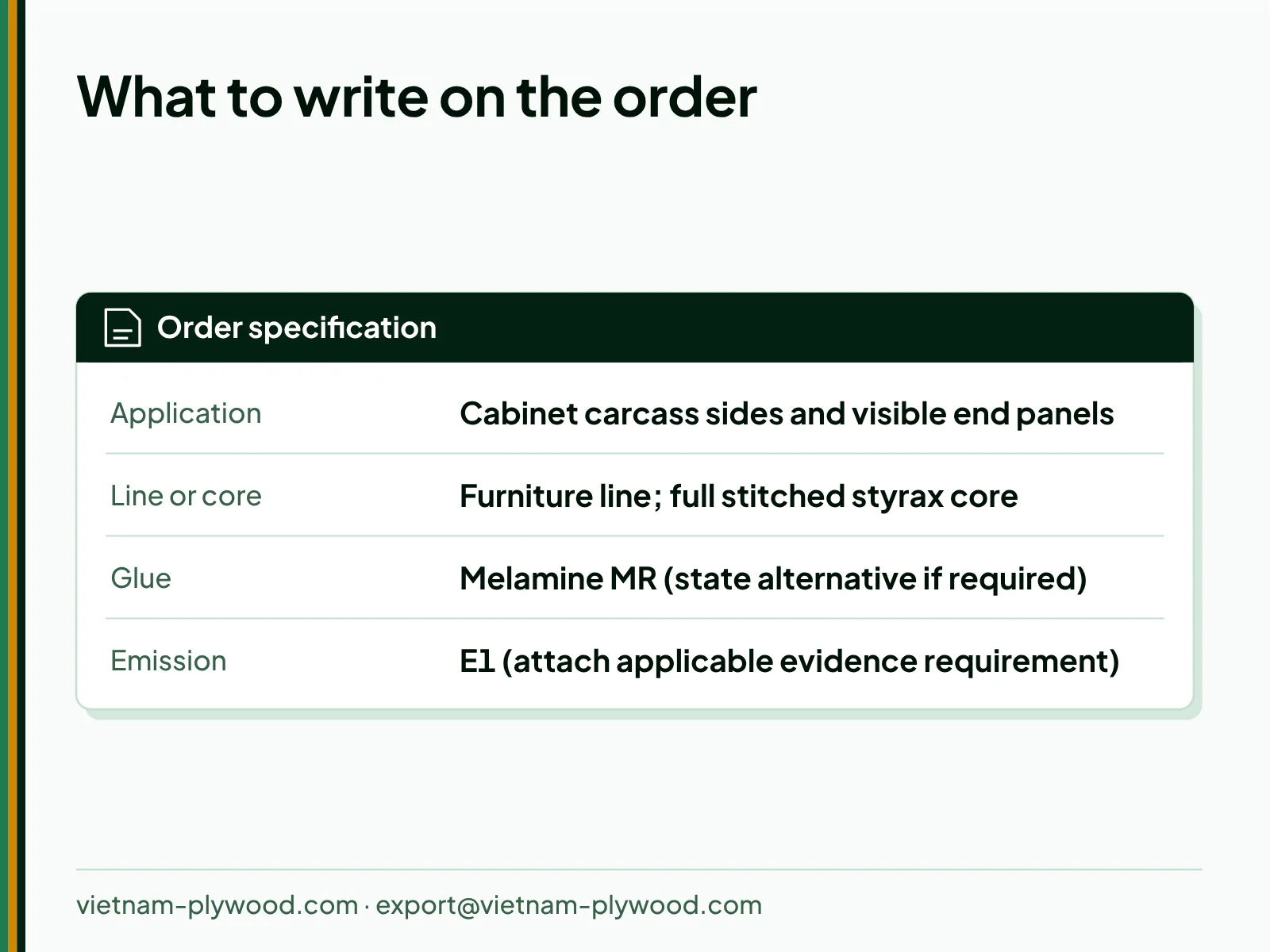
For a carcass order, state which sides are exposed, whether the interior needs a decorative back and how edges will be finished. For a distributor, add the intended downstream cabinet uses so the same panel is not sold under incompatible grade descriptions.
The cabinet carcass plywood discussion covers assembly considerations, while our Vietnam plywood manufacturing overview explains the wider product context. Send the completed brief to Lucy at export@vietnam-plywood.com for a specification-based quotation.
Application: cabinet carcass sides and visible end panels
Line or core: furniture line; full stitched styrax core
Glue: melamine MR (state alternative if required)
Emission: E1 (attach applicable evidence requirement)
Face and grade: okoume A face / B back; approved appearance sample
Thickness and tolerance: 18 mm; ±0.2 mm as ordered
Size: 1220 × 2440 mm; length/width ±2 mm
Quantity: one 40HC; final mix and payload plan to be agreed
Destination port: [buyer to specify]
Next step: plan a trial container against this written cabinet specification.