





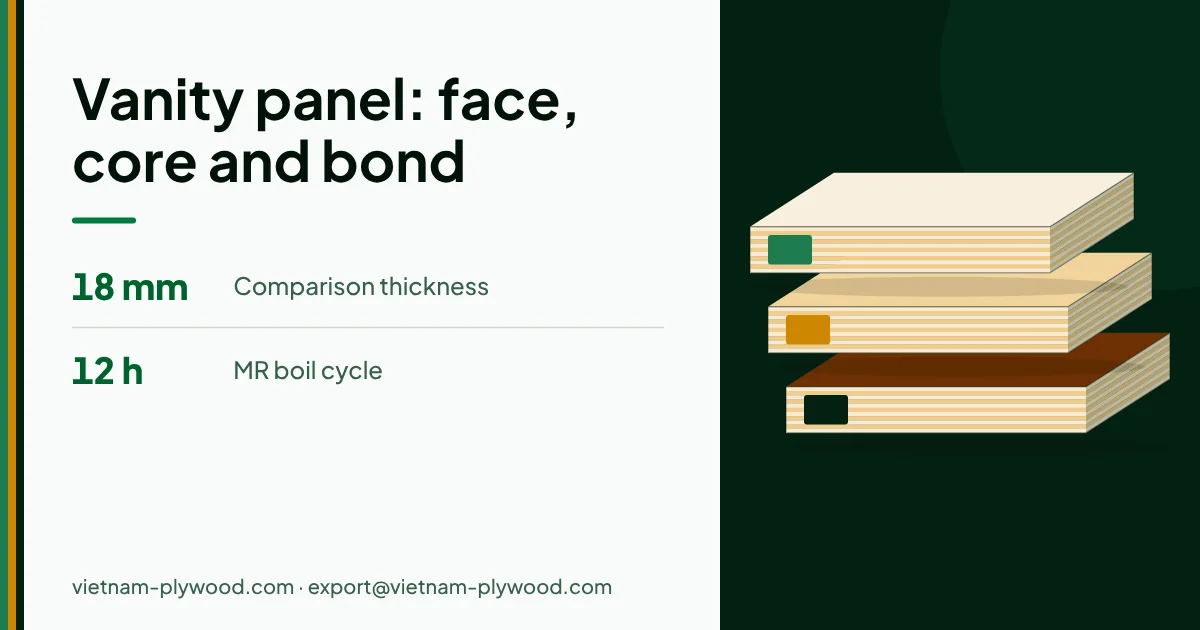
What plywood bathroom vanity specification works for cabinet makers?
A plywood bathroom vanity needs a sanded furniture face, moisture-resistant bond, sound core and sealed edges. A wrong choice can cost cabinet replacements, inspection delays or a rejected load. HCPLY offers full-stitched styrax or eucalyptus furniture cores with EV or birch faces and an agreed bond test.
HCPLY presses furniture plywood for visible cabinet components on our furniture line. A vanity carcass encounters basin splashes, condensation around plumbing, damp cleaning cloths and occasional leaks. A cabinet can fail at a cut edge even while the original factory glue bond remains intact. Design the joint, finish and ventilation alongside the panel specification.
The kitchen cabinet plywood selection guide covers adjacent cabinet applications. Bathroom cabinets add more concentrated wet zones around the basin, waste trap and floor junction. Keep the visible face and the bond requirement as separate purchase-order fields.
Which cabinet positions need stronger moisture resistance?
Specify the bond according to the actual wetting risk at each position. A wall-mounted mirror cabinet in a ventilated room faces a different exposure from a basin base with pipe penetrations.
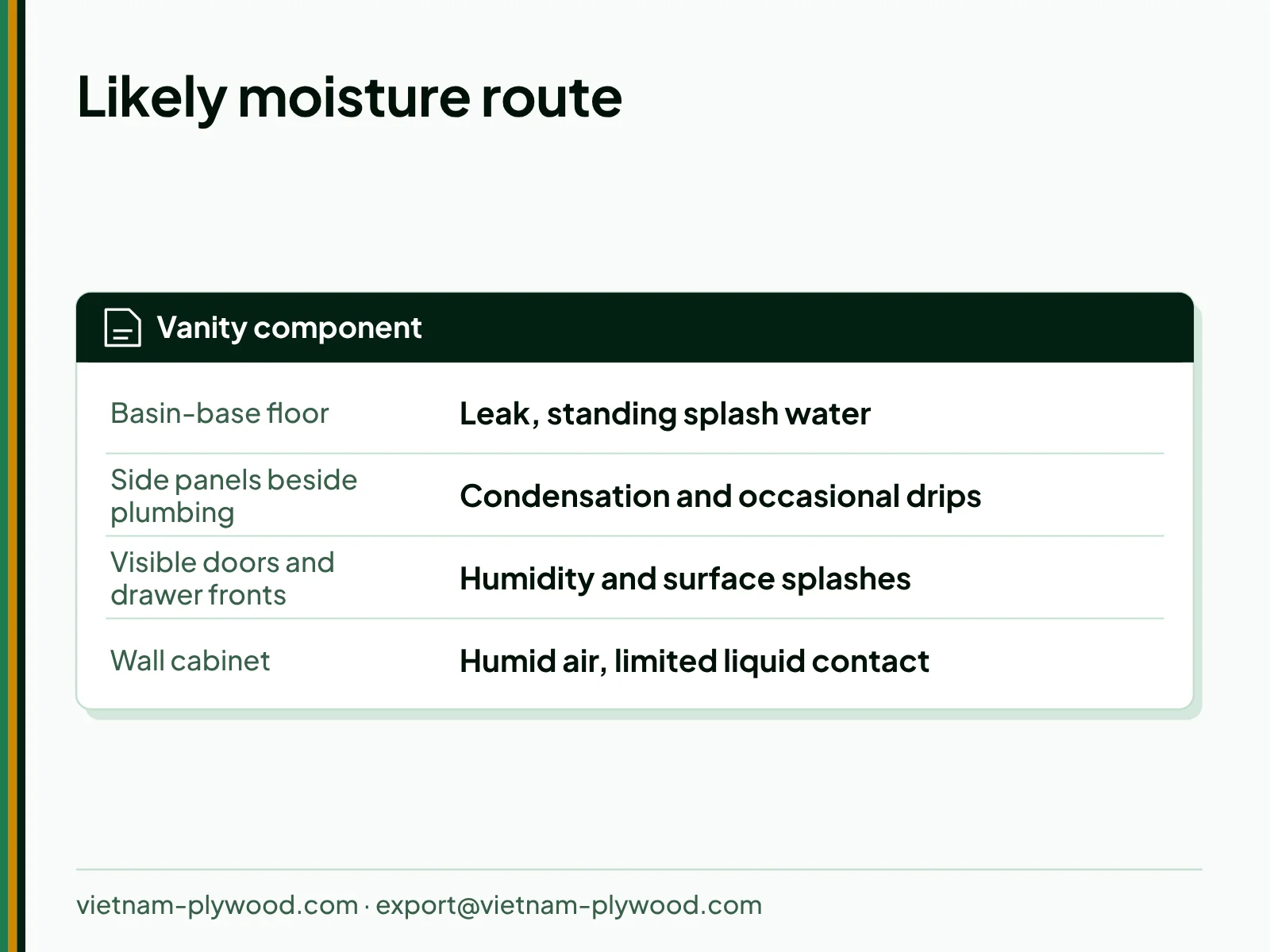
| Vanity component | Likely moisture route | Panel priority | Buyer verdict |
|---|---|---|---|
| Basin-base floor | Leak, standing splash water | Higher bond resistance, sealed cuts | Prioritise tested moisture-resistant furniture plywood |
| Side panels beside plumbing | Condensation and occasional drips | Bond plus protected drilled holes | Specify the same tested bond as the base |
| Visible doors and drawer fronts | Humidity and surface splashes | Flat sanded face, balanced finish | Furniture-grade decorative face |
| Wall cabinet | Humid air, limited liquid contact | Surface finish and dimensional control | Furniture panel with specified bond |
| Removable service panel | Repeated handling near pipes | Edge integrity and screw retention | Full-stitched core and sealed machined edges |
A cabinet finish reduces face wetting; seal saw cuts and drilled holes separately. For panel sizing across the assembly, use the cabinet plywood thickness guide.
Does a bathroom vanity need marine plywood?
Most indoor bathroom vanities need a tested moisture-resistant furniture panel rather than a marine label. A marine-labelled board becomes worth comparing when the cabinet has persistent wetting, unusually demanding cleaning or an explicit project specification.
Marine is a performance claim that needs an accepted test report for the exact proposed build. A product name alone cannot establish its adhesive cycle, veneer quality or core integrity. For HCPLY, describe a marine-labelled specification only against a test report the buyer accepts.
APA — The Engineered Wood Association explains in its 2026-accessed plywood technical guidance that bond classification indicates adhesive moisture resistance rather than decay resistance. Its Exterior and Exposure 1 categories concern wood structural panels; they are useful concepts for exposure selection, not certificates for HCPLY furniture plywood. See APA’s plywood guidance.
A vanity with regular standing water also needs better detailing and leak management. Paying for a stronger bond while leaving raw cut edges exposed gives water an easy path into the wood.
Which glue line should plywood for bathroom cabinets have?
Ask for the glue chemistry, the intended boil cycle and the lot’s test evidence as three separate items. HCPLY’s stated adhesive options are melamine moisture-resistant (MR), described by a 12-hour boil, and phenolic weather-and-boil-proof (WBP), described by a 72-hour boil.
The furniture-line brief pairs full-stitched, sanded panels with E0 or E1 emission classes. For a vanity requiring the stronger moisture-resistant option, request the melamine MR bond with the agreed boil test in writing. If a phenolic bond is specified, treat that as a distinct proposed build requiring its own sample and acceptance criteria; do not assume a decorative face changes the adhesive.
Glue and emission are separate fields. E0 and E1 describe emission classes; they do not describe water resistance. CARB Phase 2 and TSCA Title VI address US formaldehyde requirements, not a boil-test pass. Member-factory certificate material is shown with factory details masked, on request.
Specify conditioning, boiling duration, inspection method and allowable bond failure; duration alone is not a pass criterion.
Which face veneers suit a moisture-resistant vanity panel?
Choose the face for the visible finish and the core for the panel’s density and internal construction. Birch and engineered veneer (EV) suit buyers seeking a consistent furniture appearance; other offered faces include bintangor, okoume, gurjan, pine, poplar, eucalyptus and sapele.
Common face veneer thickness is 0.2–0.4 mm. Face grades A/B apply to the listed decorative options, while birch is graded D/E/F in the HCPLY specification. Put the actual grade and the approved reference sample on the order rather than translating a birch grade into an A/B claim.
A painted vanity needs a sound sanded face and careful finishing around edges. A clear-finished vanity needs face colour and grain agreement across the lot. Melamine, high-pressure laminate (HPL) and other laminate faces are finishing topics, not an HCPLY pressed product line. Coordinate those finishes with the cabinet maker after panel acceptance.
See furniture plywood and birch-faced cabinet plywood.
How do the three production lines differ for the same thickness?
Our furniture line presses the sanded, full-stitched decorative panel suited to a vanity. The other lines produce different specifications, even at the same nominal thickness.
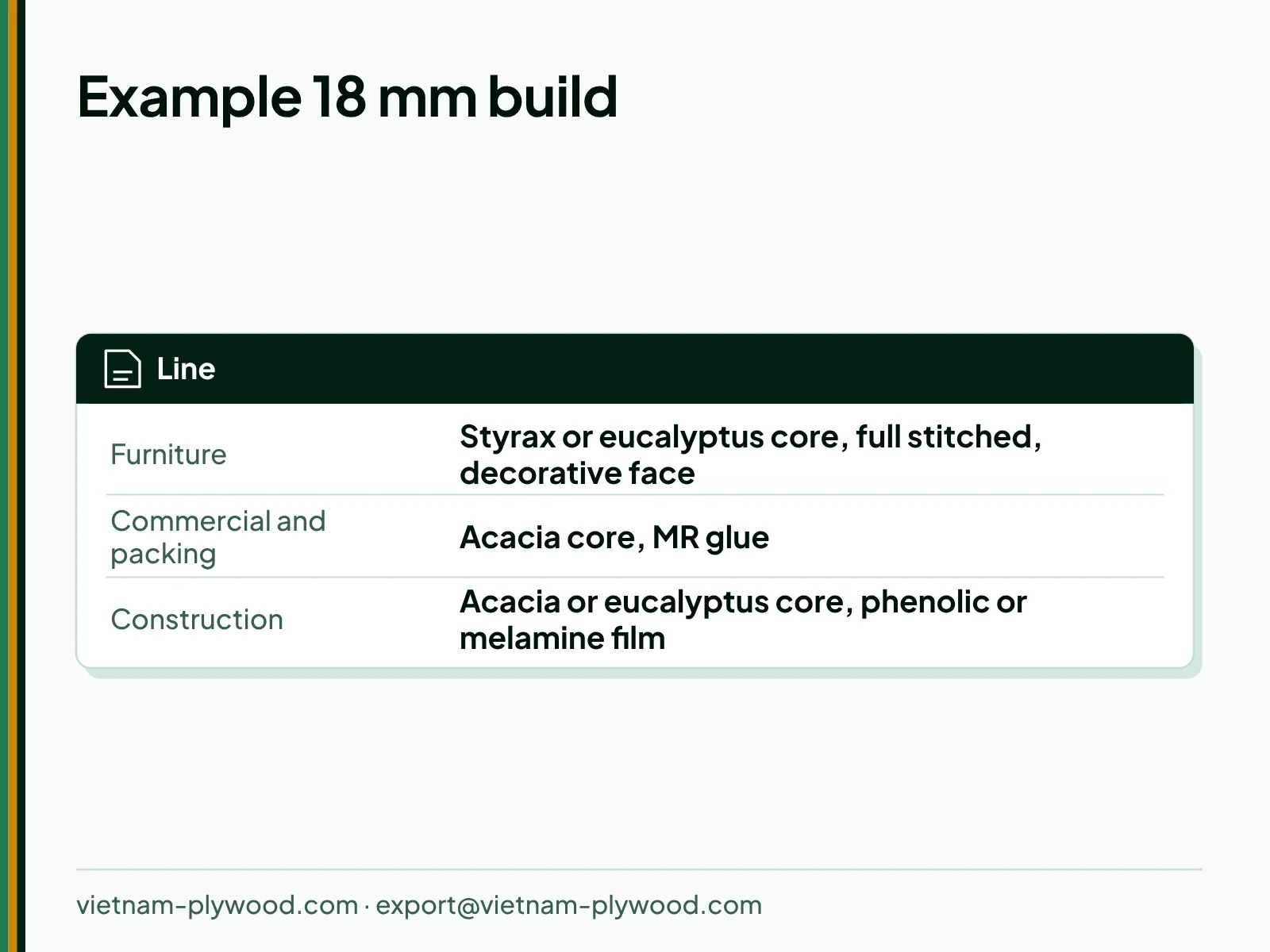
| Line | Example 18 mm build | Surface and tolerance | Use verdict |
|---|---|---|---|
| Furniture | Styrax or eucalyptus core, full stitched, decorative face | Sanded, ±0.2 or ±0.3 mm as ordered | Vanity carcass and visible components |
| Commercial and packing | Acacia core, MR glue | Unsanded or light-sanded, ±0.5 mm; packing ±0.5–1.0 mm | Crates and nondecorative packing |
| Construction | Acacia or eucalyptus core, phenolic or melamine film | Unsanded, ±0.5 mm | Formwork rather than finished vanity faces |
HCPLY has three member factories in Phu Tho and Hai Phong. Each order is produced at the factory matching the written specification and ships directly from the producing factory. A decorative bathroom panel should not be substituted with a film-faced or packing build merely because its thickness matches.
For the alternatives, see commercial and packing plywood and the cabinet-grade specification checklist.
What thickness, core and tolerance should a vanity order state?
Write the nominal thickness, actual tolerance, sheet size and core construction on the same line. HCPLY’s available thickness range is 3–40 mm, with common selections of 3, 5, 9, 12, 15, 18, 21 and 25 mm.
For carcass comparisons, quote 18 mm; request 12 mm separately for lighter components where the cabinet design permits. The cabinet designer sets load, span and hinge requirements.
Furniture panels can be ordered at ±0.2 or ±0.3 mm thickness tolerance, with length and width at ±2 mm. Standard formats include 1220 × 2440 and 1250 × 2500 mm, alongside narrower formats and custom cutting. An 18 mm panel has 11–13 plies depending on the 1.4–2.0 mm core veneer thickness.
Full-stitched construction gives the cabinet maker a stronger starting point for a clean machined edge than loose-laid cores. Ask the inspector to look for overlaps, open gaps and patch defects at representative crosscuts. Cabinet door plywood covers door-specific face and flatness considerations.
What boil test should I ask for before shipment?
Request a witnessed test of production-lot samples against the written adhesive cycle and acceptance criteria. For a melamine MR vanity panel, the stated cycle is 12 hours; for a phenolic WBP build, it is 72 hours. Ask the producing factory to record the sample identity and observed bond condition.
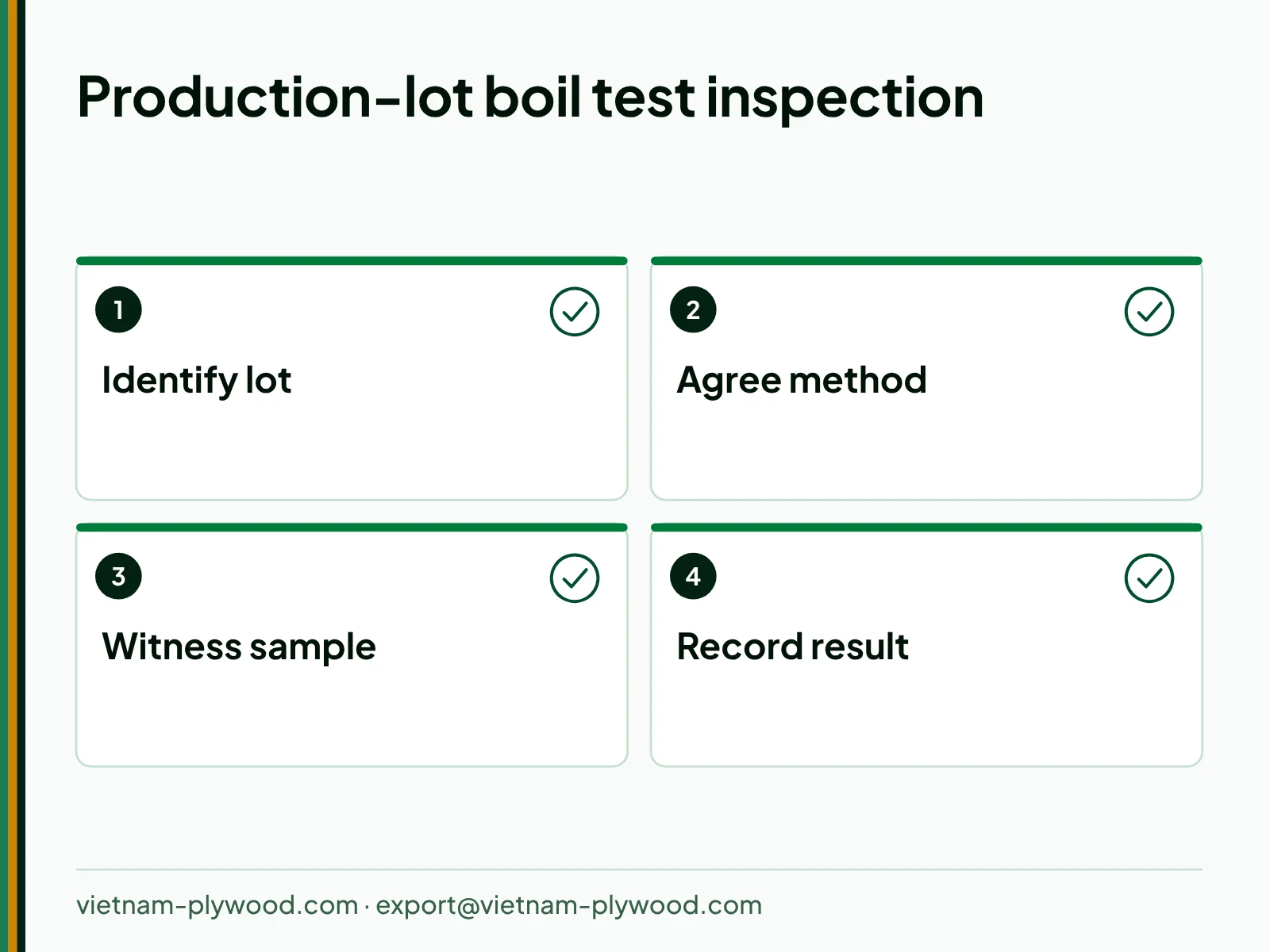
- Agree the panel build, lot identification, specimen dimensions and sample-selection method before production.
- State the boiling procedure, any cooling or drying stages, and the agreed acceptance criterion in the order.
- Draw samples from the actual production lot with the buyer’s inspector present where arranged.
- Record the test start and finish, observations at the glue lines and any visible delamination.
- Attach the accepted test report to the order’s certificate documents and compare it with the shipped lot.
An inspector can also witness thickness checks, a sanded-face review and examination of cut-edge core joints. These observations help identify manufacturing defects that a glue-cycle description cannot reveal. Do not judge a bond solely by its glue-line colour; visual colour is no substitute for the agreed test.
The shipment’s test reports belong with the agreed certificate documents in the export paperwork. After loading, the draft shipping documents come to you for approval.
How does a moisture-resistant furniture panel compare with marine-labelled plywood?
A tested furniture panel is the default for a decorative indoor vanity, while a marine-labelled panel needs a documented reason for its added specification. Compare measurable purchase criteria instead of relying on the label.
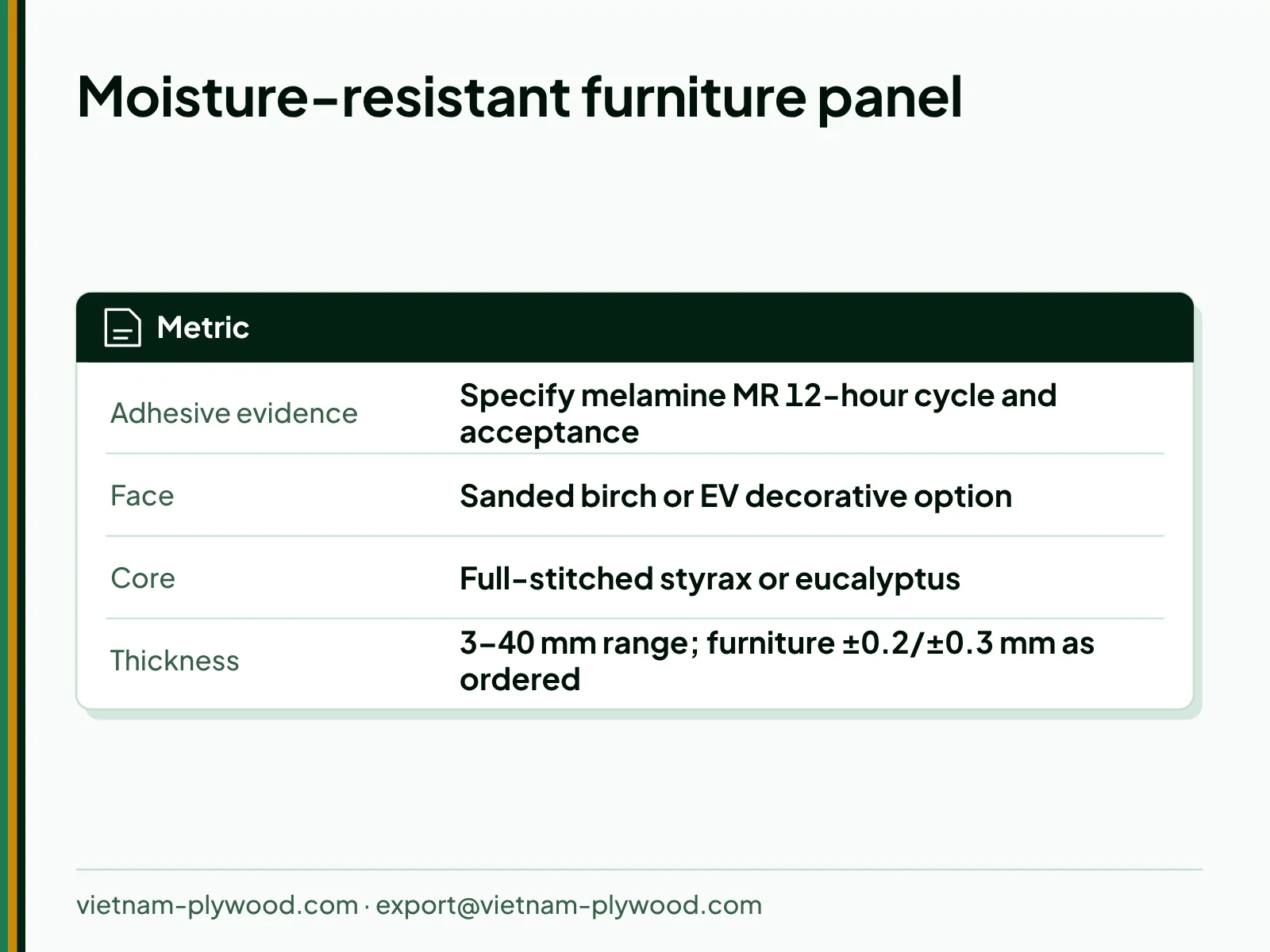
| Metric | Moisture-resistant furniture panel | Marine-labelled proposal | Verdict by use |
|---|---|---|---|
| Adhesive evidence | Specify melamine MR 12-hour cycle and acceptance | Specify exact standard, method and accepted report | Furniture panel for ordinary protected vanity; test both |
| Face | Sanded birch or EV decorative option | Face depends on proposed product | Furniture panel for visible finishing |
| Core | Full-stitched styrax or eucalyptus | Core and void criteria must be stated | Inspect both at cut edges |
| Thickness | 3–40 mm range; furniture ±0.2/±0.3 mm as ordered | Written tolerance required | Choose to suit cabinet machining |
| Wetting | Splash and humid interior with protected edges | Evaluate for repeated or sustained wetting | Escalate specification where exposure warrants |
| Cost | Decorative face and tight sanding add cost | Additional test and build requirements can add cost | Quote both to one written specification |
A marine-labelled proposal can cost more when it requires a stronger adhesive cycle, tighter core selection or extra testing. An EV-faced furniture panel can cost more than a basic raw commercial panel because of face selection, full stitching and sanding. Neither comparison gives a valid price without a matched written build.
Protect exposed edges and keep joints out of standing water.
How should buyers plan a mixed container?
A 40HC can contain mixed specifications within the 28.5 t payload limit. The packing arithmetic changes with core density even when the nominal sheet dimensions and thickness are identical.
At 18 mm and 1220 × 2440 mm, the lookup gives 990 styrax sheets at 26.52 t, 880 acacia sheets at 27.35 t, or 795 eucalyptus sheets at 27.69 t for full single-core loads. These figures are reference full loads, not quantities to add together. Styrax is 500 kg/m³, acacia 580 kg/m³ and eucalyptus 650 kg/m³.
A vanity shipment can mix decorative furniture specifications, provided the packing plan recalculates the total weight for the actual quantities. For example, using the listed per-sheet weights, 500 styrax sheets at 26.79 kg and 300 eucalyptus sheets at 34.83 kg total 23,844 kg before pallets and other packing mass. The final load plan must account for packing and the 28.5 t limit.
The container-loading reference owns the complete sheet-count method. Distributors combining cabinet programmes can also review plywood supply programmes.
What should be checked at the producing factory?
Inspect the ordered face, crosscut core, thickness and test evidence before authorising loading. A representative panel should match the approved decorative sample and the stated adhesive specification.
Ask to see the sanded face under consistent light, then measure thickness across representative sheet positions. Examine a freshly cut edge for full stitching, gaps and irregular joints. Review the selected production-lot test samples and compare their identifiers with the packing list.
HCPLY manages specification, on-site quality control, export documents and loading. Buyers can visit the factory office and inspect goods at the producing factory. Factory inspection is more useful when the purchase order already defines measurable acceptance criteria.
For US orders, request the relevant emission certificate for the agreed build. For EU lots, the document set includes the EUTR/EUDR file set and EUR.1 certificate of origin where applicable. Certificates associated with member factories are shown with factory details masked, on request.
What goes into the quotation and sample request?
Send one specification covering the wet-zone application, decorative face, glue cycle and inspection requirements. The minimum order is one 40HC, and specifications can be mixed within the payload limit.
HCPLY offers FOB Hai Phong, CFR (CNF) or CIF. Factory lead time runs 15–45 days from receipt of the 30% deposit; the exact figure depends on order size, line loading and what the contract fixes. The remaining 70% is paid on the scan of the bill of lading, by T/T, or by irrevocable sight L/C.
The export document set includes the commercial invoice, packing list, bill of lading, certificate of origin, phytosanitary and fumigation papers, insurance under CIF, and the agreed certificate documents. Specify the destination port and any destination-market documentation before quotation.
Samples cost nothing: a first-time buyer pays the courier, and that charge comes off the first confirmed order. Use the sample to assess veneer appearance, machined edges and the proposed bond-test protocol before committing the container.
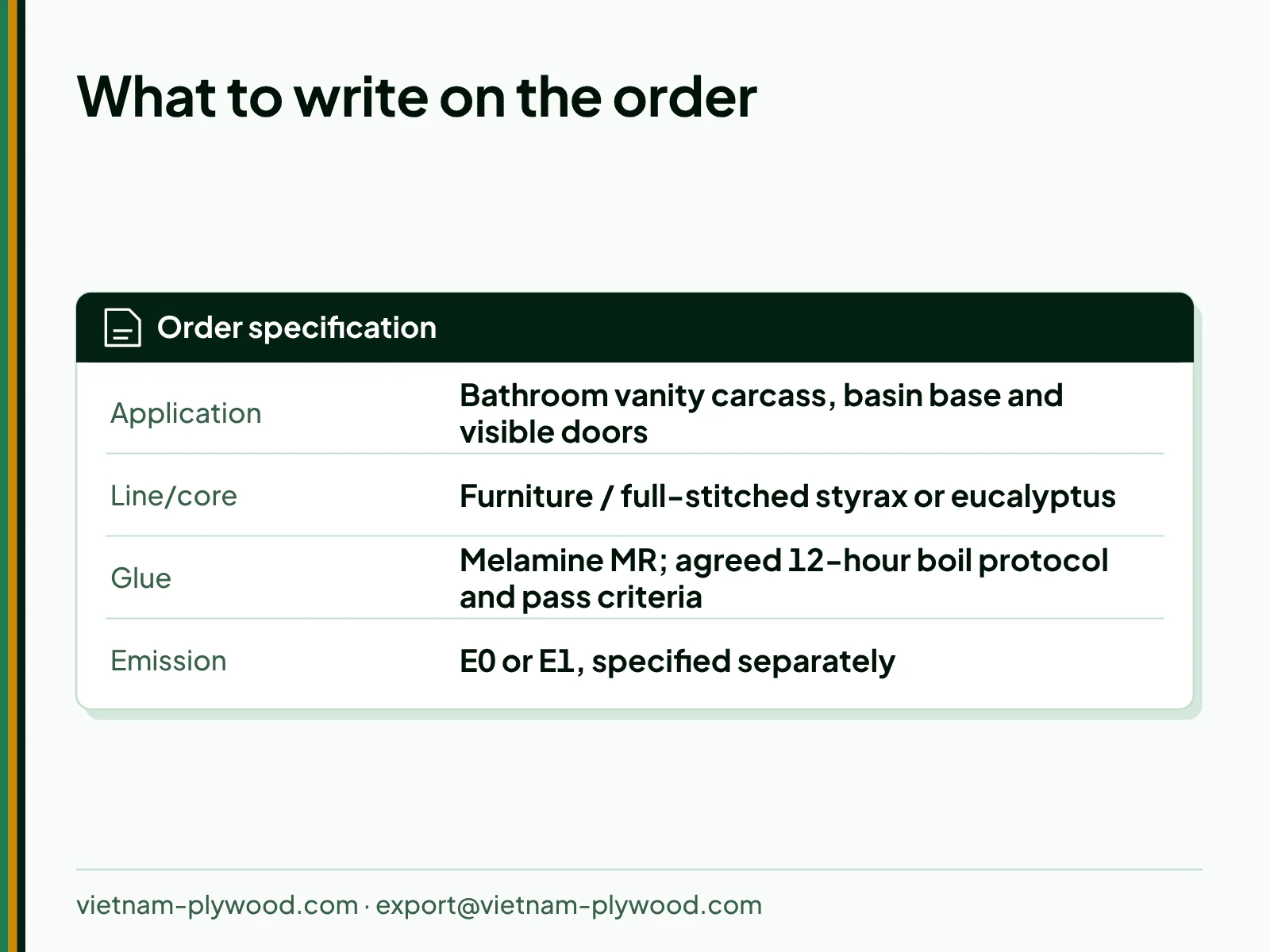
Application: bathroom vanity carcass, basin base and visible doors
Line/core: furniture / full-stitched styrax or eucalyptus
Glue: melamine MR; agreed 12-hour boil protocol and pass criteria
Emission: E0 or E1, specified separately
Face and grade: EV A/B or birch D/E/F; approved reference sample
Thickness and tolerance: 18 mm; ±0.2 mm or ±0.3 mm as ordered
Size: 1220 × 2440 mm
Quantity: one 40HC, with component quantities stated
Destination port: [port and country]
Ask Lucy at HCPLY contact for a sample set matched to this bathroom-vanity specification.