





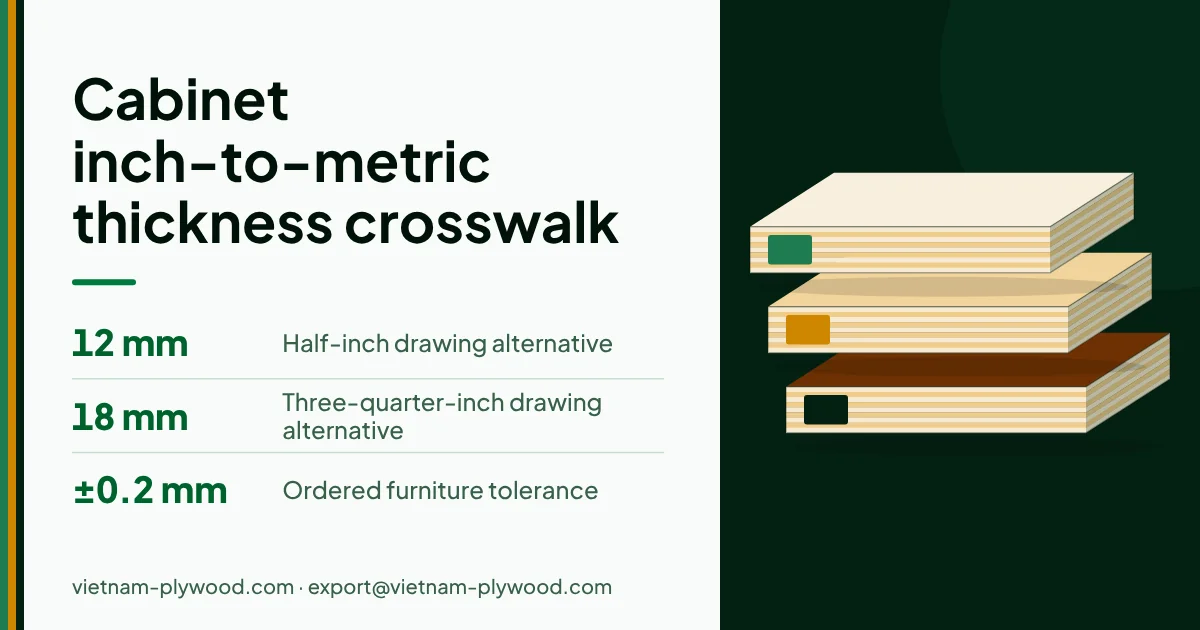
Plywood thickness for cabinets should translate inch drawings into ordered metric panels: typically 18 mm for boxes and shelves, with thinner backs and drawer parts. A wrong substitution can cause rejected CNC parts, rework and delayed assembly. HCPLY presses cabinet panels on our furniture line with explicit thickness tolerances, while mixed-thickness orders can ship together.
What sizes and thicknesses can our factories press?
For cabinet work, HCPLY’s furniture line supplies sanded panels in 3–40 mm thicknesses, including 3, 5, 9, 12, 15, 18, 21 and 25 mm. The commercial and packing line and construction line work to different surface and tolerance specifications. Our three factories use the listed sheet formats, with custom cutting available.
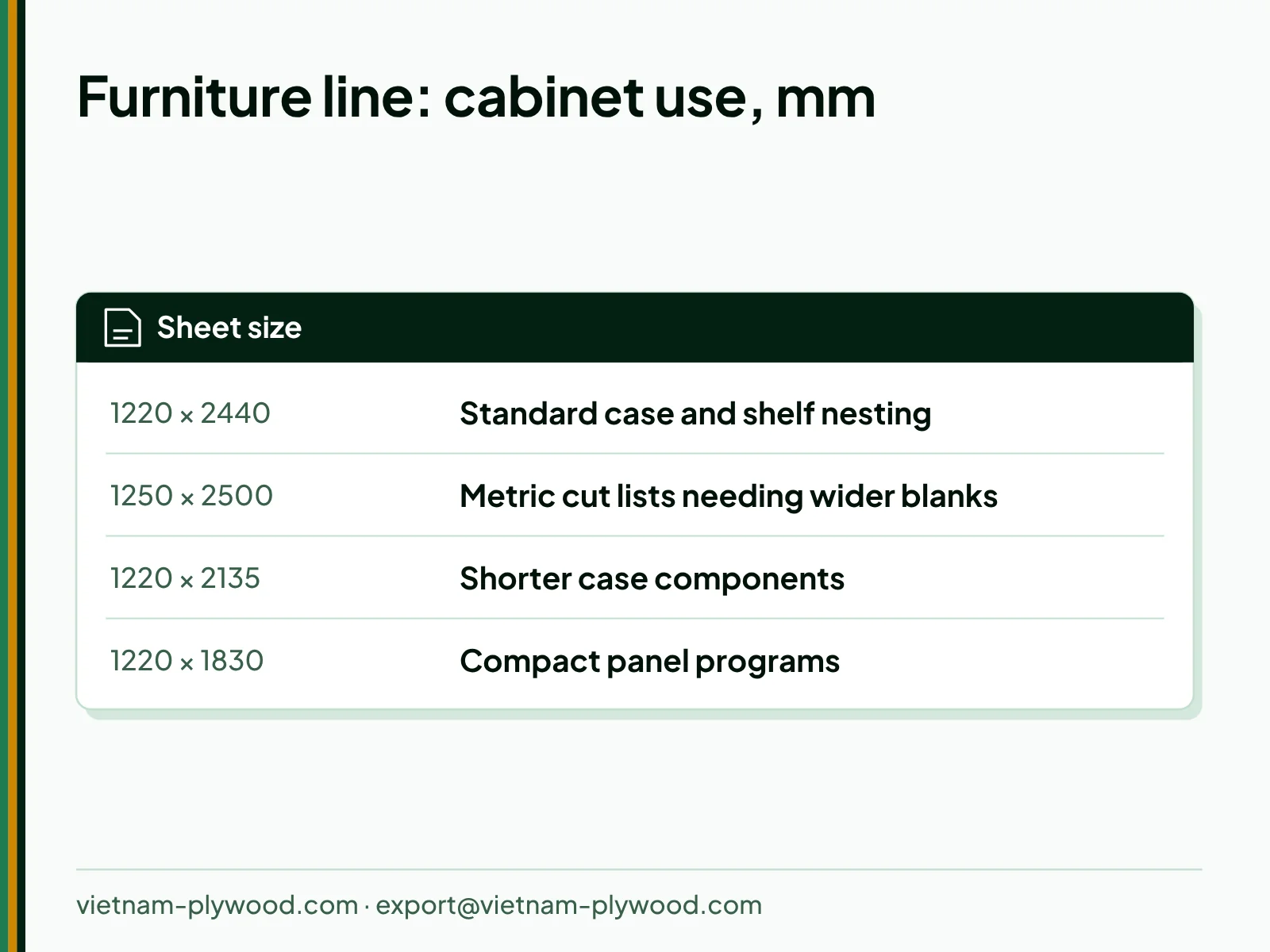
| Sheet size (mm) | Furniture line: cabinet use | Commercial and packing line | Construction line |
|---|---|---|---|
| 1220 × 2440 | Standard case and shelf nesting | Packing and commercial panels | Film-faced formwork |
| 1250 × 2500 | Metric cut lists needing wider blanks | Commercial panels | Film-faced formwork |
| 1220 × 2135 | Shorter case components | Commercial panels | Film-faced formwork |
| 1220 × 1830 | Compact panel programs | Packing panels | Film-faced formwork |
| 915 × 2440 | Narrow components and long strips | Packing panels | Film-faced formwork |
| 915 × 2135 | Narrow case programs | Packing panels | Film-faced formwork |
| 915 × 1830 | Smaller blanks | Packing panels | Film-faced formwork |
Length and width tolerance is ±2 mm. Unlike a 1525 × 1525 mm square Baltic birch format sometimes specified for drawers, that square format is not among our listed sheet sizes. For cabinet construction and face options, see kitchen cabinet plywood.
What plywood thickness for cabinets should a buyer specify?
Plywood thickness for cabinets is normally specified by part: 18 mm for box sides and load-bearing shelves, 12 or 15 mm for lighter partitions and drawer sides, and 3–9 mm for captured backs or bottoms. The choice follows the cabinet design, fixing method, shelf span and hardware geometry rather than one universal thickness.
An 18 mm carcass specification gives the assembler a clear starting point for joint design and screw placement. A 12 mm side panel can work where the engineering and fastener arrangement support it, but it leaves less material at edges and screw locations. Thin backs may act as infill, while structural backs and wall-hanging systems require their own fixing design. Keep these roles separate on the bill of materials.
For a wider cabinet-grade plywood specification, include core construction, face grade and emission class alongside thickness.
Should cabinet boxes use 1/2 inch or 3/4 inch plywood?
For a conventional cabinet box, 18 mm furniture plywood is the stronger starting specification than 12 mm when edge fastening and panel stiffness govern the design. A lighter 12 mm construction is a design decision requiring compatible joints, supports and hardware.
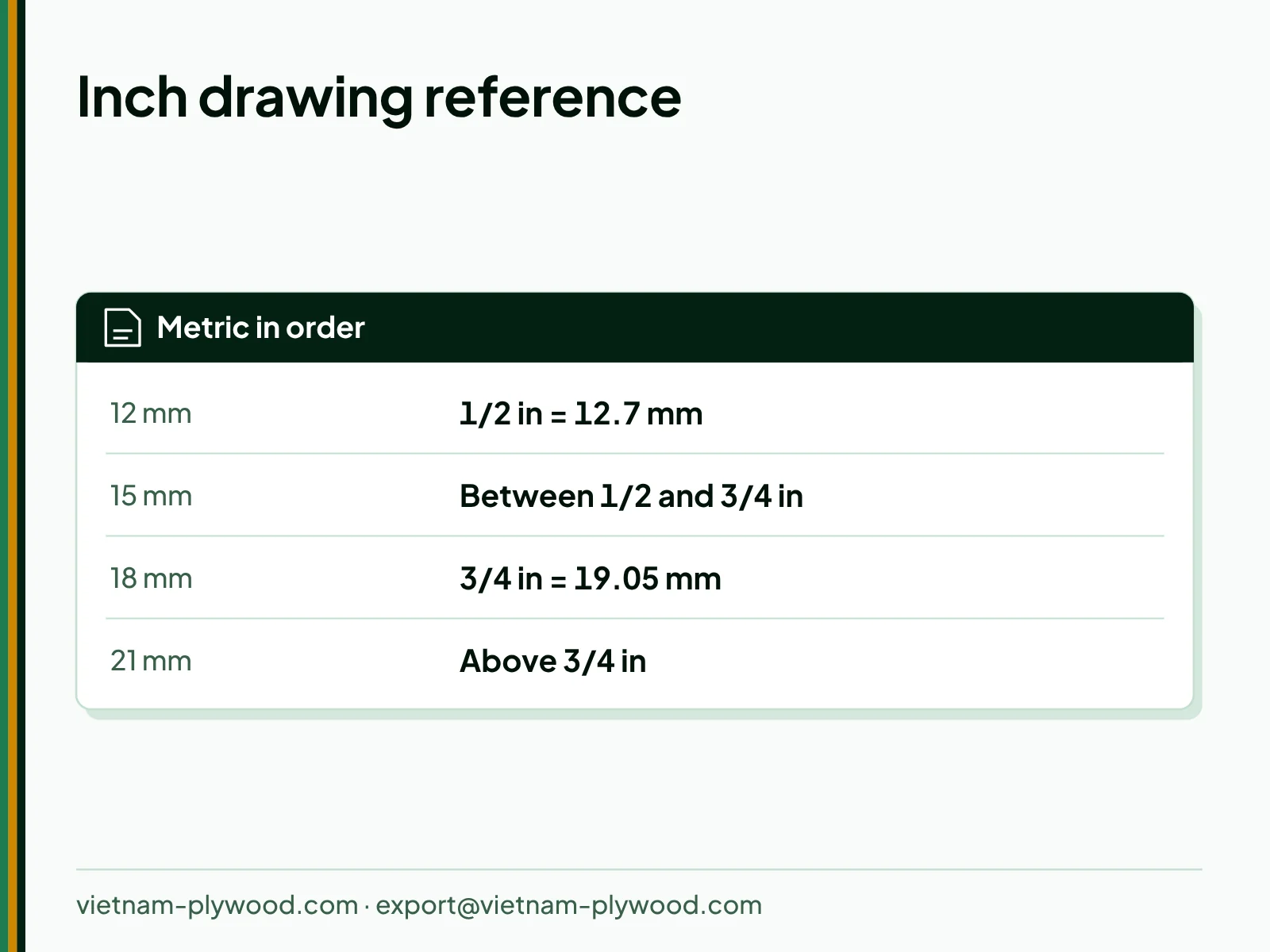
| Metric in order | Inch drawing reference | Difference from nominal inch callout | Verdict by use |
|---|---|---|---|
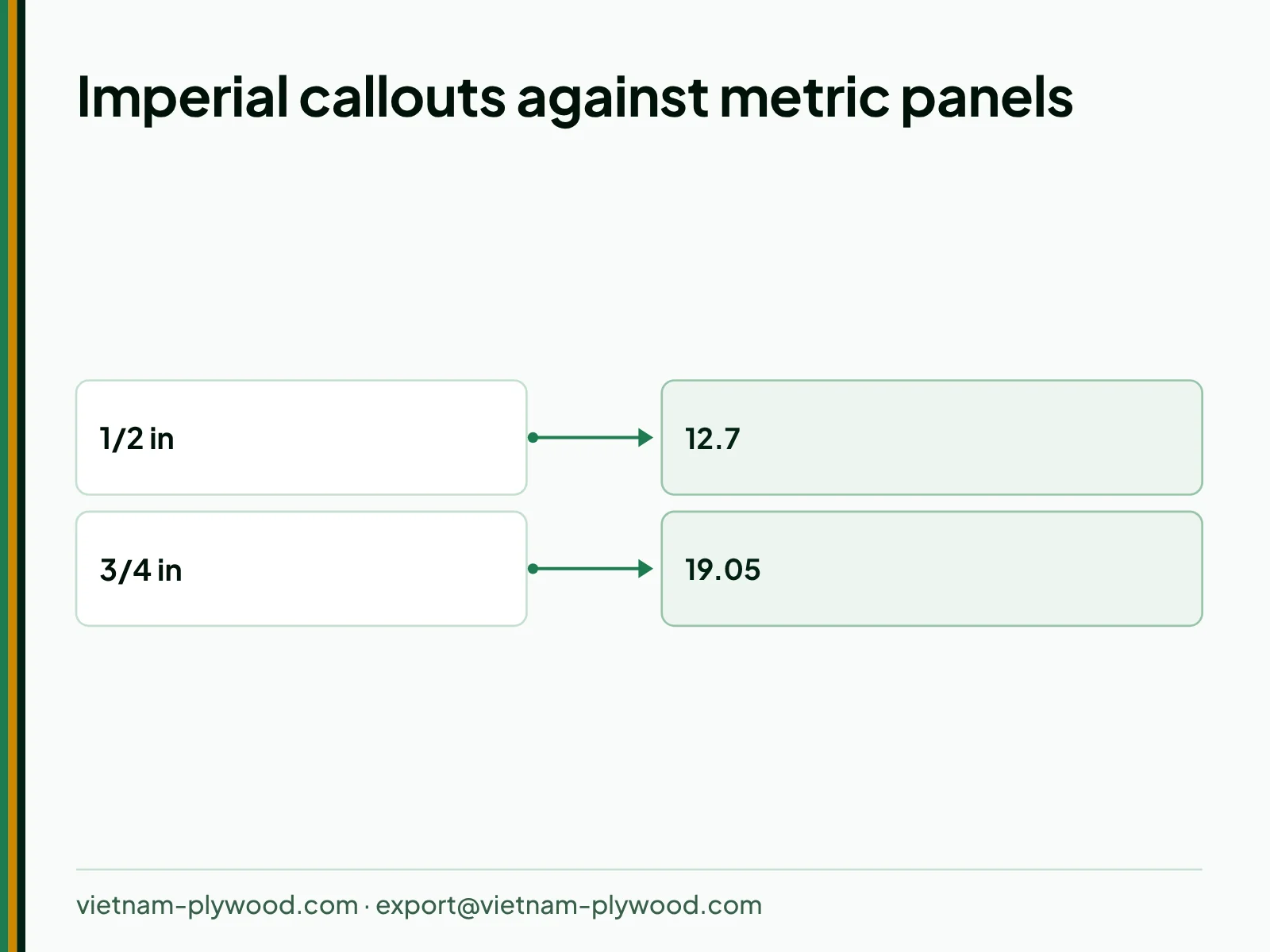
| 12 mm | 1/2 in = 12.7 mm | 0.7 mm thinner | Drawer sides, partitions, supported light boxes |
| 15 mm | Between 1/2 and 3/4 in | Design-specific | Intermediate box and shelf components |
| 18 mm | 3/4 in = 19.05 mm | 1.05 mm thinner | Default box sides, fixed shelves, many doors |
| 21 mm | Above 3/4 in | 1.95 mm thicker | Selected heavy-duty parts after design review |
The US National Institute of Standards and Technology (NIST) lists the international foot as exactly 0.3048 m in its conversion table updated in 2026; dividing by 12 gives 25.4 mm per inch. An imperial label in a drawing does not authorize substituting a metric panel without updating grooves, hinge positions and part dimensions.
For 1/2 vs 3/4 plywood for cabinets, compare joint geometry before comparing sheet cost. A reduced panel thickness changes screw embedment and the finished cabinet’s internal clearances. The fabricator should validate a representative assembly with the selected fasteners.
Is 18 mm cabinet plywood the same as 3/4 inch?
No. Eighteen millimeters is 1.05 mm thinner than the exact 19.05 mm represented by 3/4 inch. An order reading “18 mm cabinet plywood” requests a metric nominal thickness; “3/4 inch plywood for cabinets” can be read as a different nominal dimension.
For CNC programs, set material thickness to the agreed metric target and define how the machine measures each batch. Slots, dados, back grooves and concealed-hinge drilling can be sensitive to actual thickness. A drawing annotated 3/4 inch should carry a revision note identifying the accepted 18 mm substitution.
What actual-thickness tolerance belongs on the order?
For sanded furniture plywood, state nominal thickness and either ±0.2 mm or ±0.3 mm as ordered. These are the furniture-line options; commercial and film-faced panels use ±0.5 mm, while packing panels use ±0.5–1.0 mm.
An 18 mm furniture order with ±0.2 mm defines an acceptance interval of 17.8–18.2 mm. With ±0.3 mm, it defines 17.7–18.3 mm. These arithmetic intervals matter when the cutter chooses a groove width and the assembly team chooses a joint clearance. State the tolerance explicitly instead of accepting a generic label such as “cabinet grade.”
The producing factory can show an inspector a thickness check across representative panels and positions. Record the measurement instrument, locations, batch identity and acceptance criterion on the inspection sheet. A single edge reading is inadequate for diagnosing a sanding or press variation across the sheet. Buyers can witness this check at the producing factory before loading.
Which thickness suits boxes, shelves, backs and drawers?
Choose 18 mm for the main box and shelf schedule, then specify lighter parts separately. The final schedule must reflect load, unsupported span, fixing pattern and exposed-edge design.
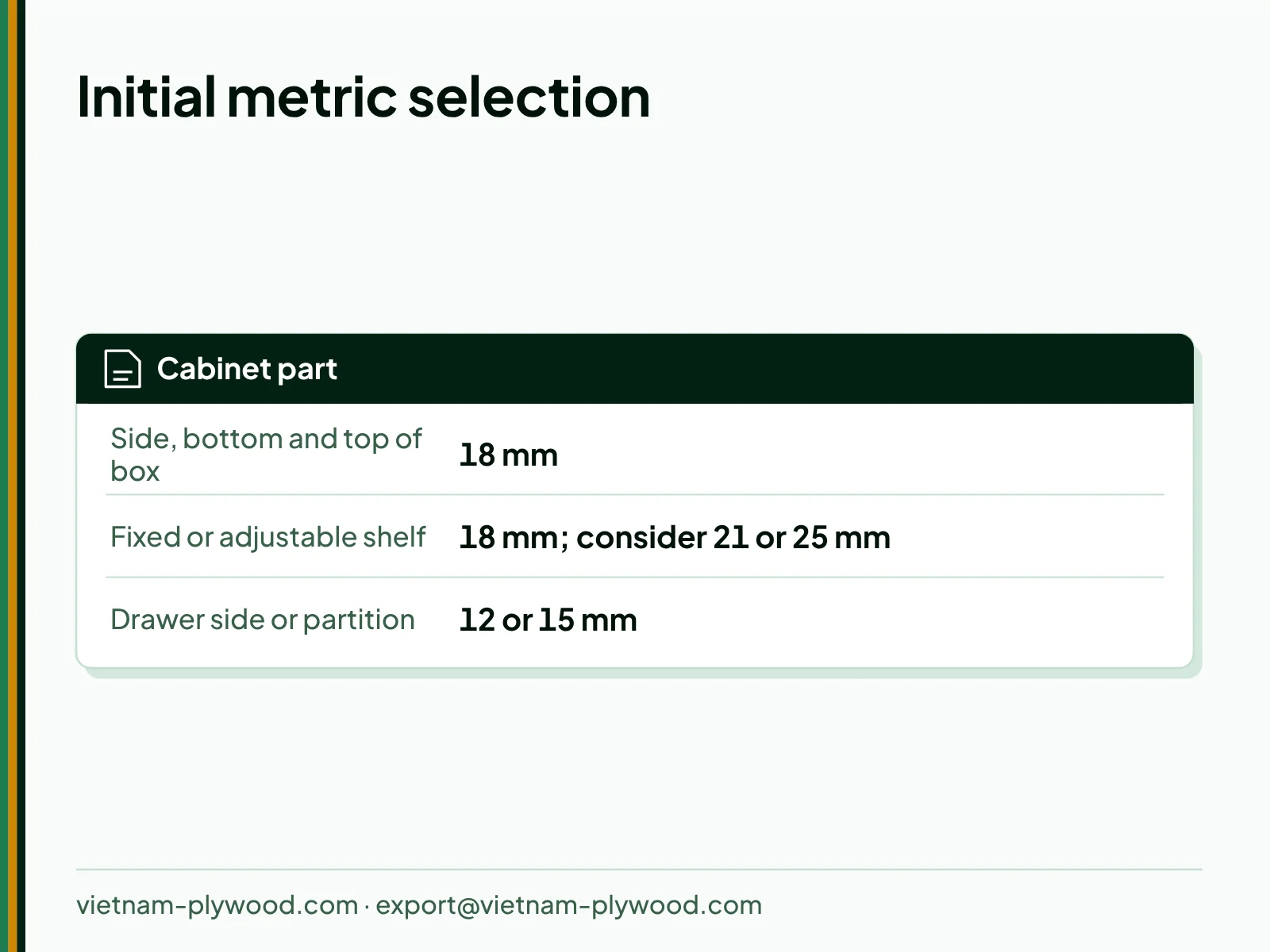
| Cabinet part | Initial metric selection | What must be checked |
|---|---|---|
| Side, bottom and top of box | 18 mm | Joinery, screw spacing, box stiffness |
| Fixed or adjustable shelf | 18 mm; consider 21 or 25 mm | Span, loading, edge reinforcement, supports |
| Drawer side or partition | 12 or 15 mm | Slide and joint geometry |
| Captured back or drawer bottom | 3, 5, 6 or 9 mm | Groove, support and retention method |
| Structural or hanging back | 12 or 18 mm | Wall fixing and load path |
| Door or drawer front | 18 mm starting point | Hinge-cup depth, flatness, finishing |
For door hardware, consult cabinet door plywood; for moisture-exposed vanity detailing, see bathroom vanity plywood.
Which HCPLY line makes cabinet panels?
Our furniture line presses the cabinet schedule with styrax or eucalyptus core, full stitched construction, sanding and E0 or E1 emission options. Our commercial and packing line instead builds acacia-core MR-glue panels with unsanded or light-sanded surfaces. Our construction line presses film-faced acacia- or eucalyptus-core panels for formwork.
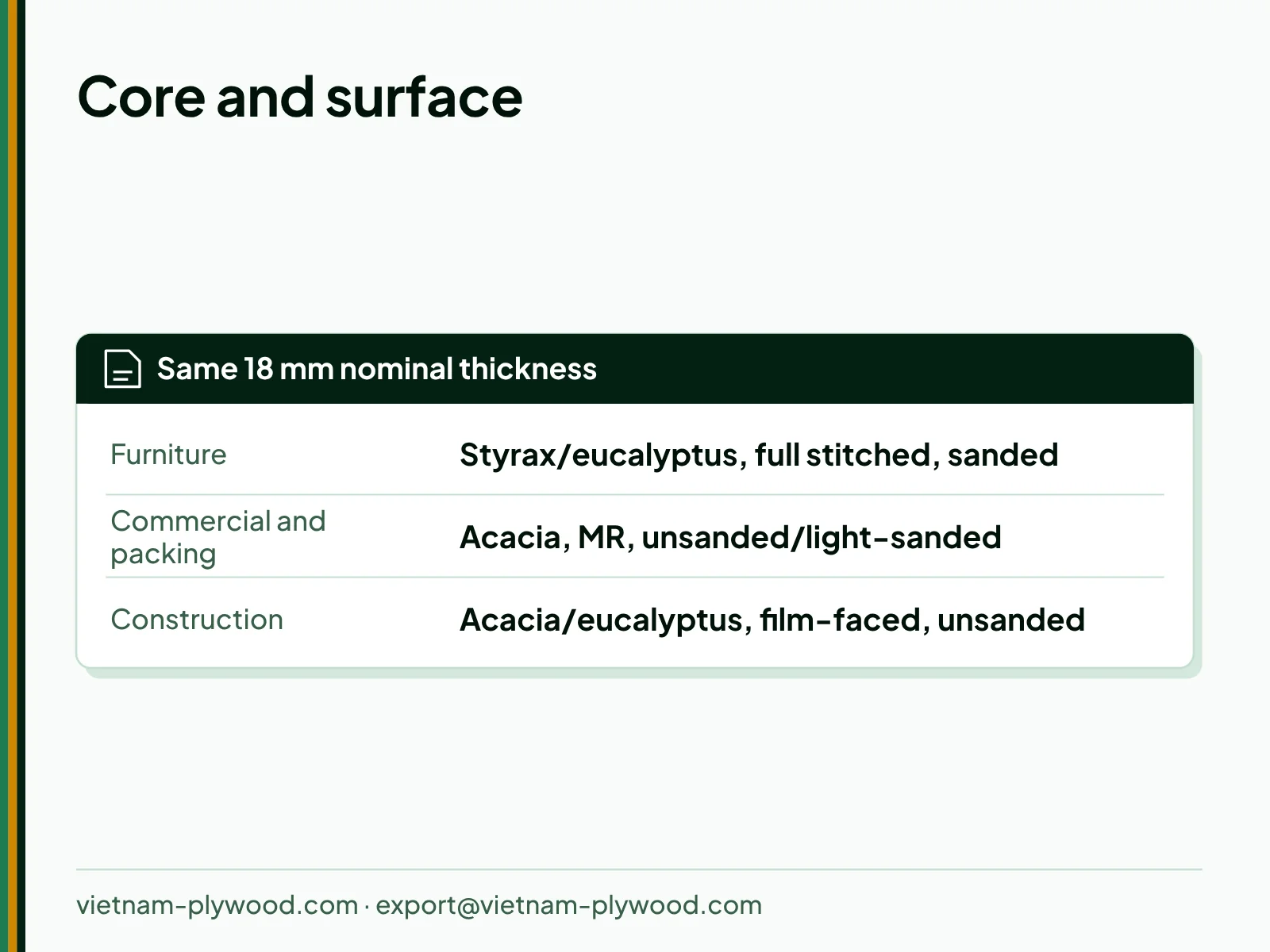
| Same 18 mm nominal thickness | Core and surface | Thickness tolerance | Appropriate order |
|---|---|---|---|
| Furniture | Styrax/eucalyptus, full stitched, sanded | ±0.2 or ±0.3 mm | Cabinet boxes and visible components |
| Commercial and packing | Acacia, MR, unsanded/light-sanded | ±0.5 mm commercial; ±0.5–1.0 mm packing | Commercial or packing applications |
| Construction | Acacia/eucalyptus, film-faced, unsanded | ±0.5 mm | Formwork rather than finished cabinetry |
HCPLY’s furniture and commercial plywood capacity is up to 100 containers a month; construction plywood is up to 140. For the cabinet schedule, request furniture plywood with its actual core, face and sanding details.
How do core, face, glue and emission affect the order?
The core sets density and construction; the face names the product and sets its visible appearance. Styrax core is 500 kg/m³, eucalyptus 650 kg/m³ and acacia 580 kg/m³. A birch-faced sheet is therefore not automatically birch-core plywood.
Furniture panels use full stitched cores and sanded faces. Available face choices include bintangor, okoume, engineered veneer (EV), gurjan, pine, poplar, eucalyptus, birch and sapele; matt denotes an unfaced raw core. Common face veneer thickness is 0.2–0.4 mm. Face grades are A/B, while birch faces use D/E/F grades. Specify the required visible and reverse faces in the purchase specification.
Glue type and emission class occupy separate fields. Melamine glue is MR with a 12-hour boil designation; phenolic glue is WBP with a 72-hour boil designation. Emission classes are E0, E1 and E2; CARB Phase 2 and TSCA Title VI are US limits involving third-party certification. Do not substitute a glue description for an emission requirement.
See birch plywood for kitchen cabinets for the face-versus-core distinction.
Can different cabinet thicknesses share one container?
Yes. The minimum order is one 40HC, and one container can carry several specifications as long as the payload limit holds of 28.5 t. For example, 18 mm box panels and 12 mm back or drawer components can share the shipment when their pallet counts and combined weight fit.
For 1220 × 2440 mm styrax-core panels, the 18 mm lookup is 55 sheets per pallet at 26.79 kg per sheet. Twelve-millimeter styrax panels are 83 sheets per pallet at 17.86 kg per sheet. For a mixed load, ask the producing factory for a thickness-by-thickness pallet plan and packing tare, then check the total against the 28.5 t payload limit.
A full single-thickness 18 mm styrax reference is 990 sheets, 53.05 m³ and 26.52 t. Acacia is 880 sheets, 47.15 m³ and 27.35 t; eucalyptus is 795 sheets, 42.60 m³ and 27.69 t. Those full-load figures describe separate core assumptions and exclude film weight. For the broader calculation, use container loading and mixed container loads.
Distributors planning recurring mixed schedules can use plywood supply programmes.
What should an inspector check before cabinet panels ship?
The inspector should check nominal thickness against the ordered tolerance, confirm the core and face specification, and compare pallet labels with the packing list. A factory visit can include a cut-edge review for core gaps and a surface check for sanding quality.
- Match the approved order to the production batch and pallet identification.
- Measure thickness at agreed locations and record the readings against the specified interval.
- Inspect cut edges for stitched-core continuity and check the face grade and sanding finish.
- Compare sheet length and width against the ±2 mm dimensional tolerance.
- Reconcile thickness-specific sheet counts and pallet totals before container loading.
Shipment paperwork includes the commercial invoice, packing list, bill of lading, certificate of origin and applicable order certificates; EU lots also include the EUTR/EUDR file set. Member-factory FSC, CARB P2, ISO 9001 and CE certificates, and EUDR/EUTR documents, are shown with factory details masked, on request.
How should the cabinet maker convert a drawing into an order?
Convert every imperial thickness callout into an approved metric target before generating the nesting program. Preserve the original drawing reference in a separate column so the production team can trace each substitution.
First group parts by function: carcass, shelf, drawer, back and door. Next assign the nominal metric thickness and the furniture-line tolerance. Then select the core, face grade, glue and emission class. Finally, reconcile the metric sheet size, cutting layout and pallet quantities with the factory specification.
For a 1/2 inch plywood cabinet callout, 12 mm is a common metric choice but is 0.7 mm thinner than 12.7 mm. For a 3/4 inch callout, 18 mm is 1.05 mm thinner than 19.05 mm. A supplier’s nominal metric designation must be carried into CAD/CAM settings, groove tests and hardware approval.
What specification should go to the furniture line?
Send a part-by-part metric schedule, with the acceptance tolerance and the shipping mix written on the same request. This gives the factory a basis for quoting and gives the buyer an inspection criterion.
Price is driven first by core construction and density, then face species and grade, sanding, glue and emission requirements, and finally thickness mix and cutting complexity. Full stitched, sanded furniture panels cost more to build than loose-laid, unsanded packing panels because the core preparation and finishing work differ. Furniture plywood starts from US$350/m³ FOB Hai Phong (October 2026). A final quotation follows the written specification.
Factory lead time runs 15–45 days from receipt of the 30% deposit; the exact figure depends on order size, line loading and what the contract fixes. The remaining 70% is paid on the scan of the bill of lading, by T/T, or by irrevocable sight L/C. We ship FOB Hai Phong, or CFR (CNF) or CIF to your port. Samples cost nothing: a first-time buyer pays the courier, and that charge comes off the first confirmed order.
Application: cabinet carcasses, shelves, drawer sides and captured backs
Line or core: furniture line; styrax core, full stitched
Glue: melamine MR
Emission: E1
Face and grade: bintangor A/B; sanded
Thickness and tolerance: 18 mm ±0.2 mm boxes/shelves; 12 mm ±0.2 mm drawer sides; 5 mm ±0.2 mm backs
Size: 1220 × 2440 mm; length/width ±2 mm
Quantity: pallet counts by thickness; mixed 40HC within 28.5 t payload
Destination port: [buyer to insert]
Request the cabinet thickness spec sheet from Lucy at HCPLY or export@vietnam-plywood.com.