





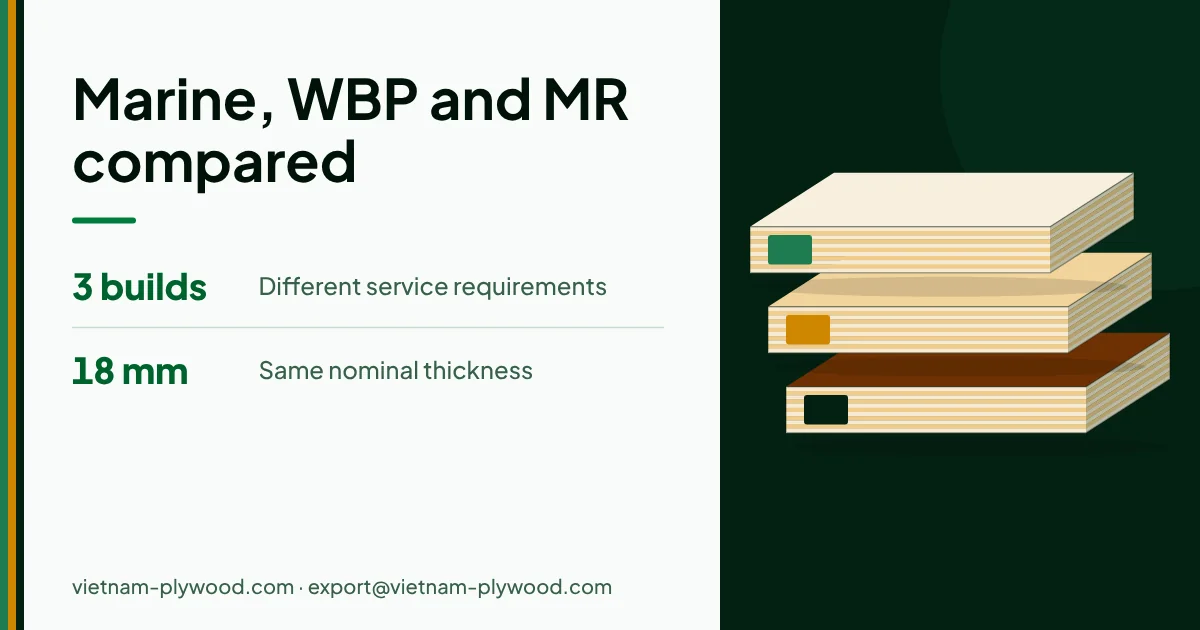
Marine plywood earns its premium when the job demands marine-grade veneer construction and verified wet-service performance; many other orders need a correctly specified WBP bond instead. Choosing the wrong sheet costs material money, replacement time or a rejected shipment. At HCPLY, compare the actual exposure, bond and core first; accept a marine-grade claim only against a test report the buyer accepts.
Marine plywood vs regular plywood: what is the difference?
Marine plywood is plywood manufactured to a defined marine specification, while regular plywood covers several constructions for different service conditions. Both can use water-resistant adhesives, but marine requirements also address veneer quality, core construction and long-term bond performance. A hardwood face or dark glue line alone cannot establish marine compliance. The buyer’s written acceptance standard decides which build belongs on the order.
The British Standards Institution’s BS 1088:2018 describes standard and lightweight marine plywood primarily for marine craft and waterways. It addresses resistance to biological deterioration and loss of bond strength over time; it does not cover every property needed for a particular installation. See the BSI 2018 standard overview.
For a marine purchase, state BS 1088 only against a test report the buyer accepts. The marine buying checklist helps turn that distinction into an order.
Which specification actually changes the buying decision?
Compare sheets by what the job asks them to survive rather than by the name printed on a quotation.
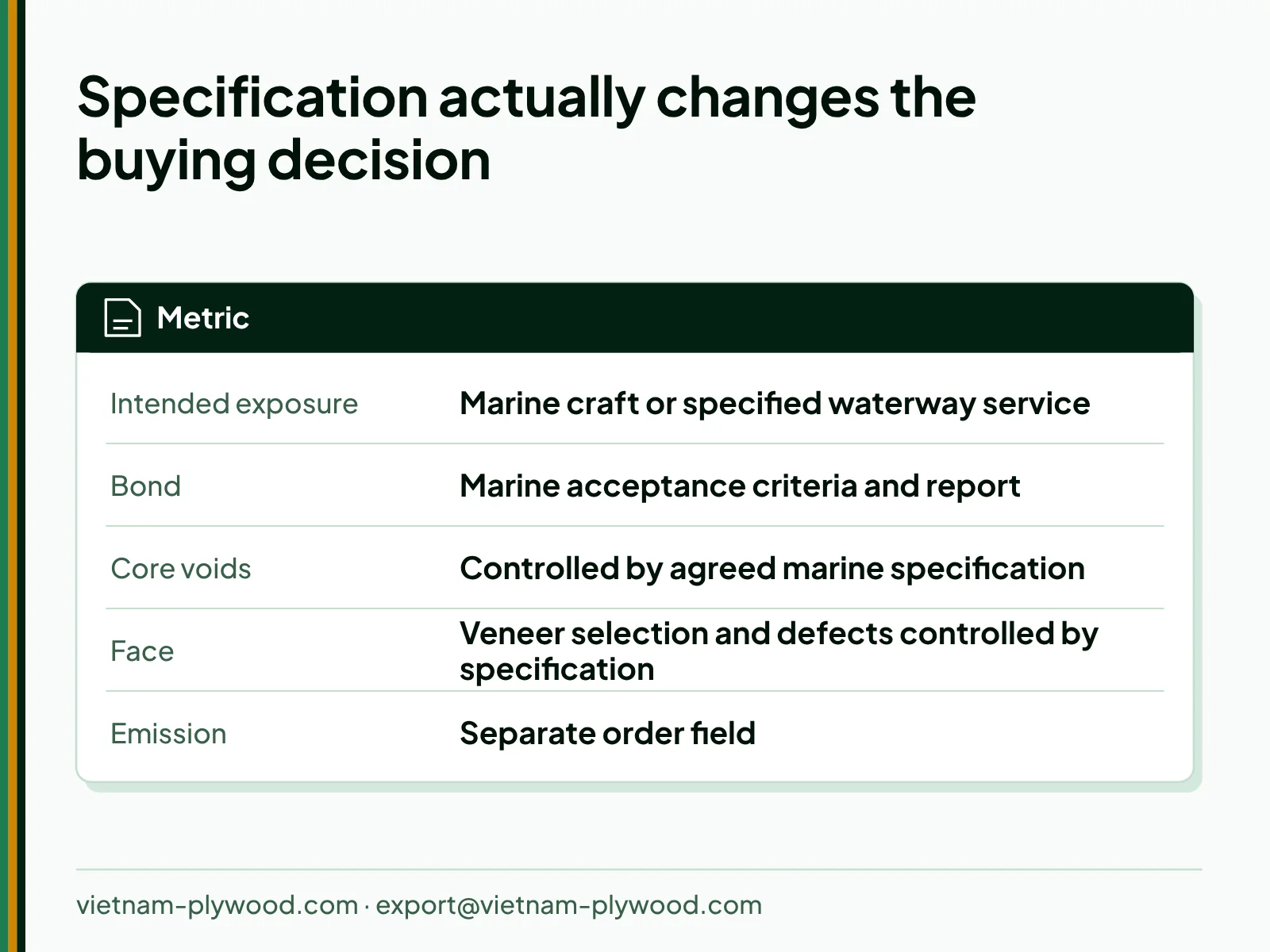
| Metric | Marine specification | Regular MR plywood | Regular WBP or film-faced plywood | Verdict by use |
|---|---|---|---|---|
| Intended exposure | Marine craft or specified waterway service | Protected, dry interior | Exterior wetting or concrete contact as designed | Marine for specified marine components; MR for dry cabinets; WBP for suitable exterior jobs |
| Bond | Marine acceptance criteria and report | Melamine MR bond | Phenolic WBP bond | WBP can answer bond demand without satisfying marine construction |
| Core voids | Controlled by agreed marine specification | Controlled by ordered core build | Controlled by ordered core build | Inspect core where fasteners, edges or bending matter |
| Face | Veneer selection and defects controlled by specification | Decorative or functional veneer | Raw exterior face or film surface | Select appearance for cabinets, film for formwork |
| Emission | Separate order field | E0 or E1 on furniture line | Separate agreed field | Emission class never substitutes for wet-bond qualification |
| Cost basis | Premium veneer selection and acceptance testing | Finish, sanding and grade | Bond, core and surface film | Buy marine only when its extra requirements solve a real risk |
| Evidence | Accepted marine test report | Approved production specification | Approved WBP build and agreed test report | Match paperwork to the delivered batch |
How do our three factories build the same thickness differently?
At 18 mm, the pressing line changes the intended service and the checks the buyer should request. HCPLY makes the selected build at the producing factory rather than treating every 18 mm sheet as interchangeable.
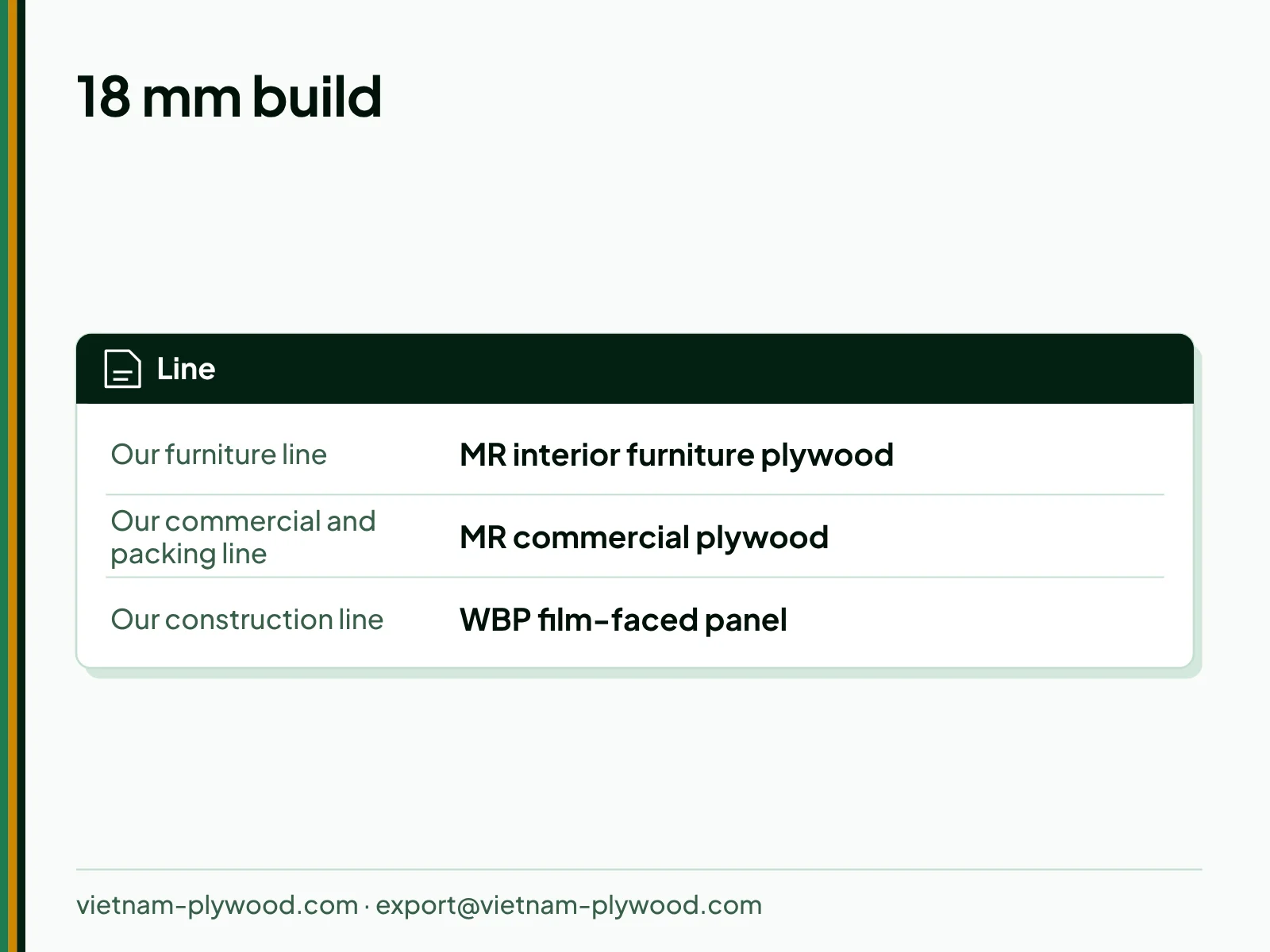
| Line | 18 mm build | Core and finish | Intended job | Inspection priority |
|---|---|---|---|---|
| Our furniture line | MR interior furniture plywood | Styrax or eucalyptus, full stitched, sanded | Cabinets and fit-out | Face, sanding, thickness and emission field |
| Our commercial and packing line | MR commercial plywood | Acacia, unsanded or light-sanded | Packing and commercial panels | Core gaps, edges and dimensional consistency |
| Our construction line | WBP film-faced panel | Acacia or eucalyptus, unsanded beneath film | Concrete formwork | Film continuity, edges and bond specification |
The furniture line uses a sanded thickness tolerance of ±0.2 or ±0.3 mm as ordered; commercial and film-faced sheets use ±0.5 mm. Our exterior plywood specification covers an alternative to consider for outdoor requirements.
How do glue, core voids and face quality change performance?
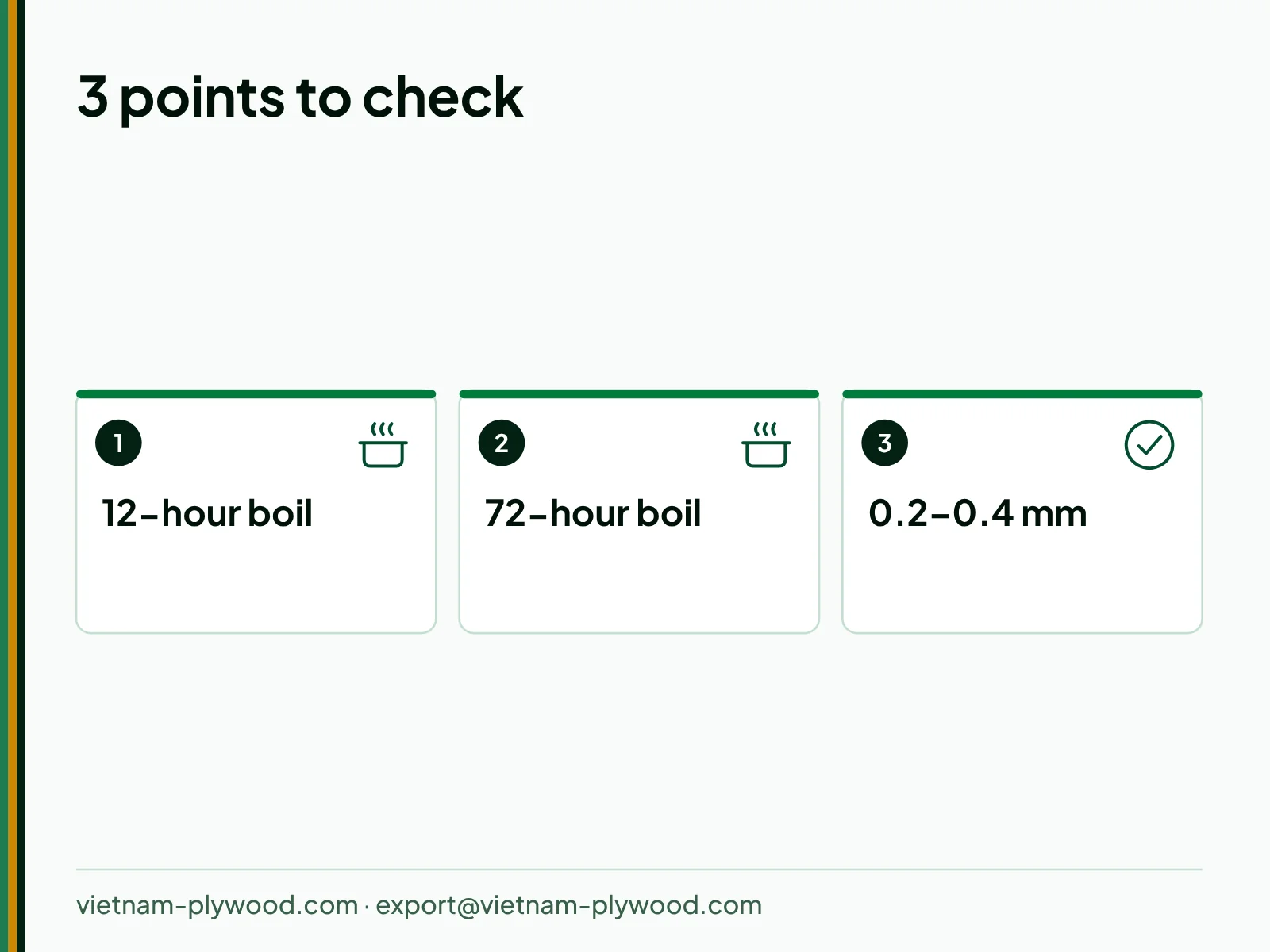
Glue determines bond resistance; the core and face determine different failure paths. Our MR melamine glue has a 12-hour boil specification, while phenolic WBP (weather and boil proof) has a 72-hour boil specification. For any marine-grade claim, assess the complete panel against a test report the buyer accepts.
Core construction matters at a cut edge, around fixings and under repeated bending. Full stitched cores are more continuous than stitched outer layers with edge-trimmed inner layers, finger-jointed cores or loose-laid veneers. Inspect a sample edge and cross-section before approving the order’s allowable gaps and repairs.
Bintangor, okoume, engineered veneer, gurjan and other named faces describe the visible veneer, commonly 0.2–0.4 mm thick. A birch face is still only a face designation; We do not press birch-core plywood. A face name cannot replace a bond test or marine construction requirement.
Is hardwood plywood the same as marine plywood?
Hardwood plywood is a species or veneer description, whereas marine plywood is a construction and performance specification. The two labels answer different questions.
Ask for a face grade and a bond requirement as distinct entries, even if both sheets are called hardwood plywood.
Is WBP plywood the same as marine plywood?
WBP plywood has a weather-and-boil-proof bond; marine plywood adds requirements beyond the glue line. The distinction matters most when an architect, vessel designer or purchasing contract names a marine standard.
The American engineered-wood association APA explains that its own marine-grade plywood has a fully waterproof structural adhesive and limits core gaps, while also noting that marine-grade plywood is not automatically preservative-treated. See the APA product FAQ.
Where BS 1088 is specified, compare the offered construction against a test report the buyer accepts. For a build that merely needs exterior bond resistance, evaluate WBP together with coating, edge sealing and the designed exposure.
Which jobs really need marine, and which need only WBP?
Marine construction belongs first on jobs whose specification requires it, particularly marine craft and waterway components. Other projects can use an appropriately designed exterior-bond panel when their engineering and procurement documents allow it.
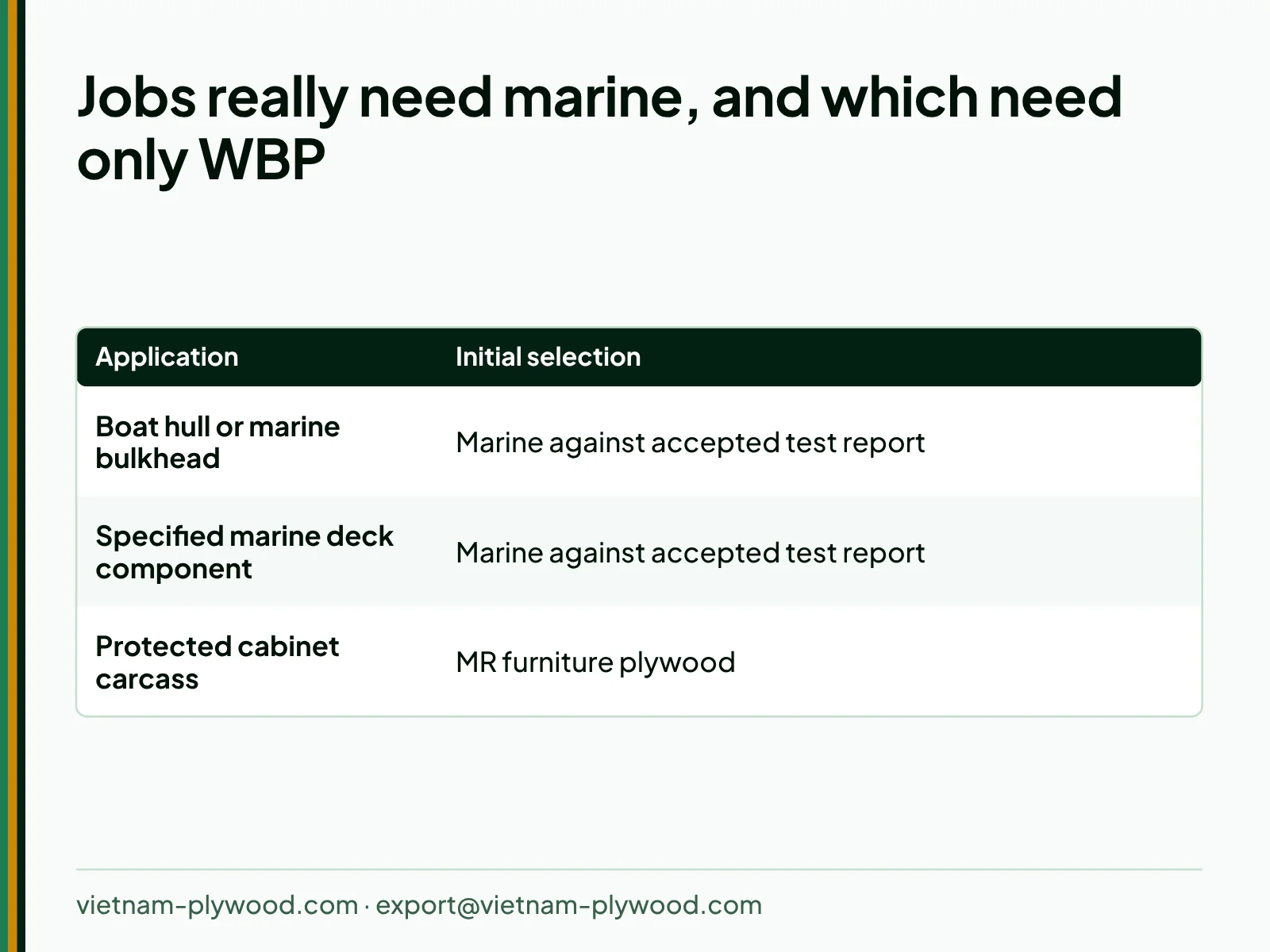
| Application | Initial selection | Reason to accept or escalate |
|---|---|---|
| Boat hull or marine bulkhead | Marine against accepted test report | Marine design and repeated water exposure |
| Specified marine deck component | Marine against accepted test report | Follow vessel designer’s material schedule |
| Protected cabinet carcass | MR furniture plywood | Sanding, appearance and interior service dominate |
| Fit-out panel in a controlled interior | MR furniture plywood | Marine veneer restrictions add little value |
| Weather-exposed non-marine cladding substrate | WBP exterior build for design review | Exposure and edge detailing govern suitability |
| Reusable concrete form | Film-faced construction plywood | Release surface and handling govern service |
| Export crate kept in protected logistics | MR commercial or packing plywood | Core and packing duty govern selection |
For vessel-specific construction, use the boat-building marine plywood discussion. For a project with design loads, the construction supply requirements must be considered independently of marine naming.
Does thickness or sheet size settle the marine question?
We offer 3–40 mm, including common 12, 15, 18 and 21 mm selections, with standard sizes including 1220 × 2440 mm and 1250 × 2500 mm. A marine specification must still address its own required thickness and construction.
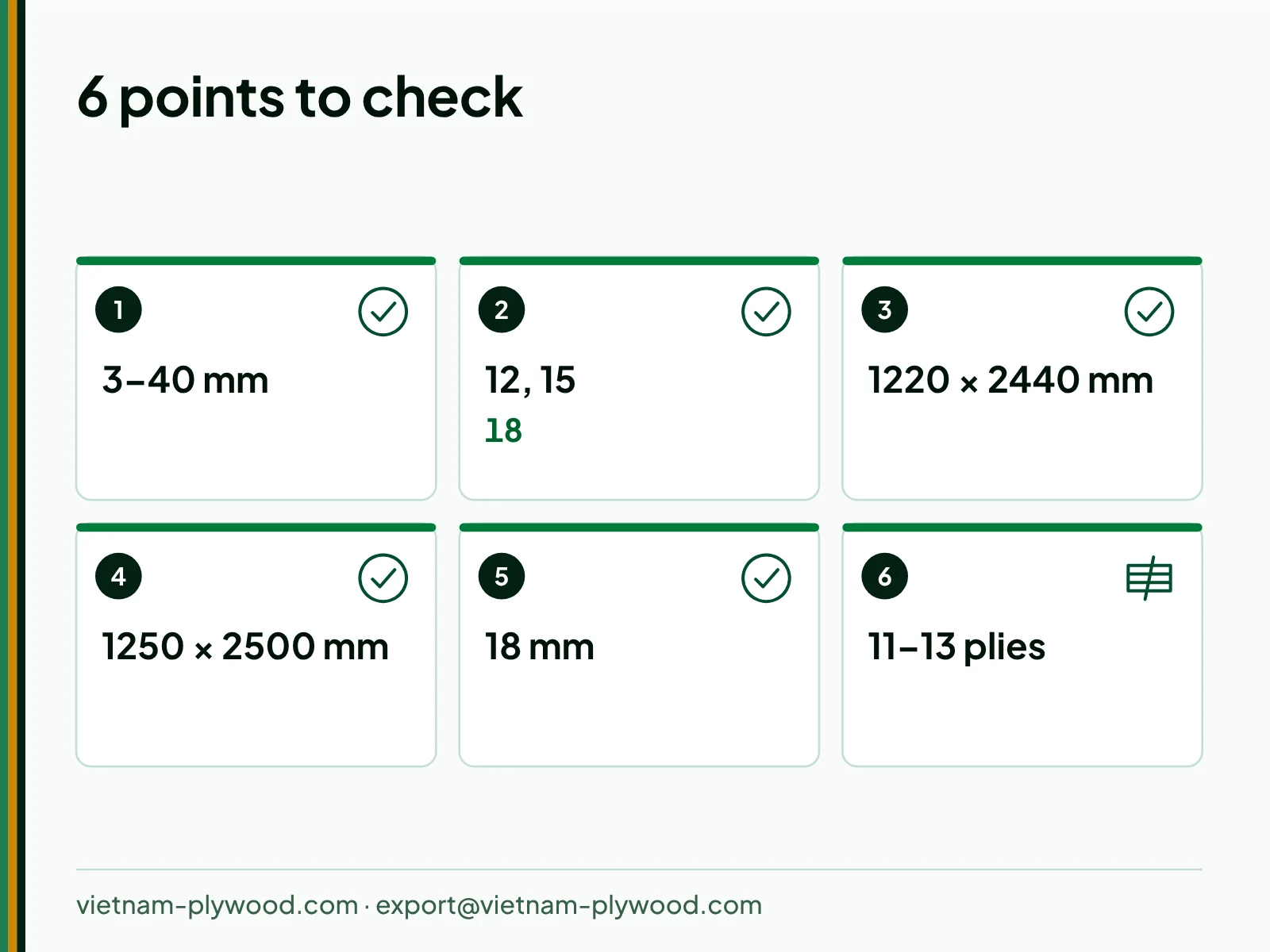
An 18 mm sheet typically contains 11–13 plies, depending on core veneer thickness. Core species also changes weight: a 1220 × 2440 × 18 mm sheet is 26.79 kg with styrax, 31.08 kg with acacia or 34.83 kg with eucalyptus, excluding film weight. Density follows the core rather than the decorative face.
Use the marine thickness and size reference to prepare the dimensional request, then set the allowable tolerance and test criteria separately.
Can different builds share a shipment?
Different specifications can share one 40HC when the combined payload stays within 28.5 t. At 1220 × 2440 × 18 mm, the full-container reference is 990 styrax sheets at 26.52 t, 880 acacia sheets at 27.35 t, or 795 eucalyptus sheets at 27.69 t. These are separate full-load references, not quantities to add together.
The container-loading reference owns the complete loading calculation.
Is the marine plywood price worth it for my job?
The marine premium pays for tighter veneer selection, more restrictive core acceptance and evidence of performance; it is worthwhile when those requirements are actually specified. Compared with MR commercial plywood, a marine-grade construction ordinarily costs more because more veneer is rejected and testing is required. WBP exterior plywood sits between those buying decisions when bond resistance is needed without the full marine specification.
For a price anchor, HCPLY’s commercial plywood starts from US$250/m³ FOB Hai Phong (October 2026), and furniture plywood starts from US$350/m³ FOB Hai Phong (October 2026). Request a written quotation for marine or WBP builds based on face, core, glue, thickness, acceptance testing, quantity and destination.
For distributors, separate these grades in the supply programme instead of treating them as substitutes.
What can the buyer witness at the producing factory?
HCPLY welcomes visits to the factory office and inspection of goods at the producing factory in Phu Tho or Hai Phong.
Measure panel thickness at agreed positions, inspect the veneer joints and edge gaps, and match the visible surface grade to the signed reference. Review the glue category and the accepted test report for any marine claim; a visual inspection cannot establish long-term bond durability by itself.
For export, the order’s test reports and certificate documents accompany the commercial invoice, packing list, bill of lading and relevant origin and phytosanitary papers. The buyer receives draft shipping documents for approval after loading. Member-factory FSC, CARB P2, ISO 9001 and CE documents can be shown with factory details masked, on request; none replaces a marine test report.
What specification should go to Lucy?
Send the intended exposure and acceptance standard first, followed by the build details. That allows Lucy to distinguish a marine requirement from a WBP exterior or MR interior order before quoting.
Application / wet exposure: [service and duration]
Line or core: [furniture / commercial and packing / construction; styrax / acacia / eucalyptus]
Glue: [melamine MR / phenolic WBP; marine test requirement if applicable]
Emission: [E0 / E1 / E2 or agreed market requirement]
Face and grade: [veneer species, face grade, or film finish]
Thickness and tolerance: [mm and agreed +/- mm]
Size: [length x width in mm]
Quantity: [sheets and number of 40HC containers]
Destination port: [port and country]
Acceptance evidence: [standard and buyer-accepted test report]
Request the marine-versus-WBP spec sheet from Lucy at export@vietnam-plywood.com.