





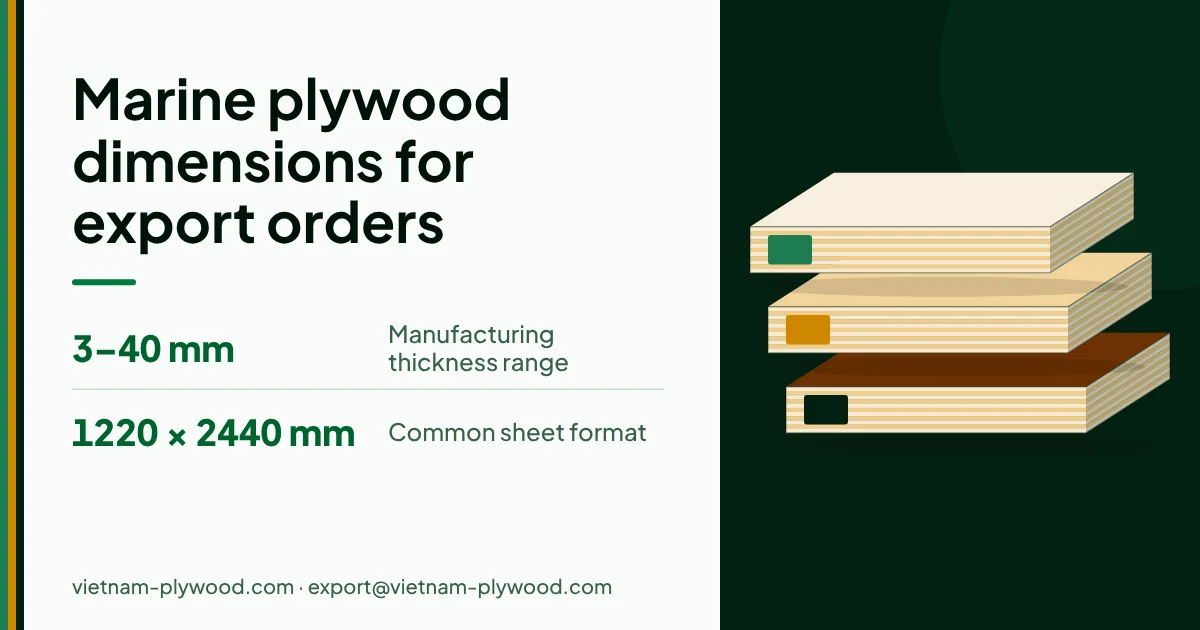
HCPLY lists marine plywood sizes by finished thickness in millimetres and sheet length × width; a marine claim for the agreed build requires a test report the buyer accepts. A mistaken thickness or sheet format can cause cutting waste, delayed production or a rejected shipment. Our three factories build different specifications, so the order must identify the producing line and the required test evidence.
What marine plywood sizes should an order state?
Marine plywood sizes on a purchase order should identify the nominal thickness, finished length and width, permitted tolerances, face and core, glue and the report used to accept the marine claim. The common 1220 × 2440 mm format is approximately 4 × 8 ft; Other metric sheet formats and custom cutting are also available. A size label alone says nothing about bond performance.
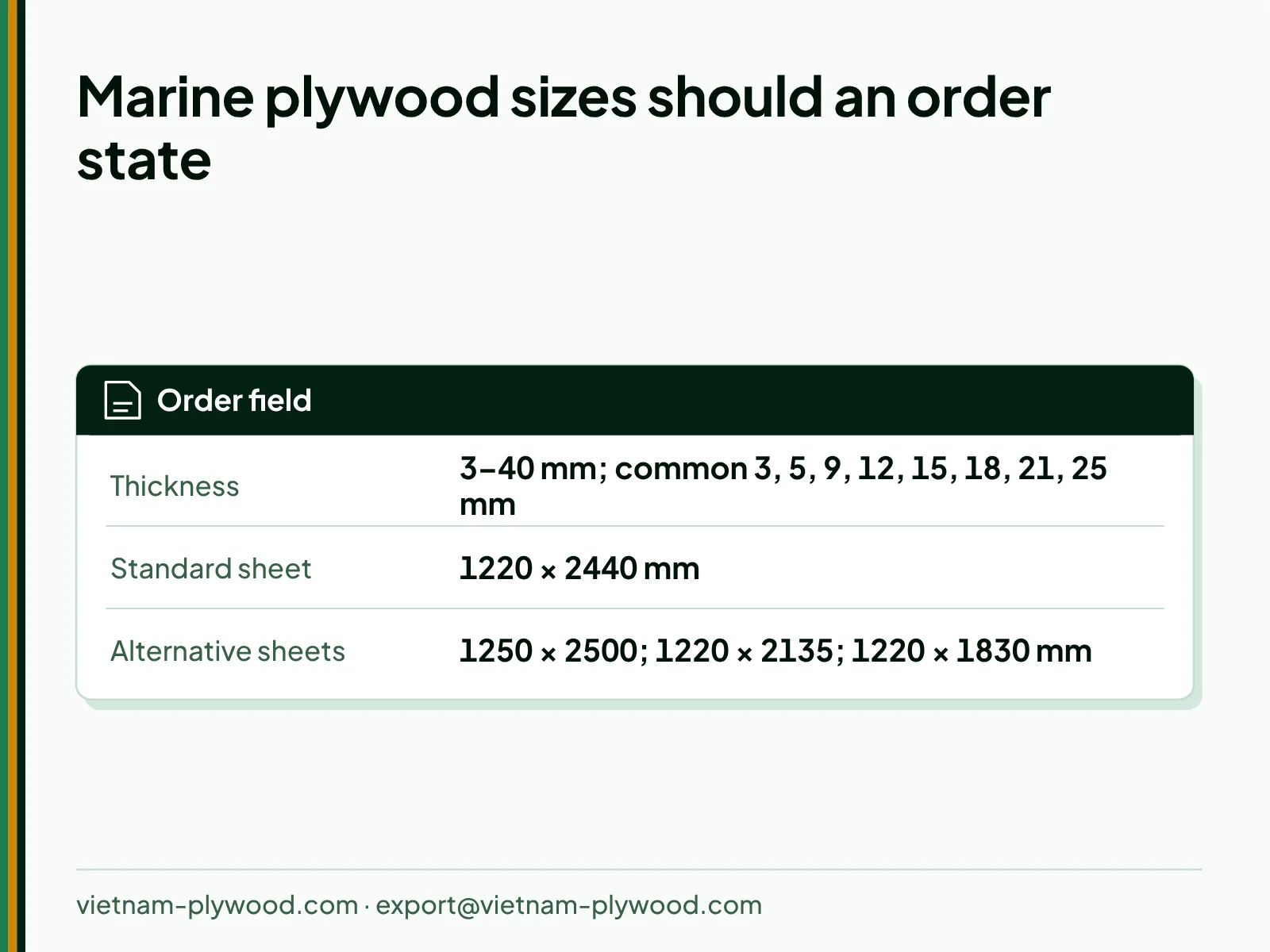
| Order field | Available specification | Buyer decision |
|---|---|---|
| Thickness | 3–40 mm; common 3, 5, 9, 12, 15, 18, 21, 25 mm | State nominal finished thickness |
| Standard sheet | 1220 × 2440 mm | Common 4 × 8 ft nominal format |
| Alternative sheets | 1250 × 2500; 1220 × 2135; 1220 × 1830 mm | Match cutting pattern |
| Narrow formats | 915 × 2440; 915 × 2135; 915 × 1830 mm | Match component width |
| Length and width tolerance | ±2 mm | State inspection basis |
| Furniture sanded thickness tolerance | ±0.2 or ±0.3 mm as ordered | Specify the selected band |
| Commercial and film-faced thickness tolerance | ±0.5 mm | Compare with fabrication allowance |
| Packing thickness tolerance | ±0.5–1.0 mm | Separate from finished cabinet requirements |
A nominal 4 × 8 sheet is 1220 × 2440 mm in our order language, rather than an exact conversion of 48 × 96 inches. The actual metric dimensions belong in the contract and packing list. For selecting a build before specifying the cut size, see how to buy marine plywood.
What thicknesses are available in millimetres?
The manufacturing thickness range is 3–40 mm, with 3, 5, 9, 12, 15, 18, 21 and 25 mm commonly specified. Marine plywood 3mm and marine plywood 9mm are therefore thickness requests within the manufacturing range; neither name establishes a marine grade. The same distinction applies to marine plywood 6mm and marine plywood 4mm, which require a written build specification.
Thin panels suit non-load-bearing liners, curved details and small fabricated parts where the buyer’s design permits bending. Intermediate 9 and 12 mm sheets are often considered for partitions and cabinet components. At 18 and 25 mm, purchasers usually compare rigidity, machining allowance and handling weight for larger assemblies. These are selection considerations, not engineering load ratings.
What sheet formats can be ordered?
The available sheet formats are 1220 × 2440, 1250 × 2500, 1220 × 2135, 1220 × 1830, 915 × 2440, 915 × 2135 and 915 × 1830 mm, plus custom cutting. In centimetres, 1220 × 2440 mm is 122 × 244 cm, and 1250 × 2500 mm is 125 × 250 cm. Marine plywood size in cm should be written as finished dimensions, with the same tolerance as the millimetre order.
An 18 mm marine plywood sheet is therefore incomplete wording. Specify, for example, 18 × 1220 × 2440 mm, then add the face, core, bond and acceptance criteria. The same 18 mm thickness can be cut into several listed formats; it does not imply one universal marine plywood sheet size.
How do inch and Philippine size names translate?
Inch labels on marine plywood orders are nominal trade descriptions; translate them into an explicit millimetre thickness before production. The arithmetic below converts inches exactly, without claiming that the converted value is a factory nominal thickness.
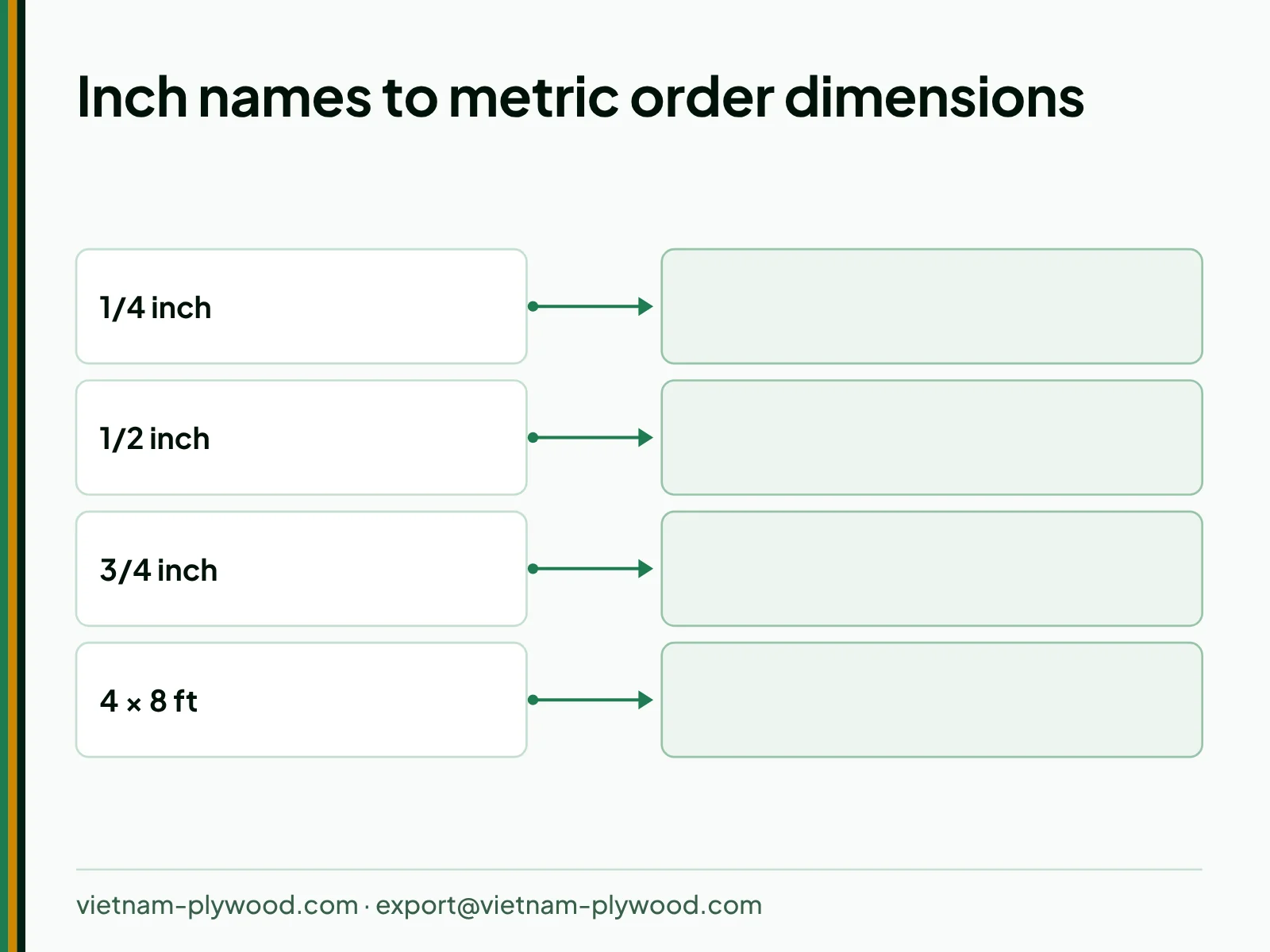
| Trade name | Exact conversion | Practical order instruction |
|---|---|---|
| 1/8 inch | 3.175 mm | Choose a written nominal mm thickness |
| 1/4 inch | 6.35 mm | State 6 mm or another agreed nominal value explicitly |
| 3/8 inch | 9.525 mm | Do not silently substitute 9 mm |
| 1/2 inch | 12.7 mm | Do not silently substitute 12 mm |
| 5/8 inch | 15.875 mm | Identify the required finished dimension |
| 3/4 inch | 19.05 mm | Do not silently substitute 18 mm |
| 4 × 8 ft | 1219.2 × 2438.4 mm | Specify 1220 × 2440 mm if that is the intended sheet |
Philippine purchasing conversations can use labels such as 1/4, 1/2, 3/4 and 4 × 8 alongside metric names. Those labels are a crosswalk for communicating dimensions, not a separate factory grade or proof of the panel’s marine classification. A purchase order headed “plywood 18mm marine” should state 18 mm as its governing nominal thickness even if a distributor calls the stock 3/4 inch.
Which production line makes a WBP marine-type panel?
Our furniture line is the relevant starting point for a sanded, veneer-faced, phenolic-glued marine-type build against a test report the buyer accepts. WBP means weather and boil proof; the phenolic glue specification uses a 72-hour boil condition. The name marine remains tied to the agreed report, rather than the press setting alone.
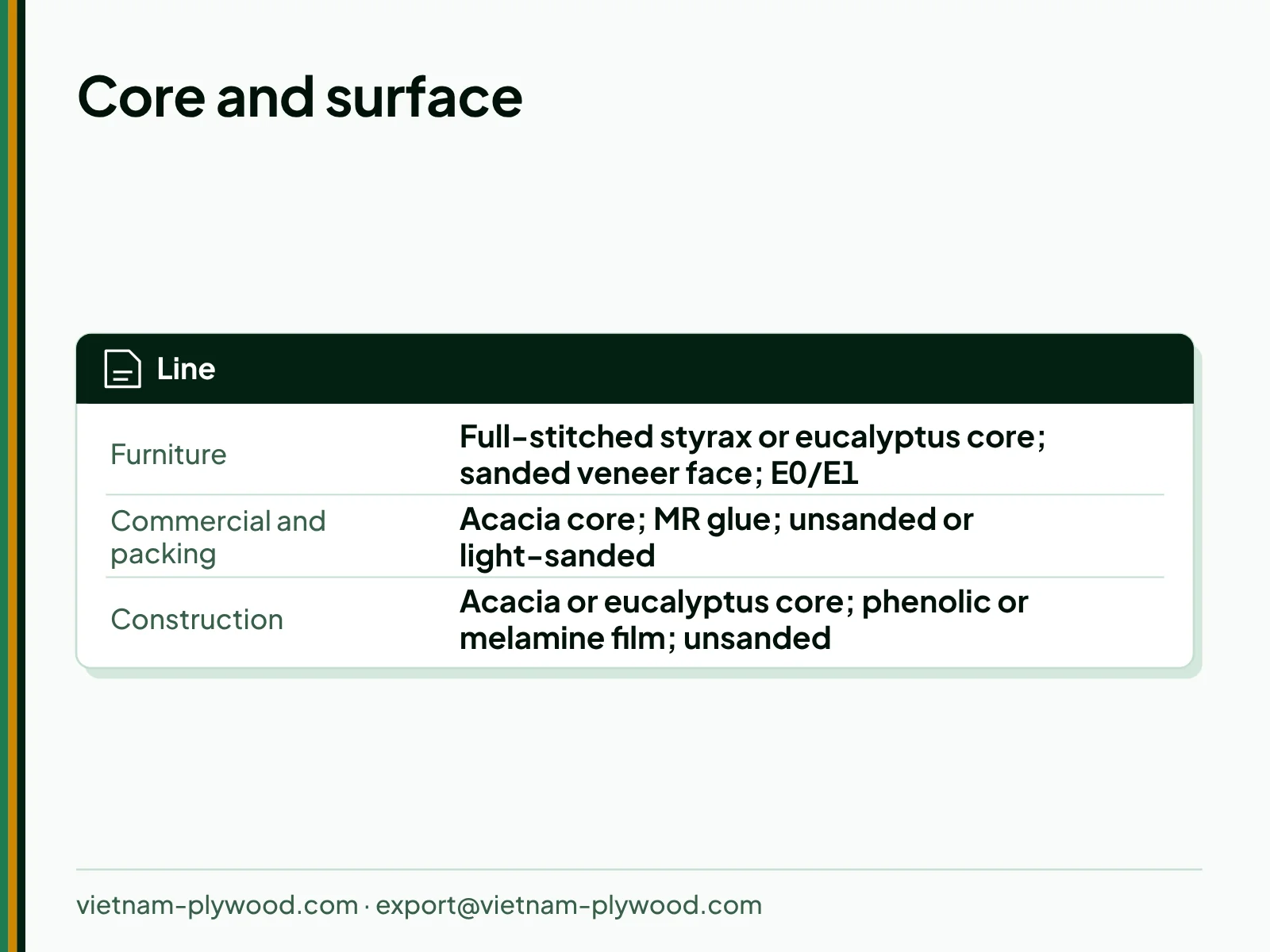
| Line | Core and surface | Typical specification at 18 mm | What it means for this order |
|---|---|---|---|
| Furniture | Full-stitched styrax or eucalyptus core; sanded veneer face; E0/E1 | Finished veneer-faced sheet with ordered ±0.2 or ±0.3 mm tolerance | Discuss phenolic-glued marine-type requirements and accepted test report |
| Commercial and packing | Acacia core; MR glue; unsanded or light-sanded | Commercial ±0.5 mm or packing ±0.5–1.0 mm | Different packing or general-purpose product, not the specified WBP build |
| Construction | Acacia or eucalyptus core; phenolic or melamine film; unsanded | Film-faced sheet at ±0.5 mm | Formwork-facing product rather than decorative marine veneer |
The furniture face choices include okoume, bintangor, gurjan, pine, poplar, eucalyptus, birch, sapele and engineered veneer (EV). Face veneer is commonly 0.2–0.4 mm; the core species controls the density. Standard face grades are A/B, while birch faces use D/E/F grades. See plywood grades across factory lines for the specification differences.
MR means moisture resistant; the melamine-glue condition is a 12-hour boil. Adhesive type and formaldehyde-emission class are separate order fields. E0, E1 and E2 refer to emission classes, while CARB P2 and TSCA Title VI concern a US emissions limit and third-party certification. A WBP adhesive entry must not be treated as an emission certificate.
What does an 18 mm marine plywood specification contain?
An 18 mm marine plywood order identifies the 18 mm nominal finished thickness, sheet dimensions, sanded tolerance and veneer construction. For the furniture build, 18 mm has 11–13 plies depending on core veneer thickness, which runs 1.4–2.0 mm. The ply count is part of the agreed construction rather than a universal test of marine performance.
A buyer choosing an okoume face can specify a full-stitched styrax or eucalyptus core and a chosen face grade. Okoume-faced plywood describes the outer veneer; it does not establish the species of the inner plies. The same distinction matters for birch-faced and sapele-faced offers. The name of the face is not a substitute for the core schedule.
Specify the end use and any edge treatment required after cutting. Marine plywood 18mm for a cabinet assembly and an 18 mm panel for a boat component can share dimensions while requiring different acceptance evidence. For the latter, use the separate boat-building marine plywood specification discussion.
What is the thickest marine plywood you can order?
The upper end of our plywood thickness range is 40 mm. An order for thick marine plywood at that thickness still needs the veneer construction, bond specification and a test report the buyer accepts before it can be described as marine. The maximum thickness is a manufacturing dimension, not a declaration of compliance with a marine standard.
Where a drawing uses an inch fraction, specify the controlling metric thickness rather than asking for the “thickest available” sheet. For a cut-to-size programme, list every component thickness separately so the order can be allocated to the correct press and finishing sequence.
What makes a panel marine beyond its dimensions?
A marine claim needs an agreed performance basis, including the relevant test report; neither 18 mm thickness nor a phenolic glue description proves it. The British Standards Institution’s BS 1088:2018, published in 2018, addresses marine plywood in standard and lightweight classes and focuses on resistance to biological deterioration and loss of bond strength over time. Its published scope also explains that other end-use requirements can remain outside that standard. See the BSI scope for BS 1088:2018.
For an order referring to BS 1088, identify the edition, acceptance report and panel construction in writing. A buyer should examine whether the report covers the proposed species, glue and build, rather than relying on a product title or a photograph. Our marine-type offer is assessed against a test report the buyer accepts. The marine plywood grades and BS 1088 guide covers the grade question in detail.
What can an inspector check at the producing factory?
An inspector can check finished sheet dimensions, face condition, thickness readings and core construction against the approved order at the producing factory. Start with a marked sample panel and record the measurement locations. Compare the measured finished thickness with the ordered tolerance and the sheet length and width with the ±2 mm dimensional tolerance.
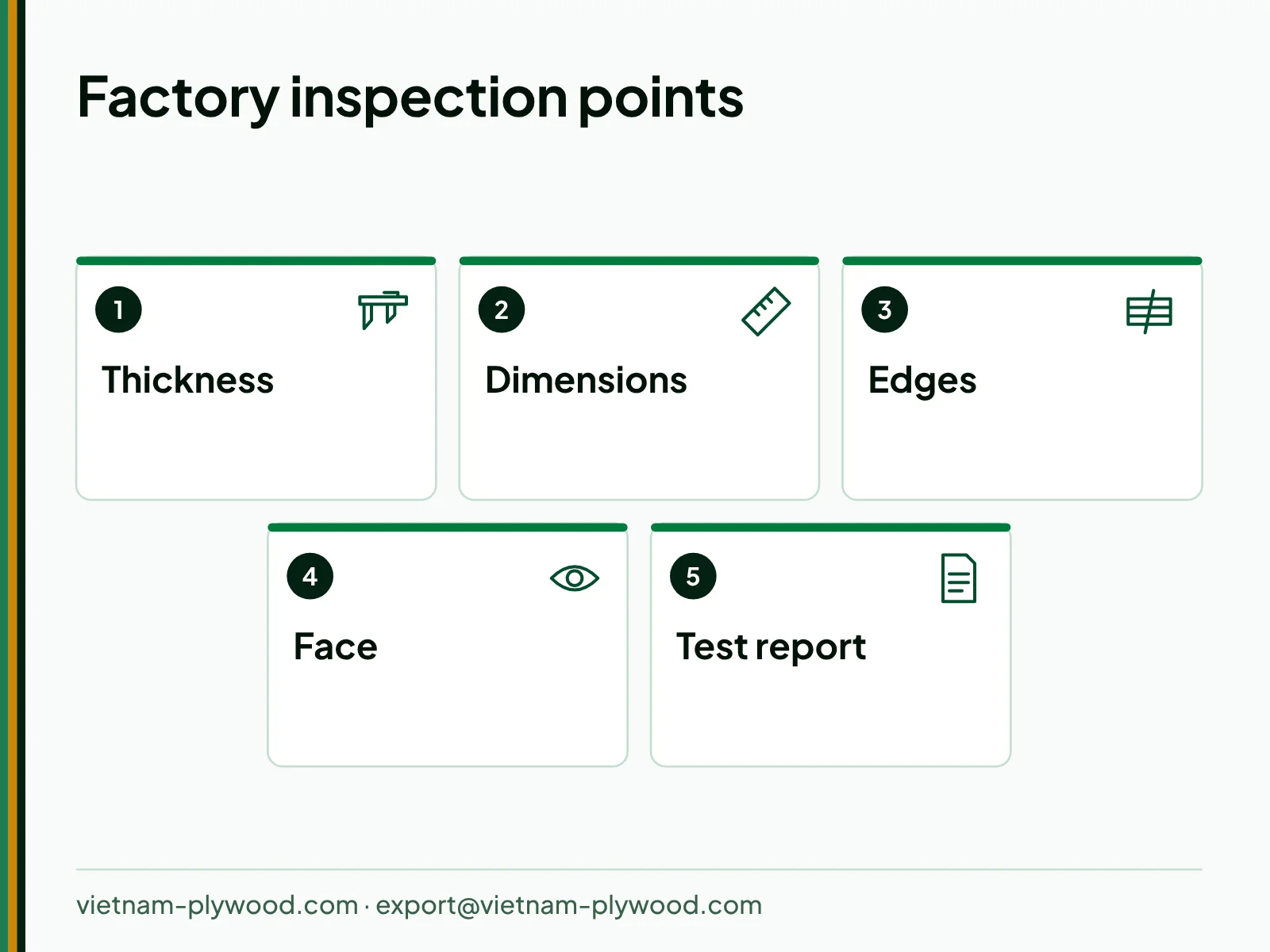
Inspect the edges for visible gaps and verify the agreed full-stitched core construction on representative exposed edges or samples. Review the face grade, sanding condition and veneer identification against the sample set. If the order calls for phenolic WBP glue, match the manufacturing specification and applicable test evidence to that batch.
HCPLY manages the specification, on-site quality control, export documents and loading. Buyers can visit the factory office and inspect goods where they are produced. Factory-specific FSC, CARB P2, ISO 9001 or CE documents and EUTR/EUDR records are shown with factory details masked, on request, where relevant to the order.
How do dimensions change shipping weight?
At 18 × 1220 × 2440 mm, the stated sheet weights are 26.79 kg for styrax, 31.08 kg for acacia and 34.83 kg for eucalyptus core. These differences follow core densities of 500, 580 and 650 kg/m³ respectively. Face selection does not change the density basis used in the loading calculation.
For a full 40HC of that thickness and format, the lookup is 990 styrax sheets (53.05 m³; 26.52 t), 880 acacia sheets (47.15 m³; 27.35 t) or 795 eucalyptus sheets (42.60 m³; 27.69 t). The payload limit is 28.5 t. These are core-based figures without film weight; they illustrate how a change of core alters a loading plan even when thickness stays at 18 mm.
A shipment can mix specifications within the payload limit. Buyers should identify each thickness, core and format on the packing breakdown rather than assume that a mixed load has the same count as a single-specification load. The detailed method belongs to container loads and packing.
How should buyers price and document the order?
A marine-type quotation is built from the written specification, with core construction and accepted test requirements driving the largest technical differences. Full-stitched core construction costs more than stitched outer layers with edge-trimmed inner plies, followed by finger-jointed and loose-laid construction. Face species and grade, sanding tolerance, phenolic bond requirements, thickness, cutting yield and order mix also affect the quotation. Request a quotation for the actual marine-type build rather than applying a general plywood starting price.
The minimum order is one 40HC. Factory lead time runs 15–45 days from receipt of the 30% deposit; the exact figure depends on order size, line loading and what the contract fixes. The balance is 70% against the scanned bill of lading (B/L), by telegraphic transfer (T/T) or irrevocable letter of credit (L/C) at sight. We ship FOB Hai Phong, or CFR (CNF) or CIF to your port.
Each shipment’s document package includes the commercial invoice, packing list, B/L, certificate of origin, phytosanitary and fumigation papers, and agreed certificate or test documents. EU lots also have EUR.1 where applicable and the EUTR/EUDR file set; CIF shipments include insurance. After loading, the draft shipping documents come to you for approval. The packing list records the shipped thicknesses, dimensions and quantities, while the agreed test report supports the marine claim.
For broader factory and export information, see plywood manufacturing in Vietnam and plywood supply for construction projects.
What specification should the buyer send?
Send a dimensioned order schedule and the test-report acceptance criteria together. We can then align the intended use with the correct production line and prepare a sample set for evaluation. Keep every nominal thickness and sheet format in metric units, even when the purchasing team also uses inch or Philippine trade names.
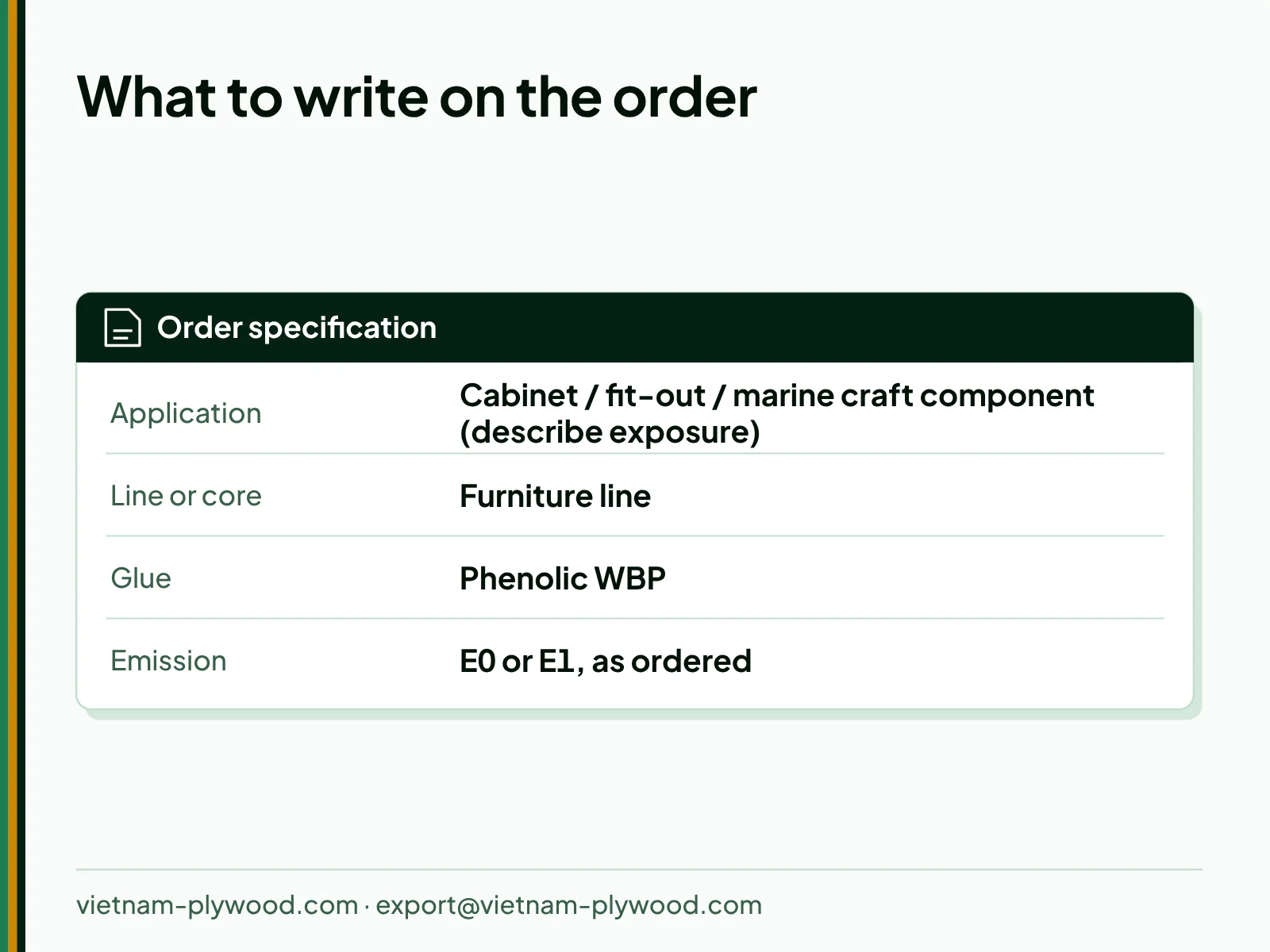
Application: cabinet / fit-out / marine craft component (describe exposure)
Line or core: furniture line; full-stitched styrax or eucalyptus core
Glue: phenolic WBP; agreed marine-type test-report acceptance
Emission: E0 or E1, as ordered
Face and grade: specified veneer species and applicable grade
Thickness and tolerance: 18 mm; sanded ±0.2 mm or ±0.3 mm as ordered
Size: 1220 × 2440 mm; length and width ±2 mm
Quantity: sheet count and specification breakdown; minimum one 40HC
Destination port: named receiving port; agreed FOB/CFR/CIF basis
Ask Lucy at export@vietnam-plywood.com for a sample set through the contact page. Samples cost nothing: a first-time buyer pays the courier, and that charge comes off the first confirmed order.