





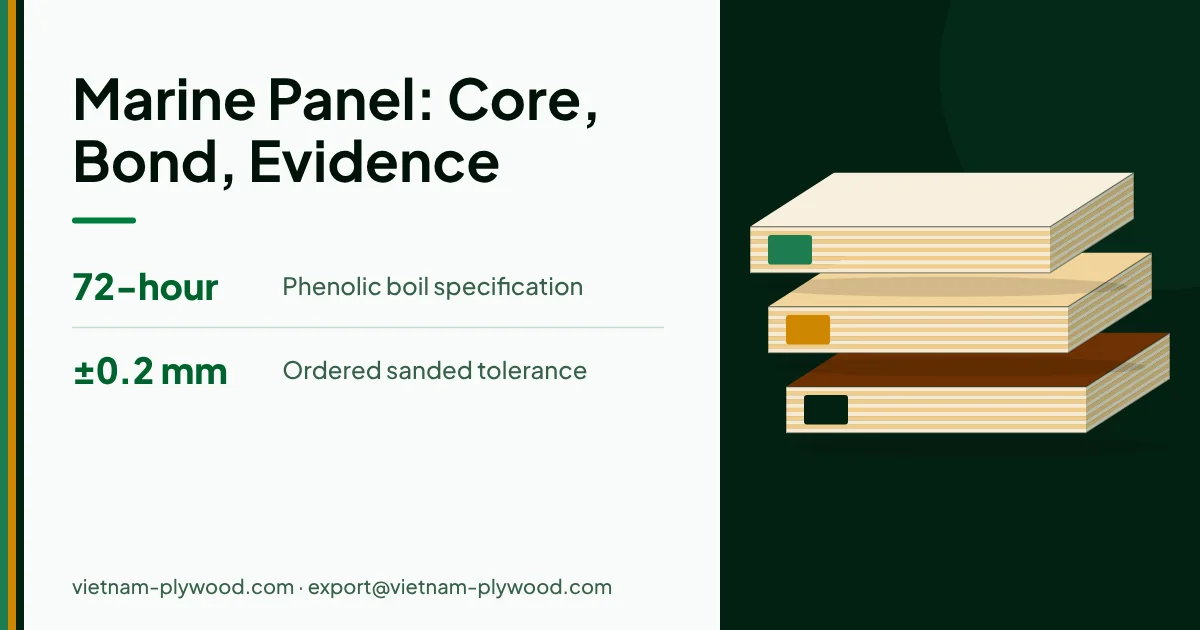
HCPLY approaches marine plywood for boat building through the core layup, phenolic bond and test report a boatyard accepts. A wrong choice can mean rejected panels, costly rework and lost production days. The face veneer alone cannot settle hull, deck or transom suitability.
What is the best marine plywood for boat building?
The best marine plywood for boat building is a panel whose veneer construction, bond durability, dimensional accuracy and documented test results match the boatyard’s drawings. A phenolic-bonded, tightly assembled core is a sensible specification starting point. Hull curvature, deck loads and transom reinforcement still require separate engineering decisions. HCPLY asks for those requirements before proposing a build.
An okoume face does not make the entire sheet okoume or establish structural strength. Name the core, face, bond and accepted test evidence. For a broader procurement sequence, see how to buy marine plywood.
The right panel must also suit the boatyard’s coating system and cutting method. Thin faces can be sanded through during fairing; unsealed edges can admit moisture even when the bond is durable. Agree the finishing allowance and edge treatment before approving production.
Which glue and core should boat building plywood have?
For a wet-service candidate, specify phenolic water-and-boil-proof (WBP) glue and a full stitched core, then require testing against the boatyard’s acceptance criteria. HCPLY’s phenolic system has a 72-hour boil specification and a hot-press range of 130–145 °C. Those production parameters describe the build; they do not independently establish BS 1088 conformity.
Our furniture line uses full stitched styrax or eucalyptus cores and sanded faces, with E0 or E1 emission classes. A marine-oriented enquiry can start with that core construction and request a phenolic-bonded build for technical review. The producing factory must assess the exact combination before a quotation is issued. The standard furniture build must not be mistaken for an approved hull panel.
Core density is 500 kg/m³ for styrax and 650 kg/m³ for eucalyptus; acacia is 580 kg/m³. Density follows the core rather than the face veneer. E0 and E1 describe emissions, whereas WBP describes adhesive bond performance. An emission classification cannot substitute for a wet-bond test.
For plywood boat construction, ask for the layup drawing, veneer joint method and permitted core gaps. A full stitched construction offers a clearer starting specification than finger-jointed or loose-laid cores when the buyer is screening for internal continuity.
How do the three production lines compare?
Our furniture line is the starting point for a sanded, full stitched core enquiry; the other lines build different products for different service conditions. Comparing the same nominal 18 mm sheet exposes differences hidden by the thickness alone.
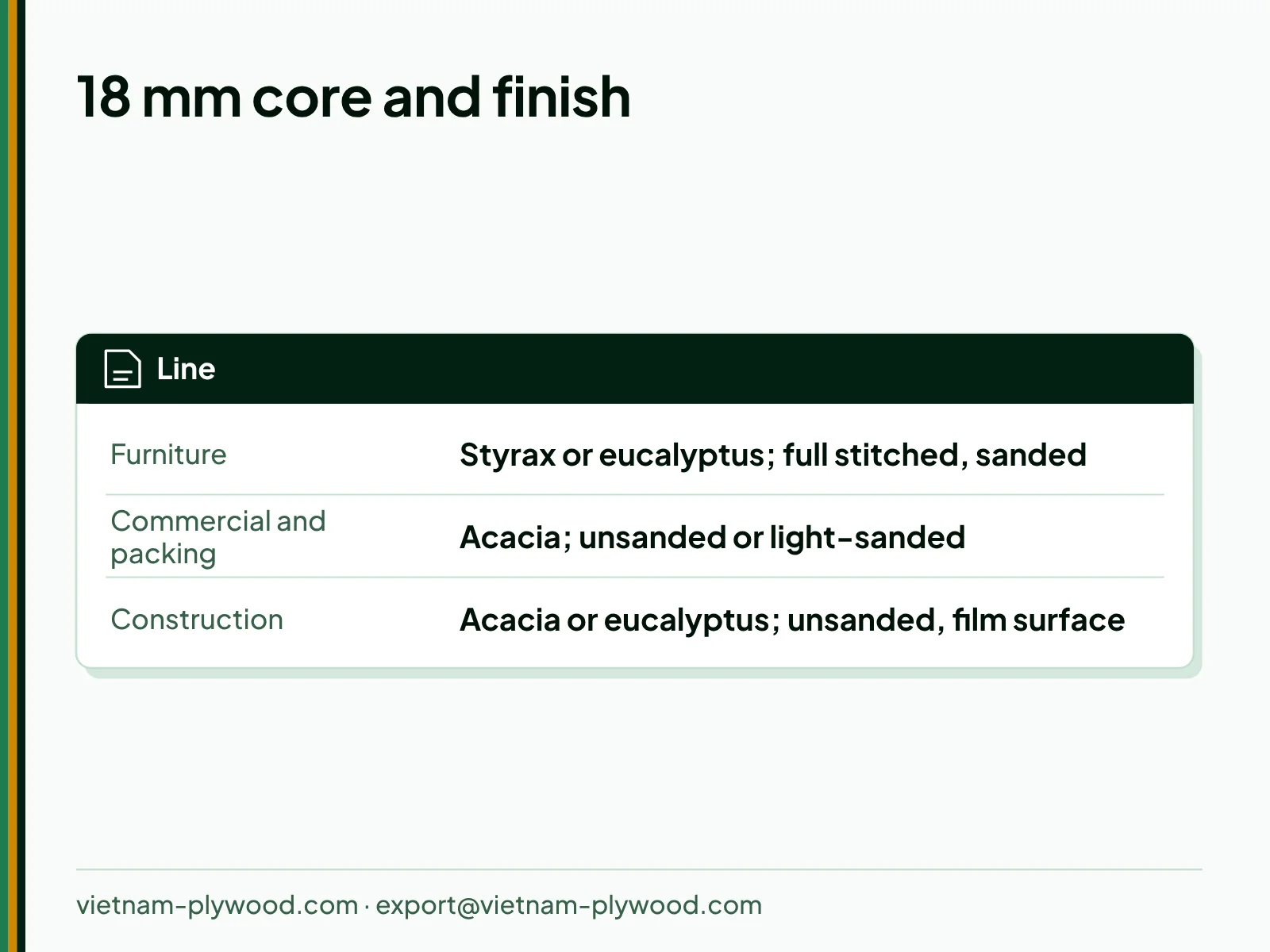
| Line | 18 mm core and finish | Glue or surface | Thickness tolerance | Appropriate purchasing use |
|---|---|---|---|---|
| Furniture | Styrax or eucalyptus; full stitched, sanded | E0/E1 emission class; phenolic build to be specified separately | ±0.2 or ±0.3 mm as ordered | Candidate for boatyard evaluation with agreed test evidence |
| Commercial and packing | Acacia; unsanded or light-sanded | MR glue | ±0.5 mm | Packing and general commercial panels, not a marine substitute |
| Construction | Acacia or eucalyptus; unsanded, film surface | Phenolic or melamine film | ±0.5 mm | Concrete formwork rather than exposed boat joinery |
The commercial and packing plywood specification has a different intended service from a boat hull. Likewise, construction plywood supply is organized around film surfaces and formwork handling. Neither application label establishes a marine test result. A buyer should request a sample of the proposed producing line’s actual layup.
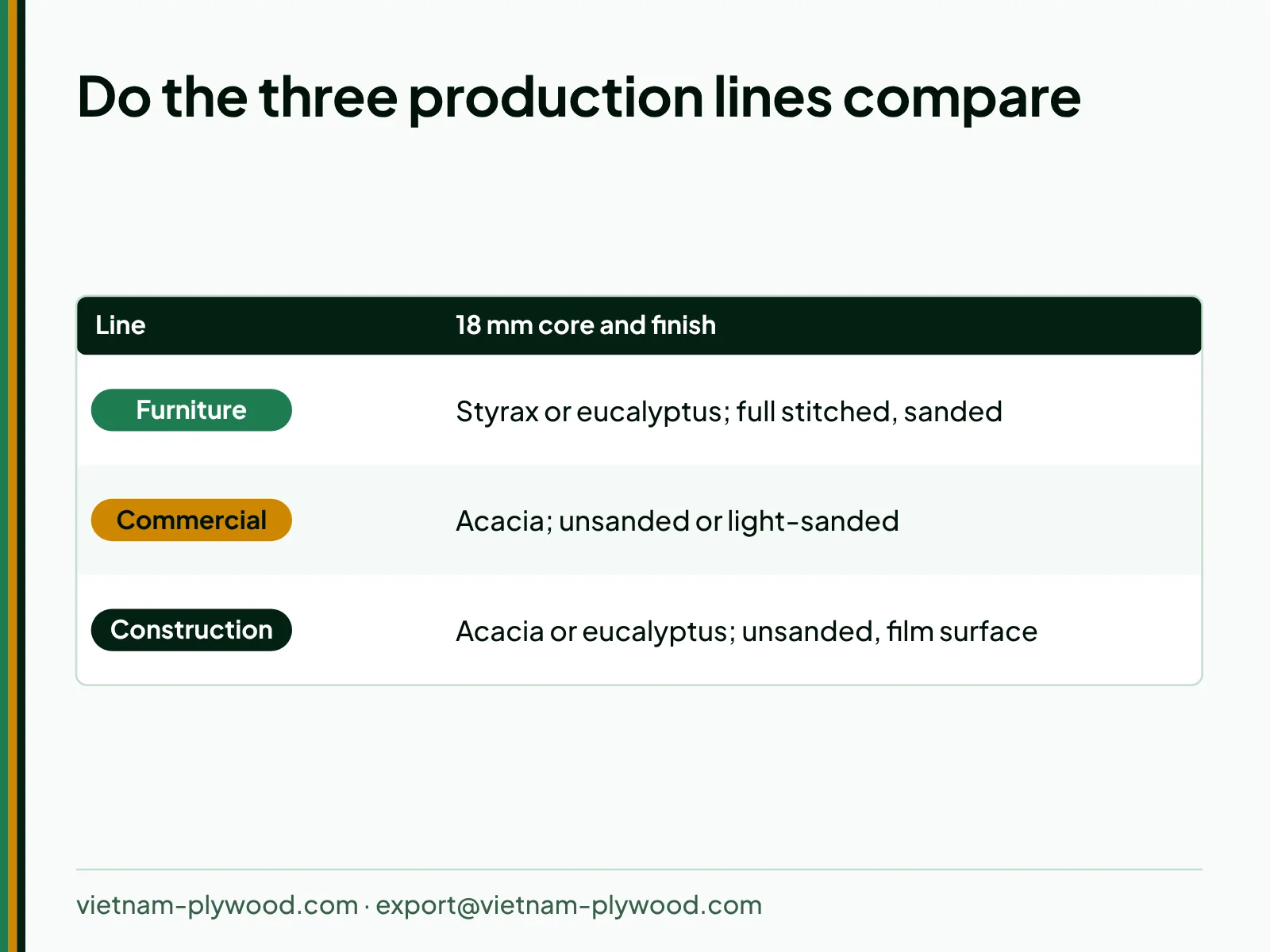
Is okoume or a hardwood face better for hulls, decks and transoms?
Okoume is useful where a boatyard values a workable face and a light appearance, while hardwood faces such as gurjan or sapele offer different appearance and finishing choices. The decisive weight and stiffness figures require the specified core and test data, rather than the face name alone.
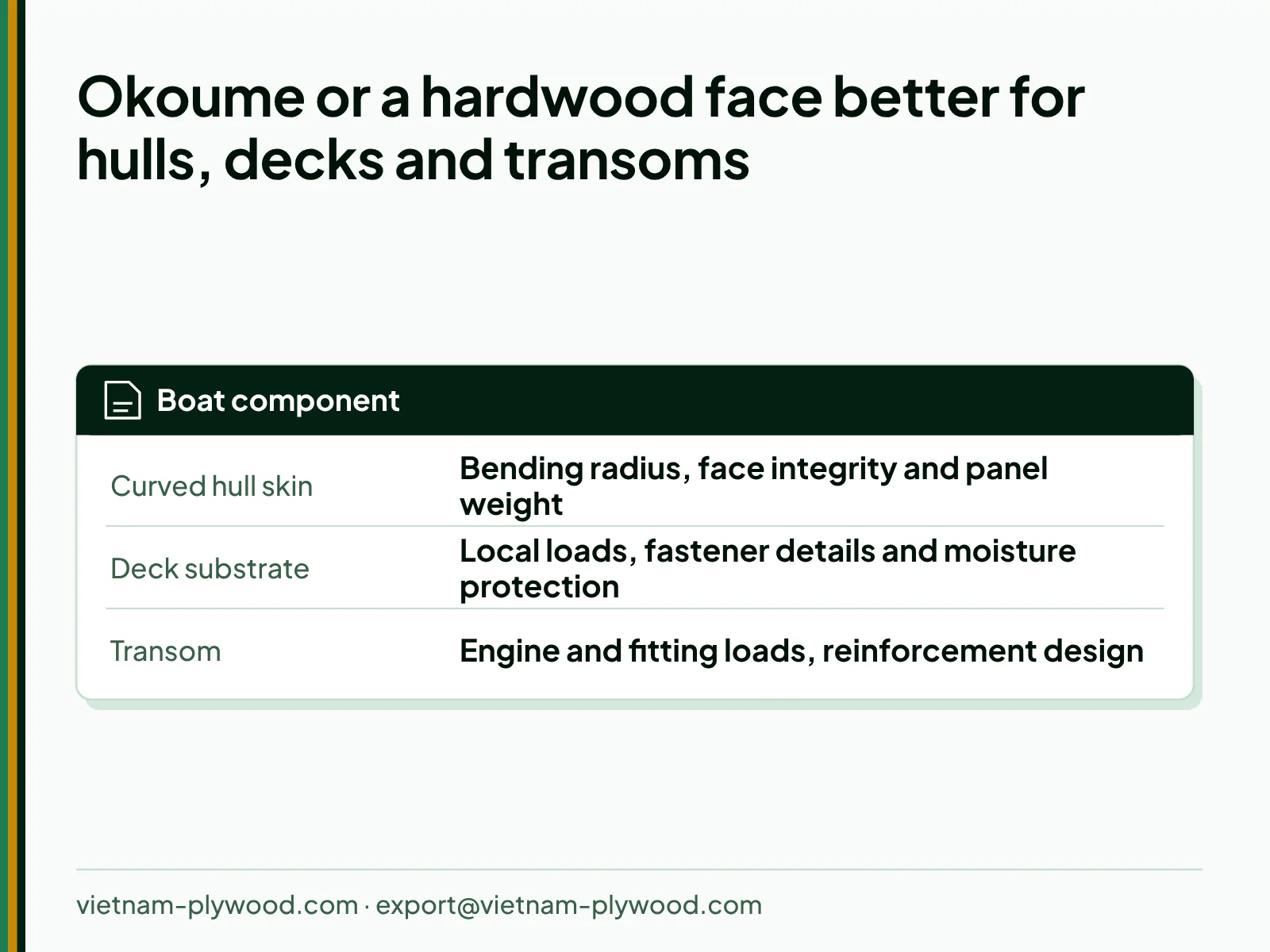
| Boat component | Selection metric | Face choice | Buying verdict |
|---|---|---|---|
| Curved hull skin | Bending radius, face integrity and panel weight | Okoume or specified hardwood | Choose after bend trial and approved laminate schedule |
| Deck substrate | Local loads, fastener details and moisture protection | Hardwood or okoume | Require deck-design stiffness and bond evidence |
| Transom | Engine and fitting loads, reinforcement design | Hardwood or okoume | Obtain structural sign-off; face species cannot certify load capacity |
| Cabin lining | Finish, flatness and coating compatibility | Okoume, sapele or another agreed face | Select by appearance and finish trial |
HCPLY offers okoume, gurjan and sapele among its face choices. The common face veneer thickness is 0.2–0.4 mm, so face appearance must not be treated as the full panel’s species or durability. The core options remain styrax, eucalyptus and acacia. We do not press birch-core plywood.
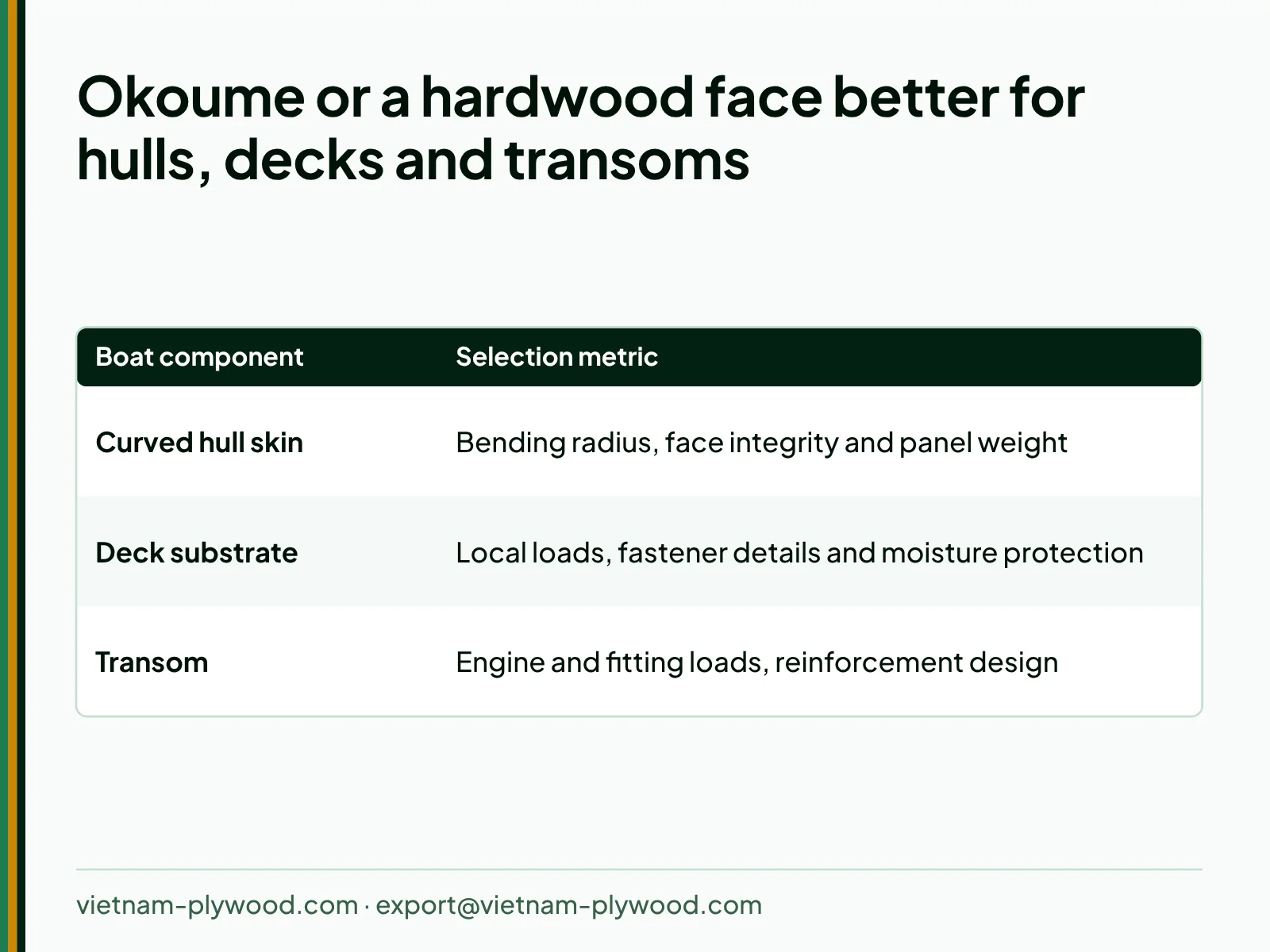
Transoms face concentrated loads and penetrations. The designer sets reinforcement and sealing. For nominal sizes and machining allowances, use the marine plywood thickness and sizes reference.
What does a BS 1088 claim need to show?
A BS 1088 claim needs an applicable test report the buyer accepts, tied to the actual panel construction and production lot. HCPLY does not sell a panel as marine on the strength of a label alone. The British Standards Institution’s 2018 edition, BS 1088:2018, addresses standard and lightweight marine plywood and resistance to biological deterioration and bond-strength loss.
The British Standards Institution states that the standard does not cover every property relevant to a particular end use. That distinction matters for transoms, deck spans and engineered hull skins: a marine classification is separate from the designer’s structural calculations. Ask the laboratory to identify the standard edition and the exact tests performed.
A useful report identifies the panel thickness, species and layup, adhesive system, sampling method, test conditions, results and laboratory identity. Match its product description to the purchase specification and sample identification. A generic certificate for another build cannot establish the requested panel’s performance. Read the BS 1088 grades explanation before setting acceptance language.
Which test report should a boatyard request?
Request a report covering bond durability and veneer construction against the buyer-accepted marine specification, with additional engineering tests where the vessel design requires them. A report should identify the tested sample, method, result and applicable acceptance threshold. Ask for the underlying results rather than a photograph of a stamp.
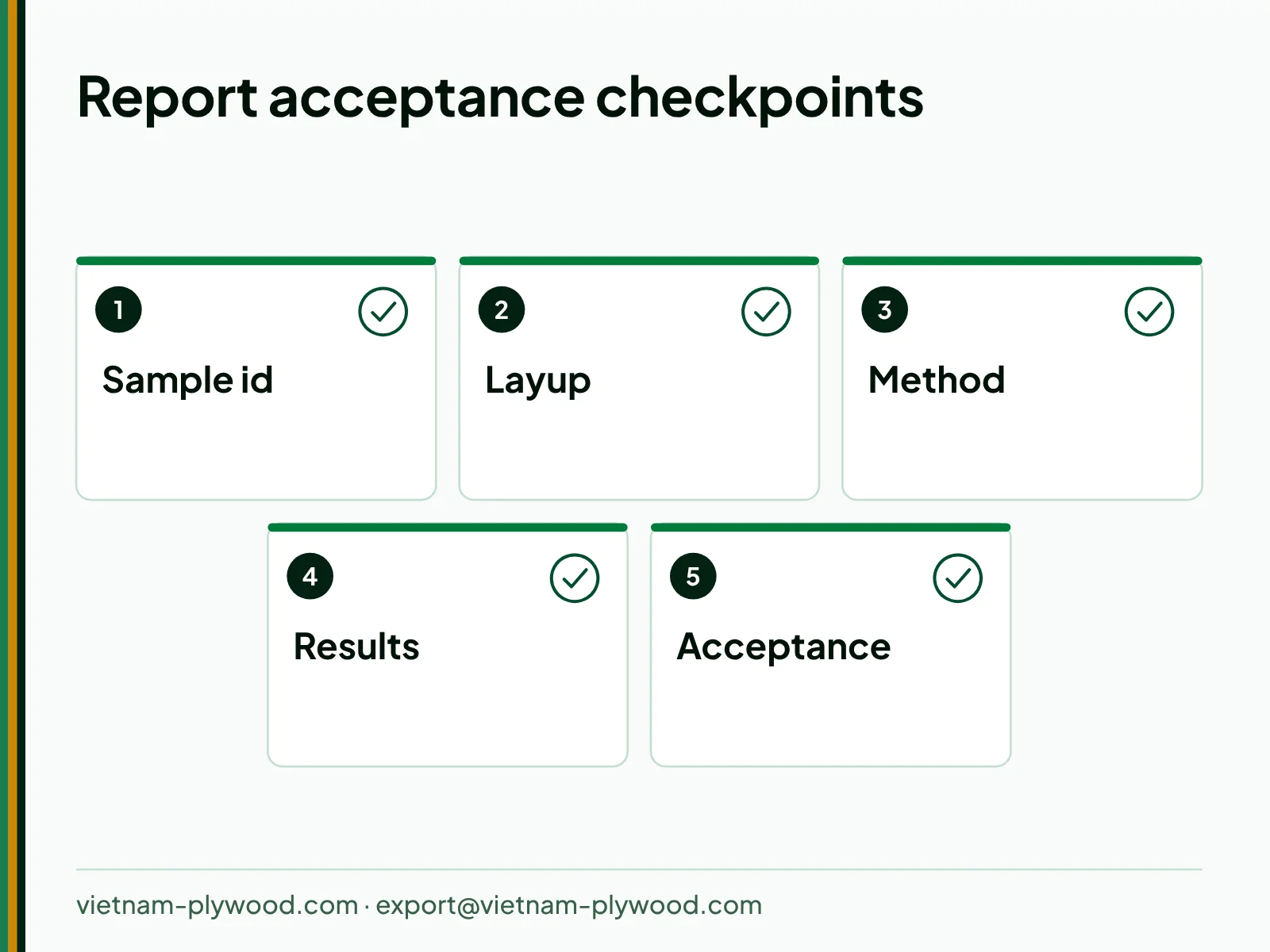
Inspect core gaps, overlaps, joints, repairs, thickness, flatness and edges. Record specimen selection and build identity. Structural parts need designer-selected mechanical evidence.
A practical approval sequence is:
- Send the boatyard’s component schedule, face and core specification, drawing and acceptance standard.
- Agree a sample identification and the independent testing scope before production approval.
- Review the report and any deviations against the written acceptance limits.
- Approve a reference sample and an inspection plan for the producing factory.
- Check the shipment paperwork against the accepted build and lot identification.
Certificates associated with member factories, including FSC, CARB P2, ISO 9001 and CE, are shown with factory details masked, on request. Those documents have different purposes from a boatyard’s agreed marine performance report.
What can an inspector witness at the producing factory?
An inspector can witness core layup, veneer joints, face condition, thickness measurement and identification of samples taken for testing. The check should follow the accepted drawing and inspection plan, with records linked to the shipment lot. Buyers visit the factory office and inspect goods at the producing factory.
At layup, check for missing veneer, overlaps and visible gaps before the press closes the panel. At finishing, measure thickness across agreed points and examine edges for hidden openings. Our furniture line offers sanded thickness tolerances of ±0.2 or ±0.3 mm as ordered; length and width tolerance is ±2 mm. Inspection acceptance should use the values written in the contract.
After pressing, record the selected sheet identifiers and keep the test-sample chain clear. A factory-floor visual check is useful, but laboratory bond results remain a separate requirement. HCPLY manages on-site quality control and the shipment documents through export loading.
Can a marine-oriented order share a 40HC container?
Specifications can be mixed in one 40HC within the 28.5 t payload limit, provided the buyer approves the separate builds. For 18 mm, 1220 × 2440 mm sheets, the reference full loads are 990 styrax-core sheets at 26.52 t, 880 acacia-core sheets at 27.35 t, or 795 eucalyptus-core sheets at 27.69 t. These figures exclude film weight.
Each 18 mm styrax-core sheet weighs 26.79 kg, versus 34.83 kg for eucalyptus core. A mixed booking must calculate weight from each line item rather than adding two full-container counts. For example, 495 styrax-core sheets and 397 eucalyptus-core sheets have a nominal sheet weight of 27,088.56 kg using the stated per-sheet lookup weights; pallet and packaging weights need separate allowance before final loading approval.
The marine-oriented build and a furniture specification can share a shipment only when their individual manufacturing and testing requirements are agreed. For the complete loading method, see container packing calculations.
How should a boatyard specify dimensions and finishing?
Specify finished thickness, tolerance, sheet dimensions, face grade and the finishing process together. HCPLY offers thicknesses from 3–40 mm, with common choices of 3, 5, 9, 12, 15, 18, 21 and 25 mm. A nominal 18 mm panel normally has 11–13 plies, depending on the 1.4–2.0 mm core veneer thickness.
Available sheet formats include 1220 × 2440 mm, 1250 × 2500 mm and 1220 × 2135 mm, with custom cutting available. For visible faces, state A/B grade and the intended coating. For an okoume-faced panel, the face grade must be assessed separately from the internal core construction.
A curved hull panel needs a bend trial. Decks and transoms need component-specific thickness and reinforcement decisions from the boat designer. When specifying a waterproof plywood for boat application, include how every cut edge and penetration will be sealed; waterproof adhesive does not make exposed wood impermeable.
Can a Vietnam manufacturer supply marine plywood for boat building?
A Vietnam manufacturer can produce a proposed boatbuilding panel to a written construction specification and arrange testing against a report the buyer accepts. HCPLY’s three factories in Phu Tho and Hai Phong cover furniture, commercial and packing, and construction production. For a marine-oriented enquiry, start with the furniture line’s full stitched core and specify the phenolic-bonded build for evaluation.
Our furniture and commercial plywood capacity is up to 100 containers a month; construction plywood is up to 140. Factory lead time runs 15–45 days from receipt of the 30% deposit; the exact figure depends on order size, line loading and what the contract fixes. The remaining 70% is paid on the scan of the bill of lading, by T/T, or by irrevocable sight L/C.
The minimum order is one 40HC. We ship FOB Hai Phong, or CFR (CNF) or CIF to your port. Samples cost nothing: a first-time buyer pays the courier, and that charge comes off the first confirmed order. See the Vietnam plywood manufacturer page for the wider production context.
What paperwork should accompany the marine-oriented shipment?
The shipment paperwork should identify the agreed panel build and carry the order’s accepted test reports. The export document set includes a commercial invoice, packing list, bill of lading (B/L), certificate of origin, phytosanitary and fumigation papers, and the order’s certificate documents. Insurance is included under CIF; European Union lots use EUR.1 and the EUTR/EUDR file set.
After loading, the draft shipping documents come to you for approval. Attach the agreed laboratory evidence and sample references to the purchase specification so the importer can trace the accepted construction. The certificate documents may include an FSC claim on sales documents or an emission certificate when relevant to the order.
For this product, price is quoted against face species, full stitched core selection, phenolic bonding, thickness, inspection scope and required test evidence. A tighter tolerance and more demanding sample approval add work compared with a basic commercial panel. Request a written quotation rather than applying an unrelated product’s starting price.
What specification should the importer send?
Send the application and component requirements first, followed by the exact core, face, glue, dimensions and test acceptance criteria. The producing factory assesses the proposed layup against the drawings. Lucy can review the specification at export@vietnam-plywood.com.
Application: Hull / deck / transom / cabin component; drawing and design loads attached
Line or core: Furniture line candidate; full stitched styrax or eucalyptus core
Glue: Phenolic WBP; agreed bond-test method and acceptance report
Emission: E0 or E1, as specified separately from glue
Face and grade: Okoume / gurjan / sapele; A/B; finish requirements
Thickness and tolerance: [mm]; ±0.2 or ±0.3 mm as ordered
Size: [approved sheet dimensions in mm]
Quantity: [sheets / mixed 40HC specification]
Destination port: [port and country]
Marine acceptance: BS 1088:2018 only against a test report the buyer accepts
Inspection: Approved reference sample, sampling plan and lot traceability
Request the marine-oriented plywood specification sheet with your drawings and acceptance requirements.