





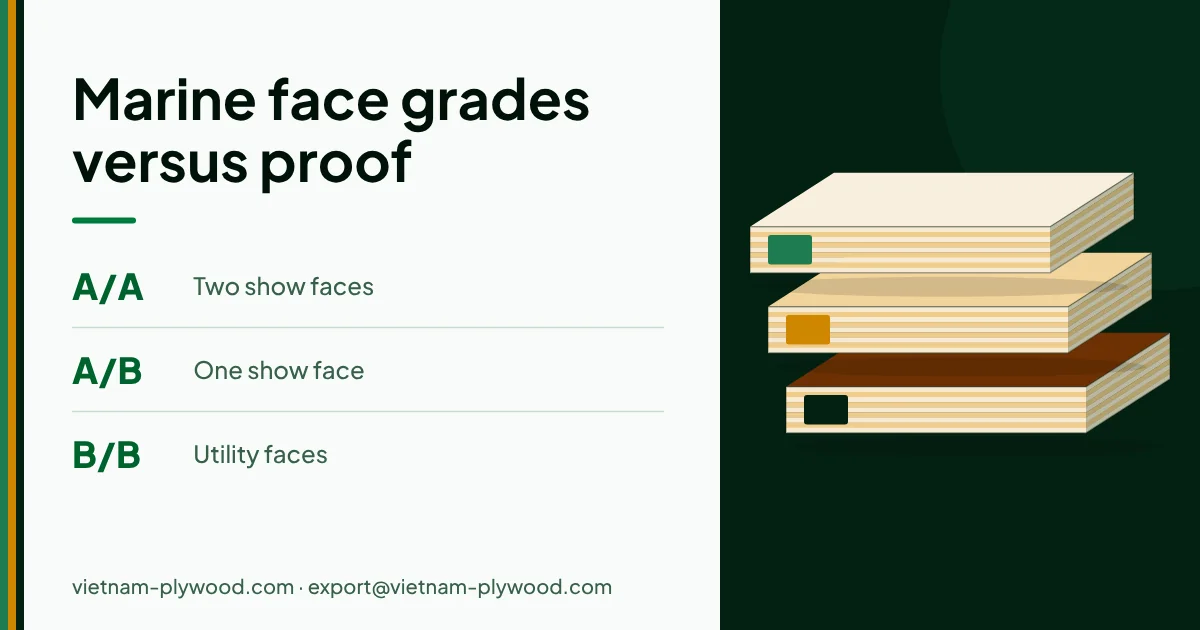
Grades of marine plywood describe visible face quality, while a marine claim needs separate evidence for bonding and core construction. A mistaken grade can cost a rejected load and replacement time. HCPLY recommends specifying both the face letters and the tests a buyer can witness before shipment.
What is marine plywood?
Marine plywood is cross-laminated veneer plywood specified for demanding wet-service applications, with controlled veneer quality, bond durability and core construction. The word “marine” alone does not identify a tested grade. A buyer should define the governing standard, face appearance, core acceptance criteria and bond test before approving production.
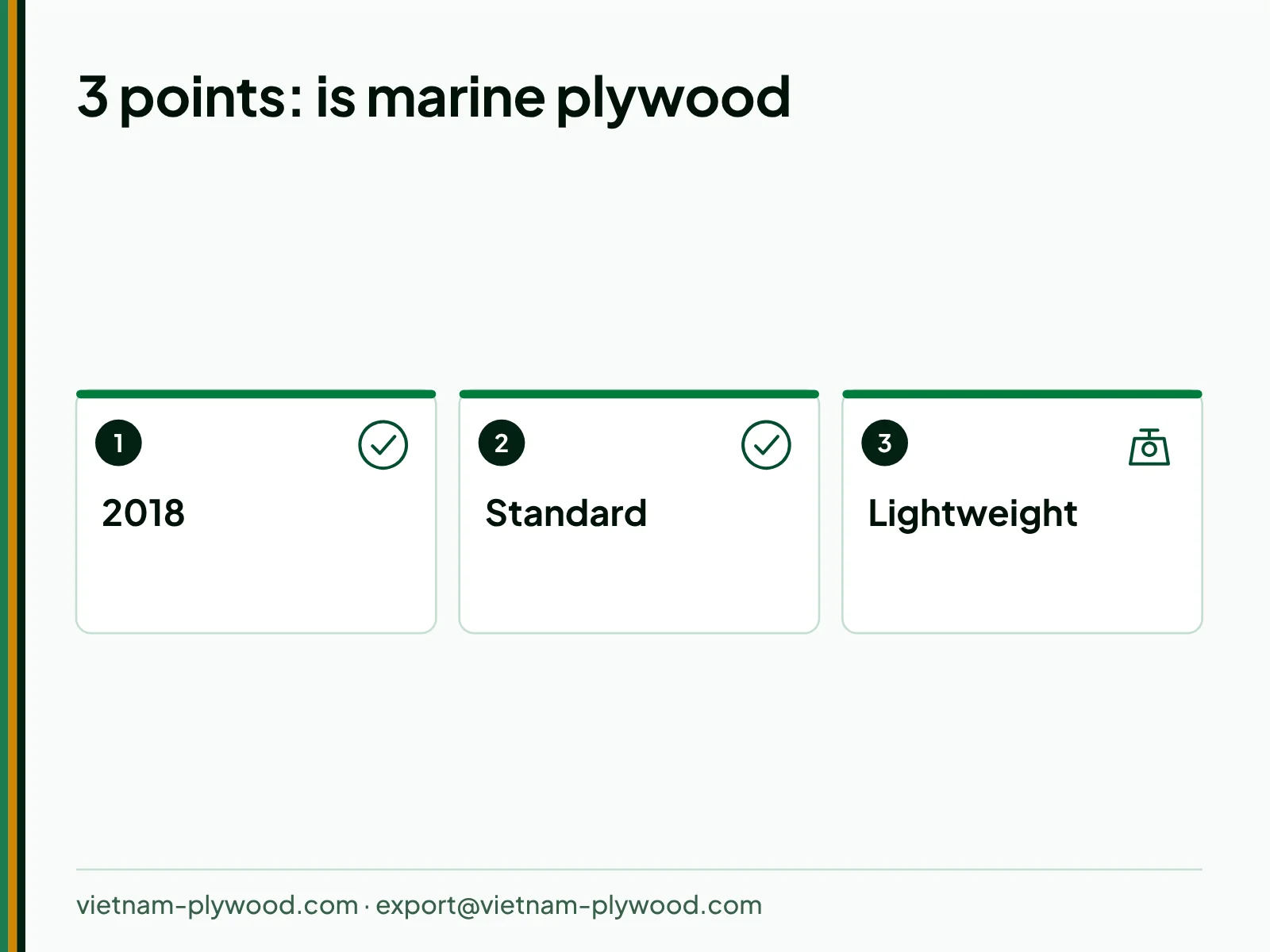
For a wider purchasing sequence, start with how to buy marine plywood. The face is visible at delivery, while internal gaps and adhesive performance need separate inspection. A smooth face cannot establish the quality of hidden veneers. Likewise, a dark glue line is a visual clue rather than a laboratory bond result.
The British Standards Institution (BSI), in its 2018 publication BS 1088:2018, identifies standard and lightweight classes. Its scope addresses resistance to biological deterioration and loss of bond strength over time. Those classes describe a standard’s intended construction; they are different from face letters used on commercial offers.
What are the different grades of marine plywood?
The grades of marine plywood in a quotation often appear as A/A, A/B or B/B, describing the two visible faces. The first letter identifies the face; the second identifies the back. These letter pairs are useful for selecting a finish, but they cannot independently establish marine performance. Ask which grading rules define acceptable knots, repairs and splits.
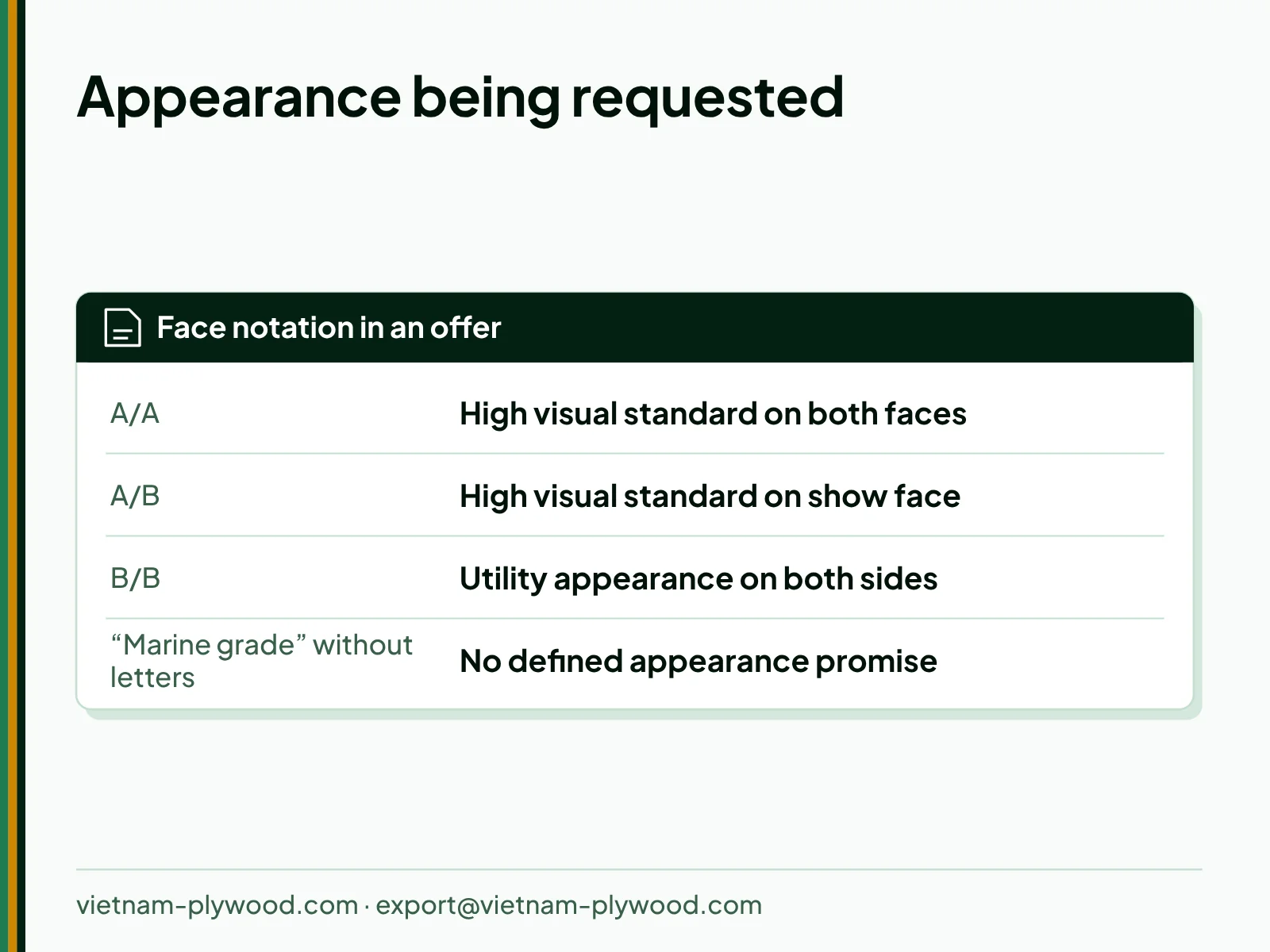
| Face notation in an offer | Appearance being requested | Appropriate purchasing use | Separate proof still needed |
|---|---|---|---|
| A/A | High visual standard on both faces | Exposed joinery on both sides | Bond test, core inspection, species and standard |
| A/B | High visual standard on show face; agreed minor defects on reverse | One-sided visible cabinetry or fit-out | Same tests and acceptance criteria |
| B/B | Utility appearance on both sides, within written B limits | Concealed substrate where appearance is secondary | Same tests; B/B alone does not imply marine compliance |
| “Marine grade” without letters | No defined appearance promise | Hold specification until faces are defined | Named standard and matching test evidence |
A, B and their combinations are commercial face descriptions unless tied to a named grading system. A B/B offer can have a sound bond, while an A/A sheet can fail a bond test. Neither the prettiest face nor the lowest letter combination resolves the entire purchasing decision.
What does each marine face grade letter promise?
An A face requests the cleaner visible veneer; a B face allows the lesser appearance agreed in the purchase specification. The precise defect allowance must be written down because letter systems are not interchangeable across suppliers and standards. Specify allowable repairs, open defects, discoloration and the required finish on both sides.
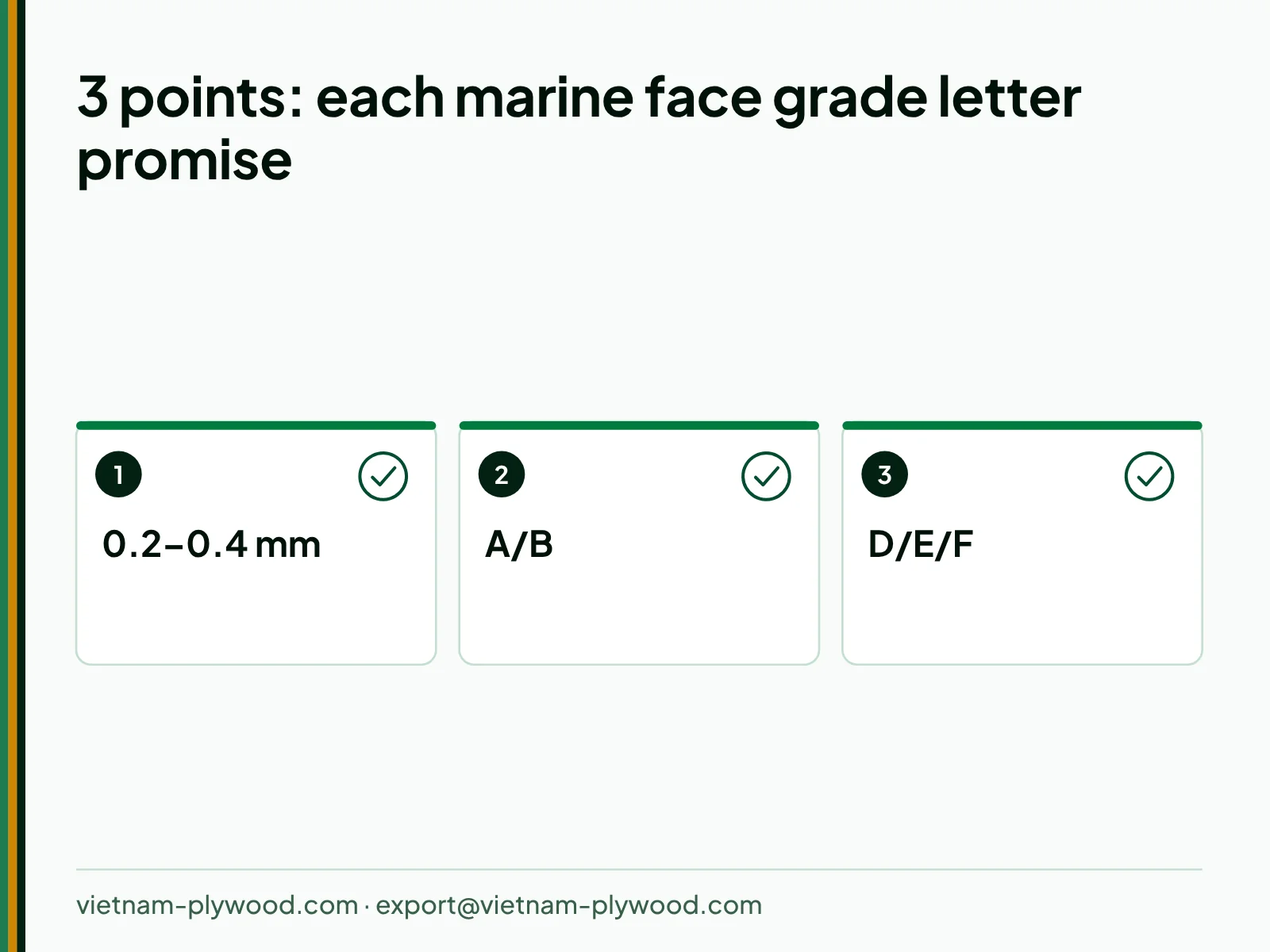
For HCPLY, common decorative face veneers are 0.2–0.4 mm and face grades for relevant veneers are A/B. Birch face descriptions use D/E/F, so a birch-faced quotation should retain that separate naming convention. The panel is named by its face species; core density follows the core rather than the face.
When appearance is critical, ask the producing factory to lay out accepted and rejected face samples beside the order’s signed reference. The inspector can compare both faces under the same lighting, mark visible repairs and photograph panel IDs. Record appearance and marine-performance findings separately.
What properties should marine plywood have?
A marine specification should state bond durability, internal veneer continuity, suitable species, dimensional accuracy and the intended exposure. It should also state which performance values must appear in a laboratory report. A face grade alone gives none of those results.
Moisture-resistant bonding is distinct from a moisture-proof wood surface. Even a durable adhesive does not stop wood from absorbing water through exposed edges. In the BSI 2018 scope, rapid edge wetting is specifically identified as a possible cause of differential core swelling in construction. Seal edges, including newly cut edges, under the project’s coating system.
For design-critical boat components, obtain the designer’s required strength and thickness criteria rather than extrapolating from appearance. See boat-building marine plywood for application considerations and marine plywood thickness and sizes for dimensional selection. A marine label does not replace a structural calculation.
Which factory line builds the requested panel?
The specified construction determines the production route. HCPLY’s furniture line handles full-stitched, sanded styrax- or eucalyptus-core decorative panels; a marine request requires its own agreed build and test report before any marine description is accepted. The other lines serve different applications rather than becoming marine panels through relabelling.
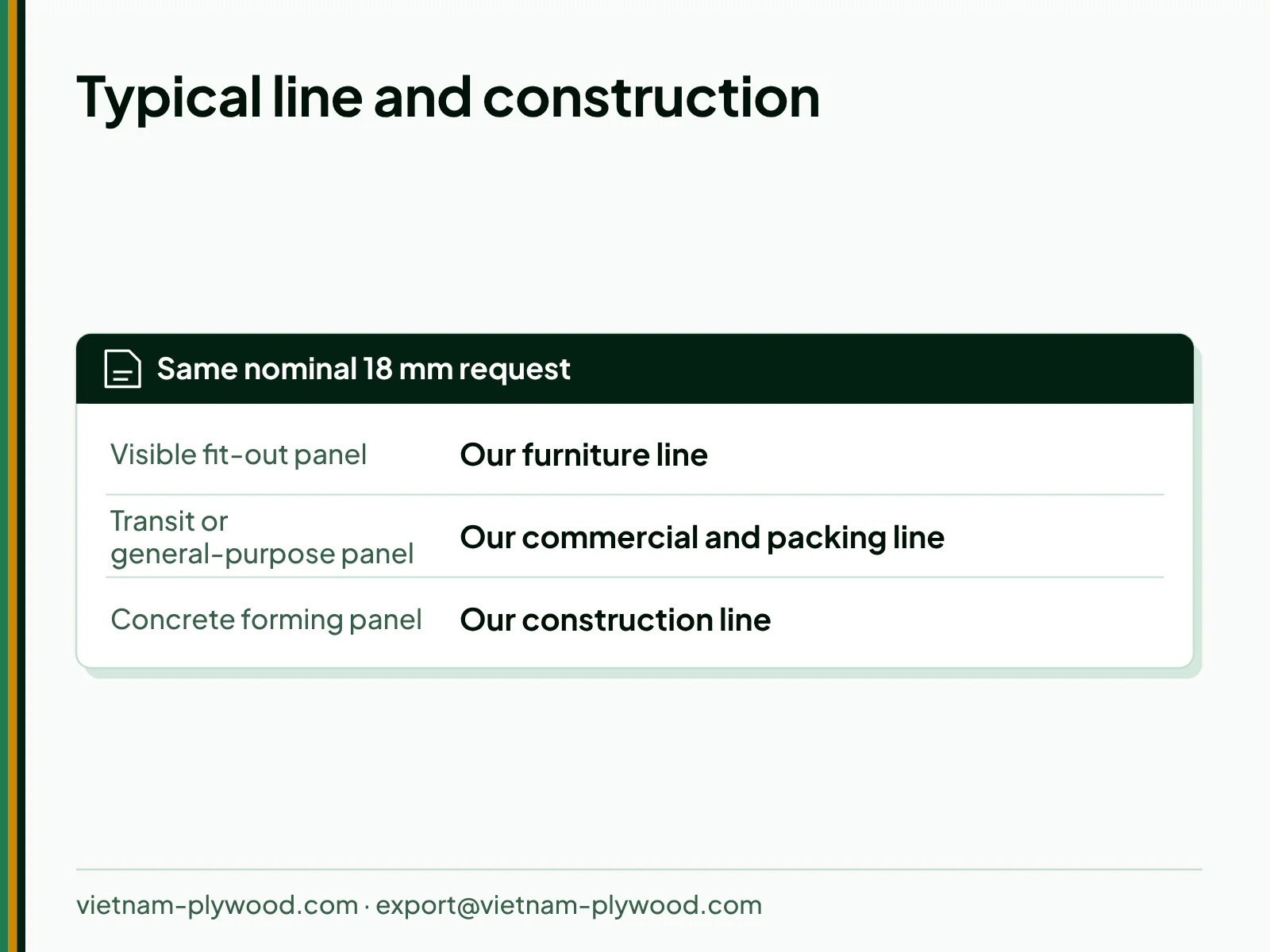
| Same nominal 18 mm request | Typical line and construction | Surface and bonding intent | Buyer verdict |
|---|---|---|---|
| Visible fit-out panel | Our furniture line; styrax or eucalyptus, full stitched and sanded | E0/E1 emission selection; glue specified separately | Evaluate for fit-out; describe as marine only against a test report the buyer accepts for the specified build |
| Transit or general-purpose panel | Our commercial and packing line; acacia core | MR glue, unsanded or light-sanded | Select for commercial or packing duties, not by marine face letters |
| Concrete forming panel | Our construction line; acacia or eucalyptus core | Phenolic or melamine film; unsanded | Select for formwork release and wear, not exposed veneer appearance |
The furniture line’s sanded thickness tolerance is ±0.2 or ±0.3 mm as ordered; commercial and film-faced panels use ±0.5 mm. These are manufacturing tolerances, not marine acceptance thresholds. A buyer should keep the line’s actual build specification distinct from the requested test standard.
Which tests at the producing factory check a marine claim?
A witnessed inspection combines a bond specimen, a destructive cross-section and a face/species check. Each answers a different question; none should be substituted for the others. Agree acceptance and sampling before cutting.
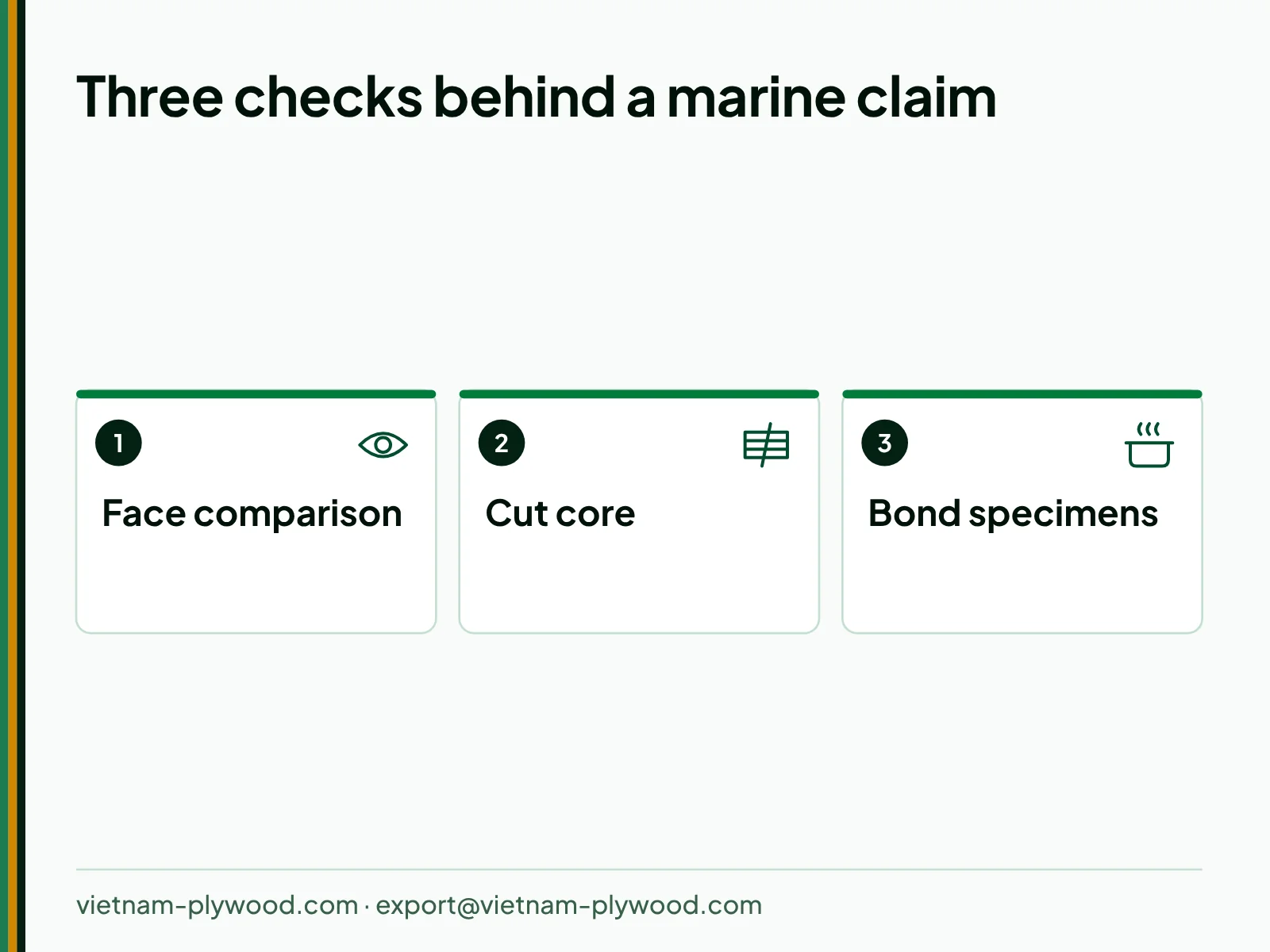
- Trace the lot. Record the order, pallet, production batch, nominal thickness and face species before selecting panels.
- Inspect the faces. Compare the front and back with approved A/B reference samples, then record patches, splits and open defects.
- Cut across the core. Take representative edge and interior sections, photograph veneer joins and measure gaps or overlaps against the agreed marine specification.
- Prepare the bond specimens. Identify the agreed test method and laboratory, witness specimen selection and seal the chain-of-custody record. For a phenolic WBP build, the specified boil category is 72-hour boil; the report must show the actual method and result.
- Check the species declaration. Compare veneer identification and manufacturing records with the written face and core requirement; obtain specialist identification where visual inspection is inconclusive.
- Release against results. Match the laboratory report, sample IDs and accepted defects to the purchase specification before loading approval.
The WBP hot-press range is 130–145 °C. A recorded press setting helps trace production but cannot stand in for a passing test. The buyer or inspector can witness sampling at the producing factory and retain cut-section photographs alongside the report.
How do I identify genuine marine plywood?
Identify it by a matching written standard, traceable specimen results and an inspected core, rather than by a label or surface sheen. Start with the exact standard edition and class on the order. Then compare the report’s species, construction and tested thickness with the shipment.
Reject a generic certificate that describes a different product. Ask whether the test concerns bonding, biological durability, appearance or structural strength; these are separate claims. The 2018 BSI scope says BS 1088 does not cover every property needed for a particular end use, so a project’s additional performance requirements must be specified independently.
At the factory office, buyers can inspect the order specification and agreed report. At the producing factory, they can witness panel selection, core cutting and loading checks. Member-factory FSC, CARB P2, ISO 9001 and CE documents are shown with factory details masked, on request; such documents should be read for their actual scope, not treated as marine test results.
What types of marine plywood are there?
Marine plywood types can be grouped by the governing specification, weight class, face species and intended service. Under BS 1088:2018, standard and lightweight are formal classes; A/A and A/B are face-appearance shorthand in a commercial offer. These two classification axes should remain separate.
Okoume and sapele describe possible face appearances, while the actual core determines panel density. Available faces include okoume, sapele, bintangor, gurjan, pine, poplar, eucalyptus, birch and engineered veneer faces. Available Vietnam cores are styrax 500 kg/m³, acacia 580 kg/m³ and eucalyptus 650 kg/m³. These density figures describe the cores, not a BS 1088 pass or a finished-panel marine classification.
Film-faced formwork is another product family, rather than an appearance grade of marine plywood. Melamine, high-pressure laminate and other laminate faces can be specified in the wider market, but they are not our production lines. Our factories do not press birch-core plywood. For the broader Vietnam plywood manufacturing range, choose the panel family by its application.
How should an importer write the acceptance specification?
Write the standard and edition first, then state the appearance and laboratory acceptance rules. Add a reference panel, core-gap limits from the applicable specification, sample identification method and who signs the inspection record. An undefined “marine rated plywood” description leaves too many decisions until loading.
Keep glue chemistry and emissions in separate fields. The melamine MR category uses a 12-hour boil description; its phenolic WBP category uses a 72-hour boil description. E0, E1 and E2 are emission classes, while CARB P2 / TSCA Title VI refers to a US emissions limit with third-party certification. A bond test cannot establish an emissions class, and an emissions certificate cannot establish marine bonding.
For an order that needs both appearance and moisture durability, ask for the face-grade reference, approved construction drawing and agreed test method on the same specification sheet. The producing factory can then compare sampled boards against those requirements before packaging.
How do core choices affect loading?
Core density changes shipping weight even when face appearance and nominal dimensions stay the same. At 18 mm, 1220 × 2440 mm, the full 40HC figures are 990 sheets / 26.52 t for styrax, 880 sheets / 27.35 t for acacia and 795 sheets / 27.69 t for eucalyptus. These values exclude film weight and use the stated pallet configuration.
The container payload ceiling is 28.5 t. A mixed load can combine specifications within that limit, so the importer should budget by core and panel thickness rather than using a single sheets-per-container assumption. For the calculation method and other thicknesses, see container loads and mixed container loads of plywood.
For repeat replenishment, see plywood supply programmes.
Which paperwork carries the marine test evidence?
The order’s agreed test report carries the marine-performance finding; the packing list identifies the shipped panels and the bill of lading records carriage. Link each test report to its lot and specification reference before shipping documents are approved.
We manage export documentation and loading for orders shipped directly from the relevant factory, with FOB Hai Phong, CFR (CNF) or CIF terms. The shipment set includes the commercial invoice, packing list, bill of lading, certificate of origin, applicable phytosanitary and fumigation papers, insurance under CIF and the order’s certificate documents. EU lots also carry EUR.1 and the EUTR/EUDR file set. After loading, the draft shipping documents come to you for approval.
Attach the grade, species, laboratory method and lot reference to the purchase order.
What should the buyer send for a marine-grade quotation?
A quotation should follow the written construction and test requirement, with the requested face appearance and shipment quantity. Higher-quality face selection and full-stitched core preparation increase material selection and processing compared with a utility-face, less demanding core. Phenolic bonding and added laboratory verification also add work compared with an MR commercial build.
The minimum order is one 40HC, with mixed specifications allowed within payload limits. Production is 15–45 days after the 30% deposit, depending on quantity, production conditions and agreement. The balance is 70% on the scanned bill of lading, by T/T or irrevocable sight L/C. Samples are free; new buyers book their own courier, and its cost can be credited against a real order.
Send Lucy at export@vietnam-plywood.com the specification below. Ask for a sample set with face references and cut-core specimens before approving the production build.
Application: marine-exposed cabinetry / fit-out / boat component (specify)
Line or core: furniture line; styrax or eucalyptus (select)
Glue: phenolic WBP; agreed bond test method and acceptance
Emission: E0 / E1 (select separately)
Face and grade: species; front/back grade and reference sample
Thickness and tolerance: ___ mm; ___ mm
Size: ___ × ___ mm
Quantity: ___ sheets / pallets; one 40HC minimum
Destination port: ___
Standard and evidence: edition, class, test laboratory, sampling plan
Request a marine specification sample set for the proposed build.