





How much does marine plywood price depend on the build?
Marine plywood price starts with the build specification, rather than a universal sheet rate. HCPLY’s dated reference points are commercial plywood from US$250/m³ FOB Hai Phong (October 2026) and furniture plywood from US$350/m³ FOB Hai Phong (October 2026). Neither figure is a BS 1088 marine-panel quotation. Request a separate quotation for the agreed marine-type construction, evidence and shipment terms.
The largest price difference is usually between documented marine-standard construction and an ordinary panel carrying a marine label. Veneer selection, bond durability, core workmanship and independent testing follow. Thickness, dimensions, finish, order volume and freight then change the landed amount. Compare Vietnam plywood export cost components before comparing a port-delivered offer with a factory-port offer.
What separates three products called marine plywood?
The term on a quotation can describe three materially different purchases. The table below ranks their likely specification burden, without assigning an unsupported market premium.
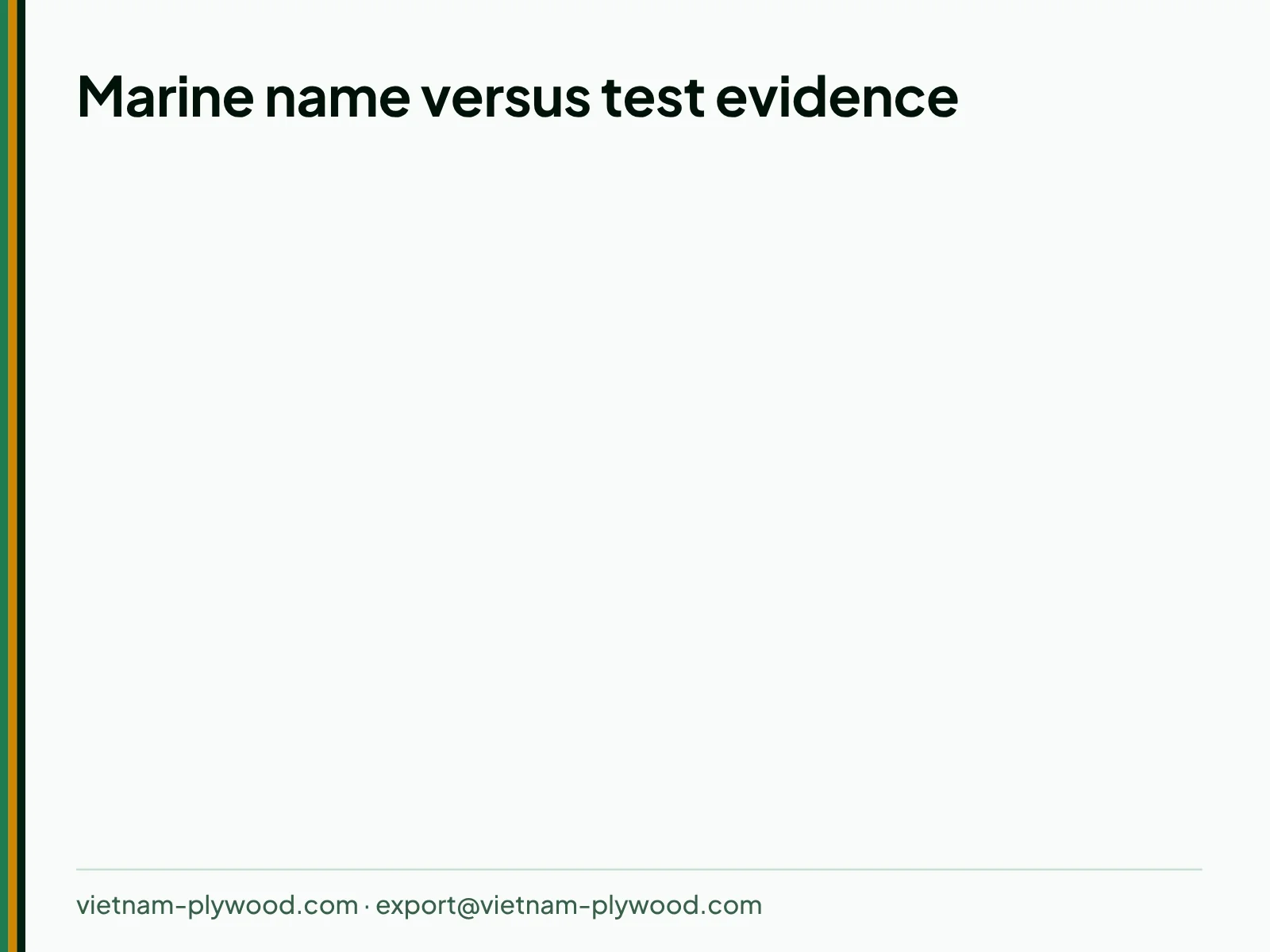
| Metric | BS 1088 panel with accepted report | Phenolic WBP exterior-type panel | Commercial panel relabelled marine |
|---|---|---|---|
| Specified benchmark | BS 1088:2018 and agreed class | Defined exterior-duty build and bond test | Ordinary commercial specification |
| Bond evidence | Report against the agreed BS 1088 requirements | Agreed phenolic bond or boil-test report | MR specification or whatever testing actually accompanies the lot |
| Veneer and core | Species, durability and construction assessed against standard | Veneer species and core quality stated in contract | Commercial core and face grade stated in contract |
| Price position | Highest evidence and selection burden | Intermediate when specification is less demanding | Lowest specification burden, but mislabelling creates rejection risk |
| Verdict by use | Marine craft where BS 1088 is required and accepted | Wet-exposure joinery when the buyer’s design accepts its tested build | Dry commercial or packing work only |
The British Standards Institution’s 2018 BS 1088 scope describes standard and lightweight marine plywood and addresses biological deterioration and loss of bond strength over time. It does not establish every property needed for every end use. See the BSI standard overview. A phenolic glue label alone cannot substitute for that wider assessment.
Why do equal-thickness marine quotes differ?
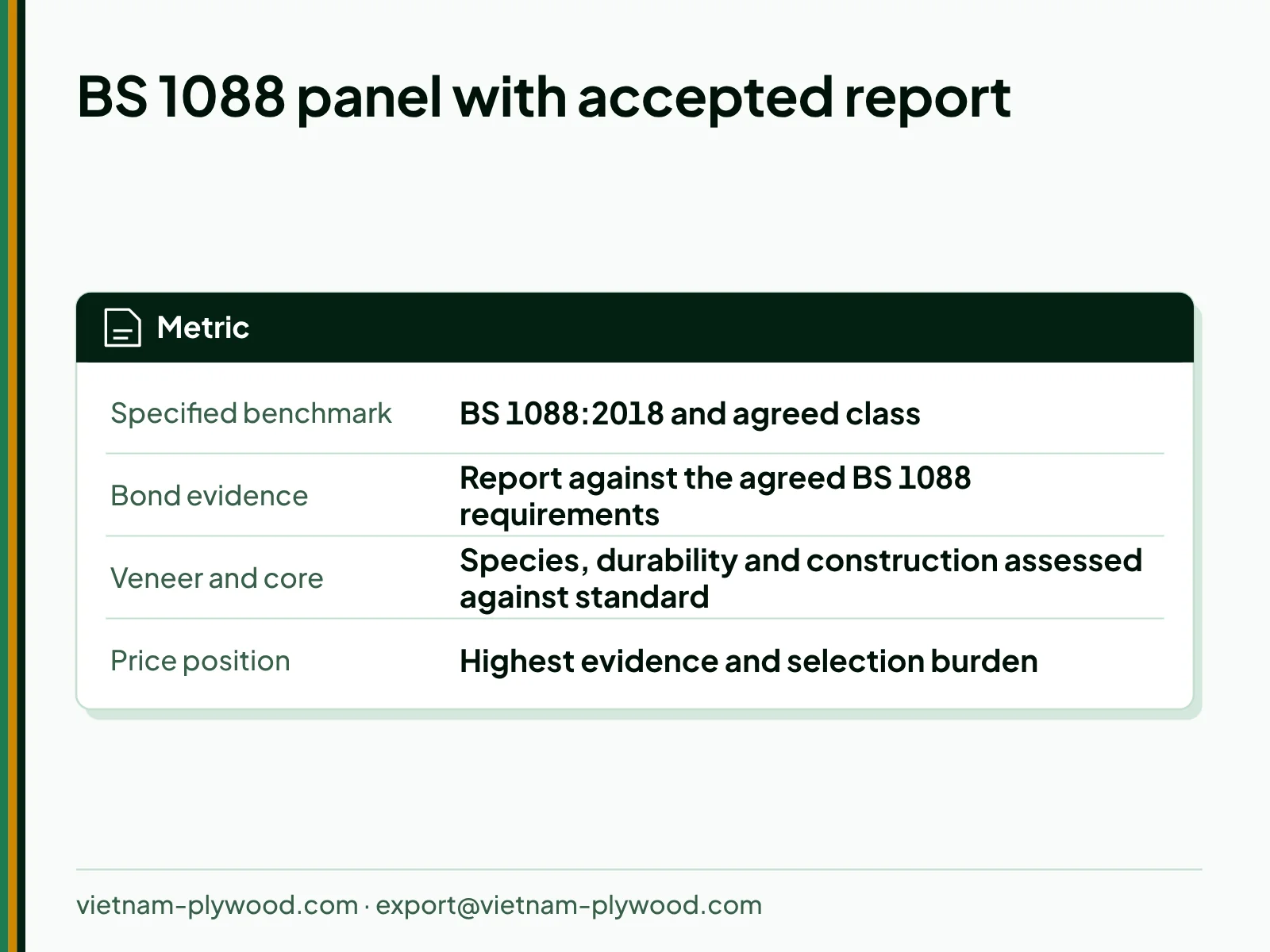
Two 18 mm offers can have different veneer layups, face species, gaps, adhesives and documentation. A supplier quoting a verified standard has to price the agreed panel and evidence; another might be pricing a moisture-resistant commercial sheet. Compare the complete construction before treating the lower number as a saving.
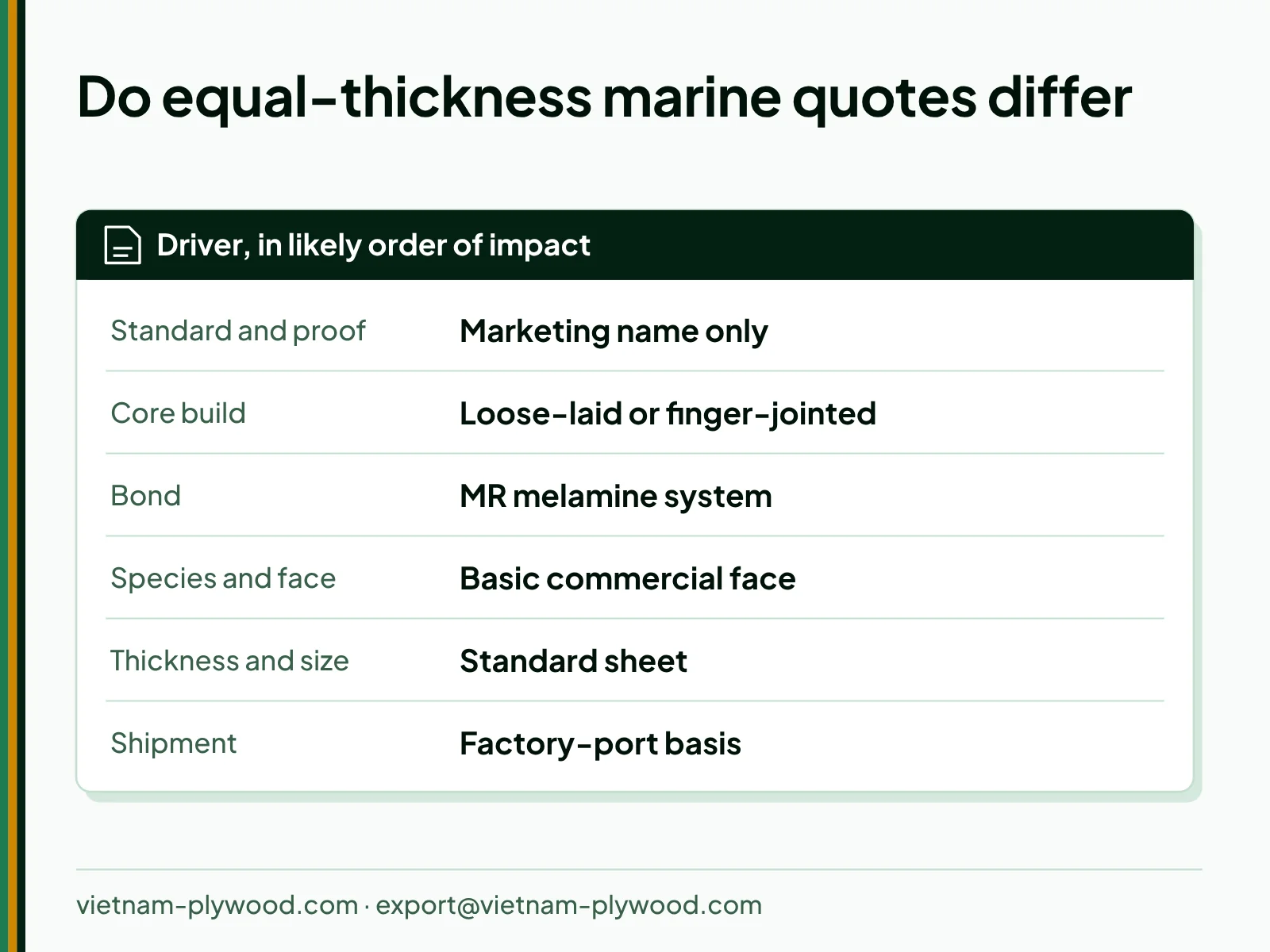
| Driver, in likely order of impact | Lower-specification quotation | Higher-specification quotation | What to request |
|---|---|---|---|
| Standard and proof | Marketing name only | BS 1088 test evidence accepted by buyer | Report, tested scope and traceability |
| Core build | Loose-laid or finger-jointed | Full stitched, selected veneers | Edge sample and layup description |
| Bond | MR melamine system | Phenolic weather-and-boil-proof system | Glue declaration and agreed bond test |
| Species and face | Basic commercial face | Selected okoume or other agreed face | Face grade and species schedule |
| Thickness and size | Standard sheet | Thicker or custom-cut sheet | Dimensions and tolerance |
| Shipment | Factory-port basis | Delivered-port terms | Same Incoterm and destination |
Our core construction ranges from full stitched through stitched outer layers with edge-trimmed inner veneers, finger-jointed and loose-laid. That ordering explains why two superficially similar panels can consume different labour and selected veneer. For a broader comparison, see grades across factory lines.
How do 12 mm, 18 mm and 25 mm prices compare?
A thicker sheet normally consumes more wood and adhesive per sheet when face, size and core stay constant. Price per cubic metre does not rise in the same fixed proportion. Veneer yield, layup, grading and the minimum accepted specification determine the quotation.
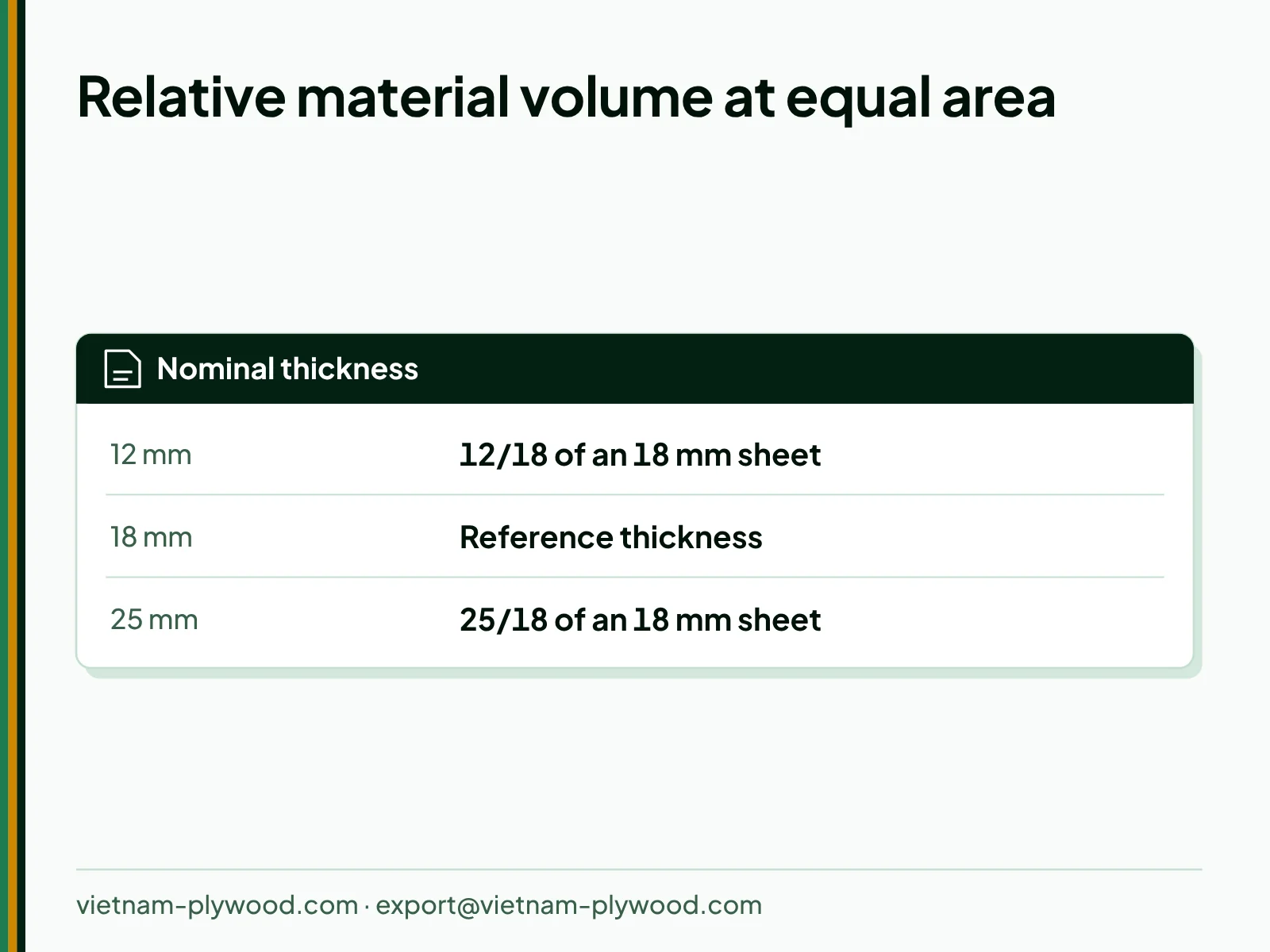
| Nominal thickness | Relative material volume at equal area | Practical quotation check |
|---|---|---|
| 12 mm | 12/18 of an 18 mm sheet | Confirm whether the lighter build meets the application |
| 18 mm | Reference thickness | Compare ply count, core gaps and thickness tolerance |
| 25 mm | 25/18 of an 18 mm sheet | Compare thicker veneer schedule, weight and machining needs |
For 18 mm plywood, our veneer thickness of 1.4–2.0 mm yields 11–13 plies. That is a construction reference, not a BS 1088 declaration. At 1220×2440 mm, an 18 mm acacia-core sheet weighs 31.08 kg before any film. A 12 mm sheet of the same core weighs 20.72 kg and a 25 mm sheet weighs 43.16 kg. The heavier sheet changes handling and container planning as well as the material bill.
For searches phrased marine plywood price 18mm, marine plywood 16mm price or marine plywood price 1/4, specify the exact nominal millimetres first. A quarter-inch request should identify the intended metric thickness rather than assume a particular local stock size.
Which panels can our lines press against a buyer-accepted marine test report?
For marine-type inquiries, our furniture line can be evaluated against a test report the buyer accepts for sanded, full-stitched styrax- or eucalyptus-core panels with E0 or E1 emission classes. Our commercial and packing line presses acacia-core MR panels with unsanded or lightly sanded faces; any marine performance claim requires a test report the buyer accepts. Our construction line presses phenolic- or melamine-film panels on acacia or eucalyptus cores; any marine performance claim requires a test report the buyer accepts. These are different builds, even when the nominal thickness matches.
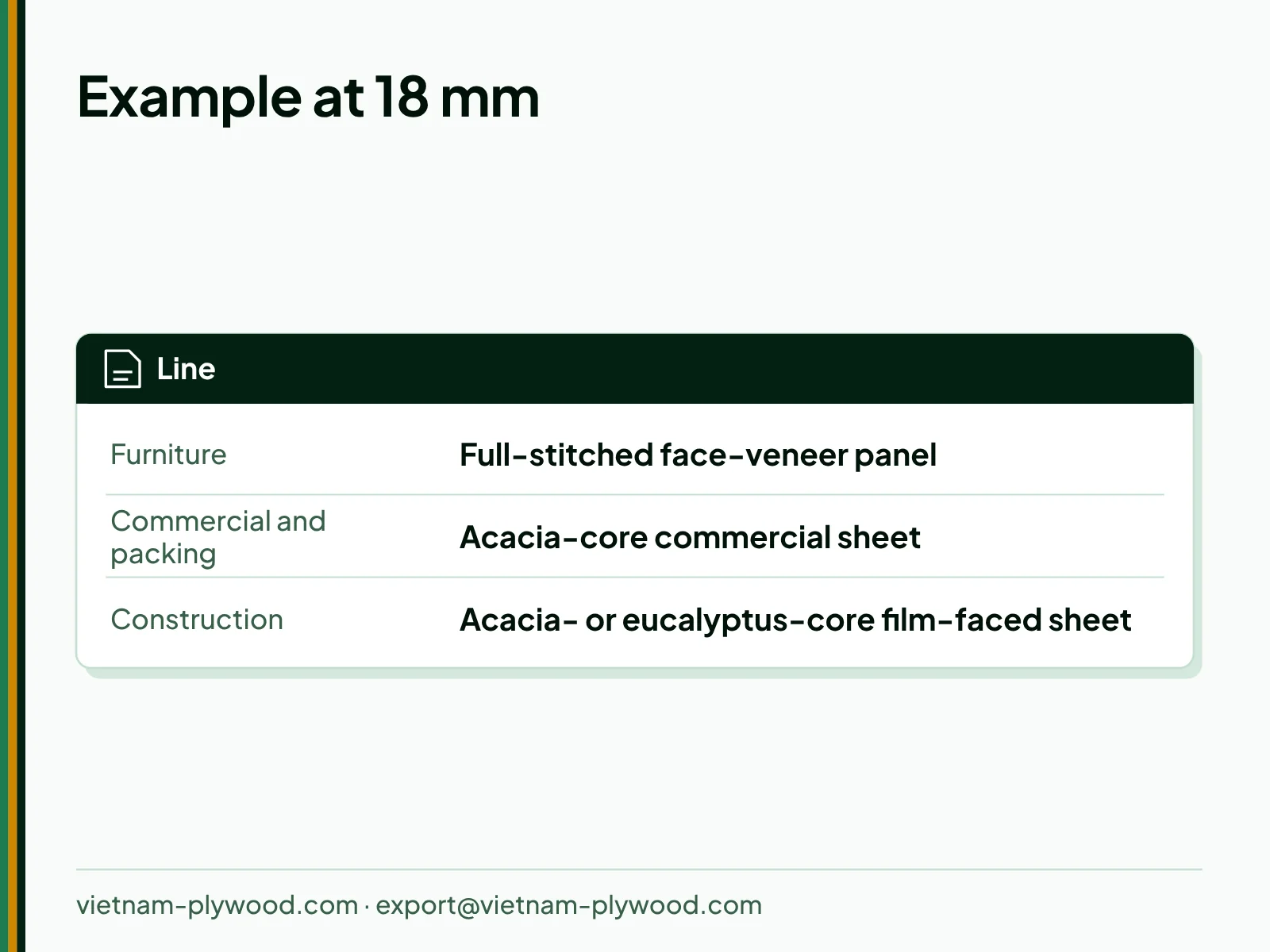
| Line | Example at 18 mm | Bond and finish | Buying verdict |
|---|---|---|---|
| Furniture | Full-stitched face-veneer panel | Sanded; emission specified separately | Cabinet or fit-out work needing a controlled face |
| Commercial and packing | Acacia-core commercial sheet | MR; light-sanded or unsanded | Dry commercial or packing application |
| Construction | Acacia- or eucalyptus-core film-faced sheet | Phenolic or melamine film; unsanded | Formwork surface, not a marine-standard substitute |
For a phenolic-bond exterior-type inquiry, describe the target performance and request a build and test report against the buyer’s accepted criteria. A BS 1088 marine claim is made only against a test report the buyer accepts. An okoume face names the face veneer; it does not mean the whole core is okoume. Our core species are acacia, eucalyptus and styrax.
Which documents prove the grade?
A genuine BS 1088 claim needs an applicable test report against the buyer-accepted standard, matched to the panel construction and lot. A WBP exterior-type claim needs the agreed bond-test evidence and written glue specification. A commercial sheet is identified by its commercial specification and shipment papers, without borrowing a marine label.
Ask for the tested thickness range, face and core description, test method, issue date, reporting laboratory and link between the sample and shipped product. Check that the report covers the ordered construction rather than a different species or adhesive. An invoice saying “marine” is not equivalent to performance evidence.
For export shipments, the document set includes the commercial invoice, packing list, bill of lading, certificate of origin, phytosanitary and fumigation papers, and the order’s agreed test and certificate documents. EU lots also have the EUTR/EUDR file set and EUR.1 certificate of origin; CIF shipments include insurance. After loading, the draft shipping documents come to you for approval. Factory-member FSC, CARB P2, ISO 9001 and CE documents, where applicable, are shown with factory details masked, on request. They address their own scope rather than replacing a marine-performance report.
Is a low-priced marine label really marine?
A low quote alone cannot establish a marine grade. The decisive question is whether the ordered panel has the construction and test evidence that the intended use requires. A commercial board can be appropriate for dry cabinetry while being unsuitable for a specification that explicitly calls for BS 1088.
Start with the written use: boat interior, wet-area cabinet, exterior fixture or dry fit-out. Ask whether the job requires a named standard, a particular bond result, or simply a moisture-tolerant finish. Then compare actual face, core, glue, emission class and tolerances. Glue and emission are separate fields: MR or WBP describes the bond system; E0, E1 and E2 describe emission classes.
A buyer accepting a lower-specification panel should revise the purchase description to match it. Otherwise a discrepancy discovered at incoming inspection can trigger rework, withheld acceptance and replacement freight. Furniture plywood cost factors cover the different priorities of interior joinery.
What can an inspector witness at the producing factory?
An inspector can match the purchase specification to labelled pallets, inspect faces and exposed edges, and measure thickness and dimensions on the ordered lot. For an 18 mm panel, the buyer can examine the veneer arrangement and look for visible core gaps before shipment.
Our furniture sanded thickness tolerance is ±0.2 or ±0.3 mm as ordered; commercial and film-faced panels use ±0.5 mm, while packing panels use ±0.5–1.0 mm. Length and width tolerance is ±2 mm. These are our production specifications, not a claim that they satisfy every marine standard. Specify the applicable acceptance procedure and sample plan in the contract.
The buyer can visit the factory office and inspect goods at the producing factory. We handle specification, on-site quality control, export documents and loading. Physical inspection complements laboratory evidence; neither substitutes for the other.
How does a marine-type order affect container cost?
Core density changes the number of sheets that fit within a container’s weight limit. At 18 mm and 1220×2440 mm, the calculated full 40HC loads are 990 styrax-core sheets at 26.52 t, 880 acacia-core sheets at 27.35 t, or 795 eucalyptus-core sheets at 27.69 t. The 40HC payload limit is 28.5 t.
Those figures are core-based loading references, without film weight. A mixed-specification shipment needs a combined pallet and weight plan; the minimum order is one 40HC, and specifications can be mixed within the payload limit. See container load calculations for the dedicated loading topic.
FOB Hai Phong, CFR (CNF) and CIF are the offered delivery terms. Compare the same delivery basis, destination port and insurance scope before calculating a landed marine ply board price. A quoted sheet price at the factory port and an insured destination-port quotation cover different cost components.
How should buyers specify face, glue and finish?
Face veneer determines the product name, while core determines density. We offer bintangor, okoume, engineered veneer, gurjan, pine, poplar, eucalyptus, birch and sapele faces, as well as unfaced matt core. Common face veneer thickness is 0.2–0.4 mm; face grades are A/B, while birch uses D/E/F.
For a visible cabinet face, define appearance and sanding alongside bond requirements. For a concealed panel, a more expensive decorative veneer may add cost without serving the application. The hardwood face price comparison helps separate appearance decisions from construction decisions.
MR melamine glue has a 12-hour boil specification and phenolic WBP glue a 72-hour boil specification in our production terminology. These factory descriptions do not independently establish compliance with BS 1088. If the job specifies a particular marine test method, name that method and its acceptance criteria in the order.
What belongs on a comparable quotation?
A comparable quotation fixes the use, standard, panel construction, tolerances, evidence and delivery basis before discussing a marine plywood rate. Ask for the same destination and quantity from every bidder. Record whether a quote is for an accepted BS 1088 build, a tested WBP exterior-type panel or a commercial sheet.
HCPLY orders are produced through three member factories in Phu Tho and Hai Phong, with each order made at the line suited to its specification and dispatched from that factory. Furniture and commercial plywood capacity is up to 100 containers a month; construction plywood capacity is up to 140. Production takes 15–45 days from the 30% deposit, set by order size, line loading and the contract. The 70% balance is against the scanned bill of lading by T/T or irrevocable L/C at sight.
Samples are free; new buyers book their own courier and the courier cost can be credited against a real order. For the sequence from specification to loading, see production lead time and Vietnam plywood manufacturing.
What should the purchase specification say?
A purchase specification should state the intended exposure and the evidence required before the factory quotes. Copy the fields below and fill in the actual application and destination. An accepted test report should be part of the agreed inspection conditions when the word marine carries a performance requirement.
Application / exposure: [marine craft / wet-area fit-out / exterior fixture / dry cabinet]
Required standard and accepted test report: [BS 1088:2018 / agreed exterior test / none]
Producing line and core: [furniture / commercial and packing / construction]; [styrax / acacia / eucalyptus]
Glue: [MR melamine / phenolic WBP]; emission class: [E0 / E1 / E2 / agreed requirement]
Face species and grade: [species]; [A/B or birch D/E/F]
Thickness and tolerance: [mm]; [mm]
Sheet size: [length × width in mm]
Quantity: [sheets / m³ / pallets / 40HC]
Delivery basis and destination port: [FOB Hai Phong / CFR / CIF]; [port]
Send this specification to Lucy and plan a trial container against the agreed build and inspection criteria.