





What sets hardwood plywood price?
HCPLY hardwood plywood price follows the entire panel specification: core construction and grade, face and back veneers, adhesive, emission requirement, thickness, tolerance and shipment basis. A thin decorative face can change the appearance without changing the mass of the underlying core. A switch from a utility core to a fully stitched, sanded furniture build changes several operations at once.
We quote the build rather than a species name. A rejected cabinet face, excessive machining allowance or mismatched core can erase a small saving at purchase. Start with the broader Vietnam plywood export cost breakdown when comparing freight and delivery terms alongside panel construction.
A face-specific quote is meaningful only when the competing panels share the same core, face grade, back specification and acceptance checks. This comparison keeps appearance choices separate from structural and processing choices.
Which cost drivers deserve attention first?
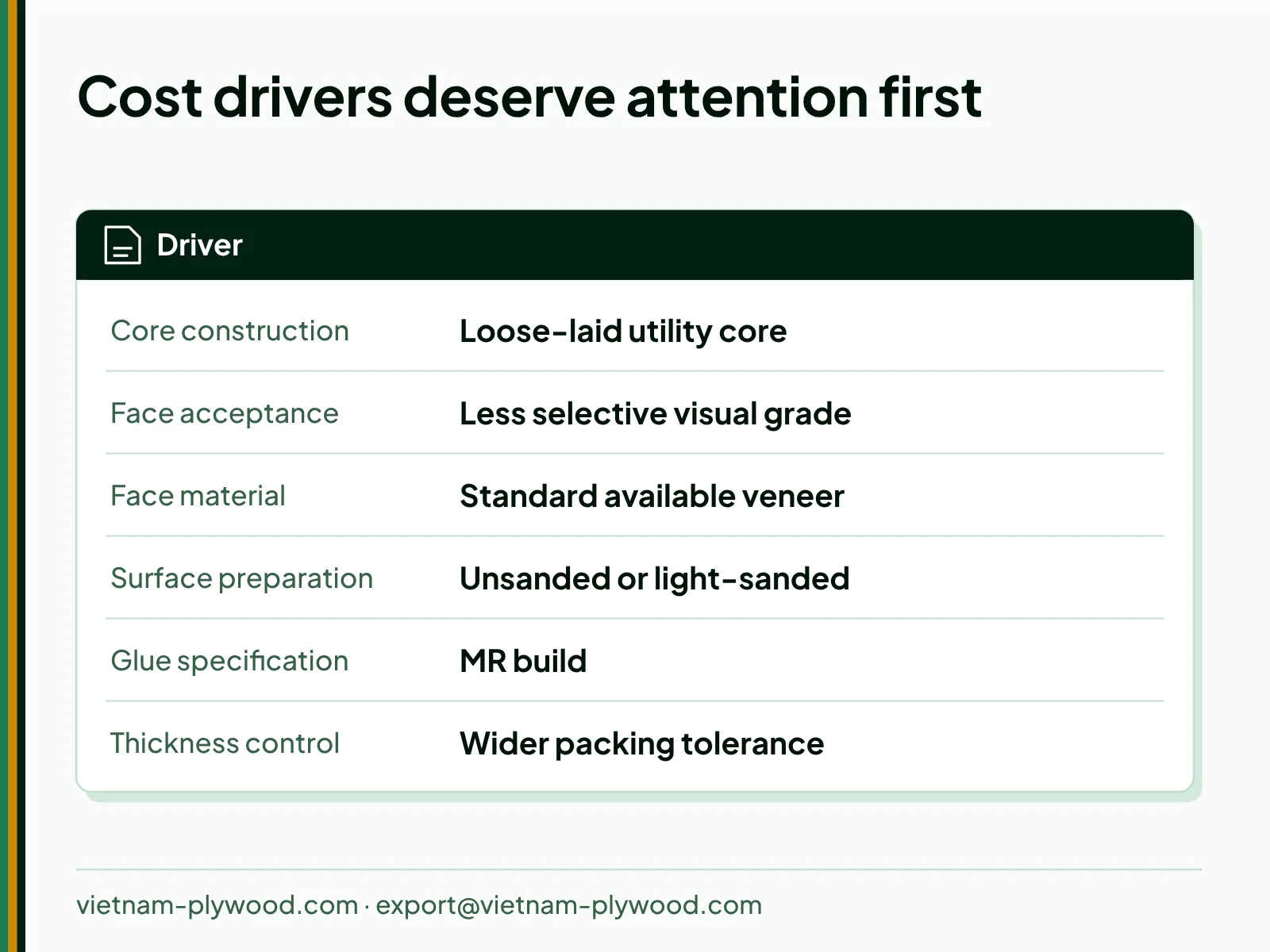
For a furniture order, core construction and grade are usually the first comparison, followed by face grade and veneer selection, adhesive and emission requirements, machining tolerance, then packing and delivery. This is a practical sequence for isolating changes, not a universal percentage breakdown.
| Driver | Lower-cost comparison | Higher-cost comparison | What to hold constant |
|---|---|---|---|
| Core construction | Loose-laid utility core | Full-stitched core | Thickness, size and face |
| Face acceptance | Less selective visual grade | Selected A/B appearance | Core, back and veneer thickness |
| Face material | Standard available veneer | More selective or scarce veneer | Grade and face thickness |
| Surface preparation | Unsanded or light-sanded | Sanded furniture surface | Core and dimensions |
| Glue specification | MR build | WBP phenolic build | End use and test basis |
| Thickness control | Wider packing tolerance | Ordered furniture tolerance | Nominal thickness |
| Delivery basis | FOB Hai Phong | CFR or CIF | Port and cargo specification |
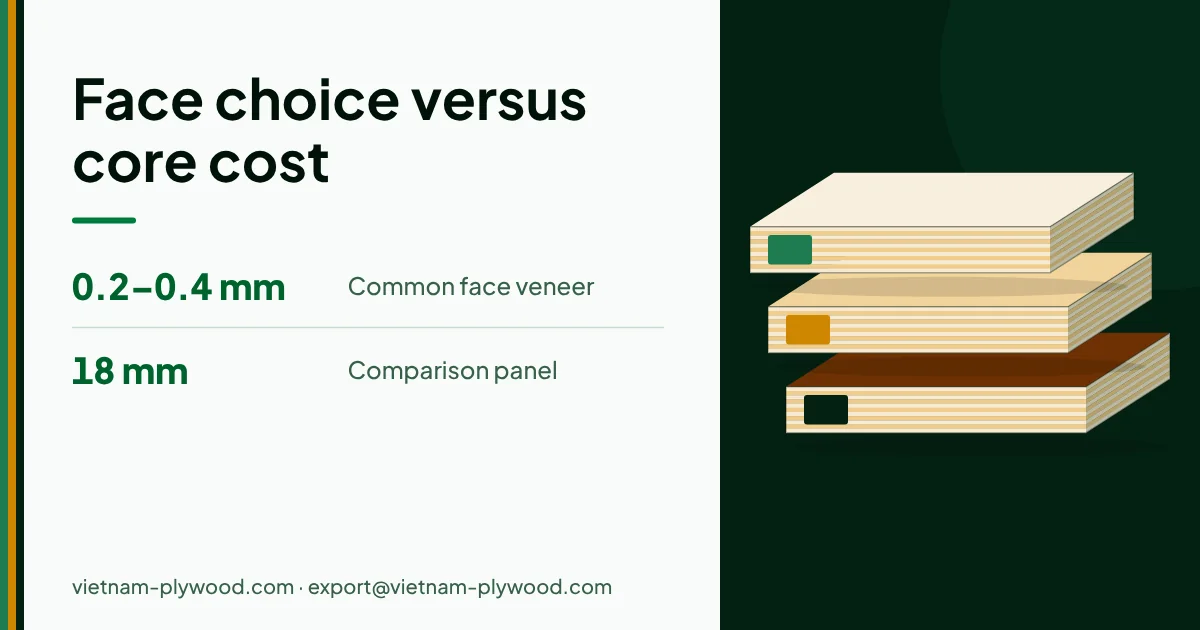
Face veneer commonly measures 0.2–0.4 mm; the core accounts for most panel thickness. Compare full-stitched with stitched outer layers and edge-trimmed inner layers, finger-jointed and loose-laid constructions in that quality order. The plywood manufacturer in Vietnam overview explains the product families behind these order lines.
How do okoume, bintangor, poplar, birch and EV faces rank?
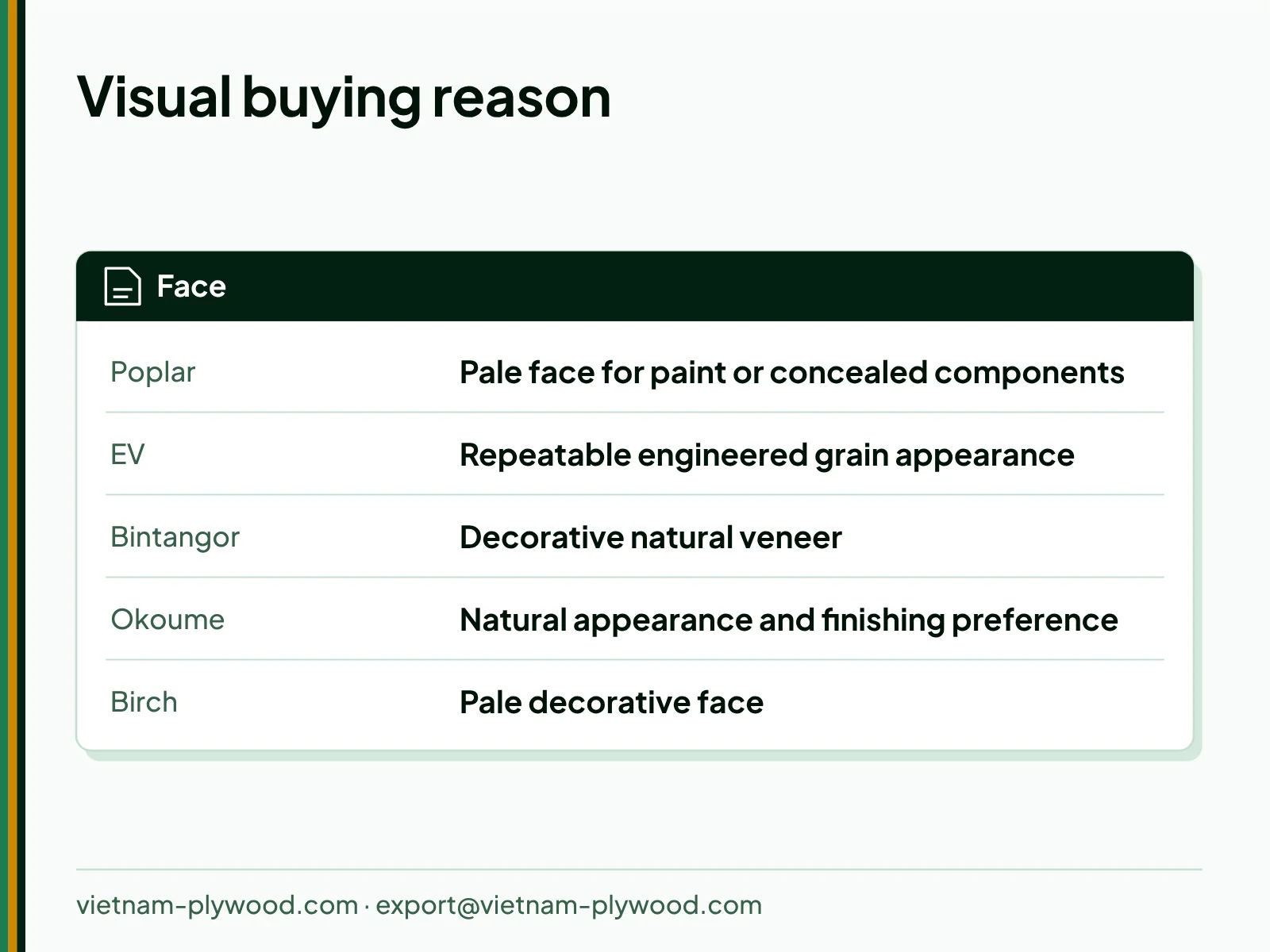
There is no defensible fixed price ladder for these faces without a shared quotation date, grade and core. Poplar and engineered veneer (EV) can be evaluated as appearance alternatives; okoume, bintangor and birch should be compared on matching A/B acceptance where applicable. Birch face grades on our specification are D/E/F, so a direct A/B label comparison would be misleading.
| Face | Visual buying reason | Price comparison instruction | Verdict by use |
|---|---|---|---|
| Poplar | Pale face for paint or concealed components | Quote the same core and face grade | Start with samples for painted cabinetry |
| EV | Repeatable engineered grain appearance | Specify pattern and acceptance sample | Compare for coordinated fit-out batches |
| Bintangor | Decorative natural veneer | Match veneer grade and thickness | Compare for visible cabinet faces |
| Okoume | Natural appearance and finishing preference | Keep back and sanding identical | Compare for exposed furniture panels |
| Birch | Pale decorative face | Specify D/E/F face acceptance explicitly | Compare where birch appearance is required |
The terms teak ply price and teak plywood price occur in buyer requests, but teak is outside our listed face options. A teak quotation from another producer must be compared against a documented species and grade. Sapele plywood price is also a face-specific question: sapele is a listed face, yet no separate sapele rate is published.
An okoume vs poplar face cost comparison must use the same substrate and visible-grade standard. The name alone cannot tell procurement whether the difference comes from veneer selection or an upgraded core.
Which production line builds each price tier?
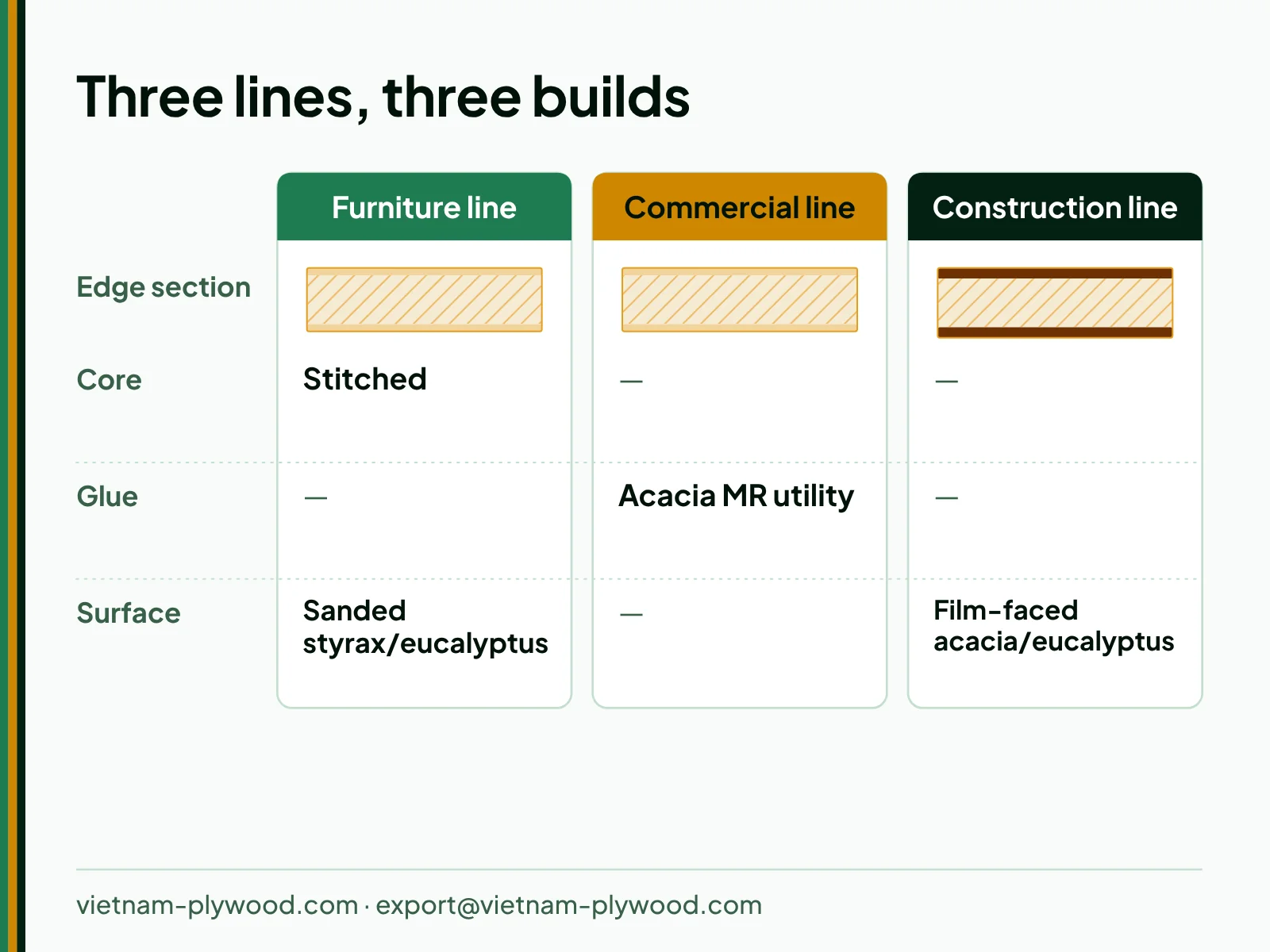
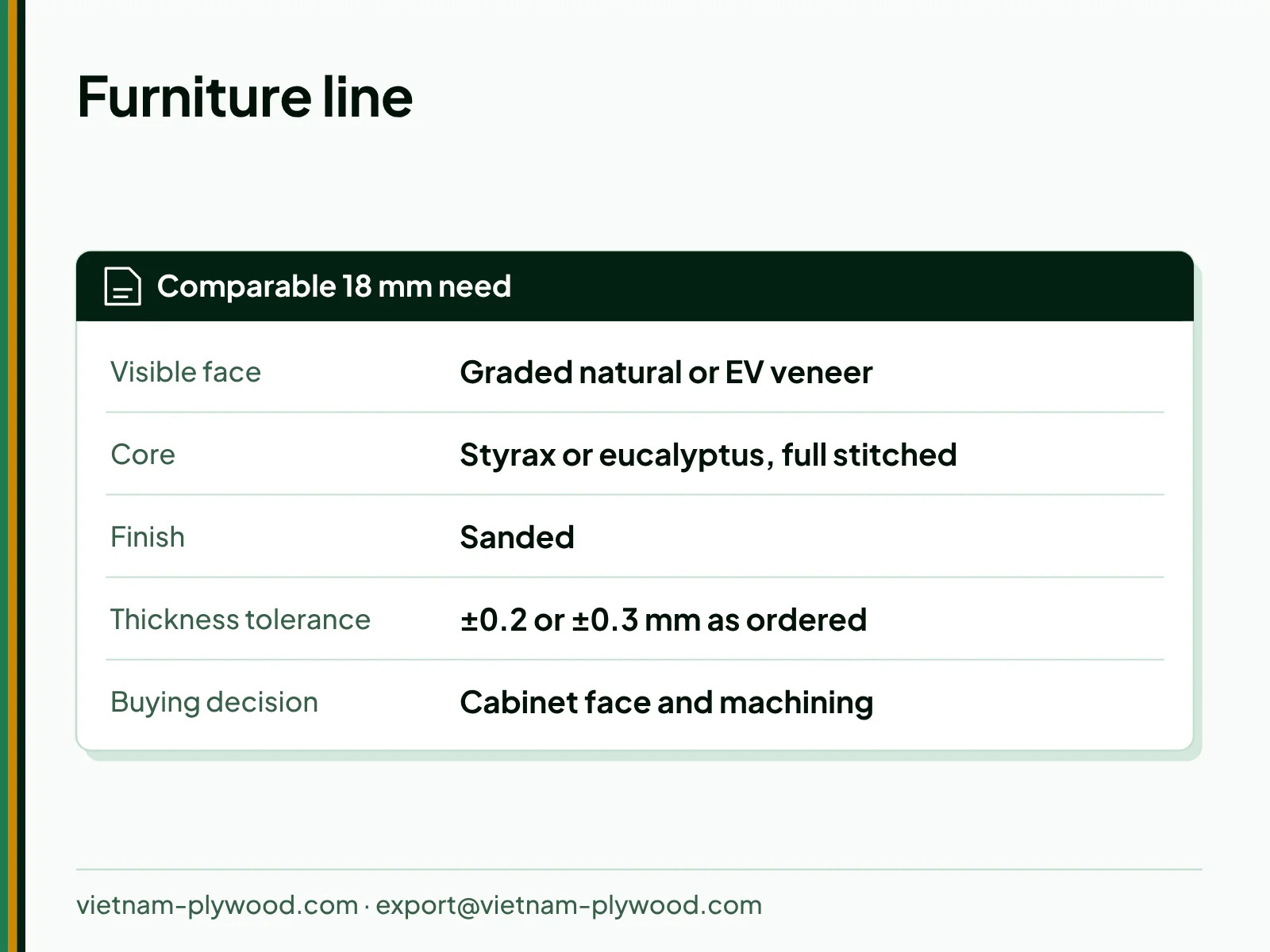
Our furniture line presses full-stitched, sanded styrax or eucalyptus cores for cabinet and fit-out work. Our commercial and packing line presses acacia-core MR plywood, unsanded or light-sanded, for utility and packing applications. Our construction line presses phenolic or melamine film-faced acacia or eucalyptus panels for formwork rather than decorative hardwood faces.
| Comparable 18 mm need | Furniture line | Commercial and packing line | Construction line |
|---|---|---|---|
| Visible face | Graded natural or EV veneer | Utility face specification | 120 g/m² film standard |
| Core | Styrax or eucalyptus, full stitched | Acacia, utility construction | Acacia or eucalyptus |
| Finish | Sanded | Unsanded or light-sanded | Unsanded film face |
| Thickness tolerance | ±0.2 or ±0.3 mm as ordered | ±0.5 mm commercial; ±0.5–1.0 mm packing | ±0.5 mm |
| Buying decision | Cabinet face and machining | Packing and utility panels | Concrete form surface |
The same nominal thickness does not create interchangeable products. A cabinet maker buying a film-faced panel pays for an overlay intended for a different job. Conversely, a packing buyer can avoid furniture-level sanding where appearance has no value. See several plywood types in one order for the cross-line specification approach.
Does the face species or the core move the price more?
Core and grade can move the quote more because they affect the full thickness and the labor used to assemble it. Face selection still matters where visual acceptance is strict or a veneer requires more selection. Compare both changes independently before concluding which dominates a particular order.
At 18 mm, core veneer thickness of 1.4–2.0 mm yields 11–13 plies. Full stitching addresses gaps and continuity across those inner layers; face selection addresses the outer appearance. The same poplar face over a styrax furniture core and an acacia commercial core is therefore two different manufacturing specifications.
Density follows the core rather than the face: styrax is 500 kg/m³, acacia 580 kg/m³ and eucalyptus 650 kg/m³. An okoume-faced eucalyptus panel retains the eucalyptus planning density. This distinction matters for payload and handling even when two panels look similar from above.
What dated FOB starting prices can a buyer use?
Our October 2026 starting references are: commercial plywood from US$250/m³ FOB Hai Phong (October 2026) and furniture plywood from US$350/m³ FOB Hai Phong (October 2026). These are product-tier starting points, not separate prices for bintangor, okoume, birch, EV, sapele or poplar faces.
A poplar plywood FOB Vietnam enquiry should therefore specify the line, core, appearance grade and thickness before requesting a price. A poplar faced plywood Vietnam price can differ from another poplar-faced offer because the inner construction and finish differ. The same applies to a veneer plywood price quotation that omits its back face.
For a price review, keep the original quotation currency, issue date, FOB basis and written specification together. If the destination requires CFR (CNF) or CIF, ask for that delivery term separately. The laminated plywood price drivers page covers a different finished-surface category; melamine, high-pressure laminate (HPL) and laminate faces are comparison topics, not HCPLY production lines.
How does thickness affect price per cubic metre?
Thickness increases sheet volume and total sheet cost at an unchanged cubic-metre rate, but the rate per cubic metre can also change with ply count, veneer preparation and press work. Thin panels can require more handling and glue lines per cubic metre than thick panels. No universal thickness surcharge is stated here.
For an identical 1220 × 2440 mm footprint, the conversion is length × width × thickness in metres. The quoted sheet dimensions and thickness determine the volume conversion. These are geometric volumes, not selling prices.
A poplar plywood price per sheet must be derived from the quoted cubic-metre rate for its actual thickness and size. For poplar plywood 18mm price enquiries, do not multiply a furniture-tier starting reference and present the result as an agreed poplar offer. Request a specification-specific quote first.
We make 3–40 mm panels, with common thicknesses of 3, 5, 9, 12, 15, 18, 21 and 25 mm. Standard sizes include 1220 × 2440 and 1250 × 2500 mm, with custom cutting available. Length and width tolerance is ±2 mm.
Why does a retail sheet price differ from an import m³ price?
Retail sheet pricing includes a different selling unit and often local distribution, storage and handling costs. An import quotation priced per cubic metre describes a defined factory build and trade term. Convert units first, then compare the same delivery stage and product acceptance.
The conversion is: sheet price on the same trade basis = quoted US$/m³ × length × width × thickness, all dimensions in metres. Reversing the equation gives US$/m³ from a quoted sheet rate. Do not compare a retail delivered sheet with an FOB export sheet as though freight and domestic selling costs were identical.
The United States International Trade Commission’s 2026 Federal Register notice defines hardwood and decorative plywood by its veneer layers and possible core, illustrating why a face name does not fully describe a customs product. Import classification and applicable measures need a shipment-specific review rather than an assumption based on the marketing name.
How can one container hold several hardwood faces?
One 40HC can carry mixed specifications within the 28.5-tonne payload limit. Faces can change while core and thickness stay constant, making separate face batches easier to compare. Mixed cores require a fresh weight and pallet plan because density changes the payload.
For 18 mm, 1220 × 2440 mm panels, the planning lookup gives styrax 26.79 kg per sheet and 990 sheets in a full styrax load; acacia 31.08 kg and 880 sheets; eucalyptus 34.83 kg and 795 sheets. The respective full-load masses are 26.52 t, 27.35 t and 27.69 t. Film weight is excluded from this lookup.
For a mixed-face styrax load, use the 990-sheet, 26.52 t full-load lookup and allocate the face batches in the packing list. If acacia panels are added, count their 31.08 kg per sheet separately and check pallet count, volume and the weight ceiling. The container loading calculator topic owns detailed load planning.
Minimum order is one 40HC; one container can carry several specifications as long as the payload limit holds. A buyer can combine an approved bintangor-faced cabinet batch with a poplar-faced batch while keeping each lot’s grade and labels distinct.
What should an inspector check at the producing factory?
An inspector should compare the approved face sample with production panels and verify the core construction before packing. At the producing factory, buyers can witness veneer sorting, face/back identification, exposed-edge inspection, thickness measurement and pallet labeling. The observed sample and the order line must refer to the same lot.
Check whether the visible veneer is bintangor, okoume, poplar, birch, EV or sapele as ordered. Record face grade, knots and repairs against the agreed sample rather than a vague species name. For furniture panels, measure the ordered ±0.2 or ±0.3 mm thickness tolerance on representative boards; commercial tolerance is ±0.5 mm.
Glue and emission are separate fields. Melamine glue is MR with a 12-hour boil specification; phenolic glue is WBP with a 72-hour boil specification. E0, E1 and E2 are emission classes. CARB Phase 2 / Toxic Substances Control Act Title VI is a US limit requiring third-party certification. Factory-member certificate details can be shown masked on request.
We manage specification, on-site quality control, export papers and loading. Buyers visit the factory office and inspect goods at the producing factory. The production lead-time guide gives context for sequencing inspection and shipment.
Which documents connect the quote to the shipment?
The commercial invoice and packing list connect the purchased face, core, dimensions and quantities to the shipment. The bill of lading (B/L) records carriage, while a certificate of origin supports the declared origin. Order-specific emission certificates or agreed test reports accompany the document set where specified.
For European Union lots, the documents include EUR.1 when applicable and the EUTR/EUDR file set. Phytosanitary and fumigation papers are included; insurance documents accompany CIF shipments. After loading, the draft shipping documents come to you for approval.
Factory lead time runs 15–45 days from receipt of the 30% deposit; the exact figure depends on order size, line loading and what the contract fixes. The remaining 70% is paid on the scan of the bill of lading, by T/T, or by irrevocable sight L/C. Samples cost nothing: a first-time buyer pays the courier, and that charge comes off the first confirmed order.
A written face acceptance standard matters as much as the price line: it lets purchasing, inspection and receiving compare the same item. For a direct quote, contact the export team with the face and core choices.
What specification should accompany the quotation request?
A comparable quotation names the application, manufacturing line, core, face grade, adhesive, emission class, thickness tolerance, dimensions and destination port. Send the same template for every face alternative; request a separate line for each construction change.
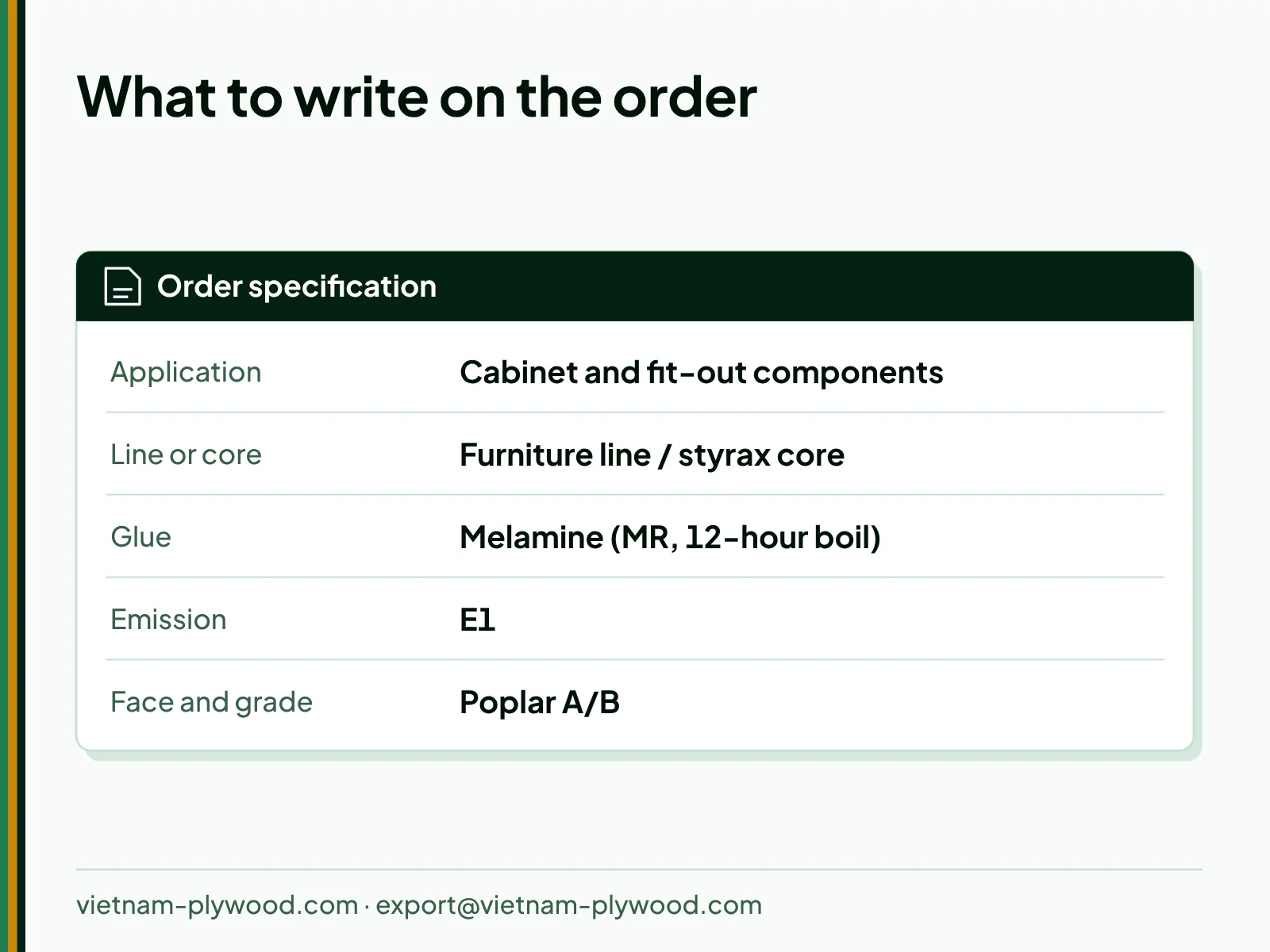
Application: cabinet and fit-out components
Line or core: furniture line / styrax core, full stitched
Glue: melamine (MR, 12-hour boil)
Emission: E1
Face and grade: poplar A/B; alternate bintangor A/B; back face specified
Thickness and tolerance: 18 mm, ±0.2 mm
Size: 1220 × 2440 mm
Quantity: one 40HC, split by approved face batches
Destination port: [buyer to specify]
Plan a trial container with Lucy at export@vietnam-plywood.com, comparing the approved face samples and written build before placing the order.