





LVL outside can tolerate limited incidental wetting when the specified bond and handling match the exposure, but glue and edge sealing do not make timber waterproof. Choosing the wrong build can mean rejected wet stock, remachining costs and lost production days. HCPLY makes industrial LVL for frames, door stock, packing and formwork bearers rather than treated outdoor structural service.
Can LVL get wet?
LVL can get wet briefly during transport or site handling, but prolonged wetting raises the risk of swelling, distortion and damaged edges. The glue bond and the wood itself respond differently to water. For HCPLY orders, specify expected exposure before choosing a bond. A wet delivery needs inspection before the material enters production.
Laminated veneer lumber (LVL) is made by bonding veneers with their grain mainly aligned along the member. See LVL meaning and uses for the product definition and LVL supplier specifications for ordering details. A dry-use LVL part and a part exposed to repeated rain require different decisions even when their dimensions match.
Rain on a wrapped bundle during unloading is a different exposure from weeks of uncovered storage. Water can reach exposed end grain, sawn edges, strap impressions and damaged wrapping. Buyers should record where water entered, how long it remained, and whether members changed shape. Do not accept a wet bundle solely because the outer face looks dry.
Is LVL outside waterproof?
No: LVL outside is not automatically waterproof. A moisture-resistant adhesive can maintain a bond under a specified exposure, while the wood veneers still absorb moisture. The terms water-resistant bond, weather exposure and preservative-treated timber describe separate properties.
APA — The Engineered Wood Association, in its 2017 technical topic on moisture exposure recommendations, distinguishes Exposure 1 and Exterior bond classifications according to service moisture conditions. That publication concerns structural wood panels; its classifications should not be transferred automatically to an HCPLY LVL order. Request the actual adhesive specification and an agreed test report for the proposed build.
Likewise, a smooth surface, decorative veneer or water-shedding wrapping cannot establish a waterproof rating. Buyers assessing is LVL timber waterproof should separate glue performance from swelling, fungal exposure, surface finish and the end-use approval.
What happens if LVL gets wet in transit or on site?
Wetting can increase dimensions, cause bowing or cupping, mark surfaces and expose weak or damaged joints. The severity follows the duration, water access, drying conditions and the member’s construction. A brief splash and standing water inside a container do not present the same inspection problem.
APA’s 2005 Proper Storage and Handling of I-Joists and LVL specifically covers distribution, storage, jobsite handling and moisture effects. Its recommendations support keeping LVL protected and checking dimensional changes after exposure; they do not provide an acceptance threshold for HCPLY material.
At receipt, photograph the wrap, pallet bases, exposed ends and any water marks before moving it. Separate affected bundles, permit controlled drying with ventilation, and compare their measured dimensions and straightness with the purchase specification. Record delamination, persistent distortion, soft areas or fungal staining for technical disposition. Do not force wet members into tightly dimensioned furniture frames or door components.
During site storage, raise bundles clear of ground moisture and keep a weather-shedding cover ventilated. Avoid trapping condensation under impermeable wrapping. Protect cut ends immediately when pieces are trimmed. The buyer’s receiving team should document both the condition on arrival and the condition after drying.
Can LVL be used outside?
HCPLY’s LVL is intended for furniture frames, door stock, packing and formwork bearers, not as treated outdoor structural timber. Temporary exposure during shipment or a construction operation calls for handling controls and a written glue specification. Permanent uncovered service needs a product explicitly qualified for that environment.
An outdoor roof member, exposed garden structure or permanently damp platform can involve decay resistance, structural design values, fastening details and local approval. An adhesive name alone answers none of those questions. Where structural performance is required, obtain the accepted engineering documentation and test report for the exact product before specifying it.
For industrial buyers, distinguish outdoor LVL as a search term from the actual exposure schedule. Covered transport, intermittent splash, sheltered service and permanent rain exposure are different conditions. HCPLY’s LVL beams guide discusses beam terminology, while LVL strength properties covers the performance questions that require separate evidence.
Which glue class should I name if LVL parts will get wet?
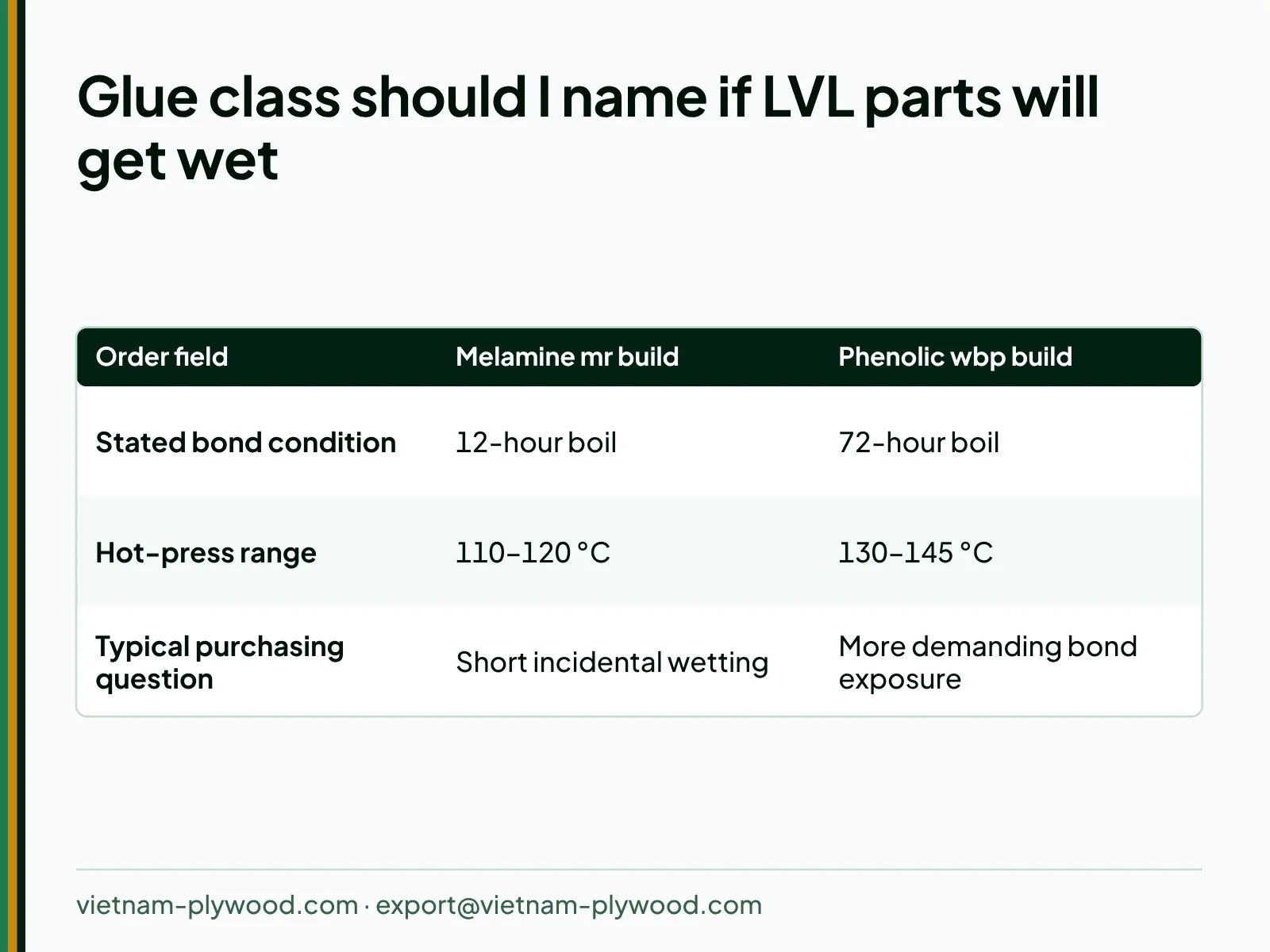
Name the expected wetting condition first, then specify melamine MR or phenolic WBP bonding in the written order. HCPLY describes melamine moisture-resistant (MR) glue with a 12-hour boil condition and phenolic weather-and-boil-proof (WBP) glue with a 72-hour boil condition. These are adhesive descriptors, not permission for indefinite outdoor use.
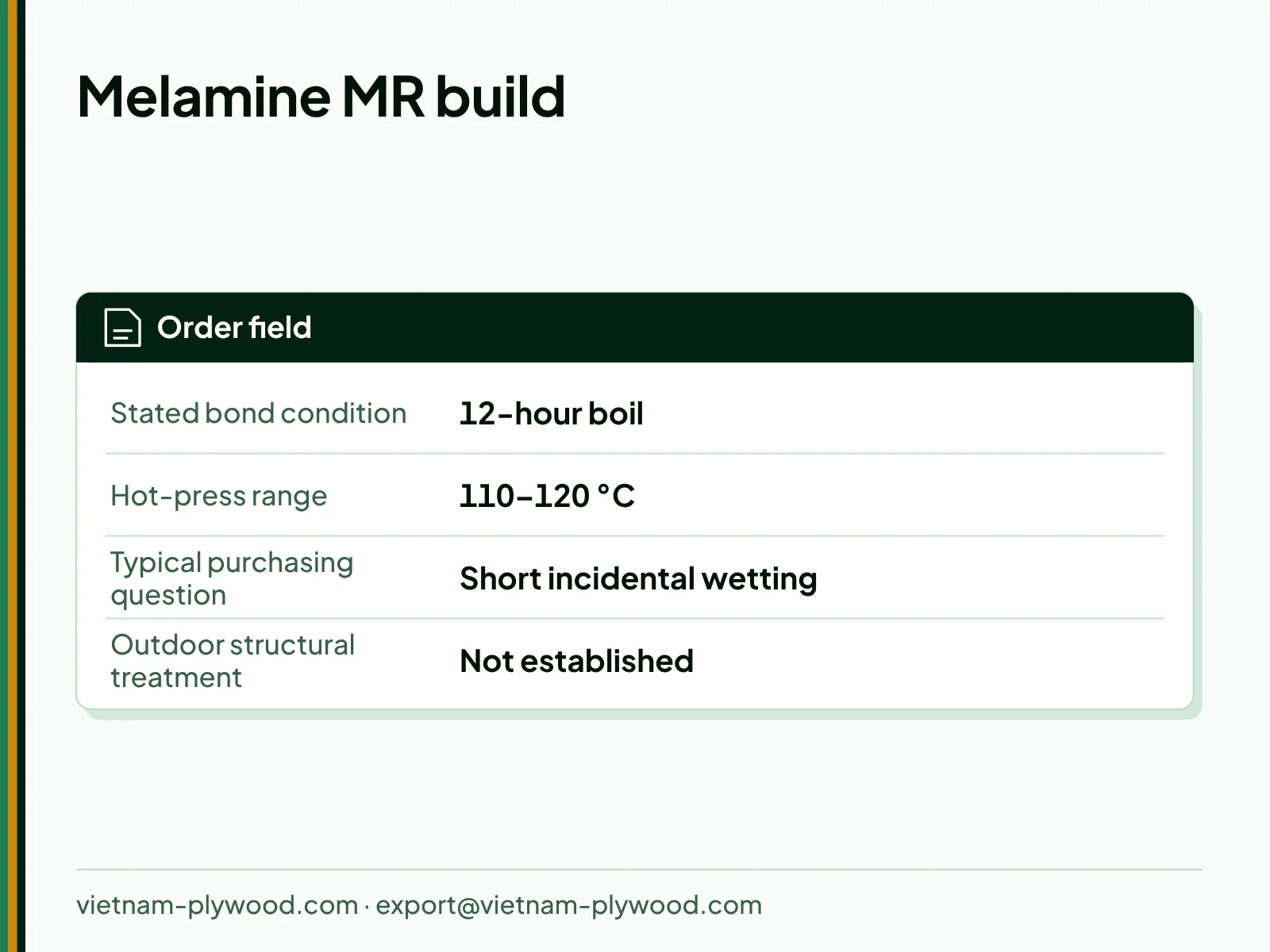
| Order field | Melamine MR build | Phenolic WBP build | Buying decision |
|---|---|---|---|
| Stated bond condition | 12-hour boil | 72-hour boil | Choose against the wetting requirement |
| Hot-press range | 110–120 °C | 130–145 °C | Confirm the producing line’s recorded process |
| Typical purchasing question | Short incidental wetting | More demanding bond exposure | Request an agreed bond test report |
| Outdoor structural treatment | Not established | Not established | Specify a separately qualified product for permanent exposed structural use |
Emission classification is another field: E0, E1 and E2 describe emissions, not glue durability. CARB Phase 2 and TSCA Title VI concern a US emission limit and third-party certification. Writing “E0 glue” leaves the adhesive unspecified. A buyer can ask for both the bond type and emission documentation without confusing them.
A phenolic bond costs more to specify than a basic MR build when its resin and processing requirements are greater; a quotation still depends on dimensions, veneer preparation, quantities and inspection requirements. There is no fixed LVL price in this page. See LVL price factors for the quotation inputs.
Does edge sealing protect LVL outdoors?
Edge sealing slows liquid-water entry at exposed veneer ends and cut faces, but it cannot turn an untreated member into outdoor structural timber. Coating continuity, abrasion, fastener holes and later cuts all affect the protection. A coating applied to an original edge does not cover a newly sawn end.
Specify whether the buyer or fabricator will coat the edges, which surfaces are covered, and how cut pieces will be resealed. For packing frames, inspect staple and screw penetrations after assembly. For formwork bearers, inspect contact points where repeated wetting or handling can damage a finish. Sealant selection should follow the coating maker’s instructions and the intended service.
A film face or decorative laminate on a different plywood product is not evidence of LVL water resistance. High-pressure laminate (HPL), continuous-pressure laminate (CPL) and melamine faces are surface treatments; they are not HCPLY LVL product lines. Surface protection must be evaluated alongside the core, bond and exposed edges.
Which factory line makes the LVL order?
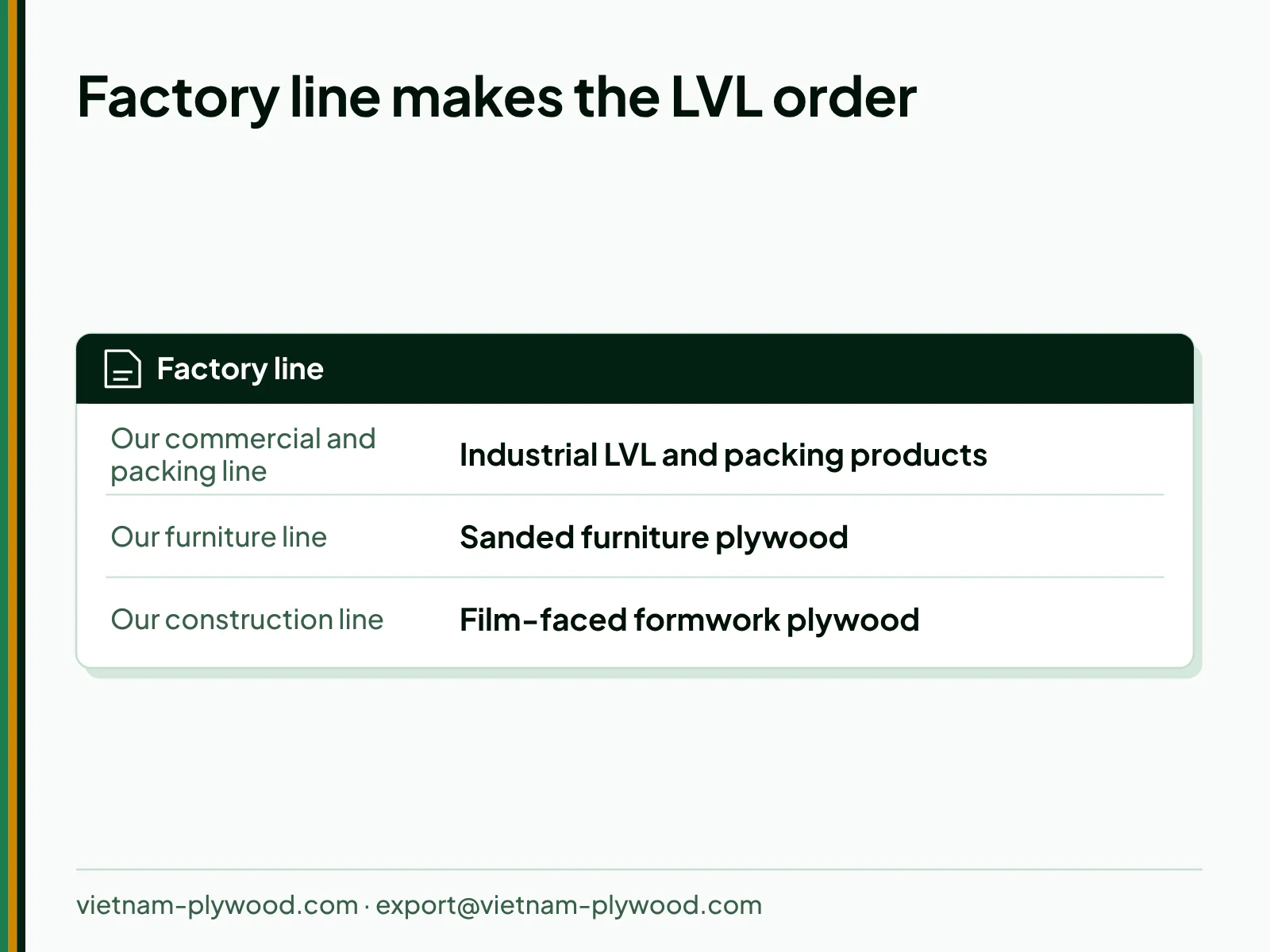
Our commercial and packing line presses the LVL specified for industrial frames, door stock, packing and formwork bearers. Our furniture line and our construction line make different panel builds for their respective applications. The same nominal thickness therefore does not mean the same product or moisture behavior.
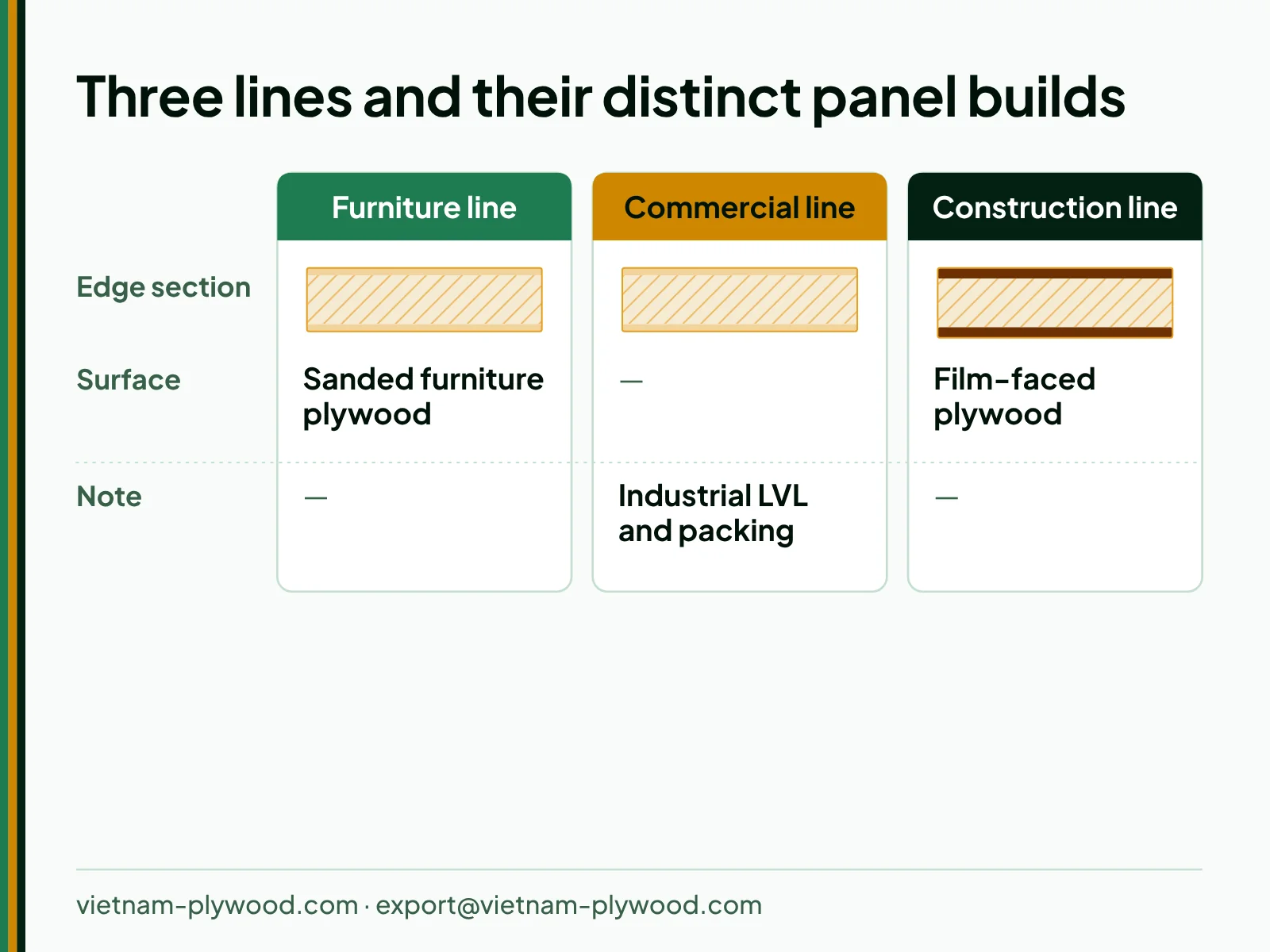
| Factory line | Relevant build | Core or face distinction | Exposure decision |
|---|---|---|---|
| Our commercial and packing line | Industrial LVL and packing products | Acacia core for commercial panels; MR is the line’s standard panel glue | Write the LVL bond and edge requirements into the order |
| Our furniture line | Sanded furniture plywood | Styrax or eucalyptus core, full stitched; E0/E1 emission classes | Select for interior component finish and tolerance |
| Our construction line | Film-faced formwork plywood | Acacia or eucalyptus core; phenolic or melamine film | Film and glue requirements belong to a different panel product |
The comparison is about production fit, not interchangeability. A film-faced sheet is not an LVL bearer, and a sanded furniture sheet is not a substitute for an engineered beam. Compare plywood grades across factory lines for the wider panel distinctions.
HCPLY coordinates specifications, on-site quality control, export paperwork and loading. Buyers can visit the factory office and inspect goods at the producing factory in Phu Tho or Hai Phong.
What should an inspector check before shipment?
An inspector should match the actual LVL build to the approved specification and check accessible edges for bond defects. Inspection starts with the order drawing, agreed glue description, dimensions, straightness criteria and the defined acceptance method. The buyer should identify which checks are visual and which require an agreed laboratory report.
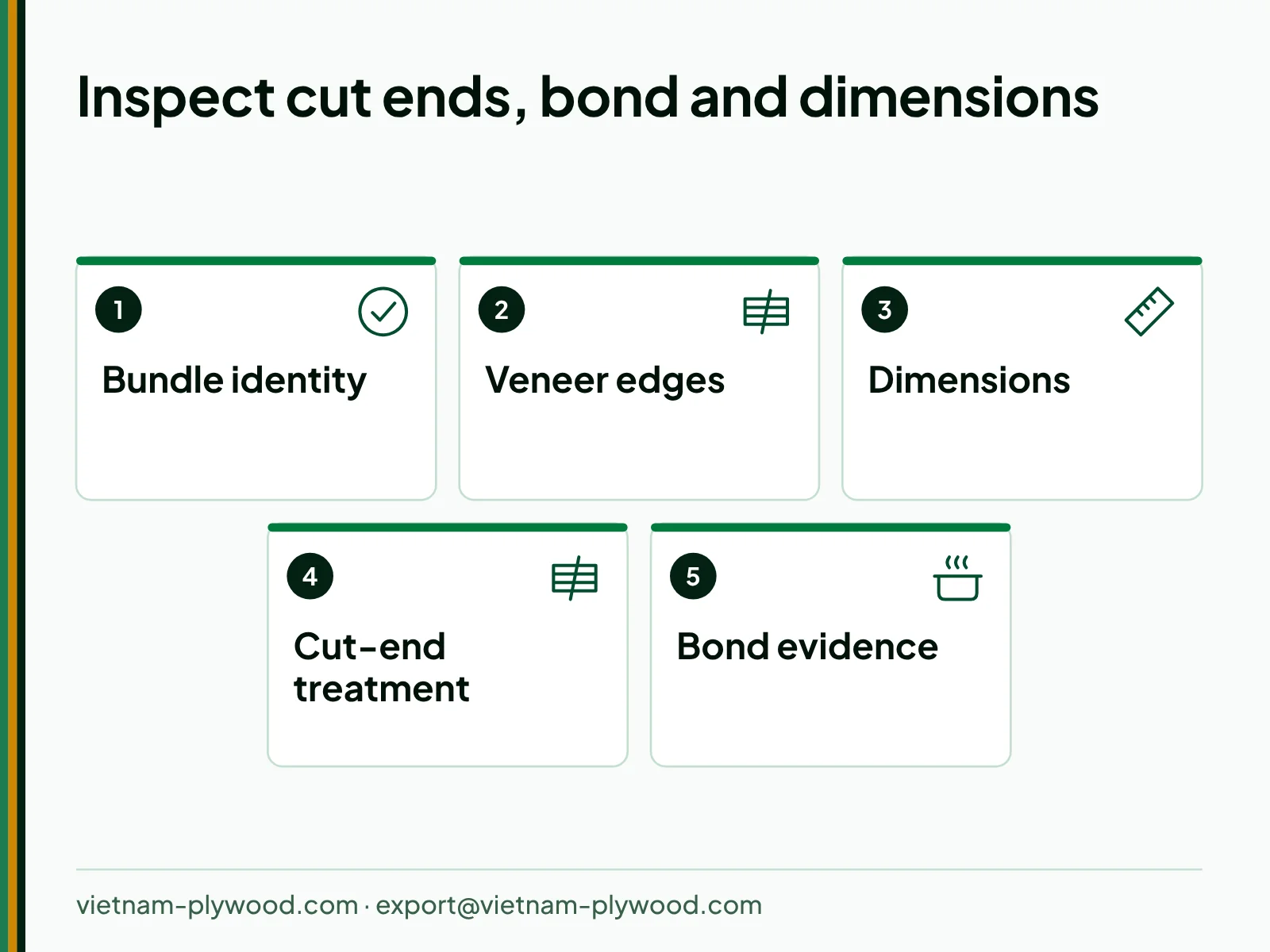
- Match bundle marks and the production lot to the written order and approved sample.
- Inspect veneer alignment, exposed ends, surface condition, visible gaps and damaged corners.
- Measure representative members against the ordered thickness, width, length and straightness tolerances.
- Check the agreed edge treatment, including any ends cut after initial processing.
- Review the agreed glue or bond-test evidence and record any departures before loading.
For panel orders, the published thickness tolerances differ by line: sanded furniture ±0.2 or ±0.3 mm as ordered, commercial and film-faced ±0.5 mm, and packing ±0.5–1.0 mm. Those panel figures are not automatic LVL tolerances. Put LVL-specific acceptance limits on the drawing instead of borrowing a plywood tolerance.
When wetting has occurred, photograph and isolate the affected pieces for reinspection. The inspection report should distinguish surface staining from measurable distortion or visible bond failure. Do not infer remaining strength from a visual check alone.
How should mixed industrial orders be planned?
A mixed order can combine LVL specifications with other compatible panel specifications in a 40HC container within the payload limit. The container payload ceiling is 28.5 t. LVL weights and pallet counts require the approved LVL dimensions and actual packing plan; panel loading tables cannot substitute for them.
For scale, an 18 mm, 1220 × 2440 mm acacia-core plywood sheet is 31.08 kg, and the full acacia-panel lookup is 880 sheets, 47.15 m³ and 27.35 t. That is a plywood example, not an LVL shipping promise. A mixed LVL load needs its own piece weights, pallet arrangement and remaining payload calculation. The container packing guide owns the broader loading calculation.
Minimum order is one 40HC; one container can carry several specifications as long as the payload limit holds. The producing factory ships directly, with FOB Hai Phong, CFR (CNF) or CIF available. State the destination port and the separate package dimensions before requesting a loading proposal.
Which records belong with the order?
The purchase specification should identify moisture exposure, adhesive, edge treatment and acceptance criteria before production begins. HCPLY manages one set of export documents: commercial invoice, packing list, bill of lading (B/L), certificate of origin, phytosanitary and fumigation papers, and the order’s agreed certificate or test documents. EU lots include EUR.1 and the EUTR/EUDR file set; CIF shipments include insurance.
The agreed test report is the technical record to request when a particular glue or structural claim needs proof. Certificates held by member factories, including FSC, CARB P2, ISO 9001 and CE, are shown with factory details masked, on request. Their presence should be matched to the producing factory and the specific order’s scope.
After loading, the draft shipping documents come to you for approval. Factory lead time runs 15–45 days from receipt of the 30% deposit; the exact figure depends on order size, line loading and what the contract fixes. The remaining 70% is paid on the scan of the bill of lading, by T/T, or by irrevocable sight L/C. These commercial terms do not replace a product acceptance specification.
Is HCPLY LVL sold as treated outdoor structural timber?
No. HCPLY offers LVL for the named industrial uses and does not sell it as treated outdoor structural timber. If a project calls for permanent exposed structural members, the purchaser needs a product with the applicable treatment, design values and independently accepted test documentation.
This boundary matters particularly when a buyer describes the product only as “waterproof LVL.” That phrase omits exposure duration, biological resistance, load requirements and the inspection method. Ask for a written end-use statement rather than treating a glue class as a structural approval.
For a covered industrial frame or temporary bearer, the correct next step is a precise drawing and moisture-exposure description. For permanent outdoor structural work, procure a separately qualified material. HCPLY can discuss the industrial LVL build but does not attach an outdoor structural grade to it.
What specification should the buyer send?
Send the intended use and moisture exposure with the complete dimensional and inspection requirements. A concise written request allows Lucy to route the build to the appropriate production team and identify missing test or treatment requirements before quotation.
Application: industrial frame / door stock / packing / formwork bearer; exposure schedule:
Line or core: commercial and packing line; requested veneer/core construction:
Glue: melamine MR or phenolic WBP; required bond test and acceptance criteria:
Emission: E0 / E1 / E2 or applicable documented limit:
Face and grade: required appearance and veneer grade:
Thickness and tolerance: ___ mm; LVL-specific acceptance limits:
Size: length ___ mm × width ___ mm; cut-end treatment:
Quantity: ___ pieces / ___ m³; packing requirements:
Destination port: ___; delivery term: FOB Hai Phong / CFR (CNF) / CIF:
Book a factory visit with Lucy at export@vietnam-plywood.com to inspect the proposed LVL build and agree the moisture-related checks at the producing factory.