





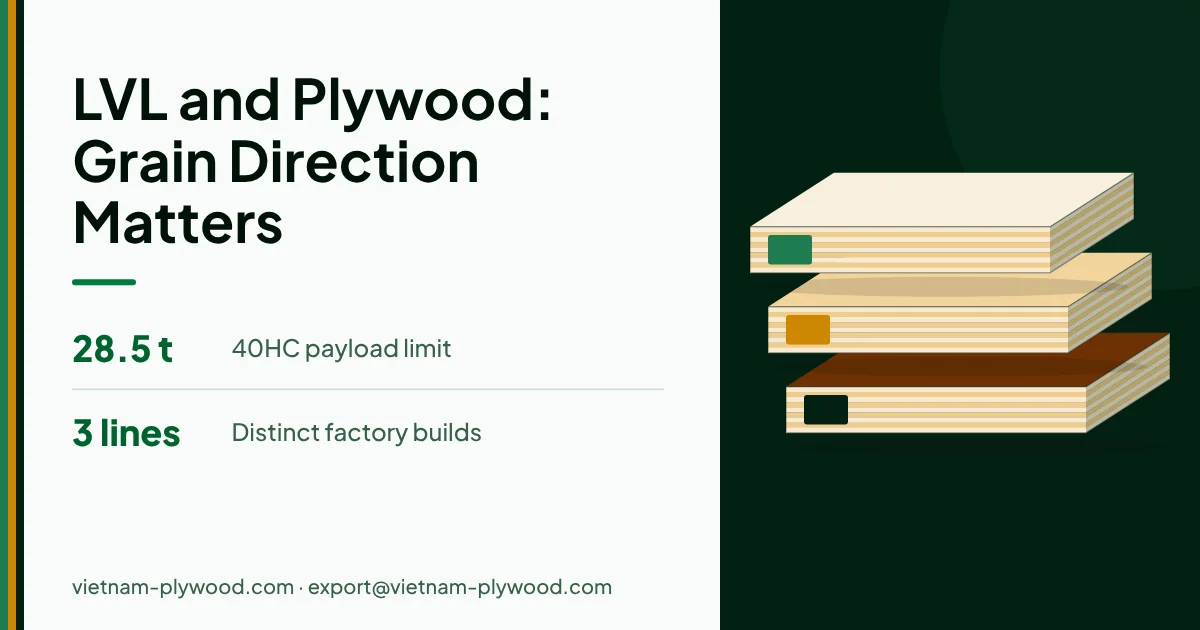
LVL is laminated veneer lumber, a parallel-veneer material that a plywood buyer can order alongside panels from HCPLY. Choosing a panel where a lengthwise member is needed can waste machining cost and delay acceptance. The right specification starts with the part being made, then identifies its grain direction, dimensions, adhesive and required performance evidence.
What is LVL, and what does LVL stand for?
LVL is laminated veneer lumber: thin wood veneers bonded with their grain running mainly in one direction. The parallel layout makes LVL useful as a long, narrow member carrying forces along its length, while cross-laid plywood is usually selected as a panel. The purchase specification still determines its actual performance.
LVL timber, LVL lumber, and LVL material commonly refer to the same veneer-based family. The 2025 United States Code of Federal Regulations, in its plywood and composite wood products definitions, describes LVL as veneers pressed with their grain primarily along the finished product’s length (40 CFR § 63.2292, 2025). This manufacturing definition does not assign a structural grade to an individual order.
The first specification question is the end use. A bed slat and a load-bearing beam can look similar in section but require different evidence. State the application before requesting a dimension or adhesive.
How is LVL different from plywood?
LVL places veneer grain mainly along the member; conventional plywood alternates grain directions between adjacent plies. That distinction changes the useful shape, loading direction, and way a buyer should inspect the order. A plywood sheet spreads loads across a surface; an LVL strip concentrates its intended use along a defined span or length.
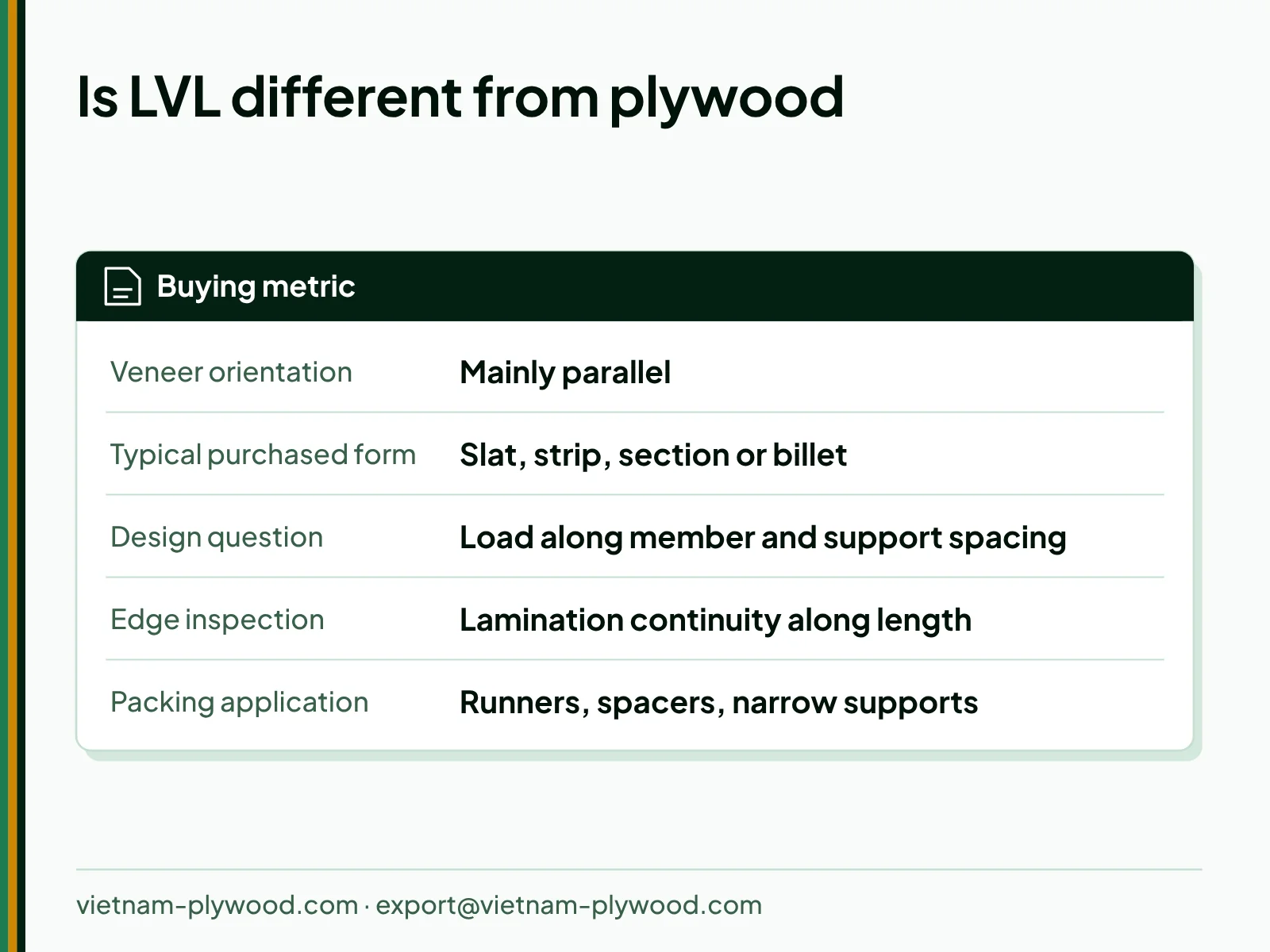
| Buying metric | LVL | Cross-laid plywood | Verdict by use |
|---|---|---|---|
| Veneer orientation | Mainly parallel | Alternating directions | LVL for lengthwise members; plywood for panels |
| Typical purchased form | Slat, strip, section or billet | Broad sheet or cut panel | Choose the form matching the assembly |
| Design question | Load along member and support spacing | Panel span, face direction and support | Neither replaces an engineered calculation |
| Edge inspection | Lamination continuity along length | Cross-ply construction and core gaps | Inspect the actual cut edge |
| Packing application | Runners, spacers, narrow supports | Crate walls, bases and dividers | Often useful in one shipment |
It does not turn parallel veneer into conventional plywood. For the broader family, see engineered wood meaning and types of plywood.
What is LVL used for in an industrial order?
LVL is used for repeated, narrow components where a consistent grain direction and a specified section matter. HCPLY’s commercial and packing line lays up LVL for bed slats, door stock, furniture frames, packing runners and formwork bearers. The buyer should distinguish a component description from a structural performance requirement.
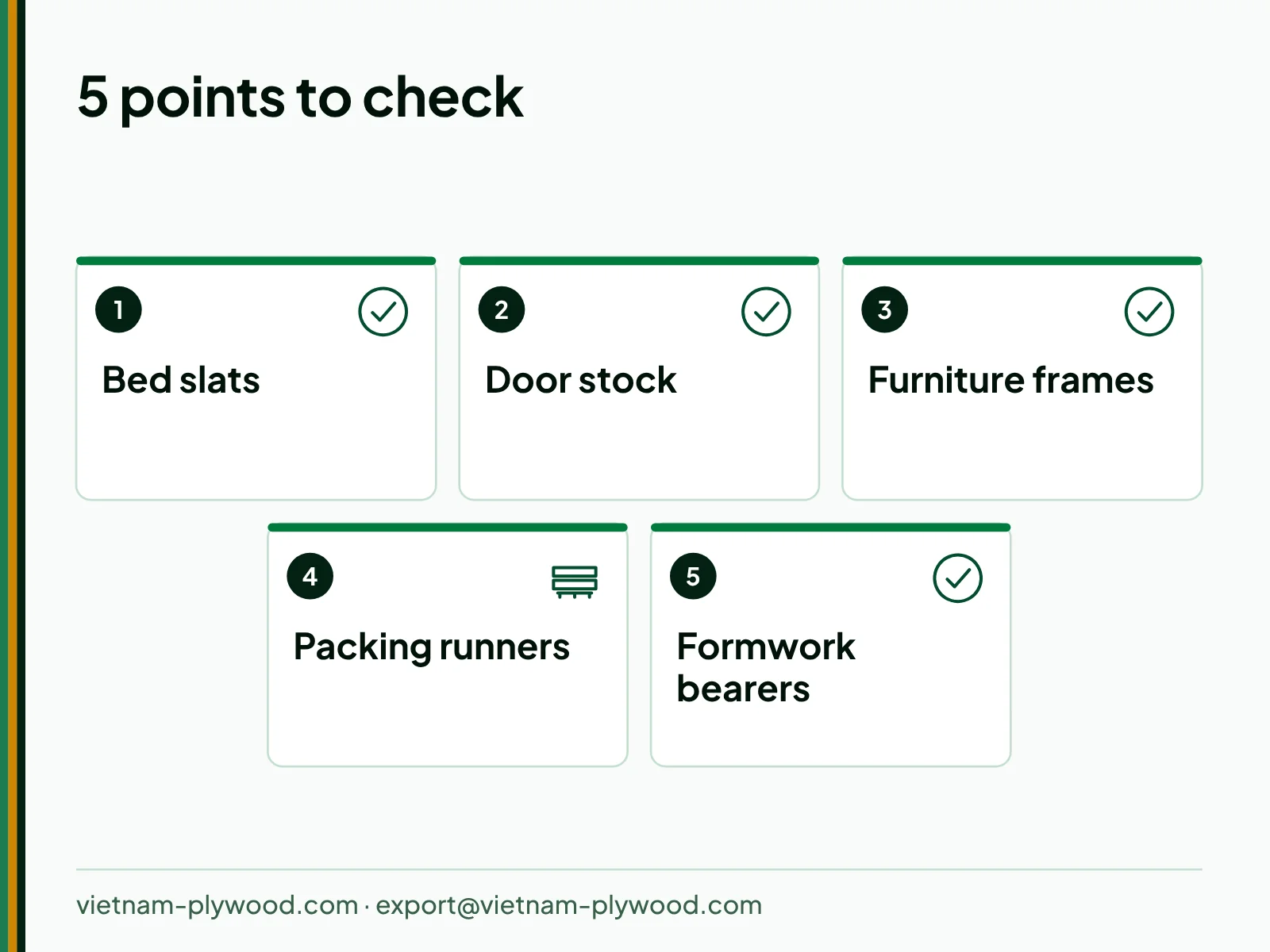
Bed slats need a defined length, section and allowable deflection under the furniture maker’s design. Door stock needs straightness and machining allowances for the door assembly. Furniture frames need repeatable cuts and joints; a hidden frame member may have different surface requirements from a visible face.
Packing runners support a crate or shipment at selected contact points. Formwork bearers belong to a temporary works design: their loads, spacing and reuse environment must be specified by the contractor. A commercial LVL description alone is insufficient for a rated bearer.
Other markets use engineered LVL for beams, headers, joists and rafters. Read LVL for furniture frames for component detailing, LVL beams for beam terminology and LVL strength for the evidence a structural buyer should request.
Is LVL a board, a sheet or a timber section?
LVL can be sold as a broad pressed blank, a cut board, or a narrow timber section; the final dimensions define what is delivered. Buyers often use LVL sheet for an uncut blank and LVL timbers for cut lengths. These labels alone do not communicate grain direction, edge quality or permissible load.
Write length × width × thickness in millimetres, followed by the grain direction relative to length. Add the cut tolerance and whether ends will be machined. A bed-frame buyer may want finished slats; a packing buyer may want stock lengths cut at its own facility.
Do not borrow a plywood sheet tolerance automatically for LVL. Our general plywood range spans 3–40 mm, with standard sheet sizes including 1220 × 2440 mm, but LVL section dimensions and tolerances belong on the order-specific drawing. A drawing should also identify whether a quoted dimension is before or after machining.
For the difference between raw-faced panels and narrow sections, see matt plywood.
Which factory line builds LVL and what do the other lines make?
Our commercial and packing line builds the parallel-veneer LVL described here, alongside acacia-core commercial and packing plywood. We have three member factories in Phu Tho and Hai Phong, and each order runs at the producing factory suited to its specification.
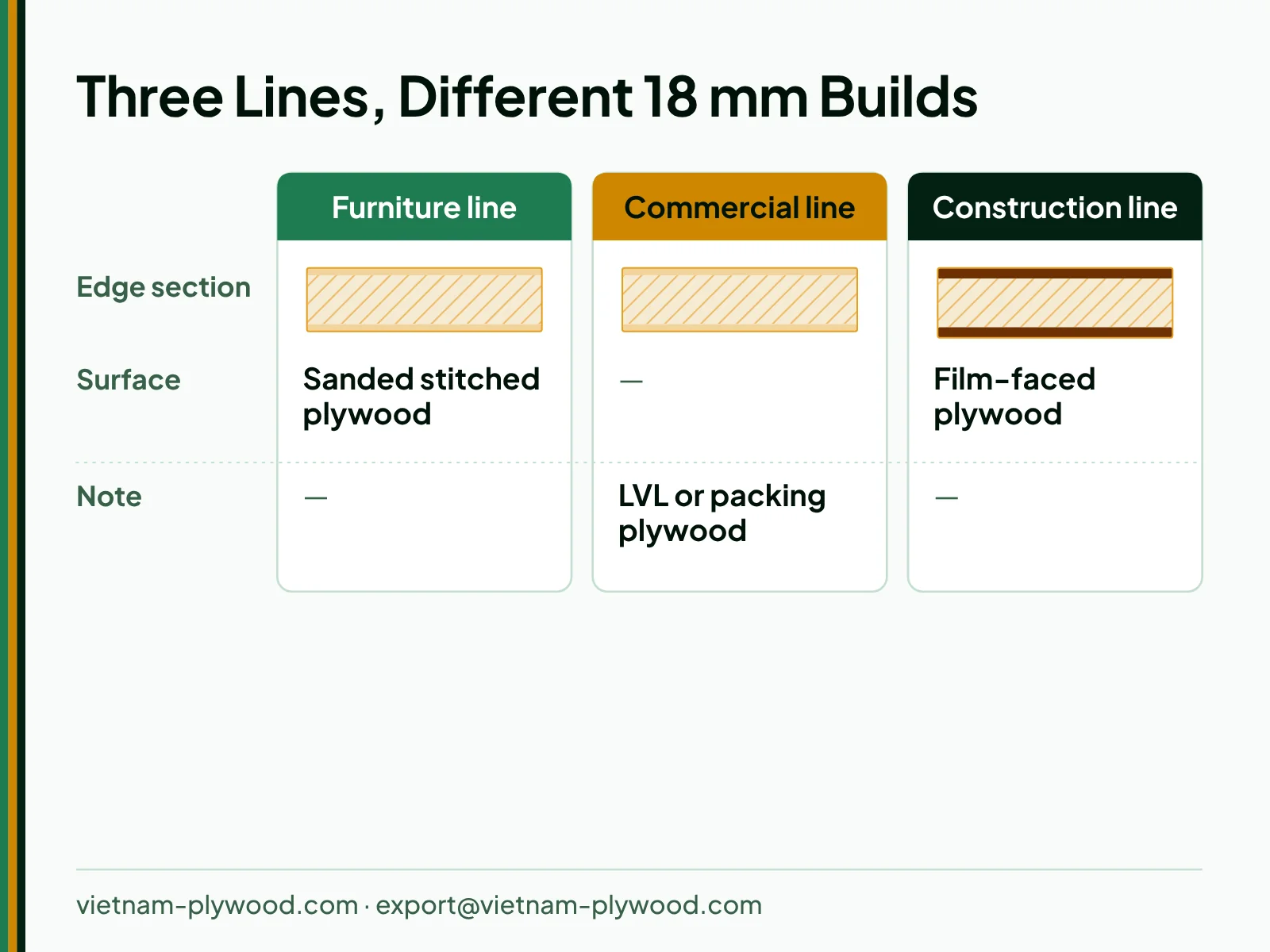
| Buyer asks for | Producing line | Core or construction | Buying decision |
|---|---|---|---|
| Narrow LVL runner or slat | Our commercial and packing line | Parallel-veneer LVL to written drawing | For long narrow components |
| 18 mm furniture panel | Our furniture line | Full-stitched styrax or eucalyptus core, sanded | For cabinet and furniture panels |
| 18 mm crate wall | Our commercial and packing line | Acacia core, MR glue, unsanded or light-sanded | For packaging faces and partitions |
| 18 mm concrete form panel | Our construction line | Film-faced acacia or eucalyptus core, unsanded | For the concrete-contact panel |
The furniture line uses E0 or E1 emission classes; these describe emissions, whereas adhesive type describes bonding. The construction line uses phenolic or melamine film. Its standard film is 120 g/m², premium film 135 g/m² and anti-slip film 220 g/m². Those film weights describe the face of a plywood panel, not an LVL rating.
For a pressed LVL batch, the inspector can witness veneer alignment before pressing and inspect the exposed laminated edge and cut sections afterward. Ask for the approved drawing, the batch identification and measurements from the actual producing run. The LVL production process explains the layup sequence in more detail.
Why add LVL to a plywood container?
Crate walls can travel with packing runners; furniture panels can travel with frame stock. A mixed order reduces the need to coordinate separate arrivals, provided the packing plan respects the payload limit.
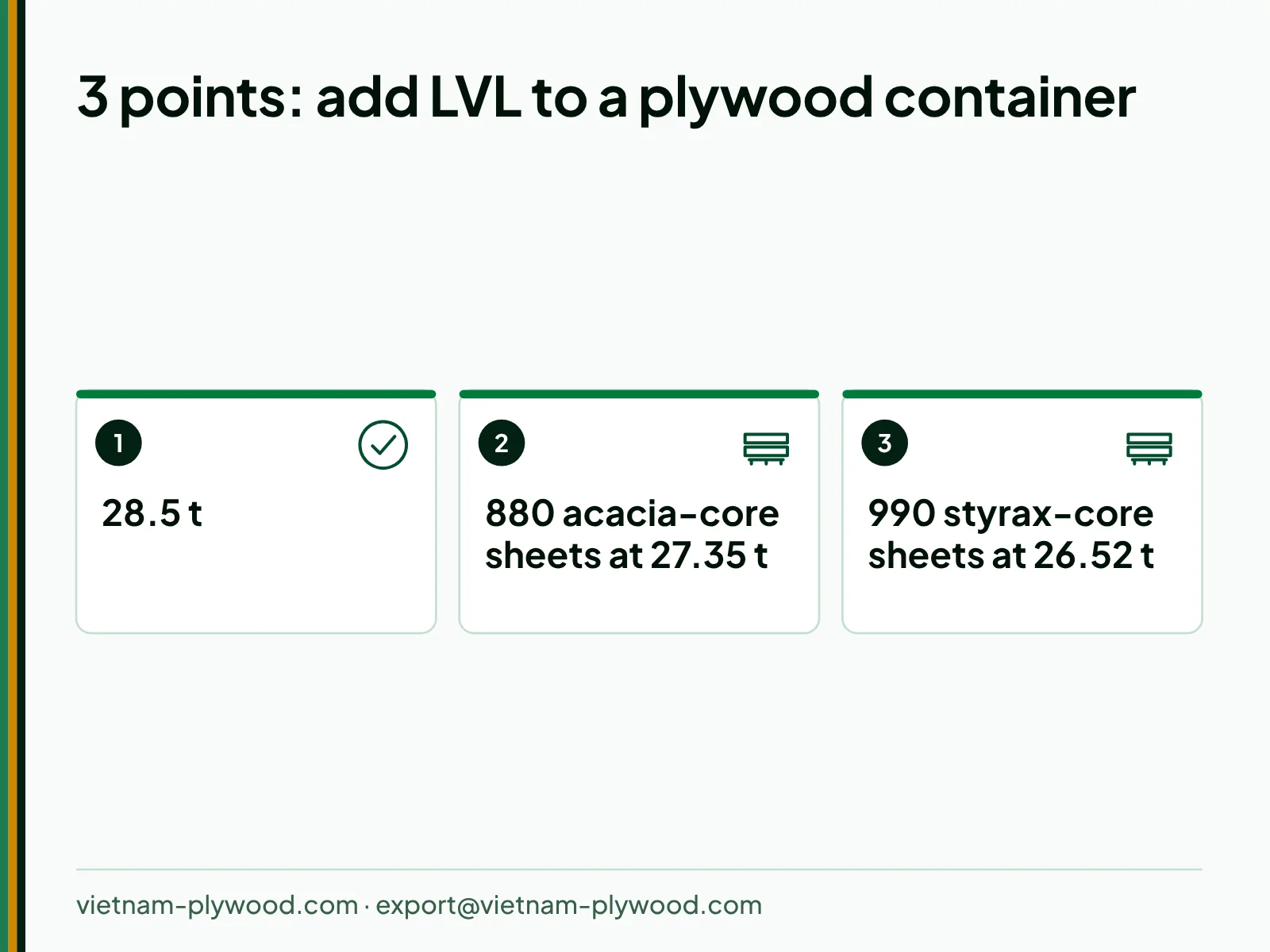
The minimum order is one 40HC, and one container can carry several specifications as long as the payload limit holds. The stated payload limit is 28.5 t. For a reference load of 18 mm, 1220 × 2440 mm panels, the calculated full-container figures are 880 acacia-core sheets at 27.35 t, or 990 styrax-core sheets at 26.52 t. These are alternative full-panel loads, not remaining space available for LVL.
A mixed-load plan uses actual pallet and LVL bundle weights against the payload ceiling. Replacing panels with LVL changes both the mass and the geometry. Request the bundle weight and final packing plan before allocating space. For the panel count method see container loads, and for arranging combined specifications see mixed container loads.
HCPLY manages the specification, on-site quality control, loading and export paperwork. The after loading, the draft shipping documents come to you for approval.
What are the disadvantages of LVL?
LVL’s main limitations are direction-dependent behaviour, moisture-sensitive detailing, exposed lamination edges and the need for application-specific performance evidence. Its parallel veneers suit lengthwise members but do not give a broad panel the same cross-direction response as plywood.
Poor storage, repeated wetting or an unsuitable adhesive system can affect the member. A wide blank also needs careful handling and cutting so the finished sections retain the intended grain orientation.
LVL is engineered from natural veneer, so an order still needs inspection for joints, voids, straightness and machining defects. Buyers ordering visible furniture parts should specify the acceptable surface and edge appearance rather than assuming a decorative face.
Adhesive and emission requirements are separate purchase fields. We describe melamine as MR with a 12-hour boil specification and phenolic as WBP, meaning weather and boil proof, with a 72-hour boil specification. These are adhesive descriptions from the offered build range; they do not establish an outdoor service class or a structural design value for LVL.
Can LVL be used outside or in wet exposure?
LVL for wet exposure needs an application-specific adhesive, detailing and accepted test evidence; the word LVL alone does not establish outdoor suitability. Water can reach veneer ends and bond lines, especially after cutting. Specify whether exposure is occasional, prolonged, sheltered or directly weathered.
A buyer should state the wetting cycle, expected service environment, treatment requirements, edge protection and the test report accepted for that application. Do not infer outdoor suitability from a glue label alone. Coatings and sealed cut ends are part of the detailing discussion, while the specified test evidence determines acceptance.
For a direct comparison of exposure categories and the purchase questions, use LVL outside. The moisture decision belongs before the order is pressed, because changing an adhesive label afterward cannot change the finished member.
Can LVL be specified for structural work?
Structural LVL needs an accepted test report, a defined grade and an engineer’s design for the intended load and support conditions. We discuss any structural grade only against a test report the buyer accepts.
Ask the project engineer for the applicable standard, bending and shear values, stiffness, span, bearing details and exposure conditions. An export certificate or a generic strength statement cannot replace those design values.
Floor joists, beams, headers and formwork bearers create different loading cases. See LVL beams and LVL strength properties for the dedicated questions; do not transfer figures from a different product or cross-section.
How should an importer inspect an LVL order?
The most useful checks occur while the veneer layup and finished cuts are accessible at the producing factory.
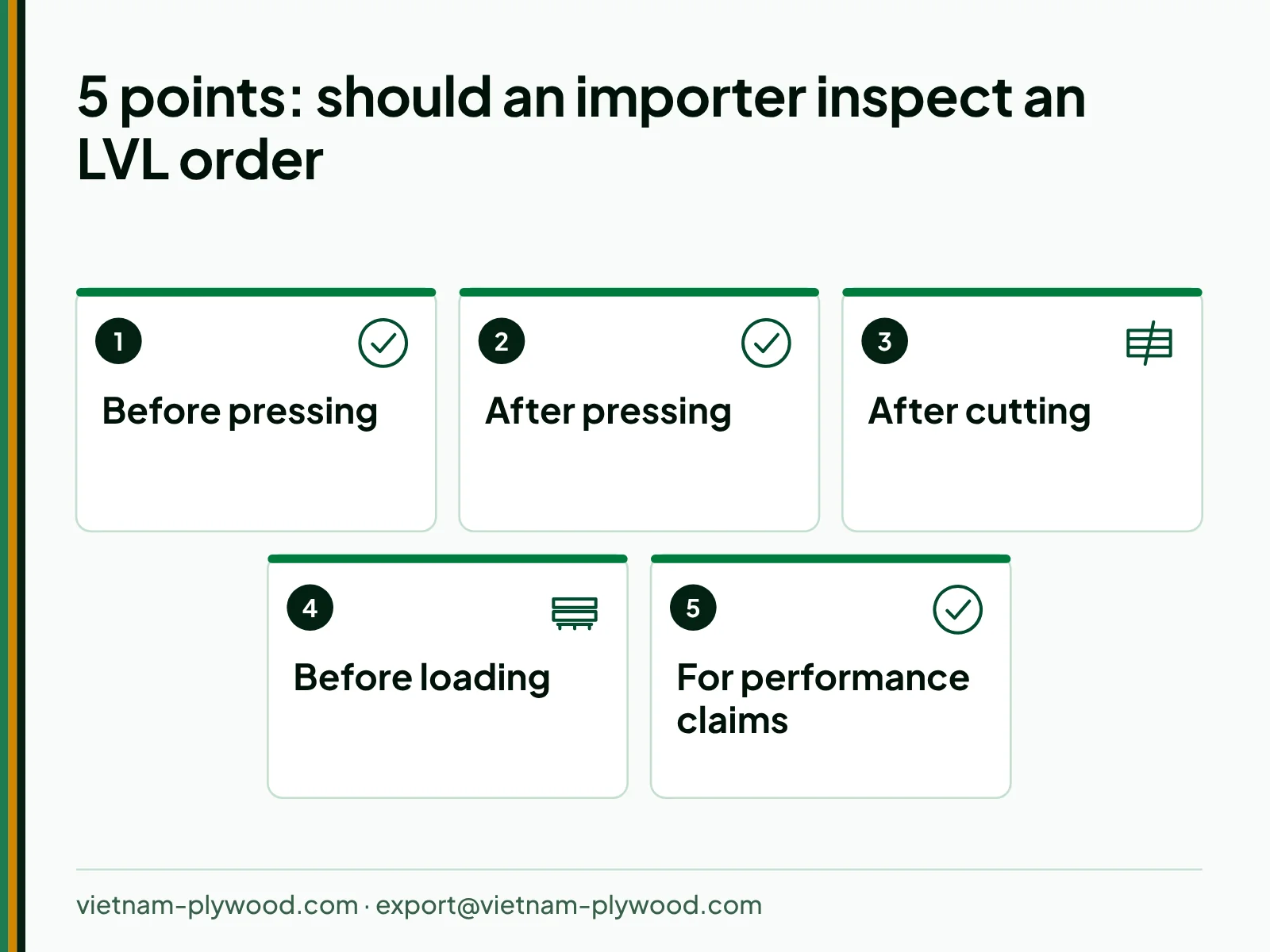
- Before pressing: check veneer direction and joint arrangement against the agreed layup.
- After pressing: inspect cut edges for continuous bonding, visible voids and unexpected gaps.
- After cutting: measure width, thickness and length at agreed positions, then check straightness.
- Before loading: match package labels, quantities and moisture-protection arrangements to the packing list.
- For performance claims: match the test report and sample identification to the exact ordered construction.
Buyers can visit the factory office and inspect goods at the producing factory. Lucy coordinates the order specification and inspection arrangements. Member-factory FSC, CARB P2, ISO 9001 and CE certificates, and EUTR/EUDR documents, are shown with factory details masked, on request. A certificate’s scope must match the claim made on the order.
For a broader panel comparison, prefinished plywood options covers face treatments; those finishes should not be assumed for an LVL section.
What affects an LVL quotation?
LVL quotation differences are driven first by performance and adhesive requirements, then veneer quality and layup, followed by section dimensions, machining and packing. A tested structural build requires more controlled selection and evidence than a non-structural packing runner. A higher-grade veneer selection costs more than a basic packing selection because usable veneer must meet tighter acceptance criteria.
Phenolic adhesive requirements can add cost against a simpler MR specification, while a narrow finished section with repeated cutting and sorting adds processing compared with a bulk blank. An LVL price therefore needs the written construction and destination rather than a generic price per cubic metre.
For the ordering variables, read LVL price factors. Request an LVL quotation against the approved drawing and use case.
What should the purchase specification say?
This gives the producing factory a build target and gives the inspector a measurable checklist.
For shipping, We offer FOB Hai Phong, CFR (CNF) or CIF. Factory lead time runs 15–45 days from receipt of the 30% deposit; the exact figure depends on order size, line loading and what the contract fixes. The remaining 70% is paid on the scan of the bill of lading, by T/T, or by irrevocable sight L/C. Samples cost nothing: a first-time buyer pays the courier, and that charge comes off the first confirmed order.
The shipment documents include the commercial invoice, packing list, bill of lading, certificate of origin, phytosanitary and fumigation papers, insurance under CIF, and the order’s agreed certificate and test documents. EU lots also carry the applicable EUR.1 and EUTR/EUDR file set. The packing list is where LVL sections and plywood panels appear as distinct shipment items.
Use the LVL supplier Vietnam product page for the product scope and the Plywood Types category for related constructions. Our export contact is Lucy at export@vietnam-plywood.com.
Application: [bed slats / door stock / furniture frames / packing runners / formwork bearers]
Line or core: commercial and packing line; [agreed veneer/core construction]
Glue: [MR melamine / WBP phenolic; required test]
Emission: [E0 / E1 / E2; required certificate]
Face and grade: [face material, finish and acceptance grade]
Thickness and tolerance: [mm and permitted deviation]
Size: [length x width x thickness, mm; grain along length]
Quantity: [pieces, bundles and total m3]
Destination port: [port, country]
Request the LVL specification sheet through contact with this completed block.