





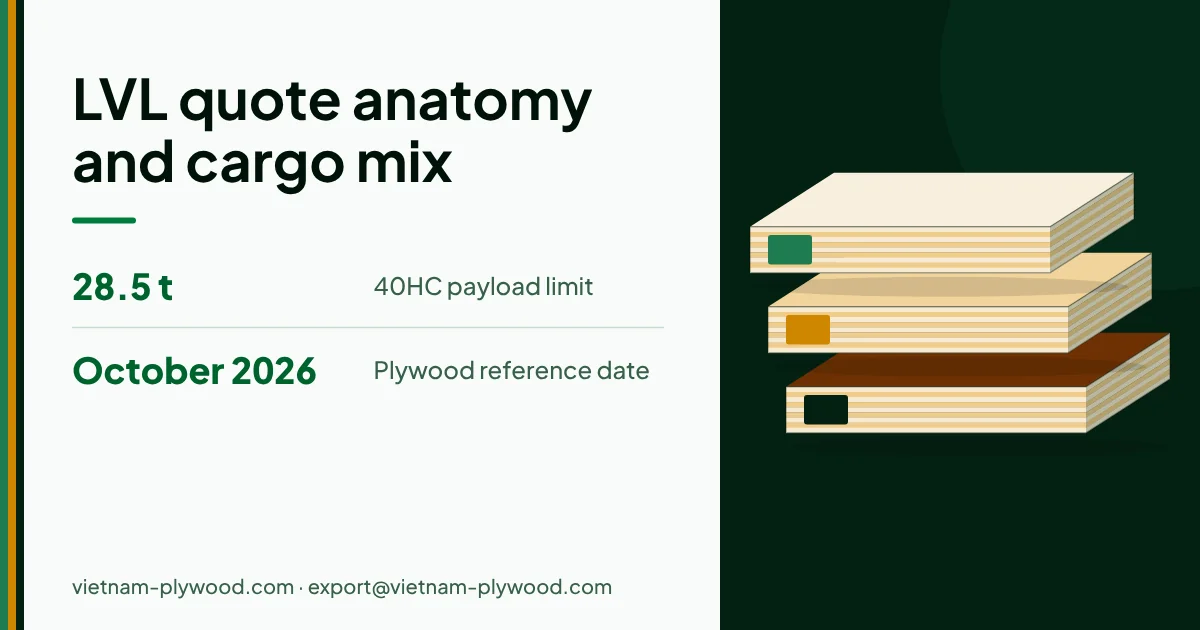
HCPLY quotes LVL prices against a defined lay-up, cut section and shipment plan; there is no LVL from-price to publish. Choosing the wrong veneer or cutting basis can leave a buyer paying for rejected pieces and avoidable trimming. The useful comparison is a written LVL specification with the same delivery term and volume basis.
What drives LVL prices?
LVL prices reflect the veneer selection, bond specification, section size, cutting yield and shipment composition. For an industrial buyer, the largest comparison error is treating two different lay-ups as interchangeable. Start with the intended job and request a priced, dimensioned build rather than a generic LVL beams price list. LVL meaning and uses explains the product before this purchasing comparison.
A packing runner with visible knots can use a different appearance selection from a bed slat. Door stock introduces tighter appearance and machining expectations. A bearer intended to carry a defined load needs engineering evidence; appearance alone cannot establish its capacity. These differences affect usable veneer recovery, sorting time, adhesive selection and cutting waste.
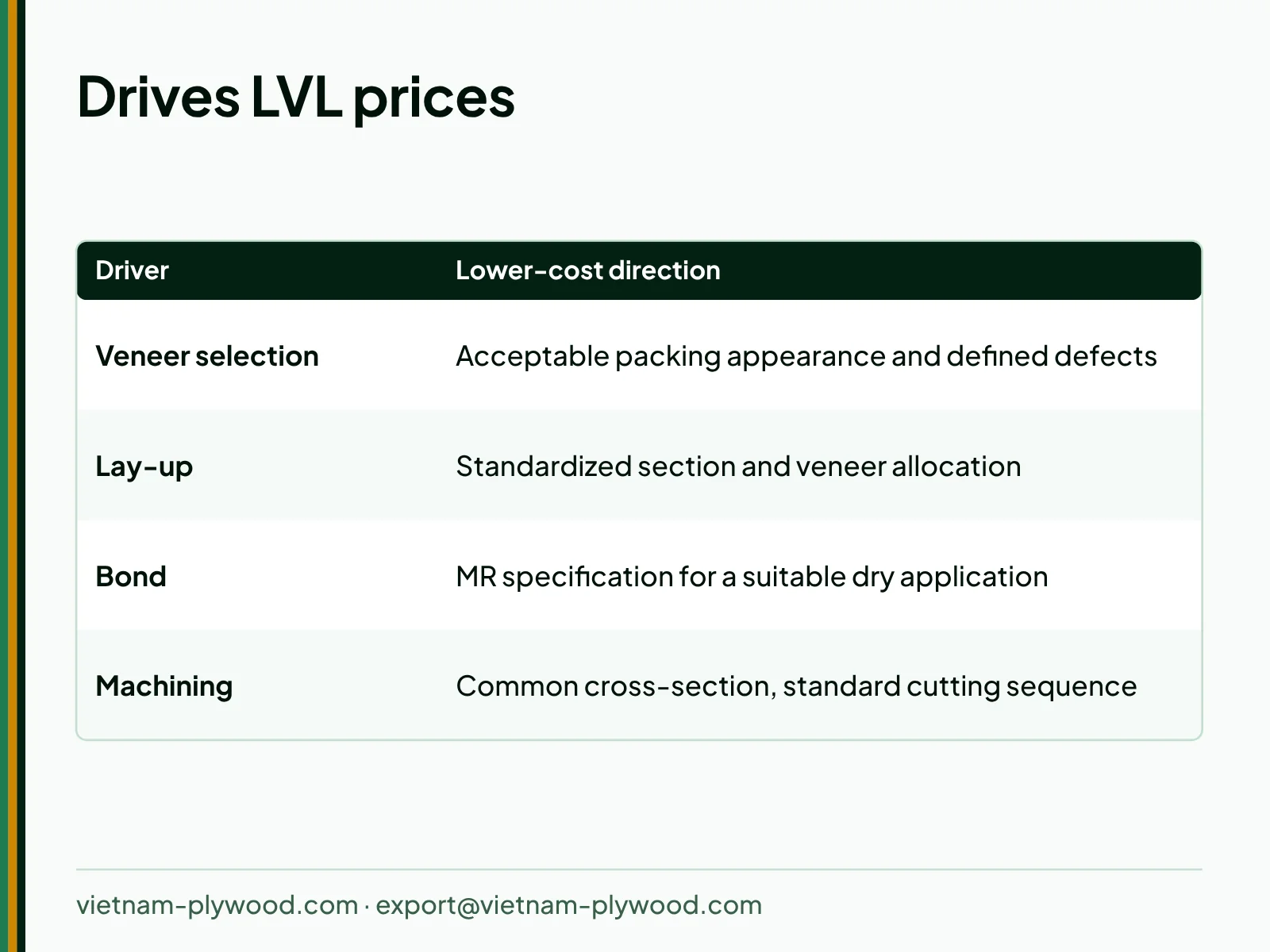
| Driver | Lower-cost direction | Higher-cost direction | Buyer decision |
|---|---|---|---|
| Veneer selection | Acceptable packing appearance and defined defects | Cleaner, more uniform visible stock | State the acceptable face and edge defects |
| Lay-up | Standardized section and veneer allocation | Special lay-up or tighter internal selection | Ask for a section drawing |
| Bond | MR specification for a suitable dry application | Phenolic bond when exposure requirements call for it | Name service conditions and test requirement |
| Machining | Common cross-section, standard cutting sequence | Narrow strips, exact lengths and tighter sorting | Quote finished dimensions and tolerances |
| Order composition | Repeat sections and efficient loading | Numerous short runs and incompatible bundles | Group compatible items by production batch |
| Documentation | Routine agreed paperwork | Additional testing or destination-specific evidence | Identify documents before quotation |
This ordering is a practical quoting sequence, not a universal ranking of monetary differences. The actual cost difference needs the producing factory’s bill of materials and cutting plan.
Is there a dated LVL from-price or a price list?
There is no published LVL from-price in this offer. HCPLY quotes LVL against a written application, lay-up, glue, finished section, cut length and shipment plan. A dated plywood reference is useful for comparing the companion cargo, but cannot be transferred to LVL.
Commercial plywood starts from US$250/m³ FOB Hai Phong (October 2026). Furniture plywood starts from US$350/m³ FOB Hai Phong (October 2026). These are separate plywood starting prices, not an LVL price, and neither is an LVL lumber price proxy.
A buyer comparing offers should request the quotation date, currency, unit, shipment term, precise goods description and packing method. An apparently lower number per cubic metre can become a higher delivered cost if it refers to rough blanks rather than accepted cut pieces. Compare identical finished units and the same port term before choosing.
How is LVL priced per m³?
LVL pricing per cubic metre starts with the finished or invoiced dimensions expressly named in the quote. For rectangular stock, multiply thickness × width × length in metres, then multiply by the number of pieces. Keep the calculation basis identical between quotations.
For example, a quotation can specify a nominal section and finished length, with the cubic metres derived from those dimensions. Do not silently substitute rough production lengths for delivered cut lengths. If the factory quotes a larger blank that will be trimmed after arrival, the buyer pays for wood that will not become a finished component.
Request both the number of pieces and the total invoiced cubic metres. Ask whether cutting loss is included in the unit price or charged through the gross volume. The packing list should reconcile piece counts, bundles and declared volume; the commercial invoice should use the agreed unit and description.
How do veneer grade and glue change an LVL quote?
Veneer grade changes both the material recovery and the appearance of the finished edge. A visible furniture component needs more consistent faces and controlled defects than a concealed packing runner. Tighter selection rejects more veneer or redirects it to another application, raising the input cost of the accepted stock.
Glue is a separate specification from formaldehyde emission classification. MR denotes a moisture-resistant melamine glue option; phenolic WBP denotes weather-and-boil-proof bonding. The factory’s reference conditions are a 12-hour boil for MR and a 72-hour boil for phenolic. These describe adhesive-system comparisons, not a structural load rating or an automatic outdoor-use approval.
Emission classes E0, E1 and E2 should be written in their own field. CARB P2 and TSCA Title VI concern a US emissions limit with third-party certification, rather than a glue recipe. If a destination or customer needs a particular declaration, name its accepted test or certificate evidence in the purchase specification.
For the distinction between pressing stages and bond selection, see LVL production process. For exposed service, read LVL outdoor exposure before assigning a glue specification.
Which factory line handles this LVL order?
Our commercial and packing line is the relevant production route for packing-oriented LVL. The furniture line instead makes sanded, full-stitched plywood with styrax or eucalyptus core, while the construction line makes film-faced plywood for formwork. HCPLY coordinates specification, on-site inspection and loading at the producing factory.
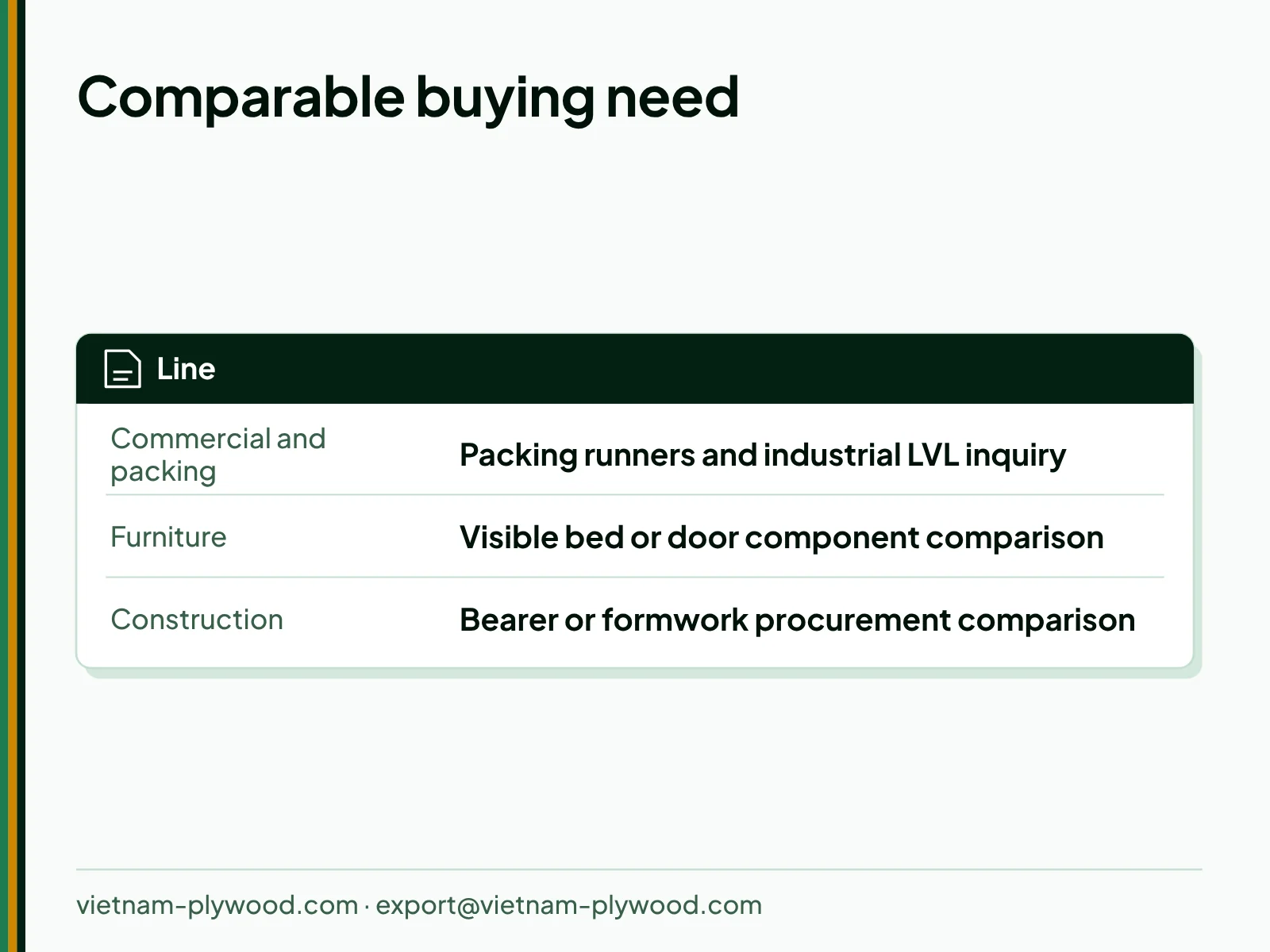
| Line | Comparable buying need | Distinguishing build | Appropriate use |
|---|---|---|---|
| Commercial and packing | Packing runners and industrial LVL inquiry | Acacia-based commercial plywood uses MR glue and an unsanded or light-sanded finish | Cost-sensitive industrial packing |
| Furniture | Visible bed or door component comparison | Full-stitched, sanded styrax or eucalyptus plywood, E0/E1 | Finished furniture panels rather than packing stock |
| Construction | Bearer or formwork procurement comparison | Acacia or eucalyptus film-faced plywood with phenolic or melamine film | Concrete-contact panel work, not an LVL load rating |
This table compares factory routes and adjacent plywood builds; it does not assign plywood sheet tolerances or core densities to LVL sections. A bed-slat request needs its own LVL construction and acceptance criteria. Compare plywood grades across factory lines provides the panel-side comparison.
An inspector can witness the veneer selection, examine the exposed edge for gaps and overlaps, measure the finished cross-section and lengths, and match bundle identification to the order. Any requested mechanical test belongs in the agreed inspection plan, with a report acceptable to the buyer.
How does cut length or end use change LVL cost?
Cut length affects the proportion of a pressed blank that becomes saleable pieces. A repeated runner length allows the cutting schedule to be arranged around that dimension. Mixed lengths can improve yield when planned together, but can also add sorting, labeling and packing work.
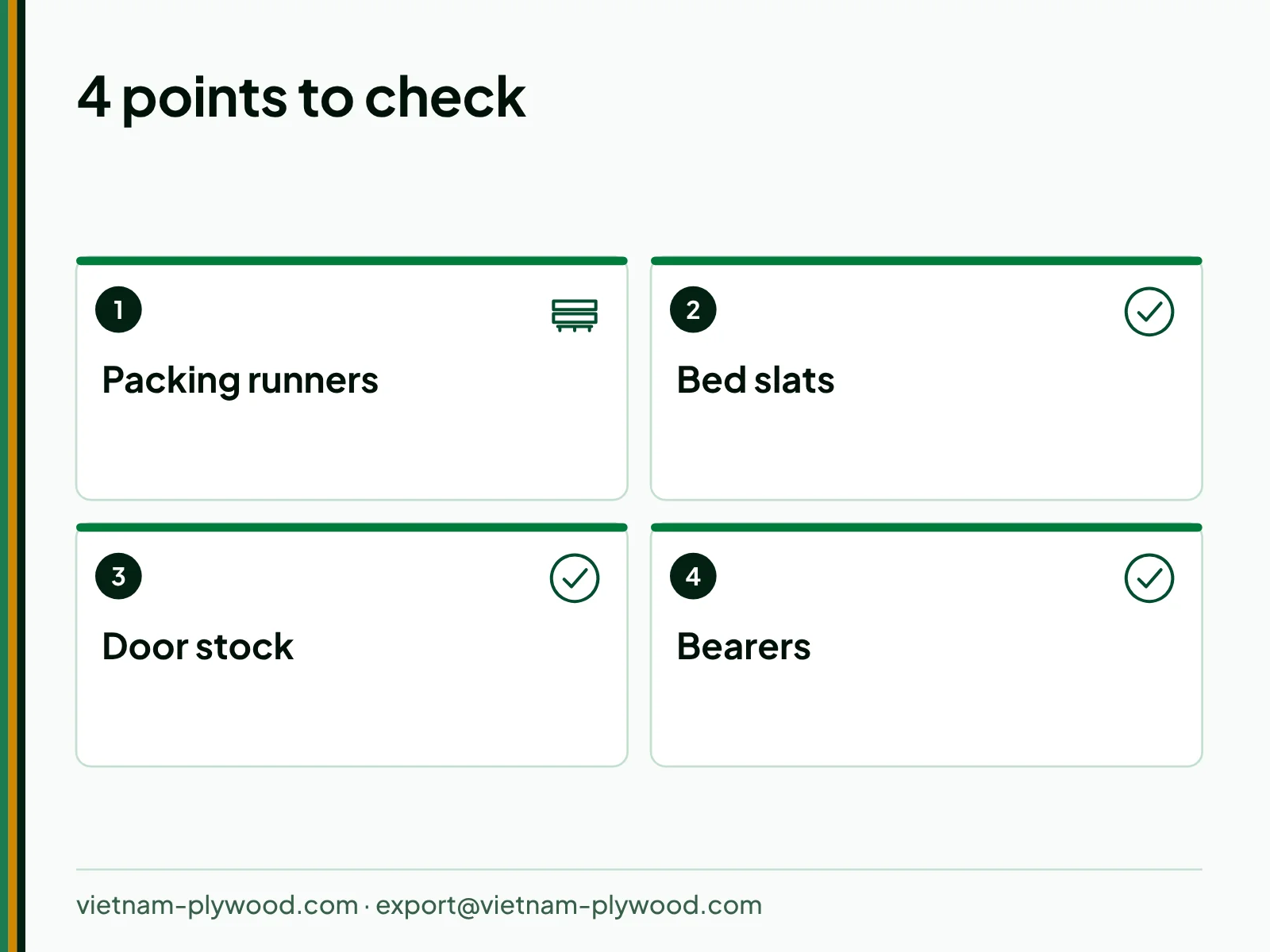
Packing runners prioritize fit, repeatable section and economical surface selection. Specify how the runner is fixed, where fasteners enter and which defects are unacceptable at the connection points. A packing company should ask for the final cut count per bundle rather than accept a vague pallet-grade label.
Bed slats need consistent curvature, edge condition and a defined performance requirement from the furniture designer. Appearance and sanding can affect both cost and acceptance. LVL for furniture frames addresses that use separately.
Door stock needs dimensional stability and machining allowance in the purchaser’s drawing. The quote should distinguish rough blank size from the final usable component. Extra trimming at the destination can offset a lower nominal cubic-metre quote.
Bearers require the designer’s load case, support spacing, orientation and accepted strength documentation. A generic LVL description or an adhesive label does not establish a structural grade. The LVL beams guide addresses section selection and evidence.
What does sharing a container with plywood do to landed cost?
A mixed container can spread a shipment’s fixed freight and destination handling costs across LVL and plywood that are already needed together. The benefit is an allocation calculation, not an automatic discount on the LVL factory price. Compare the same destination port, cargo mix and usable delivered quantities.
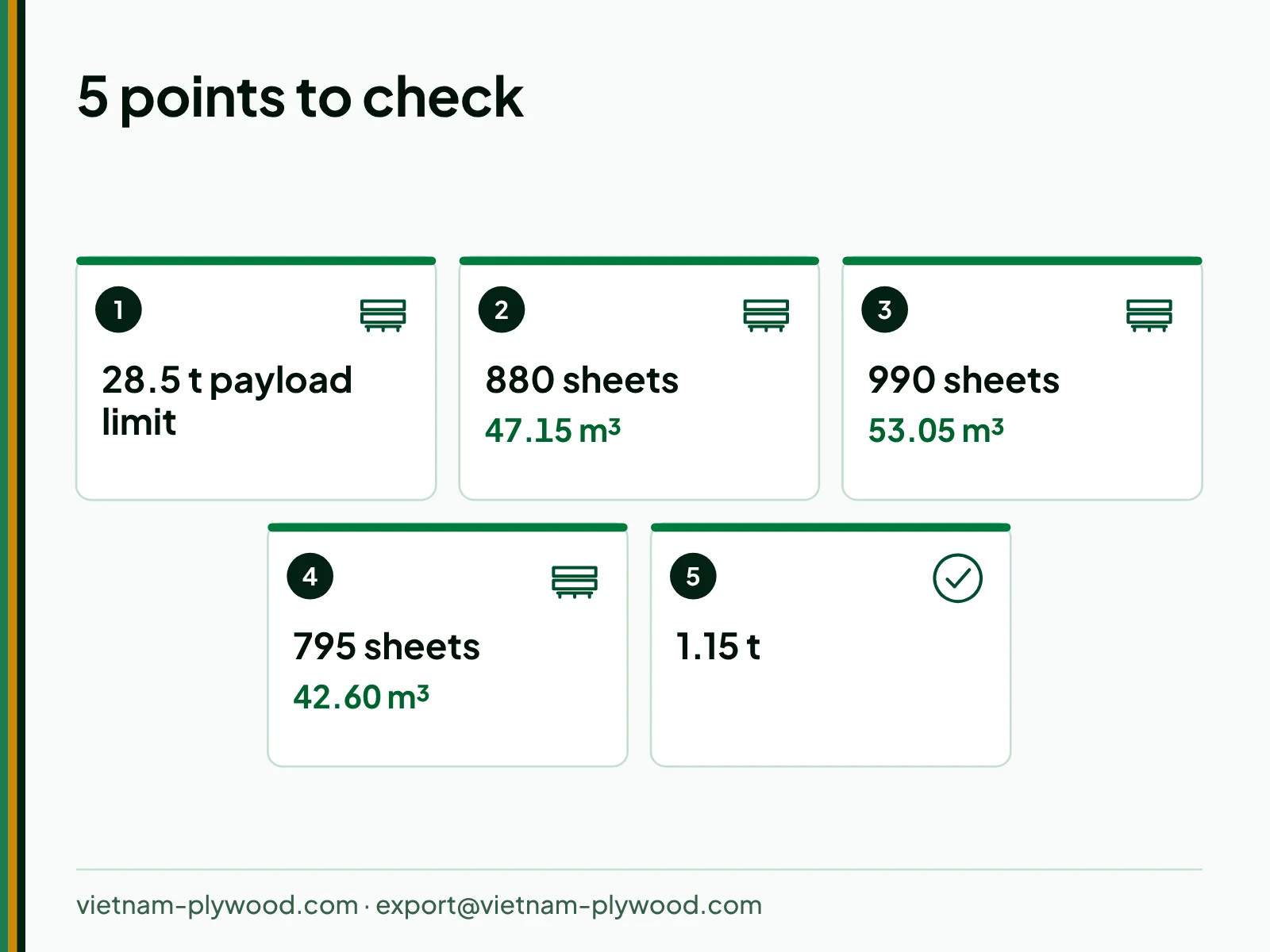
The minimum order is one 40HC, with specifications mixed within the 28.5 t payload limit. For a reference plywood load of 18 mm, 1220 × 2440 mm sheets, the factory lookup gives acacia 880 sheets, 47.15 m³ and 27.35 t; styrax 990 sheets, 53.05 m³ and 26.52 t; eucalyptus 795 sheets, 42.60 m³ and 27.69 t. These figures are for full plywood loads, not LVL capacity.
The acacia example leaves 1.15 t beneath the stated payload ceiling before packaging and other loading allowances. That arithmetic is 28.5 minus 27.35. It does not mean 1.15 t of LVL will physically fit: pallet footprint, cargo dimensions, securing and the actual mixed loading plan also matter.
For a mixed order, reduce the plywood allocation first, then enter the LVL bundle dimensions and actual mass into a loading plan. Allocate ocean freight by an agreed method, such as occupied cubic metres or chargeable cargo mass, and keep destination charges separate. See mixed container loads and the container packing reference for the panel baseline.
Which shipment term changes the comparison?
FOB Hai Phong, CFR (CNF) and CIF place different transport and insurance items into the quoted total. A buyer should compare all offers at one named destination and one Incoterms basis before drawing a price conclusion. FOB goods value alone is not the landed cost.
Under CIF, insurance forms part of the seller’s shipment arrangement; the destination’s duties, taxes and handling still need their own budget. The carrier route also affects the planning window. From Hai Phong, the stated sea transit ranges are 25–35 days to the Mediterranean and 30–40 days to Northern Europe, depending on carrier and route.
Factory lead time runs 15–45 days from receipt of the 30% deposit; the exact figure depends on order size, line loading and what the contract fixes. The 70% balance is against the scanned bill of lading, by T/T or irrevocable L/C at sight. These trade conditions should be compared alongside the physical LVL specification, rather than mistaken for a lower manufacturing cost.
What paperwork belongs with the LVL quotation?
The order should identify the documents needed to clear the destination market and prove the agreed build. The shipment package includes the commercial invoice, packing list, bill of lading, certificate of origin, phytosanitary and fumigation papers, plus order-specific certificate documents and test reports. Insurance is included under CIF; EU lots use EUR.1 and the EUTR/EUDR file set.
For an EU buyer, the European Parliament and Council’s Regulation (EU) 2023/1115, consolidated in 2025, states in Article 9 that operators collect product descriptions, wood-species information and quantities as part of due diligence. The legal text is available in EUR-Lex. This is a reason to specify material identity and traceability records early, not a substitute for checking the applicable import obligations.
Member-factory FSC, CARB P2, ISO 9001 and CE documents, where relevant to the agreed order, are shown with factory details masked, on request. HCPLY sends draft shipping documents for buyer approval after loading. State the required certificate scope and accepted evidence before the factory prepares the order.
What should an inspector check before loading?
Inspection should match the signed specification and bundle identification to measurable stock. Start with the producing factory’s cutting and sorting area, then trace accepted pieces through packing and loading. The buyer can visit the factory office and inspect goods where the order is made.
Check the finished thickness and width at several points, measure the cut length, examine edges for voids or veneer separation, and compare face defects against the approved sample. Record bundle counts and piece counts. Where bonding or performance testing is specified, compare the test report to the exact lay-up and acceptance method.
Free samples are available; a first-time buyer pays the courier, and that charge comes off the first confirmed order. A sample should carry the same grade, glue and dimensional description as the proposed bulk order.
What should the buyer send for a comparable quote?
Send one dimensional schedule and one acceptance schedule for every LVL use. Identify whether the requested volume represents rough blanks or finished cuts, and name the destination port. That allows a meaningful comparison between a packing runner and a more tightly selected furniture component.
For procurement, use the LVL supplier specification route and contact Lucy at export@vietnam-plywood.com. HCPLY coordinates producing-factory inspection against the order.
Application: packing runners / bed slats / door stock / bearers
Line or core: commercial and packing line; requested veneer/core details
Glue: MR melamine / phenolic WBP; required test method
Emission: E0 / E1 / E2 or destination-specific evidence
Face and grade: visible-face requirement; permitted defects
Thickness and tolerance: finished section and acceptance limits
Size: finished width × length; rough blank dimensions if different
Quantity: pieces and invoiced m³; bundle breakdown; plywood mix if any
Destination port: named port; FOB Hai Phong / CFR (CNF) / CIF
Next step: Book a factory visit to review the LVL cutting specification and inspect the producing factory before the order.