





How does LVL strength match the intended job?
LVL strength is useful only when tied to the member’s intended job, dimensions, loading direction and acceptance method. Laminated veneer lumber (LVL) bonds wood veneers with grain predominantly aligned along the member. That construction can distribute natural defects, but it does not give every LVL build the same structural rating. HCPLY separates non-structural component inspection from structural design evidence.
A furniture rail that stays straight through assembly has a different success criterion from a roof beam resisting sustained bending. A door stile must remain machinable and hold hardware; a packing runner must withstand its specified handling cycle. An unsupported strength number can produce rejected components even when the veneer looks sound.
Start with what LVL is and where it is used before selecting a grade. State the application and the failure that would stop production: misalignment, delamination, loose screws, damage under handling, or excessive deflection. Those become measurable purchasing conditions.
Which LVL properties matter for each use?
The relevant LVL properties change with the component and its exposure. The purchasing specification should name the performance that can be checked on representative production pieces.
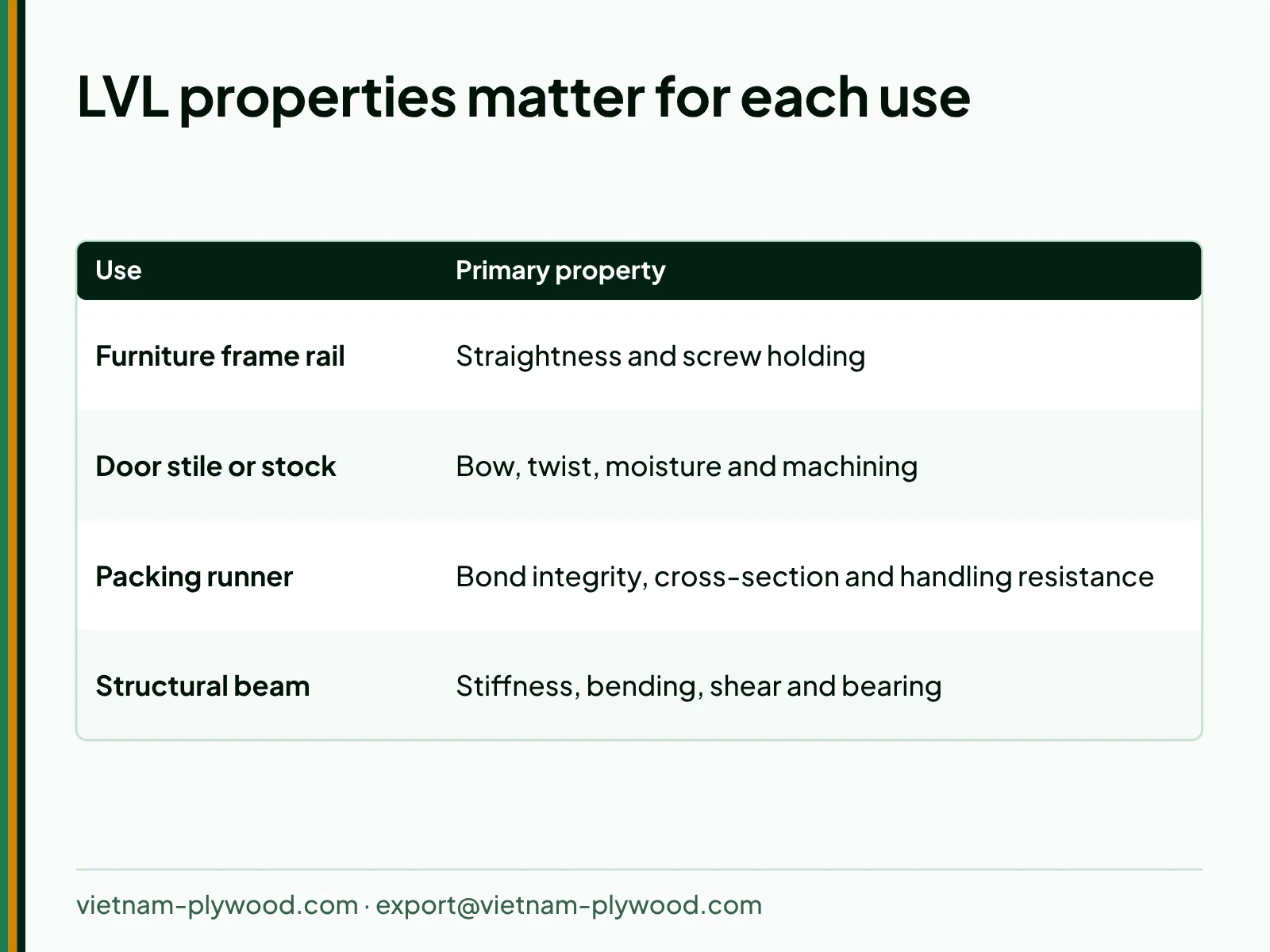
| Use | Primary property | Practical acceptance evidence | Verdict by use |
|---|---|---|---|
| Furniture frame rail | Straightness and screw holding | Straightedge readings, fastener trials at actual edge distances | Select a component build that assembles squarely |
| Door stile or stock | Bow, twist, moisture and machining | Lengthwise checks, moisture readings and a machining trial | Select stock that retains hardware alignment |
| Packing runner | Bond integrity, cross-section and handling resistance | Cut-end inspection, agreed bond test and handling trial | Select a runner for the documented package load |
| Structural beam | Stiffness, bending, shear and bearing | Accepted structural report plus engineered design checks | Select only a structurally evaluated member |
For runners, inspect fasteners and contact surfaces after the agreed handling simulation.
The furniture-frame LVL application merits its own component drawing and assembly sample. The LVL supplier specification route starts with the same written application rather than an unexplained strength label.
What does a structural E-value actually measure?
A structural E-value expresses modulus of elasticity, a measure of stiffness under a defined test and direction. It does not independently establish ultimate strength, safe span or a load rating. Bending strength, shear resistance, compression, bearing and connection performance are separate considerations.
Structural calculations also depend on section width and depth, support conditions, load duration and service exposure. A beam can meet a stiffness requirement while failing another limit state. Two members with similar E-values can therefore need different sizes or connection details.
The U.S. Department of Agriculture Forest Service’s 2010 Wood Handbook discusses mechanical properties of wood-based composites in Chapter 12. Its official handbook provides engineering background for evaluating a declared structural product. Use a report covering the actual construction and the design framework accepted by the buyer.
For span, support and load-design questions, use the separate LVL beams guide. A span figure taken from another product cannot be transferred to a furniture or packing LVL member.
What does the factory check for straightness?
Straightness inspection records bow, sweep and twist against limits written on the order. An inspector selects pieces across the lot, checks their orientation and measures deviations over the agreed reference length. The result is a measurement record tied to the sampled members.
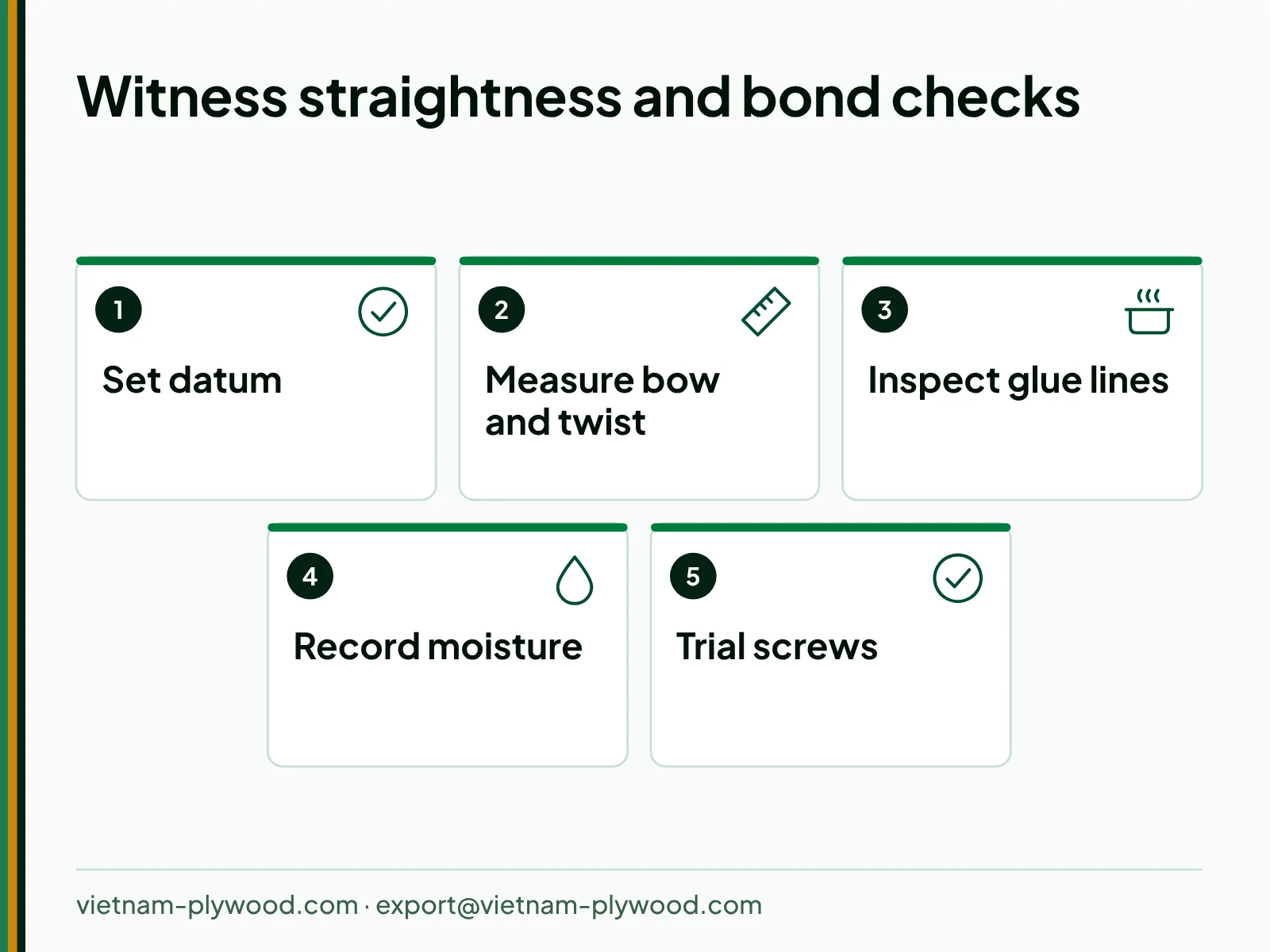
First identify the face and edge that become the assembly datum. Place the member on a stable reference surface and use a straightedge or suitable gauge. Record the largest gap and its location, then turn the member to check the second axis and twist.
Record conditioning and storage conditions alongside the readings. For door stock, inspect after the planned machining operation where that operation affects fit.
Buyers can witness this inspection at the producing factory. We can arrange sampling against the approved drawing, with nonconforming pieces separated according to the agreed inspection plan.
How are glue bond and moisture checked?
Bond checks look for open glue lines and performance under an agreed exposure and test method. Inspect cut ends for gaps, lifted veneers and poorly bonded zones, then test representative samples where the order requires bond evidence. A clean cut end alone cannot quantify bond strength.
Moisture is measured with an appropriate calibrated meter or laboratory method and recorded against the buyer’s specified range. Sampling should include interior pieces from the stack as well as exposed outer pieces. Record the meter setting, measurement positions and time since conditioning.
Adhesive and emission must be written as separate fields. In our plywood specifications, melamine glue is described as MR with a 12-hour boil condition; phenolic glue is WBP with a 72-hour boil condition. These process descriptors cannot be substituted for an LVL bond test on the ordered build.
The LVL production process explains why veneer preparation, pressing and conditioning affect subsequent inspection. Specify the exposure that matters to the component before choosing the test.
How should screw holding be evaluated?
Screw holding should be tested with the fastener and joint geometry that the buyer will actually use. The screw diameter, pilot hole, insertion direction, embedment, edge distance and moisture condition all influence the result. A generic pull-out claim without these details cannot settle an assembly decision.
Prepare representative LVL pieces from the intended production run. Drive the chosen screws at the planned locations, then apply the agreed withdrawal or joint-load test. Record splitting, veneer separation, head pull-through and fastener movement alongside any measured force.
For a furniture frame, repeat the trial near the actual rail end and at the intended joint orientation. For door stock, test hinge or lock-fixing locations after machining. Packing runners need fastener trials that reproduce how boards or blocks attach to the runner.
If those values are absent, agree them before production rather than assigning an arbitrary universal screw-holding rating.
Which factory line builds the ordered component?
Our commercial and packing line is the route for the non-structural LVL application discussed here. The other lines serve different plywood builds, so their panel specifications cannot be used as LVL strength evidence.
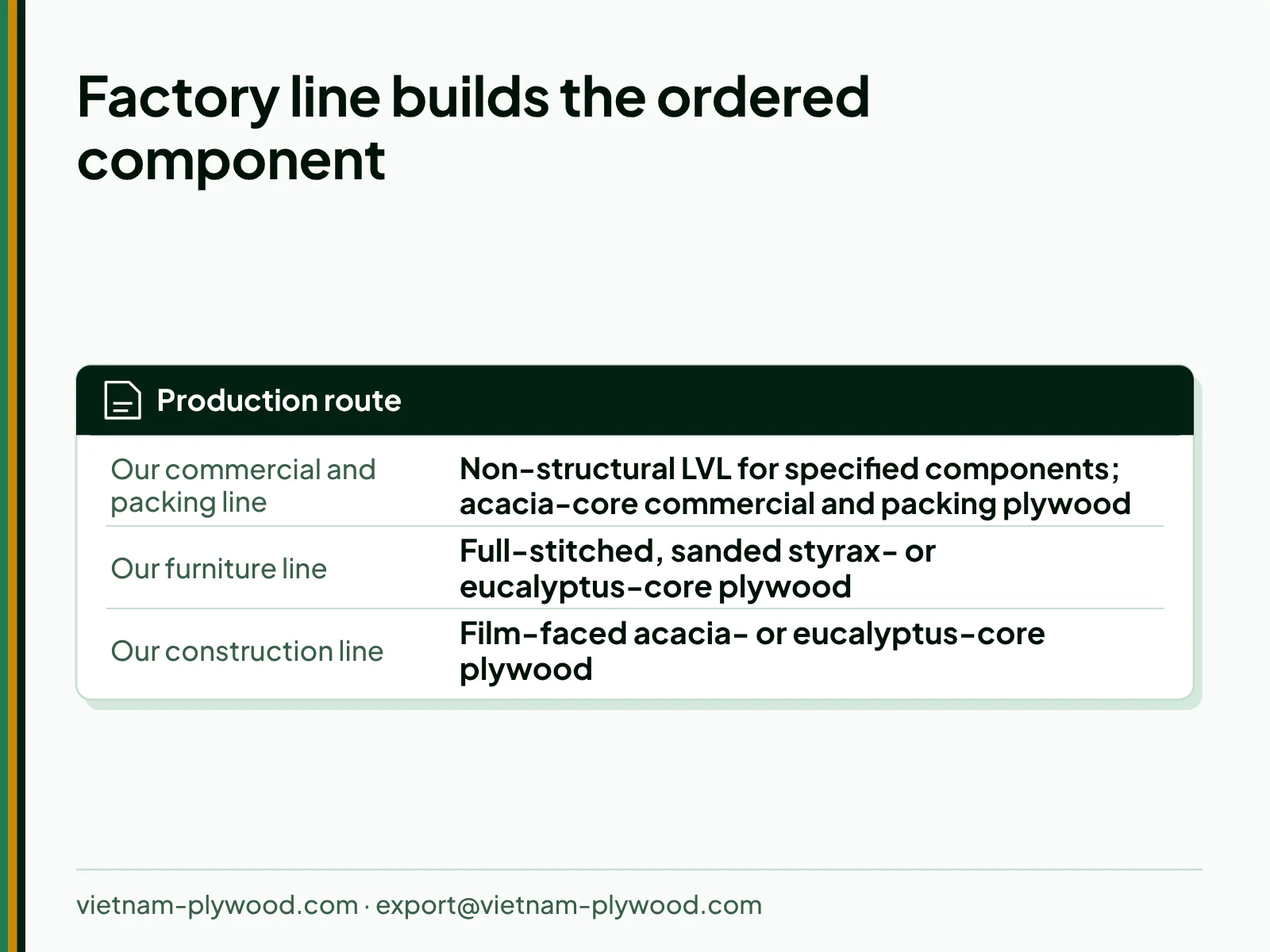
| Production route | Material focus | Relevant buyer check |
|---|---|---|
| Our commercial and packing line | Non-structural LVL for specified components; acacia-core commercial and packing plywood | LVL straightness, bonds and fasteners; plywood dimensional checks |
| Our furniture line | Full-stitched, sanded styrax- or eucalyptus-core plywood | Surface and thickness for furniture panel work |
| Our construction line | Film-faced acacia- or eucalyptus-core plywood | Film surface, edges and panel thickness for formwork |
For comparison, an 18 mm plywood panel has 11–13 plies under the stated core veneer range. That plywood construction figure is not a veneer count or stiffness rating for LVL. A request for a structural LVL grade must be evaluated against a test report the buyer accepts.
HCPLY coordinates specifications, on-site quality control, shipping papers and loading from the producing factory. Buyers can visit the factory office and inspect the actual order at the producing factory.
Can LVL share a shipment with plywood?
An LVL order can be planned alongside plywood specifications within a 40HC payload limit of 28.5 t. Mixed loading needs the actual LVL dimensions, packed weight and pallet arrangement before the remaining capacity can be assigned. No plywood sheet-weight calculation establishes an LVL member’s weight.
As a comparison point, a 1220 × 2440 × 18 mm acacia-core plywood sheet weighs 31.08 kg. Its full-container reference is 880 sheets, 47.15 m³ and 27.35 t. Pallet weights and loading geometry still require a mixed-load plan.
The corresponding styrax-core plywood reference is 990 sheets and 26.52 t; eucalyptus-core plywood is 795 sheets and 27.69 t. Use the container-load calculation topic for plywood load planning.
We can discuss a mixed specification when the buyer provides LVL packed mass and dimensions. The final loading plan should state each pallet, its footprint and the combined gross cargo mass.
Does structural LVL need a test report?
Structural LVL needs a test report the buyer accepts for the specified build and intended design use. The report must identify what was tested, the applicable test method, the measured properties and the product population represented. A non-structural factory inspection record cannot replace those results.
Ask whether the evidence covers bending stiffness, bending strength, shear and relevant connection or bearing conditions. Check member orientation, dimensions, service environment and any limits on use. The design professional then applies the accepted values to the actual loads and supports.
The 2010 USDA Forest Service handbook discusses structural composite lumber and mechanical properties separately. That distinction explains why a product name alone cannot supply an engineering design value. We do not assign a structural grade from appearance or from another producer’s data.
For a structural enquiry, send the proposed load case and the report acceptance requirements first. For furniture, door and packing work, an application-specific inspection schedule is the practical starting point.
How does LVL compare with glulam and sawn wood?
LVL uses bonded veneers; glued laminated timber (glulam) uses bonded sawn-wood laminations. Sawn wood retains larger natural features within each piece. These construction differences influence variability, appearance, available shapes and the way a designer obtains property values.
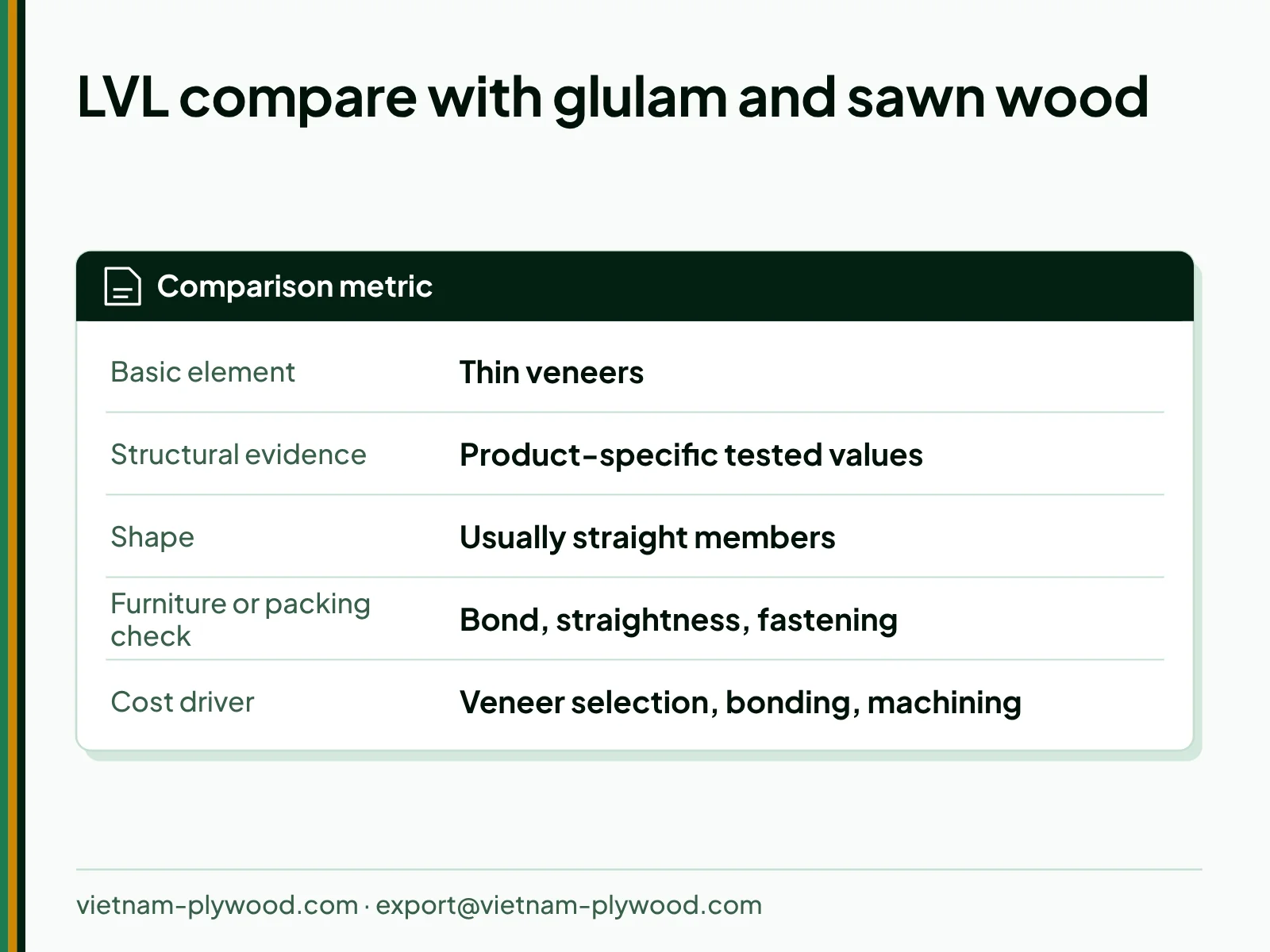
| Comparison metric | LVL | Glulam | Sawn wood | Selection implication |
|---|---|---|---|---|
| Basic element | Thin veneers | Sawn laminations | Solid section | Match material to component geometry |
| Structural evidence | Product-specific tested values | Product-specific graded values | Species and grade values | Do not interchange design figures |
| Shape | Usually straight members | Straight or shaped members | Sawn profiles | Use glulam where a curved structural form is required |
| Furniture or packing check | Bond, straightness, fastening | Joint fit and fastening | Knots, movement and fastening | Trial the actual assembly |
| Cost driver | Veneer selection, bonding, machining | Lamination and shaping | Grade and section recovery | Compare like-for-like delivered specifications |
A blanket claim that one material carries more load ignores grade, section and span. Architectural exposed beams have a different visual requirement from hidden packing components.
The commercial decision is also affected by machining waste, rejected pieces and handling requirements. Compare the cost per accepted component after inspection, rather than treating the purchase price per cubic metre as the entire cost.
What should the purchase specification contain?
A useful LVL specification names the application, dimensions, exposure and measurable acceptance criteria before it names a strength category. The buyer’s drawing should mark critical faces, joint positions and the allowable bow or twist. Include moisture range, bond test, screw trial and sampling rules.
For non-structural LVL, request a pre-production sample made to the proposed component drawing. Review its machining and assembly behavior before agreeing production inspection. For structural use, add the report and design-value requirements accepted by the project authority.
Do not transfer plywood thickness tolerances automatically to LVL. Our sanded furniture plywood is ordered at ±0.2 or ±0.3 mm; commercial and film-faced plywood use ±0.5 mm, while packing plywood uses ±0.5–1.0 mm. Those are plywood specifications; write separate LVL dimensional limits for the ordered stock.
The plywood supply programme explains how repeat orders can retain agreed specification fields. Keep revision numbers on the component drawing and inspection sheet so the accepted sample corresponds to the production lot.
What evidence travels with the shipment?
The shipment paperwork should connect the delivered goods to the approved specification and any agreed test reports. The packing list identifies quantities and packing units, while the commercial invoice identifies the transaction. Inspection records and order-specific reports support the technical acceptance discussion.
HCPLY prepares the commercial invoice, packing list, bill of lading and certificate of origin, plus the applicable phytosanitary and fumigation papers. EU lots use EUR.1 where applicable and an EUTR/EUDR file set; CIF shipments include insurance. Order-specific certificate documents and agreed test reports are added where relevant.
Member-factory certificates such as FSC, CARB P2, ISO 9001 and CE are shown with factory details masked, on request. Their availability does not convert an LVL inspection into a structural design approval. After loading, the draft shipping documents come to you for approval.
Keep any report linked to the actual agreed build, rather than relying on a generic catalogue statement.
How do buyers move from inspection plan to trial order?
Start with a component drawing and a short list of failure conditions, then agree how each will be checked. Our minimum order is one 40HC, with specifications mixed within the payload limit. Factory lead time runs 15–45 days from receipt of the 30% deposit; the exact figure depends on order size, line loading and what the contract fixes.
The remaining 70% is paid on the scan of the bill of lading, by T/T, or by irrevocable sight L/C. We ship FOB Hai Phong, or CFR (CNF) or CIF to your port. Samples cost nothing: a first-time buyer pays the courier, and that charge comes off the first confirmed order.
LVL pricing follows the veneer and bond specification, section size, machining, inspection burden and packed quantity. A more demanding tested build costs more to establish than a simple non-structural component where fewer tests are agreed. Request a written quotation for the exact LVL build; see LVL price factors for the cost breakdown.
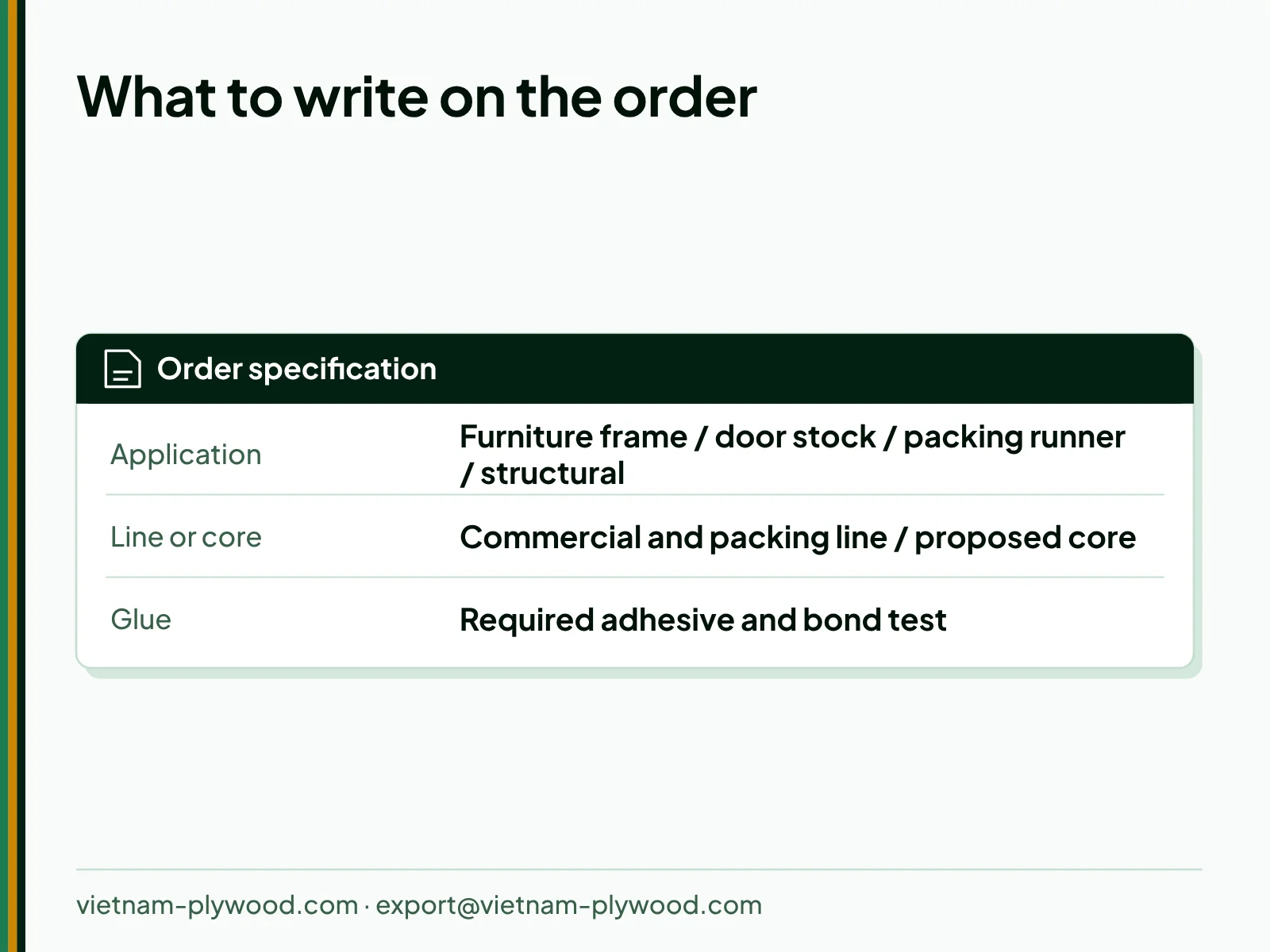
Send Lucy at export@vietnam-plywood.com the following specification, or use the contact form:
Application: furniture frame / door stock / packing runner / structural
Line or core: commercial and packing line / proposed core
Glue: required adhesive and bond test
Emission: required class or applicable market limit
Face and grade: specified veneer face and visual acceptance
Thickness and tolerance: ___ mm / ___ mm
Size: width ___ mm × length ___ mm
Straightness, moisture and screw test: methods and limits ___
Quantity: ___ members / ___ m³
Destination port: ___
Next step: plan a trial container against the agreed drawing, sample and inspection schedule.